INTRODUCTION
The head ( fig. 1) was ploughed up in a field at Steane, near Brackley, north-west Northamptonshire, in 1976. Encountering lack of interest from the then landowner and a local museum, the finder kept the head at home. It was reported to the Portable Antiquities Scheme in 2009, and acquired by the Ashmolean Museum of Art and Archaeology, University of Oxford in 2011, with support from the Art Fund, the Victoria and Albert Museum Purchase Grant Fund, the Friends of the Ashmolean Museum and individual donors. A survey of the field was made by William Wintle, Kellogg College, University of Oxford, in the autumn of 2012, and limited excavation was undertaken in the spring and summer of 2013, directed by Jane Smallridge and Zena Kamash of the University of Oxford's School of Archaeology; here a brief resumé of the spring season is provided.
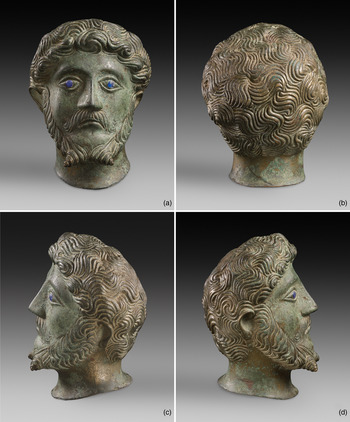
Head of Marcus Aurelius from Steane: (a) frontal view; (b) back view; (c) left profile; (d) right profile. Height 162 mm. Ashmolean Museum AN2011.46.

At 162 mm high and cast in copper alloy by the lost wax process, the head represents a male with stylised, curly hair and beard. The hair is worked to a consistent level of detail across the sides and back of the head, with a carefully designed row of projecting locks framing the brow and temples. The beard is confined to the jawbones, and is treated separately on either side of the face, ending in a projecting cone of three coils of hair at each side of the chin. The moustache is full, and waved upwards at the ends; it is not joined to the beard. Beneath the swirling locks of hair around the face, the brow is low, and in profile forms a subtle, modelled line with the ridge of the nose. The mouth is downturned, the thin lips barely indicated. The almond-shaped eyes, with emphatic upper and lower lids, are inlaid with discs of blue glass. The eyebrows are suggested as part of the modelling of the orbital sockets, but are not engraved. The head terminates at the base of the splayed neck. Only slight levelling of the lower edge of the neck has been made in recent years, probably to stabilise the head for display before it was acquired by the Ashmolean Museum. There are no traces of any means of attaching the head to a body, by for example solder, nails or rivets, nor does the head show any sign of having been cut down from a bust or full-length statue. It is then likely that the head has survived more or less in the form that it had in antiquity. However, the brass surface has acquired a green patina.
IDENTIFYING THE SUBJECT OF THE HEAD
In the report published in 2010, Sally Worrell noted the resemblance of the subject to portraits of Marcus Aurelius, and acknowledged a suggestion made by Sam Moorhead that the craftsman might have been inspired by a profile coin portrait of the emperor.Footnote 2 So far no epigraphic evidence has emerged to clarify the question of the head's identity, and in these circumstances any identification has to be undertaken by comparison with other images.
In the case of the copper-alloy head from Steane, the depiction of an apparently Roman subject is obscured by the use of what has been described as ‘a provincial style’.Footnote 3 Features rendered in non-metropolitan Roman fashion include the almond-shaped eyes, in which the irises are inlaid with discs of blue glass, with no attempt to distinguish the pupils; the lack of eyebrows; the downturned mouth; the highly stylised hair and beard and the slightly splayed neck. Though traces of iron are visible on the upper surface of the head, these are matched on the equivalent area of the inner surface, and have thus been identified as the remains of spacers used in the lost wax casting process, rather than as remains of solder for attaching attributes such as horns, a wreath or a headdress.Footnote 4
However, despite the presence of the numerous non-Roman features listed above, it is possible to draw out the Roman identity of the subject by the simple expedient of mounting the head within a vertical plane, using the circular aperture within the splayed neck ( fig. 1a), rather than inclining the head back to rest on the lower edge of the neck itself, as was done to illustrate the initial report.Footnote 5 Setting the head on a vertical mount also reveals important information about how it was displayed in antiquity (see below).
THE STEANE HEAD COMPARED WITH IMAGES OF DEITIES FROM ROMAN BRITAIN
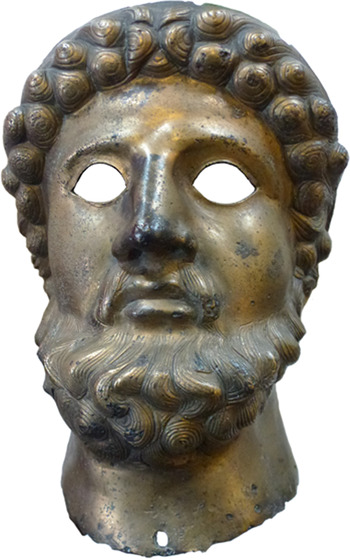
Before considering further the identification of the head as a portrait of Marcus Aurelius, an alternative identification as an image of a god requires review. At 162 mm high, the head is unusually large for a Romano-British bronze find, and it would be a reasonable inference to interpret it as a divine image. Indeed, the head does share some stylistic features with other heads of deities found in Roman Britain. A copper-alloy head of a bearded male was found in a hoard of divine images and religious apparatus buried in a ceramic cauldron at Felmingham (Norfolk) ( fig. 2).Footnote 6 Though the provincial style has led some commentators (including Jocelyn Toynbee) to describe it as ‘a head of a Celtic god’, this head bears no torc around the neck; indeed, it is an exceptionally high-quality and accurate rendering in classical Greek style of the image of Jupiter.Footnote 7 Hollow cast in two pieces, the Felmingham Jupiter shares with the Steane head a decorative, patterned styling of the beard and hair, and has settings for inlaid eyes, assumed to be glass paste or enamel, but now lost. It is also nearly the same size as the Steane head, at 155 mm high. However, the arrangement of the beard and hair is distinctly different, the stylised locks of the beard converging in the centre, while the archaising curls around the face are broken in the centre by a pair of tightly rolled, narrow locks. The moustache, too, is less luxuriant. The back of the head, separately cast, has much less detail in the patterning of the hair. It is possible that the join was concealed by a wreath. Also very provincial in style is a smaller bust of a helmeted Minerva found at Felmingham.Footnote 8
Head of Jupiter from Felmingham, Norfolk. Front view. Height 155 mm. British Museum PRB 1925.6-10.1. (Photo: British Museum)

The Felmingham hoard was found with a silver coin of Valerian, dating to a.d. 253–60. This, however, indicates a terminus post quem for the date of deposition; the group of figures was wrapped in a textile and placed in a pottery cauldron imitating a Belgic metal form, but lasting long into the Roman occupation.Footnote 9 This hoard also contains a small copper-alloy head cast in relief, representing a bearded god with rays and a crescent moon set against a nimbus. Often identified as Sol, this figure resembles more closely the Hellenistic version of Jupiter Capitolinus frequently reproduced in various media at Rome and in the provinces.Footnote 10 Further pieces from Felmingham include a figurine of a Lar, metropolitan Roman in style and iconography; two birds; a wheel with its iron axle intact, thus probably once belonging to a cart; and items of priestly regalia, the latter comprising headdresses, spears and sceptres, and a sphere made in two pieces joined in a manner akin to that of the head of Jupiter. The figures of these deities have been dated on stylistic grounds to the first and/or early second centuries a.d.; they are thought to have been imported to Britain. However, the larger head of Jupiter and the smaller bust of Minerva, as already noted, exhibit provincial elements in the rendering of the hair, of Jupiter's beard and Minerva's helmet.
Indeed, the Felmingham hoard confirms that various Mediterranean and North-West European provincial styles of depicting Roman deities were current in Britain in the first and second centuries a.d., and that the rendering of a deity in provincial style did not preclude the accurate reproduction of Roman iconographical features identifying the subject of the representation. From this it may be inferred that ease of visual recognition of the subject was a key factor in the design of these figures. In this respect it must be stressed that the head found at Steane does not replicate the hair, beard or facial structure of the heads of Jupiter or Sol/Jupiter from Felmingham.
Another small copper-alloy head of Jupiter, comparable with the Steane head for the craftsman's use of elements of provincial style, was found at Hettanges-Grande in the Moselle Valley on the borders of France and Luxembourg.Footnote 11 Of smaller scale at 87 mm high, this head, like the little head of Jupiter with solar rays from Felmingham, displays some aspects of Hellenistic Greek tradition of representing the god, with the locks of hair above the brow tumbling away from a central parting, and the mouth slightly open. The eyes are engraved rather than inlaid. With highly stylised, patterned hair and beard, this is thought to be a local work of the first or second century a.d. It was found in a burned layer of soil with another 50 objects, including three copper-alloy basins with triangular handles and pottery of very late second-century date. In this case the objects are thought to have been collected for melting down and recycling their metal. Again, although the style of the head of Jupiter is similar, the details of the hair and shape of the face differ from those of the Steane head.
Two small leaded bronze heads found near Amersham (Bucks.), identified as representations of a hooded Jupiter in Celtic style, have square sockets and were most likely mounted on a tripod. Here too, though the style is similar, the subject clearly differs from that of the Steane head.Footnote 12
Images of other bearded Roman deities from Roman Britain are less obviously comparable in style to the Steane head, but their appearance is briefly noted here. Vulcan, who might be considered especially suited to Steane, given recently recovered evidence for metal-working at the site, has a full beard. However, three-dimensional images from Britain are rare; he is usually shown at work in his forge, wearing a conical hat (pileus).Footnote 13 Mars, widely worshipped and hence frequently represented in images from Roman Britain, wears a full beard and military dress, including a helmet.Footnote 14
Turning to other media, the bearded Oceanus is represented in third- and fourth-century Romano-British mosaic pavements, and adorns the centre of the Mildenhall Great Dish, where dolphins swim through his locks of hair. However, despite controlling the sea that confirmed Britain's place at the edge of the Roman world, Oceanus does not appear, as far as I am aware, in the corpus of three-dimensional Roman images of deities from Britain.Footnote 15 The later Roman domestic contexts of the surviving images suggest that appreciation of Oceanus was by then, at least, cultural rather than religious, as indeed is the case in other areas of the Roman Empire; perhaps in Britain Oceanus represented an assertion of Roman cultural refinement beyond the ocean. Images of Neptune/river-gods found in Britain reproduce Hellenistic Greek styles of presenting such deities, with long locks flowing from the crown of the head, a full beard, upturned eyes and expressive face.Footnote 16
Each of these images of Roman deities follows closely Mediterranean iconography, regardless of the date, the medium and the style in which the figure is worked, and the context, religious or domestic, in which it was found. In an analysis published in 1978 Claire Lindgren reached similar conclusions, noting that the modification of Roman images of deities found in Britain was restricted to (using her term) technical rendition.Footnote 17 In iconographical detail the head from Steane does not closely resemble any of these figures; indeed, the rendering of the bone structure, hair and facial features is closer to Roman portraits of emperors than to images of the gods.
THE STEANE HEAD AND PORTRAITS OF MARCUS AURELIUS
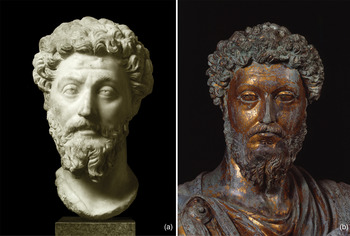
Turning then to images of emperors, it might be observed that the prominently forked beard is characteristic of images of Septimius Severus (a.d. 193–211), though by no means all images of Severus show him with this feature.Footnote 18 However, the overall shape and the planes representing the skeletal structure of the face of the Steane head are much closer to the physiognomy of portraits of Marcus Aurelius (a.d. 161–80), whose beard was restrained to his jawbones and chin, notably in the earlier versions of his mature portraits. Indeed, in some portraits Marcus too had a central fork in his beard, well seen in a marble head now in the Liebieghaus Museum, Frankfurt, which is the centrepiece of a study of the emperor's portraits by Marianne Bergmann, who categorised the head as Type 4 Variant A, thus a later image dated to a.d. 176–80 ( fig. 3a).Footnote 19 The confinement of the beard and moustache to the margins of the face of the Steane head is close to the well-known gilded copper-alloy image of the emperor from Rome, the equestrian statue long displayed on the Piazza del Campidoglio and now in the Musei Capitolini ( fig. 3b). This portrait was perhaps originally set in front of the barracks of the equites singulares near the Lateran.Footnote 20
(a) Marble head of Marcus Aurelius in the Liebieghaus Museum, Frankfurt; (b) Head of a bronze equestrian statue of Marcus Aurelius in the Musei Capitolini, Rome. ((a) Courtesy of Professor Vincenz Brinkmann; (b) Archivio Fotografico dei Musei Capitolini, neg. no. MC3247/S)

Remarkably, the craftsman responsible for the Steane head has taken the trouble to reproduce the recognisable features of the emperor's face and frontal hair; resembling the head of the equestrian figure from Rome, where the beard is slightly forked.Footnote 21 Even more noteworthy is the attempt to reproduce (albeit in stylised fashion) the arrangement of curls at the back of his head. Here the lowest lock behind the ear is not tightly curled but is combed in towards the ear, almost in the style of earlier, Julio-Claudian imperial portraits. This feature also appears in some stone portraits of Marcus Aurelius, particularly where the head is finished to a lesser level of detail at the back of the head.Footnote 22 The resemblance between the Steane head and the equestrian statue of Marcus Aurelius from Rome is less surprising if it is considered that the latter was not a single commission but an example of a type of portrait reproduced in over 50 versions, some of exceptional quality. These portraits of the emperor are classified by art historians as Type 3 of a series of four distinct portrait types, each reflecting a key stage of the emperor's life and reign. Type 3 portraits fall within the broad date-range of a.d. 161–76; noting some overlap with the succeeding image Type 4, Fittschen dated the equestrian portrait from Rome to the presumed last year of production of Type 3 in a.d. 175/6.
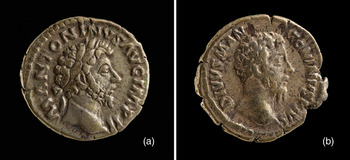
As suggested by Worrell, some, at least, of the coin portraits of Marcus Aurelius are comparable to the bronze head from Steane. This can be seen on a silver denarius from the early years of his reign, which occurs, for example, among the many Roman coins of the second and early third centuries in the ‘East of England hoard’. The hoard was found in the nineteenth century in a jug beside the Maldon Road in Colchester; some of the coins were acquired by Sir John Evans and were eventually left to the Ashmolean by his son Sir Arthur Evans.Footnote 23 Here the shoulder-length image ( fig. 4a) presents the emperor wreathed and in civilian dress; the flowing moustache and profile of the nose and brow are closely comparable to the Steane head. On this portrait the beard is lightly forked. The beard is more visibly divided on posthumous, consecration issues: for example, a silver denarius also in the Ashmolean collections ( fig. 4b), struck under Commodus (a.d. 180–92). No coin portrait reproduces the combed lock behind the ear and all are finished to the same level of detail.
Coin portraits of Marcus Aurelius: (a) silver denarius from the East of England Hoard, a.d. 161–63. Ashmolean Museum Heberden Coin Room 4969; (b) silver denarius representing Divus Marcus Aurelius, consecration issue, a.d. 180–92. Ashmolean Museum Heberden Coin Room 5244. Scale 2:1.

From its three-dimensional resemblance to the equestrian statue from Rome and to some portraits in marble, it may be concluded that the Steane head of Marcus Aurelius is not necessarily to be understood as a provincial image of the emperor loosely based upon coin portraits available only in profile. Rather, like the larger head of Jupiter from Felmingham, the iconography of the Steane head was drawn from the highest quality of sculptured images made in the Mediterranean region, albeit rendered in a local style by a craftsman trained in provincial traditions. It may be judged that the craftsman was particularly adept at capturing recognisable features of Roman iconography while working within a non-Roman tradition of representation. The forked beard is more consistently represented in posthumous portraits of the emperor, and it may be the case that the emperor was regarded as divus when the portrait was commissioned; in Rome divine status was conferred immediately after Marcus Aurelius' death in a.d. 180. The Steane head might, therefore, have been commissioned after a.d. 180 to mark the emperor's passing and change in status, or as an act of consecration. The overlap in the portrait types of Marcus Aurelius noted above may account for the selection of a Type 3 portrait after the emperor's death.
THE FUNCTION OF THE STEANE HEAD
The uniform quality of finish of the head, front, back and sides, suggests that the Steane portrait of Marcus Aurelius was intended to be seen from all sides. As noted above, there are no traces of rivets or holes cut into the neck, suggesting that it was not attached to the torso of a statue, and the surviving edge of the neck bears no evidence of it having been cut down from a portrait in bust format. The circular aperture within the neck, and the comfortable and advantageous siting of the head on a circular mount indicates that the head was most likely intended to be mounted on a sceptre or pole, on which it could have been carried in procession.Footnote 24
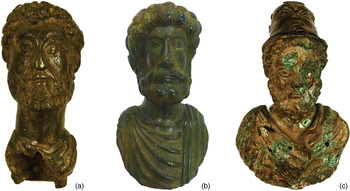
Three other bronze busts found in South-East Britain were recognised by Jocelyn Toynbee as images of the second-century emperors Antoninus Pius, Lucius Verus and a helmeted image of Commodus ( fig. 5).Footnote 25 These are made at varied scales, respectively 87 mm, 133 mm and 193 mm high. However, they all have circular apertures within the neck, and were thus capable of being mounted in similar fashion. The head of Pius, which has a cast collar below the draped bust, was evidently designed to fit on a pole. Indeed, it was found in a wooden box deposited in a fen at the Hempsals, near Willingham, north of Cambridge, with a number of poles, sceptres or maces, but unfortunately none of them the right size for the head.Footnote 26 This head has no provincial features, but the busts identified as Lucius Verus and Commodus do have non-Roman features in, respectively, the patterned rendering of the hair and beard, and the iconography of Commodus' helmet, which is decorated with a male face with a long moustache, and a torc-like design beneath it.Footnote 27 In these cases, though the resemblances to imperial portraits made in Rome are close, certain identification is more problematic: thus, though the brow line and face shape are roughly comparable, Lucius Verus' moustache does not join his beard, and Commodus' physiognomy is naturally similar to that of his father Marcus Aurelius.Footnote 28 A fourth head of a male figure with bifurcated beard resembling that of the Steane head of Marcus Aurelius was found near Mildenhall (Suffolk) ( fig. 6b). Its resemblance to portraits of the emperor Hadrian has been noted.Footnote 29 The beard is strongly patterned, the major locks forming two projecting spirals either side of a peak below the lip. The upper edge of the spirals touches the falling, curved moustache. The locks of beard around the neck are divided by vertical channels. Like the Jupiter from Hettanges and the bust of Lucius Verus from Duston, the eyes are engraved rather than inlaid; they are topped by stylised, curved eyebrows. This head could also have been mounted on a pole. However, the figure wears a torc around his neck, and perhaps an animal-skin headdress, rather than the helmet suggested by Toynbee. Another possible interpretation is discussed below.
Images of second-century emperors: (a) Bust of Antoninus Pius from Willingham, near Cambridge. Height 87 mm; (b) Bust identified as Lucius Verus from Duston, Northampton. Northampton Museum. Height 133 mm; (c) Bust identified as Commodus from Cottenham, near Cambridge. Height 193 mm. ((a) Reproduced by permission of the Museum of Archaeology and Anthropology, Cambridge, acc. no. 1918.160.1A; (b) Photo: Susan Walker; (c) Reproduced by permission of the Museum of Archaeology and Anthropology, Cambridge. acc. no. D 1948.5)

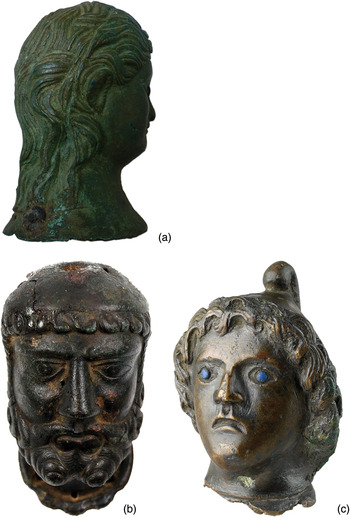
Heads of deities: (a) Right profile view of head of Venus or a nymph from Silkstead, near Otterbourne, Hampshire. Winchester City Museum ARCH 263.16. Height 125 mm; (b) Head of a man resembling Hadrian, but the animal headdress and sockets for horns may suggest Cernunnos. Found near Mildenhall, Suffolk. Height 115 mm; (c) Head from a statuette of Atys found near Mildenhall, Suffolk. Height 64 mm. Ashmolean Museum AN1927.564. ((a) Photo: Susan Walker; (b) Reproduced by permission of the Museum of Archaeology and Anthropology, Cambridge. acc. no. A 1955.130)

THE FUNCTION OF HEADS OF DEITIES IN SIMILAR STYLE
Conversely, at least some of the heads of deities made in similar style were intended to be attached to bodies. Clear evidence of this is visible in two heads from South-East Britain. At centre front and centre back, by the edge of the neck of the head of Jupiter from Felmingham ( fig. 2), the presence of holes suggests that rivets could have been used to attach it to a torso, now lost. The lack of detail in the hair at the crown of the head may suggest that this head was not intended to be seen from behind, though the back could have been concealed by a wreath covering the join. As in the original cult statue, the god was probably shown seated. Of the two pedestals preserved in the Felmingham hoard, one is too small for a seated figure of nearly half-life-sized scale, and the other, with one socket for attachment set near the front right-hand corner of the base, is better associated with the Lar.Footnote 30
The second, a head of a young woman with unbound hair, perhaps once crowned or garlanded, and inlaid eyes made of pebbles from the Reading river beds ( fig. 6a), is probably to be identified as Venus or a nymph, in either case most likely protecting a water-source.Footnote 31 This head bears clear traces of iron solder on the shoulders. Presented to Winchester City Museum in 1938, the head was probably found in the 1920s in a sandpit near the edge of the floodplain of the River Itchen at Silkstead, near Otterbourne (Hants.). The features of this head, compressed in the centre of a broad expanse of flesh, suggest a date in the late first century a.d.; they are comparable to those of the Minerva from Felmingham.Footnote 32 The classicising head of Jupiter from Felmingham is more difficult to date, but, given its close resemblance to the Vienna intaglio, might also be of this era, when the temple on the Capitoline Hill in Rome was restored by Domitian after a fire.Footnote 33 Some of the heads found at Icklingham (Suffolk) in the 1980s and now in a private collection in New York look as though they may have been pieced in similar fashion to the Felmingham Jupiter, and their appearance suggests that they could be of first- or second-century date.Footnote 34
A copper-alloy statue variously measured at 420 or 450 mm high, recovered in 1845 from the River Juine at Bouray in northern France, shows how these heads could have been attached to bodies.Footnote 35 The statue is made of plaques of copper alloy worked in repoussé technique and soldered with strips of lead hidden in ‘baguettes’ of copper. Two were used for the body; one is present on the right side. One (now lost) was used to attach each arm and two were set behind the ears to attach the head to the torso. Proportionally, the head is large, with a long, massive neck splayed at the base. The subject is shown with long locks of hair, of which the individual strands are delineated; a fringe falls on the forehead. As in the imperial portraits found in South-East Britain, the rear locks are carefully shown; the lower part appears patched. White and dark blue glass paste eyes were set in the orbital cavities, of which the left is preserved. The nose is straight, the mouth short, with finely drawn lips. The chest, buttocks and rear ribcage are shown in relief.Footnote 36 This three-dimensional figure combines an apparently Roman, Julio-Claudian hairstyle with a torc around the neck and crossed, deer- or goat-like legs with cloven hooves. Hatt identified the deity as Esus–Cernunnos, but his other examples, seated cross-legged in the same fashion, have horned heads as well as hoofed feet. This figure could represent the assimilation to Esus–Cernunnos of a Roman emperor or prince of the imperial house, or, as the museum's website suggests, an ancestor or heroised mortal.Footnote 37 It has been variously dated to the first century b.c. or a.d.
A life-sized head from a bust of a bearded male was found in the mid-fourth-century destruction levels of a mid- to late second-century building at Genainville, Oise, France.Footnote 38 It is made of sheets of brass fastened to a presumed wooden armature (or indeed a full-scale bust in wood) with nails still in position. This may represent a secondary repair of an original assemblage achieved with tin solder. The inlaid eyes were made of bone plaques set with blue glass pupils, perhaps held in position inside the head with bronze plaques. These too may be a replacement of earlier inlay soldered into position with tin. The subject has sometimes been identified as Hadrian, though Mitard prefers a sacred image of local significance, rendered in Celtic style. This head and the comparable images of deities and votaries from northern France illustrated by Mitard are (with the exception of the Bouray figure) less sophisticated in design than the British examples discussed here.
Also provided with holes at the base of the neck — and sometimes identified as Hadrian — is the head of a bearded man found near Mildenhall ( fig. 6b and above). The remains of iron on the top of the crown of the head indicate an attachment, perhaps for antlers, suggesting that this too could have been a mortal represented as Cernunnos.Footnote 39 In both cases the resemblance of the features to contemporary Roman rulers or princes of the imperial house is striking.
At half-life-size or smaller scale, these figures when complete could have been carried on trays or platforms. Seated in tailor pose with no projecting legs, the Bouray figure was well suited to being carried in this fashion.
Other smaller figures of later date, such as a head of Atys found near Mildenhall ( fig. 6c), evidently formed part of a statuette, hollow-cast as a whole figure.Footnote 40 A much larger figure of Atys, 350 mm high, was recovered from the River Moselle by the Roman bridge at Trier. The inlaid eyes are lost. At 70–76 per cent copper and 18–21 per cent lead, this too is a leaded bronze, and offers another example of observance of Roman iconography combined with a provincial style of patterning in the hair and the splayed neck.Footnote 41
THE MATERIAL OF THE STEANE HEAD
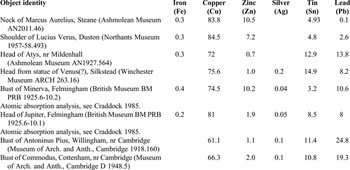
The copper-alloy head from Steane weighs an impressive 2.1 kg. The alloy contains a substantial amount of zinc. In 2012 XRF analysis was undertaken of some other heads visually and/or functionally comparable to the Steane image of Marcus Aurelius. The results are presented in Table 1.
COPPER-ALLOY COMPOSITIONS OF HEADS OF ROMAN EMPERORS AND DEITIES FROM SOUTH-EAST BRITAIN

XRF analysis unless stated. The composition is shown by weight of elements present.
Significantly, the closest comparison to the alloy used for the Steane head is offered by the bust identified as Marcus' co-emperor Lucius Verus, found unstratified in the nineteenth century in the large Roman settlement at Duston, west of Northampton, only 32 km from Steane. Both have relatively high zinc content. Though very similar to the Steane head in style, the head of Atys from Mildenhall differs in copper-alloy composition, being a leaded bronze like the Fenland busts of Pius and Commodus. The head of Venus(?) from Silkstead, near Otterbourne (Hants.), made at least a century earlier, has a high tin content. There are, of course, difficulties in drawing any conclusions from this very small range of data. The extent of recycling is unknown, and, as Riederer noted, there is no standard alloy composition for statuettes: the variety within the genre is reasonably explained as the product of different workshops working in various regions of the Empire.Footnote 42 The results given above were compared with recent analysis of the first-century a.d. Seven Sisters hoard from south Wales.Footnote 43 The results fall close to those obtained from Seven Sisters, which in turn were compared with assemblages from Camerton and Melsonby (Stanwick Hoard).Footnote 44 However, none of them exactly overlaps, the closest being the Felmingham Jupiter (bronze cluster) and the Steane Marcus Aurelius (brass cluster).Footnote 45
Though the sample is very small and specialised, the results do suggest that it is indeed worth looking for consistency in regional practice, and for diversity in the composition of copper alloys used for religious images in the regions of South-East Britain in the later first and second centuries a.d. It is possible that the busts identified as the two co-emperors Marcus Aurelius and Lucius Verus, both found in south-west Northamptonshire, come from the same workshop. Though differing in detail, they share a high quality, and the Duston head also has non-Roman stylisation of the hair and beard. Here the eyes were apparently left uncoloured, and it is not clear, if the identity is accepted, whether the bust commemorates Lucius Verus as reigning or deceased. At least some twenty years could have elapsed between their manufacture.
The craftsman or craftsmen who made these heads in about a.d. 160–90 worked in a provincial tradition that had been current for more than a century. As we have seen, several other heads from South-East Britain are comparable, including the classicising Jupiter from Felmingham and the female head from Silkstead; a likely late first-century date for both has already been noted, and the Bouray figure shows that the style was current in Gaul earlier in the first century a.d. Also recalling the earlier statue from Bouray is the second-century bearded head from Mildenhall, which shares an overlap of imperial portrait features with divine attributes.
Though the style endured, the results of the metallurgical analyses from this admittedly small group suggest that the copper alloy may have varied by region, with the Northamptonshire objects reflecting a preference for relatively high levels of zinc and low levels of lead, while in East Anglia the preference was for leaded and in Hampshire for tinned bronze. However, it has also been noted that brass was much favoured by the Roman military for decorative metalwork, and that its production may have been an imperial monopoly.Footnote 46 No composite statue within the group may be dated to the second century: the edge of drapery below the head of Atys, which may be dated to the last decades of the second century from its close resemblance to the head of Marcus Aurelius, suggests that it was part of a bust or statuette made in one piece.
WERE THESE HEADS MADE IN BRITAIN?
Material evidence suggests that these heads were made locally: of particular note are the close correspondence of alloys used to make the Steane and Duston heads, and the inlaid eyes of the Silkstead head, identified as locally sourced pebbles. However, only one workshop of Roman date of sculptors using copper alloys with the capacity for making pieced figures at this scale has yet been excavated in South-East Britain, and that is at Gestingthorpe, near Halstead (Essex).Footnote 47 The style and the technology used to make the articulated figures of likely first-century date are shared with northern Gaul (Lugdunensis and Belgica); it is possible that the sculptors of these works were Gauls working in Britain with locally sourced materials, but any notion that the heads were imported from Gaul as finished objects may be ruled out by the material evidence cited above. More generally, the wide range of bronzes, quite often distinctive in style and even superior in quality to those from Gaul, is suggestive of insular workmanship. An inscription on a figurine of Mars made for a temple near Lincoln records the insular craftsman's name, Celatus.Footnote 48
AN ARCHAEOLOGICAL CONTEXT FOR THE STEANE HEAD
All of the heads from South-East Britain cited above as similar to the head of Marcus Aurelius in respect of style and function were chance finds made in the nineteenth and twentieth centuries and lack any clear archaeological context. Indeed, the lack of association of these finds with any form of Roman structure suggested that the imperial heads, at least, could have been used in the countryside to perform religious ceremonies marking perhaps a change in land use or occupation, by priests using portable objects brought from the nearest sanctuary. It is certainly the case that south-eastern Britain was very intensively exploited in the mid- to later second century, the period to which all the imperial images date;Footnote 49 another possibility is that the heads of Pius and Commodus, at least, originated from shrines constructed on imperial estates in the Fenlands.Footnote 50 Private worship of the emperors in Britain was largely focused upon their numen, understood as the emperor's guardian deity or spiritual power, and emperors were often venerated in conjunction with other deities; the concept of the domus divina, or divine house [of the imperial family], also appeared very early in Britain, and became the subject of official patronage under the Antonine and Severan dynasties.Footnote 51
In the autumn of 2012, the suggestion that these portable objects were intended for remote rural use was put to the test. A geophysical survey of the field in which the head of Marcus Aurelius had been ploughed up in 1976 was undertaken over three days by William Wintle and John Hawes, with the kind permission of the landowner and estate manager. The results were surprising, offering the chance of discovering an archaeological context of contemporary or later Roman date for the Steane head. It was clear from the survey that Steane was the site of a hitherto unrecognised rural settlement, apparently of Iron Age and/or Roman date, and comparable to other, better explored sites in the Thames Valley region.Footnote 52 A week's evaluation excavation was undertaken in April 2013, with a small team managed by Jane Smallridge of the Institute of Archaeology, University of Oxford.
INTERIM REPORT ON EXCAVATIONS AT STEANE PARK, 12–19 APRIL 2013Footnote 53
by Jane Smallridge and Susan Walker
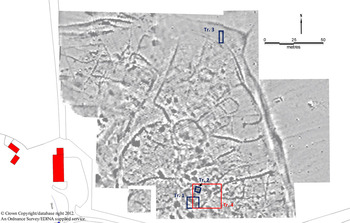
Using the geophysical survey ( fig. 7), it had been intended to open three areas of the field to investigate (1) the zone where the head was found, (2) a prominent circular feature in the central area of the settlement, and (3) its northern perimeter. Bearing in mind the association of the bust of Antoninus Pius found at Willingham Fen with staffs and other items of religious equipment, the team worked with an experienced local metal-detectorist who is very familiar with the landscape. In the event, the finds were so significant that a decision was taken to postpone investigation of the central area (2). Trenches (Tr. 1–3) dug in April 2013 are shown on fig. 7.
Geophysical survey of the ancient settlement at Steane Park, by William Wintle. Areas Tr. 1–3 were dug in April 2013; area Tr. 4 to be excavated in August/September 2013.

Trench 1, 10 by 10 m square, was located immediately west of the area where the head of Marcus Aurelius was found. A prominent feature on the geophysical survey proved to be limestone and ironstone rubble deliberately stacked in piles beside the line of a robbed wall running from north-west to south-east. This wall, as yet of unknown date, was cut by a later ditch. The upper fill of the ditch contained the skeleton of a middle-aged male of gracile build, lacking most of the skull apart from part of the jawbone and an eye socket. Most likely the head and right foot had been disturbed by earlier ploughing. The burial was not in a formal grave, and was loosely associated with small fragments of (probably) Anglo-Saxon pottery, a fragment of butchered bone and a possible stone charm or gaming token. The skeleton was fully recorded by formal licence but not lifted.
Also found in this trench were part of a stone-edged structure, possibly a hearth, and some slag, as yet of unknown date but from levels earlier than the features described above. In the south-west corner was a line of inter-connected pits adjacent to two post-holes.
The metal-detector survey indicated a concentration of lead to the north of this trench. A test pit 1 m square was opened to investigate the reading. The cause proved to be two pewter serving dishes 600 mm in diameter, of a form typical of fourth-century Roman use. These had been rammed up against a carefully constructed stone wall running south-west to north-east across the test pit. Beneath the dishes were two large sherds of a Roman storage jar of pink grog-tempered ware, made locally at Stowe. The sherds were most likely intended to stabilise the dishes to prevent any spillage of their contents. Some of the soil between the dishes is preserved, and analysis of this, along with the decoration of the plates and their metal alloy composition will be undertaken in the coming year.
The test pit was enlarged to form Trench 2, 4 by 4 m, to facilitate lifting of the pewter dishes, which were unfortunately covered with tightly packed rubble and resting on stones, so impossible to lift in one piece (in any case their condition was very friable). The wall had a rubble core faced with large stones roughly cut to triangular shape. It is apparently Roman in date and evidently earlier than the deposition of the plates.
Trench 3, 1.65 by 10 m, was excavated across an area of the north-east perimeter of the settlement. Though the geophysics suggested a ditch, the remains of a boundary wall were visible in plan and in section. Two post-holes/pits inside the perimeter yielded Roman pottery, including one sherd spot-dated to the second century a.d. It is likely that the strongly defined perimeter was designed to control the movement of animals rather than as a defence for people or possessions. In contrast to the south side of the site, the stratigraphy here was deep.
PRELIMINARY EVALUATION OF THE FINDS
It is relatively rare to find pewter, especially on this scale, and the stone structure is clearly significant. Before excavation the most likely context for the bronze head of Marcus Aurelius was thought to be a later pit or well into which it had been placed or thrown long after its original use. However, the existence of a substantial stone building, admittedly of as yet undefined Roman date (but earlier than the fourth century a.d.), and finds of second-century pottery on the site suggest that there could be a contemporary context for the use of the head at Steane.
The site yielded examples of datable Roman pottery made in the Nene Valley, in Oxford and at Stowe (Bucks.). Many of the finds comprise handles, rims and bases which will allow reconstruction of the vessel forms. A large sherd of a mid- to late Iron Age jar suggests that the site was already settled before the Roman invasion of Britain in a.d. 43. The skeleton and possibly also the wall in the large trench on the south side of the site are post-Roman. The shallow stratigraphy on the south side of the site indicates abandonment of the settlement after the Roman period, when the population moved to an adjacent field to the west, recorded as an already depleted village in the Domesday Book of 1086.
The metal-detectorist's finds range from possibly late Bronze Age to post-medieval in date, and included a significant number of late Roman coins. Their findspots and the finds themselves have been formally recorded by Julie Cassidy and Anni Byard of the Portable Antiquities Scheme.
At the time of writing further excavation of the areas explored in April is in its early stages. It is hoped that further investigation of the stone building revealed in the preliminary evaluation will assist in providing a context for the head of Marcus Aurelius; evidence of metal-working may also be helpful.
CONCLUSION
The copper-alloy, half-life-sized head ploughed up at Steane, near Brackley (Northants.) in 1976 may be confidently identified as a portrait of the emperor Marcus Aurelius (a.d. 161–80). It was probably commissioned after he was declared a god following his death in March a.d. 180. In metal composition the head is linked to a bust identified as his co-emperor Lucius Verus and found at Duston (Northants.), some 32 km away. Both portraits belong to a lively provincial tradition of representing Roman deities and emperors, in which a local style evidently originating in North-West Europe does not obscure the details of Roman iconography required to identify the subject. The inclusion of at least four consecutively ruling Antonine emperors within this group probably reflects the intensity of exploitation of south-eastern Britain in the mid- to later second century, and the popularity of the cult of the Antonine domus divina. The heads of the emperors were designed to be mounted on poles, and were probably used in ceremonial processions. While some heads of deities were also designed to be mounted on sceptres,Footnote 54 others made in similar style but of earlier date were riveted or soldered to the bodies of cult statues. The variety of copper alloys used to make these figures may reflect local preferences.
ACKNOWLEDGEMENTS
My thanks go to the finder and reporter of the head, John and Joan Lewis; to Lady Anne Connell, Christine and Dick Smith for permitting and facilitating the excavation; to Anni Byard and Julie Cassidy of the Portable Antiquities Scheme for help and support with the acquisition of the head and with the finds from the excavation; to Ralph Jackson and Paul Craddock of the British Museum for showing me the material from Felmingham and allowing me access to atomic absorption analyses of objects in the hoard; to Imogen Gunn and Cameron Petrie of the Museum of Archaeology and Anthropology, University of Cambridge, for giving me access to and analysis and photographs of relevant objects in that collection; to Jenny Hands of Northampton Museum for bringing the bust of Lucius Verus to Oxford for XRF analysis; and to Geoff Denford for giving me access to material from Silkstead in Winchester City Museum and bringing the head of Venus or a nymph to Oxford for XRF analysis. XRF readings in Oxford were kindly undertaken by Brian Gilmour of Oxford University's Research Laboratory for Art History and Archaeology, who also renormalised the readings from Cambridge. My colleagues at the Ashmolean Museum, especially Ilaria Perzia and Helen Hovey, have been hugely helpful. I am grateful to the Director, Professor Christopher Brown, and the Board of Visitors for granting me sabbatical leave in 2012–13, in which this research was carried out and written up for publication. I thank the anonymous readers of the submitted article for their helpful comments, nearly all of which have been incorporated in the final text; any remaining errors are my own responsibility.