Introduction
Variations in the sex ratios at birth (defined as the ratio of male births to 100 female births) have been the focus of numerous debates in the demographic and biologic literature (Süssmilch, Reference Süssmilch and Jacqueline1761; Ciocco, Reference Ciocco1938; Gini, Reference Gini1951; Visaria, Reference Visaria1967; Teitelbaum, Reference Teitelbaum1970; James, Reference James1987; Chahnazarian, Reference Chahnazarian1988). A feature of sex ratios is that they often change during – or shortly after – wars, as is the case for other demographic parameters, in particular birth rates, death rates and marriage rates. This has been documented for a long time in France (Aubenque, Reference Aubenque1989), and in Europe, and has been reviewed recently in detail (Graffelman & Hoekstra, Reference Graffelman and Hoekstra2000; James, Reference James2009).
For comparative purposes, the data from France were re-examined using vital registration statistics, which are available in the Human Mortality Database (2009). During the First World War (WWI), major changes in natality occurred: birth rates dropped for six years, and increased in 1919–1920 as a result of postponed marriages. The sex ratio at birth did not change during the war: it averaged 104.6 in 1914–1917, and thus was equal to the average of the previous years (1904 to 1913). However, it increased markedly just after the war, to reach 106.4 (95% CI=106.1–106.7) in 1918–1920. The sex ratio returned to pre-war levels a few years later, averaging 104.6 in 1926–1930. Similar changes also occurred during the Second World War (WWII): natality dropped during the war, and peaked in the years following the war. The sex ratio was low in the pre-war period (104.2 in 1931–1938), and remained low in the first three years of the war (104.0 in 1939–1941). However, it increased considerably thereafter, reaching 105.9 in 1942–1945 (95% CI=105.7–106.2), and stayed high in the post-war period (105.8 in 1946–1948) before returning to pre-war levels later on (104.8 in 1955–1959). All those changes were highly statistically significant, with p<10−10.
Similar changes in the sex ratio at birth occurred during WWI and WWII in other European and Northern American countries (United Kingdom, Germany, Austria, Belgium, Italy, Hungary, Romania, Bulgaria, USA, Canada, England & Wales) (cf. James, Reference James2009). Using again data available in the Human Mortality Database, it was found that the sex ratio increased on average by 0.6 during the war, the impact being the largest where the conflict was most severe (e.g. Belgium, England, Netherlands and Norway during WWII). The sex ratio increased, on average, by 1.1 after the war, with a range from 0.5 to 2.0, and this increase was visible in most countries affected by WWII. In the recent civil war following the dismantling of Yugoslavia (1991–1995), the sex ratio increased in Bosnia-Herzegovina to values as high as 109.6 from baseline values of 106.6 (pre-war) and 106.2 (post-war). In addition, no effect was found in areas less affected by the war, such as Slovenia or Croatia (Polasek et al., Reference Polasek, Kolcic and Rudan2005; Polasek, Reference Polasek2006). Another example from Sardasht, a town in north-west Iran which suffered chemical bombing in 1987, shows that the sex ratio increased from 101.4 to 106.6 right after this event (Saadat, Reference Saadat2006).
On the contrary, other studies have found that conflicts or exposure to stressful events may have a negative effect on the sex ratio at birth. For instance, in Iran the sex ratio was found to be lower during the Iran/Iraq war (0.988 in 1980–1988) than it was in the pre-war (1.066) and post-war (1.041) periods (Ansari-Lari & Saadat, Reference Ansari-Lari and Saadat2002; Saadat & Ansari-Lari, Reference Saadat and Ansari-Lari2004). In Slovenia, the sex ratio slightly decreased in 1992, during the civil war in the Balkans, although Slovenia was only marginally involved (Zorn et al., Reference Zorn, Sucur, Stare and Meden-Vrtovec2002). In Japan, sex ratios were found to be lower (100.4) 9–10 months after the Kobe earthquake than in the years before and following the event, when the average was 106.6; at the same time birth rates dropped (Fukuda et al., Reference Fukuda, Fukuda, Shimizu and Møller1998). In the USA, the sex ratio at birth decreased in the few months following the 9/11 events compared with previous levels, and this was associated with an increase in spontaneous abortions; this effect was noticed even in California, far away from New York City (Catalano et al., Reference Catalano, Bruckner, Gould, Eskenazi and Anderson2005, Reference Catalano, Bruckner, Marks and Eskenazi2006).
Several theories have been proposed to explain the rise in sex ratios during and after wars. W. H. James has been a constant advocate of the impact of changing sexual behaviour. He argues that when coital frequency increases, more conceptions occur at the beginning of the fertile period and more boys are born (James, Reference James2009). During wars many couples are separated, and when they meet during short leaves they are likely to have higher coital frequency; in this case higher sex ratio (ratio of male to female births) is expected to be associated with lower fertility and lower marriage rate. After wars, former couples reunite, new couples are formed, and they are likely to have higher coital frequency; in that case, higher sex ratio is expected to be associated with higher fertility and higher marriage rate. This theory has generated controversies (Gray et al., Reference Gray, Simpson, Bitto, Queenan, Li and Kambic1998; James, Reference James2000), and it may hint at another phenomenon: considering the strong heterogeneity between couples (Edwards, Reference Edwards1958; Garenne, Reference Garenne2009), men or women with different hormonal profiles might at the same time be more fertile and have higher sex ratios (more males or less females are born), and these couples could be favoured in times with different patterns of coital frequency. Of course, the demographic impact on national sex ratios is likely to be visible only when large numbers of couples are involved in the separation/reunion process. This is probably why such effects show up clearly after both world wars, and were associated with expected effects on birth rates and marriage rates. James (Reference James2009) noted that changes in sex ratios just after WWI were highly visible for countries extensively involved in the war, which had typically 15 to 22% of the young male population mobilized, but not for the USA which had only 4% of the population mobilized, and for a much shorter duration. Indeed, changes in birth rates and marriage rates are good checks to evaluate the possible demographic impact of a conflict. Conflicts that affect only a small proportion of the population, and those that last only for a short duration, have only marginal effects on demographic parameters (fertility, mortality, nuptiality) and are unlikely to affect sex ratios nationwide and therefore no significant change occurs in national statistics.
The effect of stress on sex ratios seems to be of a different nature. Stress seems to be associated with increased intrauterine mortality, which leads eventually to lower sex ratios at birth, since male fetuses are more susceptible to intrauterine death than female fetuses. This is why the effect of stress is more transient, is seen typically 3–9 months after the stressful event, and is associated with increased spontaneous abortion. Note that stress can also affect people not directly exposed to the stressful event, as seen in the effect of 9/11 events in New York City on sex ratios in California (Catalano et al., Reference Catalano, Bruckner, Gould, Eskenazi and Anderson2005).
Other mechanisms have also been invoked to explain changes in sex ratios during wars. Nutrition is a possible mechanism: food restriction, and possibly changing body composition during hard times (much lower fat mass), might have an effect on hormonal metabolism, on intrauterine mortality, and consequently on sex ratios. Maternal depletion is usually associated with lower sex ratios (Andersson & Bergstrom, Reference Andersson and Bergstrom1998). However, years of famines or of severe food shortages were sometimes associated with higher sex ratios, such as in Saxony in 1834–1854 or in the Netherlands in 1941–1942 (quoted by James, Reference James2009), or in the Ukraine in 1933–1936 (Adamets, Reference Adamets, Dyson and O'Grada2002). The Dutch famine is particularly interesting in this respect: pre-conceptional exposure to famine was found to be associated with higher sex ratios, whereas exposure during pregnancy was associated with lower sex ratios (Stein et al., Reference Stein, Zybert and Lumey2004). This may be due to two different effects: a positive effect on fathers, possibly through hormonal regulation, and a negative effect on mothers, possibly through selective intrauterine mortality.
Exposure to chemicals has also been invoked. In particular, mustard gas seems to have an effect on testosterone levels and to induce higher sex ratios, including in animal models (Safarinejad, Reference Safarinejad2001). However, exposure to other chemicals has been shown to induce lower sex ratios, as exemplified by the case of Aamjiwnaang Indians in Canada (Mackenzie et al., Reference Mackenzie, Lockridge and Keith2005).
It should also be remembered that there may be data collection issues, especially in countries where vital registration is weak. In some cases, the registration of vital events may stop in war areas, or its coverage be reduced, and one may have to rely on other sources (Agadjanian & Prata, Reference Agadjanian and Prata2002; Li & Wen, Reference Li and Wen2005). However, this is more likely to affect levels of birth rates and deaths rates, rather than the sex ratio at birth.
The aim of this study was to investigate variations in the sex ratio at birth during the civil war in Tajikistan, which took place in 1992–1997. The main reason for choosing this country was that the civil war had several major demographic impacts with large effects on birth, death, marriage and migration rates. Note that in such a situation, the war might have several impacts, both positive and negative, on the sex ratios, since it involved spouse separation, stress and food shortages for both sexes.
Background to the civil war in Tajikistan
Tajikistan is a landlocked country located in southern Central Asia, which borders Afghanistan, Uzbekistan, Kyrgyzstan and China. Its geography is complex, with several major divisions: the north (Sughd/Sogd) belongs to the Ferghana/Syr-Darya Valley; the Turkistan mountains lie parallel to the Zeravchan and Hissaro-Alaï Mountains north of Dushanbe; the plains in the south are marked by dry climate (Khatlon/Vakhsh Valley); the central valley (Karategin/Rasht Valley); and the mountainous areas of Gorno-Badakhshan/Pamir, which are part of the Himalaya complex, where the altitude exceeds 4000 m (13,000 feet). The ethnic make-up of the country is also complex. The ethnic Tajiks account for the majority of the population. Culturally and ethnically they are related to the Iranian people and to the Persian linguistic group. The second largest group is the Uzbek people, a group of Turkic origin (about 23% in 1989 and 15% at the 2000 census). The inhabitants of the Pamir region, who differ from the Tajik mainly by their Shiite belief and their language, account for about 1% of the population, but play a significant political role (the Pamiri were no longer registered as a category after the 1937 Soviet census). Other ethnic minorities (Russians, other Slavs, Germans, Kyrgyz) have decreased in numbers since the collapse of the Soviet Union. The number of Russians living in Tajikistan sharply decreased after perestroika and the end of the USSR (7% in 1989 and 1.1% in 2000). Although Russians account now for a small proportion of the population, they played a major political and military role during the war.
Before colonization, the territory of Tajikistan (excluding the north) was part of the Emirate of Bukhara, known as Eastern Bukhara. The territory was colonized by Russians in the latter part of the 19th century, and was then integrated into the USSR in 1922 after the October Revolution; eventually the new borders were designed by Stalin, and the actual Tajikistan became a Soviet Socialist Republic (SSR) in 1929. However, with little more than mountains and some cotton plantations, Tajikistan remained one of the poorest of the former USSR republics, and still has one of the lowest Human Development Indexes in the region (United Nations Development Programme, 1998). The country is mainly rural with an even declining proportion of the urban population since the mid-1970s (27% urban population at the 2000 census). Tajikistan also suffers from its proximity to Afghanistan, a country deeply traumatized by a series of adverse political and military events: the Soviet invasion (1979), the establishment of the Taliban regime (1995), the American invasion (2001) and by extensive drug and weapon trafficking.
Tajikistan became independent in September 1991. Soon after, the struggle for power turned into a civil war, which officially is set between May 1992 and June 1997, ending with a peace agreement signed in 1997. Most of the heavy fighting occurred in 1992 and 1993; however, fights went on until the end of the 1990s in remote areas. The origin of the civil war is complex, and has been investigated elsewhere (Dudoignon, Reference Dudoignon1994; Dudoignon & Jahangiri, Reference Dudoignon and Jahangiri1994; Whitlock, Reference Whitlock2003; Roy, Reference Roy2004; Khalid, Reference Khalid2007). Briefly, it involved a series of regional conflicts (Leninabadi/Kulyabi versus Garmi/Pamiri), ideological conflicts (communists/secular or neo-Soviets versus an alliance of democrats and Islamists, the United Tajik Opposition: UTO) and to a smaller extent religious conflicts (Shiites/Ismailis versus Sunnites). Many of these conflicts originated in the policies developed during the Soviet period, including the forced collectivization set up by Stalin in 1929, deportations, arbitrary zoning and border design, migration to escape the new regime, and various interplay between political establishment and regional elites.
The war itself was a mixture of formal battles and guerrilla fighting. It involved formal battles between regular troops, supported by the Russian army stationed in Tajikistan and the armed opposition forces, as well as numerous informal fights involving warlords and criminal gangs. The official armed forces were considerable given the size of the country: some 16,500 Russian soldiers were involved, and some 12,500 Tajik national soldiers, well equipped with battle tanks and modern artillery. In addition, most young men were involved at one point in the war. The massive participation of the male population was due to forced recruitment by all groups alike (independent of their being for or against the regime) who argued that a young man in Tajikistan has to engage if his country is in trouble, whatever side he might decide for. Many of those militant groups intensively engaged in looting, stealing and hostage taking. The Popular Front (militias from Leninabad and Kulyab) became involved in severe repressions, sometimes qualified as ‘ethnic cleansing’, against Garmis and Pamiris, which included mass killing and systematic burning of villages, especially in the south (Dudoignon, Reference Dudoignon1994; United Nations High Commission for Refugees, 1996b; Open Society Institute, 1998; International Crisis Group, 2001; Roy, Reference Roy2004; Olimova, Reference Olimova and Yaacov2004).
The final toll of the conflict was severe. For a population of 5.4 million in 1991, some 600,000 persons were internally displaced (United Nations High Commission for Refugees, 1996a), and some 80,000 persons fled to other countries, the majority to Afghanistan. Official data on migration indicate that some 280,000 persons left the country in 1992–1996, which is four times more than in the following five years (1997–2001). Estimates of mortality range from 60,000 to 100,000 excess deaths, although it will be seen later that these numbers are probably exaggerated. In addition, the economy was severely damaged, not counting the fact that the war years were followed by a severe drought lasting four years, all events that may have an impact on demographic parameters. Due to the war many families have been deprived of their main breadwinners (husbands and sons) and other events affecting their family from which they have not yet fully recovered. All these years were characterized by severe food shortages, and persons interviewed 15 years later by SH and SR remembered vividly how difficult it was to find even basic food items. There were long periods during which food was rationed throughout the country (Clifford et al., Reference Clifford, Falkingham and Hinde2010). The impact of the war on families was later amplified by massive out-migration of workers, primarily young men going to Russia. In recent years Tajikistan was one of the countries in the world sending the largest numbers of migrant workers abroad given the size of its population (Goskomstat, 2005, 2006).
Data and Methods
Published and unpublished data were used from the vital registration system and population register of Tajikistan: births by sex, deaths, marriages, divorces and in- and out-migration. Some data were found in United Nations Demographic Yearbooks (unstats.un.org/unsd/demographic/products/dyb/), some were found on the Goskomstat website, some on the World Health Organization Statistics website (www.who.int/whosis/whostat), some on the Demoscope website (http://www.demoscope.ru) and others in local statistical publications found in Dushanbe.
The series that were reconstructed are not fully complete. For births, the series ranged from 1950 to 2007, but the breakdown by sex was available only in 1981–1983 and 1985–2004, and the last three years were considered unreliable, because the distribution by sex seems to have been calculated a posteriori using an arbitrary standard sex ratio. For deaths, the series was complete from 1950 to 2007, but considered unreliable before 1975, as was the case in many republics of the former Soviet Union (Blum & Monnier, Reference Blum and Monnier1988; Hohmann, Reference Hohmann2005, 2009). For marriages, the series was complete from 1950 to 2006. However, it should be noted that marriage registration is probably not complete. In particular, according to interviews conducted by SR, some marriages seem to remain unregistered and others are delayed. This is because, since the mid-1990s, young men prefer to marry in Russia in order to get a resident permit, but may also marry another wife in Tajikistan according to traditional religious marriage, which remains unregistered. Despite their limitations, the trends identified in national data are by and large representative of major changes that occurred in marriage patterns, and are confirmed by survey data (Clifford et al., Reference Clifford, Falkingham and Hinde2010). For divorces, the series was also complete for the same years, and considered reliable only after 1965, but needs to be treated with caution for the war and post-war period. For in- and out-migration (registered arrivals and departures in the population register), the series ranged from 1951 to 2005, with 1954 and 1955 missing.
Several censuses are available for Tajikistan over the period: 1959, 1970, 1979, 1989 and 2000. They provide an independent check on the reliability of vital registration. From 1970 to 1989, the average intercensal growth rate was 29.6 per 1000, which is consistent with the average rates computed from vital registration data: birth rate of 38.3 per 1000, death rate of 7.4 per 1000 and net-migration rate of +0.02 per 1000, leaving a small difference of 1.3 per 1000. From 1989 to 2000, the average intercensal growth rate was 16.8 per 1000, compared with an average birth rate of 32.7 per 1000, an average death rate of 6.1 per 1000 and a net-migration rate of −6.9 per 1000, leaving a somewhat larger gap of 2.9 per 1000, which could be due to under-registration of out-migrations or of deaths during the civil war.
In conclusion, vital registration data in Tajikistan seem reliable, with some possible under-count of out-migration (estimated about 6% pre-war, and about 16% during the war period). During interviews conducted in the field by SH and SR, there was an opportunity to verify that most vital events were registered despite the difficult time during the war, primarily because registration is enforced at local level (kishlak). However, some events were registered late, only when the situation became calmer. For instance, cases were found where births were registered several years later, when children had to go to school, but these are probably rare. Of course, some cases are likely to have been overlooked, for instance in case of mass killing, or killing of refugees on the road, or killings at the border etc., which have been documented here and there. These cases seem less important demographically speaking, since the population found at the 2000 census was consistent with vital registration data. Likewise, the quality of data on marriage and divorce could be questioned. Formal divorce is not always the rule today, and numerous cases of informal separation were reported during the interviews. In interviews, women complained that they could be sent back to their father's home by their husbands without formal judgment, because there was no law enforcement institution. Thus public statistics may not be fully representative of the reality in the population. However, the statistical series appear meaningful despite their limitations.
Annual data were plotted, and linear trends computed over periods where trends were visible on graphs. They do vary by event, and will be presented in the next section. Changes during the war period were computed by plotting the difference between observed values and values expected from trends.
Also, contextual information was used to supplement and interpret quantitative data. The author SH conducted a series of interviews in villages around Dushanbe about the war and its demographic and social consequences; SR conducted research in Tajikistan for about 20 months, and wrote her PhD dissertation on the Tajik youth bulge in the post-civil war context (Roche, Reference Roche2009). This qualitative evidence was found to be crucial to interpret demographic evidence in the absence of proper quantitative data on nutritional status.
Results
Demographic impacts
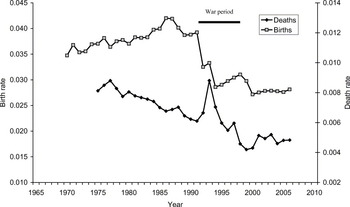
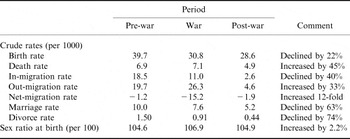
The civil war period had major demographic consequences in Tajikistan. The average rate of population growth in 1992–1995 (13.1 per 1000) was about half of that of the previous four years (25.2 per 1000) as a result of lower birth rates, higher death rates and increased out-migration. Birth rates were rising steadily from 1950 (30.0 per 1000) to 1991 (39.2 per 1000), and underwent a major drop during the war, to stabilize at a lower and steady level after 1995, with an average of 28.6 per 1000 (Fig. 1). Death rates were decreasing since 1975, but rose rapidly during the war, with a peak in 1993 (8.8 per 1000), compared with 6.1 per 1000 in 1991. By 1996, they reached again the pre-war trend line and continued to decline with some ups and downs until 2006 (Fig. 1). Compared with the pre-war trend line, the excess mortality during the war can be estimated at 27,000 persons. This is a lower figure than other values sometimes quoted of 50,000 to 100,000 excess deaths, although these values are rarely justified by proper demographic calculations.
Trends in crude birth rate and crude death rate, Tajikistan, 1970–2006.

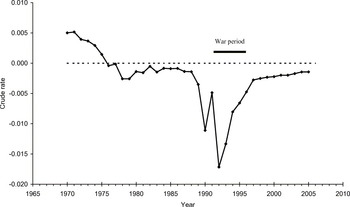
Net migration was positive until 1975, and somewhat negative and steady in the pre-war period, with an average of −1.2 per 1000 between in 1976 and 1988. The migration flows were first disrupted during the period of the collapse of the Soviet Union and the following independence (1989–1991). Negative net-migration increased considerably during the war, with a rate of −15.2 per 1000 in 1992 and 1993. By 1998, the situation had stabilized, and net-migration was similar to that of the pre-war period (Fig. 2).
Trends in crude net-migration rate, Tajikistan, 1970–2006.

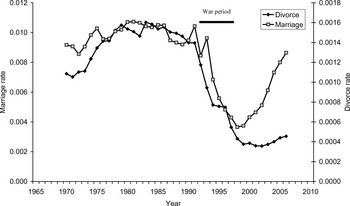
The impact of the civil war on marriages and divorces was also notable (Clifford, Reference Clifford2009; Clifford et al., Reference Clifford, Falkingham and Hinde2010). The marriage rate was stable over time from 1950 to 1991, with only some minor fluctuations, with an average value of 10 per 1000. The marriage rate declined markedly during the war, and even after, to reach a low value of 3.7 per 1000 in 1998–1999. Since then it recovered quickly, and by 2006 it was getting close to pre-war levels (8.6 per 1000) (Fig. 3). The divorce rate was on the rise from 1966 to 1979, and has remained roughly steady since, with an average value of 1.5 per 1000 up to 1991. It dropped markedly during the war, and continued to decline until 1999, after which it stabilized at about 0.4 per 1000, and even rose slightly in more recent years (2004–2006) (Fig. 3).
Trends in crude rates of marriage and divorce, Tajikistan, 1970–2006.

In conclusion, there is no doubt that the civil war had major demographic effects. Beyond the increased mortality and out-migration rates, which reflect a major stress, it also induced major changes in marital partnerships, with a major and long-lasting drop in marriages for about eight years, and a large drop in births during the four years of the war. At least two ingredients of changing sex ratios were therefore present: marital disruption, and psychological stress.
Impact on sex ratios
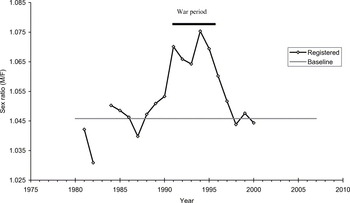
The impact of the war on the sex ratio at birth was indeed remarkable (Fig. 4). During the pre-war period, sex ratios averaged 104.6 (95% CI=104.3–104.9) and were similar in the post-war period: 104.9 (95% CI=104.5–105.4). Note that these sex ratios are somewhat low compared with the world average of 105.5 (computed from WHO: World Health Statistics from 1950 to 2004), but are almost identical to those of Iran, the country closest to Tajikistan ethnically speaking: 104.3 over the 1996–2006 period (95% CI: 104.2–104.4).
Trends in the sex ratio at birth, Tajikistan.

The sex ratios started to increase just after the collapse of the Soviet Union, and remained high during the violent turmoil of the war. By 1991 the sex ratio rose to 107.0 and remained high during the whole war period, up to 1996 (106.0), with an average of 106.7 from 1991 to 1996. Each of the annual sex ratios from 1991 to 1996 was significantly higher than the 104.6 baseline: p<10−5 in 1991, 1992, 1994, 1995; p=0.0002 in 1993 and p=0.0055 in 1996. Note that the effect on sex ratios started a year earlier and ended a year later than the excess mortality. It appears to be more correlated with trends in births, marriages and migrations, although it started a year earlier than the changes in birth rates and marriage rates.
Discussion
The magnitude of the increase in the sex ratio at birth observed during the civil war in Tajikistan (+2.1) is consistent with the highest values observed during the world wars in Europe, for instance France or Belgium during WWII. Changes in birth rates and marriage rates were also remarkable, and consistent with similar effects in countries deeply affected by WWI or WWII.
Considerable drops in births and marriages during the war were not followed by a marriage boom or a baby boom at the end of the war. This is probably due to the fact that many young men had to leave the country for political or economic reasons and tended to postpone marriage. The war period was also followed by a drought, which hampered a quick recovery. This is probably why the increase in sex ratios was limited to the war period, and did not exist in the post-war period, as was the case in Europe after WWII.
The impact of the war on sex ratios was positive (excess of male births), which means that if stress was also involved, which is likely in such conflicts, the possible negative effects were largely compensated by positive effects.
There are unfortunately no data to document the coital frequency hypothesis. However, since virtually all fighting soldiers were young men staying in the countryside, one could assume that, if married, they were separated from spouses most of the time. In addition, spousal separation could have occurred for refugees and displaced persons who tried to escape the combat areas. The war period was associated with massive out-migration, of men and also of women, primarily towards Afghanistan and Russia. This probably led to increased spouse separation and to decreased opportunities for marriage, which could explain the lower fertility and possibly the higher sex ratios.
Changes in demographic parameters during the civil war in Tajikistan

Note: changes in marriage and divorce rates are computed from lowest value after war.
More important, times were very harsh for the whole population, and Tajikistan is a country prone to famines and severe food shortages. In the interviews, there were numerous accounts of the difficulties in getting even basic foods during the war period. Severe food restriction was the rule in cities, and the situation was even worse in rural areas affected by the war, since regular soldiers, mujahiddins and other guerrillas often took by force the meagre resources kept by the farmers, appropriated parts of the food deliveries of international organizations, and blocked the movement of goods on the roads. So, it is likely that malnutrition increased during the war period, and that young men were strongly affected. If the nutritional hypothesis is correct, then changing father's nutritional status could also explain the positive changes of sex ratios. Note that if it were the nutritional status of the mother that dominated, one would have expected, on the contrary, a negative change. One should remember that men are more sensitive to famines than women, which could explain why the male effect dominated in this case (MacIntyre, Reference MacIntyre, Dyson and Gráda2002).
If the food situation improved after the war, it was by no means secured. There were again food shortages in the year 2008. It would be interesting to continue monitoring trends in sex ratios over time, and to have more information on nutritional status to better understand what happened in 1992–1996 in Tajikistan.
The Tajikistan case study reveals how complex are the effects of changes in numerous factors of the sex ratio at birth. Each factor may have – or not have – a visible effect depending on the nature and magnitude of the changes, and some may have opposite effects on fathers and mothers. More research is needed both at the biological level and at the population level to better grasp these complex effects.
Acknowledgments
The authors thank all the persons who supported the fieldwork in Tajikistan, as well as the anonymous reviewer who made numerous useful comments on the draft.