INTRODUCTION
This article investigates how voters’ gender, ethnicity and partisan preference interact with party candidates’ facial cues referencing gender and ethnicity (Eurocentric vs. Afrocentric appearance) in driving patterns of candidate support.
It is well known that voters use gender as a proxy for politicians’ ideology and their ability to deal with particular issues (Alexander and Andersen Reference Alexander and Andersen1993; Carroll and Fox Reference Carroll and Fox2009; Dolan Reference Dolan2013; Dolan and Sanbonmatsu Reference Dolan, Sanbonmatsu, Druckman, Green and Kuklinski2011; Huddy and Terkildsen Reference Huddy and Terkildsen1993; Koch Reference Koch2000; McDermott Reference McDermott1997; Sanbonmatsu Reference Sanbonmatsu2002; Schneider and Bos Reference Schneider and Bos2013; for a review, see Huddy and Cassese Reference Huddy, Cassese, Shapiro and Jacobs2013). Parallel research has investigated the racial bias in candidate evaluation—the extent to which white voters penalize non-white candidates (Hood and McKee Reference Hood and Mckee2015; Matsubayashi and Ueda Reference Matsubayashi and Ueda2011; McDermott Reference McDermott1998; Piston Reference Piston2010; Schaffner Reference Schaffner2011; Sigelman et al. Reference Sigelman, Sigelman, Walkosz and Nitz1995; Terkildsen Reference Terkildsen1993; Weaver Reference Weaver2012). It rarely happens, however, that gender and racial cues are examined simultaneously (Philpot and Walton Reference Philpot and Walton2007). More importantly, within both genres of scholarship there is relatively little evidence on the degree to which gender and ethnicity affect political judgment by signaling political similarity (in-group vs. out-group status) between the candidate and voter. We fill this gap by testing the effects of the match between a candidate and a voter's group identity defined in terms of gender, ethnicity, and partisanship on the magnitude and direction of candidate support. To do so, we present voters with differing combinations of facial cues representing a candidate's gender and ethnicity while simultaneously manipulating the candidate's party affiliation.
We predict that negative sentiment toward candidates representing out-groups will be reinforced when the number of out-group attributes increases, i.e. when the target candidate embodies gender, ethnic, and partisan out-groups. In other words, the decline in support for social out-groups—those candidates whose faces indicate opposing gender and ethnicity with respect to voters—should be more pronounced for out-party than in-party candidates. These expectations are based on theories of group solidarity (Hechter Reference Hechter1988; Skvoretz Reference Skvoretz2013) and social identity (Tajfel and Turner Reference Tajfel, Turner, Jost and Sidanius2004), assimilation and contrast effects (Sherif and Hovland Reference Sherif and Hovland1961) and motivated political reasoning (Druckman et al. Reference Druckman, Fein and Leeper2012; Lodge and Taber Reference Lodge, Taber, Lupia, McCubbins and Popkin2000; Prior Reference Prior2013).
The experimental design is based on a CAWI post-election survey conducted online in 2013 on a representative sample of Italian voters.Footnote 1 As a national setting of the experiment, Italy presents three main features: a traditionally male-dominated culture where relatively distinct gender roles persist; a majority-white population in which the ethnic composition of the electorate is still very homogeneous; a political culture characterized by a mix of political personalization and ideological polarization (ITANES 2008).
RESEARCH DESIGN
Target Candidates and Parties
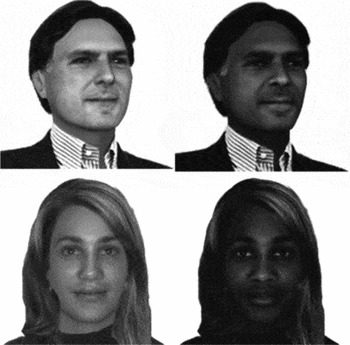
Using a series of split-sample experiments, different respondents were provided digitally altered pictures of two real Italian candidates of foreign origin (one man and one woman), who were unknown to the general public.Footnote 2 The manipulations (all implemented using the FaceGen Modeler software) made the target candidate appear more stereotypically Afrocentric or Eurocentric, both in terms of face shapes and skin textures/complexion.Footnote 3 Using the actual photographs of the party candidates (Appendix 1), we implemented identical manipulations (+ or −15 on the relevant FaceGen metric) along the ethnicity dimension. The resulting manipulations are presented in Figure 1.
Facial Manipulations for Male Candidate (Above) and Female Candidate (Below): Eurocentric (Left) and Afrocentric (Right) Treatments
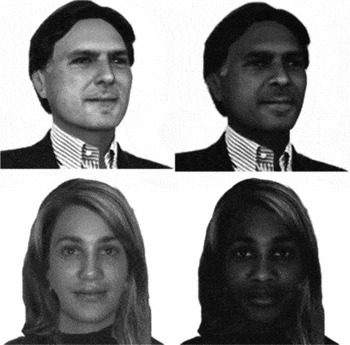
The metric that we settled on represents the best possible compromise between treatment credibility and effectiveness. A manipulation check conducted on Italian undergraduate students confirms that all race-based experimental conditions were correctly perceived as different (e.g. the Afrocentric female candidate was actually rated as more Afrocentric on a 0–10 scale than its Eurocentric version).Footnote 4
Finally, in addition to degree of Eurocentrism–Afrocentrism, we manipulated the candidates’ party affiliation. Each of the four visual conditions (by gender and ethnicity) was assigned either a Center-Left or Center-Right party label, referencing the two main Italian parties: PD (Democratic Party) and PDL (Silvio Berlusconi's People of Freedom).Footnote 5
Overall, this fully crossed 2 × 2 × 2 factorial design yields eight conditions based on the pairings of the four manipulated attributes—gender (male/female), ethnicity (Eurocentric/Afrocentric), and party (Center-Left/Center-Right).
Data Collection
The experiment was conducted online (CAWI) within the ITANES (Italian National Election Studies) post-election survey on a sample representative of the Italian adult population.Footnote 6 Our experimental test thus appeared in a much wider questionnaire covering all the standard main topics relating to the election campaign and voting choice, as in any standard national election study. All participants in the experimental survey had already completed the pre-election questionnaire, which did not include any experimental module, a few weeks earlier, and were subjected to the experiment during the second half of the second (post-election) survey questionnaire.
The entire post-election sample completed the standard questionnaire. In the case of our experimental module, however, the sample was split randomly into 8 different subsamples of about 380 respondents. All respondents in each subsample were then exposed to two randomly selected experimental conditions, corresponding to the male and female candidate. Since this study only focuses on those respondents who were randomly assigned to ethnicity-based treatmentsFootnote 7 and responded to the experimental module the final number of observations in our analysis is smaller (N = 893).
While the candidate's picture was displayed on the computer screen, participants responded to a short battery of questions about each of the three candidates. They first rated the candidate on a “feeling thermometer” ranging from 0 to 10. Then, they rated the candidates on a set of leadership attributes (strength, integrity, empathy, and intelligence). Finally, they indicated their voting intentions concerning the races involving the target candidates. The full questionnaire for the survey experiment is presented in Appendix 1.
Variables and Indicators
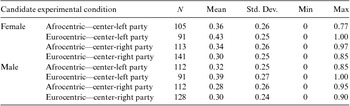
Our Candidate Support Index (CSI) collapses into a single scale the ratings on the feeling thermometer, traits (strength, integrity, empathy, intelligence), and likelihood of voting for the candidate. Appendix Table 3 shows measures of internal consistency (Cronbach's alpha) for these six items. The extremely high values of these coefficients (≥ 0.96) for each experimental condition indicate that respondents assessed candidates not only in terms of thermometer rating and likelihood of voting, but also along the four image dimensions. Since all four traits tap leadership attributes that are “valenced”—they are ideologically non-divisive and it is considered desirable for all political leaders to possess them (Barisione 2015; Stokes Reference Stokes and Kavanagh1992)—acknowledgment of these traits also becomes a proxy of potential candidate support. The resulting 0–60 scale based on these six variables was then converted to a 0–1 metric, which represents our final CSI. This scale provides us with a broader and more robust indicator of candidate perception and support. In Table 1, we provide descriptive statistics of this Index for each experimental condition.
Descriptive Statistics of Candidate Support Index (CSI) for Each Experimental Condition
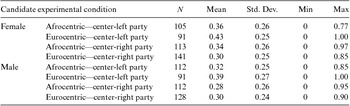
Source: ITANES CAWI 2013.
Our key covariates are respondents’ gender, ethnicity and party affiliation. If gender is well distributed within the sample, ethnicity is a constant, since the ethnic composition of the Italian electorate is still very homogeneous (over 99 percent white).Footnote 8 As for partisanship, it is given by responses to the question concerning actual vote choice at the 2013 general election. More particularly, a vote for PD (Democratic Party—Center-Left) or PDL (People of Freedom—Center-Right) is used to designate respondent's partisanship in dichotomous terms.
To test the conditional effects of group differences on candidate support, we create three dichotomous variables tapping candidate/voter similarity vs. dissimilarity in terms of party (center-left vs. center-right), gender (man/woman), and ethnicity (Eurocentric/Afrocentric). Each variable takes the value 0 when the candidate has the opposite attribute with respect to the voter (i.e. group dissimilarity), and the value 1 when they both belong, respectively, to the same party, gender, and ethnicity (i.e. group similarity).
RESULTS
If overall candidate support is relatively unaffected by visual cues referencing ethnicity, it tends to reward the female and center-left candidate conditions (see Table 1). However, in this study we focus on possible effects that are conditional on the level of group similarity/dissimilarity between candidates and voters.
Using a pooled dataset aggregating the eight experimental conditions, we estimate models of candidate support based on the match between candidates and voters in terms of social (gender and ethnicity) and political (partisanship) group memberships.
We anticipate that partisan similarity will exert the greatest impact, but possibly not to the extent of entirely suppressing the effects of nonverbal cues referencing social group similarity/dissimilarity. Moreover, we expect that when a candidate's face denotes simultaneously gender- plus ethnicity-outgroups status with respect to voters, this will make little difference for in-partisans, but may elicit further opposition among out-partisans.
To assess the conditional effects of gender and ethnic similarity both on the overall level of candidate support and—more specifically—on the CSI of in- and out-party candidates, we estimate an equation with three interaction terms corresponding to partisan similarity on the one hand, and gender, ethnic, and combined (gender x ethnicity) similarities on the other. Our present focus on PD and PDL voters results, of course, in a decrease in the actual number of cases (N = 310).
When we run these interaction models (see models 1, 2, 3, and 4 in Appendix 5) without differentiating between center-left and center-right party voters, no coefficient—both for covariates and interactions—reaches statistical significance. In other words, gender-, ethnic, and combined similarities have no overall effect both on global candidate support and support for out-party candidates. We note however that the last interaction (combined gender x ethnicity similarity) approaches statistical significance (p = 0.055) both in model 3 and 4 (with controls) (table not reported).
These null results imply that, (1) white male (or white female) voters do not disproportionally support white male (or white female) candidates; and (2) white male (or white female) voters do not appear to significantly penalize Afrocentric female (or Afrocentric male) out-party candidates.
However, when we differentiate between center-left and center-right voters, we find that, while the null results are confirmed in the case of center-left voters, our key interaction—that focusing on combined group dissimilarity (models 3 and 4)—significantly predicts center-right voters’ support for a candidate based on her in/out-party status.
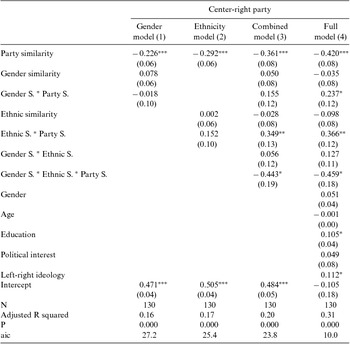
Table 2 shows that candidate/voter partisan similarity is by far—as anticipated—the strongest predictor of candidate support. The interactions of gender- and party-similarity (model 1) and of ethnicity- and party-similarity (model 2) do not significantly predict support for PDL (right of center) candidates, when taken separately. However, when gender- and ethnicity-similarity are simultaneously interacted with partisan similarity, the drop in support for the combined out-group condition (party x gender x ethnicity) becomes significant (p = 0.022 in model 3, p = 0.012 in model 4).
OLS Parameter Estimates for Candidate Support Index Scores by Matches of Candidate/Voter Gender-, Race- and Party-Similarity for Center-Right Party Voters (see Models in Appendix 5)
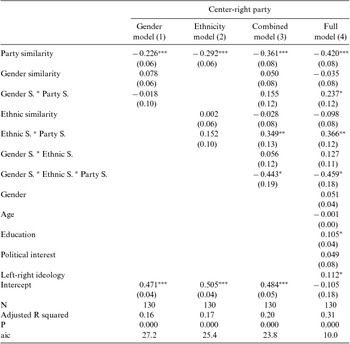
Notes: Unstandardized coefficients with standard errors in Parentheses for Candidate Support Index Scores by Matches of Candidate/Voter Gender-, Race- and Party-Similarity for Center-Right Party Voters (see Models in Appendix 5) Standard errors in parentheses. Significance levels: *p < 0.05. **p < 0.01; ***p < 0.001.
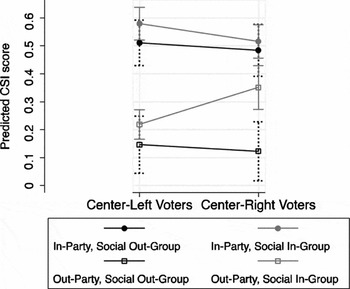
Figure 2 visualizes the interaction effects of combined group similarity on center-right party voters—as compared with center-left voters—and show that the pattern is clearly asymmetricFootnote 9 : to center-left voters, similarity or dissimilarity based on gender and ethnicity do not seem to make any difference—social in-groups seem slightly, but statistically non-significantly favored over out-groups both when the candidate represents the in- and out-party. It is thus partisanship that makes all the difference to them.
Predicted Candidate Support Index Score by Party- and Group (Gender × Ethnicity) Similarity Among Center-left and Center-right Voters (with 90% CIs) (See Appendix 5 for OLS Interaction Model)
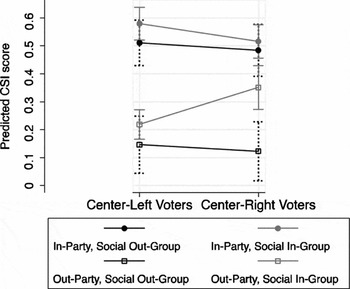
Conversely, among center-right voters, social out-groups are assimilated when the candidates have the PDL (center-right) label, but they are contrasted and subject to a clear penalty when associated with the PD (center-left) party label: the average CSI score tapping global evaluation and willingness to support on a 0–1 scale drops to 0.12 for the out-party candidate representing social out-groups (0.23 points lower than the score for the out-party candidate representing social in-groups).
In other words, to right of center Italian voters, social out-group status is immaterial for in-party candidates, but a strong negative cue for those running with the opposed party label.Footnote 10 In fact, for these voters social dissimilarity is even more important than partisan dissimilarity, since the gap in the CSI score between social in- and out-groups of the opposed party exceeds that between in- and out-party candidates with a social in-group status.
Further inspection confirms that the patterns of support for candidates based on social similarity are fundamentally the same across voter gender (both men and women PDL voters assign the lowest score to the combined out-group condition). Moreover, when the analysis is conducted only on PDL voters positioning themselves on the right of the ideological scale, the interaction of party and ethnicity (model 2) also reaches statistical significance.Footnote 11 This suggests two implications. The first is that most of the effect of the combined dissimilarity condition derives from ethnic distinctiveness, whereas the substantive effect of gender similarity is minor—as confirmed by closer inspection of the size of interaction coefficients in models 1 and 2 (Table 2). The second implication is that there is an ideological component to the rejection of out-party and ethnically dissimilar candidates, consistent, for instance, with U.S. data showing that conservatives are more sensitive to racial cues when evaluating candidates (Weaver Reference Weaver2012).
In addition to the classical notion of “right-wing authoritarianism” and related prejudice toward social out-groups (Altemeyer Reference Altemeyer1981), an ideology-based explanation would also be consistent with a more recent stream of literature in political psychology emphasizing the association between political conservatism and personality orientations such as uncertainty avoidance and intolerance of ambiguity (Jost et al. Reference Jost, Glaser, Kruglanski and Sulloway2003), need for cognitive closure (Roets and Van Hiel Reference Roets and Van Hiel2011; Webster and Kruglanski Reference Webster and Kruglanski1994) and group-based dominance (Sidanius and Pratto Reference Sidanius and Pratto2001).
Overall, however, the rejection of the social out-group is limited to out-party candidates, which confirms a key expectation in terms of motivated reasoning and assimilation/contrast effects. When a candidate's face conveys social dissimilarity, this makes little difference for in-partisans, but it exacerbates opposition among (right-wing) out-partisans. We interpret the first outcome as an extension of the “assimilation effect” due to the proximity between the source of the incoming information and its receiver, the latter as a “contrast effect” triggered by the presence of higher source-receiver ideological dissimilarity.
In conclusion, it is right of center Italian voters who are sensitive to gender- and, even more clearly, race-based differences, and who tend to reject candidates from social out-groups. However, they do so only with out-party candidates. This suggests that it is not mere racial prejudice that drives their judgment, but rather an overall sense of out-group standing (deriving from party, ethnicity, and gender) that influences the attitudes of social conservatives, as suggested by the foregoing references.
CONCLUSION
Our study demonstrates that out-partisans—namely center-right voters exposed to a center-left target candidate—respond negatively to candidates whose facial cues express social dissimilarity. Group differences between candidates and voters—especially ethnic differences—matter to vote choice, but only when the voter knows that the candidate is not from his/her preferred party. Right-wing voters “assimilate” social discrepancies with center-right candidates, but emphasize and “contrast” those with center-left ones. Hence, their more pronounced hostility toward center-left Afrocentric candidates, which is augmented when the candidate is from the opposite gender, appears to rest more on partisan motivated reasoning than on racial animus per se. In other words, it is a cumulative (party x ethnicity x gender) out-group status that enhances candidate rejection among more conservative voters, whereas partisan similarity is all that seems to matter for left-wing voters.
Left-wing voters’ blindness to social group dissimilarities could raise concerns about social desirability bias driving their evaluations of out-group candidates. However, as Figure 2 shows, they do evaluate Afrocentric and opposite-sex candidates quite negatively when they run under the center-right party label. Hence, the real question is not if left-wing voters are subject to social desirability pressures, but why they apply greater partisan bias than right-wing voters in their evaluations of target candidates. A possible explanation—beyond the lower level of prejudice toward social out-groups on the left—rests on a traditionally strong anti-Berlusconi sentiment among center-left voters, and hence their negative perception of any candidate associated with his party label.
In closing, we note that the present experiment can be replicated in contexts other than the Italian case, where the ethnic composition of the electorate is likely to be more heterogeneous. This would provide the research design with a wider sample of ethnic out-groups, thus leading to a stronger test of the theoretical expectations concerning the impact of social dissimilarity on the dynamics of candidate support.
SUPPLEMENTARY MATERIAL
To view supplementary material for this article, please visit http://dx.doi.org/10.1017/XPS.2015.15.