INTRODUCTION
Rhodoliths or maërl are calcareous nodules of red algae (Rhodophyta: Corallinales) that grow unattached to the substrata and can accumulate on the sea bottom, forming extensive beds distributed worldwide from intertidal to subtidal zones (Bosence, Reference Bosence1979; Foster, Reference Foster2001). Rhodolith beds may be one of the most important marine benthic environments dominated by macrophytes, considering the area covered (Foster, Reference Foster2001). Vegetative characteristics of rhodoliths, such as shape, sphericity, ramification, number and length of protuberances, form complex tri-dimensional structures. These features enable the existence of channels, crevices and shelters, providing microhabitats for several species (De Grave, Reference De Grave1999). However, despite the importance of rhodolith beds, little information is available on the biodiversity of these environments (Barbera et al., Reference Barbera, Bordehore, Borg, Glemarec, Grall, Hall-Spencer, De La Huz, Lanfranco, Lastra, Moore, Mora, Pita, Ramos-Espla, Rizzo, Sanchez-Mata, Seva, Schembri and Valle2003). Sabellariidae are commonly known as sand-manson or honeycomb worms. They are tube-dwelling and filter-feeding marine polychaetes that occur worldwide, from the intertidal region up to 4500 m (Kirtley, Reference Kirtley1994). Sabellariids capture and select particles from the water column and secrete a proteinaceous cement from thoracic cement glands to build their tubes. Some sabellariid species live in solitary tubes in various kinds of substrata (Calline et al., Reference Calline, Gruet, Legendre, Rhun, I'Homer, Mathieu and Zbinde1992; Kirtley, Reference Kirtley1994; Pandolfi et al., Reference Pandolfi, Robertson and Kirtley1998; Wood, Reference Wood1999; Nishi et al., Reference Nishi, Kato and Hayashi2004), while others form aggregates of tubes that are capable of colonizing wide areas along the coast (Pawlick, Reference Pawlick1988). In this paper we present a taxonomic account of the species of Sabellariidae from coralline beds collected off the north-eastern coast of Brazil.
MATERIALS AND METHODS
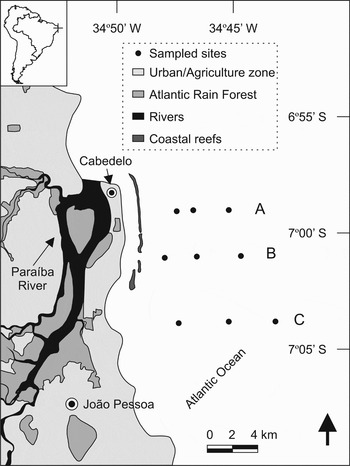
Specimens for this study were collected in rhodolith beds on the coast of João Pessoa and Cabedelo, Paraíba, north-eastern Brazil in March 2006 (Figure 1). Five replicated samples (50 × 50 cm quadrats) were collected by SCUBA in nine sites at 10, 15 and 20 m depth and conditioned in plastic bags. The specimens were retained after washing samples on a sieve of 0.5 mm mesh and preserved in 5% formalin. The material was sorted under a Zeiss stereoscopic microscope and the specimens were identified using current literature. The paleae of the opercular crown, notopodial and neuropodial chaetae, and nuchal hooks were considered diagnostic features and were observed under a microscope (Olympus BX41). Some specimens were prepared on permanent slides with pure glycerin, or in Gray and Weiss (PVA) (Humason, Reference Humason1979). Alternatively, to increase the contrast of some chaetae, some sections were hydrated, and stained with Mallory colouring. These methods enhanced the visualization of details of the opercular paleae, nuchal hooks, and notopodial and neuropodial chaetae. The material is deposited in Coleção de Invertebrados Paulo Young, Departamento de Sistemática e Ecologia, Universidade Federal da Paraíba, Brazil (CIPY-POLY). Comparative material examined was borrowed from the following institutions: Museu do Centro de Estudos do Mar, Universidade Federal do Paraná, Brasil (MCBM-BPO), Natural History Museum of Los Angeles Country (LACM-AHF), and Zoological Museum of Copenhagen, Denmark (ZMUC).
Map of the sampled sites at Paraíba, north-east Brazil.

RESULTS
Systematics
KEY TO SPECIES OF SABELLARIIDAE FROM SUBTIDAL RHODOLITH BEDS IN NORTH-EASTERN BRAZIL
1. Opercular stalk and crown completely fused.… … … … … … … … … … Phragmatopoma caudata Mörch, 1883
– Opercular stalk and crown not completely fused… … … … … … … … … … … … Sabellaria Lamarck, 1812 (2)
2. One kind of middle paleae. … … … … … … … … … 3
– Two kinds of middle paleae.… … … … … … … … …4
3. Outer paleae with 3–6 dial teeth on each side of spatulate medium plume, middle paleae short, quadrangular. … … … … … … … … . .Sabellaria nanella Chamberlin, 1919
– Outer paleae with 3–4 dial teeth on each side of spatulate and pilose medium plume, middle paleae long, narrow. … … … … … … … . Sabellaria wilsoni Lana & Gruet, 1989
4. Middle paleae of two kinds, short, oblong, and long, almost erect, outer paleae with distal denticules on each side of plume splayed toward outer margin of outer blade. … … … … … … … … … … … … … … … … … … … 5
– Middle paleae of two kinds, short, oblong, and long, almost erect, outer paleae with plume penicilate, with distal denticules on each side of plume… … … … … … … … … … … … … … … …Sabellaria corallinea sp. nov.
5. Outer paleae with distal denticules on both sides of plume splayed toward outer margin of outer blade, middle paleae without distal teeth… … … . Sabellaria bella Grube, 1870
– Outer paleae with distal denticules of one side of plume splayed toward outer margin of outer blade, both middle paleae have bigger distal denticules in each side of paleae… … … … … … Sabellaria pectinata Fauvel, 1928
Serpula caudata (Krøyer, MS) Mörch, Reference Mörch1863: 456, plate, 11, figures 27–30; Johansson, Reference Johansson1927: 102; Hartman, Reference Hartman1959: 473.
Hermella caudata Quatrefages, Reference Quatrefages1866: 321.
Phragmatopoma lapidosa Kinberg, Reference Kinberg1867: 349; Johansson, Reference Johansson1927: 2; Hartman, Reference Hartman1944: 348, plate, 36, figure 79; plate, 40, figures 10, 103; 1956: 248; plate 21; Remane, Reference Remane1954: 177; Renaud, Reference Renaud1956: 33; Kirtley, Reference Kirtley1968: 40; Reference Kirtley1971: 102; Reference Kirtley1974: 2; Pardo de Figueroa Olivo, Reference Pardo de Figueroa Olivo1975: 1; Eckelbarger, Reference Eckelbarger1976: 117, figures 7–13; Amaral, Reference Amaral1987: 471, figures 1–5; Pawlik, 1988: 41; Zale & Merrifield, Reference Zale and Merrifield1989: 1; Lana & Bremec, Reference Lana, Bremec, Dauvin, Laubier and Reish1994: 216, figures 1–2.
Sabellaria (Pallasia) castelnuai Quatrefages 1866—Grube, Reference Grube1870: 69; Augener, Reference Augener1926: 216; Fyfe, Reference Fyfe1952: 29.
Centrocorone spinifera Treadwell, Reference Treadwell1939: 1, figure 1.
Phragmatopoma attenuata Hartman, Reference Hartman1944; 353, plate, 38, figures 90–96; plate, 39, figures 100–101; Kirtley Reference Kirtley1974: 28; Fauchald, Reference Fauchald1977a: 54; Reference Fauchald1977b: 119.
Phragmatopoma californica Marsden, Reference Marsden1960: 1028, figure 19.
Phragmatopoma lapidosa lapidosa Pawlik, 1988: 41; Pawlick & Hadfield, Reference Pawlick and Hadfield1990: 452.
Phragmatopoma caudata Kirtley, Reference Kirtley1994: 31, figures 2.3.1–2.3.6.
MATERIAL EXAMINED
Total: 83 specimens. 6°59′00″S 34°46′41″W (Station A15), 1 specimen (CIPY-POLY 1011). 7°01′02″S 34°47′55″W (Station B10), 2 specimens (CIPY-POLY 1012). 7°03′50″S 34°47′19″W (Station C10), 5 specimens (CIPY-POLY 1013). 7°01′02″S 34°47′55″W (Station B10), 32 specimens (CIPY-POLY 1014). 7°01′02″ S 34°47′55″W (Station B10), 3 specimens (CIPY-POLY 1015). 6°59′01″S 34°47′23″W (Station A10), 4 specimens (CIPY-POLY 1016). 6°590′0″S 34°46′41″W (Station A15), 1 specimen (CIPY-POLY 1017). 6°59′01″S 34°47′23″W (Station A10), 11 specimens (CIPY-POLY 1018). 7°01′02″S 34°47′55″W (Station B10), 24 specimens (CIPY-POLY 1019).
ADDITIONAL MATERIAL EXAMINED
Phragmatopoma caudata (Krøyer, MS) Mörch, Reference Mörch1863. Type series: Virgin Islands: 3 syntypes, lectotype and 2 paralectotypes, determined in 18 January 1996 by D.W. Kirtley. The specimens were collected by Anders Sando Örsted during 1845–1848 (ZMUC 450).
REMARKS
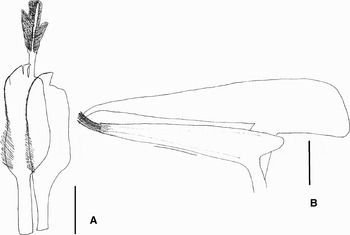
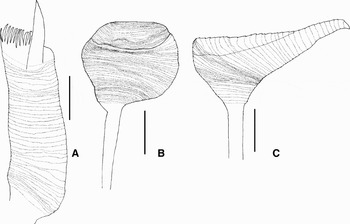
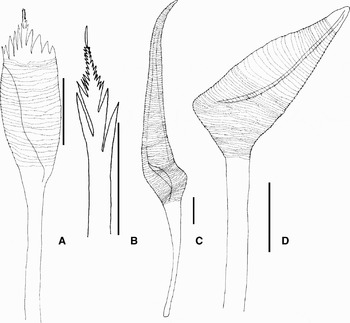
The specimens examined here agree with the type series. Kirtley (Reference Kirtley1994) shows that specimens identified as P. lapidosa along the Brazilian coast are identical to P. caudata. Both species are similar in the diagnostic characters of the operculum: three kinds of opercular paleae disposed in 3 concentric rows, only two being visible. The third row, that contains the inner paleae, is located below the second row that contains the middle paleae. Outer paleae caliciform, geniculate with two faces of thecae (Figure 2A). The plume consists of a palmate filamentous membrane (Figure 2B). Middle paleae elongate, dark chocolate, strongly geniculate, with a shallow sulcus along midline of lower surface of blades, without preeminent thecal ridges (Figure 2C). Inner series of paleae gold, strongly geniculate, elongate, with anterior ends more pointed, finishing in small extensions. These paleae always have a slight excavation in upper surface of thecal band that begins in a genicula proximal to anterior end (Figure 2D). The morphology of examined specimens corresponds totally to Kirtley's description.
Phragmatopoma caudata (Krøyer, MS) Mörch, Reference Mörch1863. CIPY-POLY 1011. (A) Outer palea; (B) middle and inner paleae. Scale bar: A & B = 174 µm.

BIOLOGICAL NOTE
This species is found in aggregates constructed onto rock substrata (Kirtley, Reference Kirtley1994). However, in this work the majority of specimens were found at 10 m and some at 15 m depth. Kirtley (Reference Kirtley1994) reported the association of P. caudata with Sabellaria nanella (Chamberlin, Reference Chamberlin1919) in the intertidal region. This is the first time that this species was reported constructing their tubes in a substratum other than rocks.
GEOGRAPHICAL RANGE
Phragmatopoma caudata was originally described from the Virgin Islands, although the species is widely distributed along the tropical and subtropical coasts of the western Atlantic and records are known from Bermuda to Brazil. This species has been reported along the entire Brazilian coast, inhabiting rocky shores (Amaral et al., Reference Amaral, Nallin and Steiner2006). Records of this species are known from Ceará (Kirtley, Reference Kirtley1994), Rio de Janeiro (Lana & Bremec, Reference Lana, Bremec, Dauvin, Laubier and Reish1994), São Paulo (Abreu, Reference Abreu1978; Amaral, Reference Amaral1987; Rocha, Reference Rocha1993; Lana & Bremec, Reference Lana, Bremec, Dauvin, Laubier and Reish1994), Paraná, Santa Catarina, and Rio Grande do Sul (Lana & Bremec, Reference Lana, Bremec, Dauvin, Laubier and Reish1994).
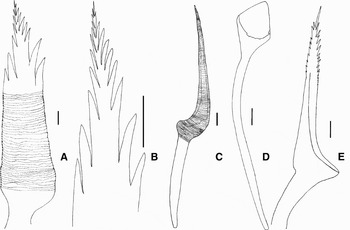
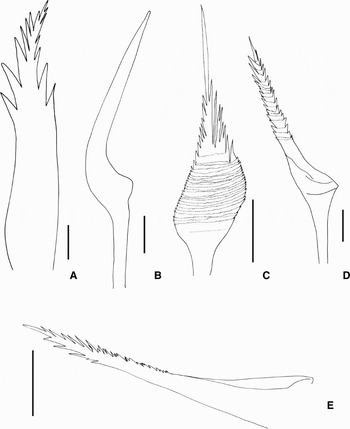
Sabellaria bella Grube, Reference Grube1870. CIPY-POLY 1022. (A) Outer palea; (B) detail of outer palea; (C) middle palea, long form; (D) middle palea, short form; (E) inner palea. Scale bar: A–E = 100 µm.

Sabellaria bella Grube, Reference Grube1870: 69; Augener, Reference Augener1934: 151, figure 31; Hartman, Reference Hartman1944: 339, plate, 33, figures 53–56; plate, 35, figures 57–60; Wells & Gray, Reference Wells and Gray1964: 76; Rullier & Amoureux, Reference Rullier and Amoureux1979: 187; Gruet & Lana, Reference Gruet and Lana1988: 32, figures 1 & 2; 1989: 243; Kirtley, Reference Kirtley1994: 53, figure 4.3; Lana & Bremec, Reference Lana, Bremec, Dauvin, Laubier and Reish1994: 216, figures 1 & 2.
Sabellaria floridensis Hartman, Reference Hartman1944: 339; Duarte, Reference Duarte1980: 1; Morgado, Reference Morgado1980: 1; Souza, Reference Souza1989: 1; Duarte & Nalesso, Reference Duarte and Nalesso1996: 139; Santa-Isabel et al., Reference Santa-Isabel, Cerqueira and Alves1996: 645.
MATERIAL EXAMINED
Total: 4 specimens. 7°01′02″S 34°47′55″W (Station B10), 1 specimen (CIPY-POLY 1022). 7°01′02″S 34°47′55″W (Station B10), 1 specimen (CIPY-POLY 1023). 7°01′02″S 34°47′55″ W (Station B10), 2 specimens (CIPY-POLY 1024).
ADITIONAL MATERIAL EXAMINED
Sabellaria bella (Grube Reference Grube1870). Brazil, Paraná State, Bay of Paranaguá, Mel Island, Ponta das Conchas beach: 25°32′18″S 48°17′34″W: 1 specimen (MCBM-BPO 251).
Sabellaria floridensis (Hartman, Reference Hartman1944). Type series: Florida. Cootypes, lectotype, and 3 paralectotypes, determined 19 July 2009 by A.S. Santos. The specimens were collected by Olga Hartman in 1939 (LACM-AHF).
REMARKS
The morphology of examined specimens agrees with the description in Lana & Gruet (Reference Lana and Gruet1989). Sabellaria bella has an opercular morphology similar to that of S. floridensis Hartman (Reference Hartman1944). It has outer paleae with 2–3 teeth on each side of plume (Figure 3A, B); middle paleae of long form, wide at base, with long blade (Figure 3C; Table 1); middle paleae of short form, elliptical (Figure 3D; Table 1); and inner series geniculate, with anterior ending in distal tip (Figure 3E; Table 1). However, S. bella differs from S. floridensis by having the medium plume long and erect, whereas in S. floridensis it is longer and curved toward the inner series. Kirtley (Reference Kirtley1994) examined diverse populations of S. floridensis, a species that was considered well-distributed in the Pacific and Atlantic Oceans until his revision, when the author considered diverse populations of S. floridensis as new species, but stated that a detailed study of these populations was necessary because he defined new species based in distribution and number of tooth of outer palea. The similarity of these species probably account for previous references to S. floridensis along the Brazilian coast made by Duarte (Reference Duarte1980), Morgado (Reference Morgado1980), Souza (Reference Souza1989), Duarte & Nalesso (Reference Duarte and Nalesso1996) and Santa-Isabel et al. (Reference Santa-Isabel, Cerqueira and Alves1996).
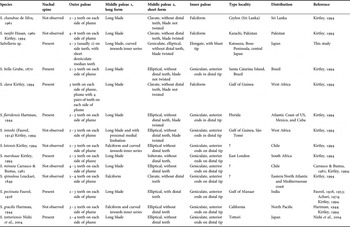
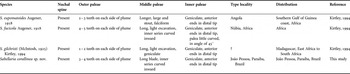
Denticulate species of Sabellaria that have four kinds of paleae (two kinds of middle paleae).

BIOLOGICAL NOTE
Sabellaria bella is usually found in solitary tubes constructed onto rock substrata. The present substrate samples differ from previous accounts of sediments with fine sand and mud, or sometimes with shells (Kirtley, Reference Kirtley1994; Amaral et al., Reference Amaral, Nallin and Steiner2006). The specimens were found at 10 m depth. This is the first time that this species is reported constructing their tubes in rhodoliths.
GEOGRAPHICAL RANGE
Sabellaria bella was originally described from Desterro Island (now Santa Catarina Island) by Augener (Reference Augener1934). After that, S. bella was also reported from Espírito Santo (Lana & Bremec, Reference Lana, Bremec, Dauvin, Laubier and Reish1994), Rio de Janeiro (Kirtley, Reference Kirtley1994), Paraná (Lana & Gruet, Reference Lana and Gruet1989) and Rio Grande do Sul (Borzone, Reference Borzone1988). This is the first record of S. bella from the north-east coast of Brazil.
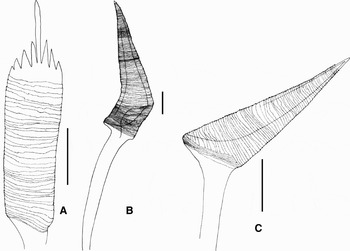
Sabellaria nanella Chamberlin, Reference Chamberlin1919. CIPY-POLY 1025. (A) Outer palea; (B) middle palea; (C) inner palea. Scale bar: A, B = 87 µm, C = 58 µm.

Sabellaria nanella Chamberlin, Reference Chamberlin1919: 261, plate 2, figures 5–7; Johansson, Reference Johansson1927: 98; Hartman, Reference Hartman1938: 16, figures 8–10; 1944: 340, plate 30, figures 18–20; Rullier & Amoureaux, 1979: 188; Lana & Gruet, Reference Lana and Gruet1989: 243; Kirtley, Reference Kirtley1994: 71, figures 4.26.1–4. 26. 2; Lana & Bremec, Reference Lana, Bremec, Dauvin, Laubier and Reish1994: 216, figures 1 & 2.
MATERIAL EXAMINED
Total: 2 specimens. 7°01′02″S 34°47′55″W (Station B10), 1 specimen (CIPY-POLY 1025). 7°01′02″S 34°47′55″W (Station B10), 1 specimen (CIPY-POLY 1026).
REMARKS
Sabellaria nanella is an uncommon species. It is the only taxon that has outer paleae semi-cylindrical or caliciform, concave, geniculate, with a series of small lateral teeth on the thecal margin, which may be curved towards the interior of the theca or straight, with one or two points (Figure 4A). Middle paleae short, strongly geniculate, square-shaped, with a slight central depression (Figure 4B), inner series of paleae strongly geniculate, elongate, with anterior end more pointed (Figure 4C; Table 3). Only two specimens were examined and morphological variation was not observed. We were not able to confirm if the specimens found along the Brazilian coast are identical to the type specimens, because all the descriptions are poorly illustrated. The specimens examined have six pairs of nuchal hooks positioned after a short digitiform medium organ. Kirtley (Reference Kirtley1994) described nuchal hooks for S. nanella, but did not state the number of pairs and position of the medium organ. Kirtley (Reference Kirtley1994) considered the occurrence of S. nanella in Brazil to represent a case of bioinvasion, possibly a consequence of ballast water.
Denticulate species of Sabellaria that have three kinds of paleae.

Brazilian Sabellaria species that have three kinds of paleae and a denticulate plume.

BIOLOGICAL NOTE
All the occurrences of S. nanella along the Brazilian coast were associated with Phragmatopoma aggregates. This species was reported before from the State of Paraíba by Young (Reference Young1989), in crevices of the coral Mussismilia hispida (Verrill, 1901) from Quebra Quilha Reef, at Tambaú Beach, João Pessoa, Paraíba. In the present study the specimens were found at 10, 15 and 20 m.
GEOGRAPHICAL RANGE
Sabellaria nanella was originally described from the Indo-West Pacific Ocean, but has also been reported from the eastern Pacific, from Equador (Kirtley, Reference Kirtley1994), and along the Atlantic Ocean, from the coast of Ceará (Kirtley, Reference Kirtley1994), Bahia (Lana & Bremec, Reference Lana, Bremec, Dauvin, Laubier and Reish1994), Espírito Santo and Rio de Janeiro (Rullier & Amoureux, Reference Rullier and Amoureux1979; Lana & Bremec, Reference Lana, Bremec, Dauvin, Laubier and Reish1994), São Paulo (Lana & Bremec, Reference Lana, Bremec, Dauvin, Laubier and Reish1994) and Uruguay (Lana & Bremec, Reference Lana, Bremec, Dauvin, Laubier and Reish1994).
Sabellaria pectinata Fauvel, 1923. CIPY-POLY 1020. (A) Outer palea; (B) middle palea one; (C) middle palea two; (D. & E) inner palea. Scale bar: A–F = 100 µm.

Sabellaria pectinata Fauvel, Reference Fauvel1928: 163, figure 3; 1930: 53; 1932: 210; Day, Reference Day1967: 671, figure 33.3; Achari, Reference Achari1974: 444; Kirtley, Reference Kirtley1994: 72, figures 4.28.1–4.28.3.
Sabellaria pectinata var. intermediata Fauvel, Reference Fauvel1932, 210, figure 35; 1953: 397, figure 207.
MATERIAL EXAMINED
Total: 2 specimens. 7°03′49″S 34°43′12″W (Station C20), 1 specimen (CIPY-POLY 1020). 7°03′49″S; 34°43′12″W (Station C20), 1 specimen (CIPY-POLY 1021).
REMARKS
The specimens reported here are identical to the illustrations provided by Fauvel (Reference Fauvel1928) and Kirtley (Reference Kirtley1994) for material collected from the Indian Ocean. In our material, the outer paleae has 2–3 teeth on each side of plume (Figure 5A, B); middle paleae of long form, one wide base with long blade (Figure 5C); middle paleae short form, wide base with falciform blades and denticulate margins (Figure 5D); and inner series geniculate, with anterior ends in distal tip (Figure 5E, F; Table 1). On the other hand, our specimens differ from the illustrations provided by Day (Reference Day1967) and Kirtley (Reference Kirtley1994) for specimens collected in Natal, in South Africa, on the short middle and inner paleae morphology. The specimens from Natal do not present a denticulate margin. The same is true for specimens illustrated from India by Fauvel (Reference Fauvel1928) and those analysed in this study. As seen for S. nanella, the occurrence of S. pectinata in Brazil could represent a case of bioinvasion, possibly as a consequence of ballast water, considering that the study area is close to a sea port. Achari (Reference Achari1974) does not provide illustrations about the specimens analysed. Therefore, it is not possible to confirm if it is the same species.
BIOLOGICAL NOTE
The specimens were found only in 10 m. This is the first time that this species was collected living near other sabellariid species.
GEOGRAPHICAL RANGE
Sabellaria pectinata was originally described from the Indian Ocean (Fauvel, Reference Fauvel1928), and, later, was reported from South Africa in Natal (Day, Reference Day1967). The species is reported for the first time for the western Atlantic.
Sabellaria wilsoni Lana & Gruet, Reference Lana and Gruet1989. CIPY-POLY 1028. (A) Outer palea; (B) middle palea; (C) inner palea. Scale bar: A–C = 100 µm.

Saballaria wilsoni Lana & Gruet, Reference Lana and Gruet1989: 239, figures 1–21; Kirtley, Reference Kirtley1994: 80, figure 4.33; Lana & Bremec, Reference Lana, Bremec, Dauvin, Laubier and Reish1994: 216, figures 1 & 2.
MATERIAL EXAMINED
Total: 2 specimens. 7°01′02″S 34°47′55″W (Station B10), 1 specimen (CIPY-POLY 1027). 7°01′02″S 34°47′55″W (Station B10), 1 specimen (CIPY-POLY 1028).
ADDITIONAL MATERIAL EXAMINED
Sabellaria wilsoni Lana & Gruet (Reference Lana and Gruet1989). Type series: Holotype: Paraná State, Ponta Grossa, Paranaguá Bay, 25°25′06″S 48°28′00″W, 10 m, collected 24 May 1982 (MCBM BPO 241). Paratype: Ponta Grossa, Paranaguá Bay, 25°25′06″S 48°28′00″W, 10 m, 15 specimens collected 24 May 1982 (MCBM BPO 242). Paratype: Ponta do Maciel, Paranaguá Bay, 25°33′S 48°25′W, 16.5 m, 1 specimen, collected 28 May1982 (MCBM BPO 243). Paratype: Ponta do Maciel, Paranaguá Bay: 25°33′S 48°25′W. 16.5 m, 1 specimen, collected 5 June 1986 (MCBM BPO 244). Paratype: Ponta da Pita, Antonina Bay, 25°26′30″S 48°3′1W, 6 m, 1 specimen collected 3 July 1986 (MCBM BPO 245).
REMARKS
The material examined here agrees with specimens described by Lana & Gruet (Reference Lana and Gruet1989). The outer paleae has flattened, oblong, thecate blades; with teeth and medial plume on distal margin of blades with penicillate form; 3–4 distal teeth present on each side of dominant tooth, progressively smaller toward outer margins on either side of dominant tooth (Figure 6A). Middle paleae with 9–12 pairs on each side; strongly geniculate, with elongated blades slightly blunted, curved toward inner series of opercular crown (Figure 6B). Inner series of paleae alveolate in form, strongly geniculate on proximal upper surface of blades, with thecal bands weakly excavate, slanting upward from horizontal plane; blade thicker and wider toward base, ending in either a bluntly rounded point, or with distal dentition on margin or, in some specimens, in a series of sharp hooked tips (Figure 6C; Table 3).
BIOLOGICAL NOTE
Sabellaria wilsoni is known from mixohaline and polyhaline environments (estuaries and shallow bottoms of the continental shelf), living in sediments with sand and mud (sometimes with shells). The specimens were found at 15 m, similarly to those of the type series collected at 10 and 15 m. This is the first time that this species was collected living near other sabellariid species.
GEOGRAPHICAL RANGE
Sabellaria wilsoni was originally described from the coast of Paraná. The species has been reported only to the Atlantic Ocean, from French Guyana, Brazil to Argentina, and possible from the Gulf of Mexico (Lana & Gruet, Reference Lana and Gruet1989; Bremec & Lana, 1994).
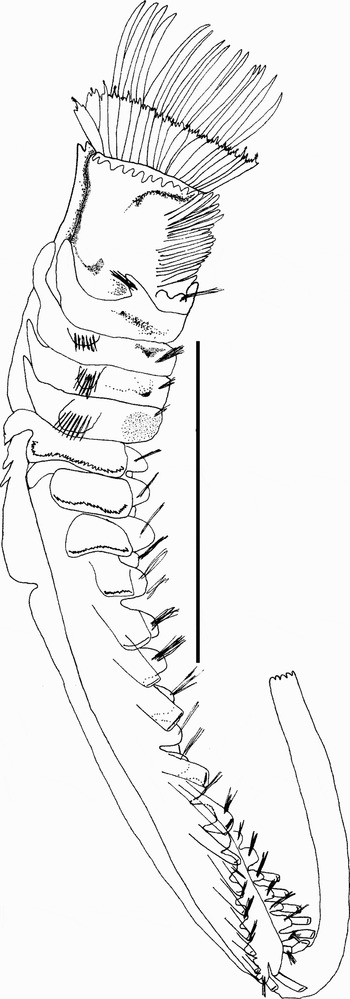
Sabellaria corallinea sp. nov. holotype. CIPY-POLY 634. Body in lateral view. Scale bar: 2.7 mm.

Sabellaria corallinea sp. nov. paratype. CIPY-POLY 639. (A) Outer palea; (B) detail of plume of outer palea; (C) middle palea; (D) inner palea. Scale bar: A–C, D = 100 µm, B = 39 µm.

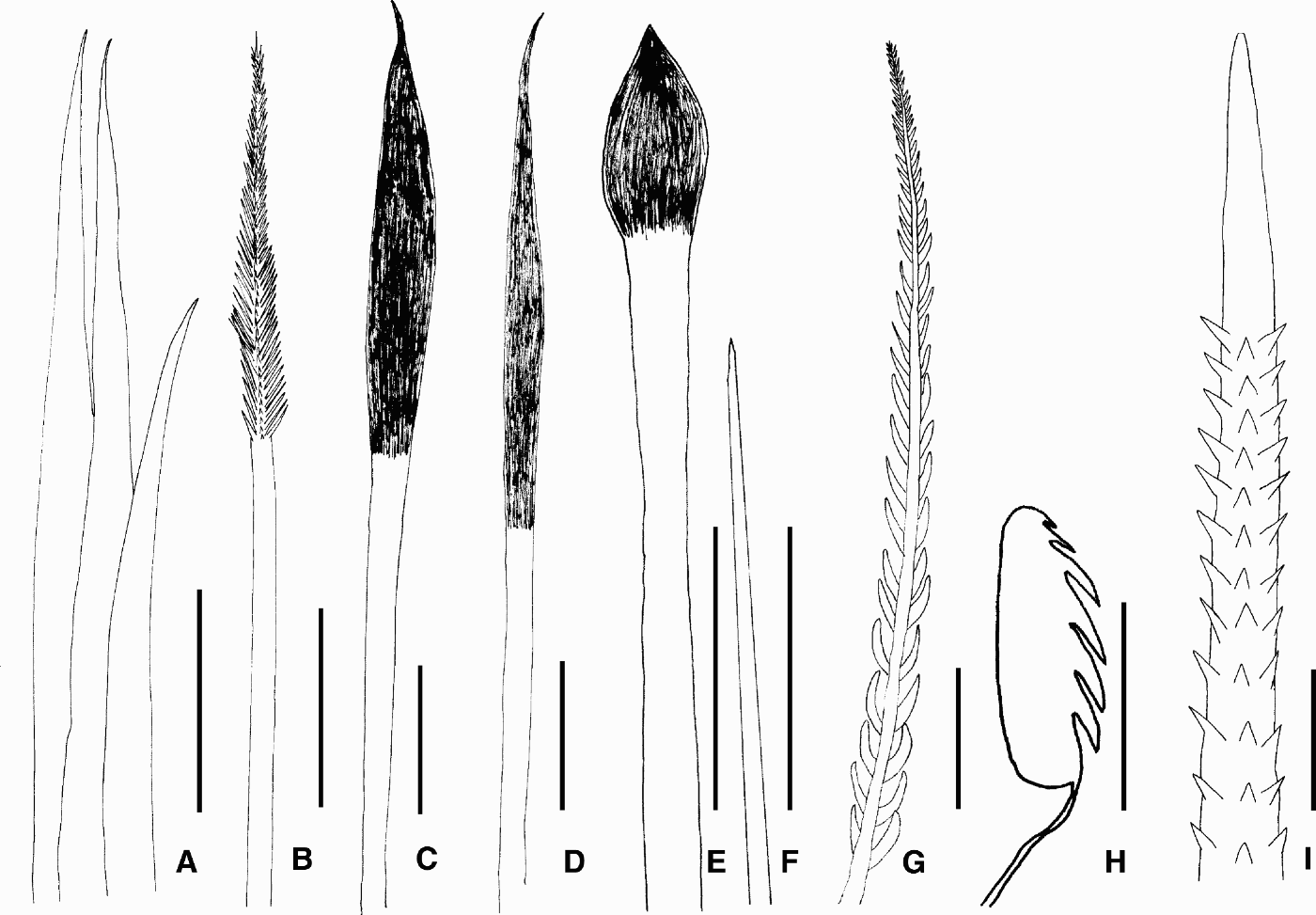
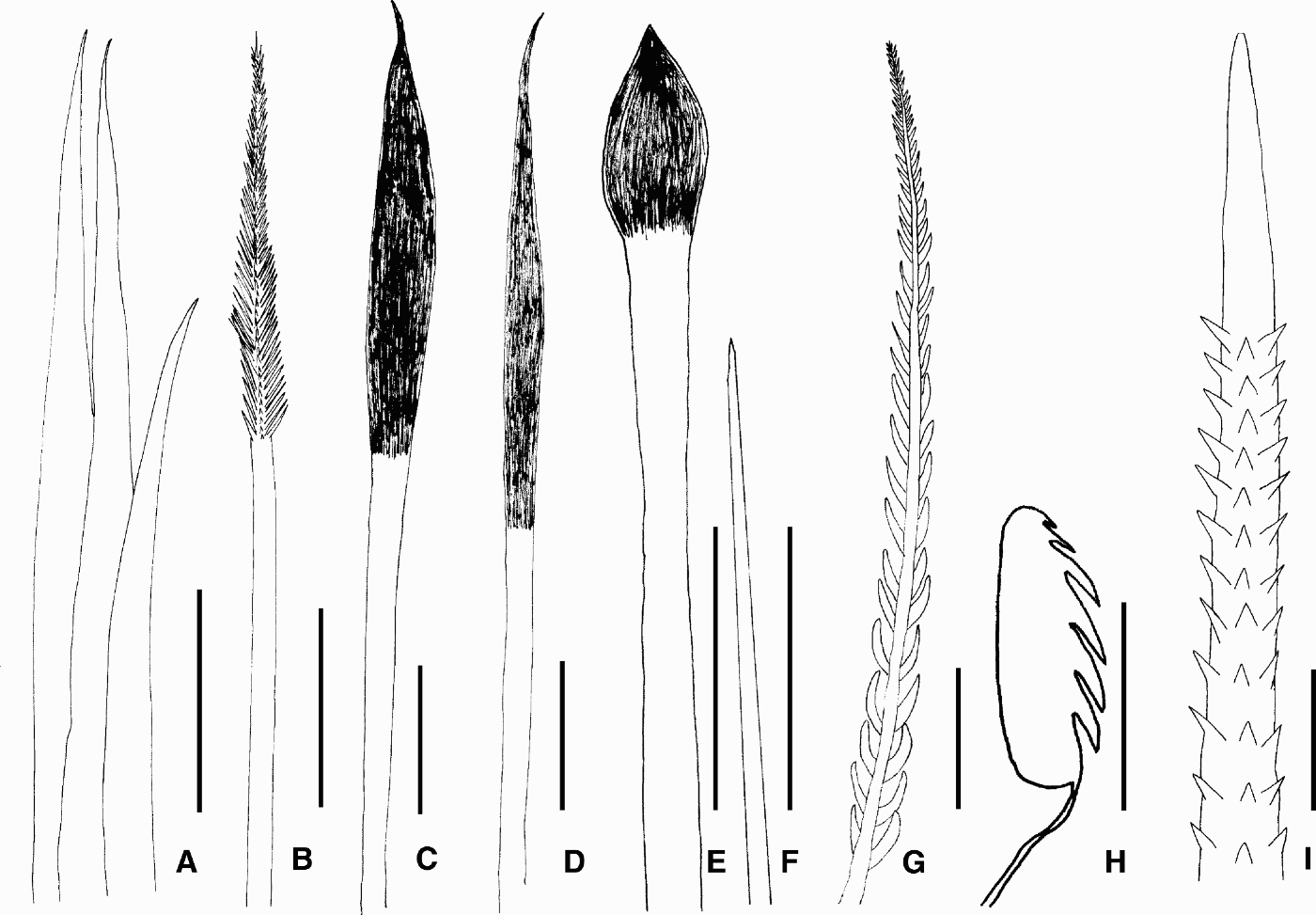
Sabellaria corallinea sp. nov. paratype CIPY-POLY 639. (A) Nuchal hooks, thoracic region; (B) thoracic chaeta. Parathoracic region (C–F); (C) small lanceolate chaeta from notopodium; (D) big lanceolate chaeta from notopodium; (E) lanceolate chaeta from neuropodium; (F) capillar chaeta from neuropodium. Abdominal region (G–I); (G) neurochaeta; (H) notochaeta; (I) ornamented hook. Scale bar: A, E, F = 100 µm, B, C, D, G = 39 µm, H, I = 19 µm.
MATERIAL EXAMINED
Type material: 7 specimens. Holotype 7°01′02″S 34°47′55W (Station B10) (CIPY-POLY 634). Paratypes: 7°01′02″S 34°47′55W (Station B10), 1 specimen (CIPY-POLY 635). 7°01′02″S 34°47′55W (Station B10), 1 specimen (CIPY-POLY 636). 7°01′02″S 34°47′55W (Station B10), 1 specimen (CIPY-POLY 637). 7°01′02″S 34°47′55W (Station B10), 1 specimen (CIPY-POLY 638). 7°01′02″S 34°47′55W (Station B10), 1 specimen (CIPY-POLY 639). 7°01′02″S 34°47′55W (Station B10), 1 specimen (CIPY-POLY 779).
SLIDES
Paratype CIPY-POLY 639. Opercule and entire body.
ETYMOLOGY
The species is named for the order Coralinalles in which the specimens were found.
DIAGNOSIS AND SUGGESTED AUTAPOMORPHY
The organization of opercular paleae with the outer paleae flattened, oblong, thecate blades; medial plume (or dominant tooth) denticulate, with teeth decreasing toward the tip; plume penicilate with three distal teeth on one side and four on the other, decreasing progressively in size toward outer margins; with medium paleae strongly geniculate, with elongate blades, slightly blunted, curved toward inner series of opercular crown; inner paleae alveolate in shape, strongly geniculate at the proximal upper surface of blades, with thecal bands weakly excavate, slanting upward from horizontal plane; and the ornamented hooks are exclusive of this species.
DESCRIPTION
Holotype: complete specimen with 17 chaetigers. The body measures 4.7 mm in length, and 1 mm in diameter in thorax region. Opercular stalk measures 0.2 mm, and the opercular crown 1 mm in diameter. Thoracic region measures 0.2 mm, the paratoracic region 0.3 mm in length. Abdominal region 3.9 mm, and the caudal region 1.5 mm in length. Anterior end of opercular stalk and crown with deep mid-ventral indentation and divided into symmetrical halves. Opercular paleae yellow-gold, with vitreous luster, positioned in three concentric rows that surround the prostomium and peristomium, differing in shape and length (Figure 7). There are 24–28 pairs of outer paleae on each side of the symmetrical halves (Figure 7), flattened, oblong, thecate blades. Medial plume (or dominant tooth) denticulate, with teeth decreasing toward the tip (Figure 8A). Plume penicilate with three distal teeth on one side and four on the other, decreasing progressively in size toward outer margins (Figure 8A, B). Blades bent slightly outward from longitudinal axis of shaft; inner surface of blade with many fine closely-spaced striations. Each striation consists of a series of small teeth (tiny extensions) (Figure 8A). Twelve pairs of middle paleae on each side of the symmetrical halves. Paleae strongly geniculate, with elongate blades, slightly blunted, curved toward inner series of opercular crown and with series of tiny extensions. Distal ends almost erect, tapering to distal tip with weak excavation on inner face of thecal bands (Figure 8C). Twelve pairs of inner paleae on each side of the symmetrical halves. Paleae alveolate in shape, strongly geniculate at the proximal upper surface of blades, with thecal bands weakly excavate, slanting upward from horizontal plane. Blade thicker and wider toward base, terminating distally in pointed tip, with tiny extensions (Figure 8D; Table 2). Opercular pedunculum with three pairs of dorsal (nuchal) spines on each side of the mid-line (Figure 9A). Anterior margin of pedunculum with series of flattened, big, spaced palps, attached to prostomium (Figure 7). Peduncle bases with a series of six longitudinal rows of compound feeding tentacles (12–15 in transverse rows). Ventral and dorsal margins of buccal cavity attached to peristomium. Prostomium fused with peristomium and limited to a region situated in front of the mouth, bearing a pair of grooved prehensile tentacles, and medium digitiform cirrus. Peristomium lips beginning in front of the mouth and ending at the base of the compound feeding tentacles. Thoracic region consists of a ‘U’-shaped building organ, and two segments with spiralled capillary chaetae. Thoracic segments with neuropodium, without notopodium, and conical palps located on each side of opercular pedunculum (Figure 9B). Cirri of first thoracic segment triangular, bent toward ventral side of body, quite similar to buccal cirri. Cirri of second thoracic segment triangular, elongated, bent toward dorsal side of body, on each side of the mid-ventral indentation of operculum (Figure 7). Parathoracic region with 3 segments and small biramous parapodia, with notopodium and neuropodium (Figure 7). Three pairs of ornamented hooks (Figure 9I) occurring along the body: the first in parathoracic region, the second in first abdominal segment and the third in sixth to seventh abdominal segments of the abdominal regions. Notopodium with shaves of large chaetae with lanceolate tips ‘oar-shaped’ (Figure 9C) and the thin large lanceolate chaetae with slightly curved tips positioned between the chaetae with large lanceolate tips (Figure 9D). Neuropodium with shaves of large chaetae with lanceolate tips, oar-shaped' (Figure 9E) and thin capillaries positioned between large chaetae with lanceolate tips (Figure 9F). Abdominal region with 18–20 segments and tori in numerous segments. Dorsal digitiform branchiae present in five anterior abdominal segments, becoming reduced in size and disappearing at segment 15. Uncinigerous tori with chaetae disposed in a single row. Notopodial uncini bipectinate, with 6 rows of teeth superposed (Figure 9H). Neurochaetal conical cirri arising from base of bundle on first abdominal segment. Neuropodium with ornamented capillaries (Figure 9G). Cirri diminishing in size posteriorly and disappearing on posteriormost segments (Figure 7). Caudal region or pygidium septate, composed of diverse fusioned achaetous segments. Cauda reflected on ventrum, with anus and more or less 10 papillae. Brownish to reddish red-brown eyespots on each expansion of the compound feeding tentacle filaments (or branchial filaments). These eyespots occur on all three parathoracic segments in great numbers. They are highly concentrated on first parathoracic segment, decreasing gradually in number and concentration in the direction of the first abdominal segment. A band of brownish eyespots were also observed on the ventral region of the third parathoracic segment (Figure 7). Black eyespots on the opercular pedunculum, on the inner face of serial conic palps, extended to mid-ventral indentation. These eyespots also occur on the prostomium, on the median cirrus, from the base to the upper edge, and on the peristomium, between the compound feeding tentacles, in the thoracic region (Figure 7). A few black eyespots are found on the paired cirri of the abdominal segments and in the lateral margin of the caudal region (Figure 7). Red eyespots are present on the ten last paired cirri of the abdominal segments (Figure 7).
VARIATIONS
The paratypes vary from 4.7 to 7 mm in length. There are no conspicuous variations except for one specimen that appears not to present the accessory hook (CIPY-POLY636) and the number of eyespots, but the position is the same in all specimens.
REMARKS
Worldwide 34 species of Sabellaria are known (Kirtley, Reference Kirtley1994; Nishi & Kirtley, Reference Nishi and Kirtley1999; Nishi & Kato, Reference Nishi and Kato2002; Nishi et al., Reference Nishi, Kato and Hayashi2004), but only 18 have denticulate outer paleae (Tables 1 & 2). Of these species, only 3 have three kinds of paleae (Table 2) and none of these have a penicilate plume, series of middle paleae with 12 pairs on each side of the symmetrical halves, medium paleae strongly geniculate, with elongate blades slightly blunted, curved toward inner series of opercular crown and series of tiny extensions. Distal ends of these extensions almost erect, tapering to distal tip. Weak excavation on inner face of thecal bands.
One of the autapomorphy of S. corallinea sp. nov. is the presence of paired ornamented hooks (Figure 9I). This kind of hook was not reported before in other adult sabellariid species. Three pairs were found in these specimens, but the number of pairs could be higher than examined. These chaetae were previously only known from the prototroch of sabellariid larvae (Eckelbarger, Reference Eckelbarger1975, Reference Eckelbarger1976). We have described these structures in the parathoracic and abdominal region for the first time. The presence of these chaetae apparently cannot be explained by progenesis.
BIOLOGICAL NOTE
This species was found in rhodolith beds at 10 and 15 m depth.
TYPE LOCALITY
Shallow subtidal zone of João Pessoa, Paraíba, Brazil (7°01′02″S 34°475′5W).
GEOGRAPHICAL RANGE
Coast of João Pessoa, Paraíba, Brazil.
DISCUSSION
The marine biodiversity from the western South Atlantic is still poorly known. Research is concentrated mainly in the south and south-east regions (Amaral & Jablonski, Reference Amaral and Jablonski2005). Data from the subtidal zone are scarce, with lack of information on the distribution and environments in which the species occurs. According to Amaral et al. (Reference Amaral, Nallin and Steiner2006), eight species of Sabellariidae were identified along the Brazilian coast. Five were identified and recorded for the first time in rhodolith beds, in addition to Sabellaria corallinea sp. nov. Worldwide, sabellariids are known to build tubes made of sandy and mucous secretions, attached to various kinds of substrata, such as rocks (Hutchings, Reference Hutchings, Beesley, Ross and Glasby2000), mollusc shells and seagrasses (Uebelacker, Reference Uebelacker, Uebelacker and Johnson1984). More recently, new associations have been reported with bryozoans (Morgado & Tanaka, Reference Morgado and Tanaka2001), fleshy seaweeds (Fraschetti et al., Reference Fraschetti, Giangrande, Terlizzi, Miglietta, DellaTommasa and Boero2002), turtle carapaces (Frick et al., Reference Frick, Williams, Markesteyn, Pfaller and Frick2004) and even cnidarians (Pérez et al., Reference Pérez, Vila-Nova and Santos2005). The occurrence of Sabellariidae in rhodolith beds is reported for the first time, adding some information on their biology. Therefore, detailed studies about association were not provided during collections and we can only report the presence of species in this area. In Brazil, rhodolith beds are assumed to occur along the entire continental shelf (Foster, Reference Foster2001) and more than 100,000 metric tons of rhodoliths per year are exploited (Riul et al., Reference Riul, Targino, Farias, Visscher and Horta2008). The description of a new species of an ecologically relevant taxon such as Polychaeta, and the occurrence of more than half of the species of Sabellariidae known from Brazil in rhodolith beds, reinforces the need for more studies in this environment, that may help to establish more adequate conservation and management policies for the subtidal zone, specifically for an ecosystem recognized worldwide as a significant source for the maintenance of marine biodiversity.
ACKNOWLEDGEMENTS
We are grateful to Paulo Antunes Horta, Robson Guimarães dos Santos, Carlos Henrique Targino, and Rui Osório for helping with the sampling. The authors also thank Danny Eibye-Jacobsen, from ZMC, and Paulo da Cunha Lana, from MCEM-BPO, for the loan of the type series of Phragmatopoma caudata and Sabellaria wilsoni, respectively. We acknowledge Leslie Harris and Kirk Fitzhugh, from LACM–AHF, for their help with selecting the cotype and determining the lectotype and paralectotype of Sabellaria floridensis, during the work at the Natural History Museum. Programa de Pós Graduação em Ciências Biológicas, Coordenação de Aperfeiçoamento de Pesquisa do Ensino Superior and Conselho Nacional de Pesquisa are acknowledged for financial support.