Introduction
In subtropical and tropical countries, paramphistomosis in cattle causes high economic losses, sometimes associated with high mortality in young stock (Kilani et al., Reference Kilani, Guillot, Polack, Chermette, Lefèvre, Blancou and Chermette2003). In Europe, this parasitosis has generally been considered as harmless for a long time, even though some clinical cases causing a drop in production were reported by Dorchies et al. (Reference Dorchies, Lacroux, Navetat, Rizet, Guéneau, Bisson and Ferté2002), Foster et al. (Reference Foster, Otter, O'Sullivan, Cranwell, Twomey, Millar and Taylor2008) and Murphy et al. (Reference Murphy, Power, Sanchez-Miguel, Casey, Toolan and Fagan2008). Several species of Paramphistomum may cause this disease in ruminants, and their distribution and impact of pathogenesis vary from one agro-climatic zone to another (Kilani et al., Reference Kilani, Guillot, Polack, Chermette, Lefèvre, Blancou and Chermette2003) and with the season (Rolfe et al., Reference Rolfe, Boray, Nichols and Collins1991). The overall prevalence of this disease in several European countries was fairly high, with greater than 18% in France (Szmidt-Adjidé et al., Reference Szmidt-Adjidé, Abrous, Adjidé, Dreyfuss, Lecompte, Cabaret and Rondelaud2000; Loock, Reference Loock2003; Rieu, Reference Rieu2004), Italy (Stancampiano et al., Reference Stancampiano, Corradini, Bulgarelli, Micagni and Battelli2007) and Spain (Díaz et al., Reference Díaz, Pedreira, Sánchez-Andrade, Suárez, Arias, Francisco, Fernandez, Díez-Baños, Morrondo and Paz-Silva2007a). Lower values were also reported in several Mediterranean countries such as Egypt (7.3%, Haridy et al., Reference Haridy, El-Sherbiny and Morsy2006) and Turkey (13.6%, Sevimli et al., Reference Sevimli, Köse, Kozan and Dogan2005). However, these values only came from surveys carried out in abattoirs or from coproscopical analyses made during a limited period of time. When prevalence was studied during several successive years, Mage et al. (Reference Mage, Bourgne, Toullieu, Rondelaud and Dreyfuss2002) noted a progressive increase in infection rate over time (from 5.2 to 44.7% between 1990 and 1999) in central France. The same finding was also reported in Argentina with a numerical increase of cases in ruminants over the past decade with disease spreading to new geographical areas (Sanabria & Romero, Reference Sanabria and Romero2008).
In Algeria, little information on this parasitosis in ruminants is available. The presence of Paramphistomum daubneyi was reported in the north-west of the country (Pačenovský et al., Reference Pačenovský, Záhor and Krupicer1987). According to these authors, prevalence was 3.9% in cattle, while up to 2204 adult specimens were recovered from a single bovine. Reference KechemirKechemir (1988a, Reference Kechemirb) also reported the presence of Paramphistomum microbothrium larval forms in Bulinus truncatus. Although these reports demonstrated the presence of paramphistomosis in Algeria, there is relatively a lack of information on this parasitosis in the other districts of the country. As numerous cases of diarrhoea and important weight losses have been noted over the past 10 years in several cattle-breeding farms of north-eastern Algeria (Titi, Reference Titi2008), this posed the question of whether these clinical symptoms would not be due to the presence of paramphistomes in these animals. Parasitological investigations were thus carried out in three slaughterhouses to verify whether this parasitosis occurs in north-eastern Algeria and, if so, to determine the prevalence and intensity of infection. These studies were carried out over a 14-month period to identify animals infected with Paramphistomum spp. among slaughtered cattle and to enumerate adult parasites in their rumens.
Materials and methods
Slaughterhouses studied
Sample collection took place in 2006–2007 over a 14-month period in the following slaughterhouses: El Khroub, province of Constantine (September–December 2006); Jijel (January–June 2007); and Ferdjioua, province of Mila (July–October 2007). The length of these periods of study was chosen according to the number of cattle slaughtered in each abattoir, at least for Ferdjioua and Jijel. The provinces of Constantine and Mila are located in the mountainous Tellien Atlas (700–900 m high), with a subsoil mainly composed of limestone. The climate is semiarid with a mean annual rainfall of 350 mm for a mean temperature varying from 4.6 to 26.9°C monthly. In contrast, the province of Jijel is part of the coastal band and its altitude is often less than 300 m. Its subsoil is mainly siliceous and its climate is more humid (mean annual rainfall of 750–900 mm, mean temperature varying from 9.5 to 26.6°C monthly).
Animals
All cattle slaughtered (local breed, Guelmoise or Brown Atlas) originated from farms located within a 50-km radius around every slaughterhouse. Owing to the mildness of the climate, these animals were reared in extensive conditions throughout the year without any restriction, and this breeding was of family type (a few cattle per farm). They fed mainly on alfalfa, oats and hay. Benzimidazole-type anthelmintics against intestinal and lung strongyles were mainly administered twice in a year to cattle. In contrast, paramphistomosis was not treated until the present study.
Protocol of investigations
A total of 2033 rumens were emptied and washed. Adult parasites recovered from the mucosa were placed in a polyethylene bag containing a saline solution (NaCl, 0.9%; glucose, 0.45%). The age and sex of each animal were determined by the veterinarian and were mentioned on each bag. The parasites were transported to the laboratory, at a temperature of 37 ± 2°C for 15–25 min (El Khroub and Ferdjioua) or 1 h (Jijel). They were immediately counted by two persons; this took 10–45 min.
As the main objectives of this study were only to detect the presence or the absence of paramphistomes in local cattle and to identify parasite species, the small intestine was not examined and no faecal sample was collected from slaughtered animals to enumerate parasite eggs.
Thirty adult paramphistomes were collected from the rumen of 30 cattle (one per ruminant) in the three slaughterhouses, to determine whether a single or several species of paramphistomes were present in north-eastern Algeria. After washing in distilled water, they were placed in Bouin's fixative for at least 2 days. Serial 5-μm-thick sections were cut and stained using Harris' haematoxylin-modified Gabe's trichrome. Species identification was made using the keys by Sey (Reference Sey1974, Reference Sey1980) and Rieu (Reference Rieu2004).
Data analysis
The prevalence of infection was calculated using the ratio: number of infected animals/number of investigated cattle, and was expressed taking into account the slaughterhouse and the month of investigation. A χ2-test (Stat-Itcf, 1988) was used to determine the influence of age (less than 2 years, 2–5 years and more than 5 years) and sex of cattle on the prevalence of these infections and to establish levels of significance.
The other parameter was the intensity of infection. For this, individual burdens of adult paramphistomes were classified in five categories according to the scale used by Szmidt-Adjidé et al. (Reference Szmidt-Adjidé, Abrous, Adjidé, Dreyfuss, Lecompte, Cabaret and Rondelaud2000): fewer than 50 adults per ruminant (slight infections); from 51 to 100 paramphistomes; from 101 to 150 adults; from 151 to 200 parasites; and more than 200 adults per cattle (heavy infections). These intensities were also expressed for each slaughterhouse and each month of investigation, and were compared using a one- or two-way analysis of variance (Stat-Itcf, 1988).
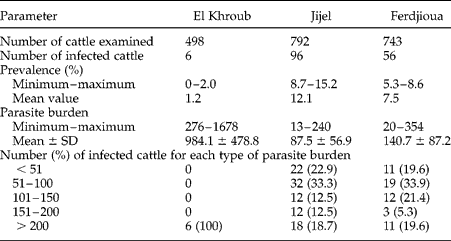
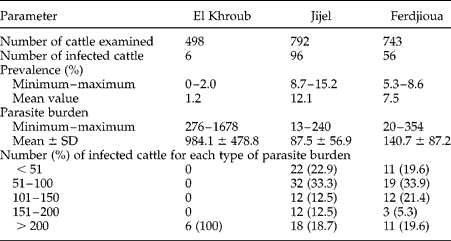
As the number of infected cattle found at El Khroub was low (only six, see table 1), the influence of age and sex of ruminants on the prevalence and intensity of natural infections was only studied for animals from Jijel and Ferdjioua.
Prevalence (%) and intensity of Paramphistomum daubneyi infection in cattle from north-eastern Algeria.
Results
All paramphistomes examined using histology belonged to P. daubneyi.
The overall prevalences (table 1) found in cattle slaughtered at El Khroub, Jijel and Ferdjioua were 1.2, 12.1 and 7.5%, respectively. The mean value noted at El Khroub was significantly lower (χ2 = 50.92, P < 0.001) than those found at Ferdjioua and Jijel. Cattle from El Khroub contained more paramphistomes than those from Jijel and Ferdjioua (a mean of 984.1 adults instead of 87.5 and 140.7, respectively), and this difference was highly significant (F = 167.36, P < 0.001). In the same way, the mean number of flukes recovered from cattle at Ferdjioua was significantly greater (F = 20.78, P < 0.001) than that found at Jijel.
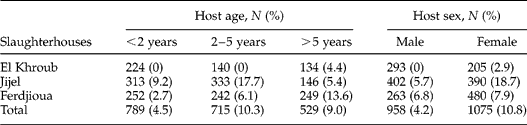
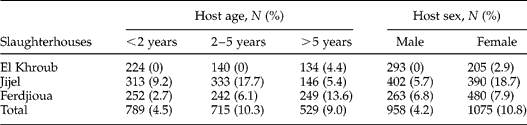
At Jijel, infected cattle (table 2) were significantly more numerous (χ2 = 23.29, P < 0.001) in the 2–5 year class than expected. In contrast, at Ferdjioua, ruminants older than 5 years were significantly more infected (χ2 = 19.08, P < 0.001) than animals in the other two categories. As a consequence, the age of cattle was not significantly associated with the prevalence of infection. Overall, females (table 2) were significantly more infected (χ2 = 13.36, P < 0.01) than males (a prevalence of 10.8% instead of 4.2%). A similar finding was noted in the case of Jijel (χ2 = 31.39, P < 0.001), while there was no significant difference in those from Ferdjioua. The age and sex of animals were independent of the worm burdens noted in slaughtered cattle, regardless of the slaughterhouse (data not shown).
Number of cattle examined (N) and prevalence (%) of Paramphistomum daubneyi infection in relation with age and sex of animals.
No significant difference between monthly values of prevalence in each slaughterhouse was noted. A similar finding was also found for monthly burdens of parasites.
Discussion
Comparison of prevalences found in the present study with values reported by other authors for natural infections of cattle with P. daubneyi is difficult because animal management practices, agro-climatic conditions and the occurrence of intermediate hosts may have an influence on infection rates in cattle. Under these conditions, the higher prevalence recorded at Jijel (12.1%) cannot be explained by management system as all animals slaughtered were reared in extensive conditions, with the same diets and the same anthelmintic treatments. To explain this discrepancy between the different slaughterhouses, the most valid hypothesis is to relate this 12.1% rate to the more temperate agro-climatic zone of Jijel, which would be more favourable to the development of intermediate host populations (Galba truncatula in this case). The mean altitude of the province of Jijel (less than 300 m) supported this interpretation, because the highest probability of infection of Spanish cattle with P. daubneyi occurred in lowland pastures (under 600 m) with a mean slope less than 13% (Díaz et al., Reference Díaz, Paz-Silva, Sánchez-Andrade, Suárez, Pedreira, Arias, Díez-Baños and Morrondo2007b). Two other points are the numerous populations of snails found in the province of Jijel by Mekroud (Reference Mekroud2004) and the prevalence of their infections with Fasciola hepatica, which was greater than that noted in the province of Constantine (Mekroud et al., Reference Mekroud, Benakhla, Vignoles, Rondelaud and Dreyfuss2004).
Even if there was a difference in the highest numbers of adult worms recovered in cattle, the range of paramphistomes counted in the rumen of north-eastern Algerian cattle (from 13 to 1678 adults, table 1) agreed with values reported by Pačenovský et al. (Reference Pačenovský, Záhor and Krupicer1987) in north-western Algeria (from 18 to 2204 per ruminant). However, this finding is difficult to compare with other reports because counts of adult paramphistomes in cattle are not very numerous in Europe. Among these infected ruminants, 56.2% at Jijel and 53.5% at Ferdjioua (table 1) contained less than 100 paramphistomes. This finding agreed with that (57.3%) reported by Rieu (Reference Rieu2004) in northern France, but was lower than that (72.3%) reported by Szmidt-Adjidé et al. (Reference Szmidt-Adjidé, Abrous, Adjidé, Dreyfuss, Lecompte, Cabaret and Rondelaud2000) in central France. In our opinion, this discordance may be due to different causes such as a primary infection of young stock by limited populations of paramphistomes, or the elimination of adult paramphistomes from the rumen of cattle after a treatment (Rieu, Reference Rieu2004).
The absence of a significant correlation between cattle age and P. daubneyi infection agreed with the reports by Szmidt-Adjidé et al. (Reference Szmidt-Adjidé, Abrous, Adjidé, Dreyfuss, Lecompte, Cabaret and Rondelaud2000) and Rieu (Reference Rieu2004). Overall, females examined in the three slaughterhouses were significantly more infected than males, and this also agreed with the reports by Kang & Kim (Reference Kang and Kim1988), Asanji (Reference Asanji1989), Szmidt-Adjidé et al. (Reference Szmidt-Adjidé, Abrous, Adjidé, Dreyfuss, Lecompte, Cabaret and Rondelaud2000) and Rieu (Reference Rieu2004). However, there was an insignificant correlation between prevalence and the sex of cattle in the case of Ferdjioua, and this finding is more difficult to interpret. In our opinion, the most valid explanation was to relate it to the particular recruitment of cattle in this abattoir, with more females and less males than in the other two slaughterhouses. However, as the present study was carried out in every slaughterhouse during a few months only, the existence of variations in prevalence with the season cannot be excluded.
The presence of P. daubneyi in cattle from north-eastern Algeria allows other studies to determine the seasonality of infection by counting eggs in faecal samples. However, this paramphistomid is not the only species, as P. microbothrium has also been reported in the south-western Algeria (Kechemir, Reference Kechemir1988a, b). As the intermediate host of this latter species (B. truncatus) has not been found in the three provinces investigated by our team (Mekroud et al., Reference Mekroud, Benakhla, Benlatreche, Rondelaud and Dreyfuss2002), the presence of P. microbothrium in any of 158 infected cattle (table 1) seems unlikely because of their local origin (they originated from farms located within a 50-km radius around each slaughterhouse). In spite of this fact, further studies using histology and/or cercarial chaetotaxy will still be necessary to determine whether other species of Paramphistomum occur in north-eastern Algeria.