Aquatic products have emerged as a crucial component of global food systems, serving as an essential source of high-quality animal protein and micronutrients for human nutrition and making considerable contributions to the security of the global food supply and human health(Reference Khieokhajonkhet, Suwannalers and Aeksiri1). In the quest for accelerated growth and high yields, global aquaculture intensification has developed rapidly, accompanied by the extensive utilisation of high-fat and high-protein feeds, frequent aquatic diseases and the overuse of antibiotics(Reference Wang, Meng and Hao2,Reference Wu, Wu and Yang3) . These practices have resulted in detrimental environmental impacts and compromised aquatic animal health, posing challenges not only to the sustainability of aquaculture systems but also triggering substantial economic losses and potential public health risks(Reference Yin, Zhuang and Liao4,Reference Limbu, Zhou and Sun5) . Therefore, enhancing the efficient utilisation of aquatic feeds and innovating efficient and safe antibiotic alternatives are imperative for the advancement of the aquaculture industry towards greener and healthier practices.
Accumulating evidence suggested that plant-derived bioactive extracts in diets have an obvious growth enhancement effect in aquatic animals(Reference Angela, Wang and Lyu6,Reference Prabu, Chandrasekar and Ambashankar7) . Shin et al. (2023)(Reference Shin, Yun and Gunathilaka8) found that feeding with piperine resulted in a significant reduction in feed conversion ratio (FCR) and a significant increase in protein efficiency ratio, suggesting that piperine could improve the growth of Litopenaeus vannamei (Boone, 1931). In addition, Fu et al. (2025)(Reference Fu, Chen and Yuan9) reported that dietary resveratrol significantly enhanced intestinal protease, lipase, amylase activities and the growth performance of L. vannamei. However, the comprehensive efficacy of the supplementation still needs to be improved. Osthole (OST) and tetramethylpyrazine (TMP), the bioactive extracts of traditional medicinal plants (Cnidium monnieri and Ligusticum sinense ‘Chuanxiong’), have the potential for improving growth. For instance, Zhang et al. (2007)(Reference Zhang, Xie and Zhu10) revealed that OST significantly enhanced the expression of lipid metabolism-related genes and reduced the serum lipid parameters in rats, while TMP increased the average daily gain of Cobb broilers, indicating that TMP can promote growth(Reference Mehmood, Zhang and Li11). However, the growth-stimulating properties of OST and OST-TMP compound and the underlying mechanisms have not been elucidated in aquatic animals.
Beyond their growth-stimulating roles, previous studies have pointed out that OST and TMP exhibited multiple health benefits, such as antimicrobial, anti-inflammatory, antioxidant and immune enhancement, widely applied in livestock and poultry animal farming(Reference Chiang, Lee and Fan12–Reference Xu, Liu and Hou15). With respect to the pharmacological mechanisms of physiological efficacy of herbal bioactive extract, the integrative application of network pharmacology, molecular docking and experimental verification has emerged as a prevalent strategy(Reference Oh, Gupta and Ganesan16–Reference Zhang, Gao and Zhou18). For instance, Gu et al. (2023)(Reference Gu, Wang and Zhan19) predicted the potential targets of artemisinin against intestinal immune disease from Hexagrammos otakii (Jordan and Starks 1895) based on network pharmacology and revealed the intestinal immune-regulatory mechanism combined with experimental validation. Notably, previous studies have reported that dietary bioactive substances in combination would achieve better effects than those of single substance alone(Reference Chowdhury, Sahu and Sardar20,Reference Wu, Gao and Li21) . However, to date, current knowledge regarding the health-promoting mechanisms of plant-derived bioactive ingredients in aquatic animals based on the novelty strategy of integrating network pharmacology, molecular docking and experimental verification is poorly understood, especially for compound herbal extracts.
Our study selected L. vannamei, the most significant penaeid shrimp cultured globally, as the research object, and used network pharmacology to predict the synergistic and complementary targets of OST and TMP in antioxidant capability and innate immune. Molecular docking was conducted to explore the interaction of OST and OST-TMP with the potential targets, respectively. Furthermore, combined with the experiment verification, we investigated the enhancement mechanisms of growth in shrimp, validating the mechanisms of antioxidant defence and immunoregulation. This work not only provided efficient antibiotic alternatives for aquatic animals but also introduced a novel strategy to study the underlying mechanism of compound herbal extracts in aquatic animals, offering a technical safeguard for the sustainable advancement of aquaculture and the safety of aquatic products.
Materials and methods
Experimental diet preparation
Diet composition and nutrition level in this experiment were shown in online Supplementary Table 1. OST (CAS: 484-12-8) was purchased from Aladdin, with purity ≥ 99 %, and TMP (CAS: 1124-11-4) was purchased from Sigma, with purity ≥ 98 %. Different levels of OST and TMP were formulated to obtain five trial feeds: CK (basal feeds, the control diet without supplementation), O1 (basal feeds supplemented with 10 mg/kg OST), O2 (basal feeds supplemented with 20 mg/kg OST), OT1 (basal feeds supplemented with 10 mg/kg OST and 100 mg/kg TMP) and OT2 (basal feeds supplemented with 20 mg/kg OST and 150 mg/kg TMP).
Shrimp feeding trial
From a shrimp farm situated in Laizhou of Shandong province, L. vannamei with an initial weight of 1·09 (sem 0·04) g were obtained and underwent a 14-d acclimatisation phase under the controlled conditions. Thereafter, a 42-d indoor feeding trial was conducted to evaluate the effects of dietary OST and TMP on growth performance, antioxidant capability and immune response of L. vannamei. Pre-weighed shrimp were randomly selected and evenly distributed into five groups (three tanks per group); in specific, a total of fifteen tanks were utilised, with seventy shrimp in every tank containing 90 l sand-filtered seawater. Five groups were treated manually with pre-weighed five trial feeds for three times a day (07.00, 13.00 and 21.00). The daily feeding rate ranged from 7 % at the beginning to 5 % at the end of the experiment and was adjusted according to shrimp’s average body weight and the actual feeding behaviour within 30 min. Shrimp were collectively weighed every 14 d to adjust feeding rates, with actual daily feed offered per tank documented. To remove the faeces, 1/3 to 1/2 volume of the water was replaced daily. Furthermore, water quality parameters were daily monitored to maintain a salinity of thirty-one, a temperature of 25–26 °C, a pH of 8·1, the un-ionised ammonia < 0·2 mg/l and the dissolved oxygen > 5 mg/l.
Sample collection
All shrimp were fasted for one day before sample collection. After testing the growth performance, three shrimp were stored at –20℃ for analysing proximate composition. Afterwards, haemolymph of nine shrimp from each tank was withdrawn to test total haemocyte count (THC) and phagocytic activity (PR) of haemocyte. In addition, biochemical parameters and antimicrobial activity (AA) and bacteriolytic activity (BA) of plasma were tested, and haemocytes were employed to analyse the gene expression. Intestine and hepatopancreas were dissected for enzyme activity and gene expression assays. And hepatopancreas was also collected for histological observation. Furthermore, intestines were also used for subsequent gut microbiota analysis.
Proximate composition analysis
The proximate composition of whole shrimp was analysed by the standard method (AOAC 1995). Briefly, the whole shrimp were dried to constant weight in an oven at 105℃ to determine moisture content. Ash content was measured by combustion in a muffle furnace at 550 °C for 6 h to a constant weight. Crude protein content was determined with the Kjeldahl method (n × 6·25) by a Kjeldahl apparatus (Kjeltec™ 8400, FOSS, Denmark). Crude lipid content was obtained by diethyl ether extraction through the Soxhlet method (Soxtec™ 8000, FOSS, Denmark).
Growth performance analysis
To assess growth parameters, survival rate (SR), weight gain rate (WGR), specific growth rate (SGR) and FCR were calculated as follows:
 ${\rm{SR}}\left( \% \right) = {\rm{final \ shrimp \ counts / initial \ shrimp \ counts}} \times 100;$
 $\eqalign{ {\rm{WGR}}\left( \% \right)& = \left( {{\rm{final}}\;{\rm{shrimp}}\;{\rm{weight}} - {\rm{initial}}\;{\rm{shrimp}}\;{\rm{weight}}} \right) \cr& {\rm{/initial}}\;{\rm{shrimp}}\;{\rm{weight}} \times 100; \cr} $
 $\small{\eqalign{{\rm{SGR}}\left( {\% /{\rm{day}}} \right)& = \left[ {{\rm{ln}}\;\left( {{\rm{final}}\;{\rm{shrimp}}\;{\rm{weight}}} \right) - {\rm{ln}}\;\left( {{\rm{initial}}\;{\rm{shrimp\ weight}}} \right)} \right] \cr& {\rm{/daysof\ experimental \ trial}} \times 100; \cr}} $
 ${\rm{FCR}} = {\rm{dry \ diet \ fed/ }}\left( {{\rm{final \ shrimp \ weight}} - {\rm{ initial \ shrimp \ weight}}} \right){\rm{.}}$
Enzyme activities and plasma biochemical parameters evaluation
In accordance with Lu et al. (2024)(Reference Lu, Jing and Liu22), the assessment of protease activity, lipase activity and amylase activity was conducted using casein, olive oil and soluble which were served as the substrate, respectively. For protein content, bovine serum albumin was employed as the reference standard, following Bradford method(Reference Bradford23).
Hepatopancreatic antioxidant enzyme activities were tested employing the commercial assay kits (Nanjing Jiancheng Bioengineering Institute, Nanjing, China). Furthermore, reactive oxygen species level in the hepatopancreas was quantified using the reactive oxygen species assay kit purchased from Beyotime (Shanghai, China). All the data were normalised with protein concentration.
Total cholesterol (TC), triglyceride (TG), HDL-C, LDL-C, aspartate aminotransferase (AST) and alanine aminotransferase (ALT) of plasma were measured using commercial kits purchased from Nanjing Jiancheng Bioengineering Institute.
Histological observation of hepatopancreas
For histological observation, hepatopancreas samples from five shrimp per experimental group were fixed in 4 % paraformaldehyde solution. Subsequently, the fixed samples underwent an ethanol dehydration process through gradient series (70–95 %), and the dehydrated samples were then transparently treated with xylene and embedded in paraffin. The hepatopancreas sections (5 μm) obtained from microtome were dyed with haematoxylin and eosin (H& E), and then observed at Nikon Eclipse Ci-L microscope.
Immune indices evaluation
200 μl of haemolymph was centrifugated at 700 g for 10 min, and then, the haemocytes were resuspended in 1 ml PBS. 10 μl of haemocyte suspension and 10 % formaldehyde were incubated for 30 min to determine total haemocyte count (THC). In terms of the assessment of PR of haemocyte, 100 μl of haemocyte suspension and equal volume of pre-prepared 1 × 10⁷ cfu ml–1 bacterial suspension (O.D.570nm = 0·7) were incubated at 25 ℃ for 30 min. And the mixture was stained for 15 min with 600 μl Gimsa. The number of phagocytising cells was counted from 200 cells under a light microscope (Olympus, Japan) after washing off the stain with clean water and air drying.
According to Hultmark et al. (1980)(Reference Hultmark, Steiner and Rasmuson24), Vibrio parahaemolyticus and Micrococcus lysodeikticus were individually prepared with phosphate buffer into two bacterial suspensions (O.D.570 nm = 0·3–0·5) to determine AA and BA in plasma. To be specific, 250 μl of bacterial suspension and 50 μl of plasma sample were mixed into 96-well plate, and the plate was put into microplate reader. The mixture was measured at 570 nm and recorded as A0. Then, the plate was incubated in the microplate at 25 °C for 30 min and the terminal optical density of the action measured at 570 nm again, which was defined as A. PR, AA and BA were calculated as follows:
 ${\rm{PR}}\left( \% \right) = \left( {{\rm{number \ of phagocytic \ hemocytes/200}}\,{\rm{hemocytes}}} \right)\\\times 100{\rm{ }}\% ;$
 ${\rm{AA}} = {\left[ {\left( {{\rm{A}}0 - {\rm{A}}} \right)/{\rm{A}}} \right]^{1/2}};$
 ${\rm{BA}} = \left( {{\rm{A}}0 - {\rm{A}}} \right)/{\rm{A}}.$
Gene expression level assays
Total RNA was extracted from haemocyte, intestine and hepatopancreas, and then cDNA was synthesised for qRT-PCR by the EvoM-MLV Reverse Transcription Premix Kit (Accurate Biotechnology Co., Ltd., China). Gene expression quantification was performed using the relative Ct method with β-actin and EF1α used as two reference genes. Primer sequences for qRT-PCR are available in online Supplementary Table 2.
Network pharmacology predictive analysis
PharmMapper (http://www.lilab-ecust.cn/pharmmapper/), Swiss Target Prediction (http://swisstargetprediction.ch/), TCMSP (https://tcmsp-e.com/tcmsp.php) and SuperPred (http://prediction.charite.de/) were used to predict the potential targets of OST, and the targets of TMP were obtained according to our previous studies. Innate immunity-related targets were retrieved from GeneCards database (https://www.genecards.org/). After Venn analysis, the potential targets were analysed by the STRING database (https://string-db.org/), setting the species as ‘Home spaiens’ and the ‘medium confidence’ as 0·4 to construct the protein–protein interaction network. Subsequently, key nodes and relevant parameters were acquired by Cytoscape 3.10.0 software. Then, targets from the STRING database were imported into the DAVID database (https://davidbioinformatics.nih.gov/) for GO and KEGG pathway analysis. Gene homology and conservation comparisons of these targets were performed using BLSAT and Clustal Omega and were also sent to UniProt (https://www.uniprot.org/) database for normalisation.
Molecular docking
Three-dimensional structures and related information of the protein targets of L. vannamei were obtained from UniProt, RCSB Protein Data Bank (https://www.rcsb.org/) and AlphaFold (https://alphafoldserver.com/), and the ligand information of OST and TMP was obtained from PubChem. Molecular docking was carried out using Auto Dock Vina (v1.1.2) and finally visualised using Pymol and Discovery Studio 2019.
Gut microbiota analysis
The gut microbiota samples were analysed with the assistance of Shanghai Meiji Biomedical Technology Co. Ltd (Shanghai, China). Based on operational taxonomic units (OTU) representative sequences and abundance information, kinds of analyses were performed. The raw data of 16S RNA were uploaded at NCBI, and the SRA database login number was PRJNA1215979.
Challenge tests
According to the results of the pre-test, at the end of the 42-d feeding trial, forty shrimp were randomly selected from CK, O1 and O2 groups and transferred to three new 90 l tanks separately, undergoing 7-d challenge test with V. parahaemolyticus. Meanwhile, sixty shrimp were selected from CK, OT1 and OT2 groups and transferred to another three new tanks for a 72-hour white spot syndrome virus (WSSV) challenge test. V. parahaemolyticus and WSSV were provided by the Department of Aquaculture, Fisheries College, Ocean University of China. According to Hou, et al. (2022)(Reference Hou, Song and Yuan25), 1 × 10⁵ CFU μl−1 of V. parahaemolyticus suspension or 1 × 10⁵ copies μl−1 of purified WSSV virus was injected intramuscularly into shrimp with a sterile syringe. The daily management and culture conditions of shrimp during the challenge test were the same as those in the feeding test. Mortality of shrimp was monitored and recorded daily, and Kaplan–Meier curves (log-rank χ2 test) were plotted to analyse the differences in survival levels.
Statistical analysis
Statistical analysis was performed using SPSS software (25·0). Experimental data are expressed as the mean (sem). Intergroup comparisons were conducted through one-way ANOVA with Duncan’s post hoc test for multiple comparisons. Statistical significance was determined at P < 0·05, with different letters denoting significant differences among groups.
Results
Growth performance and whole-body composition
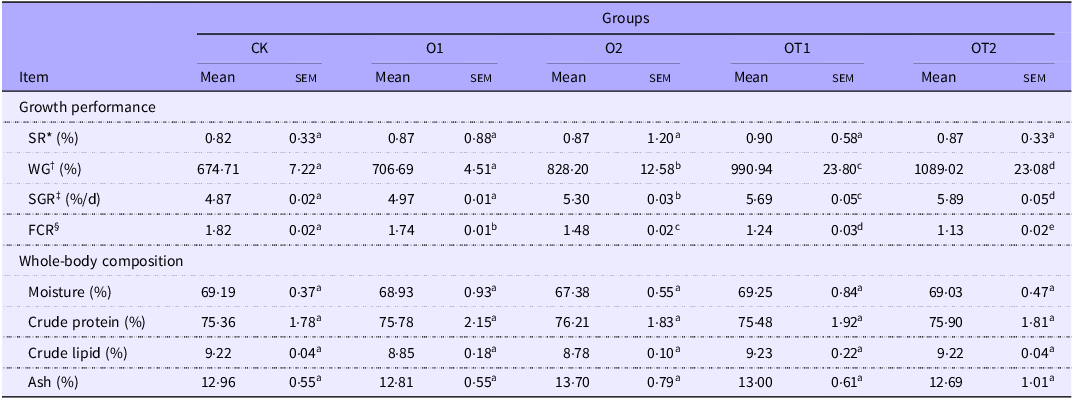
The growth performance and whole-body composition of L. vannamei are shown in Table 1. Compared with CK group, weight gain and SGR were significantly increased in all treatment groups except O1 group (P < 0·05), and the results exhibited significantly higher effects in the compound groups compared with the OST groups (P < 0·05). Furthermore, FCR was significantly improved in all treatment groups and lower in the compound groups. However, no significant effect of body composition of shrimp was observed (P > 0·05).
Impact of dietary supplementation with OST and OST-TMP on the growth performance and whole-body composition of L. vannamei

Table 1 Long description
The table presents data on the growth performance and whole-body composition of L. vannamei across five different dietary groups: CK, O1, O2, OT1, and OT2. It consists of 12 rows and 10 columns, including headers and subheadings. The columns are labeled with the group names and their respective mean and SEM values. The rows are categorized under Growth performance and Whole-body composition. Growth performance includes SR (percent), WG (percent), SGR (percent per day), and FCR. Whole-body composition includes Moisture (percent), Crude protein (percent), Crude lipid (percent), and Ash (percent). Each row provides the mean and standard error of the mean (SEM) for each group. Notable trends include variations in weight gain, specific growth rate, and feed conversion ratio across the different dietary groups, with significant improvements observed in the compound groups compared to the OST groups.
*SR (Survival rate %) = (Final shrimp counts / Initial shrimp counts) × 100; †WG (Weight gain %) = [(Final shrimp weight – Initial shrimp weight) / Initial shrimp weight] × 100; ‡SGR (Specific growth rate %/d) = [(In (Final shrimp weight) – In (Initial shrimp weight) / Experimental days] × 100; §FCR (Feed conversion rate) = Dry feed weight / Shrimp weight gain.
OST, osthole; OST-TMP, osthole-tetramethylpyrazine.
Different letters meant there was significant difference among groups (P < 0·05).
Digestive and absorptive function and lipid parameters in plasma
With respect to plasma lipid parameters, TC level was notably lower in O2 group and the compound groups, and HDL-C content exhibited a significant increase in the compound groups (P < 0·05), while the concentration of TG and LDL-C did not show a statistical significance among these groups (P < 0·05, Figure 1(a)). Hepatopancreatic protease activity of shrimp was significantly enhanced in experimental groups (P < 0·05), whereas amylase was significantly improved only in O2 and compound groups (P < 0·05). Moreover, a significantly higher lipase activity in hepatopancreas was observed in OT1 group (P < 0·05, Figure 1(b)). As shown in Figure 1(c), the expression of amino acid transporters (Solute carrier family 15 member 1, SLC15A1 and Solute carrier family 3 member 2, SLC3A2) displayed a significant up-regulation among all experimental groups, except O1 group (P < 0·05). And SLC15A1 expression in the compound groups was notably higher than the OST groups (P < 0·05). However, the expression levels of fatty acid transporters (microsomal triglyceride transfer protein, MTTP and fatty acid binding protein 1, FABP1) and sodium-glucose cotransporter 1 associated with glucose transport did not show significant changes compared with CK group (P > 0·05).
Impact of dietary supplementation with OST and OST-TMP on the digestive and absorptive performance of L. vannamei. (a) Lipid parameters in plasma; (b) activities of digestive enzymes in hepatopancreas; (c) gene expression levels related to absorptive function in intestine.

Network pharmacology and molecular docking analysis
Figure 2 displayed the complete design of this study on defining the effect of dietary OST and TMP in shrimp via network pharmacology-molecular docking-physiological health assessment. Venn diagram illustrated the gene target distribution among OST, TMP and innate immunity, displaying eight overlapping gene targets (synergistic targets) and thirty-two complementary targets (sixteen from OST-innate immune and sixteen from TMP-innate immune) (Figure 3(a)). Subsequently, forty intersection targets mentioned above were regarded as potential targets and used to create the protein–protein interaction network, which showed that Nrf2 and NF-κB were the top-ranked two synergistic targets, and mitogen-activated protein kinase 8 (MAPK8) and janus kinase 2 (JAK2) were the top-ranked two complementary targets of OST (Figure 3(b)). GO enrichment analysis revealed that the identified critical targets were predominantly related to inflammatory response, response to lipopolysaccharide, cytokine-mediated signalling pathway and immune response signalling pathway (Figure 3(c)). And KEGG enrichment analysis revealed that these targets might be related to C-type lectin receptor signalling pathway and Toll-like receptor signalling pathway (Figure 3(d)).
Workflow from network pharmacology analysis, molecular docking to experimental verification.

Network pharmacology analysis of OST and TMP on immunomodulation. (a) Venn diagrams of OST, TMP and innate immunity targets; (b) protein–protein interaction (PPI) network of OST, TMP and innate immunity targets; (c) GO functional enrichment analysis; (d) KEGG signalling pathway enrichment analysis.

Next, molecular docking was performed to assess the binding affinity of Nrf2, NF-κB (represented by Dorsal and Relish in shrimp), MAPK8 (represented by JNK in shrimp) and JAK2 (represented by JAK in shrimp). According to our previous studies, TMP could regulate innate immune in shrimp via vascular endothelial growth factor (VEGFA) and hypoxia inducible factor-1α (HIF-1α) targets; therefore, we also tested the binding energy of OST-TMP to these two targets, respectively. Our results indicated OST-TMP had more negative scores than OST or TMP alone, to be specific, the binding energies of OST-TMP with Nrf2, Dorsal and Relish were –10·9 kcal/mol–1, –8·8 kcal mol–1 and –9·6 kcal mol–1 (Figure 4). Furthermore, the visualisation results of OST with JNK (–7·3 kcal mol–1) and JAK (–7·2 kcal mol–1) were shown in online Supplementary Figure 1.
The docking pattern of OST, TMP and key targets of innate immune. (a) Binding affinities of molecular docking between OST, TMP and the key innate immune targets (I: Complementary targets of TMP; II: Complementary targets of OST; II: Synergistic targets of OST and TMP); (b) molecular docking diagram of OST-TMP and Nrf2; (c) molecular docking diagram of OST-TMP and Dorsal; (d) molecular docking diagram of OST-TMP and Relish.

Antioxidant capability and hepatopancreas status
Compared with CK group, Keap1 gene expression was significantly lower, while the expression level of total antioxidant capacity, superoxide dismutase, catalase and glutathione peroxidase was significantly higher in all experimental groups (P < 0·05, Figure 5(a)). In addition, the levels of AST and ALT in plasma exhibited significant reductions in O2 and the compound groups (P < 0·05, Figure 5(b)). Histological observation also showed that OST and OST-TMP did not cause any damage to the hepatopancreas of L. vannamei (Figure 5(c)).
Impact of dietary OST and OST-TMP on the hepatopancreas status of L. vannamei. (a) ROS content in hepatopancreas; (b) key enzyme activities and gene expression levels of antioxidant capability in hepatopancreas (I: Keap1-Nrf2 pathway; II: T-AOC activity; III – a: Generation of hydrogen peroxide; b: Metabolism of hydrogen peroxide; c: Glutathione system; d: Thioredoxin system); (c) plasma AST and ALT level; (d) histological observation of hepatopancreas (letters indicate: B: B-cells; E: embryonic cells; L: star shape of lumen; R: R-cells). Enzyme activities and gene expression levels have been normalised by z-score method.

Immune indices and disease resistance against pathogens
When analysing the effects of OST and OST-TMP on immune responses in haemocytes of L. vannamei, VEGFA demonstrated a significant down-regulation, whereas JAK and STAT exhibited marked up-regulation in OT2 group (P < 0·05). Besides, JNK pathway was significantly down-regulated while NF-κB pathway was significantly up-regulated in the compound groups (P < 0·05). And the expression of anti-lipopolysaccharide factor (ALF) and lysozyme (LYZ) and indicators related to haemocyte immune (THC, PR and AA) were significantly elevated in the compound groups (P < 0·05, Figure 6(a)). In terms of immune responses in intestines, Figure 6(b) revealed that JAK was markedly up-regulated, whereas JNK and activator protein-1 (AP1) were significantly reduced across all experimental groups (P < 0·05). Besides, with the exception of O1 group, Dorsal and Relish exhibited a notable increase (P < 0·05). mucin 19 (Muc19) was significantly elevated in all groups, while zonula occludens 1 (ZO1) was notably increased exclusively in the compound groups (P < 0·05). In addition, the expression of ALF was significantly enhanced in O1 and the compound groups, while Pen3 and LYZ were significantly increased only in the compound groups (P < 0·05). Inflammatory factors (tumor necrosis factor-α, TNF-1α and interleukin-16, IL-16) demonstrated a significant reduction in both haemocyte and intestine in all experimental groups (P < 0·05). As shown in Figure 6(c), the experimental groups showed significantly higher survival rate than CK group, during the challenge test against V. parahaemolyticus and WSSV, respectively (P < 0·05).
Impact of dietary OST and OST-TMP on the immune indices of L. vannamei. (a) Haemocyte (I – a: JAK-STAT pathway; b: JNK-AP1 pathway; c: HIF-1α pathway; d: VEGFA pathway; e: NF-κB pathway; II: Key genes involved in phagocytosis and exocytosis; III: Immune defense level; Inflammation level; IV: Haemocyte parameters); (b) Intestine (I – a: JAK-STAT pathway; b: JNK-AP1 pathway; c: HIF-1αpathway; d: NF-κB pathway; II: Physical barrier-related genes; III: Chemical barrier-related genes; III – a: Antimicrobial peptide genes; b: Lysozyme gene; c: Inflammation genes); (c) Immune protection rate against V. parahaemolyticus; (d) Immune protection rate against WSSV. Data in heatmap have been normalised using z-score method.

Gut microbiota composition and correlation analysis
Venn diagram showed that only 227 OTU in common among the five groups (Figure 7(a)) and NMDS analysis showed that the experimental groups were far away from CK group, illustrating that the similarity of the gut microbiota composition structure was low (Figure 7(b)). By analysing the species composition of shrimp gut microbiota at the phylum level, it was found that the dominant phyla in shrimp gut microbiota (from high to low relative abundance) were Proteobacteria, Patescibacteria, Bacteroidota and Verrucomicrobia, etc. (Figure 7(c)). The correlation heatmaps based on the Spearman’s rank correlation coefficient showed that norank _f_Rhodobacteraceae were significantly negatively correlated with ZO1 and crustin in intestine of L. vannamei after feeding OST (P < 0·05 Figure 7(d)). Furthermore, after feeding OST-TMP, Haloferula demonstrated significant positive associations with ZO1 and Crustin, while exhibiting a marked negative correlation with IL-16 (P < 0·05, Figure 7(e)).
Impact of dietary OST and OST-TMP on the gut microbiota of L. vannamei. (a) Venn diagram; (b) NMDS analysis; (c) community composition analysis on phylum level; (d) correlation analysis between the relative abundance of the top 10 genera and key indicators of intestinal immunity after feeding OST; (e) correlation analysis between the relative abundance of the top 10 genera and key indicators of intestinal immunity after feeding OST-TMP.

Discussion
Enhancing efficacy of dietary supplementation with osthole and osthole-tetramethylpyrazine on the growth performance of L. vannamei
Feed utilisation efficiency is primarily determined by several physiological processes such as nutrient digestion, absorption and transport. For instance, increased the activities of digestive enzymes can enhance nutrient metabolism and animal growth, thereby improving feed efficiency(Reference Gu, Pan and Li26,Reference Jin, Luo and Zhu27) . Liu et al. (2025)(Reference Liu, Jing and Chen28) demonstrated that the addition of TMP to shrimp diets significantly increased the activities of hepatopancreatic amylase and lipase and improved the expression of nutrient transporter genes in the intestine, leading to enhanced growth performance. Similarly, Ding et al. (2024)(Reference Ding, Shangguan and Li29) found that dietary OST markedly improved feed intake, feed-egg ratio and production performance in laying hens. Furthermore, Li et al. (2021)(Reference Li, Yuan and Zhang30) reported that the combination of arabinoxylan-oligosaccharides and inulin displayed superior effects on FCR and SGR in L. vannamei compared with their individual administration, improving the feed utilisation and growth performance. In addition, plasma lipid parameters are widely recognised as critical indicators for monitoring lipid metabolism in animals(Reference Jiang, Liu and Li31). Plant extracts have been shown to modulate these parameters, reducing lipid deposition. For example, Lu et al. (2024)(Reference Lu, Jing and Liu22) demonstrated that dietary ferulic acid (FA) and dihydromyricetin (DMY) caused a significant reduction of TG, TC and LDL-C in plasma of L. vannamei. In the present study, shrimp were fed at slightly above-satiation rates, calculated according to their average body weight and applied consistently across all groups, which ensures that differences in growth performance are attributable to the dietary treatments rather than feeding strategy. However, the slightly above-satiation feeding may have contributed to the relatively high FCR values observed. Dietary OST and OST-TMP notably enhanced hepatopancreatic protease and amylase activities, up-regulated the intestinal expression of key amino acid transporter genes and induced a down-regulation of plasma TC, resulting in markedly improved growth performance in L. vannamei. Notably, the growth-promoting effects of OST-TMP were significantly superior to those of the OST groups. These results were consistent with previous studies, demonstrating the efficacy of plant-derived bioactive compounds in enhancing digestive capacity and growth performance in aquatic animals. We propose that the growth-promoting effects of plant-derived bioactive substances on aquatic animals should be comprehensively evaluated by considering multiple factors, including nutrient digestibility and absorption, plasma biochemical profiles and growth performance indicators, to screen green and efficient plant-based growth enhancers.
Network pharmacological analysis and preliminary validation of molecular docking of osthole and tetramethylpyrazine
Network pharmacology serves as a powerful exploratory tool for investigating the pharmacological effects of plant-derived bioactive extracts, and molecular docking can simulate the interaction patterns between active compounds and protein targets(Reference Gu, Wang and Zhan19,Reference Cui, Zeng and Guan32) . In this study, we integrated network pharmacology with molecular docking and identified NF-κB and Nrf2 as synergistic targets of OST-TMP for innate immune and antioxidant defence regulation, respectively, and defined JAK2, MAPK8, HIF1-α and VEGFA as complementary target proteins. Furthermore, molecular docking illustrated there were high affinities (binding energies less than −5 kcal mol–1) between the ligands with their receptors and also revealed that OST-TMP would enhance the binding activities of the individual targets. Yu et al. (2019)(Reference Yu, Fan and Duan33) utilised molecular docking to demonstrate that quercetin, cinnamic acid and ferulic acid bind into distinct sites of tyrosinase, suggesting a synergistic effect on this enzyme. Similarly, Zhang et al. (2022)(Reference Zhang, Han and Ma17) applied network pharmacology and molecular docking to reveal the complementary and synergistic effects of paeoniflorin and berberine in the management of type 2 diabetes mellitus, with experimental validation in mouse. The predictive nature of network pharmacology, combined with the ability of preliminary validation of molecular docking, provides a novel strategy for investigating the underlying mechanisms of the physiological efficacy of plant-derived bioactive substances. However, the application of this strategy in aquatic animals remains at a preliminary stage. Current research in aquaculture nutrition has concentrated primarily on the analysis of single compounds, and further experimental validation is required to substantiate these predictions.
Evaluation of the effect of dietary supplementation with osthole and osthole-tetramethylpyrazine on hepatopancreatic health of L. vannamei
The antioxidant defence system serves as a critical barrier for animals to eliminate reactive oxygen species and other free radicals, thereby protecting against oxidative damage. Additionally, plasma ALT and AST levels are important biomarkers of liver health(Reference Lu, Jing and Liu22,Reference Sun, Liu and Wei34) . Cheng et al. (2023)(Reference Cheng, Geng and Li35) reported that the activities of total antioxidant capacity, superoxide dismutase, catalase and glutathione peroxidase in broilers were significantly enhanced after dietary supplementation of OST, revealing the enhancement of antioxidant capacity. Similarly, dietary fenugreek seed extracts up-regulated the gene expression of Nrf2 and glutathione peroxidase in liver, leading to enhanced antioxidant defence of Megalobrama amblycephala Yih, 1955(Reference Yu, Liang and Ren36). Furthermore, Fu et al. (2023)(Reference Fu, Wang and Cai37) demonstrated that plasma ALT and AST activities in Procambarus clarkia decreased linearly with increasing dietary concentrations of oleanolic acid. In our study, OST and OST-TMP significantly induced the up-regulation of hepatopancreatic key genes involved in Nrf2 signalling pathway and reduced plasma ALT and AST of L. vannamei. These findings indicated that OST and OST-TMP improved the antioxidant capacity without adverse effects on hepatopancreas health, which was consistent with the results of histological observations. Combining the predictive results from network pharmacology and molecular docking, we propose that OST and TMP synergistically enhance the antioxidant defence capacity of shrimp through the synergistic Nrf2 signalling pathway, thereby promoting hepatopancreas health. In addition, the observed reduction in hepatopancreas reactive oxygen species levels might be attributed to the antioxidant efficacy of OST and OST-TMP, while the underlying mechanisms require further investigation.
Exploration of the immune enhancement mechanism of osthole and osthole-tetramethylpyrazine in L. vannamei based on network pharmacology and molecular docking
Crustaceans primarily rely on their innate immune system to defend against pathogen invasion and infection, with haemocytes and the intestine serving as crucial immune organs(Reference Tong, Li and Yu38). Wu et al. (2024)(Reference Wu, Wu and Yang3) reported that dietary phlorotannins significantly enhanced the antimicrobial and BA of plasma in L. vannamei, up-regulating the gene expression of lysozyme and antimicrobial peptide in haemocyte, and then improved immune defence capability. Similarly, Su et al. (2020)(Reference Su, Fan and Pan39) demonstrated that feeding L. vannamei with Yu-Ping-Feng polysaccharides increased the expression of immune deficiency (IMD), Toll and antimicrobial peptide in intestine, and inflammatory factors were suppressed, thereby enhancing intestinal immunity. Previous studies have highlighted the critical roles of the JAK-STAT, MAPK, and NF-κB (Dorsal and Relish) signalling pathways in regulating immune defence in animals(Reference Zhou, Wang and Gu40–Reference Li, Wang and He43) and illustrated the notable synergistic effect of the combination of plant-derived bioactive extracts(Reference Lu, Jing and Liu22,Reference Lin, Jiang and Chen44) . Additionally, Chen et al. (2023)(Reference Chen, Chen and Ma45) demonstrated that hesperidin inhibited JNK phosphorylation and suppressed the expression of IL-6 and TNFα in liver, suppressing inflammation of Ctenopharyngodon idellus (Valenciennes,1844), which indicated that JNK pathway played an important role in anti-inflammation. Integrating with network pharmacology and molecular docking, our study found that dietary OST and OST-TMP enhanced shrimp immune defence through both synergistic NF-κB pathways and their complementary targeting pathways (JAK, HIF1-α and VEGFA) and reduced inflammatory factors via JNK signalling pathway, which was similar to those studies on Scylla paramamosain (Estampador, 1949)(Reference Deng, Xu and Hu46,Reference Deng, Hu and Li47) . In particular, a significant increase of haemocyte immune indicators and intestinal barrier genes and a more pronounced down-regulation of intestinal inflammation were observed in the compound groups. These findings indicated that OST-TMP could exhibit superior immune-enhancing effects, particularly in intestinal immunity, which might attribute to the synergistic effect of OST and TMP. And we believe that integrating network pharmacology with molecular docking can identify the regulatory targets and the corresponding mechanisms of plant-derived bioactive substances, providing an important tool for systematically deciphering the pharmacological mechanisms of physiological efficacy of plant-derived bioactive compounds on aquatic animals.
Efficacy of dietary supplementation with osthole and osthole-tetramethylpyrazine on the improvement of the gut microbiota composition of L. vannamei
Intestinal probiotics play a pivotal role in promoting animal health through multiple mechanisms, including enhancing the process of digestion and absorption, as well as competing for adhesion sites with pathogen(Reference El-Saadony, Alagawany and Patra48). Verrucomicrobiota have been shown to degrade polysaccharides and produce SCFA that are crucial for intestinal health and immunity in aquatic animals(Reference Luo, Yang and Wen49). Similarly, Actinobacteria, which could generate substantial amounts of butyrate and other SCFA, have possessed the ability to enhance the intestinal mucosal barrier, underscoring its critical role in maintaining gut homeostasis(Reference Binda, Lopetuso and Rizzatti50). Furthermore, the gut microbiota exhibited a close relationship with the host immune system, playing an essential role in host defence mechanisms(Reference Holt, Bass and Stentiford51). For example, Cao et al. (2021)(Reference Cao, Guo and Zhao52) revealed a significant positive correlation between Bacteroidetes abundance, a dominant phylum in the gut of C. idella, and the expression of immune-related genes (MHC-Iα and MHC-IIβ), following oral administration of Vibrio mimicu double-targeted DNA vaccine, demonstrating the significant regulatory role of gut microbiota in intestinal immunity. In the present study, OST and OST-TMP improved the composition of the gut microbiota, leading to an increased abundance of beneficial bacteria such as Verrucomicrobiota, Patescibacteria and Actinobacteria, while reducing the abundance of potentially harmful bacteria like Proteobacteria in L. vannamei. Notably, the abundance of dominant bacterial genera in the compound groups showed a significant correlation with intestinal barrier indicators, whereas the OST groups did not exhibit a clear association between microbiota composition and immune enhancement. These results suggested that changes in the gut microbiota are important for evaluating the health-promoting effects of plant-derived bioactive compounds, as they may influence the risk of pathogen proliferation, infection and disease. Based on these findings, it is recommended to prioritise the use of OST-TMP compound over OST alone in shrimp aquaculture to optimise gut health and immune function.
Conclusions
In conclusion, our research demonstrated that OST and OST-TMP could markedly enhance the growth performance in L. vannamei, and network pharmacology-molecular docking-experimental verification revealed that OST-TMP could strengthen the immune defence and reduce the level of inflammatory factors in haemocyte and intestine of shrimp via the synergistic target NF-κB and the complementary targets, including JAK, JNK, HIF-1α and VEGFA. Meanwhile, OST-TMP targeted the synergistic target Nrf2, thereby enhancing the antioxidant capability in shrimp. Furthermore, the gut microbiota composition was improved by OST and OST-TMP, and the dominant beneficial bacteria were verified to be correlated with intestinal immune activation after feeding OST-TMP. Combined with the indicators of growth performance and physiological health of L. vannamei, our results showed that the optimal addition amount of OST-TMP compound in shrimp diet was recommended to be 150 mg/kg TMP + 20 mg/kg OST, providing a novel green physiological feed additives in shrimp farming.
Supplementary material
For supplementary material/s referred to in this article, please visit https://doi.org/10.1017/S0007114526106746
Acknowledgements
The work was financially supported by the Research and Developmental Projects in Key Areas of Guangdong Province, China (No. 2020B0202010009).
X. Y.: Writing – original draft, Visualisation, Methodology, Investigation, Formal analysis, Data curation, Conceptualisation. R. L.: Writing – review& editing, Methodology, Data curation. F. J.: Writing – review& editing, Supervision. Z. C.: Writing – review& editing, Data curation. M. L.: Writing – review& editing, Methodology. Y. L.: Writing – review& editing, Data curation. L. P.: Writing – review& editing, Validation, Supervision, Resources, Funding acquisition, Conceptualisation.
There are no conflicts of interest.
The experimental manipulations obeyed the national standard GB/T 35892–2018 (Laboratory animal – Guideline for ethical review of animal welfare).