This article addresses the question of Jaina exceptionalism. Why does the island appear to be a vast cemetery of simple graves? Why do these graves hold thousands of high-quality ceramic figurines, and what do these statuettes portray? In turn, what can the great variety of these figurines reveal about the social organization of the burying population and the sweeping economic and political changes occurring during the Terminal Classic period throughout the Maya lowlands?
The hypothesis best supported by the available evidence is: If Jaina became a prosperous commercial center—linked by trade to the network of communities participating in the Late/Terminal Classic booming circum-peninsular commerce—then as wealth accumulated it was converted to prestige and power and was used by the wealthier level of society to emulate the ancient high prestige of courtly societies to the east and south. As wealth “trickled down” to the general population, every family could afford to include fine figurines among the household paraphernalia that marked their middle rank with visible symbols. The population of Jaina, facing the sea on the western extreme of the Maya realm, developed a “cult of the dead” that served their commercial and religious ends.
Courtly studies—the analysis of Maya royal courts with the intent of identifying their structures and functions, and defining the statuses and roles of their courtiers, scribes, and artisans—has recently become a focal point of research. Following the publication of Royal Courts of the Ancient Maya (Inomata and Houston Reference Inomata, Houston, Inomata and Houston2001), interest has shifted from the royal elite to those below them. The significance of these intermediate elites, or mid-level court officials (Parmington Reference Parmington2003; Schele Reference Schele1997:72) is recognized in the more recent publication edited by Elson and Covey (Reference Elson and Covey2006) and in Webster and Inomata (Reference Webster, Inomata, Evans and Pillsbury2008). Joyce Marcus' contribution to the Elson and Covey volume relates how these elites use cooperative and competitive actions to maintain and expand their political and economic position vis à vis the lords residing in the capitals. Based in satellite towns, in some areas these local or provincial elites are designated sajal and in turn are ranked internally as head sub-lord (b'a sajal) and subordinate lords (sajalob) (Marcus Reference Marcus, Elson and Covey2006:216–217). Marcus goes on to list at least half a dozen elites of lower rank than the sajal.
The status of sajal was apparently particularly significant on Jaina and surrounding figurine-producing communities (Grube Reference Grube and Prem1994). Many Jaina-style figurines wear the bivalve pendant thought to be the insignia of the sajal (Corson Reference Corson1976:10–14, 177, Figure 1, Group B; Schele Reference Schele1997:72, Plate 15), but very few can be securely identified as sacred kings.
In their recent review of “Nobles as a Classic Maya Category,” Houston and Inomata (Reference Houston and Inomata2009:168–176) note the spatial distribution of nobles and titles (Houston and Inomata Reference Houston and Inomata2009:170, Figure 6.4). Of significance is the occurrence of these titles on objects from Jaina, Jonuta, and Comalcalco, and a concentration of the sajal title glyph at the northwest Campeche site of Xcalumkin. “They [sajals] served as warriors for rulers, non-resident nobles who controlled smaller, more distant settlements under royal authority…” (Houston and Inomata Reference Houston and Inomata2009:175). The authors envision sets of noble families without kings, “aristocracy” or rule by nobles. This multitiered system provides a model for the organization of Late Classic period Jaina.
THE SETTING
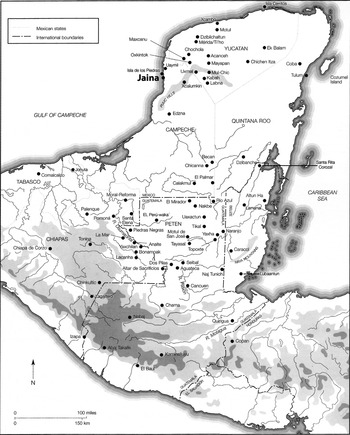
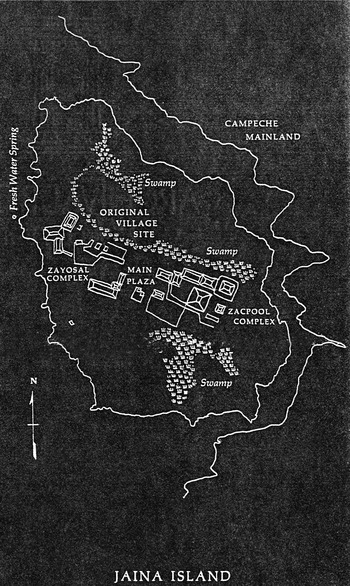
Jaina is a small, low-lying island about 60 m off the coast of northwest Campeche, about 40 km north of Campeche City. Its name is usually translated as “house in the water.” The island is only 42 ha in area (less than 1 km2), and the evidence indicates that its inhabitants built it up over the years (Benavides Reference Benavides Castillo2002a and Reference Benavides Castillob; Reference Benavides Castillo2004). It has long been assumed that at times it was connected to the coast by a sacbe (causeway), but there is no archaeological evidence for its existence. The coast is covered with dense mangrove swamps and is largely uninhabitable (see Figures 1 and 2).
Map of the Maya region (after Miller and Martin Reference Miller and Martin2004:18, Figure 3). Courtesy of Fine Arts Museums of San Francisco. Redrawn by Richard Gricies.

The Island of Jaina (after Miller Reference Miller1975:140). Courtesy of the author.

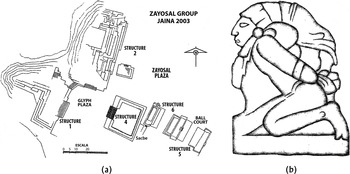
A rectangular plaza was thought to connect two ceremonial complexes—Zacapool, almost at the center, and Zayosal, at the western edge (see Figure 3a). It seems more likely that these complexes flanked an inlet now filled with sediment (Antonio Benavides Castillo, personal communication 2010). Six stelae (in fragments) bearing Late Classic dates and four panels with glyphs are known from the island. One of the stelae associated with a ballcourt clearly depicts a captive, indicating that the Terminal Classic period was also a time of turmoil in northwest Campeche (Benavides Castillo Reference Benavides Castillo2002b:71, Figure 5) (see Figure 3b).
(a) Site plan of Zayosal group (after Benavides Castillo Reference Benavides Castillo2004). Courtesy of the author. (b) Image of a captive on Zayosal ballcourt Stela 3 (after Benavides Castillo Reference Benavides Castillo2002b). Courtesy of the author.

Jaina, along with Uaymil (5.5 ha) and Isla Piedras (4.5 ha), is one of several little islands in the area. All three islands seem to have participated in a burial cult characterized by the placement of clay figurines in many, but not all, of the simple earthen graves. Despite the unpretentious graves, sufficient evidence exists to indicate that certain individuals were accompanied by more prestigious mortuary goods than others.
By the Late Classic period (a.d. 600–900) the three islands apparently engaged heavily in commerce. Inurreta (Reference Inurreta Díaz2004:30) described them as “specialized commercial ports,” and Anthony Andrews (Reference Andrews, Clancy and Harrison1990:165) categorized Jaina as a prominent “transshipment port.” Finamore (Reference Finamore and Houston2010:148) concluded that with their high concentration of luxury goods, they formed part of a ring of sites that served as nodes in a circum-Yucatan coastal trade network.
Scholes and Roys (Reference Scholes and Roys1968) provide a model for this commerce: at the time of conquest, the peninsula of Yucatan and adjoining lands along the coast of the Gulf of Mexico and Caribbean Sea formed an economic unit. Although the area was divided into a large number of small states “the entire region was united by commercial relations, which constituted a common bond of interest” (Scholes and Roys Reference Scholes and Roys1968:3; see also Piña Chán Reference Piña Chán, Lee and Navarrete1978). This common bond was fostered by the sharing of Chontal, Chol, and Chorti languages, which are mutually intelligible and similar enough to Yucatec Maya that it is claimed that one language can easily be learned by the speakers of another (Scholes and Roys Reference Scholes and Roys1968:18).
Within Acalan, a Chontal-speaking region to the south and west of Jaina, the merchants constituted the dominant class, and the wealthiest of them was the supreme ruler or the cacicazgo. Cortés was impressed when he stopped at Acalan on his way to Honduras. He described the province as large and well populated with many merchants who traded in different places and who were rich in slaves and merchandise (MacNutt Reference MacNutt1908:263).
To support their evolving economy, local lords turned to feasting and gift exchange that would establish new alliances and expand their long-distance exchange (Dietler and Heyden Reference Dietler and Heyden2001). Rice (Reference Rice2009:72) dubs this “fiesta finance” with its feasts, gifts, and collective activities. The feasting and exchanges among those engaged in commerce would seem to be universal, as with the behavior of the pochteca among the Aztec (Dibble and Anderson Reference Dibble and Anderson1959:9:14 [Chapter 7]).
Jaina may have been the complement of Cozumel on the eastern shores of the Yucatan peninsula since both islands were considered sacred, one where the sun rose in the morning and the other where it set in the evening (Miller Reference Miller and Robertson1974; Houston Reference Houston, Finamore and Houston2010:73). Sabloff and Rathje (Reference Sabloff and Rathje1974, Reference Sabloff and Rathje1975) developed a hypothesis that neatly tied together shrines, merchants, and commerce. Using an analogy with Mediterranean trade where merchants would visit shrines to their local deities on the islands and then exchange goods under “the sacred canopy,” they hypothesized that a similar dynamic was operating on Cozumel (where it still operates today as merchants serve the needs of international “sun worshippers”). It is likely that one component of Jaina's success as a trade entrepôt was its sacred character (Velázquez Castro Reference Velázquez Castro1988:36).
Although Jaina lacks the array of shrines identified on the much larger island of Cozumel, its sacredness may be associated more with death than with life and be reflected in its “necropolis-like” character, to be discussed below. This aura of sacredness probably attracted traders and their wares and possibly pilgrims to purchase them.
In discussing the transitions and transformations from Classic to Postclassic Maya society, Chase and Chase (Reference Chase, Chase, Demarest, Rice and Rice2004:23–24) consider the role of merchants in the rise of a “middle class,” noting as evidence the changing distribution of high-status artifacts. In rigidly hierarchical societies, these artifacts appear in localities occupied by nobles; in increasingly mobile societies they are distributed throughout the site. If this trend was expressed by the entrepreneurs of the Tabasco/Campeche Gulf Coast littoral, it would help explain the wide-spread distribution of status markers in Jaina graves.
This cycle of economic and political expansion at the end of the Late Classic period in the northern lowlands is marked by the appearance of unusual sets of emblem glyphs, including a glyph associated with Jaina (García Campillo 1998; Graña-Behrens Reference Graña-Behrens2006). It would appear that the newly ennobled merchants were seeking to emulate the crumbling ancien régime to the southeast. Graña-Behrens states that only three emblem glyphs comparable to those identified in the central and southern lowlands have been conclusively recognized for sites in northern Yucatan: Dzibilchaltun, Ek'balam and Jaina. The first two centers are not surprising, given their size, central locations, and presumed importance. However, the Jaina emblem glyph is unexpected not only because of the island's size and peripheral location, but also because the glyph is known primarily from almost a dozen portable objects. It appears only once on the island itself, on a fragmented stone inscription (Benavides Castillo, quoted in Graña-Behrens Reference Graña-Behrens2006:110).
Despite the emblem glyph's single known occurrence on Jaina (other examples may have been looted) the same ruler and glyph appear at other sites. As Graña-Behrens (Reference Graña-Behrens2006:110) speculates, “[t]he appearance of the Jaina emblem glyph outside the island in its hinterland at sites such as Uaymil, Xcalumkin, and Santa Rosa Xtampak uncovers a vast political activity among sites in northwest Yucatan that might even suggest that Jaina maintained a strong political influence over this area.”
What evidence, then, do Jaina figurines provide for commercial and political change taking place in the northern Maya lowlands during the Late and Terminal Classic periods?
JAINA FIGURINES
Jaina figurines, or more properly “Jaina-style” figurines, are among the most widely admired and avidly collected objects from all of Mesoamerica (Rands and Rands Reference Rands, Rands and Willey1965; Helmuth 1976). They are generally placed in two broadly defined categories: molded and modeled (Butler Reference Butler1935; Corson Reference Corson1976). It is the solid, hand-modeled, small sculptures (pastillaje) that collectors and museums covet. In Sotheby's Catalogue, for the sale of the Saul and Marsha Stanoff collection (May 17, 2007), a remarkable pastillaje “statesman” (Number 65) is estimated to sell at $100,000–$150,000.
It is unknown how many of these lords and ladies on display or illustrated are authentic. In the most recent study of Jaina figurines at Dumbarton Oaks (Pillsbury et al. Reference O'Neil, Pillsbury, Doutriaux, Ishihara-Brito and Tokovinine2012), four out of the set of six figurines allegedly found in a jar uncovered in Campeche and sold by Earl Stendahl to Robert Woods Bliss in 1954 (Lothrop et al. Reference Lothrop, Foshag and Mahler1959:161–164) are now considered “questionable.” “[V]isual and material analyses, confirmed by chemical analysis, specifically INAA testing, which resulted in no matches with archaeologically excavated ceramic objects … have led to the conclusion that these four figurines [PC.B. 196, 197, 198, 201] are modern imitations of ancient figurines” (O'Neil Reference O'Neil, Pillsbury, Doutriaux, Ishihara-Brito and Tokovinine2012).
Informal looting and commerce in figurines characterized the nineteenth century and the first decades of the twentieth. When interest in pre-Columbian art increased during the 1930s, the ransacking of the island and the appalling production of fakes began in earnest. The Mexican government stepped in and sponsored scientific excavations in 1941 and 1942. These yielded the first published reports (Fernández Reference Fernández1946; Moedano Koer Reference Moedano Koer1946). Although the adoratorios were tested by Fernández, the emphasis was primarily on the thousands of graves scattered throughout the site. One hundred fifty burials were unearthed.
In 1947, a third expedition obtained objects for the reinstallation of the Maya halls at the old National Museum of Anthropology in Mexico City. The young Piña Chán was a coleader, and in 1948 he published a brief description of some of the 76 burials uncovered. The results of the 1957 excavations led by Cook de Leonard that identified 389 graves were never publically disseminated until they were finally translated and published by the Universidad Autónoma de Campeche in Reference Cook de Leonard2003. Fortunately she had shared her data with Corson, who was writing his Ph.D. dissertation on Jaina figurines in the 1970s.
In 1964, as part of the search for objects to enhance the ceramic collections for the new National Museum of Anthropology in Mexico City (Benavides Reference Benavides Castillo2002a; Arqueología Mexicana 2003), another 400 burials were excavated. Only the best figurines were exhibited and published, and they became the data for reconstructing “courtly life.” When the two-month 1964 dig was finished, the Mexican expeditions had cleaned out a total of nearly 1,000 burials in less than 25 years (Piña Chán Reference Piña Chán1985:158). Despite this number, Aveleyra Arroyo de Anda and Ekholm (Reference Ekholm1966) “conservatively” estimated that 20,000 graves remained.
In the twenty-first century, contemporary archaeology finally reached Jaina. Benavides Castillo, in charge of many Campeche state archaeological investigations, began the first of eight expeditions to the island, focusing on the structures in the ceremonial centers and the data they could yield for reconstructing the society of the former inhabitants. Architectural restoration was also undertaken, and future plans for tourism were developed (Benavides Castillo et al. Reference Benavides Castillo, Vargas, Moll, Gayol, Castillo, Uribe and Peraza2007). These data now make it possible to begin reconstructing the society of the former inhabitants of the island.
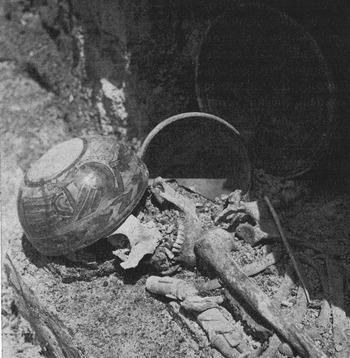
Despite the material from the excavation of nearly 1,000 burials and the looting of unnumbered others, few descriptive statistics are available. Much remains unknown about the funeral customs or how they relate to the population of Jaina. What is known is that adults and adolescents are generally interred with two or three objects in shallow pits dug directly into the ground. These grave goods usually included at least one figurine and a ceramic vessel placed over the skull (Figure 4). Flexed burials were common, and evidence indicates the deceased were wrapped as mummy bundles. There are a few secondary burials, usually without grave goods. Infants and juveniles are buried in urns or large jars commonly topped with tripod plates. Figurines are also placed in these large jars to accompany the dead; in fact, some of the most frequently exhibited figurines are associated with infant burials (Aveleyra Arroyo de Anda and Ekholm Reference Ekholm1966; López and Serrano Reference López A. and Serrano S.1984; Ochoa and Salas Reference Ochoa and Salas C.1984; Piña Chán Reference Piña Chán1968, Reference Piña Chán1985).
Typical Jaina grave with bowl over skull and figurine next to arm bone (Aveleyra Arroyo de Anda and Ekholm Reference Ekholm1966:46). Image courtesy of Natural History, Inc.

No constructed tombs have been discovered, although it can been argued that if they had been built, they would have been smashed by looters over the past 150 years. It is not clear how many graves were associated with house mounds because the evidence has been destroyed both by the grave robbers and by the collecting of all surface stones to sell in Campeche or to be burnt and converted into lime. However, on the north side of the island several low elevations appeared to be the remains of house foundations, and the 1968 excavations by Piña Chán revealed many burials associated with them.
The most recent summary of the burials is offered in Hernández and Márquez (Reference Hernández and Márquez2007). In their volume, Serrano Sánchez and López Alonso (Reference Serrano Sánchez, Alonso, Hernández and Morfín2007) describe the burials as indicating well-structured and complex burial rituals in which females were oriented to the south, males to the north, and infants to the west. Ornaments and figurines in general were most frequently found with men and children, but beads, earrings, and rings were common for all. Shells were most frequent with the women, and bezotes (lower lip ornaments), abanicos (fans), and plaques of shell with the men. Work implements were most frequently associated with men as were animal remains (principally marine). Although there were no cremations, there was some burning of objects in one-half of the adult burials and in one-third of the infant burials. Mouth beads were also more frequent with men.
Overall, the authors conclude that the graves represent a socially heterogeneous population but offer little evidence for sub-elites (sajalob), among whom one would expect a certain homogeneity in the quality of funeral offerings (Serano Sánchez and López Alonso Reference Serrano Sánchez, Alonso, Hernández and Morfín2007:84). The distance from the ceremonial center was not significant in quality of offerings. Velázquez Castro (Reference Velázquez Castro1988:40), however, reports that the greatest density of graves was associated with any source of water and deposits of marine material and bone. These locations evoked the watery land of the dead (Finamore and Houston Reference Finamore, Finamore and Houston2010).
As reviewed above, some evidence indicated family burial “plots.” Serrano Sánchez and López Alonso also feel that the burials were largely those of the local population, although they admit the possibility that some individuals traveling through the island, which was part of a coastal navigation system, may have died and been buried there.
Regardless of who was buried on Jaina, the fact that figurines of high aesthetic quality were placed in common graves is highly aberrant when compared with other sites yielding substantial collections of ceramic figurines. In all other excavations, from Comalcalco (Gallegos Gómara Reference Gallegos and Judith2003) to Jonuta (Alvarez and Casasola Reference Alvarez and Casasola1985) and up the Usumacinta to the Pasión River, and even up the Grijalva to Lagartero, figurines are most frequently found in domestic contexts, often in middens and at Lagartero in a huge termination ritual garbage dump (Ekholm Reference Ekholm, Hammond and Willey1979). This is not true of Jaina. Although Benavides Castillo (personal communication 2010) reports that some discarded figurine fragments were part of the rubble in some excavated buildings, they were few, not numerous.
Attempts to analyze frequencies of figurines and figurine types from Jaina graves have been skewed by looting, fakery, and even earlier methods of excavation. Producers of frauds strive to create great numbers of noble-appearing solid hand-modeled or molded and modeled figurines. Looters also go for the highly valued hand-modeled figurines most frequently bought and sold by collectors and museums. Even excavations that sought to discover fine specimens for museum displays have paid little attention to or have failed to publish less desirable specimens.
Despite the poorly documented context, lack of quantifiable data, and questionable authenticity of many Jaina-style figurines, they are still valuable for the reconstruction of ancient Maya social organization. First, they offer a different set of data than monumental sculpture or polychrome vessels. Monumental art can directly communicate messages about hierarchy, dynasty, and state celebratory ritual; these can only be perceived indirectly in miniatures. While polychrome pots can formally present narratives from other realms symbolizing elite dogma, figurines can only present fragments of mythology.
What figurines can do better than stelae, hieroglyphs, and painted scenes is to capture the concerns of the wider society and serve as “small-scale indices of large-scale social phenomena” (Halperin et al. [eds.] Reference Halperin, Bishop, Spensley and Blackman2009; compare with Hellmuth Reference Hellmuth1976:192). They apparently served as mass media for the plebeians and provide those who study them a bottom-up perspective rather than the top-down usually encountered in studies of Classic Maya society (Halperin Reference Halperin, Halperin, Faust, Taube and Giguet2009). As Norman Hammond observed (Reference Hammond1975:372) considering figurines from the Classic Maya site of Labaantun, “… the figurines offer us primary information to complement that obtained from excavation about aspects of Maya life that would otherwise remain lost….”
PREVIOUS INTERPRETATIONS
Although an impressive range of individuals is portrayed by Jaina-style figurines, one of the main unresolved questions is how these individuals reflect the social structure of the burying population. This question is compounded since the extensive surveys and studies of these figurines that clustered in the 1970s (Butler Reference Butler1935; Corson Reference Corson1976; Goldstein Reference Goldstein1979; Hillebrand Reference Hillebrand1974; Kellers Reference Kellers1973; Miller Reference Miller1975) relied on stylistic categories rather than functional categories related to social status and role. Although Piña Chán developed a basic typology in 1968, Corson (Reference Corson1976:175) subdivided his categories and developed a more refined typology which is still useful today.
When status and role are ascribed to figurines, the deductive logic governing their identification seems to be first to identify images from the royal courts of the Classic Maya of the southern lowlands and categorize them, and second to find Jaina-style figurines to illustrate these statuses. Once used to illustrate the courtly life of the southeastern heartland, the statuettes of noble lords and ladies, in turn, are presumed to represent the social organization of Late Classic period northwestern Yucatan. Although Miller (Reference Miller1975:34) maintained that the “examination of the sophisticated clothing and headgear of the [Jaina] figurines places them in a courtly realm,” the region that produced them during the Late Classic period was at best peripheral to the heartland areas and unlikely to support a k'uhul ajaw (sacred lord) and his ranks of courtiers.
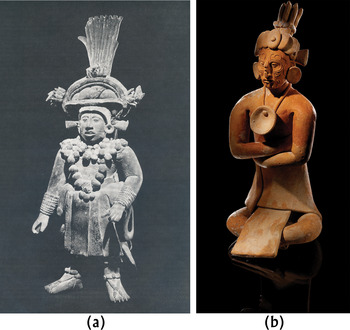
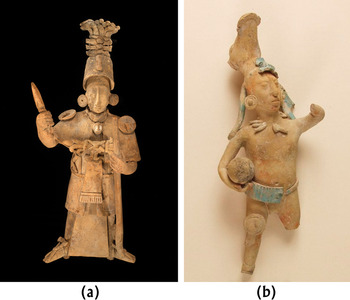
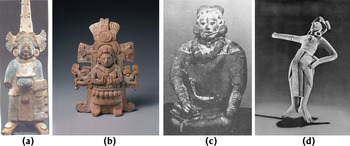
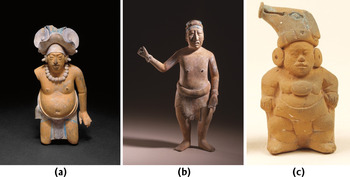
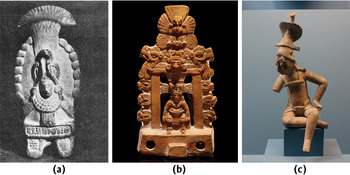
Piña Chán (Reference Piña Chán, Schmidt, de la Garza and Nalda1998:396) exemplifies the traditional approach to figurine identification when he states that “[i]n Jaina figurines what are mainly seen are lords (Figures 5a and 5b), warriors (Figure 6a), ballplayers (Figure 6b), priests (Figure 7a), priestesses (Figure 7b), and so forth (Figures 7c and 7d). There is little that shows us the common people, whose clothing must have been considerably more humble.” Foncerrada de Molina has concluded (Reference Foncerrada de Molina1988:21), however, that “Jaina art is concerned with the expressive description of all social classes,” and at Laabantun, Hammond (Reference Hammond1975:372) determined that the figurines apparently represented all classes of society. But what are these classes, and how are they to be defined?
(a) An Ahau or “señor supremo” (Aveleyra Arroyo de Anda and Ekholm Reference Ekholm1966:47; Piña Chán Reference Piña Chán, Schmidt, de la Garza and Nalda1998:389; Schmidt et al. Reference Schmidt, de la Garza and Nalda1998:546 Number 116, “… display of the rich elaborate costume worn by important individuals, members of nobles families who held power”; see also Arqueología Mexicana 2004(17):64;). Museo Nacional de Antropología, Mexico. Image courtesy of Natural History, Inc. 24.5 cm tall. (b) An elite male exhibiting the facial tattooing and large shell pectoral of a sajal or second-ranked nobility (figure often identified as a priest), “Jaina Group B” (Corson Reference Corson1976:177, Figure 1; Finamore and Houston Reference Finamore and Houston2010:59, Catalogue 12; Piña Chán Reference Piña Chán, Schmidt, de la Garza and Nalda1998:391). “Figure of a priest,” image courtesy of the National Museum of American Indian, Smithsonian Institution 23/8368, photo by photo services. 21.8 cm tall.

(a) A warrior “standing of guard and ready to strike,” with knife and lance in hand (Miller and Martin Reference Miller and Martin2004:176, Plate 94; see also Schele Reference Schele1997:99, Plate 5). “Figure of a priest,” image courtesy of the National Museum of American Indian, Smithsonian Institution 22/6348, photo by photo services. 28.5 cm. (b) A standing ballplayer poised to begin the game (Schele Reference Schele1997:125, Plate 6; see also Fox Reference Fox2006). “Maya Ballplayer,” image courtesy of the Hudson Museum, William P. Palmer III Collection, University of Maine. HM646. 24.8 cm tall.

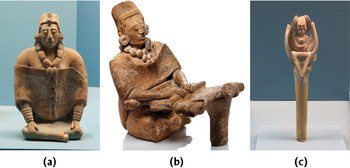
(a) A religious specialist, or priest, wearing a large mirror pectoral backed by a profile rabbit. “A valued member of the court” (Miller and Martin Reference Miller and Martin2004:38, Plate 9). “Standing figure in an elaborate costume,” image courtesy of the Metropolitan Museum of Art. 1979 206.953. 29.3cm tall. (b) A priestess or woman impersonating a deity (Schmidt et al. Reference Schmidt, de la Garza and Nalda1998:610, Number 365; see also Gallenkamp and Johnson Reference Gallenkamp and Johnson1985:160, Figure 100, and back cover. Multiple copies of two varieties of this mold-made piece are held by numerous institutions in the United States and Mexico (see Schele Reference Schele1997:178–179, Plates 5–7). National Museum of the American Indian. “Rattle depicting a goddess,” image courtesy of Princeton University Art Museum. Promised bequest of Gillett G. Griffin L.1974.7. 17.8 cm tall. (c) “Lady of the Holy Books,” a seated noble female scribe holding what has been identified as a folded codex (Schele Reference Schele1997:43, Plate 27; see also Corson Reference Corson1976:178, Figure 2c “Jaina Group C,” in memory of Christopher Corson [Raven]; Schmidt et al. Reference Schmidt, de la Garza and Nalda1998:634, Number 456. Museo Nacional de Antropología, Mexico). 15.6 cm tall. (d) A courtly dancer, perhaps in a trance state (Corson Reference Corson1976:185, Figure 9b, “Jaina modeled miscellaneous;” see also Aveleyra Arroyo de Anda and Ekholm Reference Ekholm1966, front cover; Schmidt et al.Reference Schmidt, de la Garza and Nalda1998:543, Figure 104, “a speaker”). Image courtesy of Natural History, Inc. 19.3 cm tall.

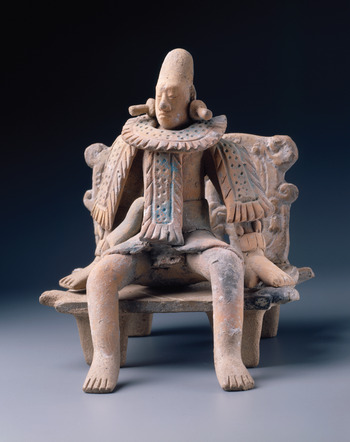
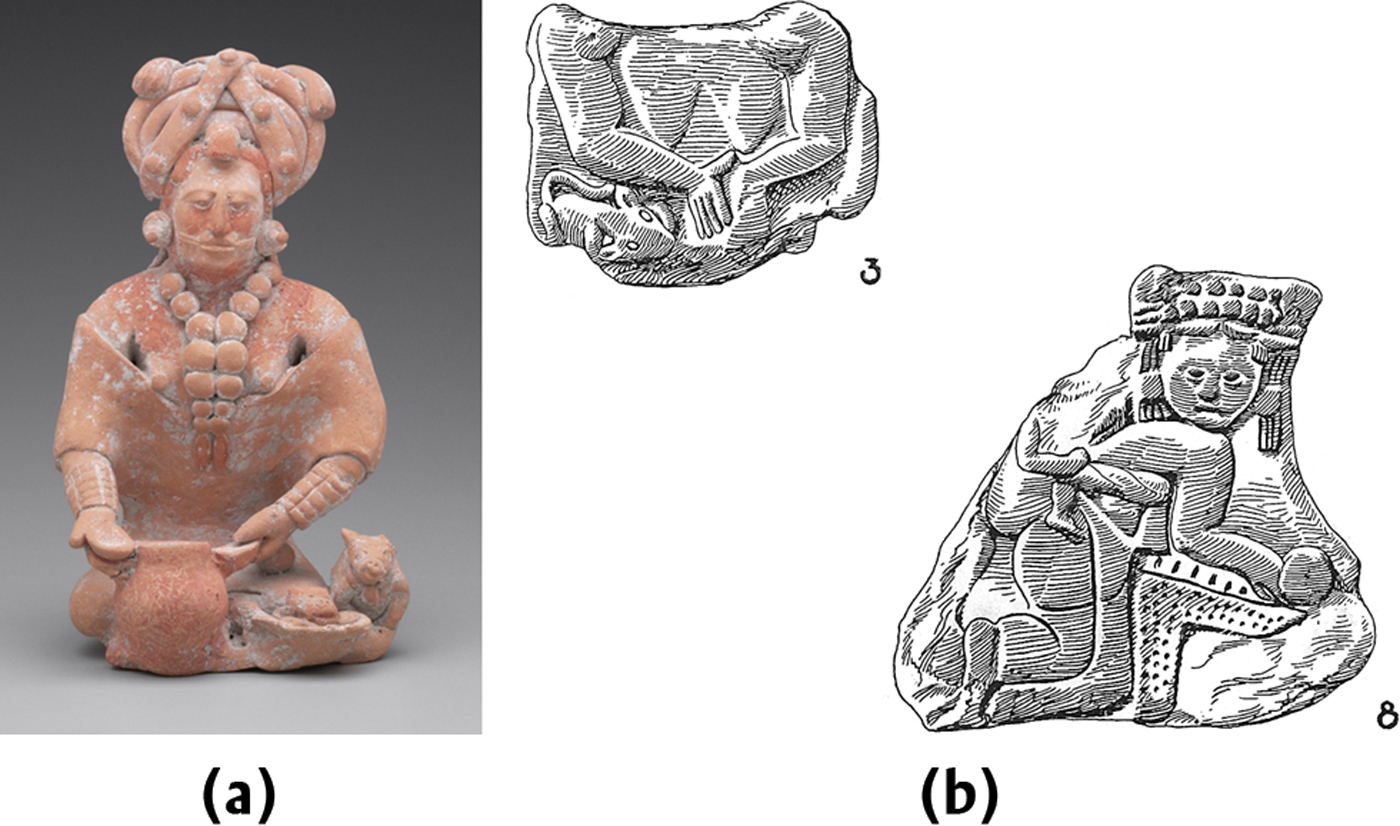
In their co-curated exposition entitled Courtly Art of the Ancient Maya, Miller and Martin (Reference Miller and Martin2004) use 25 Jaina-style figures to exemplify the courtly life, frequently comparing them to Bonampak murals and Yaxchilan bas-reliefs. In addition to an “enthroned ruler” (Miller and Martin Reference Miller and Martin2004:37, Plate 8) (Figure 8) they display a range of high-ranking courtiers (priests, “ambassadors,” “singers”), ballplayers, and warriors. They do not label a figurine “middle status functionary” or “bureaucrat” (see Figure 9a). Among the lower ranked courtiers chosen for display are a “trusted servant,” most likely a eunuch (Figure 9b), and the “contraries” of the court, dwarfs (Figure 9c) and hunchbacks. A woman preparing food (Miller and Martin:114, Plate 57) (Figures 10a and 10b) is illustrated, and musicians are represented by a trumpet player.
Enthroned lord, missing headdress. Note dwarf depicted on throne back (Schele and Miller Reference Schele and Miller1986:78, Plate 4; see also Miller Reference Miller1975:54–55, Figure 21 [Miller identified the lord as ruler of the underworld on his throne]; Schele Reference Schele1997:89, Plate 32 [Schele identified the throne image as representing the Maize God surrounded by maize leaves]). “Enthroned Ruler,” image courtesy of Princeton University Art Museum. Gift of Gillett G. Griffin, 1986–1987. a[figure 15.8 cm.]–b[throne 10.6 cm].

(a) A paunchy nonregal member of the court with an elaborate headdress, perhaps a high-ranking functionary or middle status “bureaucrat.” “Standing Male Figure, Late Classic Maya, Jaina style Campeche or Yucatan, Mexico,” image courtesy of The Art Institute of Chicago 1973, 649. 15.6 cm tall. (b) “… a trusted servant… possibly a eunuch” (Miller and Martin Reference Miller and Martin2004:41, Plate 12). “Standing male figure, a.d. 600–800, Jaina, Campeche, Mexico,” image courtesy of Los Angeles County Museum of Art, gift of Phil Berg, m.71.73.217. 25.08 cm tall. (c) Dwarf wearing a deer (or possibly a peccary) headdress. For a selection of dwarf images see Schele (Reference Schele1997:150–158, Plates 1–13). “Dwarf Whistle,” image courtesy of Hudson Museum, William P. Palmer III collection, University of Maine, HM767. 9 cm tall.

(a) Woman preparing food (Miller and Martin Reference Miller and Martin2004:114, Plate 57; see also Schele Reference Schele1997:42, Plate 26). “Seated Female Figurine with Cooking Utensils and Dog,” image courtesy of Yale University Art Gallery, Stephen Carlton Clark, B.A. 1903, Fund. 1973.88.4. 19 cm tall. (b) Figurines from Lubaantun representing women preparing food (Joyce Reference Joyce1933:vi, Numbers 3 and 8). Bodega del Departmento de Arqueología, Belmopan, Belize.

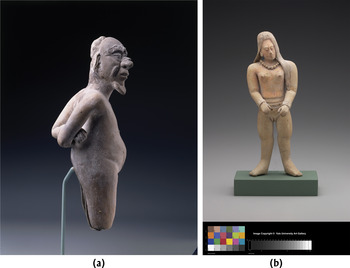
Finally, noncourtly figures are illustrated: captives (Figure 11a), a disemboweled figure and a standing nude girl (Miller and Martin:178, Plate 96) (Figure 11b). This latter figurine leads Miller and Martin (p. 175) to wonder, “who would have chosen such a companion in a tomb?”
(a) A bound nude male captive. (See also Corson Reference Corson1976:185, Figure 9d “modeled miscellaneous;” Schele Reference Schele1997:115–116, Plates 22 and 23). “Portrait figure of a defiant bound captive,” image courtesy of Princeton University Art Museum, Gift of Gillett G. Griffin, 2003, 148. 19.5 cm tall. (b) A standing nude female “captive” (Groth Kimball Reference Groth Kimball1960:27; see also a restored version in Miller and Martin [2004:178, Plate 96] and in Schele [1997:32, Plate 15]). “Figurine of Standing Female Captive,” image courtesy of Yale University Art Gallery, gift of the Olsen Foundation, 1958.15.9. 22.8 cm tall.

Schele and Miller (Reference Schele and Miller1986) chose 22 figurines, including three ballplayers, to illustrate their text for Blood of Kings. They commented that perhaps these ballplayers were defeated by the deceased and in memoriam placed in their graves. Unfortunately, no evidence for a correlation is given. In fact, ballplayer figurines are found in graves of infants as well as adults.
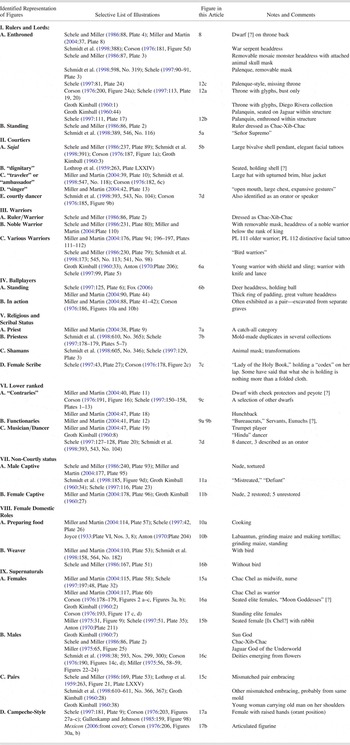
The essential question is whether or not all the characters the authors list were present in royal courts on Jaina and, if they were, what roles did they play? Table 1 summarizes named statuses and roles appearing in the literature.
Statuses and roles assigned to a selection of Jaina-style figurines

It should be noted that usually the statuses and roles ascribed to the figurines are little more than creative speculations and that the distinction between sacred and secular, priest, ruler, and warrior is ambiguous at best For example, see the interpretations of text Figure 8 “enthroned lord.”
Although there has been frequent identification of multiple social roles and statuses represented by Jaina-style figurines, little attention has been paid to frequency of presumed occupational specialization. Miller's (Reference Miller1975:61–62, Appendix I) compilation of 278 figurines is primarily based on gesture and clothing. However, her more specialized types are worthy of further consideration: 14 dwarfs, 12 men on thrones, 11 captives, and 7 ballplayers. Eight men and women were modeled emerging from flowers; no frequencies are given for the man/woman pairs often illustrated elsewhere.
Miller's 12 men on thrones deserve additional analysis. Although they appear to be representatives of nobility, Goldstein (Reference Goldstein1979:91) notes that, “the ceramic figurines occupying the throne are like the glyphs [on the throne], repeated symbols rather than individuals.” In fact, the even more regal-appearing figures carved on conch shell sections reputedly from Jaina also fail to yield inscriptions clearly designating the depicted lord as Ajaw (McVicker and Palka Reference McVicker and Palka2001:181, Figure 5).
Halperin (Reference Halperin, Halperin, Faust, Taube and Giguet2009:387) believes that she has identified a widely distributed set of molded ruler figurines that also appear with some frequency on Jaina. These all wear fan-shaped feathered headdresses that typically included zoomorphic or supernatural heads perched just above the individuals' faces—most commonly “war serpents.” In Jonuta Group B (Corson Reference Corson1976:67–72, Figure 24, 200) the figurine busts are seated on thrones decorated with pseudo-glyphs (Figure 12a). These headdresses are also commonly found on “mummy bundle” figurines carried on palanquins (Corson Reference Corson1976:196, Figure 20, “Jaina Group O”). The base of these structures is pierced by two round holes into which miniature poles may have been inserted. A subtype of these miniature full figures appears to be seated at the entrance of an elite structure also pierced by round holes. Either these models represent a lord on a palanquin or perhaps the deceased carried in procession to his grave (see Figure 12b). All of these figurines suggest a close association with mortuary rituals.
(a) Ruler with plume-framed war serpent headdress seated on a glyph inscribed throne (Schele Reference Schele1997:113, Plate 20; see also Corson:1976:200, Figure 24a “Jonuta Group B,” in memory of Christopher Corson [Raven]. Schele also considers these ancestral mummy bundles. Schele's illustration shows 16 pellets surrounding the headdress and Corson's shows 14). Villahermosa, Museo de Jonuta. 14.8 cm tall. (b) Seated ruler on a palanquin (Schele Reference Schele1997:111, Plate 17; see also Corson Reference Corson1976:196, Figure 20d “Jaina Group O; ”Groth-Kimball Reference Groth Kimball1960:44). Jaina category O presents just the bust of the figure “ancestor mummy bundle” but shares the hollow base pierced by two round holes probably used for the insertion of miniature poles to symbolize a funeral litter (Schele Reference Schele1997:112, Plate 18). “Figure of the ruler Halach Hunik, possibly carried in processions,” image courtesy of the National Museum of the American Indian, Smithsonian Institution, photo by photo services, 23/22/16. 27.5 cm. (c) Palenque-style seated elite male, missing throne (Schele Reference Schele1997:81, Plate 24, “represents a lord, probably a king;” see also Couch Reference Couch1988:40, Figure 41). “Human figure,” image courtesy of the American Museum of Natural History, 30.3/1225. 16.0 cm tall.

Noting the distribution of figurines on Jaina, Foncerrada de Molina (Reference Foncerrada de Molina1988:25) concludes that “funereal figurines were probably not destined for the elite in power, but rather a middle level powerful social class, that of merchants and craftsmen who traveled all over the region.” Even this begs the question of why deceased members of this “powerful social class” were buried like commoners with few high status markers.
Regardless of the uncritical ascription of social roles and statuses of ultimately European-derived sets of courtly categories to figurine images (Houston and Inomata Reference Houston and Inomata2009:168), as noted above, on Jaina these lordly figurines are placed in overall modest graves. By contrast, Halperin (Reference Halperin, Halperin, Faust, Taube and Giguet2009:389) finds that the ruler figurines in her sample from Motul de San José occur in both elite and commoner residences.
THE FUNCTION OF FIGURINES/A NEW INTERPRETATION
The traditional interpretations of Jaina figurines have focused on stylistic categories and uncritical acceptance of European models for Maya courtly culture. The new interpretations are based on the functions of figurines in the broader context of Jaina Island society during the Late/Terminal Classic period. They give full attention to the “lives” of the figurines.
The major challenge to interpreting figurines from Jaina in terms of their functions for producers and users is that we only have their final context, their entombment. How many transformations in function took place when they were produced and used in their original cultural context is poorly known. Their final disposition clearly does not mark their meaning as participants in daily rituals. What they represent in daily life may be far removed from the cultural choice of putting one or more in graves. This can be as misleading as placing a figure from a Nativity scene in a grave as a symbol of Christian fidelity.
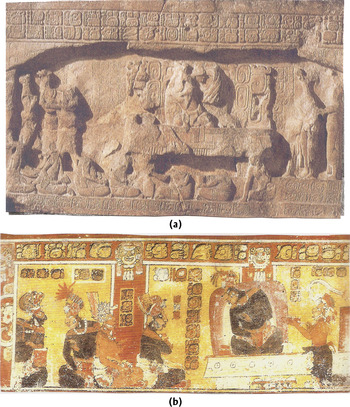
As Schele remarked more than a decade ago (Reference Schele1997:17), “… the people of Palenque used figurines in religious rituals involving both their temple and their house.” She went on to note that the figurines probably served the same purpose as Santos today, and the figurines were used to construct scenes. Later, when she discussed a particularly graceful figurine from Palenque now missing his bench (Schele Reference Schele1997:80–81, Plate 25) (Figure 12c), she speculated that perhaps this figurine was “once part of an assemblage that laid out the members of the man's court much like the palace scenes recorded on pottery and on Piedras Negras Panel 3” (Figure 13a). Schele also noted the rather low development of narrative pottery in western “Mayaland” and remarked on how it was balanced by the bias toward figurines. Following Schele's observations it is possible that Late Classic polychromes to the southeast depicting courtly scenes (Jackson Reference Jackson2009:176, Figure 2; Reents-Budet Reference Reents-Budet1994:176–177, Number 5.12) were replaced by the replication of the court in sets of figurines (Figure 13b).
(a) Piedras Negras Panel 3 (Schmidt Reference Piña Chán, Schmidt, de la Garza and Nalda1998:323, 592, Number 194; see also Miller and Martin Reference Miller and Martin2004:131, Figure 48, “a ruler and his courtly retinue.” Guatemala, Museo Nacional de Arqueología y Etnología. Image © Justin Kerr K4892/MSO445. (b) The ruler within his courtly community, Classic Maya polychrome vessel (Jackson Reference Jackson2009:73, Figure 2; see also Reents-Budet Reference Reents-Budet1994:152, [Number 4.44], 332 [Number 40]). For a rollout photograph of this vessel, see Kerr K2784/MS0445). “Painted vessel,” image courtesy of Dumbarton Oaks Pre-Columbian Collection. Washington, DC. PC.B.564.

Many investigators have been led astray in their analysis of Jaina figurines by assuming they formed a distinctive category of mortuary offerings (for example, Corson Reference Corson1976:171) and failing to identify their larger social context. Minimally, the magical role of figurines in individual rituals for the living should be considered. Among a number of Christians in the United States today, it is not uncommon to bury a little statue of St. Joseph upside down in a front yard to ensure the sale of the house.
Landa (Tozzer Reference Tozzer1941:129, Note 602) supplies a striking ethnohistoric example of the magical use of figurines in Conquest-period northern Yucatan. He reports that rich men “… worshiped idols of stone, of clay and of wood which they make with their hands in order to petition (the gods) for health and for good seasons. These buried their dead inside or in the rear of their houses, casting into the grave with them some of their idols…” (Tozzer Reference Tozzer1941:130).
Lopiparo and Hendon (Reference Lopiparo, Hendon, Halperin, Faust, Taube and Giguet2009) shift their focus from individual acts to the role of the figurine in the social group. As they state, “… meaning does not exist as some fixed and essential property inherent in the object themselves but develops from their participation in the social practices and events that contribute to the renewal of social identities and relationships” (2009:51). This was apparently true at Aguateca, a Late Classic Maya center in the Petexbatun region of southwestern Peten.
When Aguateca was overrun by Maya rivals around a.d. 810 (Inomata et al. Reference Inomata, Triadan, Ponciano, Pinto, Terry and Eberl2002), the elite fled and left many of their possessions behind, including quantities of figurines in storage or actually abandoned on the floors of their residences. Archaeologists also uncovered numerous figurine fragments that had already been discarded as refuse and in other domestic contexts. As is true of other lowland Maya sites, almost no figurines were found in burial contexts (Triadan Reference Triadan2007:285). Many figurines were incomplete, but Triadan found no consistent pattern of breakage.
The fact that on Jaina various figurines excavated from burials are broken and missing parts probably indicates that they, too, had been used in domestic rituals. Unfortunately, if there was a program of breakage, it is not known. As Delgado observes (Reference Delgado1965:15), “Se hicieron [las figurillas] tanto para uso en la vida como para acompañar a los muertos, puesto que muchas de las figurillas asociadas con esqueletos se encontraron con miembros o tocados rotos o perdidos, tal vez representando pertenencias favoritas del muerto.” (author's translation: They made [the figurines] as much for daily use as for companions of the dead, since many of the figurines associated with the skeletons are found with broken limbs or headdresses, perhaps representing favorite personal belongings of the dead.)
From her analysis, Triadan concluded that the figurines were often part of assemblages and represented character types of men and women, not portraits. Since practically all the figurines were whistles, Triadan imagines them as theatrical performers in a band, complete with grotesques performing comedic roles. Since it is more than likely that Jaina figurines were once part of assemblages, perhaps, the little clay figures excavated from Aguateca can provide insight into the pre-burial function of figurines on Jaina.
SETS OF FIGURINES
For decades the only set of figurines discussed and illustrated in Mesoamerican studies was dedicatory offering Number 4 from the Olmec site of La Venta. This set of stone statuettes provided “a fascinating glimpse of an Olmec courtly scene of a ritual in progress” (Diehl Reference Diehl2004:73). Subsequently, several sets of Preclassic ceramic figurines were identified from Oaxaca and discussed by Marcus (Reference Marcus, Halperin, Faust, Taube and Giguet2009).
Recently, arrays of Classic Maya figurines have been uncovered. As reported above, the excavations at Aguateca have been particularly productive (Inomata et al. Reference Inomata, Triadan, Ponciano, Pinto, Terry and Eberl2002). Although Triadan (Reference Triadan2007:289) sees figurines not so much as ritual objects but as idealized social types that could have been used to educate children into adult role models, she admits that they could have played a role as deities or fetishes on household altars. Certainly it is not uncommon for an object to be “multivocal” and serve both as a deity representation and as a model for adult behavior. Nonetheless, these are the types of assemblages from which a figurine could have been selected and then placed in a grave.
Although it is clear that most figurines used in domestic rituals were destined for the trash heap rather than the grave, recently several examples of elite tombs have yielded special sets of figurines.
A remarkable burial was uncovered at Cancuen on the Pasión River. In the burial of a child from an elite residential zone, the bones were encircled by four figurines; an associated figurine head was also excavated. This figurine set was composed of two warrior/ballplayers and two shamans characterized by a removable transformation mask and hat. Curiously, three of the figurines were made of clay from the nearby secondary center of Raxruja, but the one ballplayer sporting a bird headdress was made in Cancuen. This figurine matched images that appeared on altars west of the ballcourt. These images portray the king of Cancuen, Taj Chan Ahk, as a ballplayer with a bird headdress. Sears (Reference Sears2006:393) speculates that this represents a sign of allegiance or interaction between the elites in the palace and those who resided where the tomb was uncovered. Unfortunately, since Jaina lacks clearly defined residences connected with elites, sub-elites, or nonelites, there are no data comparable to those from palaces associated with the complex courts to the southeast.
The most spectacular discovery of Classic Maya figurines being associated with a royal tomb has been excavated at El Peru-Waka', near the San Pedro Martír River. What is being interpreted as a regal court scene composed of two dozen figurines of astonishing high quality was placed on top of a mid-sixth to seventh century royal burial (Finemore and Houston Reference Houston, Finamore and Houston2010:284–287; Freidel et al. Reference Freidel, Rich and Reilly2010; Lawler Reference Lawler2007:978; Rich et al. Reference Rich, Robles, Matute, Freidel and Reilly2010). The cluster of figurines was arranged in two circles: an outer ring including a king, warrior queen, ballplayer, scribes, and other court members—both male and female, some dancing. Also in the outer ring is a double figure of a nearly unadorned kneeling male with a deer on its haunches, appearing to guard him. This set has been interpreted as the dead king and his spirit guardian, or way. The inner circle, perhaps a portal to the supernatural world, includes a frog, dwarves, two helmeted “boxers,” and a “shaman with a contorted face.” This inner circle is a match for what Inomata (Reference Inomata, Inomata and Houston2001:39) describes as “contraries” among the royal court's courtiers—eunuchs, dwarfs, and hunchbacks—all opposites of the ideal types sought by the elite (see Taube and Taube [2009:246–250] for a discussion of dwarfism and its symbolism). All these categories, except the “boxers” who are replaced by ballplayers, can be easily identified among Jaina figurines.
If this multifigure scene was a royal tradition in the southern Maya lowlands, it offers a model for what became burial ritual on Jaina. Although nonelite graves could not be filled with scenes of a royal court, an individual figurine symbolizing such a scene certainly could. If sets of figurines were used in household rituals and were employed as “visual aids” to relate important mythic lessons and stories, then a single image could be removed from the set, and, pars pro toto, it could be used to symbolize the whole assemblage when placed in a grave; the figurine would carry an aura of the sacred with it as it accompanied the deceased to Xibalba.
If this were the case, it would be futile to seek a correlation between the deceased and specific features of its accompanying figurine. The representation of the figurine is too remote from its symbolism for the living. Again, the analogy with a Santos selected from a household altar seems relevant.
FIGURINES IN OTHER TEMPORAL AND ETHNOGRAPHIC CONTEXTS
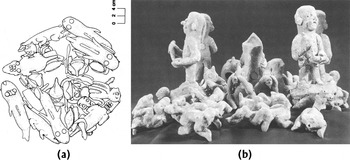
Worth reviewing are three Postclassic period assemblages of excavated figurines from Santa Rita Corozal in Belize. In Structure 183, 28 figurines had been carefully placed in a large lidded urn. The figurines represented four warriors and four women holding veils over their faces surrounded by a menagerie of jaguars, alligators, sharks, snakes, and birds (Chase and Chase Reference Chase and Chase1988:57, Figure 32) (Figure 14a). The Chases uncovered a second lidded urn in the core of Structure 213. Sixteen figurines surrounded the urn, and within were another nine. This assemblage depicted a bloodletting ritual: four penis-perforating figures stood on the back of turtles amidst birds, animals, and aquatic creatures similar to the bestiary excavated within Structure 183 (Chase Reference Chase, Robertson and Fields1991:99–95, Figures 5, 7, and 9; Chase and Chase Reference Chase and Chase1988:48–51, Figures 24a, 24b, 26; Finamore and Houston Reference Finamore and Houston2010:142–143, Plate 52) (Figure 14b).
(a) A Postclassic period figurine cache found in Structure 183, Santa Rita Corozal, Belize. Eight human figurines were surrounded by a menagerie of twenty four beasts (Chase and Chase Reference Chase and Chase1988:57, Figure 32; see also Finamore and Houston Reference Finamore and Houston2010:142, Plate 52, Figure 2). National Institute of Culture and History, Belize. Drawing courtesy of the author. (b) A Postclassic period figurine cache found in Structure 213, Santa Rita Corozal, Belize. An assemblage of 25 figurines engaged in a bloodletting ritual: left, figurines surrounding urn; right, figurines inside urn (Chase Reference Chase, Robertson and Fields1991:90–95, Figures 5, 7, 9; see also Finamore and Houston Reference Finamore and Houston2010:42, Plate 52, Figure 1). National Institute of Culture and History, Belize. Drawings courtesy of the author.

Earlier excavations conducted by Gann (Reference Gann1900, Reference Gann1918:59–63) at Santa Rita Corozal also encountered a highly similar cache of figurines. It included four warriors, four standing humans, four lizards, four alligators, four snakes, four birds, four “dragons,” four jaguars, fourteen “quash” [squash], three men sitting on stools practicing penis perforation, and one clay penis (Chase Reference Chase, Robertson and Fields1991:93).
Although these three caches (and others excavated by Gann) are securely dated to the Postclassic period, they indicate a remarkable continuity of rituals between the Late Classic Maya and their Postclassic descendants. The occurrence of Jaina figurines depicting males drawing blood from their members is not uncommon (Schele Reference Schele1997:134–135, Plates 11 and 12; Schele and Miller Reference Schele and Miller1986:192, 203, Plate 69). However, unlike Jaina, no single figurines were found in burials at Santa Rita Corozal.
Helen Pollard (personal communication 2011), of Michigan State University, has called the author's attention to the figurine assemblages characterizing cultures located in ancient west Mexico. Day provides an excellent example in her article, “The West Mexican Ballgame” (Reference Day and Townsend1998:158–160, Figures 9–19), where she states “[i]t is easy to imagine that all these figurines were arranged in scenes depicting the ritual or festival events that were associated with ballgames.”
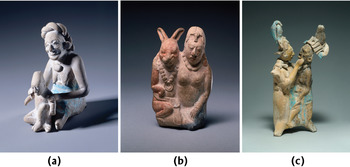
(a) The female deity Chak Chel as midwife/nurse (Miller and Martin Reference Miller and Martin2004:115, Plate 58, “The handsome and idealized face and tapering head of the child she restrains suggest the young Maize God;” see also Schele Reference Schele1997:48, Plate 32). “Old woman and young child,” image courtesy of the Princeton University Art Museum, gift of Gillett G. Griffin, 2003–26. 11.3 cm tall. (b) The “Moon Goddess,” Ix Chel, with her rabbit consort (Miller Reference Miller1975:31, Figure 9; see also Schele Reference Schele1997:51, Plate 35; compare with Anton Reference Anton1970:Plate 211 [the figurine is probably cast from the same mold]). “Whistle in the form of the moon goddess and her rabbit consort,” image courtesy of the Princeton University Art Museum, promised bequest of Gillett G. Griffin 1974.8. 12.4 cm tall. (c) Embracing couple (Moon Goddess and Aged Sun God?) (Lothrop et al. 1957:263, Figure 21, Plate LXXV; see also Miller and Martin Reference Miller and Martin2004:116, Plate 59; Schmidt Reference Piña Chán, Schmidt, de la Garza and Nalda1998:610, Number 367). “Embracing couple,” image courtesy of Dumbarton Oaks Pre-Columbian Collection, Washington, DC, PC.B.195. 25.7 cm tall.

(a) Seated elite female—“Moon Goddess” (Groth Kimball Reference Groth Kimball1960:2; see also Corson Reference Corson1976:179, Figure 3b “Jaina Group C” 13.3 cm tall). Museo Nacional de Antropología, Mexico.“Human Figure,” image courtesy of the American Museum of Natural History30.3/2526. 19.5 cm tall. (b) Female weaver (Miller and Martin Reference Miller and Martin2004:110, Plate 53; Schele Reference Schele1997:40–41, Plate 25; Schmidt Reference Piña Chán, Schmidt, de la Garza and Nalda1998:158, 564, Number 182). 16.5 cm tall. Museo Nacional de Antropología-Instituto Nacional de Antropología e Historia, Mexico. Examples from all of these alternative sources show the Museo Nacional de Antropología example with a (humming?) bird perched on the stump to which the weaver has tied her backstrap loom. The National Museum of the American Indian example appears to be identical except the bird may have been broken off (Schele and Miller Reference Schele and Miller1986:167, Plate 51). “Figure of a woman weaving,” image courtesy of the National Museum of American Indian, Smithsonian Institution, 23/2865, photo by photo services. 15.9 cm tall. (c) Old God emerging from a long-stemmed flower (Miller Reference Miller1975:57–59, Figures 22–24; Schele Reference Schele1997:168–173, Plates 7–12; Schmidt et al. Reference Schmidt, de la Garza and Nalda1998:593, Figures 299 and 300). Image, “Male in a lotus blossom,” courtesy of the American Museum of Natural History, 30.3/2532. 15 cm tall.

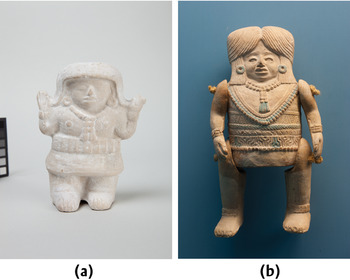
(a) Standing molded Campeche figurine with raised hands in “orant” position (Corson Reference Corson1976:203, Figure 27a, “Campeche Group A,” in memory of Christopher Corson [Raven]; Gallenkamp and Johnson Reference Gallenkamp and Johnson1985:159, Figure 98; Schele Reference Schele1997:181, Plate 9). Approximately 22.6 cm tall. (b) Articulated Campeche Group female figurine (Corson Reference Corson1976:206, Figure 30a and 30b “Campeche Group C1;” Gallenkamp and Johnson Reference Gallenkamp and Johnson1985:183, Figure 137; Mexicon Reference Whittaker2006, front cover). “Human Figure,” image courtesy of the American Museum of Natural History, 30.3/1250. 33 cm tall.

Further afield, a suggestive parallel can be drawn between the function of figurines among the Maya and an ancient figurine tradition in India rooted in the culture of Harappa and Mohenjo-Darra, and continuing today in Bengal. Clay miniatures of human attendants are still placed in figurative tableaux on temple altars to serve religious deities (Smith and Stevenson Reference Smith and Stevenson2010:39). Although the Indian figures may be categorized as attendants rather than sacred figures, the line between representations classified as sacred and those ostensibly secular can be hard to draw—particularly in the absence of social context.
Triadan's view that Aguateca figurines could have played a role as deities on household altars brings to mind a comparison with Hopi ritual clowns and the Katsina “cult” among the western Pueblos of the American Southwest. As Wright (Reference Wright, Vane and Bean1989:65) remarks, “… these so called Katsina dolls are not playthings or curios but a dramatic form of religious art.” Traditionally, they were secretly carved by men of the village and painted to represent the array of different spirits in the pantheon of supernaturals. The dolls, small copies of the external appearance of Katsina dancers, were given to young women and girls by their uncles who were dancing Katsina. These Katsinas range from improvising clowns to rather awe-inspiring supernaturals.
Taube and Taube (Reference Taube, Taube, Halperin, Faust, Taube and Giguet2009) consider Hopi ritual clowns as the equivalent of Maya figurines that represent well known genres from everyday Maya life, religion, or lore. In this manner, Maya Classic period figurines functioned much like Native North American Hopi Katsina dolls (tithu Katsinas). “They are the images of holy beings that are didactic and at the same time are owned by most members of the society. In addition to functioning in religious ceremonies, they serve also as children's playthings” (Taube and Tabe Reference Blomster, Halperin, Faust, Taube and Giguet2009:243). Like Jaina figurines they are multifunctional and multivocal.
From the point of view of one Hopi, Ramson Lomatewama (personal communication 2009)—elder, educator, and artist—Hopi tithu should never be confused with the Katsinas or their dancers. They have their own spirit that is within the object. As Blomster (Reference Blomster, Halperin, Faust, Taube and Giguet2009:142) remarks, figurines could be infused with an animating spirit; “different figurines could have been channels for different kinds of forces.”
Tithu Katsinas are never buried. When they are “worn out” spiritually and physically, they are discarded on a trash heap. This disposal of the object appears analogous to Mesoamerican traditions that resulted in the throwing away of figurines, later recovered by archaeologist from middens.
Although many tithu Katsinas are often recognizable as representatives of powerful supernaturals, this is not true of most Jaina figurines whose iconography first appears to identify them as representations of everyday life. This has led to debates and conflicting identifications, probably based as much on the tendency of Western science to insist on nonoverlapping categories as on cultural realities. On the one hand the little figures are interpreted as representatives of everyday life and a key to reconstructing the organization of Classic period Jaina society, but on the other hand they are argued to be mythological beings “in disguise” associated with the land of the dead.
Miller (Reference Miller1975) has creatively related Jaina figurines to characters and events from the great Maya creation and origin myth, the Popol Vuh. She followed Michael Coe and others who were relating images painted on polychrome pots to the K'iche Maya creation myth (Robicsek and Hales Reference Robiscek and Hales1981). Because the Hero Twins in the Popol Vuh were ballplayers, perhaps ballplayer statuettes present in Jaina graves recall the mythic actions of these demigods.
The collections from Jaina graves are remarkable for the scarcity of identifiable deities among the clay statuettes. This is particularly true when compared with the proliferation of sacred images on metropolitan sculpture to the southeast and on painted pots. When supernaturals do appear as Jaina-phase figurines, they are most commonly females: Chak Chel as warrior (Miller and Martin Reference Miller and Martin2004:117, Plate 60), and as midwife presiding over childbirth and the hearth (Figure 15a). She is quite similar to “The Warrior Queen,” one of the most important figures in the El Peru-Waka' assemblage. The image of Ix Chel as a young woman associated with the moon and sexuality is also prominently represented among female figures placed in graves (Figure 15b). Both deities are associated with both (re)birth and fertility and would be particularly appropriate for domestic rituals and burials.
In her guise as symbol of sexuality, Ix Chel is frequently paired with a lascivious old man who may be the aged sun god (Miller and Martin Reference Miller and Martin2004:116, Plate 59) (Figure 15c). As Schele and Miller (Reference Schele and Miller1986:153) remark about the same figurine pair, maybe this image promised “renewed sexuality for the entombed old men.” Although this is a charming speculation, there is no secure correlation between the appearance of this figurine pair and graves of old men.
The representation of mismatched pairs is hardly Maya-specific. As Taube and Taube (Reference Taube, Taube, Halperin, Faust, Taube and Giguet2009) point out in their recent article, “The Beautiful, the Bad, and the Ugly…” there is a European tradition of “ill-matched lovers,” and they provide illustrations from Nederlandish prints (2009:236, Figure 9.2) that mingle mythological, religious, and secular scenarios. The parallels with Jaina images are startling and lend support to the Taubes' contention that figurines capture the daily concerns of the wider society (2009:237) and need not be culturally specific.
Identifying deities and their iconography can be challenging at best. For example, Corson (Reference Corson1973; Reference Corson1976, Figures 2 a–c, Figure 3 a–b) is convinced that one of the most common Jaina-phase images, a seated female wearing a huipil (or quechquemitl) represents the Moon Goddess rather than just an elite woman (see Figure 16a). Figurines of women weaving, of which there are five recorded from Jaina, are also presumed to be the Moon Goddess (Arqueología Mexicana 2003:55, 2004:65; Schmidt et al. Reference Schmidt, de la Garza and Nalda1998:564, Number 182). Of note is the fact that the best known of these was excavated by Delgado (Reference Delgado1986:35, 36, Figure 16) from burial 87, an infant burial (Figure 16b). Once again, the correlation between the age/sex variables of the deceased and the imagery of the associated figurine is not immediately apparent. However, as a reviewer of this article pointed out, the connection between weaving, rebirth, and the Moon Goddess may make the placement of a weaving figurine in an infant grave conceptually appropriate.
Although potters produced an abundance of male figures, few can be securely identified as deities—despite the commonly made connection between ballplayers and the demigod Hero Twins. Most masculine figurines fall into the categories of lords, warriors, ballplayers, and members of a court. Aside from a magnificent, but so far unique “Jaguar God of the Underworld” (Finamore and Houston Reference Finamore and Houston2010:280–281, Plate 96; Miller Reference Miller1975:64, Figure 25), the most commonly encountered male “gods” are young and old men emerging from blossoms with long stems. The youths are usually tagged as “young corn gods,” and the elderly are simply referred to as “old gods” (see Figure 16c). Schele (Reference Schele1997:168–173, Plates 7–12) discusses these enigmatic figures and recalls that the Lacandon Maya say that their major gods were born from Plumeria or Tuberose flowers (p. 172) and gives additional examples of them from pottery and architectural decoration (p. 173); compare Miller (Reference Miller1975:57–59, Figures 22–24) and Schmidt (Reference Piña Chán, Schmidt, de la Garza and Nalda1988:593, Figures 299–300). Miller (Reference Miller1975:61), in her compilation, counts eight men and women in flowers. Again the imagery of birth and rebirth is repeated in Jaina mortuary art.
THE PRODUCTION OF FIGURINES
Where and how figurines were manufactured, let alone by whom, has received surprisingly little attention in the Maya area. Peña (Reference Peña Castillo2003) notes that workshops have been identified in Tabasco and the Peten, but evidence is lacking for them on the coast of Campeche and the northwest coast of Yucatan. Certainly there is no evidence that figurines were manufactured in quantity on Jaina. It can be proposed that there were artisans on Jaina who created the justly famous modeled figurines, while the mass quantities of mold-made figurines reached Jaina from workshops not yet located at Jonuta, Comalcalco, or other regional sites. This was certainly true of the later Campeche Group molded female figurines.
Instrumental neutron activation analysis (INAA) of Jaina samples conducted at the Smithsonian Institution (Bishop et al. Reference Bishop, Sears and Blackman2005) has identified different pastes for vessels and figurines. Some figurine pastes came from Jonuta, others from Comalcalco, and still others from many different locations in southern Veracruz. Some were even manufactured in the Jaina region (Goldstein Reference Goldstein1979).
It is usually assumed that figurines were produced by females and that the analysis of occupations they depicted would reveal their attitudes, particularly if the interaction between producers and users had a profound effect on the conceptualization and playing of social roles. Faust and Halperin (Reference Faust, Halperin, Halperin, Faust, Taube and Giguet2009:11) note that “human activities actively shape their material and cultural surroundings and their material and cultural surroundings shape them.” Since figurines represent an idealized world, the viewers and users will be encouraged to bring this world into their actualities. The Classic Maya site of Lubaantun in southern Belize, where figurines were manufactured in great quantities, should provide an example of Faust and Halperin's contention.
T.A. Joyce (Reference Joyce1933:xvi) excavated at Labaantun, where he encountered “an extraordinary abundance of pottery mould-made figurines and plaques each with a whistle at the back.” These were all confined to a relatively small area within the ceremonial center (Hammond Reference Hammond1975:373). He recognized that Lubaantun specialized in figurines in contrast to its neighbor Pusilha, which had an abundance of painted pottery that was absent at Lubaantun. There is a contrast between Jaina and Lubaantun in the number of figurines that show women engaged in domestic tasks. Prominent among the Lubaantun images are women grinding maize on their metates, one with a baby on her back (Joyce Reference Joyce1933, Plate VI) (see Figure 10b). On Jaina, weaving is the most frequent image of women's work, and, as mentioned above (see Figure 16b), women at their looms can be interpreted as images of the Moon Goddess, not of textile production.
There are two possible exceptions among the illustrated Jaina figurines that represent women engaged in domestic tasks: the “figurine of a woman preparing food” (Miller and Martin Reference Miller and Martin2004:174, Plate 57) and the figurine of a woman at her metate. The former is a typical Jaina Phase I, Group C woman, modeled with a pot and holding in her left hand what has been identified as a thick tortilla while by her left side sits a fattened dog presumably destined for the pot (Figure 10a). She is referred to as a “noble woman,” and if Corson (Reference Corson1973) is correct, she is related to the Moon Goddess. Regardless, she provides a rare depiction from Jaina of a woman carrying out everyday domestic duties. The second exception is a solid modeled figurine illustrated by Anton (Reference Anton1970, Figure 204). She is a standing woman grinding maize with two children, one on her back (see also Hillebrand Reference Hillebrand1974:148, Plate II). It would appear that the statuettes and plaques featuring women were destined to play a different role in household and burial rituals on Jaina than at Lubaantun and its neighbors.
Masculine figures from Jaina present the same selective presentation of male everyday life as appears to be true of female figurines. From the artistic evidence it seems that Jaina men spent most of their time playing ball or on the battle field, while the rest of the time they stood or sat around looking dignified. At Labaantun and El Peru-Waka' they also were boxers (Joyce Reference Joyce1933, Plate VII; Freidel et al. Reference Freidel, Rich and Reilly2010:1).
In 1992, Rosemary Joyce offered an intriguing hypothesis, arguing that the contrast between male and female roles depicted on ceramic vessels and by figurines expressed the distinction between men as producers of “raw” material and women as the creators of finished products. Weaving would be a case in point, as would be culinary activities. Unfortunately, Jaina figurines do not offer much support for Joyce's hypothesis. Most women are passive and are most frequently portrayed as a seated “moon goddess,” and even weavers are scarce. Similarly, although some warriors may actually be hunters, men do not seem to be engaged in activities providing products for women to process.
Also it is often assumed that there is a direct correlation between men's and women's activities and the sex of the interred, Blomster (Reference Blomster, Halperin, Faust, Taube and Giguet2009) has concluded these are independent variables. He cites the case of weaving and related artifacts associated with the individual in Monte Albán Tomb 7. These were used to “gender” the individual as female, although the fragmentary bones suggested a biological male. McCafferty and McCafferty (Reference McCafferty and McCafferty1994) remind the reader that figurines could be channels for different kinds of forces (not gender determined) and that the concept of coessence could determine the choice of figurine to be placed with the deceased to evoke spirits and/or ancestors.
Joel Palka (personal communication 2010) observed that objects depicting the human body hold or capture the animating life force(s) in a person; thus they are included in burials to retain the life force or capture it from the dead person so it does not leave the body and/or harm someone. If that be the case, what the figurine appears to represent is largely irrelevant to its function in the grave. It is not uncommon among the Maya and other American indigenous peoples to believe that life forces exist in what Westerners call inanimate objects, just as some Catholics view images of their saints as repositories of spiritual power. It is these beliefs that determine the appropriateness of the object to be placed with the deceased, not superficial similarities determined by sex, gender, or social role and status.
THE SHIFTING ROLE OF FIGURINES IN THE TERMINAL CLASSIC PERIOD
In a broader sense it is not simply what the figurines portray and how, but how changes in figurines and figurine frequencies and types mirror changes in the society itself. Why, for example, are figurines so popular during the Preclassic period and then become less frequent and virtually disappear during the earlier Classic period in the Maya area? This is particularly strange since the manufacture and use of figurines remained strong in the central Mexican highlands. Marcus (Reference Marcus1996:290) correlates the change in figurine popularity in Oaxaca with the increasing complexity of Oaxacan society during the Classic period. In this case, invoking the royal ancestors and the rising role of the priesthood profoundly altered the role of household rituals for commoners and reduced the role of nonelite women in communicating with deceased ancestors.
In respect to the Maya, the intriguing question is, why, in the Late Classic period, did the trend reverse and the frequency of figurines in assemblages increase so greatly? What could have been the changes in the political and economic hierarchies of Late Classic social organization that would encourage the reinstitution of figurine rituals (Roosevelt Reference Roosevelt and Miller1988:2)?
If it is correct that figurines were more connected with household activities, whether depicting activities of regal, noble, middle status, or common persons, this may be early evidence for the loosening of the centralizing grip of the holy lords and their vast courts. This would be particularly true in the commercializing societies of the Terminal Classic period where the maritime elite garnered wealth for themselves in this new era.
On Jaina there is a change from a preponderance of hand-modeled figurines classified by Corson as “Jaina Phase I” to those he classifies as “Jaina Phase II” (see Piña Chán [1968] Tipo I to Tipo II). In this latter phase there is a progressive adaptation to molding technology and to the function of female figurines as rattles and male figurines as whistles. It is likely that this represents a commercialization of figurine manufacture and a concomitant shift in the appropriateness of certain objects to be used in household activities and mortuary rituals.
An even more radical change marks the transition on Jaina to Jonuta Group A, which appears to have been first traded in from the lower Usumacita drainage and then imitated. Jonuta Group A in turn intergrades with the untempered orange ware of the Campeche phase with its white-slipped torso (Corson Reference Corson1976:147–148). Unlike the Jonuta Group, the Campeche Groups are characterized by molding hollow female figurine rattles with their arms raised close to their sides in what has been interpreted as a gesture of awe and reverence (Figure 17a) and closely resemble styles associated with southern and central Veracruz. This provides evidence for the expansion of Chontal-speaking “Putun Maya” around the Yucatan Peninsula and their increasing domination of Terminal Classic commerce.
Evidently historical events were considerably more complex. Although the styles are often assumed to be chronological markers, the same grave is apt to hold examples of both Jaina phase and Campeche Group figurines. Even the articulated figurines restricted to the Campeche Group are represented in these mixed funeral assemblages (Figure 17b). Benavides Castillo (Reference Benavides Castillo2006) has published a Classic period example of a figurine that was probably manufactured in central Veracruz before being placed in a Jaina grave. This is an example of the well-known articulated “dolls” that occur with some frequency in Jaina Island graves and along the western coast of the Yucatan Peninsula. Also among similar recent finds is a standing Campeche Group female mold-made figurine with arms raised to her shoulders. This object, produced for regional or long-distance trade, was excavated by the Proyecto Arqueológico Jonuta 2009. It has been dated to the Terminal Classic period (a.d. 850) (Arqueología Mexicana 2009:10).
The Campeche Group figurines probably were produced for use in a particular ritual that was shared by various groups along the littoral of the Gulf of Campeche. Since they are found as additions to the figurines commonly placed in Jaina graves, they do not appear to mark a sharp break with traditional mortuary rituals. Instead, they exemplify the international and multicultural dynamics of Terminal Classic period societies, rather than the chronological lock-step and stylistic replacement assumed by earlier typologies.
CONCLUSIONS
Jaina as a Necropolis
Benavides Castillo (Reference Benavides Castillo, Hernández and Márquez2007:22) remains convinced that Jaina never served as a cemetery for outsiders nor as a necropolis. The number of graves is due to the accumulation of inhumations of many generations in a restricted space. He estimates that five generations a century for hundreds of years would fill up the space and was adequate for burying the elite, “middle class,” and commoner.
An alternative explanation for the source of corpses would be that the buried population was brought from the mainland to a sacred necropolis (Prager Reference Prager and Grube2000). It has even been suggested by Griffin (Reference Griffin2007:128) that the burying population brought their figurines with them, having carried them from the region from which the dead person came. If they did, then the question arises: If Jaina was a necropolis serving the mainland, what happened to the thousands of bodies produced over generations by the local population? Were they tossed into the sea to make room for “paying guests?”
For many, the high number of primary burials on Jaina does not match the pattern of graves identified at other Maya sites. The Maya are well known for practicing a variety of methods to dispose of their dead: tombs, cremations, crypts, in middens, in fill, underneath house floors shrines, caves, etc. (Ruz Lhuillier Reference Ruz Lhuillier1989). Even at major sites only a few thousand people lived in the confines of the settlement and the burials number in the hundreds.
Furthermore, if Jaina supported a food producing population there was not a lot of space for them and their gardens. Conversely, if the majority of the residents were devoted to non-food producing activities, from where did they import their provisions?
When all the excavated data are reviewed, Benavides Castillo's hypothesis that the living inhabitants of Jaina Island were the primary burying population bears further investigation, particularly if Jaina was a functioning residential city and not just a commercial and ceremonial center. Jaina's civic architectural complexes, sculptural images, epigraphy and other site features indicate that its resident population was stratified. The extent to which its population was stratified is less clear from the contents of the graves as is any variation of intermediate elite or sajalob. What is clear is that Jaina possessed a locally specialized burial cult that remains unmatched at other contemporary Maya sites. It may be that the other western coastal sites, Isla Piedras and Isla Uaymil, shared in these burial cult practices which are similar to ones reported from central and southern Veracruz (Antonio Benavides Castillo, personal communication 2010). Unfortunately, these coastal sites have also been savagely sacked.
Perhaps one impetus for the development of the cult was the lack of other burial options on an island cut off from the mainland by a shoreline densely covered with mangroves. Another could be the significance of its far west location “over the waters,” which could then be used to attract additional merchants to its sacred shores. Commerce and religion are inextricably intertwined whether expressed in pilgrimage or fiesta markets.
Ideological factors contributing to Jaina's exceptionalism should not be overlooked. The symbolism of Jaina and its graves is well summarized by Velázquez Castro in his thesis, Los ofrendas mortuorias de concha de la isla de Jaina, Campeche (1988:40). “Mucho de la evidencia arqueológica de Jaina, guarda relación directa con este ciclo mítico vida-muerte-renacimiento: para empezar, el enclave del sitio, en el lado mas occidental de la península yucateca, nos coloca ante las puertas del inframundo, tanto por la presencia del mar a él como porque el oeste, lugar por el que el sol se oculta, es to punto cardinal asociado a la muerte y al inframundo; en este mismo sentido no hay que olvidar que los entierros por lo regular se hallaron a la orilla del mar—o del río, fuentes de agua que sin duda evocan al inframundo…” (author's translation: Much of the archaeological evidence from Jaina bears a direct relationship with this mythological cycle life-death-rebirth: to begin, the setting of the site on the westernmost side of the Yucatan Peninsula, placed before the doors of the underworld… placed where the sun sets, it is the cardinal point associated with death and the underworld; in the same sense, it should not be forgotten that the burials are regularly found at the sea shore or on the banks of the river, sources of water that undoubtedly evoke the underworld…).
Stephen Houston (Reference Houston, Finamore and Houston2010:74) sums up what he sees as “… the safest scholarly route [that] lies between the two extremes, acknowledging Jaina as an active participant in coastal interaction yet with unusual features and a special mortuary role for the figurines of the zone.” I agree with Houston's conclusion, but feel that to underplay the ideological features underlying Jaina's material success is to deny the power of symbolic thought so characteristic of Maya civilization.
Representing Social Status and Role
Interpretations of who or what the figurines portray range from actual portraits to deities masquerading as mortals (or mortals masquerading as deities). Portraiture seems unlikely. Corson (Reference Corson1976:168) wrote that it was not possible even to specify whether the fine modeled little figures constituted portraits, “as numerous of the supposed portraits fail to reveal emblems of status which would separate them from the replicative groups….” The difficulties of trying to force figurines into categories of “deity, deity impersonator, nondeity” has been discussed above. Adhering to fluidity of classification rather than to rigidly exclusive categories will yield a greater understanding of the social organization represented by Jaina figurines.
The extant corpus of figurines does not represent the range of statuses and roles expected to be present in any Classic Maya community. If it is true, as in all early states, that the elites represent 10–15% or less of the population of a community, then where were all the common folks buried? If only the upper ranges of society on the island were permitted to be placed in graves, then were the hoi polloi tossed into the sea? Again, this is a highly unlikely scenario.
However, Benavides Castillo believes that the differences in grave goods do reflect different socioeconomic levels of the island's population. Support for this conclusion could be drawn from the changing organization of Late-Terminal Classic period Maya social organization. With the breakdown of an almost caste-like stratification system to the southeast and the rise of a commercial class along the coast, intergrading statuses would emerge and erase the ancient distinctions between farmers, craftsmen, intermediate elites, and royal lineages.
The famous figurines were not objects restricted to upper levels of society but were household items used in a domestic context, which is consistent with other regional sites. It is only unusual that on Jaina so many figurines were placed in graves and that so many appear to collectors and museum curators to be exceptionally fine. Once again, the data are biased. Benavides Castillo (personal communication 2010) warns that if you visit the archaeological bodegas in Campeche and Merida, you will find that there are many figurines that are not so fine. The best are given attention and go to the international exhibitions or appear in publications, but many others stay at home. Unfortunately, the survey of bodegas in Mexico and the gathering of statistical data are beyond the scope of this article.
However, if statistics were available, the stratification system of Jaina might be clearly marked by the distribution of quality figurines and other status indicators that could be associated with the graves of sajalob when compared with the lesser quality of those found buried with lower ranked individuals.
Nonetheless, it is worth noting Halperin's (2009:385) finding that the identical forms of iconography were present in households of both common people and the elite supports the “multivocality” of images as they shift from one context to another. Since a preponderance of her figurines are mold-made, the quality of the figurines is apt to remain the same across statuses.
The Life of Figurines
It seems probable that prior to burial, many of the figurines, much like Hopi tithu Katsinas, were given as gifts, perhaps intended for young relatives, and were essential for learning social statuses and roles in the social and supernatural worlds. These would become part of household shrines and rituals, gaining an aura of sacredness before they followed their stewards into their graves.
Therefore, it is the “life of figurines” that holds the key to uncovering the meaning of the figurines placed in graves. I have stressed that the sacred/spiritual nature of figurines chosen for mortuary use is derived as much from prior use and associations among the living as it is from its iconographic markers identified by its excavators. As a member of an assemblage, an individual figurine partakes in the overall sacredness of the scene. When removed from the whole, it carries with it a share of the ensemble's spirituality, which can then be invested in its new setting.
Given the canons of Classic Maya art, whether painted, carved, or modeled, it is clear that a single image can represent a range of beings, from sacred to secular. The much debated moon-goddess serves as a clear example. There certainly were real women; some of high status, weaving cloth for elite consumption. There certainly were many myths that associated Ix Chel with weaving. Perching a bird on a craftwoman's loom causes it to resonate with a sacred symbol associated with the sun god; thus, it becomes quite appropriate to place in any grave, male, female, or infant (Figure 16b).
Figurines in Ensembles
If figurines placed in graves on Jaina had previously been members of a domestic ritual scene, what images were used to compose these assemblages? The most frequently encountered figurines taken from Jaina graves (Table 1) follow rather closely the ensemble of types that characterize the El Peru-Waka' offering. The courtly scene would include a lordly figure either enthroned or standing. He would be in the company of an elite female, usually seated and referred to by Corson (Reference Corson1973) as a “Moon Goddess,” followed by the attendants, musicians, dancers, “orators,” and scribes. Other figures representing warriors and ballplayers would appear, as would some that have been labeled priests or shamans. Accompanying the court would be a band of “contraries” including dwarfs and hunchbacks. Also prominently displayed would be statuettes of Chac Chel (as warrior or midwife) or Ix Chel in her role as a symbol of sexuality.
Although mismatched male-female pairs were popular, they are absent from the El Peru-Waka' set. Sears (Reference Sears2001:257–258, Figures 19.13 and 19.14) offers comparisons of figures from Cancuen with examples from Jaina and Jonuta. Perhaps these pairs were not part of scenes but operated independently. Jaina has yielded relatively few animal representations. It is possible that these images of nature were considered less appropriate for burial with humans.
Certainly it would not be expected that all household rituals presented only images that followed a single protocol. If modern ofrendas (altar offerings) constructed to celebrate el dia de los muertos (Day of the Dead) in both Mexico and the United States are considered, each installation reflects the life of the individual or group being celebrated (Mexican Fine Arts Center Museum 1991). Objects imbued with the sacred can take many forms.
Further elaboration of Schele's notion that ancient Maya figurines were analogous to little figures assembled in a Christian Nativity creche may yield additional insights into the process and elaboration of household altars. The basics are an infant in a crib surrounded by a kneeling woman in blue and a male figure dressed in simple rustic clothes. Then there is a raft of supplementary figures, both natural (shepherds) and supernatural (angels). An interpretive challenge would be offered by the three richly robed males holding what would appear to be symbols of high status. Are these attendants, sacred beings, or exotic visitors? And yet, for the religious cognoscenti any one of the figures could be separated and placed elsewhere, and still maintain its spiritual quality.
In the permanent exhibit Mexicanidad on display in the National Museum of Mexican Art in Chicago (formerly the Mexican Fine Arts Center Museum) is a creche scene set in a Mexican village. Although the essential characters are there, the landscape is populated by a riot of characters dancing and making music. Even the devil and his band are included lurking down by the stream bed. Such creative elaboration of sets of key icons was probably as characteristic of ancient Mexican scenarios as it is among their descendants today (Vogt Reference Vogt1969:485, Illustration 165).
Recently, Halperin et al. (Reference Halperin, Faust, Taube and Giguet2009:472) have brought forward a view that is relevant to any analysis of figurine functions and distribution. They propose that Late Classic Maya figurines do not necessarily represent everyday life, but instead reflect a performative and public context that alludes to festivals and fairs, ceremonial pomp, and spectacle settings. The authors' argue that figurine distribution is as much a function of their festival and fair market model as it is of local or long-distance exchange. They compare their data from Motul de San José near Lake Peten Itza with data gathered by Sabloff and Rathje (Reference Sabloff and Rathje1975; see also Sabloff and Freidel Reference Sabloff, Freidel, Sabloff and Lamberg-Karlovsky1975) on Cozumel. If this festival and fair model can be applied to Cozumel, then it is equally applicable to the pattern of exchange postulated for Jaina. Figurines in “fancy dress” appropriate for ceremonial pomp and performance would explain why the social organization of Jaina is not directly related to figurines decked out for theatrical performances. Furthermore, it is certainly appropriate to speculate that these figurines in households would have formed assemblages of the various performers and served as a rich resource for the selection of mortuary offerings.
Shifting Commercial Routes during the Terminal Classic Period
Complicating the picture of figurine use and distribution is the fact that figurines apparently were widely traded not only around coastal Yucatan, but up and down the Maya river systems as well (Goldstein Reference Goldstein and Robertson1980:95). Sears (Reference Sears2006) has described this center-to-center trade in detail, and with the INAA carried out by Bishop (Sears and Bishop Reference Sears, Bishop, Laporte, Escobedo and Arroyo2002), trade can be traced from Jonuta up the Usumacinta to Cancuen on the Pasión River. Flores Jiménez (Reference Flores Jiménez, Blos, Cobas and Robertson2002:433) is probably correct in her judgment that many pieces found at Palenque had been produced for interregional exchange of prestige objects. In fact, as Goldstein (Reference Goldstein1979:121–122, Reference Goldstein and Robertson1980:94–95) has observed, the highly prestigious XAC-style figurines (Butler Reference Butler1935) reached their longest trading distance between Jaina and Palenque (Sambale Reference Sambale2002).
There is no evidence that figurines were produced in any quantity on Jaina, certainly not in sufficient numbers to stock the hundreds of graves. In fact, in the first application of INAA technology (Goldstein Reference Goldstein1979) it was clear that the Jaina figurines were molded or modeled from many sources of clay. Benavides Castillo (personal communication 2005) points out that there are no sources of clay on the island and that Jaina was a center for the distribution of clay objects proceeding from diverse localities, as far as the central and southern part of Veracruz—objects that were made at various points in an ample commercial circuit.
Societies producing and consuming Jaina-style figurines flourished during the time of change and innovation that marked the end of the Late Classic period. They participated in a grand commercial circuit at least 700 km in length from Isla de Sacrificios, Veracruz, to the northeast of coastal Yucatan (Benavides Castillo Reference Benavides Castillo2009).
As the shift to the Postclassic world system gathered momentum, access to new resources and commercial opportunities were available, and these societies no longer responded to symbolic and economic pressures that emanated from the weakening cultural system to the southeast (Smith and Berdan Reference Smith and Berdan2003). This was a time remarkably like the end of the “Middle Classic” era marked by the decline of Teotihuacan and the rise of Cacaxtla, Xochicalco, and El Tajn, dynamic “eclectic centers” in the central highlands and on the Gulf of Mexico. It was “high times in the hill country” (Carmean et al. Reference Carmean, Dunning, Kowalski, Demarest, Rice and Rice2004) as the Puuc centers expanded and international markets driven by expanding maritime commerce opened up. Local power holders, formerly unable to claim legitimate Ajaw status, now proudly presented themselves as sajalob or lesser nobles.
However, neither the minority nonregal elites nor the majority of the population had access to the quantities of jade, quetzal feathers, pearls, and Spondylus shell so highly prized by the traditional lords in their royal courts. Instead, the previously provincial people gloried in their own ceramic representations that replaced images once found on prestigious polychromes and stelae—and in their splendid images carved from the common marine conch that populated their beaches and inlets rather than from imported exotic shells. In the grave they placed finely crafted figurines, replacing the figural polychrome pots that once spoke to the spirits of the deceased as they traveled the road to Xilbalba.
RESUMEN
Las figurillas de barro estilo Jaina son unos de los objetos más conocidos y admirados en todo Mesoamérica. A pesar de su popularidad con los historiadores de arte precolombino y arqueólogos mesoamericanos, todavía existen algunos problemas con los artefactos que no han sido tratados a fondo por los investigadores. Las funciones y los roles de estos en la sociedad maya del período clásico tardío no han sido examinado adecuadamente. El hecho de que la mayoría de las figurillas Jaina provienen de entierros presenta un reto a la interpretación de estos objetos y el uso de ellos. En el sureste de Mesoamérica se encuentra una cantidad alta de figurillas o sus fragmentos en contextos domésticos, especialmente basureros. ¿Será que Jaina era una necropolis maya donde los habitantes de Campeche enterraban a sus muertos en búsqueda de una puerta al inframundo Xibalba en esta isla occidental? Por el contrario, el autor los entierros provienen de los mismos residentes de Jaina a través del tiempo y concluye que su uso como una necropolis no es cierto.
Este artículo discute los rasgos específicos culturales y arqueológicos de Jaina dentro del contexto general del desarollo político y económico en las tierras bajas mayas del norte en el periódo clásico terminal. Los cambios culturales en esta época fueron respuestas al colapso de las cortes reales del clásico tardío dominadas por los nobles sagrados (k'uhul ajaw) en las tierras bajas del sur. Aunque los mayas en las tierras bajas del norte trataron a emular las estructuras arcáicas de la sociedad maya clásica del sureste, por ejemplo creando su propio emblema jeroglífico, su nueva economía política era más abierto y fue controlada por la elite maya intermedia y no por la realeza. Este cambio refleja directamente una reorganización social y económica dominada por la clase mercantil. Cuando estos mercaderes se esparcieron por toda la peninsula de Yucatan sus centros y bases comerciales ganaron riqueza económica.
A pesar de que no tuvieron mucho acceso a objetos reales tradicionales, como jade, plumas exóticas, y concha importada de Spondylus, estas nuevas élites mayas crearon sus propios recursos que incluían figurillas finas de barro y objetos de concha trabajados.
Este artículo también considera la producción de grupos de figurillas para uso ritual en contextos domésticos. Estos grupos de figurillas luego pasaron a ser una fuente de objetos para ceremonias mortuorias. Era este uso ritual en contextos habitacionales lo que determinó su colocación en un entierro específico en vez de acuerdo a la edad, sexo, u ocupación del muerto.
ACKNOWLEDGMENTS
This article could not have been written without the support of two summer grants from Dumbarton Oaks Research Library and Collection. I would like to thank all the staff members of the Pre-Columbian Studies Division for their guidance and assistance. I owe a particular debt to Bridget Gazzo, Pre-Columbian Studies Librarian and Bibliographer, and to Jeffery Quilter, former Director of Pre-Columbian Studies. Joanne Pillsbury, current Director of Studies, Pre-Columbian Program, deserves recognition for encouraging me to pursue my research interests beyond my original project examining Classic Maya period carved conch shell plaques and to include the related Jaina-style clay figurines. Among others deserving special commendations are Juan Antonio Murro, who assured me access to the collections, and Reiko Ishihara-Brito, who provided me with insights into Maya research at Dumbarton Oaks. Deserving of my sincerest gratitude is Antonio Benavides Castillo, Instituto Nacional de Antropología e Historia Campeche. To attempt to research Mesoamerican artifacts without a Mexican collaborator would be a thankless task. Among my many colleagues who shared their expertise with me, I thank Joel W. Palka and Virginia Miller, both of the University of Illinois, Chicago, and Cynthia Otis Charleton, associated with the University of Iowa, expert on figurines and household workshops. I would like to recognize Nilda Flores-Gonzales, also of the University of Illinois, Chicago, for her translation of my resumen. Recognition is also due to Dr. Charlotte Smith, a Senior Curator at Museum Victoria, Melbourne, Australia, who shared her expertise with me on clay figurines manufactured on the Indian subcontinent for over three thousand years. I am grateful to Richard Gricius for sharing his expertise in computer graphics and design. Finally, I thank my wife, Mary Frech McVicker, without whose expert editorial skills my prose would be even more convoluted.