After the end of the Second World War, Germans in all four occupation zones faced the hostility of an international community that had observed and experienced the war and crimes of Nazism. This enmity continued after the founding of the Federal Republic of Germany (FRG) and the German Democratic Republic (GDR) in 1949. In the early 1950s, in the context of the heating Cold War, each state sought acceptance within the international community through economic cooperation and military alliances. The high-level German diplomatic efforts of both states in this period demonstrate the emerging competition between the two Germanys, as well as their respective prioritization with gaining acceptance in their own bloc.
In 1955, the Federal Republic joined the North Atlantic Treaty Organization (NATO), founded in 1949, and the GDR became a cofounder of the Warsaw Pact in the same year. By the mid-1950s, however, traditional high-level diplomacy had become static in the Cold War environment. In particular East Germany, as an entirely new state that was in addition the smaller and less prosperous of the two, struggled to find international recognition outside of the communist world. To achieve this aim, the GDR government turned to foreign cultural policy (auswärtige Kulturpolitik), a method of diplomacy that aimed to cultivate a positive impression of its state among foreign politicians and populations through techniques varying from visiting orchestras to propaganda magazines. This foreign cultural policy would not change the competitive and reciprocal nature of the Cold War, but by 1955–56 the GDR shifted the focus of its diplomacy away from its own bloc to aggressively targeting nonaligned countries and selected states and groups in the Western world with its new cultural promotion initiative. In other words, in the middle of the 1950s both the regional focus of East German diplomacy and its means underwent a profound shift. It sought to combat its relative weakness in the inter-German competition by compensating with cultural advertising campaigns demonstrating the vibrant economic and cultural success of the East.
The FRG, which was recognized by the Western international community as the successor state of the defeated Third Reich and the Weimar Republic, was initially satisfied with prioritizing its connections to the West. At first, Bonn had little to answer in its response to the increasingly assertive East German foreign cultural policy.Footnote 1 Officials in the West German Foreign Office (Auswärtiges Amt) cited their lack of funding and organization vis-à-vis the centralized dictatorship of the East to explain this imbalance even as some worked to address it.
The first academic studies of the Cold War published in the 1970s and 1980s approached each German state's foreign policy as an extension of their respective superpower allies. Some focused on the institutions under concern, explained the core actors, or examined the diplomatic agreements of the period.Footnote 2 One early work on foreign cultural policy that focused on the self-representations (Selbstdarstellungen) of the GDR and the FRG was the 1980 book by political scientist Anita Mallinckrodt. It examined the cultural image of both states and demonstrated that these images, though on some level propagandistic, are vitally important in the creation and maintenance of international relations because they affect broader public perceptions of the two states. But her examination of self-representations was limited to a case study of German foreign-policy material aimed at American audiences. The focus was primarily on the institutions involved in creating these images.Footnote 3 Although Mallinckrodt's study was an interesting start, her analysis tended to eschew close interpretive analysis of specific media campaigns to instead focus on the broader development of state systems.
Later, studies from the 1990s looked more at foreign cultural policy and provided a great deal of contextual information on the development of the foreign offices and the relationship between the governments and the intermediary organizations.Footnote 4 But these works mostly restricted their analysis to institutions and government offices rather than examining the specific images that were produced over the course of German division. Most explored the foreign policy of one of the German states and interpret it solely within a broader Cold War context or in relation with their superpower allies.Footnote 5 More recently, Johannes Paulmann in his 2005 study of foreign representations (auswärtige Repräsentationen) in German cultural diplomacy after 1945 attempted to integrate the narrative that was framing foreign representations. He conceptualized the cultural representations of each side in a Cold War context as a “mirror image of the unloved other” in relationship to the National Socialist past and the “other state” in a divided Germany.Footnote 6 In a related vein, Frank Trommler's 2013 book on the development of German foreign cultural relations in the twentieth century focuses more on the institutional dimensions of cultural diplomacy. It demonstrates how the FRG developed a series of intermediary organizations (Mittlerorganisationen) that served as semiformal ambassadors to foreign countries at the same time as the GDR centralized its efforts toward legitimacy through government organizations.Footnote 7
Building upon these pioneering studies and using some of their framing for a study of the selfimage of each states and their interrelationship, this article pursues an entangled approach that more closely examines specific image-building campaigns as they developed in magazines central to divided Germany's foreign cultural politics during the 1950s and 1960s.Footnote 8 To that end, I explore the following three questions: First, how did these politics develop over time in each state? Second, what organizations and instruments were used to carry out these politics? And third, how do their messages and the relationship between the German states emerge in the self-representations present in their media productions, such as Scala International and GDR Review? I start the following analysis with a brief discussion of the institutions, organizations, and media of cultural diplomacy first in the GDR and then the FRG. Afterward, I look at the competing self-representations of both states with a focus on the images of women's role in society, because this was one core theme of the cultural Cold War, and one which the GDR particularly emphasized. I end with a comparative examination of the representations of rebuilding and industrial development in both states, which the Federal Republic used in its attempt to stake its claim as the superior Germany.
Institutions, Organizations, and Media in the GDR
In East Germany, the Society for Cultural Relations with Foreign Countries (Gesellschaft für kulturelle Verbindungen mit dem Ausland; hereafter the Gesellschaft) and the Ministry of Foreign Affairs (Ministerium für Auswärtige Angelegenheiten) implemented and guided foreign cultural policy. The relationship between the Ministry of Foreign Affairs and the Gesellschaft grew increasingly conflicted through the mid-1950s because of the disorganized nature of the GDR's foreign cultural policy and its overlapping structure of control. Ostensibly, the Ministry of Foreign Affairs was to supervise the Gesellschaft and provide oversight while the Gesellschaft implemented policy. In effect, however, the Ministry of Foreign Affairs had only little oversight. As a result, it alternated between denying responsibility for the Gesellschaft's implementation of foreign cultural policy and demanding heightened supervision over it in the future.
The central figure in this bureaucratic context was Rudi Engel. Technically an employee (Mitarbeiter) of the Ministry of Foreign Affairs, Engel was well known to the Central Committee (Zentralkommitee, ZK) of the ruling Socialist Unity Party (Sozialistische Einheitspartei Deutschlands, SED). He had belonged to the group of communists that had taken shelter in Moscow during the Second World War. As the liaison between the Gesellschaft and the Ministry of Foreign Affairs, he played a central role in determining how it was restructured in 1958, and he used his personal relationship with the ZK to lobby for additional powers for the Ministry of Foreign Affairs in foreign cultural policy.Footnote 9
Starting in 1954, Engel, with the support of the ZK, was a driving force in changing the tasks of the Gesellschaft from providing support, organize, and evaluate the relations with socialist countries to an expanded focus on the capitalist countries of western Europe and the nonaligned countries of Africa and Asia.Footnote 10 This altered focus in the GDR's foreign cultural policy was primarily conveyed through a series of print media publications. The first magazine, aiming at the new goal of building connections in the West, was DDR im Aufbau (GDR under Construction), which came out since the mid-1950s and was produced by the Gesellschaft with a circulation of 120,000 copies. In addition, two similar, but smaller magazines were also published with another 65,000 copies. One of them, DDR Revue, was proposed in a council meeting of the Ministry of Foreign Affairs headed by Engel. DDR Revue was supposed to be of higher quality. It should impress readers still unsure about East Germany and provide information about a peaceful and sovereign GDR.Footnote 11
In the end, the Gesellschaft produced two major magazines that served its cultural diplomacy, DDR and DDR Revue. DDR was primarily distributed to socialist countries with a yearly circulation of approximately 1.5 million copies in Russian, Chinese, Polish, Czech, and German. The Soviet Union was the chief consumer of this magazine. DDR Revue was, by contrast, primarily designed for the capitalist world and appeared monthly with a distribution of 600,000 copies. It was produced in German, English, French, Swedish, and Spanish—the name of the English-language edition was GDR Review—and was sent primarily to Australia, France, Britain, Latin American countries, Sweden, and India, as well as to all of the trade missions of the GDR.Footnote 12
The commitment to print propaganda in the GDR contributed greatly to efforts of the Gesellschaft, and later the League for the Friendship between Nations (Liga für Völkerfreundschaft, Liga) to transform DDR Revue into a magazine capable of pursuing the regime's goals. The Liga, founded in 1947, was an umbrella organization of friendship societies and committees in the GDR. Its task was to contribute to the establishment and maintenance of international relations of the GDR. Both organizations were quite efficient in their public-relations production. For example, in 1958 the Gesellschaft produced thirty-two different thematic brochures and distributed 600,000 copies in sixteen languages, 67 percent of which were in German, English, and French. Of these, half were on political themes and questions, while the others spanned economic, social, and cultural issues.Footnote 13 In an effort to improve its publications, the Gesellschaft emphasized the need to make the content and form more appealing as well as to increase the speed of production of its publications. This was a major issue because up through 1958 the magazines could only contain articles on long-lasting or persistent themes (thus becoming stale) because production, translation, printing, and manufacture took months.Footnote 14
The production of print media like DDR Revue was given consistent emphasis in the GDR's foreign cultural policy. Print publications were usually at the top of the list of the Gesellschaft's and the Ministry of Foreign Affairs's priorities because they offered a means to inform and influence large audiences in countries that would not accept formal diplomatic relations with East Germany. Observers in the Federal Republic's Foreign Office correctly identified the intent of this media to establish cultural connections with well-connected and sympathetic individuals. These figures could then either spread their knowledge of East Germany to the general population or place pressure on government officials to work with the GDR. The East German Ministry of Foreign Affairs hoped to use these cultural relations to cultivate economic agreements that could culminate in full diplomatic recognition.
The relative prioritization of foreign cultural policy in each state can be somewhat obscured if looking purely at budgetary figures. In 1956, the yearly budget goal for funding foreign propaganda was to be more than 1.2 Million DDM (East German marks) in the GDR, and even the far more modest actual amount of 678,000 DDM was still a significant figure in the rather narrow field of publications.Footnote 15 In contrast, the Federal Republic failed to prioritize print media despite its budget of 18 million DM (West German marks) for foreign cultural policy, which was certainly worth far more than the East German mark. The FRG's budget made no direct references to print media production and tended to prioritize other efforts such as expanding German-language training. These efforts reflected a general trend in West German foreign cultural policy to largely ignore the GDR while establishing cultural connections to other countries. As a result, Bonn did not aim for the same kind of direct juxtaposition with the neighboring other, as the GDR had prioritized. The lack of any kind of central publication about the FRG and persistent funding complaints from both the Federal Press and Information Office (Bundes Presse- und Informationsamt, BPA) and the Foreign Office in this matter further indicate that print media were not initially a priority.
Institutions, Organization, and Media in the FRG
The relative importance of foreign cultural policy in the Federal Republic during the 1950s was not high. Complaints over insufficient funding peppered numerous reports from the Foreign Office and the BPA to the federal government, varying from concerns that federal funding could not keep up with the demands of foreign audiences for material to fears that high-quality East German material would outshine the economically more-prosperous West. What the lack of funding and general lack of focus belies, however, is the remarkable frequency with which this topic is mentioned and discussed at high-profile events such as speeches to academics, radio programs, or newspapers.Footnote 16 Furthermore, officials within the Cultural Department (Kulturabteilung) of the Foreign Office in their communications with other government branches, such as the BPA or the National Head Office for Tourism (Zentrale für Fremdenverkehr), showed that there was a strong understanding of the need for the Federal Republic to begin to cultivate a more comprehensive policy to compete with the campaigns emanating from the rival East.Footnote 17 Despite these conversations, however, the FRG struggled to respond to the increasingly robust and active foreign cultural policy developed in the GDR. Frequent reports, interdepartmental memos, and meetings of related government institutions demonstrate that officials had no choice but to admit just how far ahead the GDR was in the creation of a state image and building relations. Although the complaints were partially an effort to obtain more funding, the fact remained that West Germany lacked a print media campaign competitive with the East.
In February 1956, Federal Republic embassy representatives met in the West German capital of Bonn to discuss what they referred to as the “cultural offensive in the Cold War.” These West German Foreign Office officials stationed in thirteen countries discussed the new aspect of the “psychological” war the East was waging wherein worldviews struggled on the “battlefields” of radio, television, magazines, newspapers, theater, ballet, film, and sport among others. Their conclusions about the emerging situation called for action on the part of the federal government, while citing the difficulty of separating the cultural and political in a democratic, if not in a totalitarian, society. The common refrain of identifying ideological conformity and dictatorship in the East as the reason for the GDR's lead in producing foreign cultural policy material pervades West German documents on the topic. According to some in the office, the critical shortcomings of the FRG's foreign cultural policy included a lack of observers, general staff, funding, or a plan. In their minds, the cost of this “psychological” war of foreign cultural policy was minimal by comparison to a hot war, and thus the federal government should recognize that the increasing cultural activity of the GDR was a part of a planned offensive in the Cold War that must be answered first by observation and reporting and then by responding in kind.Footnote 18
The activities of the GDR grew more alarming for members of the West German Foreign Office when they received reports from their embassy in Australia that in 1956 East Germany had begun distributing print media there, which the embassy lacked the means to combat. A representative of the Foreign Office in Australia wrote a report to the BPA requesting material to compete with the cultural and economic advertising magazine GDR under Construction.Footnote 19 Earlier in 1956, the Foreign Office had sent a memo to BPA entitled “Soviet Zonal Culture Propaganda” criticizing the existing FRG promotional materials. The media distributing organization, primarily contracted by the BPA, Inter Nationes, had offered two print options to all embassies—the Bulletin, a plain news text, or the German Review, a magazine that focused much more on tourism propaganda than cultural advertising. Inter Nationes had been founded in 1952–53 as a private association, initiated by the Christian-conservative government under Chancellor Konrad Adenauer, to produce and distribute publications that informed an international audience about West Germany.
The report sent from the Foreign Office to the BPA found both options lacking. Instead, the FRG needed something informative and well made like the GDR magazine, which could be distributed at no cost to subscribers.Footnote 20 In his response two weeks later, Helmut Arntz, who worked from 1951 to 1957 as a leading official (Referent) for the BPA, agreed that an illustrated magazine was important to the BPA and had been a goal for some time, but it was actually the responsibility of the Foreign Office to make it, not the underfunded BPA.Footnote 21 The Foreign Office found itself in a bind because the GDR's ongoing campaign included print media that was more appealing to foreign audiences than West German equivalents, but there was a conflict over who should take responsibility to develop new publications.
The fears of members of the Foreign Office, embassies, and the BPA were deepened in December 1956 when reports of the new magazine, DDR Revue, reached them. The West German embassy in Australia reported that the GDR had produced DDR Revue as a follow-up to the earlier journal DDR im Aufbau and had begun distributing it gratis to the same subscribers. The magazine had also taken out numerous advertisements in major Australian daily periodicals, such as the Sunday Morning Herald, during the 1956 Olympic Games in Melbourne to solicit additional subscribers. A local West German representative further assumed that because an Australian importer had set up the location of his business in an expensive part of town that the company had considerable money available. He worries that the contents and style of contemporary English editions of GDR Review in Australia led local embassy officials to argue that its advertising would be successful there.Footnote 22
A further obstacle for the development of West German foreign cultural policy was the legacy of National Socialism. Although the GDR Ministry of Foreign Affairs and SED officials rarely referred to the Nazi period outside of pointing to its ongoing influence on West German politics, the shadow of the Third Reich continued to serve as a driving force in the cultivation of the West German approach to foreign cultural policy. Conflicts over the organization of institutions emerged early on in the FRG, for example in 1953, when Otto Lenz, who served from 1951 to 1953 as head of the chancellery (Kanzleramt) and was from 1953 until his death in 1957 a Christian Democratic member of the Federal Parliament, the Bundestag, responded to a general public outcry against the creation of a centralized German Information Ministry by claiming that this criticism was misguided. Lenz denied the German press charge that such a ministry would be in the mold of Joseph Goebbels, stating that the comparison was “as obvious as it was inaccurate.”Footnote 23 Instead, according to Lenz, such a centralization would allow the numerous separate institutions that dealt with publications for Germany abroad and at home to have a cohesive message and waste fewer resources duplicating each other's work. Centralization was perceived by broad swathes of the public as a dangerous slide back to Nazism even as it was identified by members of the Foreign Office as core to the success of parallel East German efforts in foreign cultural policy.Footnote 24
It was not merely geographic reach, but also content that concerned observers of GDR foreign cultural policy in the West German Foreign Office. For example, the GDR attempted to broaden its appeal by portraying itself in the DDR Revue as having cleansed itself of Nazism, while simultaneously picturing the FRG as making disturbing returns to a fascist legacy. Specifically, in February 1958, GDR Review began its long-running campaign “Let us turn the Baltic into a sea of peace” in its different language editions. In this series, the GDR's peaceful motives of cooperation and trade were juxtaposed with the revanchist FRG, where former Nazi naval commanders like admirals Karl Dönitz and Erich Raeder were still hailed as war heroes.Footnote 25 More disturbingly, an article in GDR Review titled “SS Comeback” asserted that “twelve out of twenty-one party officials in the neofascist West German ‘Refugee’ Party … are former SS men.”Footnote 26 Thus, despite its claims to denazification, the FRG was shown in the GDR media to have maintained fascist figures in power, or at least to idolize former fascists.
These criticisms were reinforced with articles demonstrating that antifascism was more than a legacy to be honored, but a way of life in the GDR. To demonstrate this, the militaries of both states were a source of constant comparison. According to the GDR Review, as troops in the West German Bundeswehr enjoyed “the old Nazi hate songs threatening the world with death and destruction,” a “new kind of song is heard from the other half of Germany.”Footnote 27 The suave-looking GDR Minister of National Defense and former worker, Willi Stoph, was juxtaposed with the head of the Bundeswehr, General Adolf Heusinger, a former Wehrmacht general in the Second World War, to show that the states worked at conflicting aims of peaceful coexistence and revanchist war, respectively.Footnote 28 Similarly, in the highly emphasized Baltic Week campaigns, this GDR festival was said to be entirely different from the Kiel Week of the FRG because the GDR's goals were not meant to disguise “the aggressive aims and intentions of the German imperialists.”Footnote 29 These efforts placed the Federal Republic in a bind, as it increasingly realized it was necessary to combat GDR attacks, but faced pushback when trying to coordinate a strategy and campaign to do so.
Because the FRG initially disdained any attempt to build cultural relations with the Eastern bloc, the battleground between the two Germanys was largely focused on the Western world and the nonaligned countries.Footnote 30 Typically, West German depictions of East German foreign cultural-advertising activities criticized the messages and the clearly ideological approaches, but expressed a degree of admiration for their production value. In their criticisms of East German ideological productions, West German bureaucrats in the Foreign Office emphasized their own commitment to democracy, freedom, and German independence. Heinrich von Brentano, a member of the Christian Democratic Union (Christlich Demokratische Union, CDU) and from 1955 to 1961 foreign minister of the FRG, for example, criticized East German efforts in a January 1958 speech at the University of Munich. He argued that the GDR media merely created a “shoddy effort, a soulless nationalism or a cheap personal or party cult like Hitler would have wanted and how today exists in the new halls of the Tretjakow-Gallery in Moscow.”Footnote 31 In contrast, the FRG's foreign cultural policy was to be kept free of politics and remain purely cultural. Of course, this was impossible. Later in the same speech, Brentano discussed the difficulties of this stance and proposed that cultural foreign policy should put political meaning in the back seat, build international cooperation in the act of self-representation, and finally “seek to make itself superfluous.”Footnote 32
The challenge for print media designed for consumption abroad was that they had to be so informative and appealing that they encouraged readers to perceive the Federal Republic favorably. Thus, early print media productions from the FRG were forced to walk a thin line between being pretty, but uninformative, such as heavily illustrated advertising for tourism, or of being overly political, text driven, and ultimately unappealing. In fact, in the many reports coming from different embassies, a pattern emerges with suggestions for an improved print media campaign that, despite Brentano's ideals, clearly emphasized the political nature of building cultural connections. The Foreign Office's dissatisfaction with fluff pieces advertising tourism on the one hand and dry political reports on the other became increasingly clear in the second half of the 1950s. This situation led in 1961 to the production of the so-called “prestige magazine” Scala International by the BPA, in conjunction with the Foreign Office. Modeled after the illustrated American Life magazine, this publication aimed to be of higher quality than DDR Revue while making its own messages subtler.Footnote 33
The production of Scala International was outsourced by the BPA to the publishing and printing house Frankfurter Societäts Druckerei (FSD), which had to print 340,000 to 400,000 copies per month. The magazine typically had forty-eight pages: thirty-three in one color and then fifteen more in four-color print format.Footnote 34 FSD published Scala International in English, French, German, Spanish, Portuguese, Arabic, and Indonesian in the 1960s.Footnote 35 The distribution of Scala International varied. Some copies were distributed freely to West German consulates and other locations; others were commercially distributed. In 1963–64, for example, 8,500 copies were circulated in various consulates, 100,000 were commercially distributed, and some 78,000 in individual sales and another 22,000 in regular subscriptions.Footnote 36
Although Werner Wirthle, the publisher and editor of Scala International, explicitly acknowledged the political role of the magazine in his correspondence with the BPA, he also argued that these topics should be couched in terms that would be appealing to general audiences interested in more than just Cold War German-German rivalry.Footnote 37 Wirthle argued, “A man cannot be forced to read a magazine even if it were given to him.”Footnote 38 In other words, there needed to be a certain likeability to the magazine if people were going to pick it up and read it. As a result of this approach, Scala became a slicker, more refined, and certainly subtler magazine than DDR Revue. The magazine, however, continued to operate in a persistent bind of trying to appeal to a broad international audience while facing constant demands to focus on specific political topics. This pressure came on the one hand from government officials, such as Karl-Günther von Hase, the spokesman of the BPA, who stated that “there are critics of the opinion that ‘Scala International’ has too few political topics and that it is too entertaining.”Footnote 39 On the other hand, German industry leaders complained that “the magazine should report on less international issues” and that “it should not be ‘Scala International’ but rather ‘Scala Deutschland.’”Footnote 40
Together, DDR Revue and Scala International, although sometimes dismissed as relatively unsophisticated propaganda, provide a look into German state-run, or at least, state-funded self-image creation.Footnote 41 In the GDR, a long tradition of communist propaganda and illustrated magazines from Germany influenced the creation of DDR Revue. Its overarching goal was to normalize the GDR in the eyes of foreign audiences. It did so via news articles and images that provided information to foreign audiences that was not simply fear mongering about West Germany or highlighting the grand cultural achievements of the new state, although it included these elements.Footnote 42 Scala International, in turn, worked to show that the FRG was nonthreatening, democratic, and cosmopolitan. The political and ideological differences aside, the magazines have a number of striking similarities, including a remarkably high number of images and a focus on similar topics varying from the role of women in society to industrial success. Through these articles, DDR Revue and Scala International provided information on life in their countries and perspectives on world events inflected by and mediated through their respective ideologies.
The actual working of the magazines will now be examined in two case studies. The first theme in the cultural Cold War in the two magazines was the place of women in both East and West German society, which became a core marker of the difference of the competing systems. Searching for new beginnings, the GDR emphasized a universal topic that it pushed a great deal more due to its more progressive agenda in this area. This topic further developed a targeting of the nonaligned countries as they oftentimes already leaned in a more socialist direction and were simultaneously looking for models of social structure. The FRG then emphasized their economic success as proof of the superiority of consumer capitalism as a route to modernization and success in contrast to the planned socialist economy in the GDR. These complementary and opposing themes formed two of the central tensions in each state's foreign cultural policy that will be analyzed following.
Competing Images of Women's Role in Society
Despite a mutual rhetorical commitment to gender equality, ideological distinctions regarding gender roles resulted in different policies. Whereas family, social, and labor policies championed the traditional male-breadwinner-female-homemaker model in the West, the East fostered a dual-earner family ideal that expected full-time work even from married women and mothers, who were supported by social and educational programs such as all-day childcare.Footnote 43 Of course, this did not mean that the societies differed fundamentally in their gendered division of labor in everyday life, as several studies have demonstrated recently; women still were responsible for household and family in the GDR.Footnote 44 Despite lagging legal and practical movement toward gender equality in household and family in the 1950s and 1960s, the rhetorical and political distinctions remained central to each state's competitive articulation of their different identities, which is also reflected in both magazines.
GDR Review portrayed women living in the GDR as fully emancipated contributors to the workforce and public sphere, while Scala International presented women in the FRG as free consumers of an advanced capitalist economy unburdened with paid work, meaning that they could focus on housework and childcare. A key complication in this polarized description was that each German state was acutely aware of the tactics and presentations of the other, and to that end, had to tailor its own narrative to counter even implicit criticisms lobbed from the other side of the Iron Curtain. Several articles throughout the 1960s mirror this ideological and social wrangling, and in their contestations addressed broader political goals of the period including economic systems, modernization, prosperity, consumerism, and differing conceptions of freedom.
In January 1961, GDR Review published the article “Is the Woman's Place in the Kitchen?” (see Figure 1) in response to a letter from a man in Norway who argued that a woman should work in the home and that a man's wages should be sufficient to support the family.Footnote 45 This letter, clearly selected for this purpose, or potentially created by the magazine itself, offered GDR Review an excellent opportunity to counter the criticism and to provide its own perspective. The smile on the face of the woman on the first page of the article as well as the structure of the response—snippets of interviews of regular GDR citizens responding to this topic—give readers a sense of community, and immediately push them to see the Norwegian man's argument as absurd and obsolete. From there, the interviews evoke not only the central theme of demonstrating the key political claim that women in the GDR quite happily participated full-time in the workforce, but also inflects this issue with other important themes of the period. For example, one male interviewee emphasized that his salary was more than enough to support his family alone, which was meant to be a response to the Norwegian reader that highlighted both prosperity and wage security in the GDR, and showed that married women and mothers were working out of genuine desire. Anticipating Western criticism that the GDR was struggling so much that they had to bring women into the workforce, GDR Review reinforced that argument further in the article. A female interviewee stressed that women in the GDR shared ambitions with men and were sufficiently emancipated to make their own choices when she argued that she “could not possibly consider it the height of” her “ambition to spend the rest of” her “life in the kitchen.”
Cover image for article “Our Topical Questions: Is the Woman's Place in the Kitchen?” GDR Review, January 1961.

The different economic and social models of the GDR and the FRG articulated through the women's role in society manifested in a variety of ways, but one of the key issues was that of childcare. Unsurprisingly, this topic depended on who in the family worked and what social programs were available for childcare. The GDR developed childcare programs “extending from day nurseries to after-school centers that supplemented the half-day elementary school” in the late 1950s. In the FRG, the ideal of the male-breadwinner-female-homemaker family led to a childcare policy enacted by the governing CDU that expected mothers to stay at home and take care of the children. Childcare was mostly offered half-day; the main providers were the churches. All-day childcare was available only for families in “crisis,” when the mother was divorced, single, or widowed, or needed to earn an income for other reasons to support the family.Footnote 46
Most of the women interviewed in the article in GDR Review in January 1961 had a child, and they talked about the childcare facilities and the community building that it engendered in their socialist society. According to one of them, public childcare was good “because it has been proved that life in a community has a favorable effect on the development of children.” This argument not only anticipated the West German Christian-conservative critique, arguing that women belonged in the home caring for children, but also emphasized the community aspects of life in a socialist society and the freedom it offered. Freedom is redefined as emancipation from burdens and individual fulfillment.
Women in the GDR, according to their representation in the GDR Review article, were individuals desiring to work outside the home and were no longer forced “to become bored with doing domestic chores all the time.” Furthermore, the article also contests the Western claim to labor-saving technology in the household. One male interviewee emphasized, “There are enough modern household machines and gadgets available so that the modern housewife does not have to run around the house all day with a duster in her hand.” Others underline how “old fashioned” the idea is that women belong in the kitchen, while also sliding in other progressive GDR projects, such as old-age pensions. The article concludes with one woman recognizing, “Many men still hold the wrong, selfish view that a woman's place is in the kitchen, but I think we women have laid that ghost long ago.”Footnote 47
Images of many of the women and some of the men interviewed in the article emphasize their professional roles and their appreciation of the possibilities the GDR economy offered to both sexes. The women worked in a wide array of professions, including a technical saleswoman, a worker in a fountain pen factory, the director of a ladies and children's clothes factory, a lathe hand at a Bautzen engineering factory, a head nurse at a hospital, a senior agronomist, a clerk, a housewife, and a draughtswoman. Other than the cover image of the article (see Figure 1), all the women are shown in their professional roles and are quite happy. This cover picture portraying a young housewife in her small modern kitchen with new household technology seems, at first glance, to be somewhat at odds with the rest of the article. But image and text together resolve the contradiction. She was able to do the work at home after her shift in the labor force because her kitchen was equipped with modern technology and her husband helped her “around the house.” In this way, possible conflicts of expectation between the husband and wife in everyday life could be easily solved.Footnote 48 The image is thus de facto a critique of the female contentment in the kitchen in West Germany. In combination with the textual and visual representations of professional women throughout the rest of the article, it argues for the superiority of the more progressive East German approach. Simultaneously, the article operates in an implicit dialogue that demonstrates that the East was equally as technologically advanced and prosperous as the West, both in their homes with their modern kitchens as well as in the workforce.
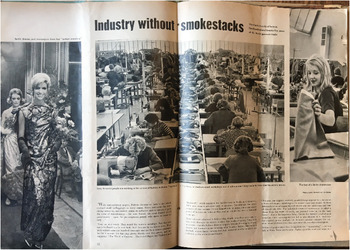
In West Germany, Scala International's portrayals of women differed greatly from those of the East. The article “Industry without Smokestacks” in the magazine's April 1963 issue evokes common impressions of West German views of gender roles through a discussion of the West Berlin fashion industry (see Figure 2).Footnote 49 Scala International portrays women in the article primarily as consumers thrilled with changing fashions and glamour. The text conveys that West Berlin is “today Europe's producer of women's outerwear” and provides a history of the development of the Berlin women's fashion industry. It traces the industry's origins to 1837, when Valentin Manheimer, a lottery-winner from Magdeburg, moved to Berlin and started selling women's dressing gowns in his shop. The article conveys how despite strong competition, and the destruction of World War II, the industry remained strong in divided Berlin. A fashion show of “mannequins,” or models, further demonstrates that West Berlin remains a center for women's fashion. Finally, the article describes how the industry in West Berlin remains focused on quality but is gradually transitioning from its old model of the individual sewing of garments to a more organized, industrial form which is reinforced by the two images in the center and the right of article, showing clothing production by women workers.
Front page of article “Industry without Smoke Stacks.” Scala International, April 1963.

The article, although generally informative offers a subtle, yet important look in to how a specific topic, such as the women's fashion industry in West Berlin, could raise political issues. When appealing to international readers, the article explicitly states that West Berlin should be perceived as at least an equal to London and Paris, thereby placing the city, and by extension the Federal Republic, firmly within the West. The narrative of rags-to-riches business success presented in the story about a young German man winning the lottery and finding success in selling women's dressing gowns emphasizes how businesses can grow and prosper in response to market conditions. The description of modern-day trendy parts of West Berlin, such as the major shopping street Kurfürstendamm in the center, also shows that the city is an active part of modern international fashion. In short, the article's narrative consists of emphasizing Western connections, capitalism, and cosmopolitanism.
On another level, however, these more specific political messages are interwoven and inflected by the overarching presentation of women's roles in the modern Federal Republic. The article presents women as value-conscious consumers preoccupied with maintaining style and having their dresses look more expensive than they are, “not so that they can save money, but so that they can buy something new more often.” Women, then, are the consumers of this story, liberated from the supposedly more serious male concerns of fiscal conservatism. In seven of the eight images accompanying the article, mainly young women are shown in productive roles in the industry, including as models, saleswomen, and factory workers. These young women fit the life model of the West German system of the early 1960s in which young, unmarried women were supposed to work full time until marriage. Married women might then work part time, because that did not challenge the male-breadwinner family model, but allowed them to earn a “surplus income” for the family's consumption.Footnote 50 Although this portrayal fits the dominant West German ideal of the family, it is also an example of how the magazine, its editors, and ultimately the decisions-makers at the BPA were aware of East German emancipatory narratives about freeing women from domestic oppression and the importance of women's employment opportunities. In this way, a blend of overarching political ideas with specific themes, such as women's role in society, determined the self-representation abroad, and the German-German debate about social and political policy became an arena in which to demonstrate the superiority of one system over the other.
Rebuilding and Industrial Development
Although the GDR had the upper hand with women's issues, the success of the social market economy overshadowed the advances of socialist planning in images of reconstruction and industrial development. The parallel rebuilding of both Germanys after the war and the development of industries thus served as a key theme in both GDR Review and Scala International. In GDR Review, articles demonstrated that crucial heavy industries such as aircraft, ship, and automobile manufacturing were well developed. In contrast, Scala International promoted the chemical industry, automobiles, and trade fairs while also focusing on worker welfare in articles about trade unions to show the benevolence of the social market economy. Similar to the development seen in articles on women's roles in society, these articles on one level provide a general image of development, prosperity, and productivity. On another level, they develop key political messages to international audiences clearly inflected by concerns over opposing messages promoted by the neighboring other.
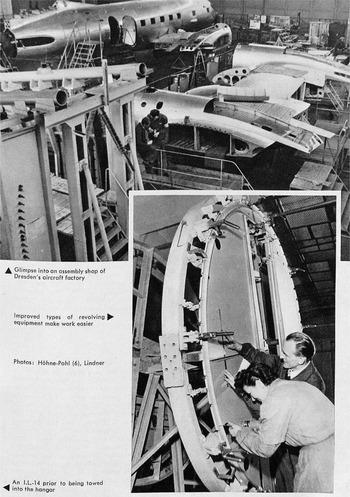
In the January 1958 article “Turbo-Jets Invade Civil Aviation,” GDR Review presents a developing industry that places the GDR near the forefront of airplane manufacturing despite serious structural disadvantages. This fits with the general narrative that East Germany promoted about how it had to overcome severe deficits caused by wartime destruction and Nazi policies. One example is the story of a skilled Dresden airbase worker, Richard Kurth, who after the war was forced to “put aside his spanners and wrenches and exchanged them for pick and shovel” to clean up his old factory and start with “improvisations.”Footnote 51 This cleanup was necessary because the Nazis had ordered “the blowing up of the Klotzche airbase installations” at the end of the war.Footnote 52 Overcoming such obstacles, GDR Review clarified, was possible only because the Soviet Union gave “specialists an opportunity of studying the most recent developments in Soviet aircraft factories,” enabling them to “catch up with the rest of the world in technical know-how.”Footnote 53 Ironically, shortly after this, the Soviet Union shut down the GDR's aircraft industry to assure the dominance of their own aircraft construction industry in the Eastern bloc.
The resumption of aircraft design in East Germany after the Second World War was potentially contentious, so the article was careful to demonstrate that the GDR had become a peaceful aviation power. Heinz Korwitz, the foreman of the wing section, who had been an apprentice in the factory in 1944, thus stated, “formerly we used to build bombers and fighters,” but “today, I help to make passenger planes in which I may one day fly myself.”Footnote 54 The cultivation of a new civilian jet airplane, the article argued, “is but a reflection of the fast all-around advance of the GDR as a modern industrial state.”Footnote 55 The photographs accompanying the article further reinforce key political messages, while also developing other agendas (see Figure 3). For instance, several images of airplane fabrication show the highly technical and advanced stage of GDR manufacturing. Most depict passenger planes in various stages of construction, but some also push the topic a bit further. For example, one image shows how “improved types of revolving equipment make work easier.” Another accompanying image shows a woman working on a plane. The caption, “Women workers are no rarity in Dresden's aircraft industry,” places an even earlier point to the narrative about women's role in society found later in the 1960s.Footnote 56 In this article, the GDR advances four of its core narratives in cultural diplomacy: a clear demarcation from the Nazi past, its peaceful aspirations, its profound economic recovery, and its progressive changes in society, household, and family indicated by the new role of women as both workers and mothers.Footnote 57
“Turbo-Jets Invade Civil Aviation.” GDR Review, January 1958, 16.

Stakhanovite Kurth, the worker from Dresden introduced in the article works at “the biggest steel structural shed in Western Europe.”Footnote 58 He serves as the consummate proletarian willing to do whatever work was necessary to rebuild the GDR, while new cadres of engineers and pilots leave behind the fascist legacy to transition from bombers to civilian jets. They built the jet model 152, “the first built again in Germany since the end of World War II and, after over twenty years, the first model of a civil aircraft and not of a warplane.” The emphasis on aircraft complements the publication's international nature because the jets connected the GDR not only to eastern Europe but also other parts of the globe.Footnote 59 The image presented here furthermore attempts to place the GDR quite clearly at the forefront of the German-German technological competition by demonstrating its significant advancement and preeminence. Narratives of the West German economic miracle further inflect the depictions: Where “in 1954 the farmer was driving the plough across the fields, large factory buildings have risen” in the GDR. Both states now were reaching parity through “the combined efforts of enthusiastic and devoted scientists, engineers, and workers.”Footnote 60
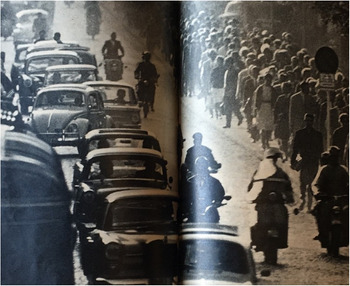
In West Germany, different narratives of building industry predominated. For example, in the August 1963 edition of Scala International, the article “The Struggle for the Secrets of Nature” celebrated the hundredth anniversary of the chemical company Bayer. The article provided a general description of the modern new plant on the Rhine between Cologne and Düsseldorf, a history of Bayer's development, and discussed its current enterprises. According to the article, at the new central buildings of the factory, “everywhere there is still a faint smell of fresh paint. The age of the slender building is still counted in terms of months.”Footnote 61 This sense of newness is further balanced with descriptions of the 36,000 people working at the factory who arrived on one of 250 buses or driving one of 6,000 cars that commuted to work each day. A large image (see Figure 4) showing the commute to work demonstrates the vastness of the enterprise, and also the prosperity of the workers, one-sixth of whom drive their own car.Footnote 62 The key emphasis, however, is on Bayer's success as “second among the chemical factories in Europe and [being] the eighth largest enterprise of the world's chemical industry.”Footnote 63
“The Struggle for the Secrets of Nature.” Scala International, August 1963, 14–15.

The rebuilding narrative so central to the GDR emerges in this article as well. For instance, it cites various economic downturns in the market and also the upheavals of the wars, vaguely referenced as “reflected in the annals of this company” and in discussions of IG Farbenindustrie, the large German chemical and pharmaceutical conglomerate disbanded by the Allied Control Council in 1945.Footnote 64 More important than just commercial success in this narrative, however, is the essential political goal of promoting the social market economy by demonstrating that Bayer cares for its employees. The article intoned, “Without human ideas, will power, imagination and industriousness a plant is just an empty shell.”Footnote 65
The history of Bayer and its activities of the 1960s overlapped on the subject of employee welfare. The article argued, rather disingenuously, that “as early as 1873, at a time when such an idea would not have occurred to any German politician, Bayer set up a benevolent fund for workers.” Furthermore, the reduction of work hours from ten to nine per day, as well as the company's decision that worker committees (Betriebsräte) would be “allowed” at Bayer all were meant to serve as markers of how companies like Bayer took care of their employees without the explicit intervention of the state. In this narrative, Scala International provides a clear description of a society where the social market economy functioned and a company concerned with its workers’ well-being preempts state action out of the goodness of its heart. The further sponsorship of “ten different sports clubs, eight art clubs, four animal-breeding clubs, photography clubs, shorthand clubs, chess and stamp collector clubs” also served as a clear marker of the various options for a full life that a company offers its employees, most famously through the sponsorship of the soccer club Bayer Leverkusen. This serves as a clear juxtaposition with the GDR, where social welfare and organizations were coordinated through the state. The FRG purported to provide an alternative model that was more prosperous and yet also socially engaged.
Beyond just demonstrating economic success and worker welfare, the internationalization of the FRG's success remained a key concern. By presenting a West German company as focused on employee welfare and on aid projects to the third world, Scala International attempted to show West German economic interests as simultaneously robust and nonthreatening. Bayer's magnanimity was demonstrated in the article's description of its efforts in 1961 to deliver insecticides to Cairo and epidemic-preventing drugs to Somalia. In a further example, the article poignantly recalled, “A few weeks ago heavy lorries, driving day and night, delivered an urgent consignment from Leverkusen to Teheran. Iran's grain crop was seriously endangered by plant pests. Bayer pesticides saved the situation.”Footnote 66 The fatherly concern for the third world and the FRG's philanthropy were a deliberate attempt not only to win sympathy among these countries, but also to counter East Germany's presentation of the West as a cutthroat capitalist and revanchist society. Images of German engineers educating men from different countries show a transfer of knowledge that West Germans could generously bestow on those willing to do business with them. The article could thus place the FRG in a positive light internationally and shine a spotlight on further peaceful linkages.Footnote 67
Conclusion
The early development of foreign cultural policy in the mid-1950s followed by the aggressive demarcations of the 1960s put the GDR and the FRG in the difficult position of having to present themselves positively vis-à-vis a shared past and a divergent future. In short, both Germanys emerged from the 1950s with institutions working to direct foreign cultural policy in a way that could fit their key narratives and convince casual observers of their political goals. The major institutions, organizations, and media of foreign cultural diplomacy in both German states developed in fits and starts due to funding struggles and internal conflict, but gradually became essential features in the effort of both Germanys to differentiate themselves from both the Nazi past and each other. Consistent references to the techniques, messages, and development of the foreign cultural politics of the neighboring other drove the institutions’ methods and funding forward because this competition was, at least in the GDR's mind, an existential one.
The magazines GDR Review and Scala International attempted to carry each state's message to international publics and in so doing overcome negative opinions past and present. The most convincing way to do this in magazines was to present everyday life in divided Germany by threading political messages through interesting lifestyle articles. One discussed example was the women's role in German society, which both illustrated journals presented quite differently. The broader political contest between the GDR and the FRG inflected this debate and turned it into an important battleground in the Cold War. Portrayals of economic development in the GDR and FRG also diverged. East Germany pushed to have its state planned socialist economy taken seriously, while the West was more concerned with showing how good and kind companies could be to their workers in the capitalist social market economy.
The presentation of societies reformulating gender roles and rebuilding industry goes beyond some of the more common understandings of foreign cultural politics in divided Germany, such as the promotion of antifascism in the GDR. Instead, it shows how each state envisioned its role in the world and how it attempted to redeem Germanness after the Second World War. The focus on image creation and promotion in magazines such as Scala and GDR Review demonstrates a commitment to cultivating soft power that would define first divided Germany and, after 1990, reunified Germany as well. The lessons that were learned over the course of this competition not only about methods, but also the need for self-criticism and self-reflection, propelled the development of these policies into their present-day form.
In these initial stages, it was the GDR that drove the conversation and established the standard of foreign cultural policy that the FRG worked to meet, combat, and supersede. Thus, despite the West's clear lead in many important areas of state development, the East managed to develop a better system of cultural diplomacy in the 1950s and 1960s. While Christoph Klessman's pioneering work has argued that Abgrenzung (demarcation) was more important for the GDR, and that the FRG exerted a great deal more influence on its neighbor than vice versa, I was able to show in this article that in the early stages of foreign cultural policy, this pattern differed.Footnote 68 The winner of the competition for the hearts and minds of an international public was not a foregone conclusion entering the 1960s. In fact, the GDR's efforts in foreign cultural policy managed to open up this competition in ways that comparison based on traditional metrics could not. What remained to be seen was to what extent the image-creation campaigns could respond to change over time in the international community and within the states themselves as they each strove to establish themselves as the “better” Germany.