Introduction
The mammalian heart uses several substrates, including fatty acids, glucose, lactate and ketone bodies, to meet its constant demand for energy to support contractile function. Such flexibility in substrate choice facilitates adequate energy production despite changing availability of substrates in blood. In the fasting state, fatty acids are the preferred substrate for energy production in adult hearts. Conversely, in the fed state, when the concentration of non-esterified fatty acids in blood is low, glucose is the main energy substrate. Type 2 diabetes mellitus is associated with accumulation of triacylglycerol (TAG) in the heart and remodelling of the myocardium, left ventricular hypertrophy, myocardial fibrosis and progressive left ventricular systolic dysfunction; this is termed diabetic cardiomyopathy.Reference Factor, Minase and Sonnenblick1, Reference Bell2 These structural changes may reflect increased availability of non-esterified fatty acids in blood due to impaired regulation of fatty acid secretion by adipose tissue and increased demands for fatty acids for energy production to offset impaired glucose utilization due to insulin resistance.Reference Denton and Randle3–Reference Rizza, Crass and Shipp5 The resulting increase in fatty acid β-oxidation may induce oxidative damage to myocardial cell membranes leading to remodelling and apoptosis.Reference Chiu, Kovacs and Ford6, Reference Finck, Lehman and Leone7
Cardiac energy production from fatty acids is regulated by specific transcription factors including PPARα, PPARγReference Watanabe, Fujii and Takahashi8–Reference Finck and Kelly10 and sterol regulatory element binding protein (SREBP)-1C.Reference Shimano11 Dysregulation of PPARα has been implicated in the pathogenesis of diabetic cardiomyopathy.Reference Boudina and Abel12 Activation of PPARα increases fatty acid β-oxidation by binding to specific response elements in the promoter regions of carnitine : palmitoyl transferase (CPT)-1 and acyl-CoA oxidase (AOX), which encode the enzymes that catalyze their respective rate-limiting reactions in mitochondria and peroxisomes, and the fatty acid transporter CD36. PPARα also increases transcription of pyruvate dehydrogenase kinase 4, which in turn decreases the activity of the glycolytic pathway. The evidence for a role for PPARα in diabetic cardiomyopathy is largely based on the findings of animal studies. PPARα null mice were protected from increased cardiac fatty acid utilization following induction of diabetes by streptozotocin.Reference Finck, Han and Courtois13 Cardiac-specific over-expression of PPARα was associated with increased fatty acid β-oxidation and cardiac remodelling that was exacerbated by feeding a high-fat diet that caused accumulation of TAG within the myocardium,Reference Finck, Han and Courtois13 and left-ventricular dysfunction and premature death.Reference Chiu, Kovacs and Ford6 SREBP-1C and PPARγ together promote insulin-mediated lipogenesis and TAG biosynthesis.Reference Shimano11 SREBP-1C and PPARγ expression is increased in the ventricles of patients with the metabolic syndrome,Reference Marfella, Di and Portoghese14 which is consistent with increased deposition of TAG.
Environmental constraint before birth is associated with increased risk of metabolic syndrome in later life.Reference Gluckman, Hanson, Cooper and Thornburg15 Rodent models of maternal under-nutrition during pregnancy induce in the offspring metabolic changes that resemble the metabolic syndrome in humans.Reference Armitage, Khan, Taylor, Nathanielsz and Poston16 Feeding pregnant rats a protein-restricted (PR) diet induces in the offspring increased hepatic fatty acid β-oxidation, which is marked by raised plasma β-hydroxybutyrate concentration.Reference Burdge, Lillycrop, Jackson, Gluckman and Hanson17 This was associated with increased PPARα, AOX and CPT-1 expression in the liver associated with induced hypomethylation of the PPARα promoter.Reference Lillycrop, Phillips, Jackson, Hanson and Burdge18 Feeding a PR diet to pregnant rats also induced impaired cardiac function and recovery from ischaemia in the offspring.Reference Elmes, Gardner and Langley-Evans19, Reference Elmes, McMullen, Gardner and Langley-Evans20 However, the effect of maternal under-nutrition during pregnancy on the transcription of genes involved in cardiac energy homeostasis has not been reported.
We investigated in rats the effects of maternal protein restriction during pregnancy and fat intake after weaning on the mRNA expression of critical genes in cardiac fatty acid and carbohydrate metabolism, and on the methylation status of the PPARα promoter in the offspring. We also determined the effect of maternal and post-weaning (PW) diets on TAG concentration in adult hearts.
Materials and methods
Animal procedures
The study was carried out in accordance with the Home Office Animals (Scientific Procedures) Act (1986). The hearts used in this study were collected from animals which have been described previously.Reference Burdge, Lillycrop, Jackson, Gluckman and Hanson17 Briefly, virgin female Wistar rats (approximately 220 g; n = 6 per dietary group) were mated and fed either protein-sufficient (PS; 180 g protein/kg feed) or PR (90 g protein/kg feed) diet from conception until delivery (Special Diets Services, Witham, Essex). The composition of these diets has been described.Reference Burdge, Lillycrop, Jackson, Gluckman and Hanson17 After spontaneous delivery on approximately post-conceptional day 21, litters were reduced to eight pups, equal males and females, within 24 h of birth, and the hearts from excess animals were frozen in liquid nitrogen and stored at −80°C (neonatal group). Offspring were weaned on post-natal day 28 on to either a diet containing lard and soyabean oil (9 : 1, w/w) to provide 40 g fat/kg feed low fat (LF) or a diet containing 100 g fat/kg feed high fat (HF).Reference Burdge, Lillycrop, Jackson, Gluckman and Hanson17 Food intake and body weights of these rats have been reported previously.Reference Burdge, Lillycrop, Jackson, Gluckman and Hanson17 On post-natal day 105, food was withdrawn at about 08.00 hours, but water was provided ad libitum. Offspring were killed by asphyxiation with CO2 6 h later and hearts were removed immediately, frozen in liquid nitrogen and stored at −80°C.
Measurement of TAG composition
Portions of the right and the left ventricle from adult hearts (approximately 100 mg) were pulverised under liquid nitrogen. The internal standard (triheptadecanoin, 70 μg) was added, and total lipids were extracted and TAG purified by solid phase extraction using 100 mg aminopropylsilica cartridges.Reference Burdge, Wright, Jones and Wootton21 Fatty acid methyl esters (FAMEs) were synthesized by incubation with methanol containing 2% (v/v) sulphuric acid at 50°C for 2 h.Reference Burdge, Wright, Jones and Wootton21 FAMEs were resolved using a 6890 gas chromatograph (Agilent, Cheshire, UK) equipped with a 30 m × 0.25 μm × 0.25 mm BPX-70 fused silica capillary column (SGE, Milton Keynes, UK) and flame ionization detection. The concentrations of individual fatty acids were determined by comparing the peak area to the peak area of the internal standard, corrected for the mass of extracted tissue. Total TAG concentration was calculated from the sum of the areas of the identified peaks.
Analysis of gene mRNA expression by real-time RT-PCR
Measurement of the levels of specific mRNA transcripts was carried out essentially as describedReference Burdge, Lillycrop and Phillips22 using the primers detailed previously,Reference Lillycrop, Phillips, Jackson, Hanson and Burdge18, Reference Burdge, Lillycrop and Phillips22 with the exception of DGAT2 (forward ATCTTCTCTGTCACCTGGCT and reverse ACCTTTCTTGGGCGTGTTCC) and SREBP-1C (Qiagen QuantiTect primer assay QT00432684). Briefly, total RNA was isolated from the left and right ventricles, which had been pulverized under liquid nitrogen using Tri Reagent (Sigma) according to the manufacturer’s instructions. cDNA was prepared and amplified using real-time RT-PCR.Reference Burdge, Lillycrop and Phillips22 Samples were analyzed in duplicate and the expression of the individual transcripts was normalized to ATP synthase subunit beta (ATP5B) and Calnexin (CANX), which did not differ in transcript levels between groups.
Measurement of DNA methylation of the putative 5′-regulatory region of PPARα
PPARα promoter methylation was measured using PCR primers described previously.Reference Burdge, Lillycrop and Phillips22 Genomic DNA was isolated from the left and right ventricles as described.Reference Burdge, Lillycrop and Phillips22 Purified DNA was incubated with the methylation-sensitive restriction endonucleases AciI and HpaII according to the manufacturer’s instructions (New England Biolabs).Reference Burdge, Lillycrop and Phillips22 The resulting DNA was amplified in duplicate using real-time PCR as described previously.Reference Burdge, Lillycrop and Phillips22 A region of the PPARγ2 promoter that does not contain AciI or HpaII cleavage sites was used as an internal control.Reference Burdge, Lillycrop and Phillips22
Statistical analysis
Data are presented as mean ± 1 s.d. Statistical analysis was carried out using SPSS (SPSS Inc., Chicago, Illinois, USA). Comparisons between groups of adult offspring were made by a General Linear Model with sex, maternal diet and PW diet as fixed factors using Bonferroni’s post hoc correction. Comparison between adult and neonatal hearts was by Student’s unpaired t-test. Analysis using the Kolmogorov–Smirnov test showed that the results of measurement of mRNA expression and DNA methylation were not normally distributed, and so data were log transformed prior to statistical analysis. The relationship between the methylation status of the PPARα promoter and its expression was assessed by linear regression. While it would have been preferable to analyze litters rather than individual offspring, this was prevented by the cost- and labour-intensive nature of the molecular biology analyses.
Results
TAG concentration
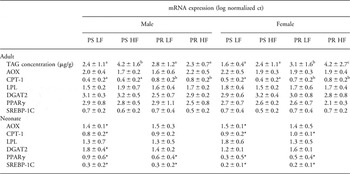
There were significant interactive effects of maternal diet (P = 0.004), and interactive effects of sex * maternal diet (P = 0.006) and sex * PW diet (P = 0.015) on TAG concentration in adult hearts. In males, feeding the HF diet increased total TAG concentration in the hearts of offspring of dams fed the PS diet, but did not alter TAG concentration in the offspring of PR dams compared to PS LF offspring (Table 1). Total TAG concentration did not differ between PS LF and PR LF offspring. In female offspring, there was no effect in PS offspring of feeding the HF diet on total TAG concentration in hearts compared to PS LF offspring. Total TAG concentration was higher in PR LF offspring than in PS LF offspring, and was significantly greater in PR HF offspring compared to all other groups of female offspring (Table 1).
TAG concentration in adult heart, and mRNA expression of genes involved in carbohydrate and fatty acid metabolism

PS, protein-sufficient; LF, low fat; PR, protein-restricted; HF, high fat; TAG, Triacylglycerol; AOX, acyl-CoA oxidase; CPT, carnitine : palmitoyl transferase; PPAR, peroxisomal proliferator-activated receptor; SREBP, sterol regulatory element binding protein.
Values are mean ± 1 s.d., n = 7–15. Overall effects of maternal and post-weaning diet, and sex on gene expression and on PPARα methylation in adult and neonatal hearts were tested by a General Linear Model and the results are given in the text. Different superscripts indicate values, which differ significantly (P < 0.05) for each gene among adult or neonatal hearts.
*Indicates statistically significant differences (P < 0.001) by Student’s unpaired t-test between hearts from adults fed the LF diet after weaning and neonatal heart from the same maternal dietary group.
mRNA expression in adult and neonatal hearts
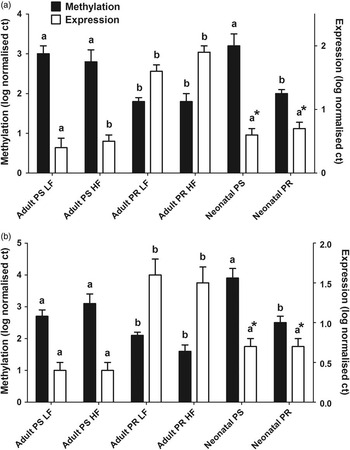
There was a significant effect of maternal diet (P < 0.0001), but not of sex or PW diet, on PPARα expression in adult hearts. PPARα expression was increased in adult male and female offspring of PR dams compared to PS offspring, irrespective of PW diet (Fig. 1). There was no effect of maternal or PW diet, or offspring sex on AOX expression (Table 1). CPT-1 expression was increased in both adult male and female offspring of PR dams, irrespective of PW diet, compared to PS offspring. There was no effect of maternal or PW diets, or offspring sex on the mRNA expression of lipoprotein lipase (LPL), PPARγ, SREBP-1C or diacylglycerol acyltransferase-2 (DGAT2) in adult hearts (Table 1).
PPARα mRNA expression (open bars) and promoter methylation (solid bars) in (a) male and (b) female adult and neonatal hearts. Values are mean ± 1 s.d., n = 7–15 samples per group. LF, low-fat post-weaning diet; HF, high-fat post-weaning diet; PS, maternal protein-sufficient diet; PR, maternal protein-restricted diet. Values that are significantly different (P < 0.05) within an age group for each outcome are indicated by different superscripts. *Indicates statistically significant differences (P < 0.001) by Student’s unpaired t-test between hearts from adults fed the LF diet after weaning and neonatal heart within the same maternal dietary group.

There were no statistically significant differences in expression of any of the genes measured between neonates from different maternal dietary groups or between sexes (Table 1, Fig. 1). There was a significant effect of age (P = 0.014) on PPARα expression. PPARα expression was similar in all male and female neonates to adult PS offspring, but lower than in adult PR offspring (Fig. 1). There was a significant effect of age on AOX expression (P < 0.0001), and a significant effect of age (P < 0.0001) and of age * maternal diet (P < 0.0001) on CPT-1 expression. AOX expression was lower and CPT-1 mRNA level was higher in hearts from neonatal compared to adult PS offspring, irrespective of sex (Table 1). There was no significant difference between males and females in AOX expression in hearts from neonatal or adult offspring (Table 1). There was a significant effect of age on DGAT2, SREBP-1C and PPARγ (all P < 0.0001) such that the expression of these genes was lower in neonatal compared to adult hearts, irrespective of sex or maternal diet (Table 1). LPL expression did not differ significantly between neonatal and adult hearts.
PPARα promoter methylation in adult and neonatal hearts
Analysis of PPARα methylation in adult and neonatal hearts is summarized in Fig. 1b. There was a significant effect of maternal diet (P < 0.0001), but not age, sex or PW diet, on PPARα methylation. The methylation status of the PPARα promoter was significantly lower in both neonatal and adult hearts from offspring of PR dams compared to offspring of PS dams. There were no significant differences in the level of PPARα methylation between hearts from adult and neonatal offspring from the same maternal dietary group. When analyzed across dietary groups, the methylation status of the PPARα promoter was associated negatively (r = −0.34, P = 0.01) with its expression in adult offspring, but there was no significant association with the mRNA level in neonatal hearts.
Discussion
Poor nutrition before birth induced dysregulation of lipid metabolism in the heart leading to increased TAG concentration. However, the nature of this effect was contingent on the sex of the offspring and fat intake after weaning. We have shown previously in these adult rats that dyslipidaemia and impaired glucose homeostasis induced by maternal dietary protein restriction were similar for male and female offspring.Reference Burdge, Lillycrop, Jackson, Gluckman and Hanson17 The present findings suggest that the changes in total TAG concentration in the heart were not simply dependent upon the supply of fatty acids from the blood and therefore imply that the protein content of the maternal diet specifically modifies the metabolic partitioning of fatty acids in the hearts of offspring.
There were no differences between maternal dietary groups in the mRNA expression of any of the genes measured in neonatal hearts. The expression of all of the genes measured, except LPL, differed between adult and neonatal hearts, which is consistent with maturation of specific regulatory pathways in lipid and carbohydrate metabolism during post-natal development.Reference Rajabi, Kassiotis, Razeghi and Taegtmeyer23 Hearts from the adult offspring of dams fed the PR diet showed a specific increase in PPARα mRNA expression irrespective of fat intake after weaning. This was accompanied by increased CPT-1 expression with no change in AOX, which suggests increased mitochondrial, but not peroxisomal, fatty acid β-oxidation. In the fasting state, fatty acids are the preferred substrate for energy production in the heart. Thus, the offspring of PR dams may have greater capacity for energy production from fatty acids. PPARα also increases pyruvate dehydrogenase kinase 4 expression, which decreases the capacity to generate energy by glycolysis.Reference Bishop-Bailey9 Thus, one implication of these findings is that the hearts from PR offspring are at risk of increased oxidative damage due to higher capacity for fatty acid β-oxidation, but may also have reduced flexibility to change substrate use in different nutritional states. Such metabolic changes are consistent with impaired recovery from ischaemia-reperfusion injuryReference Elmes, Gardner and Langley-Evans19 and the protective effects of antioxidants.Reference Elmes, McMullen, Gardner and Langley-Evans20 There was no effect of maternal or PW diet on the mRNA expression of DGAT2, SREBP-1C or PPARγ, which suggests that the accumulation of TAG within the heart in this model does not appear to involve these genes.
The presence of changes in the mRNA expression of PPARα and CPT-1 associated with differences in maternal protein intake in adult, but not neonatal heart, suggests two possible mechanisms. First, the mechanism that underlies altered cardiac gene expression was induced before birth but did not exert an effect until later in life. Alternatively, the effects of maternal protein restriction persisted beyond the period of feeding the restricted diet and induced altered gene regulation at some later point. To investigate which of these processes was likely to occur in the hearts of these offspring, we measured the methylation status of the PPARα promoter. PPARα promoter methylation was reduced in both adult and neonatal hearts from the offspring of PR dams. This suggests that the altered regulation of PPARα was induced before birth, but that the effects on its mRNA expression were only detected later, possibly as a result of developmentally programmed induction of PPARα expression in response to increased fatty acid availability after birth.Reference Panadero, Herrera and Bocos24
Together, these findings show for the first time that poor maternal nutrition during pregnancy induces in the offspring altered epigenetic regulation of a key transcription factor that controls energy homeostasis, which may have important consequences for future cardiac function. One implication in the context of human disease is that the risk of developing cardiomyopathy as a complication of diabetes mellitus may be contingent on the quality of nutrition before birth. Furthermore, appropriate epigenetic probes may provide a means of detecting such vulnerability before the onset of disease.
Acknowledgements
This study was funded by a grant from the British Heart Foundation (PG/06/098/21347), which also provided salary support for MAH.
Statement of Interest
None.