Introduction
Depression may be an important factor that contributes to increased health service use, particularly hospitalization and physician visits among the elderly. This is because depression, which is highly prevalent among the elderly, has been found to be associated with reduced functional status (Penninx et al., Reference Penninx1998), increased cognitive impairment (Ganguli et al., Reference Ganguli, Du, Dodge, Ratcliff and Chang2006), and increased risk of cardiovascular disease and mortality (Rugulies, Reference Rugulies2002).
Among the younger population and chronically ill patients, studies have established that depression is a strong risk factor of health service use (de Boer et al., Reference de Boer, Wijker and de Haes1997; Koopmans et al., Reference Koopmans, Donker and Rutten2005). However, studies of elderly populations have reported equivocal findings on the associations between depressive symptoms and hospitalization episodes, with some reporting a lack of association (Luber et al., Reference Luber2001; Beekman et al., Reference Beekman2002; Fischer et al., Reference Fischer2002), and others reporting a positive association, but only among subgroups of elderly men (Anttila, Reference Anttila1991), or only among older men aged 75 and over (Huang et al., Reference Huang, Cornoni-Huntley, Hays, Huntley, Galanos and Blazer2000).
With regard to visits to physicians by older adults, several cross-sectional studies (Luber et al., Reference Luber2001; Fischer et al., Reference Fischer2002) have reported a positive association of depressive symptoms with physician visits, but this was not replicated in a prospective study (Beekman et al., Reference Beekman2002).
The interpretation of reported findings are often limited by the use of predominantly cross-sectional data, insufficient data on competing health risks (such as medical illnesses, physical disability and cognitive impairment), inadequate control of confounding, and selection bias from studying special populations such as those in managed care and health maintenance organizations.
An important point to note is a possible two-way cause-effect relationship between depression and health service use. This has mostly been ignored in previous investigations, and most prospective studies have examined only whether depressive symptoms result in increased health service use, not vice versa. In this population-based prospective cohort study of community-dwelling Chinese older adults (aged 55 and over) in Singapore, we investigated this two-way relationship by testing the forward hypothesis that, controlling for the effects of chronic medical conditions, functional status, cognitive impairment and other factors, depressive symptoms were associated with increased episodes of hospitalization and physician visits. Conversely, we tested the hypothesis that hospitalization episodes and frequent physician visits resulting from worsening chronic medical illnesses had the effect of increasing depressive symptoms.
Methods
Study population
The Singapore Longitudinal Aging Studies (SLAS) is an ongoing prospective cohort study of aging and the health of older persons in Singapore. The sample methodology has been described in detail previously (Ng et al., Reference Ng, Niti, Chiam and Kua2006). The original cohort comprised 2804 older persons including Chinese (80%), Malays (12%) and Indians (8%) who were (i) aged 55 years or older, (ii) Singaporean citizens or permanent residents, and (iii) were not physically or mentally incapacitated because of severe illnesses or functional impairment such as cancer, stroke, congestive heart failure and severe dementia, to participate in the study. They were recruited through a complete door-to-door census for the study (response rate 78.5%). Participants signed informed consent for the study which was approved by the National University of Singapore Institutional Review Board. Baseline assessment – conducted in 2004/2005 on 2804 participants in the original cohort using face-to-face interviews, assessments and tests performed by trained research nurses in the on-site study centre – included an extensive range of demographic, biological, clinical, psychosocial and behavioral characteristics. The health system in Singapore provides for near universal access to health services regardless of socio-economic status and ability to pay.
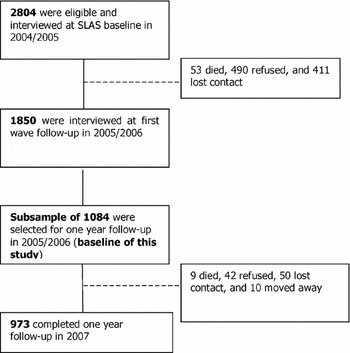
The present one-year prospective study of health service outcome followed up a subsample of 1084 participants by listing out the 1850 participants who were re-interviewed in the first wave of SLAS follow-up in 2005/2006 (see Figure 1). The incipient cohort members who did not participate at the first wave re-interview included 53 who died, 490 who refused re-interview and 411 with whom contact was lost or who had moved away. They were more likely to be women (p = 0.024), had fewer depressive symptoms (p = 0.004), and better baseline cognitive performance (p = 0.003), but were not significantly different in age, education level and gender or other characteristics, than subjects who participated. In the present study, the subsample of 1084 participants provided, at the first wave of re-interview (baseline) and one year later, through telephone or home interviews, data on depressive symptoms and episodes of new physician visits and hospitalizations at two-monthly intervals during the one-year follow-up. In the subsample of 1084 participants in the present study, nine participants died, 42 refused re-interview, 60 lost contact or moved away, leaving 973 who completed the one-year follow-up interview in 2007. The 973 followed-up participants, compared with the non-participants (N = 111), were significantly (p<0.05) older, reported fewer social supports, and had poorer functional status, but did not differ otherwise on baseline medical comorbidities, depressive symptoms and other characteristics.
Selection of study population.

Main variables
Depressive symptoms was assessed by the 15-item GDS short form (Yesavage, Reference Yesavage1988), which has been validated externally for local use in elderly Singaporeans (Nyunt et al., in press). The cutoff of 5 or more was used to define the presence of depressive symptoms, and has been shown to have overall sensitivity of 0.97 and specificity of 0.95 in predicting major depressive disorder, with no clinically significant differences in test performance among different age, gender, and ethnicity. The overall Cronbach's α was 0.80, and the intraclass coefficient of test-retest reliability over two weeks was 0.83 and inter-rater reliability was 0.94.
Health service use was determined by cumulating the participants' self-reports every two months of new hospitalizations and physician visits for each of 16 listed major and other chronic medical conditions (except mental disorders) over one year.
Correlates and confounders
Chronic medical illnesses
The presence of 16 major and other specified chronic disorders was determined by corroborating information from respondent's self-reports at baseline of a physician's diagnosis and treatment in the previous 12 months, identification of medications produced by the respondents, self-reports of investigative and operative procedures for coronary heart and other diseases, and blood pressure, lipids and glucose measurements. The cumulated number of chronic illnesses was used to categorize each participant according to the number of multiple comorbidities (0, 1–2, ≥3).
Social and emotional support
This was measured using eight questions including the respondent's marital status, living arrangements, frequency of visits or calls by children/relative/friends, having someone to help when needed or to confide in over personal problems, having religious or spiritual support, and financial ability to pay for medical care. The response score on each of the questions was converted to z scores and then averaged to yield a single, global measure of social emotional support, with high scores indicating higher support available. The scores were used to categorize the participants in tertile levels of psycho-social support.
Functional disability
Functional disability was assessed using self-reported measures of instrumental and basic activities of daily living (IADL and BADL; Lawton and Brody, Reference Lawton and Brody1969; Mahoney and Barthel, Reference Mahoney and Barthel1965). IADL disability was defined as needing assistance with one or more IADL. BADL disability was defined as being present if the respondents reported difficulty in performing one or more ADLs.
Cognitive impairment
Global cognitive function was measured by Mini-mental State Examination (MMSE), (Folstein et al., Reference Folstein, Folstein and McHugh1975). The Chinese translation of the instrument has been validated for local use in Singaporean older adults (Ng et al., Reference Ng, Niti, Chiam and Kua2007), with the conventional cutoff of 23/24 used to determine cognitive impairment. Using this cutoff, the MMSE has high sensitivity (97.5%) and specificity (75.6%) for diagnosing dementia.
Self-rated physical health
This was assessed by asking the participants a single-item question: “In general, would you say your health is: excellent, very good, good, fair or poor?” In our analysis, we classified fair, good or excellent as indicating good perceived health, and poor or very poor response as indicating poor perceived health.
Other socio-demographic information included age, gender, education, housing type and ethnicity.
Data analysis
Baseline characteristics of the depressed (GDS score ≥5) and non-depressed subjects were compared using χ2 tests for categorical variables. The Wilcoxon rank sum two sample test was used for comparison of doctor visits and hospitalizations.
The risk of hospitalization associated with baseline depressive symptoms was estimated via bivariate and multivariate Cox proportional hazards regression analysis, using time to first hospitalization as the dependent variable. The proportional hazard assumption was met in all the models. The association between baseline depressive symptoms and subsequent doctor visits was estimated by unadjusted and adjusted rate ratios from Poisson regression analyses. Given the highly skewed and overdispersed nature of physician visit counts, the scale parameter was adjusted by Pearson's χ2 statistic. The natural logarithm of time at risk was used as an offset variable in a regression model to adjust for the effect of varying times at risk. Covariates adjusted for in the Cox and Poisson regression models were identical and included age, gender, education, ethnicity, housing type, social-emotional support, medical comorbidities, self-rated physical health, ADL and IADL disability, and cognitive impairment.
The reverse association between health service use through hospitalization and doctor visits during the study period and subsequent depressive symptoms at 1 year was modeled using logistic regression. The frequency of doctor visits was divided into two categories using five doctor visits as the upper tertile cutoff. The analyses controlled for confounding by baseline levels of depressive symptoms by modeling it as a baseline covariate and by excluding participants with depressive symptoms at baseline. Other covariates that were adjusted for without collinearity problems included age, gender, education, ethnicity, housing type, social-emotional support, medical comorbidities, self-rated physical health, ADL and IADL disability, and cognitive impairment.
We also explored the possible interaction between depressive symptoms and other covariates in the regression models. A two-sided P-value of <0.05 was considered statistically significant. All analyses were performed using SAS software (SAS Institute, Inc., Cary, NC).
Results
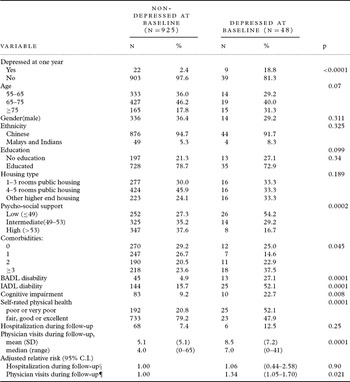
Among the 973 respondents, 48 (4.9%) were depressed at baseline and 31 (3.2%) were depressed at one year (Table 1). The mean score of GDS at baseline was 1.1 (SD 1.9, median score: 0, range: 0–14). At the end of the follow-up, the mean score of GDS was 0.5 (SD 1.3, median score: 0, range: 0–11. At baseline, depressed respondents were older and reported lower psychosocial support compared to the non-depressed respondents. A significantly higher proportion of depressed respondents had three or more chronic medical conditions, ADL disability, IADL disability, cognitive impairment, or classified their health as poor or very poor than did non-depressed respondents. Other variables were comparable between depressed respondents and non-depressed respondents (Table 1).
Baseline characteristics of depressed and non-depressed participants and health service use during one year follow-up (N = 973)

* Adjusted for age, gender, education, ethnicity, housing type, social-emotional support, medical comorbidities, self-rated physical health, ADL and IADL disability, cognitive impairment.
§ Hazard ratio from Cox regression.
¶ Relative risk from Poisson regression.
BADL = basic activities of daily living; IADL = instrumental activities of daily living.
In multivariate analyses, hospitalization was significantly associated with low (versus high) level of psycho-social support (hazard ratio (HR) = 1.49, p = 0.032) and IADL-BADL (versus no) disability (HR = 1.92, p = 0.031). Doctor visits were significantly associated with Chinese (versus non-Chinese) ethnicity (relative risk (RR) = 1.41, p = 0.026), ≥3 medical comorbidities (RR = 2.04, p = 0.0001), and poor to very poor self-rated physical health (RR = 1.21, p = 0.009).
Table 2 shows the association between baseline depressive symptoms and use of health services. In both bivariate and multivariate analysis using Cox proportional hazard regression, baseline depressive symptoms were not associated with increased risk of hospitalization. On the other hand, baseline depressive symptoms were significantly associated with more physician visits in bivariate Poisson regression, and this association remained significant after adjusting for medical comorbidity, self-rated health, functional status and other covariates (RR,1.34; 95% CI, 1.05–1.70). Because no interaction term was significant in this model, we did not consider interaction in the final model.
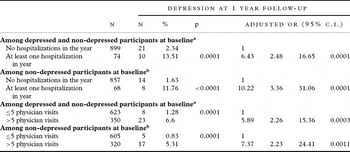
Association between prior health service use during study period and depression at one year follow up (N = 973)

aAdjusted for baseline depression, age, gender, education, ethnicity, housing type, social-emotional support, medical comorbidities, self-rated physical health, ADL and IADL disability, cognitive impairment.
bAdjusted for age, gender, education, ethnicity, housing type, social-emotional support, medical comorbidities, self-rated physical health, ADL and IADL disability, cognitive impairment.
The reverse association between health service use during the one-year study period and subsequent depressive symptoms at one year are summarized in Table 2. Participants who were hospitalized during the study period were more likely to report depressive symptoms at one year (OR = 6.43, 95% CI, 2.48–16.6). Likewise, compared with those with fewer than five physician visits during the study period, participants who reported five or more such visits were more likely to report depressive symptoms at one year (OR = 10.2, 95% CI, 3.36–31.1).
We repeated the analyses by excluding participants with depressive symptoms at baseline; similar associations with incident cases of depressive symptoms at one year were observed for both hospitalization and physician visits.
Discussion
In this study, our observation of a positive association between baseline depressive symptoms and subsequent increased physician visits independent of medical comorbidity and other confounders is in line with previous findings (Luber et al., Reference Luber2001; Fischer et al., Reference Fischer2002). Some authors (Katon and Ciechanowski, Reference Katon and Ciechanowski2002) have suggested that the link between depressive symptoms and increased episodes of physician consultation could be due to the tendency of depressed patients to amplify medical symptoms, the worsening of medical conditions by direct biological mechanism such as alteration in cellular immunity and platelet activity (Herbert and Cohen, Reference Herbert and Cohen1993; Musselman et al., Reference Musselman, Evans and Nemeroff1998) or by indirect behavioral factors such as non-adherence to medical treatment and poor self-care among depressed patients (DiMatteo et al., Reference DiMatteo, Lepper and Croghan2000), or other unrecognized underlying diseases. Other authors have reported that depressed patients always had distorted views of their susceptibility to and the severity of their medical illness (Levinson and Druss, Reference Levinson and Druss2005), and that this factor rather than the desire to use health services was the primary determinant of higher consultation rates.
Consistent with other findings from population-based studies (Luber et al., Reference Luber2001; Beekman et al., Reference Beekman2002; Fischer et al., Reference Fischer2002), we found that depressive symptoms at baseline were not associated with subsequent increased hospitalization risks. However, a number of studies have also reported a positive association but in subgroups of older people living in the community (Anttila, Reference Anttila1991; Huang et al., Reference Huang, Cornoni-Huntley, Hays, Huntley, Galanos and Blazer2000) or among older patients with chronic medical conditions (Hedayati et al., Reference Hedayati2005; Jia et al., Reference Jia2006). It is possible that an increase in the number of visits to doctors in outpatient clinics reduced the frequency of subsequent hospitalization, or that the actual impact of mental disorders on health service use may be easily masked by the prevailing high level of health service use in the elderly. Depressive symptoms likely play a predisposing secondary role to the direct roles of physical illnesses in increasing acute hospitalization. Finally, in community-based studies of elderly people, milder subsyndromal depression may not be as strong a predictor of acute hospitalization use as clinical grade depression in hospital-based studies of older elderly people with severe chronic diseases.
Our findings suggest that increased doctor visits and hospitalizations for chronic medical illnesses were associated with subsequent greater likelihood of depressive symptoms at follow-up. It was possible that the persistence of depressive symptoms associated with chronic illness during the follow-up could have resulted in increased health service use. We did observed the same associations when subjects with depressive symptoms at baseline were excluded in the analysis. However, given the tendency for depressive symptoms to fluctuate over time, new depressive symptoms may develop during follow-up, even in initially non-depressed individuals or after hospitalization. It is arguable whether depressive symptoms were the direct result of health service use per se, rather than the illness for which health services were sought. Although the odds ratio of association was adjusted for medical comorbidity by including the number of chronic illnesses as a covariate, this did not take the severity of illness into account. Speculatively, factors associated with frequent hospitalization and doctor visits in themselves could possibly make patients more depressed such as through the increased use of multiple drugs (Wolinsky et al., Reference Wolinsky, Culler, Callahan and Johnson1994), including those capable of causing depressive symptoms in elderly patients. However, this needs to be substantiated by further studies.
Since effective biological and psychological treatments exist for most forms of depressive symptoms, the findings in our study point to the possibility that providing treatment for depressive symptoms may optimize health service use in the healthcare system. Unfortunately, depressive symptoms are generally under-recognized and undertreated in the elderly. Research has shown low rates of diagnosis of depression in elderly patients in primary care setting (NIH Consensus Conference, 1992). Fewer than half of primary care patients with depression are actually treated (Schulberg et al., Reference Schulberg1997). There are many contributing factors. First, older adults may have a stigmatizing belief about depression or may consider depression as a “natural” reaction to difficult life circumstances, and therefore do not seek help (O'Connor et al., Reference O'Connor, Rosewarne and Bruce2001). Medical comorbidity often complicates the diagnosis and treatment of depression, and doctors may be less likely to recognize depression in older patients who present with somato-dysphoric symptoms, and may not think that psychiatric treatment is necessary or effective (Banazak, Reference Banazak1996). Our study shows that a better understanding and awareness of the complex multi-directional relationships between depression and healthcare use will help to improve recognition and treatment of depression in elderly patients, especially those with large numbers of consultation episodes and hospitalizations.
The strength of the present research was the longitudinal study design used to follow up a community-living cohort of seniors; because they were collected at close intervals, data on the frequencies of physician visits and hospitalization episodes were more accurate and complete by minimizing recall difficulties and bias.
There are, however, some limitations and the results should be interpreted with care. First, by using the GDS to determine depressive symptoms, the study did not elicit the presence of clinical grade depression with the use of a more stringent diagnostic interview instrument. It was possible that the study lacked the ability to demonstrate the more pronounced effect of clinical depression on hospitalization. Nevertheless, by using the GDS to identify predominantly cases of subsyndromal grades of depression, the results demonstrated that milder cases of depression typically seen in primary care did have a tangible impact on healthcare use. Secondly, limitations in sample size and the short follow-up period may preclude us from observing a delayed and more pronounced effect of depression on hospitalization risk, and the limited monitoring frequencies of depressive symptoms do not allow us to establish clearly the cause-effect relationship between depressive symptoms and health service use. Finally, it is possible that some unmeasured or unknown important variables such as severity of illnesses, chronic pain, health belief and caregiver and physician characteristics may act as residual confounding variables in the observed relationships.
In conclusion, we found that depressive symptoms and healthcare use in older adults may have reciprocal relationships. While the presence of depressive symptoms may predispose to increased episodes of healthcare use, especially physician visits, it could possibly also result from increased healthcare use owing to worsening medical comorbidity. Primary care physicians should attach importance to recognizing and treating depression in elderly patients after hospital discharge.
Conflict of interest
None.
Description of authors' roles
Dr Liang Feng performed the literature review, designed the epidemiological survey, analyzed the data, and drafted the manuscript; Associate Professor Keng Bee Yap participated in the conceptualization of the study, the interpretation of the results, and drafting of the manuscript. Professor Kua Ee Heok participated in the conceptualization of the study, the interpretation of the results and drafting of the manuscript Associate Professor Tze-Pin Ng conceptualized the study, formulated the hypothesis, designed the epidemiological survey, and drafted the manuscript.
Acknowledgment
The study was supported by a research grant (No. 03/1/21/17/214) from the Biomedical Research Council, Agency for Science, Technology and Research (ASTAR).