INTRODUCTION
Species of the genus Metamysidopsis are some of the most common mysids in coastal regions of the south-west Atlantic, especially in shallow waters. Metamysidopsis species are an important component of coastal trophic webs, being part of the diet of species of economic interest (e.g. Mendoza-Carranza & Vieira, Reference Mendoza-Carranza and Vieira2008). Some species are frequent and abundant components of the neritic fauna, such as M. neritica and M. elongata atlantica found on the south coast of Brazil (Odebrecht & Castello, Reference Odebrecht, Castello, Seeliger and Kjerfve2001; Calil & Borzone, Reference Calil and Borzone2008), and M. munda, which has a wide distribution, from North America to the south of Brazil (Tavares & Bond-Buckup, Reference Tavares and Bond-Buckup1990).
Five species of Metamysidopsis have been recorded along the south-western Atlantic coastal regions and continental shelf of Brazil: Metamysidopsis elongata atlantica Bacescu, 1968; M. munda Zimmer, 1918; M. Swifti (Bacescu, 1969); M. macaensis da Silva, Reference Da Silva1970; and M. neritica (Tavares & Bond-Buckup, Reference Tavares and Bond-Buckup1990; Bond-Buckup & Tavares, Reference Bond-Buckup and Tavares1992; Murano, Reference Murano and Boltovskoy1999). Among these, Metamysidopsis macaensis is the only elusive species, having been recorded only once on the south-east coast of Brazil, where the original description was made based on one single female (da Silva, Reference Da Silva1970). In this paper I report the occurrence of this species in the south of Brazil, and describe some morphological differences from that of the original description.
MATERIALS AND METHODS
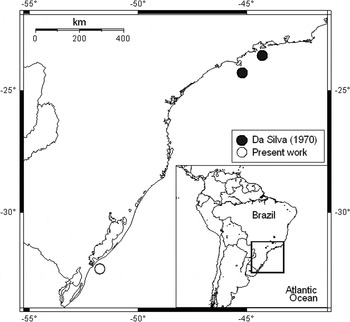
Zooplankton samples were collected in a survey at the Carpinteiro Shoals off the coast of the Rio Grande do SuI State in the south of Brazil, aboard the RV ‘Atlantico SuI’ (Figure 1). The Carpinteiro shoals, located 17 nautical miles south-east of the Patos Lagoon estuary, are an outcrop of beach rocks forming three distinct massifs associated with biodetritic sediments and coarse quartz sands with fluvial features (relic sands) (Calliari et al., Reference Calliari, Esteves, Oliveira, Tozzi and Cardoso1994). Sampling was conducted by vertical hauls using WP2 plankton net of 300 µm mesh with a flowmeter and a temperature and depth recorder. Zooplankton samples were preserved in 4% borax buffered formalin. Specimens were identified, measured, dissected, photographed and drawn using an Olympus BH-2 microscope with a camera lucida.
Map showing where Metamysidopsis macaensis was first recorded by da Silva (Reference Da Silva1970) (filled circle) and where the species was found in the present study (open circle).

RESULTS
SYSTEMATICS
Family MYSIDAE Haworth, 1825
Subfamily MYSINAE Hansen, 1910
Tribe LEPTOMYSINI Hansen, 1910
Genus Metamysidopsis Tattersall, 1951
Metamysidopsis macaensis da Silva, Reference Da Silva1970
(Figures 2–4)
Metamysidopsis macaensis: da Silva (Reference Da Silva1970), pp. 199–201, figures 1–4.
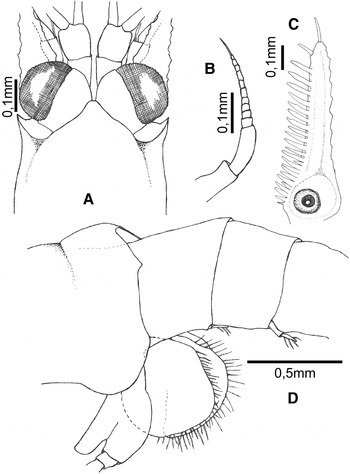
Diagnostic features of Metamysidopsis macaensis: (A) rostrum and eyes; (B) exopod of the last pair of pereiopods; (C) endopod of uropod; (D) marsupium detail.

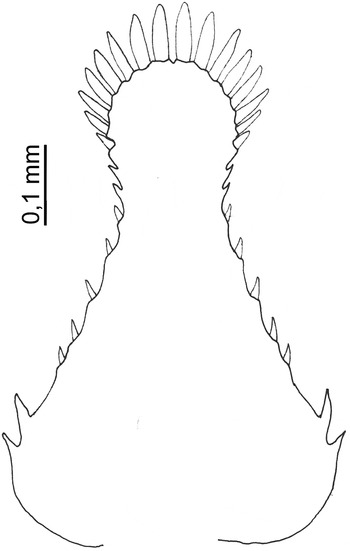
Telson of Metamysidopsis macaensis.

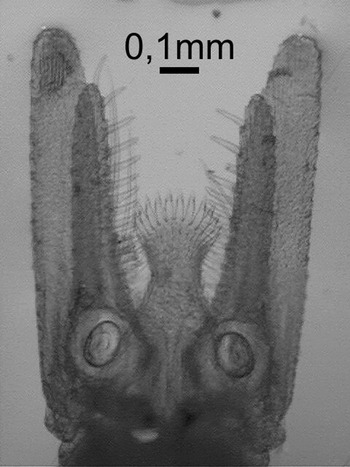
Photograph of Metamysidopsis macaensis tail fan.

MATERIAL EXAMINED
South-west Atlantic: 1 mature female and 5 juveniles, 32°15.46S–51°45.74W, depth 22 m, 17.5°C, salinity 29, 2001.
South-west Atlantic: 3 juveniles, 32°13.95S–51°45.19W, depth 18 m, 17.5°C, salinity 29, 2001.
DIAGNOSIS
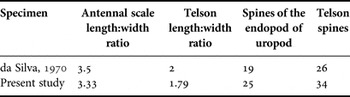
Metamysidopsis adult female with intact marsupium, but no embryos. Rostrum short, leaving eyes exposed. Eyes round and cornea with approximately half the size of the eyes (Figure 2A). Marsupium limited to the last pair of pereiopods with a setose ornamentation (Figure 2D). Pleopods rudimentary and exopod of the last pair of pereiopods has 12 segments (Figure 2B). Endopod of the uropod has 25 spines along the inner margin, those close to basal margin of the endopod unequal and close spaced, while those close to apical edge subequal and more spread out (Figure 2C). Telson triangular and with a strangulated shape, 1.79 times longer than broad, with a total of 34 spines around the margin, the ones in the distal lobe very strong and the ones close to the base small (Figures 3 and 4). Antennal scale 3.33 times longer than broad.
COMPARATIVE ANALYSIS
The M. macaensis specimen reported here and the one described by da Silva (Reference Da Silva1970) have some important taxonomic differences in lengths, ratios and numbers of spines of some diagnostic characteristics (Tables 1 and 2). The female described by da Silva (Reference Da Silva1970) presented fewer spines in the endopod of uropod and in the telson than the female described here (Table 2). In addition, the ratios between length and width of the antennal scale and the telson of the present female are smaller than in the original description. There is no information on the body length of the original holotype. While the endopod and exopod of the uropod had similar sizes in the holotype, in the present female the exopod was longer than the endopod (Figure 4). Finally, da Silva (Reference Da Silva1970) observed 11 segments from the third to the eighth pair of pereiopods, while the individual analysed here had 12 segments in the last (eighth) pair of pereiopods.
Body and telson lengths (mm) of a Metamysidopsis macaensis female.

Comparison of some morphological features of the holotypes of Metamysidopsis macaensis described by da Silva (Reference Da Silva1970) and in the present study.

DISCUSSION
Morphological differences
Geographical differences in morphological characteristics of mysid species are relatively common (Mauchline, Reference Mauchline1980). However, the differences between the holotype and the female described here are usually observed between adults and young mysids, suggesting that the original description was probably made based on an immature female. Some features of the original description support this hypothesis, such as the missing description (or lack) of the marsupium, the smaller number of spines in the endopod of the uropod and in the telson (Table 2), and the smaller number of segments in the endopod of the eighth pereiopod.
Distribution
The species was first recorded on the shelf between São Paulo and Rio de Janeiro States on the south-east coast of Brazil (23°31.5S–44°16.5W and 24°15S–45°11.5 W) (da Silva, Reference Da Silva1970). Here, I report the occurrence of this species on the shelf of Rio Grande do Sul State, on the south coast of Brazil (Figure 1), suggesting that the species has a wide distribution along the Brazilian shelf. Moreover, Metamysidopsis macaensis is the only species of the genus Metamysidopsis not found in the surf zone of Brazilian beaches. Considering that the co-occurrence of Metamysidopsis species on Brazilian beaches is uncommon (author, personal observation), it is likely that species of this genus have distinct distribution patterns across the shelf. More research is needed to verify this hypothesis.
The lack of records of M. macaensis on the Brazilian coast indicates that this species is either rare or not sampled efficiently. Most mysid studies carried out on the Brazilian coast sample populations using plankton nets in the surf zone of beaches. While plankton nets are an efficient sampling device for mysids on beaches due to the mix of the water column promoted by waves in shallow depths, further off the shelf, and in deeper waters, plankton nets may not be the most efficient sampling device. The swarming and fast swimming behaviour of mysids may contribute to plankton net avoidance in deeper waters, where devices such as epibenthic sleds may be more appropriate. Plankton nets are likely to underestimate or simply not sample mysids on the shelf. This may be the case for M. macaensis, which in this study, was recovered from samples collected using plankton net over relatively shallow beach rock shoals on the shelf.
Metamysidopsis macaensis is a very poorly known species, and there is no information on its ecology. In addition, no male has been captured to date. In order to fill these gaps in the knowledge, and considering the importance of the genus Metamysidopsis in coastal regions, further investigations focused mainly on mysids should be carried out on the Brazilian coastal and shelf regions.
ACKNOWLEDGEMENTS
I thank the captain and crew of the RV ‘Atlantico Sul’ for their support in sampling at sea. I am also grateful to Marcelo Kitahara, David McKinnon and anonymous referees for helpful comments. Finally, I thank CNPq for financial support.