INTRODUCTION
Morphometric data have been widely used in crustaceans for studies of relative growth to detect changes in levels of allometry related to the size at sexual maturity (Hartnoll, Reference Hartnoll1974). In brachyuran crabs, morphological changes in male chelipeds and female abdomen characterize growth stages. The transition between immature and mature instars is achieved at a particular moult, the puberty moult (Hartnoll, Reference Hartnoll1974). In spider crabs (Majoidea sensu Ng et al., Reference Ng, Guinot and Davie2008), changes in allometry of male chelae differentiate three growth stages: prepubertal, pubertal and a third stage during which the chelae increase considerably in volume in one abrupt step, caused by the pubertal moult or moult to maturity (Teissier, Reference Teissier1933, Reference Teissier1935; Hartnoll, Reference Hartnoll1963). Comeau & Conan (Reference Comeau and Conan1992) showed that these three stages are separated by two critical moults: immature males undergo a first critical moult called juvenile moult, which marks the onset of sperm production and a subtle increase of chelae growth relative to carapace width; and a second moult, the moult to morphometric maturity, during which the chelae enlarge disproportionately compared to the carapace. The moult to maturity may occur over a large range of carapace sizes. It was hypothesized that the moult to morphometric maturity is a terminal moult (O'Halloran, Reference O'Halloran1985; Conan & Comeau, Reference Conan and Comeau1986), and that it occurs in both sexes. Consequently, in spider crabs the pattern of growth is of the ‘determinate’ type characterized by a terminal moult after which there is no further moulting (Hartnoll, Reference Hartnoll1985).
The assessment of physiological or gonad maturity involves the study of functional and structural characteristics of female and male genitalia. In particular, morphological characteristics are related to macroscopic analysis such as the shape and colour of gonads. Functional characteristics are related, in males, to the production of spermatophores (Comeau & Conan, Reference Comeau and Conan1992); while in females they depend on oocytes development (Johnson, Reference Johnson1980).
In brachyurans, the acquisition of morphometric and physiological maturity is a necessary condition for successful mating (Comeau & Conan, Reference Comeau and Conan1992; Sainte-Marie et al., Reference Sainte-Marie, Raymond and Brèthes1995; Barón et al., Reference Barón, Quiroga, Leal and González-Pisani2009). A number of studies have mostly used different criteria to establish the size at which these reproductive events occur (Corgos & Freire, Reference Corgos and Freire2006). Both types of maturity in spider crabs have been addressed (Conan & Comeau, Reference Conan and Comeau1986; Diesel, Reference Diesel1989; Comeau & Conan, Reference Comeau and Conan1992; Lanteigne et al., Reference Lanteigne, Savoie, Robichaud and Landsburg1996; Sampedro et al., Reference Sampedro, Gonzalez-Gurriarán, Freire and Muino1999; Carmona-Suarez, Reference Carmona-Suárez2003; Mura et al., Reference Mura, Orrù and Cau2005; Corgos & Freire, Reference Corgos and Freire2006), however there is more than one pattern of temporal sequence in which they occur: gonad and morphometric maturity could be synchronized, gonad maturity could precede morphometric maturity or morphometric maturity could be prior to gonad maturity (Corgos & Freire, Reference Corgos and Freire2006).
The spider crab Libinia spinosa (Milne-Edwards, 1834) is distributed from Espírito Santo (Brazil) to Chubut (Argentina) (Melo, Reference Melo1996; Boschi, Reference Boschi2000). In Argentina it is very abundant in coastal waters of the Buenos Aires province having an important role in local marine food webs (Scelzo et al., Reference Scelzo, Martinez Arca and Lucero2002). On the Mar del Plata coast it is one of the most frequently caught crustaceans as by-catch by bottom trawlers in the northern Argentine shelf (Boschi, Reference Boschi1964). Recent studies have been conducted on its reproductive system (Sal Moyano et al., Reference Sal Moyano, Gavio and Cuartas2010) but no further information has been published about its population in the Mar del Plata coast.
The aim of this study was to assess the sexual maturity of the spider crab Libinia spinosa on the coast of Mar del Plata in which we: (1) describe and estimate the size at morphometric and gonad maturity in both sexes; and (2) determine the moult to maturity in males.
MATERIALS AND METHODS
Crabs were collected by trawl nets towed by commercial boats along the coast of Mar del Plata (38°S 57°33′W), Argentina, during summer and autumn 2004, spring 2006 and summer and autumn 2007. Crabs were killed, by placing them in a freezer at –15°C during approximately 15 minutes, and analysed fresh. Individuals were sexed and the presence of ovigerous females was registered. Carapace width (CW) of crabs was measured with a digital calliper and used as the reference dimension. Data were pooled and no seasonal information was considered.
Relative growth and morphometric maturity
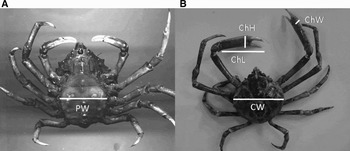
In females, CW and maximum pleon width (PW) at a level of the fourth abdominal segment were measured (Figure 1A, B). Quantitative relationships between morphometric data were described by least square regressions. Log–log regression slope values (b) between 0.9 and 1.1 were considered indicative of isometry, lower than 0.9 indicative of negative allometry and upper 1.1 indicative of positive allometry (‘conservative definition’; Clayton, Reference Clayton1990). Slope values were compared to the expected isometric values using Student's t-test, with significance level of α = 0.05. Slopes and intercepts of different regression lines were compared by covariance analysis (ANCOVA).
Libinia spinosa, photographs showing the various morphometric features measured. (A) Maximum pleon width (PW); (B) carapace width (CW), cheliped length (ChL), cheliped width (ChW) and cheliped height (ChH).

In males, CW, cheliped length (ChL), cheliped width (ChW) and cheliped height (ChH) were measured (Figure 1B). A principal component analysis (PCA) of these measurements was used in order to reduce the number of initial variables to a small number of dimensions, determining which variables were the most representative of the size factor and of the sexual differentiation factor (Conan et al., Reference Conan, Comeau and Moriyasu1985). A log transformation was used to linearize the morphology data. The transformation normalizes the dispersion of points around the linear regression lines and stabilizes their variances, conditions required by PCA.
A bivariate discriminant analysis was conducted for observations made on the two variables identified in the PCA as being suitable for discriminating individuals into different groups, best representing the sexual differentiation factor versus the growth factor (Conan & Comeau, Reference Conan and Comeau1986). From the output of the PCA, the most suitable measurements that appeared to efficiently represent the sexual differentiation in males were used to describe relative growth. The analysis of the regression lines was similar to that used for females for the study of their allometry.
The relative size that females and males reach morphometric sexual maturity (CW at which 50% of females and males are morphometrically mature) was estimated by the ‘Mature Program’ (Somerton, Reference Somerton1980), using the variables CW and PW for females and the variables obtained from the output of the PCA for males.
Gonad maturity
Crabs were dissected and gonad development was classified according to macroscopic characteristics like the shape and coloration of ovaries, testis and vas deferens, and the presence of spermatophores within the lumen of the vas deferens. Different stages of gonad development were described for both sexes. In females, the content of the seminal receptacle was analysed to relate their condition (presence or absence of spermatozoa) with gonad development stages. Size–frequency distributions per stages were analysed for both sexes. The relative size at which females and males reach gonad maturity (CW at which 50% of females and males are physiologically mature, LC50) was calculated using the logistic equation. The logistic function used was y = 1/1 + e r(CL–CL50), where CL50% corresponds to the size at which 50% of the individuals are considered mature and r stands for the slope of the curve.
Male growth-at-moults
A total of 137 males were collected in January 2009 and kept in three communal seawater aerated tanks (4 m3), under natural daylight conditions. Crabs were fed squid twice a week and the water was changed weekly. Males that showed signs of moulting were isolated in individual aerated seawater aquaria (0.4 × 0.5 × 0.2 m). Two days after the moult was completed, CW and ChL of the exuvium and live crab were measured.
Hiatt growth diagrams (Hiatt, Reference Hiatt1948) were used to model male CW and ChL growth at moult. The Hiatt model relates postmoult (LT+1) to premoult (LT) size by linear least-squares regression as LT+1 = b LT + a. The methods of analysis and comparison of Hiatt models for different groups of males were the same as those used above for the study of allometry.
RESULTS
Relative growth: morphometric maturity
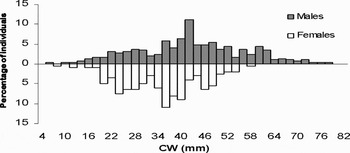
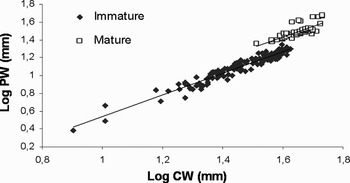
A total of 201 females and 312 males were collected. The carapace width ranged from 8 to 56.5 mm in females, from 40 to 56.05 mm in ovigerous females (N = 23) and from 4.6 to 81.97 mm in males (Figure 2). Relative growth analysis in females showed that the growth of PW with respect to CW was positively allometric in immature (log PW = 0.6793 + 1.2181 log CW, R2 = 0.93, t = 7.8043, P < 0.001) and isometric in mature females (log PW = 0.4844 + 1.1973 log CW, R2 = 0.59, t = 1.3960, P > 0.05) (Figure 3). Although the slopes of the PL×CW relationships did not differ between female phases, differences in y-intercept were significant (ANCOVA, F = 340.82, P < 0.001). The size at which 50% of females were morphometrically mature was 40.6 mm. The smallest mature female measured 36.5 mm CW, and the largest immature female 42.2 mm CW.
Overall size–frequency distribution of carapace width (CW) by sex of Libinia spinosa (N = 513).

Libinia spinosa, females. Relationships between pleon width (PW) and carapace width (CW); the regression lines correspond to immature and mature females (N = 201).

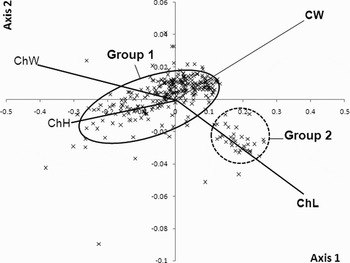
In males, component 1 explained most of the variance in the PCA (97.17%), but component 2 explained only 1.36%. Therefore, for further graphic analysis in the PCA only projections in the plane defined by the first and the second components were considered. On the projections of the observations two groups of points were elongated at an angle with the first axis, and on the projection of the variables, all variables appeared to be almost entirely defined within the plane (Figure 4). The two groups of points were recognized as different male groups. Group 1 corresponded to the upper group and was defined by CW, ChW and ChH variables, which had the same orientation as the major axes and efficiently represent the growth factor (Figure 4). Thus, axis 1 distributed males in terms of size, with crabs having a smaller CW, ChW and ChH located on the negative side of the axis, and individuals with larger CW, ChW and ChH on the positive side (Figure 4). CW was used as the determinant variable of the size factor. This group 1 was characterized as ‘immature’ crabs. On the other hand, ChL was the variable less correlated with the above three variables mentioned, thus characterized the second group (Figure 4). This group belonged to the group localized on the negative side of axis 2 and was denominated as ‘mature’ crabs, characterized by the largest CW and ChL (Figure 4). Clearly, ChL was the most efficient variable to discriminate the two groups of points by representing the sexual differentiation factor. Consequently, CW and ChL were selected as the most suitable variables for a bivariate analysis because they appeared to efficiently represent the size and the sexual differentiation factor, respectively.
Principal component analysis on four variables of Libinia spinosa males, carapace width (CW), cheliped length (ChL), cheliped height (ChH) and cheliped width (ChW): simultaneous representation of the variables as vectors and of the observations (N = 312). CW and ChL represent the size and the sexual differentiation factor respectively, differentiating two groups. The groups of points elongated along axis 1 were attributed to immature males (Group 1, positive direction of axis 2) and mature males (Group 2, negative direction of axis 2).

The first canonical discriminant functions were used by discriminant analysis for the two groups (immature/mature crabs). Test of function 1: Wilks' lambda = 0.354, χ2 = obtained that explained 97.2% of the original cases was:

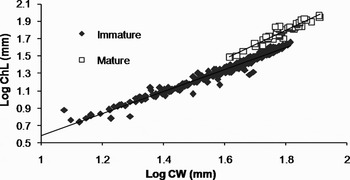
The relative growth of ChL with respect to CW showed positive allometric phases, differing markedly between immature (log ChL = 0.6906 + 1.2687 log CW, R2 = 0.96, t = 12.7498, P < 0.001) and mature (log ChL = 1.1478 + 1.632 log CW, R2 = 0.92, t = 4.9137, P < 0.001) males (Figure 5). The slopes of the regression lines differed significantly when the ChL × CW relationship was compared between immature and mature males (ANCOVA, F = 8.71, P < 0.01). Along the group of immature points, the absence of an inflection point did not suggest a prepubertal moult. The size at which 50% of males were morphometrically mature was 58.9 mm. The smallest mature male measured 46.2 mm CW, and the largest immature male measured 69.8 mm CW. A wide overlap between immature males of larger CW and the mature phase was observed, thus crabs having the same carapace width can have undifferentiated or differentiated cheliped of different sizes.
Libinia spinosa, males. Relationships between cheliped length (ChL) and carapace width (CW); the regression lines correspond to immature and mature males (N = 312).

Gonad maturity
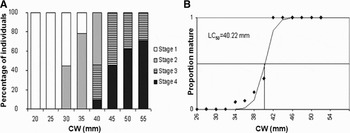
In females, according to the macroscopic characteristics of ovaries, four stages of gonad development were described; two corresponded to the immature phase and two to the mature phase. Stage I presented translucent, not clearly differentiated ovaries, while immature females of stage II presented thin, translucent and clearly differentiated ovaries. Mature females presented conspicuous ovaries, of white colour in females of stage III, and of orange colour in females of stage IV. The seminal receptacles were empty in stage I and stage II females, while they were full of spermatozoa in stages III and IV. The size distribution analyses per stages showed that females of stage I ranged from 20 to 35 mm CW, females of stage II ranged from 30 to 40 mm, while females of stages III and IV ranged from 40 to 55 mm CW (Figure 6A). All females larger than 45 mm CW were mature, corresponding to stages III or IV. The logistic equation showed that the size at which 50% of females reached gonad maturity is LC50 = 40.33 mm (Figure 6B).
Libinia spinosa, females. (A) Size distribution analysis of stages of gonad maturity; (B) relationships between the proportion of females reaching gonad maturity and carapace width (CW). Fifty per cent of females reached gonad maturity at 40.22 mm CW (N = 87).

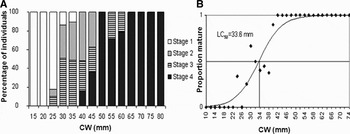
In males, according to the macroscopic characteristics of the testis and vas deferens, four stages of gonad development were also described; two corresponded to immature and two to mature phases. Immature males were characterized by the absence of spermatophores in their vas deferens. Stage I presented thin, translucent and not clearly differentiated testis and vas deferens, while they were opaque and clearly differentiated in males of stage II. Mature males presented large, convoluted and white testis and vas deferens; and were characterized by the presence of spermatophores in their vas deferens, being scarce in males of stage III and abundant in males of stage IV. The size distribution analyses by stages showed that stage I immature males ranged from 15 to 35 mm CW, while stage II immature males ranged from 25 to 45 mm CW (Figure 7A). Mature males of stage III ranged from 25 to 60 mm CW, showing a large overlap with immature individuals of stages I and II (Figure 7A). Mature males of stage IV ranged from 40 to 80 mm CW, showing also a large overlap with individuals of stages II and III of 40–45 mm CW and 40–60 mm CW respectively (Figure 7A). All males larger than 45 mm CW were mature, while all males smaller than 25 mm CW were immature. The analysis of the logistic equation showed that the size at which 50% of males reached gonad maturity is LC50 = 33.6 mm (Figure 7B).
Libinia spinosa, males. (A) Size distribution analysis of stages of gonad maturity; (B) relationships between the proportion of males reaching gonad maturity and carapace width (CW). Fifty percent of males reached gonad maturity at 33.6 mm CW (N = 187).

Male growth-at-moults
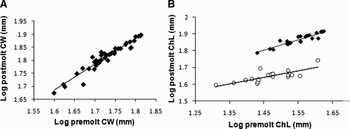
A total of 41 males of 39.8–65.1 mm pre-moult CW moulted in the laboratory. A single Hiatt model was used to describe CW growth per moult (CWT+1 = 0,986 CWT + 0.929, R2 = 0.929, P < 0.001) (Figure 8A). ChL growth per moult was explained by two Hiatt growth models: regular moults (ChLT+1 = 1,077 ChLT + 0.388, R2 = 0.596, P < 0.01, N = 18) and terminal moults (ChLT+1 = 0.89 ChLT + 0.628, R2 = 0.863, P < 0.001, N = 23) (Figure 8B). ANCOVA of the two Hiatt models showed significant differences in slopes and intercepts (P < 0.0001). The size of males reaching their terminal moult was wide, ranging from 48.5 mm CW to 61.4 mm CW.
Libinia spinosa, males (N = 41). (A) Single Hiatt diagram representing carapace width (CW) growth per moult; (B) two Hiatt diagrams representing cheliped length (ChL) growth per moult, regular (open circles) and terminal (solid symbols) moults.

DISCUSSION
Similar to other majoid species, Libinia spinosa females showed the presence of two phases in the PW with respect to the CW separated by the puberty moult (Sainte-Marie & Hazel, Reference Sainte-Marie and Hazel1992; Carmona-Suarez, Reference Carmona-Suárez2003; Schejter & Spivak, Reference Schejter and Spivak2005; Barón et al., Reference Barón, Quiroga, Leal and González-Pisani2009). Phases were coincident with other morphological characteristics like the pleon engaged to the sternum and the seminal receptacle empty in immature individuals, while the pleon was not held by the sternum and the seminal receptacle was full of spermatozoa in mature females (Sal Moyano, Reference Sal Moyano2007). This pattern is similar to other Majoidea in which immature and mature (primiparous and multiparous) stages can be recognized (Elner & Beninger, Reference Elner and Beninger1995). The importance of the enlargement of the pleon is related to its function as an incubation chamber sufficient for carrying the developing eggs (Hartnoll, Reference Hartnoll1974).
The stages described for the degree of ovary development corresponded to those proposed for Maja crispata (Risso, 1827) by Carmona-Suarez (Reference Carmona-Suárez2003). The analysis of the size–frequency distributions per stage in L. spinosa showed a small overlap of immature and mature stages at a size of 40 mm CW, which corresponded to the size of gonad maturity.
According to the sizes at which the individuals acquired morphometric and physiological maturity, we found that in females of L. spinosa they occur simultaneously at the size of approximately 40 mm CW. Different studies conducted on majoid females have registered that both types of maturity were also coincident at a similar size (Hartnoll, Reference Hartnoll1963; Bryant & Hartnoll, Reference Bryant and Hartnoll1995), as was observed for L. spinosa, or that maturation of ovaries occurs later than morphometric maturity (Hinsch, Reference Hinsch1972; Jones & Hartnoll, Reference Jones and Hartnoll1997).
In several species of majoid males, the relationships between the size of the chelae and CW were described by the presence of two phases: immature and mature, separated by the pubertal moult (Watson, Reference Watson1970; Hartnoll, Reference Hartnoll1978; Conan & Comeau, Reference Conan and Comeau1986; Comeau & Conan, Reference Comeau and Conan1992; Schejter & Spivak, Reference Schejter and Spivak2005; Barón et al., Reference Barón, Quiroga, Leal and González-Pisani2009); or the presence of three phases: juveniles, adolescents and adults, which slightly overlap, separated by prepubertal and terminal moult respectively (Conan et al., Reference Conan, Moriyasu, Comeau, Mallet, Cormier, Chiasson, Chiasson, Jamieson and McKone1988; Sainte-Marie et al., Reference Sainte-Marie, Raymond and Brèthes1995; Sampedro et al., Reference Sampedro, Gonzalez-Gurriarán, Freire and Muino1999; Carmona-Suarez, Reference Carmona-Suárez2003). For L. spinosa males the measurement that best explain sexual differentiation is ChL and the growth relative to CW differentiated two groups: immature and mature phases. The immature phase did not show any discontinuity; consequently a prepubertal moult could not be distinguished. The wide overlap between larger males of the immature phase and mature crabs, indicate that individuals could have similar sizes of CW but small or large ChL depending on the acquisition of their morphometric maturity. Thus, we found three different male groups: (1) those with both small CW and ChL; (2) those with large CW and small ChL; and (3) the ones with both large CW and ChL.
With respect to gonad maturity, the stages described for the degree of testis and vas deferens development corresponded to the stages proposed by other authors in different species of Majoidea (Powles, Reference Powles1968; Watson, Reference Watson1970; Conan et al., Reference Conan, Moriyasu, Comeau, Mallet, Cormier, Chiasson, Chiasson, Jamieson and McKone1988; Comeau & Conan, Reference Comeau and Conan1992). The analysis of the size–frequency distributions per stage presented a huge overlap of immature and mature stages, from 25 to 45 mm CW, being 33.6 mm CW the size of gonad maturity. According to the sizes at which the individuals acquired morphometric and physiological maturity, we found that in males of L. spinosa, gonad maturity is reached prior to morphometric maturity.
In several species of male spider crabs, different studies have registered that, morphologically immature or juvenile males that have not undergone the pubertal moult, but have fully formed spermatophores in their vas deferens (Hinsch, Reference Hinsch1972; Conan & Comeau, Reference Conan and Comeau1986; Beninger et al., Reference Beninger, Elner, Foyle and Odense1988; Homola et al., Reference Homola, Sagi and Laufer1991; Sainte-Marie et al., Reference Sainte-Marie, Raymond and Brèthes1995; Corgos & Freire, Reference Corgos and Freire2006). Consequently, the terminal moult in Libinia emarginata for example is not necessarily a maturational moult, because spermatophores are present in sperm ducts prior to this moult (Rotllant et al., Reference Rotllant, Takac, Liu, Scott and Laufer2000), as was also observed for L. spinosa males. In this sense, we distinguished three different types of males: (1) morphometrically immature individuals of smaller sizes which have not produced spermatophores; (2) morphometrically immature individuals of bigger sizes which produce spermatophores, although they have undifferentiated cheliped; and (3) morphometrically mature individuals who have differentiated cheliped and always bear spermatophores. Many authors have discovered and explained these male polymorphisms as part of the process of achieving reproductive maturity (Hartnoll, Reference Hartnoll1963; Homola et al., Reference Homola, Sagi and Laufer1991; Laufer & Ahl, Reference Laufer and Ahl1995).
The two Hiatt growth models are necessary to explain differences in the growth of the ChL between regular (immature) and terminal (mature) moulters. Moreover, the wide range of premoult ChL of males attaining their terminal moult coincided with the males moulting to their terminal moult in CW–ChL scatterplots of the regression lines, thus the size at morphometric maturity coincided with the terminal moult. It was established that at the terminal moult, the transition from juvenile to adult occurs when crabs are moulting to different stages, resulting in a wide size-range of mature individuals in the population (Alunno-Bruscia & Sainte-Marie, Reference Alunno-Bruscia and Sainte-Marie1998; Barón et al., Reference Barón, Quiroga, Leal and González-Pisani2009). For such a wide size-range over which maturation occurs there must be advantages to moulting at a small size as well as advantages to moulting at a large size: moulting small means earlier maturation and more chances to reproduce, but moulting large means that males get more copulations (McLay & Van den Brink, Reference McLay and Van den Brink2009).
In L. emarginata the different morphotypes of male chelipeds are associated to different levels of methyl farnesoate in haemolymph, being higher in individuals with larger claws (Laufer & Ahl, Reference Laufer and Ahl1995; Rotllant et al., Reference Rotllant, Takac, Liu, Scott and Laufer2000). Moreover, the existence of male morphotypes that exhibit different reproductive behaviours has been described for several majoids, such as Chionoecetes opilio (Fabricius, 1788) (Conan & Comeau, Reference Conan and Comeau1986), C. bairdi (Rathbun, 1924) (Donaldson & Adams, Reference Donaldson and Adams1989) and L. emarginata (Leach, 1815) (Homola et al., Reference Homola, Sagi and Laufer1991; Sagi et al., Reference Sagi, Ahl, Danaee and Laufer1991).
Elner & Beninger (Reference Elner and Beninger1995) established that morphologically immature C. opilio males with small chelae, but bearing spermatophores in their vas deferens, can copulate, and that these males, according to long-term population cycles influencing inter-male competition levels, could control their pubertal moult. Thus, during phases when mature males are abundant, reproductive opportunities for immature males are probably low; however, they become greater when mature males become scarce (Elner & Beninger, Reference Elner and Beninger1995). It was suggested that these immature males appear to ‘mimic’ females avoiding aggressive behaviour from the morphologically mature males, thus they may be able to increase their mating opportunities by ‘sneak’ mating (Laufer & Ahl, 1995). By this way, the hypothesis advocates that morphologically immature males that successfully copulate will opt to remain in their immature stage and continue growth after the next moult, while those who fail to copulate will become morphometrically mature at the next moult (Elner & Beninger, Reference Elner and Beninger1995). According to the existence of the three types of males in the population of L. spinosa, we can propose that individuals which are gonad and morphometrically mature are the dominant reproductive males. On the other hand, morphometrically immature males but bearing spermatophores could have the possibility to mate under certain population circumstances, thus supporting the hypothesis stated by Elner & Beninger (Reference Elner and Beninger1995). Consequently, these individuals could control their morphometric terminal moult to the next morph or remain in their condition according to the male population structure. Future studies about the competitive mating and the different reproductive strategies between the different morphs, the population structure and the contribution of each type of male to the paternity of the broods are necessary to rule out competing hypotheses.
ACKNOWLEDGEMENTS
We gratefully acknowledge two anonymous referees whose critical comments improved this paper. This research was supported by the project: ‘Biología de Crustáceos’ developed by the Universidad Nacional de Mar del Plata, Argentina, to M.A.G. M.P.S.M and M.D.M. had a fellowship from Consejo Nacional de Investigaciones Científicas y Técnicas (CONICET).