Introduction
Orthostatic hypotension (OH) is defined as a systolic blood pressure (SBP) drop of at least 20 mmHg, or a diastolic blood pressure drop of at least 10 mmHg within 3 minutes of standing from a supine position.1 It can be symptomatic or asymptomatic, and is a common condition that can affect up to one in three older people living in the community.Reference Luukinen, Koski, Laippala and Kivela2 The prevalence is higher amongst those with Parkinson's diseaseReference Allcock, Ullyart, Kenny and Burn3 and, unsurprisingly, amongst those attending a syncope clinic.Reference McIntosh, Da Costa and Kenny4 The aetiology and pathophysiology of OH have been comprehensively discussed in previous articles in this journal, most recently by Kearney et al. (2007).Reference Kearney, Moore and Donegan5
OH can accompany acute illness, or present more chronically in individuals who are not obviously unwell. The management of OH in the acute setting is to treat the underlying cause and this rarely presents a significant management problem. The management of chronic symptomatic OH is more problematic, however.
The prevalence of OH varies according to the population studied. In a general geriatric clinic for example, the prevalence of OH approaches 55%, while among the home-dwelling older population the prevalence of OH is closer to 30%.Reference Applegate, Davis, Black, Smith, Miller and Burlando6–Reference Poon and Braun8 Recent large population-based studies suggest that the prevalence of OH may be higher than previously reported. This probably reflects a shift in the clinicians’ approach to its detection rather than a change in blood pressure behaviour. Previously OH was sought in the context of unexplained falls or dizziness. More recently, however, population-based studies have begun to routinely screen for the presence of OH. The results of these studies suggest that OH is more often asymptomatic than symptomatic and thus quite common indeed.
These studies also suggest that OH, where present, bears significant prognostic implications for individuals. Symptomatic or asymptomatic OH detected in middle or late life increases the likelihood of incident co-morbid diseases of various types on follow-up. In middle-aged people for example, OH correlates with later life incident heart failure (hazard ratio (HR) 1.31, 95% CI: 1.05–1.63),Reference Fedorowski, Hedblad, Engström and Melander9 later life incident kidney disease (HR 2.0, 95% CI: 1.5–2.8),Reference Franceschini, Rose, Astor, Couper and Vupputuri10 incident coronary events (HR 1.6, 95% CI: 1.3–1.9),Reference Fedorowski, Stavenow, Hedblad, Berglund, Nilsson and Melander11 and atrial fibrillation (HR 1.30, 95% CI: 1.05–1.61).Reference Fedorowski, Hedblad, Engström, Gustav Smith and Melander12 In the older population, OH is associated with all cause mortality (HR 1.22, 95% CI: 1.1–1.36).Reference Verwoert, Mattace-Raso, Hofman, Heeringa, Stricker, Breteler and Witteman13 These data suggest that this predominantly silent condition carries with it significant prognostic implications. To date it is not clear whether intervention may abate incident co-morbid disease. Indeed, OH is possibly a marker of frailty rather than a risk factor for disease in itself. What is clear, at least, is the benefit that appropriate therapy will confer on the frequency of orthostatic symptoms experienced by patients.
Medication review
The non-pharmacological management of OH should begin with a review of the patient's medication for potentially inappropriate agents. The well-validated ‘STOPP’ criteria for ‘potentially inappropriate medications’ list vasodilator agents as inappropriate in those prone to falls.Reference Gallagher and O'Mahony14–Reference Pyszka, Seys Ranola and Milhans17 In their validation cohort, these authors identified patients at high risk of falls who presented to the emergency department on vasodilating agents. In 50% of these cases, symptomatic hypotension was the primary reason for their presentation.Reference Gallagher and O'Mahony14 While beneficial in the prevention of cardiovascular disease at all ages, an appropriate class of anti-hypertensive agent should be considered on a case-by-case basis.
The HYVET (Hypertension in the Very Elderly Trial) demonstrated the positive benefits of blood pressure lowering in older people; however, the selected patients had less co-morbid disease than would be expected for this age category and only those with sustained systolic blood pressures of greater than 160 mmHg underwent treatment.Reference Beckett, Peters, Fletcher, Staessen, Liu, Dumitrascu, Stoyanovsky, Antikainen, Nikitin, Anderson, Belhani, Forette, Rajkumar, Thijs, Banya and Bulpitt18 Furthermore, in a recent study Van der Velde et al. stopped or reduced ‘falls-risk-inducing-medication’ among OH patients; repeat TILT assessment resulted in significantly greater orthostatic tolerance among these patients than in the placebo group.Reference van der Velde, van den Meiracker, Pols, Stricker and van der Cammen19
While the body of evidence suggests that measures taken to reduce blood pressure are effective preventative therapy at all ages, we suggest some degree of caution in a subgroup of frail patients, where anti-hypertensive agents may be contributing to hypotensive falls. This is pertinent in those patients with multiple co-morbidities.
Non-pharmacological therapy
For those with chronic OH in whom medication withdrawal is not an option, the alternative is to consider pharmacological or non-pharmacological means of management. The goal of treatment should be to improve the patient's quality of life rather than to achieve a specific blood pressure target.
Treatment of OH works through two mechanisms, either by increasing plasma volume or increasing peripheral resistance.
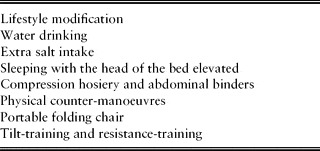
Anti-hypotensive medications are associated with side-effects that can limit their utility. Importantly, supine hypertension is common in patients with OH, occurring in up to 80% of patients.Reference Ejaz, Haley, Wasiluk, Meschia and Fitzpatrick20 We recommend the use of a 24-hour blood pressure monitor to assess the presence of supine hypertension. The European Guidelines on the management of OH recommend non-pharmacological therapy before the consideration of pharmacological agents and also state that education of patients to recognize symptoms and avoid situations that exacerbate the condition is essential first-line therapy.Reference Lahrmann, Cortelli, Hilz, Mathias, Struhal and Tassinari21 Non-pharmacological treatment of orthostatic hypotension is summarized in Table 1.
Non-pharmacological treatment of orthostatic hypotension

Lifestyle modification
Patients are advised to sit down quickly at the onset of symptoms and, if possible, to keep their head at the same level as the heart by bending forward (putting their head between their knees) or lying down.Reference Lahrmann, Cortelli, Hilz, Mathias, Struhal and Tassinari21 OH tends to be worst in the morning and patients are advised to carry out most activities in the afternoon. They should also avoid quick postural changes. Hot environments exacerbate cutaneous vasodilatation and increase fluid loss through sweating. Patients with OH are advised to avoid hot environments (hot rooms, hot baths or showers) and need to be more vigilant about symptoms during the summer. Petrofsy et al. reported that patients with diabetes who develop OH during head-up tilt-testing have greater falls in blood pressure in a hot environment of 42°C than at 22°C.Reference Petrofsky, Besonis, Rivera, Schwab and Lee22 During the heat wave of 2004 in France, Pathak found higher morbidity amongst those with OH.Reference Pathak, Lapeyre-Mestre, Montastruc and Senard23
Post-prandial hypotension, defined as a fall in systolic blood pressure of greater than 20 mmHg up to 90 min following a meal, is a common condition.Reference Jansen and Lipsitz24 It can co-exist with OH and is related to the rate of glucose entering the small intestine.Reference O'Donovan, Feinle, Tonkin, Horowitz and Jones25, Reference Jones, O'Donovan, Russo, Meyer, Stevens, Lei, Keogh, Tonkin and Horowitz26 OH patients with concomitant post-prandial hypotension should avoid eating large carbohydrate meals and should drink extra water with their meal.Reference Shannon, Diedrich, Biaggioni, Tank, Robertson, Robertson and Jordan27
Alcohol causes diuresis by suppressing antidiuretic hormone release and it also prevents vasoconstriction, thereby exacerbating OH.Reference Narkiewicz, Cooley and Somers28 Alcohol should therefore be used in moderation by patients with OH.
Physical counter-manoeuvres
Patients with OH often complain of debilitating dizziness in the upright position. The treatment goal is to maintain cerebral perfusion when standing, so that symptoms do not occur. Physical counter-manoeuvres (PCM) that increase peripheral resistance and venous return allow patients to stand longer without symptoms.Reference Wieling, van Lieshout and van Leeuwen29 These manoeuvres increase the blood pressure by up to 10–15 mmHg and may be used in conjunction with other therapies for OH.Reference Krediet and Wieling30
Lowering the head into a stooped position and crossing the legs has been described since 1928.Reference Ghrist and Brown31–Reference Bickelmann, Lippschutz and Brunjes34 Leg-crossing, leg muscle pumping and tensing, shifting weight from leg to leg, and putting one foot on a chair, can also bring relief of symptoms.Reference Ten Harkel, van Lieshout and Wieling35 Some patients find standing with legs crossed is very effective in preventing symptoms, while others are helped by squatting and stooping.Reference van Lieshout, ten Harkel and Wieling36 Thigh contractions and toe extension have been shown to be effective as well.Reference Bouvette, McPhee, Opfer-Gehrking and Low37
In a case report, Bickelmann et al. described a businessman whose work required him to stand talking to customers.Reference Bickelmann, Lippschutz and Brunjes34 He averted syncope by tensing the muscle of his arms and legs or bending forwards as if to tie his shoelaces. An Italian physician, Biaggioni, described a complex manoeuvre of ‘leg-crossing at a 30 deg angle, leaning the torso 30 deg forward and placing his right hand on his right thigh for support’.Reference Biaggioni, Goldstein, Atkinson and Robertson38 Takishita et al. reported that patients could maintain blood pressure if they leg-crossed while sitting.Reference Takishita, Touma, Kawazoe, Muratani and Fukiyama39
Wieling et al. described how a patient who had dysautonomia after Hodgkin's disease was able to use PCM to alleviate orthostatic symptoms.Reference Wieling, van Lieshout and van Leeuwen29 Before adopting PCM, the patient had such incapacitating postural symptoms that she was confined to the supine position. However, she noticed that she was able to move around by adopting a series of manoeuvres. Squatting seemed to help dizzy symptoms that came on shortly after standing. Orthostatic tolerance also improved markedly when she stood with the head bent with contracted abdominal muscles. By applying these PCM, she was able to walk short distances in a stooped position. She climbed stairs by hopping backwards up the stairs, while maintaining a knee-bent posture. During exercise (such as riding a bike), the patient relieved exercise-induced hypotension by drawing her knees to the frame of the bicycle or bending forwards over the handlebars.
Patients can be trained to perform these manoeuvres effectively by biofeedback. Leg-crossing has been found to be more effective than neck flexion or abdominal contractions.Reference Bouvette, McPhee, Opfer-Gehrking and Low37 Certain manoeuvres such as thigh contractions and leg-crossing improved with practice. These physical manoeuvres seem to be helpful in younger patients with OH. We routinely give counter-manoeuvre advice to our older patients and our experience is that they report using the manoeuvres as much as younger patients do. In addition they are often highly motivated to prevent falls and, as a result, may retain the exercises better than younger patients.
Their utility in older patients is less clear. Leg-crossing during prolonged standing and sitting, and isometric contraction of arm muscles would probably be tolerated by older patients. However, squatting, leg muscle pumping (tip-toeing), abdominal contractions and bending forwards may be less acceptable to older patients with gait imbalance. Effectiveness of these manoeuvres is influenced by physical strength: frail older patients are less likely to generate sufficient muscle contraction to alter cardiac output.
A recent randomized control trial demonstrated that young patients with vasovagal syncope respond well to physical counter-manoeuvres.Reference van Dijk, Quartieri, Blanc, Garcia-Civera, Brignole, Moya and Wieling40 In this study 208 patients were assigned either to conventional advice or training in counter-pressure manoeuvres. After 12 months of follow-up, 51% in the conventional treatment group reported symptom recurrence compared with 31.6% in the intervention group (P = 0.005). While this study was conducted in syncope patients rather than OH, similarity between both entitiesReference Podoleanu, Maggi, Brignole, Croci, Incze, Solano, Puggioni and Carasca41 ensures that it is reasonable to extrapolate these findings to the management of patients with postural hypotension.
Water-drinking
The advice to drink 1.5–2 litres of extra water a day is an important part of the non-pharmacological measures in patients with symptomatic orthostatic hypotension. If symptoms are most pronounced on rising from bed we recommend the patient drinks 2 cups of water 30 minutes before rising.Reference Figueroa, Basford and Low42 In addition to rehydration, water-drinking has an acute pressor effect.
One of the earliest reports of the documented pressor effect of water was by Jens Jordan et al.;Reference Jordan, Shannon, Grogan, Biaggioni and Robertson43 in 1999, they reported that when patients with severe autonomic failure drank 480 ml of tap water quickly, there was a substantial rise in blood pressure of up to 35 mmHg. This effect is equivalent to smoking two unfiltered cigarettesReference Cryer, Haymond, Santiago and Shah44, Reference Benowitz45 or ingesting 250 mg caffeine (2 cups of strong coffee).Reference Robertson Robertson, Frölich, Carr, Watson, Hollifield, Shand and Oates46 Claydon et al. demonstrated that when patients drank 500 ml of water, as opposed to 50 ml of water, 15 min before head-up tilt, there was a significant increase in time to orthostatic intolerance.Reference Claydon, Schroeder, Norcliffe, Jordan and Hainsworth47 Water-drinking has also been shown to be effective in attenuating post-prandial fall in blood pressure.Reference Shannon, Diedrich, Biaggioni, Tank, Robertson, Robertson and Jordan27 Its effectiveness is seen within 5 minutes.
Jordan found a rise (11 mmHg) in blood pressure after water-drinking in older subjects (age 57 years), and no effect in younger controls (age 25 years), suggesting an attenuation of its pressor effect in younger people.Reference Jordan, Shannon, Black, Ali, Farley, Costa, Diedrich, Robertson, Biaggioni and Robertson48 Tank et al.’sReference Tank, Schroeder, Stoffels, Diedrich, Sharma, Luft and Jordan49 observation of a corresponding fall in heart rate (64 to 60 b.p.m.) after water ingestion is consistent with the results of other investigators.Reference Shannon, Diedrich, Biaggioni, Tank, Robertson, Robertson and Jordan27, Reference Schroeder, Bush, Norcliffe, Luft, Tank, Jordan and Hainsworth50 Interestingly, the temperature of the water does not seem to affect blood pressure rise.Reference Jordan, Shannon, Black, Ali, Farley, Costa, Diedrich, Robertson, Biaggioni and Robertson48
One must also be mindful of issues with water compliance. A recent randomized controlled trial by Fan et al. reported compliance issues among older patients.Reference Fan, Walsh and Cunningham51 Although patients were instructed to drink 1.5–2 litres per day fluid regime, at 6 weeks follow-up only 49% of patients reported sustained compliance. Of note, 6-week follow-up indicated that only 55.5% of patients had a urine output of greater than 1.5 litres over 24 h. Compliance in clinical practice is usually worse than in a clinical trial setting and thus we recommend regular top-up advice regarding the importance of water consumption.
Mechanism of action
There are several theories as to how water-drinking exerts a pressor effect. One consistent finding amongst those with normal or residual autonomic nervous function is that water-drinking causes sympathetic system activation. Jordan et al. found that, when older controls (mean age 57 years) drank 480 ml of water, there was an increase in plasma noradrenalin levels.Reference Jordan, Shannon, Black, Ali, Farley, Costa, Diedrich, Robertson, Biaggioni and Robertson48 Increased muscle sympathetic nerve activity (MSNA) was also noted by Scott et al. in young healthy subjects after drinking water.Reference Scott, Greenwood, Gilbey, Stoker and Mary52 Another investigator also noted a sharp increase in radial artery resistance in young volunteers after drinking 11 ml/kg of water.Reference Joannides, Moore, de la Gueronniere and Thuillez53 Flevari et al. demonstrated that syncope patients exhibited excessive vasodilatory reflexes in response to forearm hyperaemia induction when compared with normal controls.Reference Flevari, Fountoulaki, Leftheriotis, Komporozos, Lekakis and Kremastinos54 This exaggerated reflex response was normalized by ingestion of 500 ml of water. Jordan et al. found that patients with residual efferent sympathetic function have a greater pressor response than those patients with little or no residual autonomic function.Reference Jordan, Shannon, Black, Ali, Farley, Costa, Diedrich, Robertson, Biaggioni and Robertson48 There is little blood pressure rise in those with absent autonomic function.
The exact mechanism by which water-drinking causes a rise in sympathetic activity is unclear. Oropharyngeal activation,Reference Endo, Yamauchi, Tsutsui, Ishihara, Yamazaki, Sagawa and Shiraki55 gastric dilatation,Reference Endo, Yamauchi, Tsutsui, Ishihara, Yamazaki, Sagawa and Shiraki55, Reference Rossi, Andriesse, Oey, Wieneke, Roelofs and Akkermans56 osmosensitive afferent structures in the gastrointestinal tractReference Lipp, Tank, Franke, Arnold, Luft and Jordan57 and rehydration of subtle volume depletionReference Mathias58 have all been implicated. Water, being inexpensive and readily available, would appear to be an ideal potential treatment for OH but evidence on its tolerability and acceptability to older people requires further work.
Salt
Sodium plays an integral part in maintaining intra- and extra-vascular volume and therefore daily intake of sodium has an effect on blood pressure. An animal study in chimpanzees showed that blood pressure rose with increased salt intake and reverted to normal when the increase was stopped.Reference Denton, Weisinger and Mundy59
Salt has received bad publicity from its casual link with hypertension. In 1982, the collaborators of the INTERSALT project set out to study 52 populations in 32 countries.Reference Elliott, Stamler, Nichols, Dyer, Stamler, Kesteloot and Marmot60 Amongst 10,074 subjects, there was a significant positive correlation between urinary sodium excretion and systolic blood pressure. A 100 mmol difference (for example 170 and 70 mmol/day) of urinary sodium excretion was associated with a difference of systolic blood pressure of 5 to 7 mmHg and a diastolic difference of 4–6 mmHg. The difference was greater in those who were older. Recent longitudinal data, however, suggests that those with low urinary sodium excretion may also be at an increased risk of cardiovascular death.Reference Stolarz-Skrzypek, Kuznetsova, Thijs, Tikhonoff, Seidlerová, Richart, Jin, Olszanecka, Malyutina, Casiglia, Filipovský, Kawecka-Jaszcz, Nikitin and Staessen61 This study, although large (2096 participants, mean follow-up 6.5 years), is at variance with the body of evidence regarding salt and cardiovascular outcomes and thus, in isolation, its results must be assimilated with caution.
Sodium intake varies widely. A person usually excretes only about 1–2 litres of urine and 150–250 mmol of sodium a day. Aldosterone and atrial natriuretic peptide (ANP) are the main hormones that are responsible for sodium reabsorption in the distal segments of the nephron. Low perfusion pressure in the afferent arteriole triggers the juxtaglomerular apparatus to release renin, which in turn leads to an increase in aldosterone and thereby causes sodium absorption and retention. Excessive sodium intake in subjects with borderline hypertension also produces abnormal increases in forearm vascular resistance, neurogenic vasoconstriction and arterial pressure.Reference Mark, Lawton, Abboud, Fitz, Connor and Heistad62 When a 24-hour blood pressure monitor was applied to salt-sensitive subjects, high salt intake resulted in a blunted nocturnal dip in blood pressure. The normal circadian rhythm to blood pressure was disturbed.Reference Hou, Liu, Liu, Liu, Wang and Geng63 For these reasons high salt intake is best avoided in those with co-existing supine hypertension.
However, in patients with isolated OH, increased salt and water intake has been used with therapeutic effect. A case report described how salt was useful in a 14-year-old Japanese boy with OH in whom alpha-agonists had failed to control symptoms. Within 2 days of taking a high-salt diet (i.e. an extra 5–6 g sodium daily), his symptoms improved greatly, and this was associated with increased plasma volume. He gained 1.6 kg in weight.Reference Shichiri, Tanaka, Takaya and Tamai64
El-Sayed and Hainsworth carried out an elegant double-blind, placebo-controlled trial in 20 patients, and an open study in 11 patients, of the effect of giving 120 mmol/day of sodium chloride.Reference El-Sayed and Hainsworth65 Patients who showed an improvement in orthostatic tolerance were those whose salt excretion prior to the study was less than 170 mmol/day. Salt-loading increased plasma volume by 300 ml. The effect of salt was evident after 3 days.Reference Mtinangi and Hainsworth66
Cooper and Hainsworth studied the effect of dietary salt on orthostatic tolerance in patients with recurrent syncope.Reference Cooper and Hainsworth67 The investigators examined orthostatic tolerance using head-up tilt and lower-body suction. Those with low salt excretion and poor orthostatic tolerance were given daily salt supplements of 1.5 mmol/kg and reassessed after 3 months. At baseline, those with sodium excretion of <170 mmol/day had significantly lower orthostatic tolerance than those with higher excretion. Salt loading was shown to increase mean arterial pressure by 1.8 mmHg without any significant change in supine systolic blood pressure. More than two-thirds of the patients given salt supplementation had increases in orthostatic tolerance by 2 minutes or more. None of the patients who were given salt supplementation (about 100 mmol/day) in this study developed blood pressure in the hypertensive range.
Claydon and Hainsworth, in a later study, found that 2 months supplementation with 100 mmol/day of salt improved orthostatic tolerance in 10 of the 11 subjects who had recurrent syncope.Reference Claydon and Hainsworth68 There was no change in supine blood pressure. For those who responded to salt supplementation, the forearm vascular resistance also increased.
Increased fluid and liberal salt intake has now become part of the standard advice for patients with orthostatic hypotension.Reference Engstrom and Aminoff69–Reference Oldenburg, Kribben, Baumgart, Philipp, Erbel and Cohen72 However, we need to caution against its use in those who are hypertensive.Reference Sclater and Alagiakrishnan73 It is our practice to perform 24-hour ambulatory blood pressure monitoring initially to identify an excessive blood pressure rise in those to whom we advocate extra salt intake.
Compression hosiery, abdominal binders and others
Application of graduated pressure from a support garment to the lower limbs reduces venous pooling and improves ventricular filling. However, this effect is temporary and quickly wears off when the garment is removed.Reference Mathias, Bannister, Bannister and Mathias74 Denq et al. evaluated the efficacy of compression of various compartments of the body (for instance calves, thighs, lower abdomen, and all compartments combined) using a modified anti-gravity suit.Reference Denq, Opfer-Gehrking, Giuliani, Felten, Convertino and Low75 This experiment was carried out in patients with autonomic failure. Orthostatic systolic blood pressure rose by 26.3 mmHg with full compression of various components. The single compression most effective in reducing blood pressure fall was at the level of the lower abdomen. Anti-gravity suits, though effective in theory, are not practical for daily purposes.Reference Bannister, Ardill and Fentem76, Reference Stead and Ebert77
Tanaka et al.Reference Tanaka, Yamaguchi and Tamai78 and Smit et al.Reference Smit, Wieling, Fujimura, Denq, Opfer-Gehrking, Akarriou, Karemaker and Low79 reported the benefits of using inflatable abdominal bands or abdominal binders to reduce the capacitance beds. The more commonly used compression hosiery was evaluated by Henry et al. who found that the drop in blood pressure was significantly reduced when thigh-length compression stockings were worn.Reference Henry, Rowe and O'Mahony80
Two recent randomized control trials have investigated the potential benefit of compression stockings. Gorelick et al. applied compression bandages at pressures of 40 mmHg to the lower limbs in 49 older heart failure patients (mean age 75 years).Reference Gorelik, Almoznino-Sarafian, Litvinov, Alon, Shteinshnaider, Dotan, Modai and Cohen81 Postural drop and symptoms were evaluated on standing on two separate occasions. On one occasion, sham bandages were applied (3 mmHg pressure), while on a separate occasion active compression bandages were applied with a pressure of 40 mmHg. Compression bandages prevented postural hypotension in 21 of 49 patients (43%). Among older heart failure patients, where fludrocortisone and midodrine are usually contraindicated, compression bandages should be considered. Podoleanu et al. carried out a well-constructed randomized single blinded cross-over study among older patients with OH.Reference Podoleanu, Maggi, Brignole, Croci, Incze, Solano, Puggioni and Carasca41 Among 21 patients studied with TILT examination, compression binders prevented hypotensive symptoms in 90% of patients. Sham compression bandages prevented hypotensive symptoms in only 53% of patients. Interestingly, at 6 months follow-up, 71% of patients remained compliant.
Sleeping with the head of the bed elevated
Sleeping with the head of the bed elevated (SHU) is widely recommended in the literature for treatment of orthostatic hypotension.Reference Brignole, Alboni, Benditt, Bergfeldt, Blanc, Bloch Thomsen, van Dijk, Fitzpatrick, Hohnloser, Janousek, Kapoor, Kenny, Kulakowski, Masotti, Moya, Raviele, Sutton, Theodorakis, Ungar and Wieling82, Reference Wieling, Van Lieshout and Hainsworth83 The European Society of Cardiology recommends it as treatment for OH as several researchers have reported that sleeping with the head of the bed elevated greater than 12 deg (18 inches head-up) is associated with an increased orthostatic tolerance in patients the following day. A postal questionnaire addressed UK physicians’ attitudes to SHU. Sixty per cent stated that they prescribed the technique in the management of OH. The most commonly used angle among those surveyed was 3–5 deg (which corresponding to 4–6 inches of bed elevation). However, participating physicians frequently disagreed on the optimal angle, which ranged from less than 3 deg to 45 deg.
The practice of sleeping head up was first described in 1940 by two physicians from the Mayo Clinic, MacLean and Allen.Reference MacLean and Allen84 They instructed four of their patients with OH not to sleep or lie on a flat bed but to lie in a semi-inclined or head-up position. This tilt of the bed corresponded to 13 deg in a standard 75-inch length bed. There was a marked improvement in patients’ orthostatic symptoms. The improvement was evident within 3 days and disappeared after sleeping horizontally for a night. Since then physicians have tried a variety of angles to some effect.
Van Lieshout et al. reported small reductions in upright BP at 1-min standing after 3 weeks treatment with SHU and fludrocortisone in eight patients with autonomic failure.Reference van Lieshout, ten Harkel and Wieling85
A recent randomized control trial, however, has cast doubt on the effectiveness of sleeping head-up in the treatment of idiopathic OH among older people at 5 deg tilt. Fan et al. reported non-superiority of this technique at 6-week follow-up.Reference Fan, Walsh and Cunningham51 The angle of 5 deg, chosen in accordance with their postal questionnaire as mentioned above, was designed to trial the bed height that was most frequently advised in clinical practice.
Despite its lack of efficacy in the treatment of idiopathic OH, it is probable that SHU is still an effective treatment for those with autonomic failure. Future work is needed to investigate the potential benefit of tilting the head of the bed at angles greater than 5 deg.
Inspiration (impedance) threshold devices
Impedance threshold devices (ITD) have demonstrated some promise in the treatment of OH. Orthostasis induces an efflux of blood volume from the intra-thoracic cavity with a consequent reduction in stroke volume.
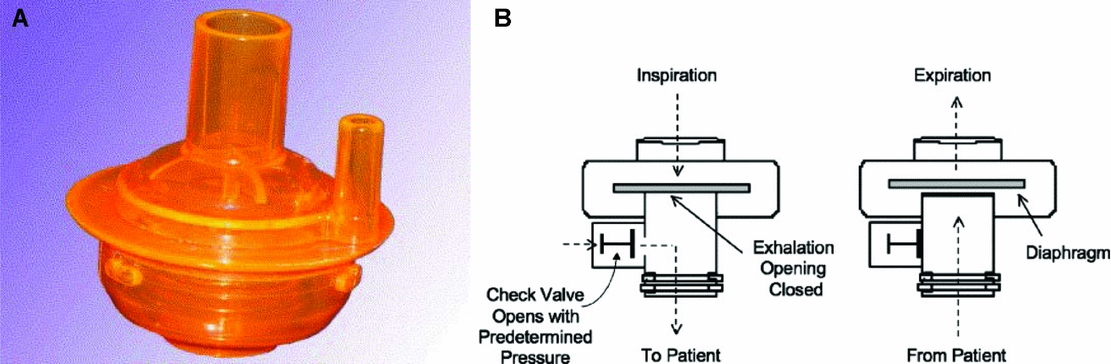
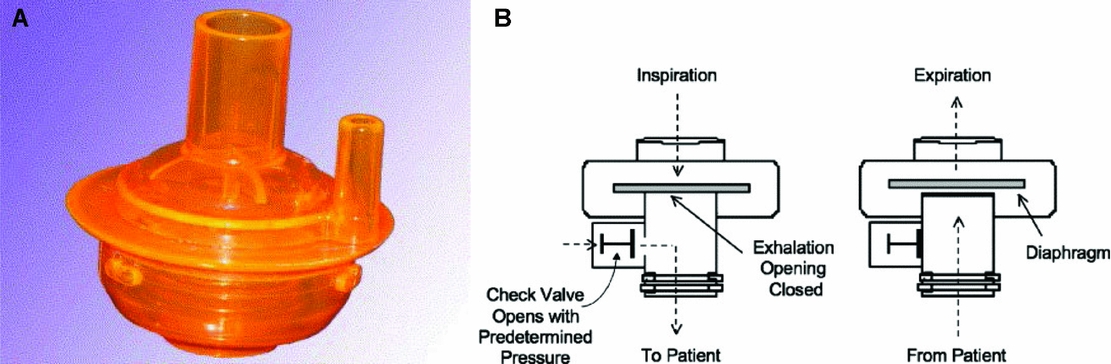
Recent studies have investigated the potential to ameliorate this negative intra-thoracic pressure through impedance devices.Reference Convertino, Ratliff, Crissey, Doerr, Idris and Lurie86–Reference Mittal90 They have utilized a simple device to do so: a portable 6 × 6 cm instrument primarily used to enhance the effectiveness of cardiopulmonary resuscitation. It does this by augmenting the negative intra-thoracic pressure induced during chest wall relaxation after release of each compression. There is a valve in the device which opens only when the patient generates a forceful negative intra-thoracic pressure on inspiration. The impedance device offers no resistance to expiration. In doing so it tempers the efflux of blood from the thoracic cavity and facilitates venous return to the heart with positive effects on cardiac output, heart rate and systemic blood pressure. The device and valve system are shown in Figure 1.
A, the inspiration threshold device. B, the valve system induces a greater negative intra-thoracic pressure on inspiration by opening only when a greater degree of negative pressure is created on inspiration. Expiration occurs without any impedance.
The benefit of impedance threshold devices in the context of OH has been demonstrated in 22 controls and 18 OH patients.Reference Melby, Lu, Sakaguchi, Zook and Benditt88 In this group, the ITP device significantly blunted orthostatic blood pressure fall at 100 s (P < 0.04). While further studies are needed, it is worth noting that the older population appears to gain most benefit from the use of this device. Supine hypertension and co-morbidities in this population make pharmacological therapy difficult and so this device may have some potential for the future.
Conclusion
Reports from cross-sectional data suggest that OH is more common than previously thought. The detection of OH yields important prognostic information, signifying a risk for future co-morbid disease.Reference Luukinen, Koski, Laippala and Kivelä7–Reference Verwoert, Mattace-Raso, Hofman, Heeringa, Stricker, Breteler and Witteman13 The European Guidelines on the management of OH recommend a non-pharmacological approach as first-line therapy.Reference Lahrmann, Cortelli, Hilz, Mathias, Struhal and Tassinari21 The mainstay of non-pharmacological therapy consists of advice regarding the avoidance of precipitants, physical counter-manoeuvres, 1.5–2 litres of daily water consumption, moderate salt supplementation and leg binders. Sleeping with the head of the bed up may be beneficial in those patients with pure autonomic failure; however, its role in the general management of OH is questionable. Potential therapies for the future include impedance threshold devices.
Conflicts of interest
The authors of this article have no conflicts of interest to declare.