Introduction
Adverse life events (ALEs) interacting with susceptibility genes (gene×environment interaction; GxE) are recognized risk factors for mood disorders (Caspi et al. Reference Caspi, Sugden, Moffitt, Taylor, Craig, Harrington, McClay, Mill, Martin, Braithwaite and Poulton2003; Brezo et al. Reference Brezo, Bureau, Merette, Jomphe, Barker, Vitaro, Hebert, Carbonneau, Tremblay and Turecki2009). However, there have been inconsistent and unreplicated findings (Uher & McGuffin, Reference McGuffin, Murray, Kendler, McGuffin, Wessely and Castle2008; Munafo et al. Reference Munafo, Durrant, Lewis and Flint2009) which may have been, at least in part, due to the methods used for measuring and analysing the role of ALEs.
First, both the design of studies (e.g. cross-sectional or longitudinal, retrospective or prospective) as well as the method for measuring ALEs (e.g. detailed structured interview, self-report questionnaires) have been criticized (Paykel, Reference Paykel2003; Johnson, Reference Johnson2005a). While prospective longitudinal studies using lengthy interview methods have clear advantages (Johnson, Reference Johnson2005a), such approaches are labour intensive and time consuming, and are not generally practical or affordable for use in very large genetic case-control studies numbering thousands of participants. Short questionnaires possibly limiting enquiry to a few specific ALEs, that can be applied cross-sectionally, are required. In fact adopting a researcher-administered version would be a good compromise since this approach could possibly reduce at least some of the biases associated with self-report questionnaires.
Second, while some GxE studies have applied additive statistical models such as multiple regression with continuous outcome measures (e.g. self-reported mood scores in cases only), others have used multiplicative approaches such as logistic regression with dichotomous case-control outcome measures. Similarly some studies have included ALEs as a dichotomous present/absent dependent variable, while others have employed the number of ALEs reported (Munafo et al. Reference Munafo, Durrant, Lewis and Flint2009).
In the present study, we will examine 11 ALEs measured using the researcher-administered List of Threatening Experiences Questionnaire (Brugha et al. Reference Brugha, Bebbington, Tennant and Hurry1985) reported by the participants of two large genetic association studies of unipolar depression (UPD) and bipolar disorder (BD) affective disorders to evaluate whether this questionnaire provides a useful measure of ALEs for future GxE studies. We will report both dichotomous and continuous measures of ALEs, comparing UPD and BD cases with controls for ALEs occurring in the 6 months before interview (UPD cases and controls) and before their worst illness episodes (UPD and BD cases), and examine potential confounding factors for ALE reporting in these participants.
Method
Study participants
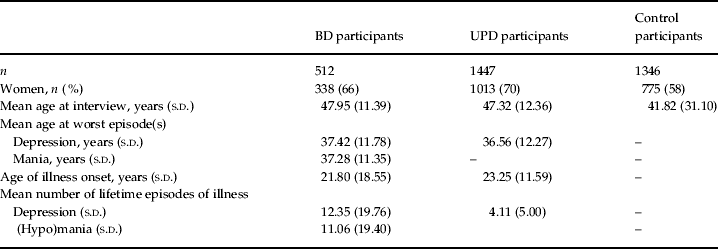
The 3305 study participants were initially recruited for two genetic case-control association studies, one UPD study (Korszun et al. Reference Korszun, Moskvina, Brewster, Craddock, Ferrero, Gill, Jones, Jones, Maier, Mors, Owen, Preisig, Reich, Rietschel, Farmer and McGuffin2004) and the one BD study (Gaysina et al. Reference Gaysina, Cohen-Woods, Chow, Martucci, Schosser, Ball, Tozzi, Perry, Muglia, Craig, McGuffin and Farmer2008). It should be noted that the control participants used in the present investigation were taken from both studies (851 participants from the UPD study and 495 from the BD study). The demographic and clinical characteristics of the sample are presented in Table 1.
Demographic and clinical characteristics of the sample
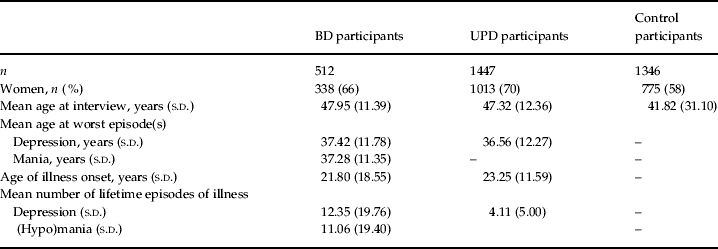
BD, Bipolar disorder; UPD, unipolar depressed; s.d., standard deviation.
For the UPD study, UPD participants who had experienced two or more episodes of major depression of at least moderate severity which fulfilled operational criteria for recurrent UPD according to the International Classification of Diseases (ICD-10; WHO, 1993) of at least moderate severity were recruited from psychiatric clinics and hospitals, general practice and through self-help groups and media advertisement from three sites in the UK – at Birmingham, Cardiff and London – during the years 2001 to 2004. Participants were excluded if they had intravenous drug dependence or depression occurring only in relation to substance misuse or a medical illness, or a personal or family history of mania or schizophrenia.
BD participants who had experienced at least two episodes of illness, at least one of which fulfilled diagnostic criteria for mania/hypomania according to the ICD-10 (WHO, 1993), were recruited from the greater London area, mainly via self-help groups (Manic Depression Fellowship/The Bipolar Society) and media advertisement and from psychiatric clinics between the years 2004 and 2007. Participants were excluded if their BD episodes only occurred in relation to substance misuse, physical disorder, or if they reported a personal or family history of schizophrenia.
The control participants for the UPD study were selected from among 34 371 participants originally recruited through general practices in England and Wales to the GENESiS (Genetic and Environmental Nature of Emotional States in Siblings) study (Sham et al. Reference Sham, Sterne, Purcell, Cherny, Webster, Rijsdijk, Asherson, Ball, Craig, Eley, Goldberg, Gray, Mann, Owen and Plomin2000) and who fell into the bottom 20% of the distribution on the Sham Composite Index of liability to depression and anxiety (‘G’) (Sham et al. Reference Sham, Sterne, Purcell, Cherny, Webster, Rijsdijk, Asherson, Ball, Craig, Eley, Goldberg, Gray, Mann, Owen and Plomin2000). Those who responded positively to a postal invitation to participate in the UPD genetic study and who had returned signed consent forms were then contacted by telephone.
Control participants for the BD study were recruited via newspaper advertisement as well as internal email advertisement to members of staff at King's College London campuses. Those who volunteered to participate were then interviewed face to face by trained research assistants (graduate psychologists).
All control participants were screened using the Past History Schedule (McGuffin et al. Reference McGuffin, Katz and Aldrich1986) administered by telephone (UPD study) or face to face (BD study) and only included if they had no personal current or past history of any psychiatric disorder, and no family history of psychiatric illness in a first-degree relative.
All participants were aged at least 18 years and provided written informed consent. Since the original studies were genetic association studies, all participants were of white European ancestry. Ethical approval was obtained from the Joint South London and Maudsley, and Institute of Psychiatry Research Ethics Committee and from local ethics committees in Birmingham and Cardiff for both studies.
Clinical assessment
All the UPD and BD cases were interviewed face to face using the Schedule for Clinical Assessments in Neuropsychiatry, version 2.1 (SCAN; Wing et al. Reference Wing, Babor, Brugha, Burke, Cooper, Giel, Jablenski, Regier and Sartorius1990) to ascertain a formal lifetime diagnosis of recurrent UPD (F33) or BD (F31). The presence and severity of the psychopathology items were rated for the UPD cases' self-identified worst and second worst episodes of depression and for BD cases for the worst episodes of depression and mania/hypomania.
The 4- to 6-week peak intensity of symptoms within each worst episode was then used to rate the presence and severity of each SCAN item. The computerized version of SCAN 2.1 is built on top of the ISHELL system, which is a computer-aided personal interviewing tool produced by the WHO (Celik, 1997) and which provides ICD-10 operationally defined diagnoses.
Adverse life events
The List of Threatening Experiences Questionnaire (LTE-Q; Brugha et al. Reference Brugha, Bebbington, Tennant and Hurry1985; Brugha & Cragg, Reference Brugha and Cragg1990) was used to record 11 types of ALEs that may have occurred 6 months before the UPD cases' worst episode of depression and the 6 months before interview, and for the BD cases 6 months before the onset of the worst depressive and manic/hypomanic episodes. For controls ALEs occurring in the 6 months before interview were rated. The LTE-Q was administered to all participants during their interview; this entailed asking whether they experienced an event, confirming the event occurred during the specified index period and obtaining some contextual information to establish that the reference event fulfilled the classification of the items listed on this instrument. For example, the respondent reporting a cold or flu would not be included under the ‘personal illness’ category of event (insufficiently severe illness).
While the original LTE-Q consists of 12 events, two of these were combined into a single item for the present study (these were: ‘did you have a separation due to marital difficulties?’ and ‘did you break off a steady relationship?’ combined to ‘did you have a separation due to marital difficulties or break off a steady relationship?’). In the present analyses, the percentage of participants reporting at least one ALE, as well as the mean number of ALEs, for cases and controls for each time-frame will be reported.
Present mood measures
All cases and the UPD controls completed the Beck Depression Inventory – Second Edition (BDI-II; Beck et al. Reference Beck, Steer and Brown1996) reporting on their depressed mood over the previous 2 weeks. This scale consists of 21 groups of four statements. Each statement represents a different degree of severity. The participants were asked to endorse one of the four statements in each group which best describes their mood over the past 2 weeks.
Data analyses
All data was analysed using SPSS (Windows version 13.0; SPSS Inc., USA, 2004). Dichotomous variables were analysed using χ2 tests, and mean group differences between cases and controls were analysed using independent-samples t tests. Paired-samples t tests were conducted to analyse the statistical difference between the mean number of ALEs in cases in the 6 months before their worst episodes and in controls for the 6 months before interview.
Results
Sample characteristics
The demographic and clinical characteristics of the entire sample are presented in Table 1.
There was a highly significant correlation for age at the worst episode of mania and age at the worst episode of depression (Pearson's R=0.60, p<0.001).
There was a significant difference in age at interview for the BD controls compared to the other three groups [F(3, 3253)=252.04, p<0.001, Tukey's B post-hoc test: BD controls <UPD cases, UPD controls, BD cases].
Correlations between age and event reporting
There was a significant negative correlation between the number of ALEs reported and age at interview for the combined control groups (Pearson's R=−0.08, p=0.006). There were negative correlations for the UPD and BD cases for age at interview and number of ALEs reported in their worst episodes and 6 months before interview in the UPD cases, but these failed to reach statistical significance.
In light of the differences in the number of ALEs reported across different ages in the combined controls, cases were compared to controls whose age at interview was the same as that of the mean age (±s.d.) at worst episodes for the cases. Thus, for the analyses of UPD participants' reported ALEs in the 6 months before interview, control participants were selected in the age range 33–59 years (n=810). However, for comparison with the UPD cases' worst episodes of depression, control participants were selected who were in the age range 24–49 years at the time of interview (n=646). For BD cases, the mean age (±s.d.) at their worst episodes of depression and mania was the same (26–49 years); controls were therefore selected in this range for comparison with the BD cases' worst episodes (n=578).
Sex differences
There were significant sex differences across the four groups of participants (χ2=50.09, df=3, p<0.001). However, there were no significant sex differences for the number of UPD cases reporting at least one ALE in the 6 months before interview (χ2=0.38, df=1, n.s.) or for UPD or BD cases in the 6 months before their worst episodes of depression (UPD: χ2=0.01, df=1, n.s.; BD: χ2=0.13, df=1, n.s.) or for BD cases before their worst episodes of mania (χ2=0.05, df=1, n.s.). Similarly, there were no significant sex differences in the combined control groups for participants reporting at least one ALE in the 6 months before interview (χ2=0.83, df=1, n.s.).
There were also no significant sex differences for the number of ALEs reported for these time-frames: UPD cases [6 months before interview: t(753.62)=1.77, n.s.; 6 months before worst episode of depression: t(788.31)=0.82, n.s.]; BD cases [6 months before worst episode of depression: t(321.51)=0.41, n.s.; 6 months before worst episode of mania: t(321.51)=0.41, n.s.], or for the combined control participants for the 6 months before interview [t(1255.55)=−0.42, n.s.].
ALE reporting
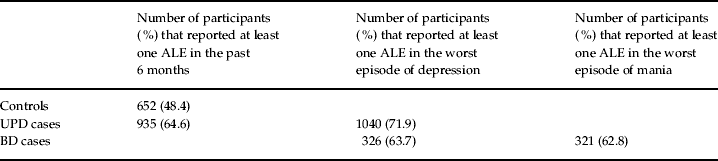
The number and percentage of participants reporting at least one ALE are presented in Table 2. There were significant case-control differences for reporting at least one ALE for UPD cases in the 6 months before interview (χ2=105.58, df=1, p<0.001). There were also significant case-control differences for UPD and BD cases reporting at least one ALE in the 6 months before their worst episode of depression (UPD: χ2=105.58, df=1, p<0.001; BD: χ2=25.78, df=1, p<0.001) and for BD participants before their worst episode of mania (χ2=22.55, df=1, p<0.001).
Percentage of participants reporting at least one ALE in the 6 months before interview (UPD cases and controls), worst episode of depression (UPD and BD cases) and worst episode of mania (BD cases)

ALE, Adverse life event; UPD, unipolar depressed; BD, bipolar disorder.
Significantly more UPD cases reported at least one ALE in the 6 months before their worst episode of depression compared to BD cases (χ2=11.92, df=1, p=0.001). There was no significant difference for the number of BD participants reporting at least one ALE before their worst episodes of mania or depression (χ2=0.07, df=1, n.s.).
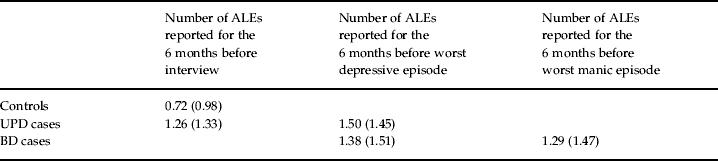
The mean number of ALEs reported for the index periods is shown in Table 3. There were significant case-control differences for UPD cases for the 6 months before interview [t(2138.68)=−11.55, p<0.001]. There were also significant case-control differences for UPD and BD cases for the number of ALEs reported in the 6 months before their worst episodes of depression [UPD: t(1777.61)=−14.45, p<0.001; BD: t(863.30)=−8.47, p<0.001] and for BD cases for the 6 months before their worst manic episode [t(880.71)=−7.71, p<0.001].
Number of ALEs reported for the past 6 months (UPD cases and controls), worst episode of depression (UPD and BD cases) and worst episode of mania (BD cases)

ALEs, Adverse life events; UPD, unipolar depressed; BD, bipolar disorder.
Values are given as mean (standard deviation).
There were no significant differences in the number of ALEs reported by UPD and BD cases in the 6 months before their worst depressive episodes [t(874.04)=−1.57, n.s.]. Similarly, there were no significant differences in the number of ALEs reported by BD participants in the 6 months before their worst depressive or manic episodes [paired t test: t(512)=−1.18, n.s.].
Present mood as measured by the BDI and correlation with ALE reporting
The mean BDI score for the UPD cases was 20.09 (s.d.=12.18) and for the BD cases was 15.03 (s.d.=12.17). For the UPD control group the mean BDI score was 1.97 (s.d.=2.12). There were significant case-control differences for BDI for UPD participants [t(1512.56)=−53.87, p<0.001]. Only 22% of UPD cases scored below the caseness threshold on the BDI (Beck, 1961) when interviewed, compared to 40% of the BD cases.
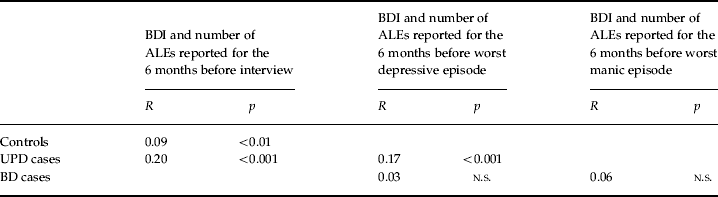
The Pearson correlation coefficients for BDI score and number of reported ALEs for cases and controls are shown in Table 4. While there are significant modest correlations for number of ALEs and BDI score for the UPD cases and UPD controls for the two time periods, the correlations for the BD cases with their worst illness episodes are non-significant.
Pearson's correlation coefficient of present mood (BDI score) and number of reported ALEs

BDI, Beck Depression Inventory; ALEs, adverse life events; UPD, unipolar depressed; BD, bipolar disorder; n.s., non-significant.
Discussion
Studies investigating the impact of genetic influences as well as the gene–environment interplay in UPD and BD require very large samples if they are to have sufficient power to detect relatively small genetic effects. However, the size of such studies usually precludes undertaking lengthy and detailed interviews such as the Life Events and Difficulties Schedule (LEDS) (Brown & Harris, Reference Brown and Harris1978) for evaluating ALEs, on grounds of time and cost. In the present study we have investigated the applicability of a short brief interview version of a well-used self-report questionnaire (LTE-Q), to establish whether 11 ALEs have occurred in two large case-control genetic association samples in specified 6-month periods, namely, the 6 months before interview (UPD cases and controls) and 6 months before worst episodes of depression (UPD and BD cases) and mania (BD cases). In this report we have focused on the two main measures of ALEs used in previous gene–environment interaction studies (Munafo et al. Reference Munafo, Durrant, Lewis and Flint2009): the percentage of participants reporting at least one ALE and the mean number of ALEs reported for the specified time-frames.
Worst illness episodes were selected for rating psychopathology and ALEs for two pragmatic reasons. First, in cross-sectional case-control studies selecting such episodes allows the peak intensity of psychopathology to be rated for diagnostic purposes, and for subsequent analysis of subphenotypes. Second, recall of the events occurring in relation to the self-identified most prominent ‘worst episodes’ may reduce the potential for recall bias (Paykel, Reference Paykel2003; Alloy et al. Reference Alloy, Abramson, Urosevic, Walshaw, Nusslock and Neeren2005) compared to rating ALEs before less prominent episodes.
The LTE-Q has been validated for use either as an interview or as a self-report questionnaire, and has been shown to have good validating characteristics compared to the LEDS (Brugha & Cragg, Reference Brugha and Cragg1990). In the present study trained research assistants administered the LTE-Q as an interview. According to recent reviews of the methodological problems associated with retrospective rating of ALEs (Paykel, Reference Paykel2003; Johnson, Reference Johnson2005a) interviews have fewer difficulties (effort after meaning, events as the consequence rather than the cause of the episode, fall off/distortion in reporting) compared to self-administration of a questionnaire.
Illness characteristics of the UPD and BD cases
For both UPD cases and controls and the BD cases, their mean ages at interview are remarkably similar despite the studies being undertaken at different times. However, the BD participants report an earlier age of illness onset (19 years) than the UPD participants (23 years). In addition, BD cases report considerably more episodes of illness than the UPD participants (i.e. 24 episodes of mania/hypomania and depression for BD cases compared to four depressive episodes for the UPD participants). These UPD and BD differences have been noted in previous epidemiological studies (McGuffin, Reference McGuffin, Murray, Kendler, McGuffin, Wessely and Castle2008). However, both groups report the mid-thirties for their worst episodes, and it is noteworthy that these are virtually the same (37 years). Indeed, for the BD cases there is also a highly significant correlation for age at worst episodes of mania/hypomania and depression, suggesting that the worst elevated mood-swing has been followed almost immediately by the worst depressive-swing.
There was a preponderance of female participants recruited to the studies in both cases (UPD 70% and BD 66%) and controls (58% in the combined studies). There was also a statistically significant sex difference between cases and controls. In UPD cases the sex ratio only slightly exceeded the 2:1 female:male ratio routinely reported for the disorder in Western countries (McGuffin, Reference McGuffin, Murray, Kendler, McGuffin, Wessely and Castle2008). However, in BD (type I) the sex ratio is generally considered to be equal (Weissman et al. Reference Weissman, Bland, Canino, Faravelli, Greenwald, Hwu, Joyce, Karam, Lee, Lellouch, Lépine, Newman, Rubio-Stipec, Wells, Wickramaratne, Wittchen and Yeh1996), so we might have expected a more even sex distribution. However, studies that have recruited volunteers almost always have more women than men (Farmer et al. Reference Farmer, Harris, Redman, Sadler, Mahmood and McGufiin2000), which probably explains the excess of female participants as both cases and controls in the present studies.
Impact of age on event reporting
Although the majority of participants (UPD controls, UPD and BD cases) were in their mid-forties when interviewed, the BD controls were significantly younger and in their early thirties. In addition, the results showed that there was a significant negative correlation for the number of ALEs and age in the control participants but not in the cases.
Cases were also considerably younger when the events at the time of their worst episodes took place than the majority of controls were at the time of interview. Hence, in order to eliminate inflation or distortion of case-control differences in ALE reporting due to an age effect, the subset of control participants in the same age range as the cases at the time of their worst episodes or time at interview for the UPD cases (±s.d.) were selected for case-control comparisons.
Percentage of participants reporting at least one ALE during each index period
A lower percentage of BD participants reported an ALE related to the onset of their worst episode of depression than UPD participants (63.7% v. 71.9%), although this is still substantially higher than the percentage of controls who reported an ALE in the 6 months before interview (48.4%) (see Table 2). However, almost the same percentage of BD participants report at least one ALE before their worst episode of mania (62.8%) compared to their worst episode of depression (63.7%). This has been a consistent finding in other studies (Alloy et al. Reference Alloy, Abramson, Urosevic, Walshaw, Nusslock and Neeren2005, Reference Alloy, Abramson, Walshaw, Keyser and Gerstein2006), where, despite some methodological limitations (Johnson, Reference Johnson2005a), the majority have also demonstrated that BD participants experience an increase in adversity before manic as well as depressive episodes.
A total of 65% of UPD cases also report at least one ALE in the 6 months before interview which is also significantly higher than the percentage in controls with an ALE. This is remarkably similar to the percentage of first-onset UPD participants reporting at least one ALE in the 6 months before episode onset (62.8%) in a Danish study of 301 participants (Bock et al. Reference Bock, Bukh, Vinberg, Gether and Kessing2009). Although our UPD participants were not selected for being depressed at the time of interview, nonetheless the study shows that 78% did have at least mild depression according to the BDI. Hence it could be argued that there may be more similarities with the consecutive series of first-episode cases included in the Danish study than is initially apparent.
Number of ALEs reported by UPD and BD cases before worst illness episodes
Table 3 shows that the mean number of LTE-Q events reported by UPD and BD cases for the 6 months before their worst episodes of illness are also significantly higher than those reported by controls for the 6 months before interview. However, there is no significant difference between UPD and BD cases for the number of ALEs reported before their worst episodes of depression, or for BD cases for the 6 months before their worst depressive and manic episodes. Like previous authors (Leff et al. Reference Leff, Fischer and Berteksen1976; Ambelas, Reference Ambelas1979, Reference Ambelas1987; Johnson, Reference Johnson2005a) we have shown that BD cases report a similar number of ALEs before their manic as before their depressive episodes.
Event reporting and present mood
The cases were not selected on the basis of being euthymic at interview and a substantial proportion (78%) of the UPD participants had significant depressive symptoms as measured by the BDI when interviewed. Table 4 shows that BDI scores are significantly but modestly correlated with the number of ALEs reported by both the UPD cases and controls, both at the time of interview, and for the worst episode of depression for the UPD cases. However, this is not the case for the BD cases where there was only a small and non-significant correlation between BDI and ALE reporting. A significant correlation does not provide any information about the causal direction (i.e. whether there are excess events influencing mood, or whether mood is influencing the reporting of adversity). In addition, the checklist method for rating ALEs has no external contextual rating of severity and threat of events that is built in to the LEDS methodological approach, and mood at the time of interview is clearly a potential confounder for the number of ALEs reported in UPD cases and controls.
At this juncture it is important to note that recent research suggests that other types of life events are important to BD, particularly for mania; these include disruption to one's normal routine (known as schedule-disrupting events; Grandin et al. Reference Grandin, Alloy and Abramson2006) and striving to or achieving one's goal (goal-attainment events; Johnson, Reference Johnson2005b). In the present study information about these types of life events was not collected and therefore we cannot discuss the impact of age and current mood on reporting schedule-disruption and goal-attainment events. These events should be addressed in future studies.
Comparison of ALE reporting in UPD participants from the present study with those of the Cardiff Depression Study (CARDEP)
The CARDEP study (Farmer et al. Reference Farmer, Harris, Redman, Sadler, Mahmood and McGufiin2000) used the LEDS to evaluate ALE reporting in approximately 400 participants (depressed participants, healthy controls and both groups' nearest aged siblings) and was insufficiently powered for genetic analyses. By contrast, the present study is large enough for genetic association case-control comparisons but was too large to be able to undertake the lengthy LEDS interview. However, the two studies can be considered complementary in some respects, allowing a comparison of ALE reporting in UPD using the two approaches. For both groups ALEs were recorded for the 6 months before interview. All of the CARDEP depressed probands were depressed at the time of interview, and the results of the present study showed that nearly 80% UPD cases had at least mild depression when interviewed, which suggests that the two studies' depressed participants are reasonably comparable in terms of their present mood.
With the LTE-Q, 1.5 times as many UPD cases reported at least one ALE in the 6 months before interview compared to the more detailed LEDS interview (63% and 42%, respectively). Similarly, for the controls from both studies, with the LTE-Q, approximately 1.5 times as many participants reported at least one ALE compared to the LEDS interview (23% and 14%, respectively).
The mean number of ALEs reported in the 6 months before interview also showed similarly inflated scores with the LTE-Q compared to the LEDS [cases 1.21 (s.d.=1.34) and 0.81 (s.d.=1.19) respectively; controls 0.66 (s.d.=0.91) and 0.15 (s.d.=0.37), respectively]. Again the brief interview gives inflated mean numbers of ALEs compared to the LEDS.
The CARDEP study did not include any participants with BD, so we can only speculate that there might be a similar inflation in the number of ALEs reported, and, given the similar results found for both percentages and participants reporting at least one ALE and mean number of ALEs by UPD and BD cases, this seems highly likely.
What implications could these findings have for future GxE interplay studies?
The present study shows that the LTE-Q does provide significant case-control differences for ALE reporting in both UPD and BD participants. The percentage of participants reporting at least one ALE as well as the mean number of ALEs reported are both comparable with other studies. Although there may be some inflation of event reporting using the brief interview compared to the LEDS, possibly due to the lack of any objective rating of severity or threat, nonetheless, the short questionnaire is highly applicable in very large genome-wide association studies.
Age and present mood are potential confounders of event reporting in UPD, but only age seems to be problematic in this respect in BD. Although there are sex ratio differences between cases and controls, there are no significant sex differences in the reporting of adversity.
It is important to point out the advantages as well as the limitations with any data collection method. Using interview measures is extensive and probably the most informative way of measuring the experience of ALEs; however, they are time and labour intensive, making them extremely expensive when applied to large studies needed for the examination of gene–environment interactions. On the other hand, questionnaires completed by the participant are quick and easy to complete and are therefore cheaper to use and more suited to very large studies. However, some important contextual information is lost using this method, thereby potentially inflating the reporting of such events. In the present study we have attempted to arrive at a compromise: namely, a researcher-administered questionnaire that attempts to address dating and contextual issues missed using participant-completed questionnaires, but which reduces the time and expense of more intensive and lengthy interview measures.
Acknowledgements
G.M.H. was supported by a Medical Research Council (MRC) and Economic Research Council (ESRC) UK interdisciplinary Ph.D. studentship. The bipolar case-control genetic association study was funded by an unrestricted grant from GlaxoSmithKline Research and Development.
Declaration of Interest
None.