Atrial septostomy is performed in selected patients with idiopathic pulmonary arterial hypertension because patency of the oval foramen in such patients is known to improve survival when compared to those with an intact atrial septum,Reference Rozkovec, Montanes and Oakley1 and because patients with Eisenmenger syndrome are known to have a better outcome than those with idiopathic pulmonary arterial hypertension.Reference Hopkins, Ochoa, Richardson and Trulock2 Such septostomy as a palliative therapy for refractory patients was first reported in 1983.Reference Rich, Dodin and McLaughlin3 Case series have demonstrated improvements in cardiac index,Reference Reichenberger, Pepke-Zaba, McNeil, Parameshwar and Shapiro4–Reference Kerstein, Levy, Hsu, Hordof, Gersony and Barst9 right ventricular end diastolic pressure,Reference Sandoval, Gaspar and Pulido6 right atrial pressure,Reference Rothman, Sklansky and Lucas7 systemic oxygen transport,Reference Reichenberger, Pepke-Zaba, McNeil, Parameshwar and Shapiro4 the latter despite a decrease in systemic arterial oxygen saturation,Reference Sandoval, Gaspar and Pulido6, Reference Rothman, Sklansky and Lucas7 and standing in the functional classification of the World Health Organization.Reference Sandoval, Gaspar and Pulido6, Reference Micheletti, Hislop and Lammers10 The current criterions for performing an atrial septostomy at our institution include presence of refractory right heart failure, occurrence of syncope or near syncope, and/or as a palliative bridge to transplantation. Although chest pain has not been an indication for atrial septostomy to date, we have observed that patients with idiopathic pulmonary arterial hypertension suffering chest pain in the absence of intrinsic coronary arterial disease or dynamic coronary arterial compression due to enlargement of the pulmonary trunk also appear to improve following atrial septostomy, suggesting the septostomy reduces right ventricular strain.
The brain type natriuretic peptide is a 32 amino acid peptide produced by ventricular myocytes in response to ventricular strain. Levels of this peptide are increased in patients with elevated right-sided filling pressures, and also in patients with right ventricular dysfunction.Reference Thanopoulos, Georgakopoulos, Tsaousis and Simeunovic8 We hypothesized that if atrial septostomy reduces right ventricular strain, there should be a corresponding decrease in levels of the brain type natriuretic peptide following the procedure. To test this, we retrospectively reviewed our recent experience with atrial septostomy in patients in whom levels of the peptide had been measured before and after an atrial septostomy.
Case series
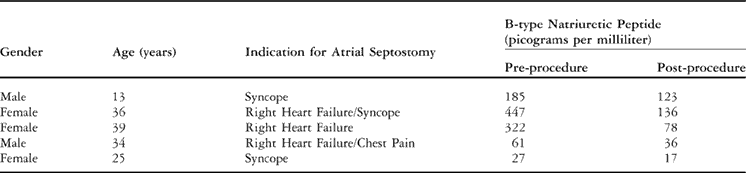
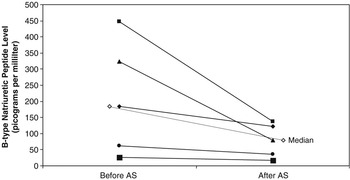
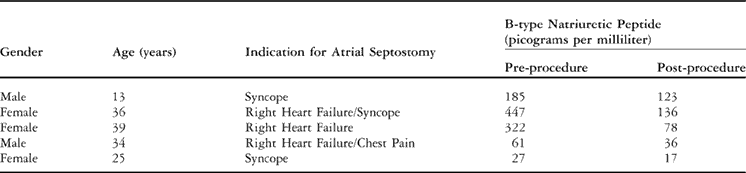
From January, 2005, to August, 2006, we performed septostomies in 5 patients with idiopathic pulmonary arterial hypertension as based on the indications discussed above, their demographics and clinical characteristics being shown in Table 1. Septostomy was performed using graded dilation in four patients, while a combined blade and balloon approach was used for the other patient. We measured concentrations of the peptide in the serum before and after the procedures. Median concentrations before the procedures, obtained at a median of one day prior to the procedure, with a range between ten days prior to the procedure and the day of the procedure, were 185 picograms per millilitre, with a range between 27 and 447 picograms per millilitre. Median concentrations obtained after a median of 13 days following the procedures, with a range of 4 to 33 days, were 79 picograms per millilitre, with a range between 17 and 136 picograms per millilitre. The levels of the peptide decreased in all patients following the septostomy, as depicted in Figure 1. Following a natural log transformation, a paired two-tailed t-test revealed a significant decrease in the concentration in the serum, with a p-value of 0.018. There was concomitant clinical improvement in all patients, with a median follow-up of 57 days, and follow-up range of 4 to 216 days. Patients previously suffering from symptoms of presyncope and syncope have had no further episodes.
Demographics and clinical characteristics of the patients before and after atrial septostomy, and levels of the brain-type natriuretic peptide.
Concentrations of the brain-type natriuretic peptide in the serum before and after atrial septostomy.

Based on overall considerations of risk versus benefit, atrial septostomy is initially performed by balloon septostomy alone. The atrial septal defect produced in this way, however, may close. In two patients, serial echocardiograms demonstrated narrowing with subsequent closure of the atrial septal defect, concomitant with recurrence of symptoms and an increase in B-type natriuretic peptide in both patients. The more recent availability of cutting balloons may alleviate this problem.
Discussion
Our series of cases reviewed in retrospective fashion demonstrates that levels of the brain-type natriuretic peptide decrease following atrial septostomy in patients with idiopathic pulmonary arterial hypertension, consistent with a decrease in right ventricular strain. In 2 of the 5 patients in whom the atrial septal defect subsequently closed spontaneously, the levels of the peptide increased with closure of the defect. This data provides a reason for making serial measurements of levels of the peptide so as to monitor right ventricular function, a surrogate for the severity of disease in patients with idiopathic pulmonary arterial hypertension. Our brief experience also points to the need for further studies.