


Introduction
Depression among adolescents and young adults has become an escalating public health concern, with global data from 1990 to 2019 showing a 21.7% increase in prevalence and a 19.1% rise in incidence rates (Yang et al., Reference Yang, Lv, Kong, Chu, Li, Lu and Li2024). Traditionally conceptualized as a psychiatric condition, depression is increasingly recognized as a potential precursor to broader systemic health deterioration (Copeland et al., Reference Copeland, Alaie, Jonsson and Shanahan2021; Fleetwood et al., Reference Fleetwood, Guthrie, Jackson, Kelly, Mercer, Morales, Norrie, Smith, Sudlow and Prigge2025). Emerging evidence suggests that early-onset depression may not only reflect psychological distress but also signal emerging vulnerabilities across multiple physiological systems (Mannan et al., Reference Mannan, Mamun, Doi and Clavarino2016; Goldstein and Korczak, Reference Goldstein and Korczak2020; Frank et al., Reference Frank, Batty, Pentti, Jokela, Poole, Ervasti, Vahtera, Lewis, Steptoe and Kivimaeki2023). For instance, childhood-onset compared to adulthood-onset of major depression is associated with increased rates of serious cardiovascular events, independently of cardiovascular risk factors (Franco et al., Reference Franco, Hoertel, Peyre, Rodríguez-fernández, Limosin and Blanco2015).
Despite these insights, most longitudinal studies have concentrated on short-term outcomes, with follow-up typically limited to early adulthood (before age 35) (Franco et al., Reference Franco, Hoertel, Peyre, Rodríguez-fernández, Limosin and Blanco2015; Leone et al., Reference Leone, Kuja-halkola, Leval, D’onofrio, Larsson, Lichtenstein and Bergen2021). However, emerging data indicate that persistent depressive symptoms in adolescence predict increased healthcare utilization well into midlife, underscoring the need to examine long-term health trajectories (Ssegonja et al., Reference Ssegonja, Alaie, Philipson, Hagberg, Sampaio, Moller, Von Knorring, Sarkadi, Langenskiold, Von Knorring, Bohman, Jonsson and Feldman2019). Critically, prior research has largely examined adolescent depression in relation to individual diseases, such as cardiovascular or autoimmune disorders (Benros et al., Reference Benros, Waltoft, Nordentoft, Ostergaard, Eaton, Krogh and Mortensen2013; Goldstein and Korczak, Reference Goldstein and Korczak2020), overlooking the fact that multimorbidity, where multiple chronic diseases coexist, often serves as a more significant determinant of poor health outcomes (Mannan et al., Reference Mannan, Mamun, Doi and Clavarino2016; Fleetwood et al., Reference Fleetwood, Guthrie, Jackson, Kelly, Mercer, Morales, Norrie, Smith, Sudlow and Prigge2025). Such epidemiological observations raise critical questions about the biological pathways through which adolescent depression may contribute to later-life multimorbidity.
Recent studies have begun to elucidate shared biological mechanisms linking depression and chronic diseases. For instance, dysregulation of the hypothalamic–pituitary–adrenal axis, alterations in the gut microbiome and metabolic signalling disruptions (e.g., involving adiponectin and leptin) have all been implicated in the depression–diabetes axis (Hood et al., Reference Hood, Lawrence, Anderson, Bell, Dabelea, Daniels, Rodriguez, Dolan and Group2012; Mazala-De-Oliveira et al., Reference Mazala-De-Oliveira, Silva, Campello-costa and Carvalho2023). In parallel, associations between depression and biological ageing (Lorenzo et al., Reference Lorenzo, Kuchel, Kuo, Moffitt and Diniz2023) and metabolic dysfunction (Goldsmith et al., Reference Goldsmith, Bekhbat, Le, Chen, Woolwine, Li, Haroon and Felger2020) have been documented. Nevertheless, few studies have comprehensively investigated how these biological processes might mediate the progression from early-life depression to multimorbidity. To bridge these gaps, we incorporate three synthetic indicators – frailty index, KDM biological age acceleration (KDM-BA) and allostatic load (AL) – as mechanistic mediators, along with a panel of 30 circulating biomarkers representing key metabolic, inflammatory, hepatic, endocrine and renal pathways.
Leveraging the longitudinal phenotypic and genomic data from the UK Biobank (UKB), we test the hypothesis that adolescent depression initiates persistent dysregulation across interconnected physiological systems, thereby increasing susceptibility to multimorbidity in later life. To investigate this, we integrated epidemiological, genetic and multi-omics data to characterize multimorbidity profiles, explore causal pathways and identify potential biological mediators. This comprehensive, multimethod approach enables a systems-level understanding of how early-life mental health can shape long-term physical health outcomes.
Methods
Study design and population
This study utilized data from the UKB, a large-scale prospective cohort comprising over 500,000 participants aged 37–73 years at baseline (2006–2010). Participants provided extensive phenotypic, genomic and health-related data through questionnaires, physical measurements and electronic health records.
This study employed a multi-phase analytical framework to investigate the systemic health impacts of adolescent depression. First, we conducted longitudinal observational analyses using Cox proportional hazards models to examine associations between adolescent depression and 24 chronic diseases. Second, we performed genetic validation through Mendelian randomization (MR) to assess causal relationships between adolescent depression and chronic diseases. Additionally, colocalization analysis was applied to identify shared causal variants within linkage disequilibrium blocks. Third, we explored potential biological pathways using mediation analyses, evaluating the role of 30 circulating serum biomarkers and 3 synthetic indices in linking depression to chronic diseases.
Assessment of adolescent depression
Adolescent depression was operationally defined as depression with first onset between ages 10 and 24 years, capturing depressive episodes emerging during adolescence and the transition to young adulthood. This age range was selected because it is supported by contemporary developmental frameworks and has been widely used in global burden of disease and epidemiological studies of young people and depression (Gore et al., Reference Gore, Bloem, Patton, Ferguson, Joseph, Coffey, Sawyer and Mathers2011; Sawyer et al., Reference Sawyer, Azzopardi, Wickremarathne and Patton2018; Yang et al., Reference Yang, Lv, Kong, Chu, Li, Lu and Li2024).
Adolescent depression cases were identified through a multi-step validation process using UKB data. Primary case definition required: (1) self-reported age of first depressive episode (UKB Field 20433) between 10 and 24 years; (2) endorsement of either prolonged depressed mood (UKB Field 20446) or anhedonia (UKB Field 20441) lasting ≥2 weeks. Control participants denied lifetime depressive symptoms per the Composite International Diagnostic Interview and maintained PHQ-9 ≤ 5. To further enhance diagnostic precision, individuals with any lifetime diagnosis of depressive disorders (ICD-10 codes F32-F33) documented in electronic health records were excluded. Additionally, participants with a history of adult-onset depression, defined as first onset after age 24, were removed from the control cohort.
Outcome assessment
We assessed 24 physical health conditions based on validated comorbidity frameworks (Charlson and Elixhauser indices [Metcalfe et al., Reference Metcalfe, Masters, Delmestri, Judge, Perry, Zogg, Gabbe and Costa2019]). These conditions were categorized by physiological systems to reflect a comprehensive spectrum of multimorbidity. The conditions were grouped by physiological system to capture a comprehensive spectrum of multimorbidity: respiratory diseases (asthma; chronic obstructive pulmonary disease [COPD]); cardiovascular diseases (cardiac arrhythmia; congestive heart failure; myocardial infarction; cerebrovascular disease; hypertension; peripheral vascular disease; pulmonary circulation disorders; valvular disease); neurological disorders (epilepsy; multiple sclerosis; Parkinson’s disease; seizures, excluding cerebrovascular disease and dementia; paralysis or paresis); endocrine and metabolic disorders (type 1 and type 2 diabetes; hypothyroidism; fluid and electrolyte disorders); gastrointestinal and hepatic diseases (liver disease; peptic ulcer disease); renal disease; oncological conditions (all cancer types); infectious disease (HIV/AIDS); and hematologic disorders (deficiency anaemia; blood loss anaemia; coagulopathy). The ICD-10 codes for all 24 conditions are listed in Supplementary Table S1.
Covariate assessment
The analysis adjusted for a range of demographic, socioeconomic and lifestyle covariates measured at baseline. Demographic factors comprised age (years) and sex. Ethnicity was dichotomized as White or non-White (UKB Field 21000). Socioeconomic status was captured by highest educational attainment (UKB Field 6138) and the Townsend Deprivation Index (TDI; UKB Field 22189), a composite measure of neighbourhood-level deprivation based on postal code. Lifestyle factors included body mass index (BMI), calculated from measured height and weight and categorized as underweight (<18.5 kg/m2), normal weight (18.5–24 kg/m2), overweight (24–28 kg/m2) and obese (≥28 kg/m2); smoking status (never, former, current; UKB Fields 20116); alcohol drinker status (never, former, current; UKB Fields 20117); and physical activity, defined as the number of days performing walking, moderate and vigorous activity (UKB Field 22033). Use of medications for lipid lowering, blood pressure, diabetes or exogenous hormone therapy was recorded (UKB Field 6153). Participants with missing data on any covariate were excluded from all multivariable analyses.
Statistical analysis
We performed survival analyses to assess associations between adolescent depression and incident chronic diseases using Cox proportional hazards models. Survival time was calculated from the baseline assessment date (UKB Field 53) until the earliest of: (1) disease diagnosis, (2) death (UKB Field 40000), (3) loss to follow-up (UKB Field 191) or (4) study end (29 October 2022). We constructed two sequential models: Model 1 adjusted for age, sex and race; Model 2 additionally adjusted for BMI, TDI, smoking status, drinking status, educational attainment, physical activity and hormone medication use. To evaluate effect modification, we conducted stratified analyses by sex (male/female) and age (<55/≥55 years). All models satisfied proportional hazards assumptions, verified through Schoenfeld residual testing. Participants with missing covariate data were excluded from analyses. To account for multiple testing, Bonferroni correction was applied across 22 outcomes (excluding two diseases with <100 cases) evaluated in two Cox models, resulting in 44 comparisons. Accordingly, the Bonferroni-adjusted significance threshold was set at α = 0.05/44 = 0.00114. All statistical analyses were performed using the ‘survival’ package (version 3.8.3) in R (version 4.4.1).
Additional analyses were conducted to provide complementary genetic and mechanistic evidence. MR was used to evaluate potential causal relationships between adolescent depression and related chronic diseases, while colocalization analysis was used to assess shared genetic signals. For mediation analyses, we examined three integrative indices and 30 serum biomarkers selected to capture multisystem physiological dysregulation. Specifically, the frailty index reflected multisystem vulnerability, KDM-BA reflected accelerated biological ageing and AL reflected cumulative metabolic, cardiovascular and inflammatory burden. The 30 serum biomarkers represented metabolic, inflammatory, hepatic, endocrine and renal pathways. Detailed procedures are provided in the Supplementary Methods.
Results
Cohort characteristics
The study included 87,562 participants from the UKB, comprising 68,711 individuals without a history of adolescent depression and 18,851 with documented adolescent depression (Table 1). Participants with adolescent depression were younger (median age 54 vs. 58 years) and more likely to be female (68.3% vs. 46.9%, χ2 P < 0.001). Socioeconomic disparities were evident, with the depression group showing higher Townsend deprivation scores (median: −1.85 vs. −2.62, Mann–Whitney P < 0.001) and lower educational attainment (52.9% vs. 44.8% with college-level education, P < 0.001). Lifestyle factors differed substantially, with higher smoking prevalence (48.1% vs. 39.7%, P < 0.001) and lower physical activity levels (median 26.55 vs. 27.93 MET-hours/week, P < 0.001) in the depression group. Medication use patterns revealed greater psychotropic drug utilization among those with adolescent depression (17.8% vs. 11.5%, P < 0.001).
Baseline characteristics of participants

Table 1 Long description
Baseline characteristics are compared between participants without adolescent depression (68,711) and with adolescent depression (18,851), using counts with percentages for categories and medians with interquartile ranges for continuous measures. The adolescent depression group was younger (median 54 years) than the no-depression group (median 58 years), with a statistically significant difference. Sex differed strongly: females were 68.3% in the adolescent depression group versus 46.9% in the no-depression group, while males were 31.7% versus 53.1%. Ethnicity was similar, with White participants about 97% in both groups, though the difference reached statistical significance. Socioeconomic status differed: the adolescent depression group had a higher (less negative) Townsend deprivation index, indicating greater deprivation. Education distributions differed, with a higher share reporting a college degree in the adolescent depression group (52.9% versus 44.8%) and lower shares in several other categories. Smoking was more common with adolescent depression (48.1% versus 39.7%), while drinking was similarly high in both groups (about 97%) and not statistically different. Physical activity was slightly lower with adolescent depression, and body mass index categories differed modestly, with more normal weight and fewer overweight participants in the adolescent depression group. Hormone medication use was higher with adolescent depression (17.8% versus 11.5%); most comparisons were statistically significant, but p values do not indicate the size or clinical importance of differences.
Notes: Data are presented as n (%) for categorical variables and median [interquartile range] for continuous variables. P values were calculated using the chi-square test for categorical variables and the Wilcoxon rank-sum test for continuous variables.
Association between adolescent depression and chronic disease
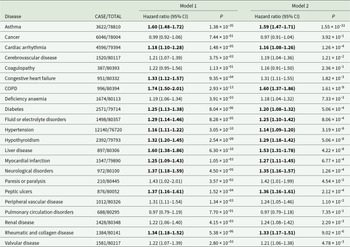
Adolescent depression was significantly associated with 12 chronic diseases after Bonferroni correction, spanning cardiovascular, metabolic, respiratory and immune systems (Table 2). Hazard ratios (HRs) ranged from 1.16 to 1.74, with the strongest associations observed for COPD (HR = 1.74, 1.50–2.01) and liver diseases (HR = 1.60, 1.38–1.86). Comparison between minimally adjusted (Model 1) and fully adjusted models (Model 2) revealed limited attenuation of effect sizes.
Associations of adolescent depression with incident chronic diseases in full cohort analyses

Table 2 Long description
Associations between adolescent depression and later onset of 22 chronic diseases are summarized using hazard ratios with confidence intervals and p values for two Cox regression models. Model 1 adjusts for age, sex, and ethnicity; Model 2 adds body mass index, deprivation, smoking, alcohol use, education, physical activity, and hormone medication use. In Model 2, the largest increases in risk are for COPD (about 1.60) and asthma (about 1.59), with liver disease also elevated (about 1.53). Several cardiovascular and metabolic outcomes show modest increases in Model 2, including myocardial infarction (about 1.27), congestive heart failure (about 1.31), hypertension (about 1.14), diabetes (about 1.20), and cardiac arrhythmia (about 1.16). Other elevated outcomes include hypothyroidism (about 1.29), neurological disorders (about 1.35), peptic ulcers (about 1.36), renal disease (about 1.24), and rheumatic and collagen disease (about 1.33). Cancer shows no clear association (about 0.97), and pulmonary circulation disorders are also near no association (about 0.97); coagulopathy is not clearly elevated after adjustment (about 1.16). Results are broadly similar between the two models, suggesting limited change after adding lifestyle and socioeconomic covariates. Some outcomes have small case counts, such as paresis or paralysis, so estimates there are less precise. Statistical significance is assessed with a stringent multiple-testing threshold, so only the smallest p values should be treated as robust.
Notes: Hazard ratios (HRs) and 95% confidence intervals (CIs) were estimated using Cox proportional hazards models. Model 1 was adjusted for age, sex and ethnicity. Model 2 was additionally adjusted for body mass index (BMI), Townsend Deprivation Index (TDI), smoking status, alcohol drink status, educational attainment, physical activity and hormone medication use. Bolded values indicate statistical significance after Bonferroni correction (P < 0.0011, i.e., 0.05/44 tests).
Stratified analyses revealed sex- and age-specific variations in depression-related disease risks (Supplementary Tables S2 and S3). Sex-specific patterns revealed both shared and unique vulnerabilities: while asthma emerged as a common risk across both sexes (females HR = 1.67 [1.53–1.84]; males HR = 1.40 [1.23–1.60]), females exhibited exclusive susceptibility to 10 additional conditions including COPD (HR = 1.76 [1.43–2.17]), liver disease (HR = 1.68 [1.39–2.04]) and hypothyroidism (HR = 1.27 [1.15–1.41]). Age-stratified analyses revealed stronger associations among younger individuals (≤55 years). Among ≤55-year-olds, adolescent depression conferred elevated risks for eight distinct conditions, with pronounced effects observed for asthma (HR = 1.69 [1.52–1.89]), COPD (HR = 1.88 [1.34–2.66]) and diabetes (HR = 1.46 [1.24–1.73]). Four conditions demonstrated persistent but diminished associations in older adults, including asthma (≤55 HR = 1.69 vs. >55 HR = 1.50), COPD (≤55 HR = 1.88 vs. >55 HR = 1.53), hypertension (≤55 HR = 1.23 vs. >55 HR = 1.10) and hypothyroidism (≤55 HR = 1.41 vs. >55 HR = 1.22).
Causal inference via Mendelian randomization
MR analyses using two independent instruments (rs2429657, rs10511068) revealed significant causal effects of genetically COPD (OR = 1.04, 95% CI: 1.02–1.06), diabetes (OR = 1.01, 1.01–1.02) and hypothyroidism (OR = 1.45, 1.03–2.05) (Fig. 1). The limited instrument count precluded leave-one-out analyses, limited instrument count precluded reliable heterogeneity testing; conservative random-effects models were employed.
Causal effects of adolescent depression on chronic disease risk.

Figure 1 Long description
Outcome table with a forest plot of odds ratios and confidence intervals. Columns are labeled, Outcome, nSNP, OR(95 percentCI) and P.value. Rows list: Asthma, nSNP 2, 1.00 (0.99-1.02), 0.394. Cardiac arrhythmia, nSNP 2, 1.09 (0.96-1.23), 0.188. COPD, nSNP 2, 1.04 (1.02-1.06), 1.6e-05. Diabetes, nSNP 2, 1.01 (1.01-1.02), 3.1e-05. Hypertension, nSNP 2, 1.03 (0.66-1.60), 0.903. Hypothyroidism, nSNP 2, 1.45 (1.03-2.05), 0.035. Myocardial infarction, nSNP 2, 1.01 (0.73-1.40), 0.952. Peptic ulcers, nSNP 2, 0.99 (0.78-1.24), 0.903. The x-axis is labeled, protective factor, risk factor. The x-axis shows tick labels 0.5, 1, 1.5 and 2. Each row has a point estimate marker with a horizontal confidence interval line, aligned to the listed odds ratio and confidence interval values.
Colocalization analysis
For the three validated diseases, we further investigated genetic colocalization across these conditions. Our colocalization analysis revealed robust signals for both diabetes and hypothyroidism, implicating specific genetic loci and effector genes (Fig. 2). For hypothyroidism, we observed three independent loci on chromosome 6 with strong colocalization evidence: rs1235162 (250 SNPs, PP.H4 = 0.910), rs3094220 (179 SNPs, PP.H4 = 0.870; implicating CDSN/PSORS1C1) and rs9265797 (40 SNPs, PP.H4 = 0.769). Additionally, a moderate colocalization signal was detected on chromosome 17 (rs17320971, 294 SNPs, PP.H4 = 0.504). For diabetes, a 17-SNP locus on chromosome 6 (rs9272426, PP.H4 = 0.508) identified HLA-DQA1 as the likely effector gene. For COPD, no genomic loci exhibited significant evidence of shared causal variants with adolescent depression (all PP.H4 < 0.5).
Colocalization analysis of genetic loci associated with adolescent depression and three chronic diseases.

Figure 2 Long description
The image consists of three scatter plots labeled A, B and C, each representing colocalization analysis for different diseases across chromosomes. A) The plot for diabetes shows the x-axis labeled ′Chromosome′ with numbers 1 to 22 and ′X′. The y-axis is labeled ′PP. H4′. Data points are plotted with varying sizes indicating the inverse of SNP number, with larger circles representing higher values. A dashed horizontal line is present at approximately 0.5 on the y-axis. Notable points are observed on chromosome 6. B) The plot for hypothyroidism follows a similar format with the same x and y-axis labels. Significant points are observed on chromosomes 6 and 17, with a dashed line at approximately 0.5 on the y-axis. C) The plot for COPD also uses the same axes. Data points are more dispersed, with no significant clustering above the dashed line at 0.5. Each plot includes a legend indicating the size of circles corresponding to SNP numbers: less than 0.33, 0.33 to 0.99 and greater than 1.99.
Mediation analysis
Mediation analyses suggested outcome-specific indirect-effect patterns for the three prioritized chronic disease outcomes, with estimates presented as β and 95% CI (Fig. 3 and Supplementary Table S4). Among the integrative physiological indices, the frailty index showed consistent positive indirect effects for diabetes (β = 0.066, 0.048–0.082), COPD (β = 0.055, 0.028–0.073) and hypothyroidism (β = 0.031, 0.019–0.045). KDM-BA showed the largest indirect effect for COPD (β = 0.174, 0.147–0.214), whereas its indirect effects were not evident for diabetes or hypothyroidism.
Mediation effects of biomarkers and synthetic indices in the associations between adolescent depression and chronic diseases.

Figure 3 Long description
The heatmap displays associations between various biomarkers and indices with chronic diseases: COPD, diabetes and hypothyroidism. The vertical axis lists biomarkers and indices such as alkaline phosphatase, alanine aminotransferase, apolipoprotein A, apolipoprotein B, aspartate aminotransferase, direct bilirubin, urea, calcium, creatinine, HDL cholesterol, IGF-1, LDL direct, phosphate, total bilirubin, testosterone, total protein, triglycerides, urate, vitamin D, allostatic load, frailty score and KDM-BA. The horizontal axis represents the diseases. Numerical values within the cells range from negative 0.05 to positive 0.15, indicating the strength of association. The color gradient from green through white to red represents increasing association values, with green indicating negative or lower associations, white as neutral and red as positive or higher associations. Notable patterns include stronger positive associations for KDM-BA with COPD and frailty score with diabetes. The strongest positive association is observed for KDM-BA with COPD, while the weakest is for vitamin D with hypothyroidism. The legend maps these colors to the numeric scale, providing a visual representation of the data trends.
Among serum biomarkers, diabetes showed the broadest mediation profile, with notable indirect effects for testosterone (β = 0.085, 0.042–0.109), creatinine (β = 0.059, 0.018–0.088), apolipoprotein A (β = 0.034, 0.017–0.045), HDL cholesterol (β = −0.078, −0.095 to −0.050), direct bilirubin (β = −0.048, −0.074 to −0.031), apolipoprotein B (β = −0.042, −0.053 to −0.026), urea (β = −0.033, −0.046 to −0.022) and alanine aminotransferase (β = −0.027, −0.036 to −0.017). For hypothyroidism, the main biomarker-related indirect effects involved creatinine (β = −0.028, −0.042 to −0.017) and total protein (β = −0.005, −0.007 to −0.002). For COPD, serum biomarker mediation was limited, with the clearest signal observed for total bilirubin (β = 0.016, 0.002–0.029). All mediation effects highlighted in the text were statistically significant at P < 0.05, and full indirect-effect estimates, 95% confidence intervals and exact P values are provided in Supplementary Table S4.
Discussion
This study provides evidence that adolescent depression is associated with increased vulnerability to 12 chronic conditions across metabolic, cardiovascular, immune and respiratory systems. Genetic analyses further supported potential links with diabetes, COPD and hypothyroidism, while mediation analyses highlighted potential endocrine, metabolic, ageing-related and frailty-related pathways involved in these associations.
Adolescent depression was also significantly associated with a higher risk of hypothyroidism in adulthood, a relationship that has gained growing research attention (Hirtz et al., Reference Hirtz, Focker, Libuda, Antel, Ozturk, Kiewert, Munteanu, Peters, Fuhrer, Zwanziger, Thamm, Hebebrand and Grasemann2021, Reference Hirtz, Holling and Grasemann2022; Leone et al., Reference Leone, Kuja-halkola, Leval, D’onofrio, Larsson, Lichtenstein and Bergen2021). Emerging evidence has highlighted that chronic psychological stress may alter hypothalamic–pituitary–thyroid axis function (Xu et al., Reference Xu, Liang, Cao, Shan, Liu and Xia2017), contributing to thyroid hormone dysregulation. Our results support this link and further identify creatinine as a potential biomarker involved in this pathway. Although the mechanistic role of creatinine remains unclear, it may reflect disrupted cellular energy metabolism and oxidative stress – processes implicated in both depression and hypothyroidism (Glombik et al., Reference Glombik, Detka, Kurek and Budziszewska2020, Reference Glombik, Detka and Budziszewska2021; Liu et al., Reference Liu, Zhong and Wang2025). Animal studies demonstrate hypothyroidism and depression synergistically disrupt brain glycolysis and mitochondrial activity, key pathways where creatinine metabolism might reflect underlying deficits (Glombik et al., Reference Glombik, Detka, Kurek and Budziszewska2020, Reference Glombik, Detka and Budziszewska2021).
Adolescent depression was strongly associated with an elevated risk of diabetes in adulthood. This finding is consistent with previous longitudinal studies demonstrating that depressive symptoms during adolescence predict insulin resistance and elevated fasting insulin, independent of adiposity (Shomaker and Goodman, Reference Shomaker and Goodman2015; Suglia et al., Reference Suglia, Demmer, Wahi, Keyes and Koenen2016; Olive et al., Reference Olive, Telford, Byrne, Abhayaratna and Telford2017; Shomaker et al., Reference Shomaker, Tanofsky-kraff, Stern, Miller, Zocca, Field, Yanovski, Hubbard and Yanovski2020). Mediation and colocalization analyses suggested two complementary pathways potentially involved in this relationship. First, several metabolic biomarkers mediated the depression–diabetes link, including testosterone, creatinine and apolipoprotein A. Notably, testosterone emerged as a key mediator, likely through its regulatory roles in neuroinflammation, insulin sensitivity and vascular function (Seidman et al., Reference Seidman, Spatz, Rizzo and Roose2001; Tully et al., Reference Tully, Baumeister, Martin, Atlantis, Jenkins, Januszewski, O’loughlin, Taylor, Wittert and Florey Adelaide Male Ageing2016; Atallah et al., Reference Atallah, Mhaouty-kodja and Grange-messent2017; Peng et al., Reference Peng, Dai, Li and Li2022). Low testosterone levels are associated with both depression and diabetes risk (Kapoor et al., Reference Kapoor, Malkin, Channer and Jones2005; Tully et al., Reference Tully, Baumeister, Martin, Atlantis, Jenkins, Januszewski, O’loughlin, Taylor, Wittert and Florey Adelaide Male Ageing2016), and testosterone replacement has shown efficacy in improving mood and glycemic control in clinical (Seidman et al., Reference Seidman, Spatz, Rizzo and Roose2001; Corona et al., Reference Corona, Monami, Rastrelli, Aversa, Sforza, Lenzi, Forti, Mannucci and Maggi2011) and animal studies (Atallah et al., Reference Atallah, Mhaouty-kodja and Grange-messent2017; Peng et al., Reference Peng, Dai, Li and Li2022). Second, colocalization analysis identified HLA-DQA1 as a shared genetic locus linking adolescent depression and diabetes. Prior studies have reported associations between HLA variants and depression (Cheng et al., Reference Cheng, Yang, Cheng, Pan, Liu, Meng, Yang, Wei, Liu, Jia, Wen and Zhang2024), while HLA-DQA1 specifically has been strongly implicated in diabetes susceptibility through both genetic predisposition and immune activation (Farina et al., Reference Farina, Picascia, Pisapia, Barba, Vitale, Franzese, Mozzillo, Gianfrani and Del Pozzo2019). Together, these findings suggest that endocrine, metabolic and immune dysregulation may contribute to the depression–diabetes association.
The association between adolescent depression and COPD was modest but significant, with mediation analysis identifying frailty as a key intermediate factor. Longitudinal and cross-sectional studies have consistently shown that depression elevates frailty risk over time, which in turn heightens susceptibility to health deterioration, including pulmonary dysfunction (Borges et al., Reference Borges, Voshaar, Romanini, Oliveira, Lima, Petrella, Costa, Martinelli, Mingardi, Siqueira, Biela, Collard and Aprahamian2021; Campo‐Arias et al., Reference Campo‐Arias, Pedrozo-pupo and Caballero-domínguez2024; Sun et al., Reference Sun, Li, Liu, Li, Gui, Zhang, Li, Sun, Wang, Li, Liu, Zhang, Gao, Kang, Lei, Zhang and Yuan2024). This pathway may be reinforced by behavioural contributors, as depressed adolescents are more likely to initiate smoking (Groenman et al., Reference Groenman, Janssen and Oosterlaan2017), a well-established risk factor for COPD. Notably, frailty is highly prevalent among COPD patients and is associated with increased exacerbations and reduced lung function (Campo‐Arias et al., Reference Campo‐Arias, Pedrozo-pupo and Caballero-domínguez2024; Dutta et al., Reference Dutta, Goel and Kumar2024). Thus, adolescent depression may initiate a trajectory of early physiological vulnerability that amplifies long-term pulmonary risk.
The sex- and age-specific correlations observed in our study, particularly the heightened risks in females and individuals under 55 years. Several studies found sex-specific effects in the relationship between adolescent depression and disease risk, particularly for type 2 diabetes (Suglia et al., Reference Suglia, Demmer, Wahi, Keyes and Koenen2016; Olive et al., Reference Olive, Telford, Byrne, Abhayaratna and Telford2017). The primary mechanisms underlying these disparities include hormonal regulation (Stumper and Alloy, Reference Stumper and Alloy2023), metabolic responses (Suglia et al., Reference Suglia, Demmer, Wahi, Keyes and Koenen2016), behavioural differences and social risk factors (Collishaw, Reference Collishaw2015). Additionally, age differences in these associations, along with mediation analyses identifying KDM-BA as a mediator, suggest that adolescent depression may accelerate biological ageing, thereby contributing to the earlier onset of chronic diseases.
The consistent mediation by the frailty index across the three focal disease outcomes highlights its potential value as a pragmatic marker of multisystem vulnerability. Frailty, operationalized as depleted physiological reserves across multiple systems (Fried et al., Reference Fried, Tangen, Walston, Newman, Hirsch, Gottdiener, Seeman, Tracy, Kop, Burke and Mcburnie2001), may provide a quantifiable metric to assess long-term multisystem risk in individuals with adolescent depression. From a clinical perspective, incorporating brief frailty-informed assessment into routine follow-up for adolescents and young adults with depression, using validated tools such as the FRAIL (Romero-Ortuno et al., Reference Romero-Ortuno, Walsh, Lawlor and Kenny2010) scale or Fried (Fried et al., Reference Fried, Tangen, Walston, Newman, Hirsch, Gottdiener, Seeman, Tracy, Kop, Burke and Mcburnie2001) phenotype where appropriate, could enhance early identification of high-risk individuals. In parallel, biomarker panels reflecting multisystem physiological dysregulation may further support risk stratification by identifying biological profiles associated with long-term chronic disease vulnerability. Although these approaches require prospective validation before clinical implementation, they provide a practical framework for integrating mental healthcare with long-term chronic disease prevention.
Our study’s integration of observational, genetic and mediation analyses provides a robust triangulation of evidence rarely achieved in multimorbidity research. The application of validated tools, such as the Charlson/Elixhauser indices, enhances comparability with global burden studies. From a public health perspective, these findings advocate for integrating depression screening into chronic disease prevention programmes, particularly for women and younger populations. Nevertheless, several limitations warrant consideration. First, although UKB provides a large and deeply phenotyped cohort, its volunteer-based design and predominance of participants of White European ancestry should be considered when interpreting the generalizability of our findings to broader and more diverse populations. Second, adolescent depression was identified using retrospective self-reported age at first depressive episode and depressive symptoms. Although this approach enabled the assessment of early-life depression in a large adult cohort and was strengthened by our multi-step case definition, recall error remains possible. Third, the lack of MR support for four other diseases may stem from residual confounding or insufficient sample sizes, underscoring the need for larger, more diverse cohorts to confirm the broader applicability of these results. Finally, many mediating variables were measured at a single baseline time point, which limits the ability to fully characterize longitudinal biological trajectories. Future studies with repeated biomarker assessments and prospective ascertainment of early-life mental health are warranted.
Conclusion
Adolescent depression was associated with increased long-term vulnerability to multiple chronic diseases, with particularly consistent evidence for hypothyroidism, diabetes and COPD. Genetic and mediation analyses suggested potential involvement of endocrine, metabolic, immune, ageing-related and frailty-related pathways, while stronger associations in females and younger adults point to the need for targeted prevention. These findings support integrating early mental health assessment with long-term physical health monitoring. Frailty-informed assessment and biomarker-based risk profiling may offer a future framework for identifying high-risk individuals, pending validation in prospective and diverse populations.
Supplementary material
The supplementary material for this article can be found at https://doi.org/10.1017/S2045796026100821
Availability of data and materials
The datasets generated during and/or analysed during the current study are available from the corresponding authors upon reasonable request.
Acknowledgements
As the lead author and guarantor of this manuscript, I hereby affirm that this manuscript is an honest, accurate and transparent account of the study being reported; that no important aspects of the study have been omitted.
Author contributions
W.W. and B.C.: material preparation, data collection and analysis; W.W.: first draft of the manuscript; X.Q., D.H., S.C., X.Y. and J.F.: figures and tables; C.P., J.H., Y.G., B.Z., Y.W., H.L., L.L. and Y.J.: literature searches; F.Z.: study design. W. Wei and B. Cheng contributed equally to this article.
Financial support
This research has received financial support from the Natural Science Basic Research Plan in Shaanxi Province of China [2021JCW-08].
Competing interests
The authors declare no competing interests.
Ethical standards
The UK Biobank has received ethical approval from the North West Multi-Centre Research Ethics Committee (REC reference: 21/NW/0157). The initial approval was granted in 2011 and subsequently renewed in 2016 and 2021, with the next renewal due in 2026. All participants provided written informed consent. Access to the UK Biobank data was obtained under approved application number 46478.



 Open access

