Introduction
Understanding the complex dynamics of host shifting in parasites is vital for the effective development of controls to prevent their transmission to people. Cross-species transmission can be influenced by rates of host–parasite contact, host immune response and parasite adaptation (Lloyd-Smith et al., Reference Lloyd-Smith, George, Pepin, Pitzer, Pulliam, Dobson, Hudson and Grenfell2009). For many microorganisms, genetic adaptation is often proposed to be the key driver of successful emergence into a new host species, but it is difficult to distinguish which processes generate genetic change (Pepin et al., Reference Pepin, Lass, Pulliam, Read and Lloyd-Smith2010; Chabas et al., Reference Chabas, Lion, Nicot, Meaden, van Houte, Moineau, Wahl, Westra and Gandon2018). The genetic variability of parasites in new hosts may provide some insights into the evolutionary processes driving adaptation (Penczykowski et al., Reference Penczykowski, Laine and Koskella2016). Comparative analysis of parasite genetic diversity within and among hosts could help to clarify transmission-evolution dynamics, as well as their associated risk for host shifts and outbreaks among people. Distinguishing changes in genetic patterns is fundamental for monitoring pathogen evolution, adaptation to new hosts, identification of factors driving cross-species transmission and, ultimately, the reduction of risk to public health.
Cryptosporidium is one of the most common enteric parasites in humans. This parasite causes infant deaths from diarrhoea, as well as disease in wildlife and domestic animals (Kotloff et al., Reference Kotloff, Nataro, Blackwelder, Nasrin, Farag, Panchalingam, Wu, Sow, Sur, Breiman, Faruque, Zaidi, Saha, Alonso, Tamboura, Sanogo, Onwuchekwa, Manna, Ramamurthy, Kanungo, Ochieng, Omore, Oundo, Hossain, Das, Ahmed, Qureshi, Quadri, Adegbola, Antonio, Hossain, Akinsola, Mandomando, Nhampossa, Acácio, Biswas, O'Reilly, Mintz, Berkeley, Muhsen, Sommerfelt, Robins-Browne and Levine2013; Striepen, Reference Striepen2013). Most of the approximately 38 species of Cryptosporidium and several related genotypes are adapted to different vertebrate hosts, which limits between-species transmission (Xiao and Feng, Reference Xiao and Feng2008; Garcia-R and Hayman, Reference Garcia-R and Hayman2016, Reference Garcia-R and Hayman2017; Garcia-R et al., Reference Garcia-R, French, Pita, Velathanthiri, Shrestha and Hayman2017; Feng et al., Reference Feng, Ryan and Xiao2018). Humans are the major host of Cryptosporidium hominis and Cryptosporidium viatorum (Ryan et al., Reference Ryan, Fayer and Xiao2014), but C. hominis is reported in other mammal species (Widmer et al., Reference Widmer, Köster and Carmena2020), whereas no alternative animal reservoir has been identified for C. viatorum (Elwin et al., Reference Elwin, Hadfield, Robinson, Crouch and Chalmers2012; but see Koehler et al., Reference Koehler, Wang, Haydon and Gasser2018). Nevertheless, about 17 Cryptosporidium species with diverse animals as main hosts are now found in humans at different notification levels. For instance, cattle are an important reservoir of C. parvum, but this species is reported in a significant proportion of human Cryptosporidium infections (Feng et al., Reference Feng, Ryan and Xiao2018). Likewise, Cryptosporidium meleagridis, C. cuniculus, C. tyzzeri and C. ubiquitum (previously known as the cervine genotype) primarily parasitize birds, rabbits, rodents and ruminants, respectively. These species have recently been found in gastroenteritis cases of humans, but are less commonly reported (Chalmers et al., Reference Chalmers, Robinson, Elwin, Hadfield, Xiao, Ryan, Modha and Mallaghan2009a; Bouzid et al., Reference Bouzid, Hunter, Chalmers and Tyler2013; Rašková et al., Reference Rašková, Květoňová, Sak, McEvoy, Edwinson, Stenger and Kváč2013; Li et al., Reference Li, Xiao, Alderisio, Elwin, Cebelinski, Chalmers, Santin, Fayer, Kvac, Ryan, Sak, Stanko, Guo, Wang, Zhang, Cai, Roellig and Feng2014). This apparent expansion of host range demonstrates the plasticity of these species and their ability to adapt to new niches.
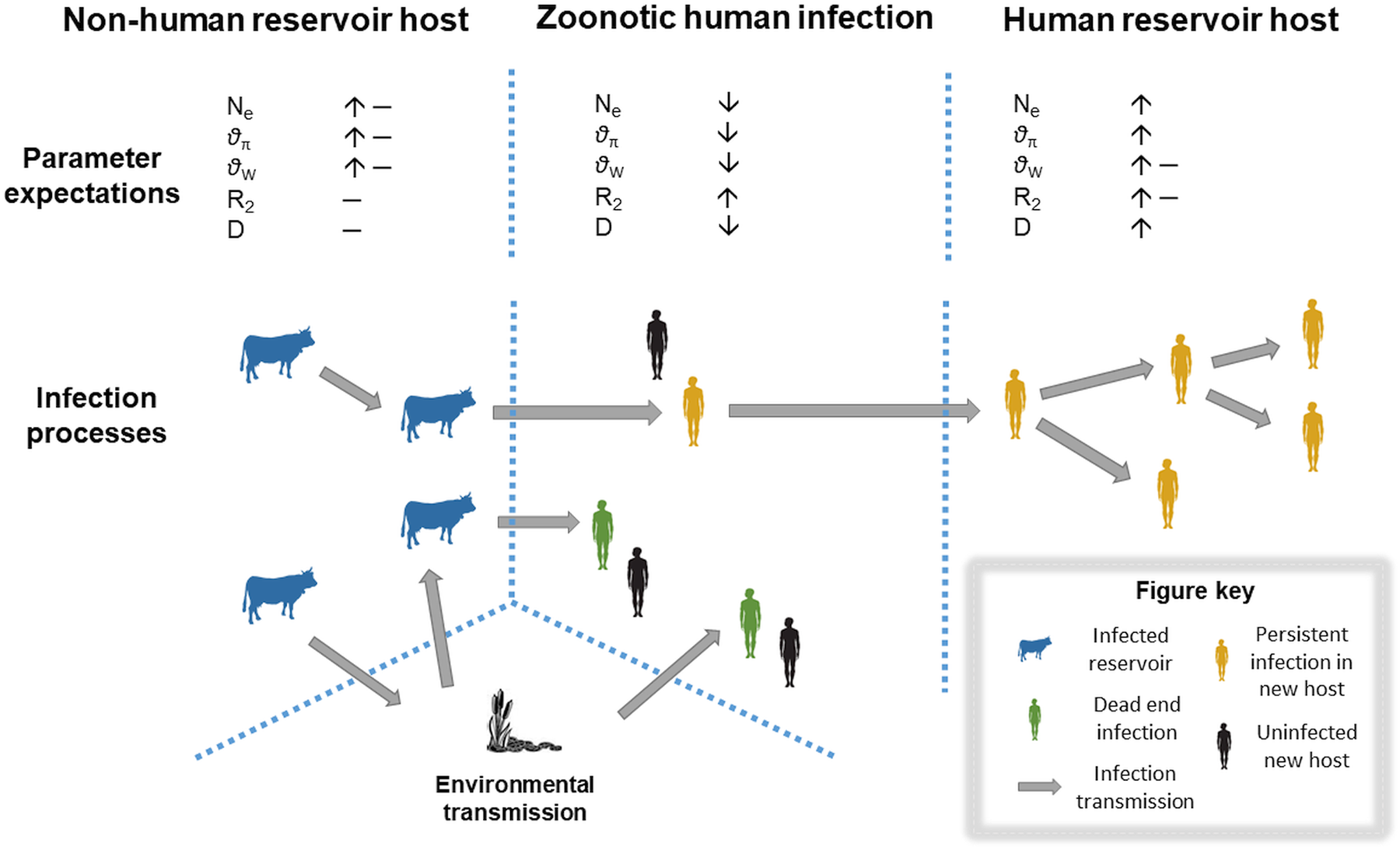
The change to new environments (here, new hosts) must be associated with traits that influence parasite fitness and hence cause signatures in the genetic diversity of the parasites (Barrett et al., Reference Barrett, Thrall, Burdon and Linde2008). Changes in parasite gene frequencies can be estimated by comparison of genetic variation in the known reservoir host source (where the infection is maintained and perpetuates) and the new host (Fig. 1). The comparison of quantitative genetic differences can help to untangle the processes involved in parasite–host dynamics, and the rates and barriers parasites need to overcome to enable successful cross-species transmissions (Geoghegan et al., Reference Geoghegan, Duchêne and Holmes2017). While low genetic diversity in the parasite that colonizes a host does not necessarily imply that an episode of shifting has occurred, it is strongly indicative of genetic factors affecting adaptation and highlights the importance of comparative studies across multiple populations and species (Fig. 1).
Population and genetic parameter expectations during Cryptosporidium host shifting. Key transmission pathways show non-human reservoirs (blue) infecting each other and the environment through oocyst shedding. Cross-species transmission and host shifting occur through direct and indirect transmission (e.g. via the environment), mostly leading to dead-end infections (green). Subsequent establishment in new hosts with possible adaptation through ongoing transmission may occur (yellow). Transmission between individuals of the new host is necessary to establish long-term associations that characterize a successful host shift, in contrast to occasional spillover pathogen infections in the new host. The expected ranges (e.g. ↑ = high, ↓ = low, – = no change, ↑– = high or no change) for population genetic parameters are shown above each scenario; N e – effective population size; θ π – nucleotide diversity; θ W – Watterson's theta; R 2 – Ramos-Onsins and Rozas' population growth test; and D – Tajima's D.

Cryptosporidium species in a large, well-mixed host population might have high genetic diversity, with their transmission dynamics stable over time (Fig. 1). However, during a parasite population expansion and founder event, a large chain of cascading effects may influence these parameters (Longdon et al., Reference Longdon, Brockhurst, Russell, Welch and Jiggins2014). Infectious doses for humans can be as few as 10 infectious oocysts, each with four diploid sporozoites within the oocysts. Such population bottlenecks typically promote loss of genetic diversity in the parasite population of the new host and generate among-population genetic differences. Upon infection, however, populations may expand massively, with infected hosts excreting up to 6 × 10⁷ oocysts per gram of feces (Uga et al., Reference Uga, Matsuo, Kono, Kimura, Inoue, Rai and Ono2000) and up to 1010 oocysts per day for up to 2 weeks while infected (Meinhardt et al., Reference Meinhardt, Casemore and Miller1996). The parasite population will reach a recovery point after the colonization event if the host population is large and interconnected (Fig. 1). Although host species differ in many traits, including population size, distribution and resistance, we predict that there is a relationship between the dynamics of host jumps and genetic changes in parasite populations of Cryptosporidium that records important clues to their transmission into new hosts.
Here, we use a population-based study to infer patterns of genetic diversity from host shifting in Cryptosporidium parasites. We study Cryptosporidium genetic variation across host species using publicly available data to discern different likely outcomes of host–parasite dynamics and the cause-effect relationship of Cryptosporidium parasites that host shift. Our aim is to help understand host–parasite shifts, such as for human cryptosporidiosis, by addressing the following questions: can general patterns of changes in genetic diversity be detected in the genes of parasites that host switch? Are genetic diversity measures lower in Cryptosporidium species recently reported in humans? How is the genetic diversity of Cryptosporidium species distributed across different animal hosts?
Methods
Data collection
We use data from previously published sequences of Cryptosporidium species found in GenBank (see Table S1 for details). Here, we defined populations and genetic diversity as genetic variants on six evolutionary lineages of Cryptosporidium (C. hominis, C. parvum, C. meleagridis, C. cuniculus, C. tyzzeri and C. ubiquitum) detected in both humans and other vertebrates around the world. Nucleotide sequences of interest were downloaded using Geneious v.10.2 (Kearse et al., Reference Kearse, Moir, Wilson, Stones-Havas, Cheung and Sturrock2012) with a search strategy comprised of fields including species names [‘Organism’] and gene names [‘All Fields’ or ‘Protein Name’]. The 60-kDa glycoprotein (gp60), heat shock protein (HSP-70), oocyst wall protein (COWP) and actin gene (actin) are the most frequent markers used for detection and identification of Cryptosporidium, and we, therefore, focus on these four genes here. Among these markers, gp60 is the only gene considered to be under selection (Widmer, Reference Widmer2009; Abal-Fabeiro et al., Reference Abal-Fabeiro, Maside, Bello, Llovo and Bartolomé2013) and its adaptive evolution plays a powerful role in pathogen entrenchment across species boundaries. This marker has, however, been readily and extensively adopted as a key component for molecular epidemiological investigations because of its high reliability in the characterization of genotypes and detection of variants within populations (Garcia-R and Hayman, Reference Garcia-R and Hayman2017; Garcia-R et al., Reference Garcia-R, Pita, Velathanthiri, French and Hayman2020).
Very short sequences (<200 bp) or sequences overlapping only a short section of the overall alignment were discarded (see Supporting Information). Related meta-information (host and isolation/source) was appended to the final dataset and sequences were organized by species, gene, host and source (feces-only to ensure that samples were obtained only from the specific host). Hosts were chosen according to common names when the scientific name was not available and when the names indicate that sequences are from the given host species. In population genetic studies, assigning individuals to populations may be challenging if there is incomplete knowledge of the sampling design. Due to the low number of samples from geographically and taxonomically distant hosts, we compared the data obtained from humans to a combined dataset of all non-human hosts. The reason for this approach is to test for evidence of diversity estimates supporting our expectations (Fig. 1).
Analyses
Nucleotide diversity (θ π) and Watterson's theta (θ W) within hosts were estimated for sequences of Cryptosporidium species associated with humans and other hosts using DnaSP v.5.0 (Librado and Rozas, Reference Librado and Rozas2009). The Tajima's D statistic (Tajima, Reference Tajima1989) was used to test the null hypothesis of neutrality and demographic growth was assessed using the R 2 test (Ramos-Onsins and Rozas, Reference Ramos-Onsins and Rozas2002), both using DnaSP v.5.0. Sensitivity analyses were performed to test the effect of sample size and the number of segregating sites (Subramanian, Reference Subramanian2016). We advocate for subsampling the data to ascertain the robustness of the summary statistics using a rarefaction approach for our most data-rich sample, the gp60 gene, which displays a high mutation rate and high level of polymorphisms (Strong et al., Reference Strong, Gut and Nelson2000).
Results
Sequences used in this study were submitted to GenBank between 2002 and 2017, with the exception of a few COWP gene sequences isolated from humans in previous years. This is important due to nomenclature changes in Cryptosporidium. For instance, C. hominis was referred to as C. parvum genotypes H or 1 before 2002, which can create confusion when assigning sequences to species and influence the results of genetic diversity analyses. In total, we compiled 697 sequences of the gp60 gene from C. cuniculus, C. hominis, C. meleagridis, C. parvum, C. tyzzeri and C. ubiquitum that infect humans, as well as isolates from a range of different hosts (462 sequences from humans and 235 sequences from other animals); 13 sequences of the HSP-70 gene from C. hominis (11 sequences from humans and two sequences from other animals); eight sequences of the actin gene from C. parvum (five sequences from humans and three sequences from other animals); and 46 sequences of the COWP gene from C. parvum (18 sequences from humans and 28 sequences from other animals) (Table S1).
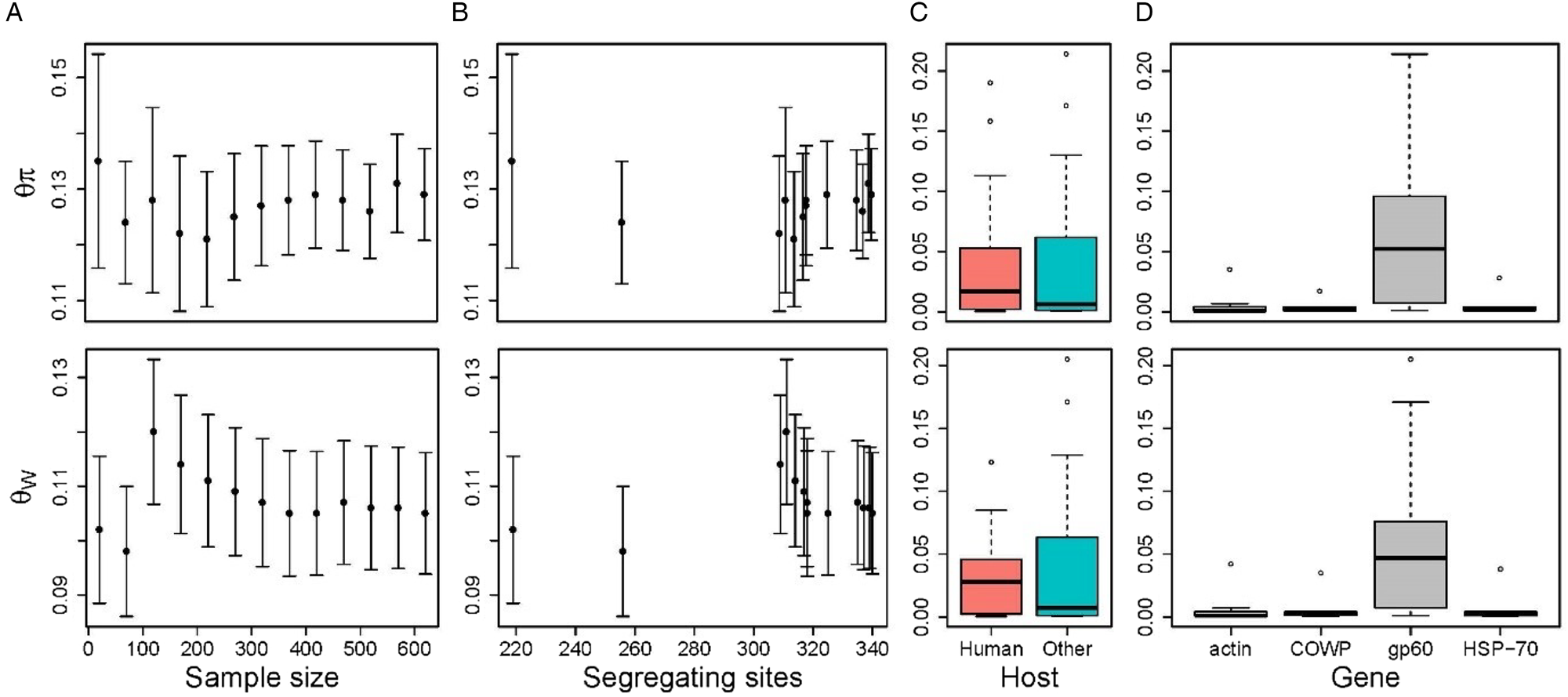
Genetic diversity estimates, including standard deviations, are provided in Table S2. We performed sensitivity analyses and did not find a significant difference between data partitions as a result of reductions in either sample size or the number of segregating sites on θ π and θ W (Fig. 2A and B), showing that the estimates of these summaries are robust across a range of sample sizes in this instance. We confirmed that gp60 has the highest variation, but that genetic diversity estimates are not statistically significant among other genes and hosts (Fig. 2C and D).
Rarefaction analysis of the stability of genetic diversity measures (θ π and θ W) from publicly available data in Cryptosporidium. Outputs derived as a function of downsampling individuals (A) or segregating sites (B) in a number of gp60 sequences. Nucleotide diversity (θ π) and Watterson's estimator (θ W), upper and lower respectively, by host (C) and genes (D).

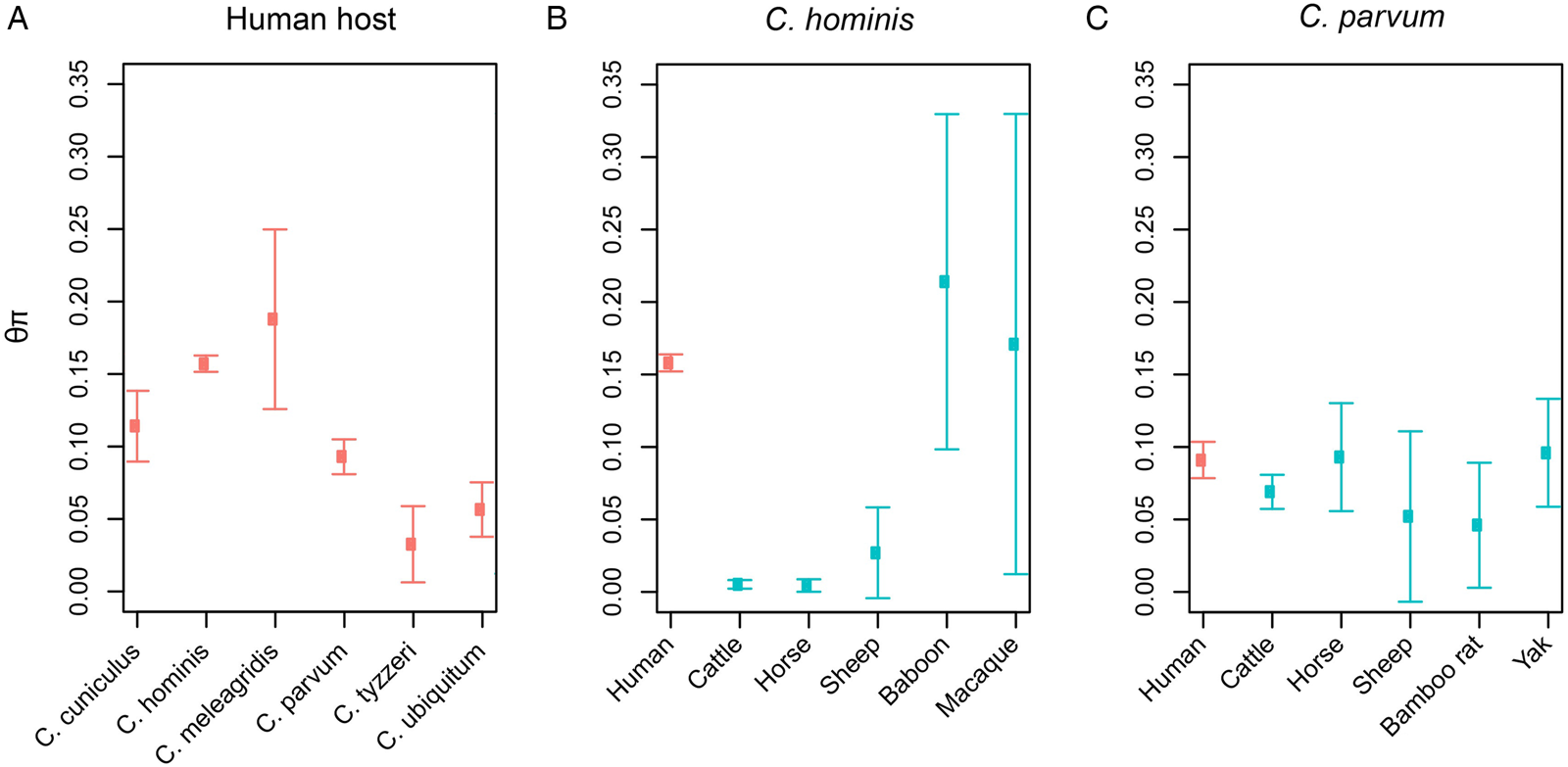
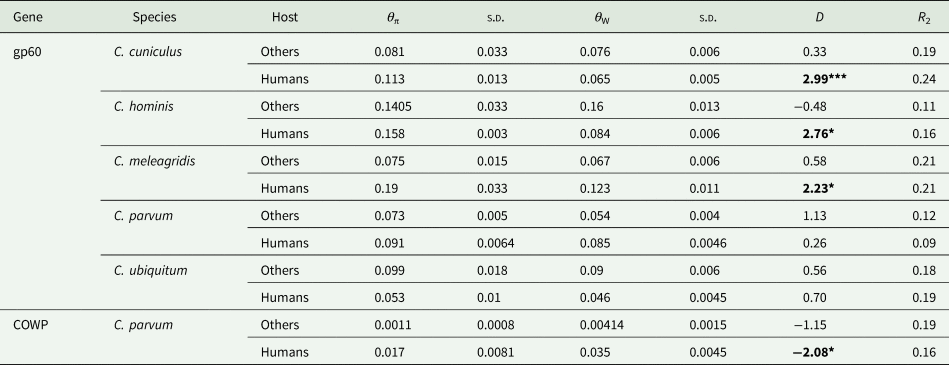
Population parameter estimates yield a high θ π for the gp60 gene in humans infected with C. meleagridis and C. cuniculus in comparison to their other hosts (Fig. 3A and Table S2). In contrast, C. hominis presents high θ π values in its major host group (humans and non-human primates; Fig. 3B) suggesting a bottleneck and likely a dead-end infection in domesticated animals. The more ubiquitous C. parvum has low values in its major host source (cattle) but similar values across several other hosts, even though they cover greater taxonomic distances (Fig. 3C). The intermediate levels across the board of hosts might suggest a sustained infection across a broad host range. The same pattern was found in C. meleagridis and C. tyzzeri with their likely host groups (birds and rodents, respectively) presenting low θ π values (Table S2). Evidence of distortion in the frequency of polymorphism distributions (Tajima's D) was found in two species of Cryptosporidium that have been recently reported in humans (C. meleagridis and C. cuniculus), as well as the type human species (C. hominis), at the gp60 gene (Table 1).
Population estimates of Cryptosporidium species infecting humans and other hosts. (A) Estimates of nucleotide diversity (θ π) using the gp60 gene for six Cryptosporidium species infecting humans (red); and variation in nucleotide diversity (θ π) in gp60 in C. hominis (B) and C. parvum (C) among other hosts (blue).

Estimates of nucleotide diversity (θ π), Watterson's estimator (θ W), Tajima's D and Ramos-Onsins and Rozas' population growth test (R 2) using gp60 and COWP genes for Cryptosporidium species infecting humans and other animal hosts (n ⩾ 4, the minimum number of sequences required to compute these tests). *P < 0.05, ***P < 0.001.

Discussion
Understanding the factors that influence the success of Cryptosporidium to colonize new hosts can help to explain host shifting in humans. The putative main hosts of C. meleagridis (birds), C. cuniculus (rabbits) and C. parvum (cattle) were found to harbour low genetic diversity at the gp60 gene compared to the diversity found in humans. Greater θ π of these parasites in humans did not meet our expectations of high diversity within major hosts and low diversity in new ones (here, humans; Fig. 1). Nonetheless, significant Tajima's D positive values in C. meleagridis and C. cuniculus in humans at the gp60 gene might indicate that these lineages have recently decreased their level of genetic variability through a population bottleneck caused by recent colonization of a new host. These species have lately expanded their range to humans and caused outbreaks worldwide (Chalmers et al., Reference Chalmers, Elwin, Thomas, Guy and Mason2009b, Reference Chalmers, Elwin, Hadfield and Robinson2011; Koehler et al., Reference Koehler, Whipp, Haydon and Gasser2014). An increased number of observed polymorphisms at the gp60 gene must be the result of advantageous adaptations during colonization of the new host and subsequent ‘arms race’, indicating that these parasites are either human-adapted or often cause infection in people (Akiyoshi et al., Reference Akiyoshi, Dilo, Pearson, Chapman, Tumwine and Tzipori2003; Feng et al., Reference Feng, Ryan and Xiao2018).
The genetic diversity of C. hominis observed in people matches our expectations for the reservoir host–parasite relationship. There are genetically diverse C. hominis genotypes identified in humans causing unusual infections (Lebbad et al., Reference Lebbad, Beser, Insulander, Karlsson, Mattsson, Svenungsson and Axén2013, Reference Lebbad, Winiecka-Krusnell, Insulander and Beser2018), as well as in other hosts (Plutzer and Karanis, Reference Plutzer and Karanis2009; Feng et al., Reference Feng, Ryan and Xiao2018). This might indicate a predictable relationship between genetic diversity and taxonomic distance of primary and secondary hosts (i.e. similar parasite diversity in closely related hosts). High variable genotypes lead to an increase in genetic polymorphisms that cause a deviation from the theoretical expectation of neutrality. Differences in genetic diversity could be due to higher rates of adaptation in lineages with large population sizes (Feng et al., Reference Feng, Ryan and Xiao2018) that allow the parasite to respond to novel selection pressures from the host(s).
Despite the high genetic diversity in Cryptosporidium species that infect humans, the range of potential evolutionary processes in host–parasite interactions needs to be better understood (Barrett et al., Reference Barrett, Thrall, Burdon and Linde2008; Longdon et al., Reference Longdon, Brockhurst, Russell, Welch and Jiggins2014). We aim to draw inferences about patterns of host–parasite associations and evolutionary history of episodic host shifting or adaptation within this system (Fig. 1). Nonetheless, we acknowledge that information on the timing of shifting or details of the cross-species transmission events is currently limited. The precise effects of host shifting in Cryptosporidium populations could depend on many factors including the life cycle, population subdivision, sampling strategy (markers under selection pressure or mixed geographical origin of the samples), reproductive mode, genetic recombination, host phylogeny and host resistance to parasites (Lively, Reference Lively2010; Wang et al., Reference Wang, Zhang, Axen, Bjorkman, Jian, Amer, Liu, Feng, Li, Lv, Zhao, Qi, Dong, Wang, Sun, Ning and Xiao2014), among others.
Sampling strategies play a key role in observed population summary statistics and we need to study the actual evolutionary units in time and space. Unfortunately, publicly available data are invariably found in scattered locations due to piecemeal submission of sequences to genetic databases and different questions and research designs from the original studies. The scale at which Cryptosporidium species adapt to new hosts might depend on the properties and dynamics of the given system. For instance, a species with a time-dependent association for host adaptation and large geographic and host ranges may be more likely to adapt through multiple, geographically-restricted mutations than by global sweeps of local and host-restricted species (Leffler et al., Reference Leffler, Bullaughey, Matute, Meyer, Ségurel, Venkat, Andolfatto and Przeworski2012). Studies at multiple scales are required to tease these processes apart, but clearly defining and delimiting the population being studied is essential for accurate estimates of host shifting.
We previously showed that departures from neutrality in Cryptosporidium from humans in New Zealand could be detected through changing epidemiological patterns (Garcia-R and Hayman, Reference Garcia-R and Hayman2017). This means that analysing disease patterns by fine-scale surveillance is likely a more powerful way to infer parasite dynamics. With the advent of cheap and rapid sequencing of whole genomes, we expect that understanding genetic diversity and population structure will provide explanatory power to identify the risk of the spread of Cryptosporidium species and ecological fitting into humans (Nader et al., Reference Nader, Mathers, Ward, Pachebat, Swain, Robinson, Chalmers, Hunter, van Oosterhout and Tyler2019). Ideally, studies using genomes and fine-scale longitudinal sampling before and after the putative host shifting event will help to identify the patterns in genetic diversity variation caused by parasite evolutionary processes, which can, in turn, be used to predict novel host shifts from genetic data alone.
Supplementary material
The supplementary material for this article can be found at https://doi.org/10.1017/S0031182020001493
Acknowledgements
Matt Knox and four anonymous reviewers provided helpful comments that improved this manuscript.
Financial support
JCG-R and DTSH thank the New Zealand Ministry of Health for funding. DTSH acknowledges funding from the Royal Society Te Apārangi Rutherford Discovery Fellowship (MAU1701). The funders played no part in the design of this study.
Conflict of interest
The authors declare that there is no conflict of interest.
Ethical standards
Not Applicable.