Introduction
This paper arises from my interest in two general areas of inquiry in the social sciences in general, and in Applied Linguistics in particular: on the one hand, I am interested in identity, both in terms of theoretical discussions and research; on the other hand, I am interested in migration as the flow of people around the world in the current global age. In much of the literature on identity and migration, theorists and researchers portray individuals in terms of sociocultural constructs such as gender, race, ethnicity, nationality, religion and social class. In addition, they attempt to give migrants names, such as ‘immigrant’, ‘transmigrant’, ‘cosmopolitan’ and ‘expatriate’, situating them as participants in large-scale movements of people, which are, depending on the presented circumstances, called ‘immigration’, ‘diaspora’, ‘transnationalism’ and so on. Viewed charitably, the practice of employing this array of terminology can be seen as part and parcel of academic inquiry: it is what we do. However, it is obviously not without its problems, not least because the putative reality to which the terminology is meant to apply is in a constant state of flux and change. And although we can fall back on Weberian notions of ‘ideal types’, whereby we know that we are using necessarily partial tools of analysis, as opposed to actual descriptions of reality, there is surely still room for greater clarity. In this paper, I aim to explore the difficulties I have encountered over the past several years with terminology of the type previously mentioned. I begin by defining identity and situating it as an at-best imprecise construct. I then probe this imprecision via a close examination of an England and Wales census question ‘What is your ethnicity?’. From here I move to migration and the problematics of naming migrants in research. I conclude the paper with the consideration of an added dilemma, arising not only from my previous discussion but from my general readings of identity and migration research. Throughout this paper, the orientation adopted is a very personal one, as I reflect on my personal journey through the issues raised. This means that I will be citing my own experiences and academic work extensively. It also means that I will not cover every single angle on identity and migration out there and therefore what I have to say will be partial at best.
What is identity?
There has been a veritable discursive explosion in recent years around the concept of ‘identity’, observed Stuart Hall in the introduction to a volume of studies published in 1996. A few years have passed since that observation was made, during which the explosion has triggered an avalanche. No other aspect of contemporary life, it seems, attracts the same amount of attention these days from philosophers, social scientists and psychologists. It is not just that ‘identity studies’ are fast becoming a thriving industry in their own right; more than that is happening – one may say that ‘identity’ has now become a prism through which other topical aspects of contemporary life are spotted, grasped and examined. (Bauman Reference Bauman2001a: 140)
Thus writes Zygmunt Bauman as he begins a discussion of identity in the global age in which we live (or at least are purported to live). Citing a Stuart Hall publication from 1996, in a book he himself published in 2001, Bauman (Reference Bauman2001b: 16) makes the point that identity had by the end of the last century become ‘today's talk of the town and the most commonly played game in town’. And if one is to judge by publications over the past decade, at present ‘identity’ is, if anything, an even bigger player on the social sciences and Applied Linguistics playing field. However, when talking about identity as such an important construct, one question that surely must arise is: What exactly do we mean by identity?
To answer this question in the simplest manner available to me, I consult a recent publication of mine, Second language identities (Block Reference Block2007), to see what I had to say about what identity is and how it has been approached in recent years in Applied Linguistics. The following attempt at a definition is based on the work of a long list of social theorists, sociologists and anthropologists, such as Bauman (e.g. Reference Bauman2001b), Hall (e.g. Reference Hall, Hall and du Gay1996), Giddens (e.g. Reference Giddens1991) and Butler (e.g. Reference Butler1990):
[F]or many social scientists today, identities are socially constructed, self-conscious, ongoing narratives that individuals perform, interpret and project in dress, bodily movements, actions and language. Identity work occurs in the company of others – either face-to-face or in an electronically mediated mode – with whom to varying degrees individuals share beliefs, motives, values, activities and practices. Identities are about negotiating new subject positions at the crossroads of the past, present and future. Individuals are shaped by their sociohistories but they also shape their sociohistories as life goes on. The entire process is conflictive as opposed to harmonious and individuals often feel ambivalent. There are unequal power relations to deal with, around the different capitals – economic, cultural and social – that both facilitate and constrain interactions with others in the different communities of practice with which individuals engage in their lifetimes. Finally, identities are related to different traditionally demographic categories such as ethnicity, race, nationality, migration, gender, social class and language. (Block Reference Block2007: 27)
This definition is very tidy, although it no doubt raises as many questions as it answers. For example, in it, and indeed in my book as whole, I use identity as a cover term for a range of other terms often used by researchers and theoreticians: apart from ‘identity’ itself, there are the terms ‘subjectivities’, ‘subject positioning’ and ‘self’. In doing so, I do no worse than a long list of Applied Linguistics (hereafter AL) scholars have done over the years. Nevertheless, it might well be a good idea to differentiate and tease out these terms. For example, one could use the term ‘subject positioning’ to capture the dynamic making of and emergence of identity in ongoing practices and activities engaged in by individuals. In this case we are talking about what Davies & Harré (Reference Davies, Harré, Harré and van Langenhove1999: 37) call ‘the discursive process whereby people are located in conversations as observably and subjectively coherent participants in jointly produced storylines’. Identity, by contrast, could have a less ephemeral, though not entirely stable, feel to it, denoting what Chris Weedon calls the ‘limited and temporary fixing for the individual of a particular mode of subjectivity as apparently what one is’ (Weedon Reference Weedon2004: 19). In his work, Stuart Hall brings these two ideas together in a more concise statement to the effect that ‘identities are . . . points of temporary attachments to the subject positions which discursive practices construct for us’ (Hall Reference Hall, Hall and du Gay1996: 6).
There are other identity-related issues to resolve, such as clarity in how the interrelationships between structure and agency are dealt with (Block forthcoming), or the prospects for incorporating psychological angles into the discussions of identity, particularly psychoanalytic ones (Wetherell Reference Wetherell2007), or what exactly what one might really mean by ‘social identity’ (Riley Reference Riley2007). These will not be covered here for reasons of space. However, my aim in mentioning them is not to discuss them but simply to make the point that as regards ‘identity’, a critical stage has been reached in the social sciences construct cycle. It seems that after more than a decade of relatively unproblematised use of identity in research, an increasing number of scholars are starting to interrogate the construct, in particular how it is formulated and used in analysis and interpretation. In fact, in social theory there has always been debate about what is meant by identity, with this problematising stance being a constant in the work of authors as diverse as Bauman and Butler. However, in the realm of AL, this has not been the case until very recently as witnessed by the very recent publication of two books with suggestive titles: Identity trouble, edited by Caldas-Coulthard & Iedema (Reference Caldas-Coulthard and Iedema2008), and Problematizing identity, edited by Lin (Reference Lin2008).
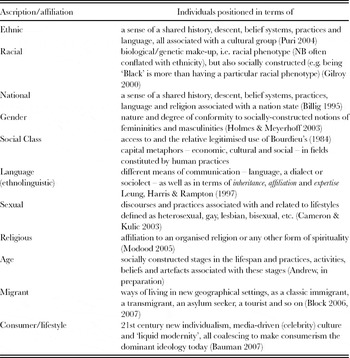
Another way to look at identity is in terms of traditional demographic categories used in the social sciences, as mentioned in the last sentence of my definition above. These traditional demographic categories might be updated as ‘types of identity’ or ‘dimensions of identity’. Or one might use ‘identity ascriptions and identity affiliations’ to capture the idea that individuals are attributed or assigned identities by others while they feel attached to or inhabit the same or different identities. A broader term to capture both of these general ways of viewing identity is ‘identity inscriptions’. In Table 1, I present an updated and expanded version of what I have presented elsewhere under the rubric ‘types of identity’ (Block Reference Block2006, Reference Block2007). My intention is to include what I see as an ever-expanding list of ways of conceptualising Hall's ‘points of temporary attachments to the subject positions which discursive practices construct for us’ (Hall Reference Hall, Hall and du Gay1996: 6), gleaned from my reading of identity research.
Identity ascriptions and affiliations.

One noteworthy shortcoming of any list if this type is the way that it seems to suggest that these inscriptions are bordered entities which can be studied in isolation. This is certainly not the case although there is always a tendency in discussions of identity to emphasise one particular inscription over others. In the next section I will examine these inscriptions in action, focusing on a census question that is, in effect, about how individuals are positioned by census question writers and how individuals position themselves within the parameters established by these census question writers.
Identity inscription problems: an example
I focus here on the 2001 census for England and Wales, which I consulted a few years ago as I gathered background information for a discussion of migrants in London (Block Reference Block2006). The census aimed not only to collect population figures, but also to improve on methods used in previous censuses to capture the multicultural and ethnic diversity of modern Britain. In doing so, it put a great deal of the responsibility for gathering such information on the question ‘What is your ethnic group?’. The question had been rewritten after complaints were made about the 1991 question being too restrictive and, as a result, in its 2001 version, it contained more choices, especially as regards the category ‘mixed’ (shorthand for ‘mixed race’Footnote 1). The question, in its entirety, looked as follows:
(a) White
British ( ), Irish ( ), Any other White background ( )
(b) Mixed
White and Black Caribbean ( ), White and Black African ( ),
White and Asian ( ), Any other Mixed background ( )
(c) Asian or Asian British
Indian ( ), Pakistani ( ), Bangladeshi ( ), Any other Asian background ( )
(d) Black or Black British
Caribbean ( ), African ( ), Any other Black background ( )
(e) Chinese or other ethnic group
Chinese ( ), Other ethnic group ( )
One initial problem with this question is related to exactly what one means by ethnicity. Most social scientists who use the term do not attempt to define it and instead talk around it.In other cases, the task of defining is made difficult by the existence of so many different frameworks which one can bring to bear on the construct. Thus, in a recent book entitled Ethnicity in everyday life, Karner (Reference Karner2007) eschews definitions, opting instead to show how ethnicity can be understood in terms of frameworks provided by theorists ranging from Pierre Bourdieu to Raymond Williams.
This state of relative imprecision often leaves one to wonder if ethnicity is being used to mean something akin to culture, or if it is a polite way to talk about race. In the former case, ethnicity may be seen to be more about ‘common descent and . . . a cultural heritage shared because of common descent’ (Joseph Reference Joseph2004: 162) and in the latter case there is a recognition that race has moved from being considered just a biological concept – as about skin colour or phenotype and nothing more – to being framed as socially constructed (Gilroy Reference Gilroy2000). However, Puri (Reference Puri2004) does see ethnicity as separable from race. She explains:
Ethnicity is . . . a form of collective identity based on shared cultural beliefs and practices, such as language, history, descent, and religion. Even though ethnicities often allude to enduring kin-based and blood ties, it is widely recognized that they are cultural, not biological, ties. (Puri Reference Puri2004: 174)
Of course, there are numerous problems with any attempts to shoehorn people and their beliefs, dispositions, behaviours and so on, inside something called ‘culture’. For example, how should people who self-position as Jewish respond to the ethnicity question? Jewish people would likely be considered an ethnic group by most observers. However, they also are likely to be European in appearance. If, in addition, they are British passport holders, then surely they should tick the box for ‘White British’. Or would ‘Any other White background’ be better? And then there is the possibility of ticking the category for ‘Jewish’ elsewhere in the census form, where religion is asked about. So perhaps Jewish people should tick all three options. I would imagine that the authors of the question about ethnicity have firmer and more exclusive categorisations in mind than this, but the terminology being used militates against such firmness and exclusiveness.
Similar problems arise when ethnicity is understood in terms of race, although many authors, such as Puri (cited above), would argue that ethnicity and race should be kept separate. MacMaster (Reference MacMaster2001: 1) expresses a constructivist view on the matter when he writes that ‘[r]acial categories cannot be explained through a scientific system of classification based on biological/genetic methods, but are ideological constructs, forms of boundary definition between groups that have evolved within specific historical and social contexts’. The authors of the census question might or might not have been bothered about such nuances, but in any case, they opted for an essentialist biological version of race as synonymous with ethnicity. Not surprisingly, this kind of conflation is not unproblematic, as illustrated by a close examination of the category of ‘Mixed’, with its subcategory options: ‘White and Black Caribbean’, ‘White and Black African’, ‘White and Asian’ and ‘Any other Mixed background’.
The inclusion of the category ‘Mixed’ seems to have come about, as I suggested above, as part of an attempt to make the question about ethnicity more accurate and discriminating than it had been in previous censuses. The thinking was that it would elicit a more accurate estimation of the number of individuals who consider themselves to be neither entirely Black nor entirely White, neither entirely Asian nor entirely White, and so on. With some 226,111 people choosing this response (ONS 2001), there would appear to have been some degree of success in this regard. However, solving one problem all too often leads to others. For example, is ‘Mixed’ a category easily separable from White or Black or Asian? Examining the variety of stories told in the accounts provided by children and parents in mixed race contexts (e.g. Ali Reference Ali2004), it is easy to see that mixed race does not tell the whole story of how individuals self position, nor how they are positioned by others. There might be a question of how phenotypically mixed race one is, which could lead to ever greater essentialisation of racial composition of individuals. For example, in London today, how does one classify the children of Afro Caribbean-White British unions, when individuals in the former category very often are already classified as mixed race? Or what about the children of Carlos, one of the Colombian informants in my study of Spanish-speaking Latinos in London (Block Reference Block2006, Reference Block2008), and his British wife? Carlos's father was Black and his mother was from an indigenous background. His wife's mother was a Colombian of European phenotype and her father was part Egyptian. The children would seem to be clear cases of ‘mixed race’, but which kind of mixed race are they? Or is the category ‘Any other mixed background’ enough for such cases?
Equally problematic is the way the ethnicity question includes nation-state affiliations, such as Irish, Indian, Pakistani and Bangladeshi. A broad range of authors, from Hobsbawm (Reference Hobsbawm1990) to Anderson (Reference Anderson1991), have noted how nationality and national identity are slippery constructs. In more recent framing of the construct (e.g. Billig Reference Billig1995; Raj Reference Raj2003), national identity is no longer seen as fixed at birth and tied to one's birthplace. Instead, it is seen as an ongoing project or narrative, something produced and reproduced daily via participation in activities, which are often banal, such as flag waving and the invocation of historical events to explain present day phenomena (Billig Reference Billig1995). Thus even in the cases of individuals who are born, raised and educated in a particular nation-state, national identity is still an ongoing project that must be made and maintained in day-to-day activities. In this context, elaborating a list of nation-state identities in a setting like the UK is always going to be problematic. It is even more so in the census question above because, as researchers such as Raj (Reference Raj2003) and Modood (Reference Modood2005) observe, the categories offered under the general heading ‘Asian or British Asian’ conflate nationality and ethnicity and ignore differences that are perhaps more salient among Londoners of South Asian heritage, such as religion. Raj writes:
While the ‘Asian community’ is fractured into ‘communities’ of religious difference and calling for recognition of such distinctions, the nation-state readily identifies other differences by emphasising ethnicity. The specific forms of this emphasis highlight an alternative national identity (Indian, Pakistani, Bangladeshi) and thereby keep Asians distinct as a perpetual ‘other’ in which ethnicity is first judged by phenotypic racial category. (Raj Reference Raj2003: 193)
Thus, the census probably has its focus wrong when it conflates ethnicity and national identity under the general rubric of ‘Asian or British Asian’. In a sense, it is ignoring religion as a more grassroots manifestation of ethnicity.
The example I have cited here serves, I hope, to make the point that portraying individuals according to identity inscriptions is a tricky business to say the least. However, the difficulties increase when the focus of research is not just identities, but migrant identities. Here, the problems just mentioned are combined with an attempt to situate and present individuals against a backdrop of the forces and flows of migration in an increasingly globalised world. To make this point, in the next section I discuss a fraction of my personal experience as a researcher grappling with the portrayal of middle class migrants in London.
Portraying migrants: an early example
My personal history with narrating migrants dates back just a few years, and here I focus on a paper, published in 2002, in which I discussed the life stories of two MA students living in London: Noemi, a 45-year-old English teacher from Japan and Carly, a 28-year-old English teacher from Taiwan.Footnote 2 I based my discussion on lengthy interviews I conducted with each of these students in 2001. In my attempt to frame and interpret the stories told to me by these two women, I drew on my readings at the time on issues around migration and identity. In particular, I focussed on the work of migration specialist Papastergiadis (Reference Papastergiadis2000) and what he had to say about newer forms of migration, such as the increasing movements of citizens of the advanced economies of Europe, North America and the Pacific Rim to different parts of the world. I described this type of migrant as follows:
This international class of mobile citizens includes the obvious examples of international celebrities and highflying business executives who often have homes in two or more countries. However, it also includes a second tier of citizens who for reasons of study or work cross nation state borders for extended periods of time. These individuals may take on one or more of several different possible positions vis-a-vis their temporary homes. On the one hand, they might go completely ‘native’ and become immigrants. In this case, they opt for a total and complete abandonment of their home culture and have every intention of staying in their new home culture for the rest of their lives. On the other hand, they may effectively remain tourists for the entirety of their stay abroad, not taking the time to get to know the sociohistorical, cultural or linguistic sides of the host environment and are therefore condemned to only the most superficial of contacts with local people and engagement with local culture. (Block Reference Block2002: 2–3)
I thus developed a rather rudimentary, and in retrospect very stark, distinction between what we might call immigrants and expatriates. However, as I sought an intermediate category between these two extremes, I went on to introduce the work of Hannerz and his discussion of cosmopolitans, defined as follows:
Cosmopolitans tend to immerse themselves in other cultures, or in any case be free to do so. They want to be participants, or at least do not want to be too readily identifiable within a crowd of participants, that is, of locals. They want to be able to sneak backstage rather than being confined to the frontstage areas. (Hannerz Reference Hannerz1996: 105)
Taking this definition and adapting it to my interview data, I decided that there were two types of cosmopolitans within Hannerz's definitions. I described these two types as follows:
On the one hand, there is what I will call ‘early cosmopolitans’, that is individuals who at a very young age have been moved from their home culture to an entirely foreign culture. These individuals are children or adolescents at the time of their move and they are expected by their parents and others to adapt to local conditions. On the other hand, there are what I will call ‘expatriate cosmopolitans’, that is adults who embody three characteristics: (1) they have chosen to live abroad for an extended period of time; (2) they know that whenever they want, they can return home; and (3) they have chosen to immerse themselves to a significant extent in their new cultural environment. (Block Reference Block2002: 3)
In addition, I was taken by further comments by Hannerz concerning the effects of migrant experiences which are long in duration and therefore what we might call deep and meaningful. Hannerz (Reference Hannerz1996: 110) wrote about ‘real cosmopolitans’, which he said ‘are never quite at home again . . . [and] their perspectives have been irreversibly affected by the experience of the alien and the distant’. Interested in this idea of long lasting and disruptive effect in sociolinguistic terms, above all how it might lead to feelings of ambivalence with regard to ethnic, ethnolinguistic and national identity, I introduced the concept of critical experiences as a way of accounting for such changes to an individual's sense of self:
By critical experiences, I mean periods of time during which prolonged contact with an L2 and a new and different cultural setting causes irreversible destabilization of the individual's sense of self. There is, in a sense, an element of before and after in critical experiences as the individual's sociohistorical, cultural and linguistic environment, once well defined and delimited, becomes relatively ill defined and open-ended. Importantly, it is not enough to spend time abroad for such a process to take place; one must have what we might call a cosmopolitan spirit and access to experiences significant enough to destabilize one's identity. (Block Reference Block2002: 3)
I then went on to frame Noemi and Carly as ‘real cosmopolitans’, whilst noting significant differences between the two. On the one hand, Noemi had lived in four different countries by the time she was 18, had had almost all of her formal education up to the age of 20 in English medium schools outside of Japan, and had lived for a further five years in the USA between the ages of 27 and 32. I termed her an ‘early cosmopolitan’ because her first critical experience had occurred when she was just six, although what made her interesting to me was how, well into her 40s and long since firmly established living in Japan, she still projected an identity far more European and North American than Japanese, and she conveyed a certain ambivalence about a Japanese national identity. She positioned herself as ‘not very Japanese’ but also unable to claim a ‘native’ English language speaker identity.
If Noemi's story was about making her ‘own culture’, then Carly's was cast far more in terms of being either Taiwanese or English-speaking Western (in this case British). Carly did not actually leave Taiwan for any significant period of time until she was 18 and therefore her first critical experience took place when she was a young adult. At this time, Carly was sent by her parents to live with her sister, who was already on a BA course in the UK. She eventually spent four years in the north of England until she finished a BA and then went back to Taiwan. When I met her and spoke to her some six years later (when she was in London doing an MA), Carly positioned herself as somehow not typically Taiwanese but Taiwanese all the same. I called Carly a ‘cosmopolitan expatriate’ to convey somewhat contradictory forces elaborated on in her interview.
In this brief archaeology of my 2002 publication, we see elements of my early grappling with migrant identity categories in an attempt to make sense of migrant life stories. Looking back, I can see how the terminology employed in my attempts to narrate Noemi and Carly is highly flawed. For example, the concept of ‘critical experiences’, while interesting as regards its parallels with Hannerz's work, is nonetheless absolute in tone, with references to ‘irreversible destabilization of the individual's sense of self’, ‘the individual's sociohistorical, cultural and linguistic environment, once well defined and delimited’ and an apparently unitary identity that can be destabilised. In addition, why did I not use ‘late cosmopolitan’ instead of ‘expatriate cosmopolitans’ to contrast with ‘early cosmopolitan’? Indeed, the term ‘expatriate’ is not an altogether happy one for Carly, as she seems to have done more as regards acculturation to British life than what I would currently understand expatriates to do. I now see expatriates as individuals who: (i) have chosen to live abroad for an extended period of time, (ii) know that whenever they want, they can return home and (iii) live a ghetto-ised existence, associating almost exclusively with fellow nationals (or those who speak the same language(s) as they do), which prevents them from acquiring local social and cultural capital and ultimately acculturating to their local environment (Block Reference Block2006, Reference Block2007). The latter characteristic certainly does not apply to Carly's story.
Migrant identities.

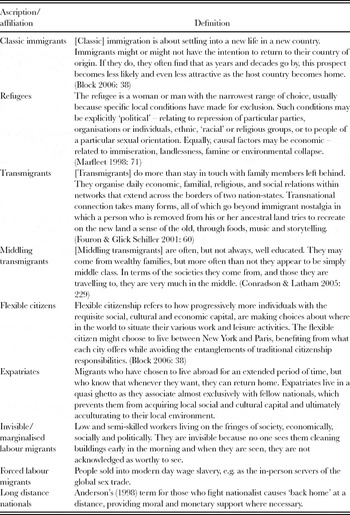
This refinement of my understanding of ‘expatriate’ extends to other labels I might have used in my early work on migrations. ‘Immigrant’, for example, might be renamed as ‘classic immigrant’ to indicate someone who arrives somewhere and stays for good, the way that immigration was understood to work when the focus of discussion was the Americas of the early part of the last century. It was at this time that millions of Europeans made their way to the USA, Brazil, Argentina, Canada and other countries. However, as migration theorists and researchers note (e.g. Castles & Miller Reference Castles and Miller2009; Vertovec Reference Vertovec2009), almost a century later, we live in very different times and the ways that migrations occur and develop have become considerably more diversified. In an attempt to reflect this diversity and above all the different ways that current theorists and researchers have attempted to capture it, I list some key terms that have been used in recent years to describe migrants in Table 2.
As is always the case with such categorising attempts, caution is in order. First, such categories cannot capture the more emotive side of migration. For example, there is the ambivalence experienced by migrants, where ambivalence is understood as ‘the acute discomfort we feel when we are unable to read the situation properly and choose between alternative actions’ (Bauman Reference Bauman1991: 1). There is also the way that migrants are often, in the words of George Simmel, ‘strangers’, intimate with their surroundings while manifesting ‘objectivity’, which ‘does not simply involve passivity and detachment . . . [but] distance and nearness, indifference and involvement’ (Simmel Reference Simmel and Wolff1950: 404), or even the way that migrants often become ‘strangers to themselves’ (Kristeva Reference Kristeva1994) in the sense that they not just ‘strangers’, in Simmel's thinking, but also somehow distanced from themselves as they have left behind the assemblages of concepts, emotions and experiences with which they have grown up.
In addition, there is the idea that an individual is a certain type of migrant for life. In her recent work on the school based literacies of migrant children in London, Catherine Wallace shows us how problematic these two ways of framing migrants can be. Wallace has documented how some children might experience two or more moves during their lifetimes, what I would call ‘two-step’ or ‘multi-step’ migration, thus making issues around national and ethnolinguistic identity, as well as migration type difficult to qualify. She describes one of her informants as follows:
Suresh came to the United Kingdom two years ago from Germany. His family are Sri Lankan but he was born in Germany. Although now still only 15 he . . . came to the UK unaccompanied by his parents. They joined him later. Suresh speaks Tamil with his mother, but German with the rest of his family. (Wallace Reference Wallace2008: 66)
The classical immigrant experience discussed above can also change during migrants’ lifetimes, as with age individuals can become less bound to the adopted home and more transnational. In this case, migrants begin to harbour feelings of nostalgia after years of marginalising their past, and if local conditions allow, they might evolve from classic immigrant to transnational. Of course, transnationalism requires a certain critical mass of migrant compatriots in fairly close physical proximity and, above all, the technology necessary to carry out many of the activities associated with transnationalism, such as watching television from ‘back home’ or maintaining day-to-day contact by email.
It is also worth bearing in mind that migrant labels can lack precision due to the way that they are applied. In particular, I am thinking about how the nation-state is a key construct in so many discussions as researchers write about migrants in the European Union countries and North America who are Mexicans, Somalis, Algerians, Sri Lankans, Brazilians and so on. However, very often where there is a strong affiliation to what is deemed a national culture, this affiliation takes place at the sub-nation-state local level. Thus, for many Mexican migrants in the USA, national affiliation passes not through the nation-state Mexico, but through regional (state) affiliations, such as Tabasco or Zacatecas, and even smaller geo-political units such as municipalities within these states. Such affiliations remind us of the ways that constructions of national identity (and indeed, citizenship) are highly complex and problematic. In addition, with regard to migrants classified as ‘middling transmigrants’, the social class dimension may well trump the national dimension or any local affiliation within a nation-state when it comes to understanding how particular individuals experience their middling migrant experiences. This example raises the prospect of a global middling migrant identity tied not to nation state of origin but to the class of people in the world who live similar lives based on their living conditions, how they construct their social and family lives and, above all, what they consume. In this sense, middling transmigrants are much like what Reich (Reference Reich1991) has called ‘symbolic analysts’, that is professionals who are skilled in new literacies (the written word, new technologies, numeracy), and who owe their allegiance not to the nation states in which they were born and nurtured, but to whatever affiliations have got them to the position they hold at present – professional networks, social networks and so on.
Conclusion
In this paper, I have focused primarily on the imprecision of names and labels for individuals in general and specifically for those classified as migrants in AL research. Via two examples – the census question about ethnicity and my research on British graduate students from East Asian backgrounds – I have attempted to convey to the reader the problematics of portraying people in terms of identity inscriptions and types of migration experience. There are, of course, numerous other issues, and indeed problems, related to the kinds of practices I have discussed here and I would like to close this paper with just one.
In elaborating portrayals of migrants, AL researchers generally work ethnographically and within a grounded theory framework, in that they try to somehow get inside the heads and skins of their informants. The aim is to arrive at understandings of informants’ lived experiences which are similar to the ones which the informants purportedly have. However, engaging in such practices carries with it all kinds of potential pitfalls, not least of which is the tendency to romanticise the worlds of informants while imposing a good dose of wishful thinking on harder more nuanced lived realities on the ground. There is, therefore a degree of what Bourdieu, citing Dewey, terms the ‘spectator's theory of knowledge’:
Projecting his theoretical thinking into the heads of acting agents, the researcher presents the world as he thinks it (that is, as an object of contemplation, a presentation, a spectacle) as if it were the world as it presents itself to those who do not have the leisure (or the desire) to withdraw from it in order to think it. (Bourdieu Reference Bourdieu2000: 51)
From this perspective, I see my earlier preoccupations with getting ethnicity right or getting migrant terms right as relatively insignificant. For the issue that Bourdieu identifies here cuts to the heart of the portrayal business that we engage in. And it is an aspect of researcher activity that is all too often pushed to the side as authors and readers get carried away with portrayals that they create and read, respectively. But if we are to be honest in such matters, we really do need to continuously ask ourselves about the epistemological status of these portrayals.
David Block is Professor of Education in the Department of Learning, Curriculum and Communication, Institute of Education, University of London. He has published articles and chapters on a variety of Applied Linguistics topics. He is co-editor (with Deborah Cameron) of Globalization and language teaching (Routledge, 2002) and author of The social turn in second language acquisition (Edinburgh University Press, 2003), Multilingual identities in a global city: London stories (Palgrave, 2006) and Second language identities (Continuum, 2007). His main interests are the impact of globalisation on language practices of all kinds, migration, and the interface between identity and language learning and use.