Introduction
Sugarcane (Saccharum spp.) silage can be a forage source for ruminants since the harvesting phase coincides with the winter, a period of pasture shortage (Bernardes and do Rêgo, Reference Bernardes and do Rêgo2014; Oliveira and Millen, Reference Oliveira and Millen2014). The sugarcane silage (SS) has high biomass productively (70,357 kg of natural matter/ha – CONAB, 2022) with low production cost. However, alcoholic fermentation by yeasts could comprise SS ensiling. This fermentation increases gas losses, resulting in low-quality and decreased dry matter (DM) recovery (Pedroso et al., Reference Pedroso, Nussio, Paziani, Loures, Igarasi, Coelho, Packer, Horii and Gomes2005; Daniel et al., Reference Daniel, Checolli, Zwielehner, Junges, Fernandes and Nussio2015).
The limitations of natural fermentation in SS led to the identification of additives that inhibit epiphytic yeast populations and mitigate nutrient losses (Ávila et al., Reference Ávila, Carvalho, Pinto, Duarte and Schwan2014). Additives such as lactic acid bacteria (LAB) increase the quality of forage fermentation (Kleinschmit and Kung, Reference Kleinschmit and Kung2006; Rabelo et al., Reference Rabelo, Härter, Ávila and Reis2019). The LAB regulate yeast growth by producing high concentrations of organic fatty acids, such as acetic and propionic acids, which have a fungicidal effect (Moon, Reference Moon1983). Consequently, LAB decrease ethanol production and improve silages' aerobic stability (Driehuis et al., Reference Driehuis, Oude Elferink and Spoelstra1999; Kleinschmit and Kung, Reference Kleinschmit and Kung2006).
Obligatory heterofermentative (i.e. L. buchneri) and facultative heterofermentative (i.e. Lactobacillus plantarum and Pediococcus acidilactici), and have been used as silage additives (Ávila et al., Reference Ávila, Carvalho, Pinto, Duarte and Schwan2014; Carvalho et al., Reference Carvalho, Ávila, Pinto, Neri and Schwan2014; dos Santos et al., Reference dos Santos, do Nascimento, Magalhães, Silva, Silva, Santana and Soares2015). Lactobacillus plantarum and P. acidilactici were evaluated on SS without benefits to justify their use, but studies are limited and hence more studies have to be carried out (Carvalho et al., Reference Carvalho, Ávila, Pinto, Neri and Schwan2014; dos Santos et al., Reference dos Santos, do Nascimento, Magalhães, Silva, Silva, Santana and Soares2015). Lactobacillus buchneri reduces DM losses and increases the aerobic stability of SS (Pedroso et al., Reference Pedroso, Nussio, Loures, Paziani, Ribeiro, Mari, Zopollatto, Schmidt, Mattos and Horii2008; Ávila et al., Reference Ávila, Pinto, Figueiredo and Schwan2009).
New additives are being used in SS, improving the fermentation process. Among these additives, we could mention chitosan (CHI) (Gandra et al., Reference Gandra, Oliveira, Takiya, Goes, Paiva, Oliveira, Gandra, Orbach and Haraki2016; Del Valle et al., Reference Del Valle, Antonio, Zilio, Dias, Gandra, Castro, Campana and Morais2020). Chitosan is a biopolymer obtained by partial deacetylation of chitin. Its antimicrobial activity had been well documented (Şenel and McClure, Reference Şenel and McClure2004; Deng et al., Reference Deng, Wang, Chen and Liu2020). Del Valle et al. (Reference Del Valle, Zenatti, Antonio, Campana, Gandra, Zilio, Mattos and Morais2018) reported that 6 g of CHI/kg DM reduced fermentative losses, besides reduced fibre content and increased DM degradation of SS. Gandra et al. (Reference Gandra, Oliveira, Takiya, Goes, Paiva, Oliveira, Gandra, Orbach and Haraki2016) used 10 g of CHI/kg as-fed (36 g/kg DM), finding a higher DM content, fewer total losses, and higher neutral detergent fibre (NDF) in vitro degradation. Del Valle et al. (Reference Del Valle, Antonio, Zilio, Dias, Gandra, Castro, Campana and Morais2020) reported that CHI linearly increased acetic acid concentration, reduced ethanol production, and improved silage DM recovery.
We hypothesized that microbial inoculants and CHI would positively affect the fermentation pattern and aerobic stability, improving DM recovery, nutritional value, and DM and NDF in vitro degradation of SS. The objective of the present study was to evaluate the effects of two different microbial inoculants and CHI on the parameters of SS, such as fermentation profile, losses, chemical composition, in vitro degradation, and aerobic stability.
Materials and methods
The trial was performed in the Group of Agricultural Studies and Work (GETAP) of Agrarian Sciences Center (CCA), Federal University of São Carlos (UFSCar), from July to October 2019. The Ethics Committee of UFSCar previously approved experimental procedures (approval number: 1,395,120,219).
Experimental design and treatments
Forty experimental silos (PVC tubes with 28 cm inside diameter, 25 cm height) were used in a randomized block design to evaluate the following treatments: (I) Control (CON): SS ensiled with no additive; (II) LB: SS ensiled with 5.0 × 10⁵ colony forming units (CFU) of L. buchneri (NCIM 40788, Lasil Cana®, Lallemand Animal Nutrition, Montreal, Canada)/g of fresh matter; (III) LPPA: SS ensiled with 1.6 × 10⁵ CFU of L. plantarum and 1.6 × 10⁵ CFU of P. acidilactici (Kera SIL®, Kera Nutrição Animal, Bento Gonçalves, Brazil)/g of fresh matter; and (IV) Chitosan (CHI): SS ensiled with 6 g/kg DM of chitosan. Lactobacillus buchneri dose was defined according to the manufacturer and was slightly higher than recommended by Kleinschmit and Kung (Reference Kleinschmit and Kung2006) to promote aerobic stability (4 × 10⁵ CFU/g of fresh matter). Lactobacillus plantarum and P. acidilactici doses were defined according to the manufacturer's suggestion. Chitosan level was defined based on Del Valle et al. (Reference Del Valle, Antonio, Zilio, Dias, Gandra, Castro, Campana and Morais2020). Chitosan (Polymar, Fortaleza, Brazil) used in the present study showed 0.640 density, 883 g/kg DM, 20.0 g/kg of ash, and 7.0 to 9.0 pH.
Ensiling, sampling, and data record
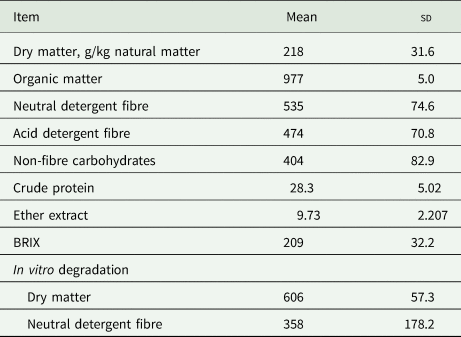
Five sugarcane cultivars (RB 985476, RB 975201, RB 975952, RB 935744, and RB 975242) plots were harvested at 5-cm height to produce eight silos (2 per treatment) from every cultivar. Plants were chopped in a stationary hammer mill (TRF300®, Trapp, Jaguará do Sul, Brazil). One sugarcane sample of each cultivar (Table 1; n = 5) was collected for chemical analysis and degradation assay. Brix was determined according to the refractometric method (# 990.35, AOAC, 2000). Cultivars were defined as blocks to allow inference in the sugarcane population (Kononoff, Reference Kononoff2020). Two experimental units from the same block in each treatment were defined by the ensiling period (morning and afternoon).
Chemical composition and in vitro degradation of sugarcane before the ensiling (n = 5; g/kg DM, unless stated)

Silos were prepared with 5 kg of oven-dried sand (80°C for 24 h) and a nylon screen in the bottom to allow effluent quantification and avoid air contamination. The sugarcane of each silo was weighed (7.80 kg) to find 650 kg/m3 of density. Individual treatment was applied and manually mixed to sugarcane. Distilled water (50 ml per silo) was used to permit spray to apply of microbial inoculants. Control and CHI-silos received the same water volume to obtain the placebo effect. Silos were weighed, before and after fill and sealing, using a 5-g sensitivity scale (Mettler Toledo, Barueri, Brazil). Silos were stored for 90 days at room temperature, without sun and rain contact. The ambient temperature averaged 22.0°C (ranging from 9.9 to 36.6°C) during the storage period. Silos' weight was recorded at 15, 25, 35, 45, 55, 65, 74, and 90 days after the ensiling to evaluate gas losses through the ensiling process. After the storage period, silos were opened. The topmost and the bottom layers (5-cm) were discarded, and silage was homogenized for sampling. One sample (~ 500 g) was used to obtain silage fluid using a hydraulic press (PHE-45®, Engehidro, Piracicaba, Brazil). Silage pH was immediately recorded using a benchtop potentiometer (LUCA210®, Lucadema, Sao José do Rio Preto, Brazil) and the fluid was frozen for fermentation profile evaluation. Another sample (~500 g) was collected, dried in a forced-air oven for 72 h at 60°C, and ground in a knives mill (SL-31, Solab Científica, Piracicaba, Brazil), using a 2-mm and 1-mm sieve for in vitro assay and chemical analysis, respectively. Thus, another sample (3 kg) was moved back to PVC tubes and stored for 144 h in a controlled temperature room (21.3 ± 1.24°C; mean ± sd) without compaction. Silage pH was recorded every 24 h after water solubilization [10 g in 100 ml of distilled water (Cherney and Cherney, Reference Cherney, Cherney, Buxton D and Muck R2003)], using a benchtop potentiometer, as previously described. The temperature was evaluated every 8 h using spit thermometers (K29-5030®, Kasvi Produtos Laboratoriais, Pinhais, Brazil). The aerobic stability period was defined as the time when the silos temperature remained up to 2°C higher than the environment (Ranjit and Kung, Reference Ranjit and Kung2000).
Chemical analysis
Silage fluid was thawed at room temperature and centrifuged at 500 × g for 15 min. Ammonia-nitrogen (NH3-N) was analysed using the Kjeldahl method (984.13; AOAC, 2000) without sample digestion. The fluid lactic acid concentration was analysed according to Pryce (Reference Pryce1969), using the spectrophotometric method. Other organic acids (acetic, propionic, butyric, valeric, iso-valeric, and isobutyric acids) and ethanol concentrations were evaluated using the chromatographic method. The sample (1.8 ml) was acidified using ortho-phosphoric acid (0.2 ml). A gas chromatography (GC-2010 Plus chromatograph, Shimadzu, Barueri, Brazil) equipped with an auto-sampler (AOC-20i), a capillary column (Stabilwax-DA™, 30 m, 0.25 mm i.d., 0,25 μm df, Restek©), and a flame ionization detector was used. The sample (1 μl) was injected using a 40:1 split ratio, using He as carrier gas (42 m/s of linear velocity). Injector temperature was 250°C and detector temperature was 300°C. The following standards were used to calibrate the chromatographic method: WSFA-2 (Ref. 47056, Supelco©) and ethanol (Ref. 459828, Sigma-Aldrich©).
Chemical analyses were performed using 1-mm processed samples. It was analysed DM (method 950.15), crude protein (CP, N × 6.25, Kjeldahl method 984.13), ether extract (EE, method 920.39), and organic matter (OM = 1000- crude ash; method 942.05) according to AOAC (2000). Neutral detergent fibre and acid detergent fibre (ADF) were determined according to Van Soest et al. (Reference Van Soest, Robertson and Lewis1991). Non-fibre carbohydrate (NFC) was calculated as NFC = 1000 − (NDF + CP + EE + ash). Silage protein fractions were analysed using methods described by Licitra et al. (Reference Licitra, Hernandez and Van Soest1996). It was accessed non-protein-N (A-fraction) using trichloroacetic acid, acid-detergent insoluble-N (fraction C), and neutral-detergent insoluble-N (NDIN). The B3 fraction was obtained by NDIN and C-fraction difference. The B1 plus B2 fractions were obtained by the difference between the total N and A fraction plus NDIN.
In vitro assay
DM and NDF in vitro degradation were analysed according to Holden (Reference Holden1999) technique. 2-mm processed samples were placed into non-woven fabric bags (100 g/m2; Casali et al., Reference Casali, Detmann, Valadares Filho, Pereira, Henriques, Freitas and Paulino2008). The internal dimension of the bags was 5 × 5 cm and the sample weight was set at less than 20 mg DM/cm2 (Nocek, Reference Nocek1988). Bags (triplicates per sample) were incubated for 48 h at 39°C in an in vitro incubator (NL162®, New Lab, Piracicaba, Brazil). Each incubator vial received 2.0 l of ruminal inoculum [1.6 l of McDougall (Reference McDougall1948) buffer and 0.4 l of fresh ruminal fluid]. Ruminal fluid was sampled from two Holstein heifers (500 kg of body weight) maintained in a Megathyrsus maximus pasture with no concentrate supplementation. After incubation, bags were washed in running tap water, dried at 55°C for 72 h and at 105°C for two hours to assess undigestible DM (Detmann et al., Reference Detmann, Souza MA, Valadares Filho, Queiroz, Berchielli, Saliba, Cabral, Pina, Ladeira and Azevedo2012), and sample NDF content was analysed as previously described.
Calculations
Gas losses (GL; Eqn 1), effluent production (EP; Eqn 2), and DM recovery (DMR; Eqn 3) were analysed as follows (Jobim et al., Reference Jobim, Nussio, Reis and Schmidt2007):

where WSW is the whole silo weight, en and op stands for weight at ensiling and at opening, respectively; and EDM is the ensiled DM. Gas losses through the ensiling process were calculated using the same equation and considering every partial weight as WSWop.

where ESW is the empty silo weight (containing sand). DM recovery was obtained by the ratio between opening DM (ODM) and ensiling DM, as following:

Statistical analysis
Statistical analysis was performed using PROC MIXED of SAS (version 9.4, SAS Inst. Inc., Cary, NC, USA), and the following model:

with
-
$s_j\approx N( {0, \;\;\sigma_s^2 } )$
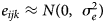
 and $e_{ijk}\approx N( {0, \;\;\sigma_e^2 } )$; where:
-
Y ijk is the observed value of response variable (n = 40);
-
μ is the general mean;
-
T i is the fixed effect of treatment (i = 1 to 4);
-
s j is the random effect of sugarcane cultivar (j = 1 to 5); e ijk is the random experimental error; N stands for Gaussian distribution;
-
$\sigma _s^{\,2}$
and -
$\sigma _e^{\,2}$
are variances associated with sugarcane cultivar and experimental error, respectively.



Silage pH and temperature after aerobic exposure were evaluated as repeated measures, using the following model:

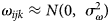
with $s_j\approx N( {0, \;\;\sigma_s^2 } )$ , $\omega _{ijk}\approx N( {0, \;\;\sigma_\omega^2 } )$
 , and e ijkl ≈ MVN(0, R) where: Y ijkl is the observed value response variable; μ is the general mean; μ, T i, s j, N, and $\sigma _s^2$
 were previously described; ω ijk is the error associated with experimental units (silos); H l is the fixed effect of time/hours after aerobic exposure (l = 1 to 18 for silage temperature; and 1 to 6 for silage pH); T × H il is the fixed interaction between treatment and time and time effects; e ijkl is the experimental error; $\sigma _\omega ^2$
 is the variance associated with experimental units (silos) error; MVN stands for multivariance normal distribution; R is a variance and covariance matrix due to repeated measures. Matrix (CS, CSH, AR, ARH, TOEP, TOEPH, FA, UN, ANTE) were evaluated using the Bayesian method. For all analyses, additives effects were decomposed using the Fisher's protected means test. Significance was declared at P ≤ 0.05.
Results
Fermentative profile
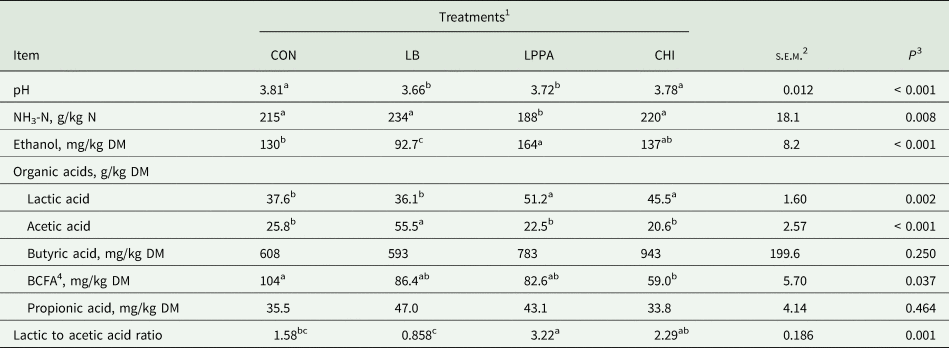
Microbial inoculation of SS reduced (P ≤ 0.05) silage pH relative to CON and CHI treatment (Table 2). Additionally, LPPA inoculation decreased (P ≤ 0.05) NH3-N and LB treatment decreased (P ≤ 0.05) ethanol concentration in relation to other treatments. Chitosan and LPPA-treated silos showed higher contents than CON and LB-treated ones, whereas LB increased (P ≤ 0.05) acetic acid silage concentration compared to other treatments. Therefore, the lowest lactic to acetic concentration was observed in LB silos, and the highest ratio was observed in LPPA-silos. Additionally, CHI showed lower (P ≤ 0.05) branched-chain fatty acids (BCFA) concentration than CON.
Silage fermentation profile of sugarcane silage treated with microbial inoculants and chitosan
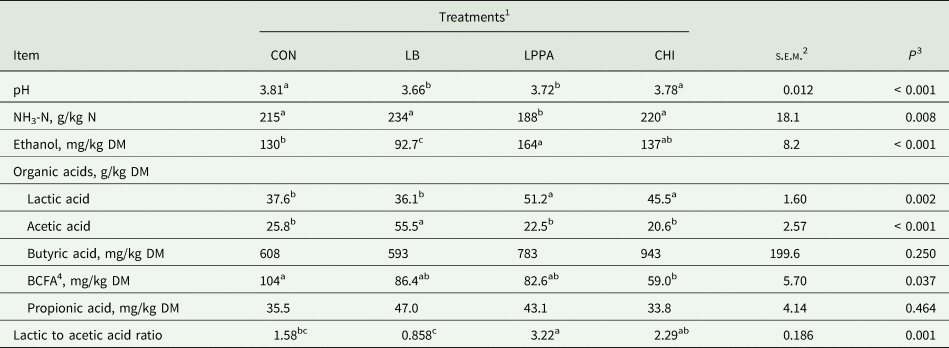
a−cFisher means test (LSD) at 5% of probability.
1Control (CON): SS with no additive; LB: SS with 5.0 × 10⁵ CFU of Lactobacillus buchneri (NCIM 40788)/g of fresh matter; LPPA: SS with 1.6 × 10⁵ CFU of Lactobacillus plantarum and 1.6 × 10⁵ CFU of Pediococcus acidilactici/g of fresh matter; and Chitosan (CHI): SS ensiled with 6 g/kg DM of chitosan.
2Standard error of mean;
3Probability of treatment effect;
4Branched-chain fatty acids.
Fermentative losses, DM recovery, and chemical composition
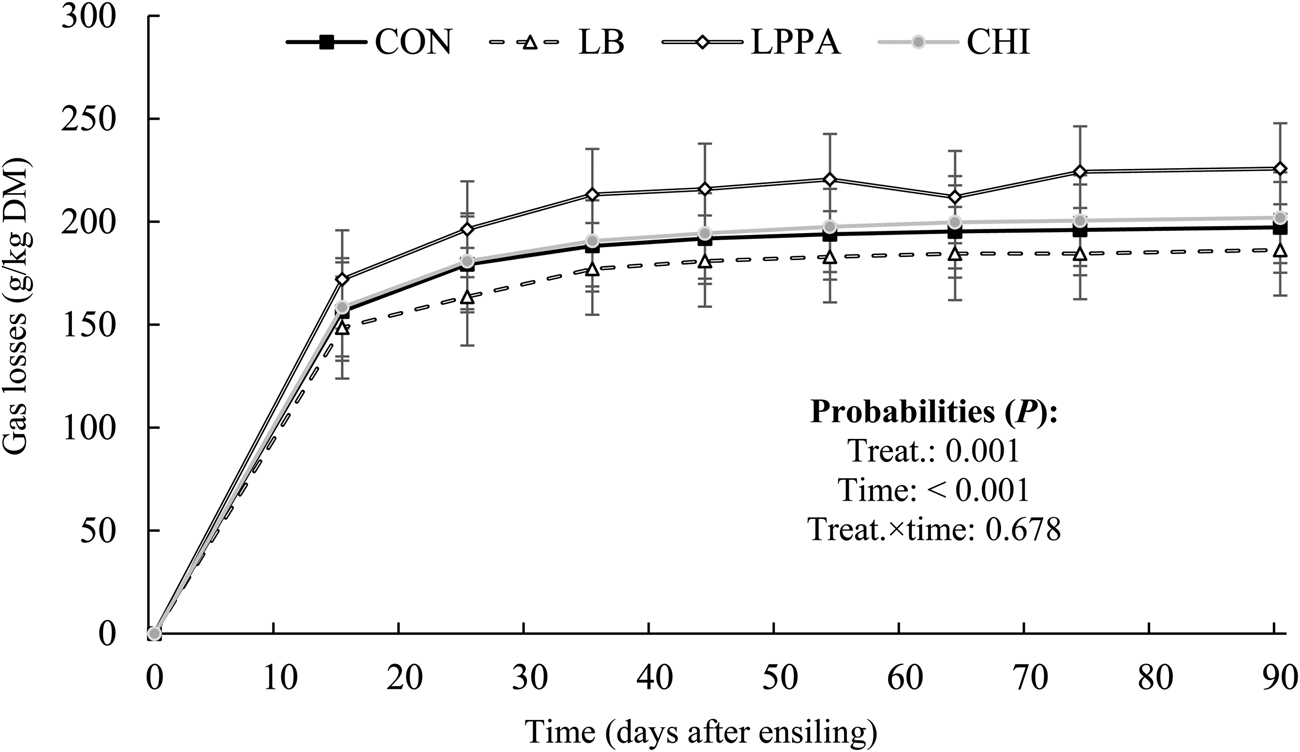
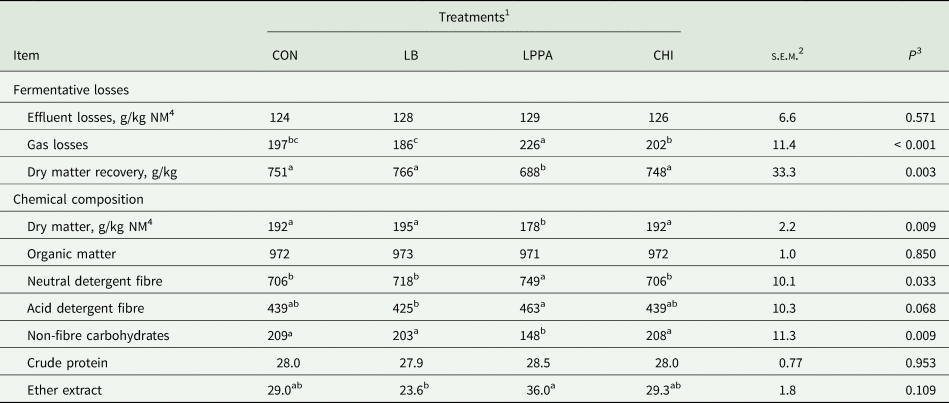
There was no treatment effect (P = 0.571) on effluent losses (Table 3). However, LPPA-silos had higher (P ≤ 0.05) gas losses (Fig. 1) and lower (P ≤ 0.05) DM recovery than silos of other treatments. LB reduced (P ≤ 0.05) gas losses compared to CHI, but both treatments had similar (P > 0.05) DM recovery. The LPPA-treatment reduced (P ≤ 0.05) DM and NFC, whereas increased (P ≤ 0.05) NDF silage concentration compared to other treatments. Evaluating microbial inoculated silos, LB decreased (P ≤ 0.05) ADF and EE silage content relative to LPPA.
Gas losses through the ensiling process of sugarcane silage treated with microbial inoculants and chitosan. 1Control (CON): SS with no additive; LB: SS with 5.0 × 10⁵ CFU of Lactobacillus buchneri (NCIM 40788)/g of fresh matter; LPPA: SS with 1.6 × 10⁵ CFU of Lactobacillus plantarum and 1.6 × 10⁵ CFU of Pediococcus acidilactici/g of fresh matter; and Chitosan (CHI): SS ensiled with 6 g/kg DM of chitosan. 2Standard error of mean; 3Probability of treatment effect.

Fermentative losses, dry matter recovery, and chemical composition of sugarcane silage treated with microbial inoculants and chitosan (g/kg DM, unless stated)

a−bFisher means test (LSD) at 5% of probability.
1Control (CON): SS with no additive; LB: SS with 5.0 × 10⁵ CFU of Lactobacillus buchneri (NCIM 40788)/g of fresh matter; LPPA: SS with 1.6 × 10⁵ CFU of Lactobacillus plantarum and 1.6 × 10⁵ CFU of Pediococcus acidilactici/g of fresh matter; and Chitosan (CHI): SS ensiled with 6 g/kg DM of chitosan.
2Standard error of mean.
3Probability of treatment effect.
4Natural matter.
In vitro degradation and protein fractions
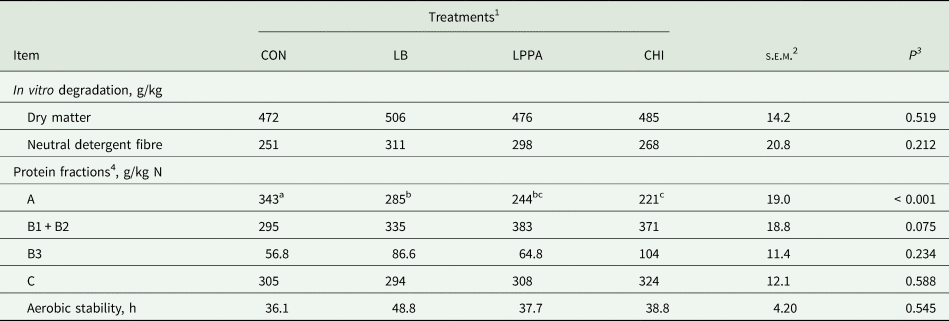
There were no treatment effects (P ≥ 0.212) on in vitro degradation of DM and NDF (Table 4). In addition, treatments did not affect (P ≥ 0.075) B1 + B2, B3, and C fraction of protein. However, CON had a higher (P ≤ 0.05) A protein fraction than other treatments, and CHI showed a lower (P ≤ 0.05) A protein fraction compared to LB.
In vitro degradation, protein fractions, and time of aerobic stability of sugarcane silage treated with microbial inoculants and chitosan

a−bFisher means test (LSD) at 5% of probability.
1Control (CON): SS with no additive; LB: SS with 5.0 × 10⁵ CFU of Lactobacillus buchneri (NCIM 40788)/g of fresh matter; LPPA: SS with 1.6 × 10⁵ CFU of Lactobacillus plantarum and 1.6 × 10⁵ CFU of Pediococcus acidilactici/g of fresh matter; and Chitosan (CHI): SS ensiled with 6 g/kg DM of chitosan.
2Standard error of mean.
3Probability of treatment effect.
4Protein fractions: A: non-protein nitrogen; B: available protein, where B3 is neutral-detergent insoluble N and B1 + B2 is neutral detergent soluble N; C is unavailable protein.
Aerobic stability
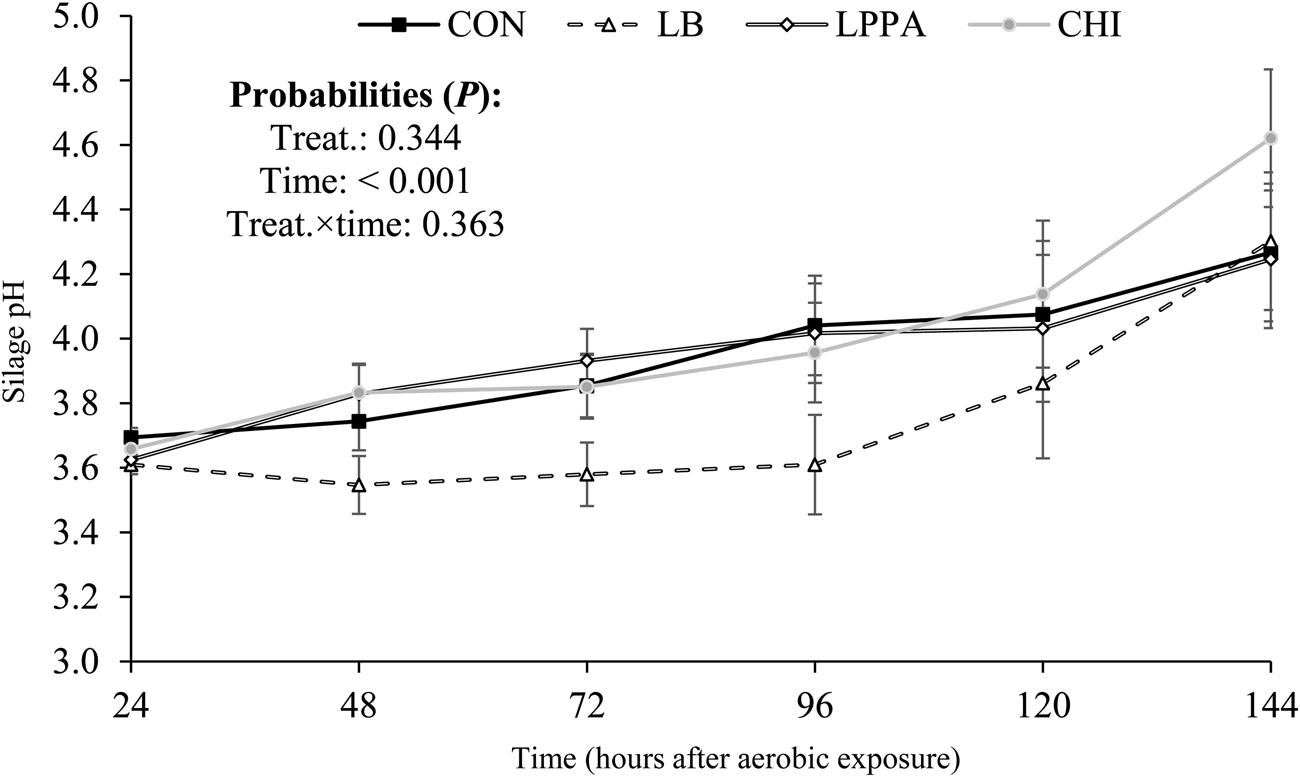
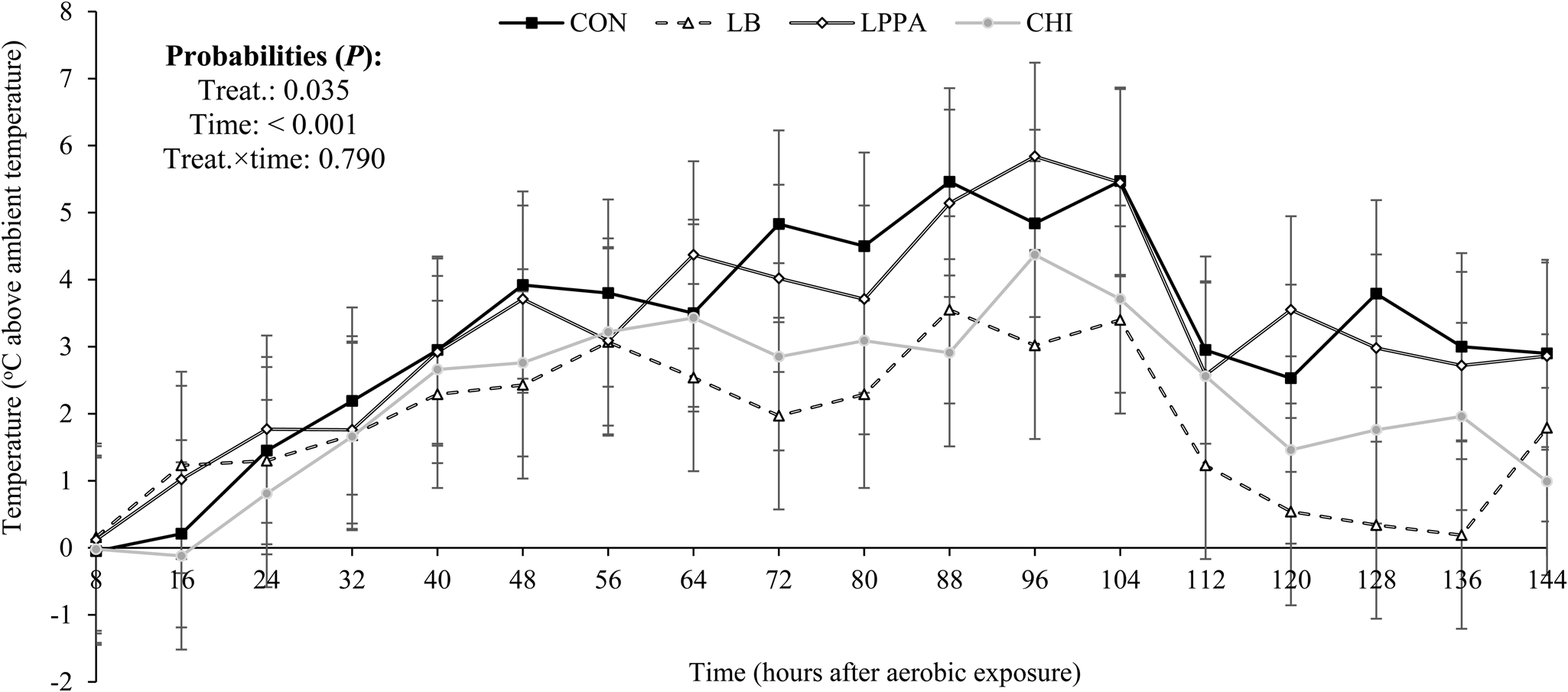
Treatments had no effect (P = 0.344) on silage pH after aerobic stability, regardless (P = 0.363) of the time of evaluation (Fig. 2). Similarly, treatments did not affect (P = 0.545) the period of aerobic stability (Table 4), and there was no treatments and time interaction effect (P = 0.790) on temperature after aerobic exposure. However, in general, LB decreased (P ≤ 0.05) silage temperature compared to CON and LPPA treatments (Fig. 3). Besides, CON-silos showed higher (P ≤ 0.05) temperatures after aerobic exposure than CHI-silos.
pH after aerobic exposure of sugarcane silage treated with microbial inoculants and chitosan. a−bFisher means test (LSD) at 5% of probability. 1Control (CON): SS with no additive; LB: SS with 5.0 × 10⁵ CFU of Lactobacillus buchneri (NCIM 40788)/g of fresh matter; LPPA: SS with 1.6 × 10⁵ CFU of Lactobacillus plantarum and 1.6 × 10⁵ CFU of Pediococcus acidilactici/g of fresh matter; and Chitosan (CHI): SS ensiled with 6 g/kg DM of chitosan. 2Standard error of mean; 3Probability of treatment effect.

Temperature after aerobic exposure of sugarcane silage treated with microbial inoculants and chitosan. Means: CON: 3.37a; LB: 1.95c; LPPA: 3.24ab; and CHI: 2.26bc. a−bFisher means test (LSD) at 5% of probability. 1Control (CON): SS with no additive; LB: SS with 5.0 × 10⁵ CFU of Lactobacillus buchneri (NCIM 40788)/g of fresh matter; LPPA: SS with 1.6 × 10⁵ CFU of Lactobacillus plantarum and 1.6 × 10⁵ CFU of Pediococcus acidilactici/g of fresh matter; and Chitosan (CHI): SS ensiled with 6 g/kg DM of chitosan. 2Standard error of mean; 3Probability of treatment effect.

Discussion
As hypothesized, LB promoted heterolactic fermentation, reduced fermentation losses, and decreased silage temperature of SS after aerobic exposure. Although chitosan also had decreased temperature after aerobic exposure and improved DM recovery compared to LPPA, it had lower effects than LB on the SS fermentation profile. LPPA-inoculation increased gas losses and comprised DM recovery and carbohydrates composition compared to control.
In the present study, SS inoculation (LB and LPPA) reduced silage pH compared to CON and CHI treatments. Reduced silage pH in LPPA-silages occurred because homofermentative (or facultative heterofermentative) LAB promote lactic acid production from water-soluble carbohydrates and reduce silage pH (Ávila et al., Reference Ávila, Carvalho, Pinto, Duarte and Schwan2014; dos Santos et al., Reference dos Santos, do Nascimento, Magalhães, Silva, Silva, Santana and Soares2015), once lactic acid has lower pKa than other organic acids (Moon, Reference Moon1983; Gandra et al., Reference Gandra, Oliveira, Takiya, Goes, Paiva, Oliveira, Gandra, Orbach and Haraki2016). Reduced silage pH observed in LB inoculated silages is a non-expected result. Arriola et al. (Reference Arriola, Oliveira, Jiang, Kim, Silva, Kim, Amaro, Ogunade, Sultana, Cervantes, Ferraretto, Vyas and Adesogan2021) reported that a high inoculation rate of LB could reduce silage pH. However, the exact action mechanism is not clear. Previous studies observed an increase in the pH of SS when chitosan was added during the ensiling (Gandra et al., Reference Gandra, Oliveira, Takiya, Goes, Paiva, Oliveira, Gandra, Orbach and Haraki2016; Del Valle et al., Reference Del Valle, Zenatti, Antonio, Campana, Gandra, Zilio, Mattos and Morais2018). This effect had been associated with the antimicrobial effect of chitosan and the absence of chitosan effect on silage pH seems associated with slight effects observed on other evaluated variables.
The use of LB reduced the lactic to acetic acid ratio compared to other treatments. LB-inoculated silages typically contain more acetate and less lactate than untreated silages because LB converts lactate to acetate and 1,2-propanediol during silage fermentation (Oude-Elferink et al., Reference Oude-Elferink, Krooneman, Gottschal, Spoelstra, Faber and Driehuis2001). Metanalytic studies have reported 30.8% (Rabelo et al., Reference Rabelo, Härter, Ávila and Reis2019) and 61.8% (Arriola et al., Reference Arriola, Oliveira, Jiang, Kim, Silva, Kim, Amaro, Ogunade, Sultana, Cervantes, Ferraretto, Vyas and Adesogan2021) positive effects of LB treatment on acetic acid silage concentration. In the present study, LB increased (29.7 g/kg or 115%) acetic acid concentration, compared to CON treatment. On the other hand, LPPA and CHI had higher lactic acid concentrations relative to other treatments in the current study. The increased lactic acid concentration in LPPA-silages is a consequence of the lower production of other organic acids during the fermentation process (Oliveira et al., Reference Oliveira, Weinberg, Ogunade, Cervantes, Arriola, Jiang, Kim, Li, Gonçalves, Vyas and Adesogan2017). Increased lactic acid concentration observed in CHI-treated silages has not been observed in previous studies of our research group (Del Valle et al., Reference Del Valle, Zenatti, Antonio, Campana, Gandra, Zilio, Mattos and Morais2018, Reference Del Valle, Antonio, Zilio, Dias, Gandra, Castro, Campana and Morais2020; de Morais et al., Reference de Morais, Cantoia Júnior, Garcia, Capucho, Campana, Gandra, Ghizzi and Del Valle2021). Only Gandra et al. (Reference Gandra, Oliveira, Takiya, Goes, Paiva, Oliveira, Gandra, Orbach and Haraki2016) observed increased lactic acid concentration in CHI-treated silage. This effect was associated with increased LAB count.
Acetic acid has an antifungal effect (Moon, Reference Moon1983) and can decrease yeast activity after aerobic exposure (Kleinschmit and Kung, Reference Kleinschmit and Kung2006). This effect seems to reflect in numerical lower silage pH and lower temperature observed in LB-silos compared to CON and LPPA-silos, regardless of evaluated time. Arriola et al. (Reference Arriola, Oliveira, Jiang, Kim, Silva, Kim, Amaro, Ogunade, Sultana, Cervantes, Ferraretto, Vyas and Adesogan2021) reported a 73.8% increase in the time of aerobic stability using LB inoculation. However, there was no treatment effect on the aerobic stability period, in the present study. The LB had 12.7 h (35.2%) more aerobic stability, and LB significantly decreased average temperature after aerobic exposure relative to CON. In addition, no difference was observed between CHI and LB in silage pH and temperature after aerobic exposure. The positive effect of chitosan on aerobic stability has been associated with direct inhibition of yeast and mould after air exposure (Del Valle et al., Reference Del Valle, Zenatti, Antonio, Campana, Gandra, Zilio, Mattos and Morais2018, Reference Del Valle, Antonio, Zilio, Dias, Gandra, Castro, Campana and Morais2020). Chitosan can suppress fungal sporulation and spore germination (Hernandez-Lauzardo et al., Reference Hernández-Lauzardo, Del Valle and Guerra-Sánchez2011), especially in acid environmental conditions.
Lactobacillus plantarum increase by 43.8% the concentration of ethanol in SS, resulting in 9.6% increased DM losses (Rabelo et al., Reference Rabelo, Härter, Ávila and Reis2019). In our experiment, LPPA reduced DM recovery and increased gas losses compared to other treatments, similar to Rabelo et al. (2018). The LPPA-silos showed + 26.2%, + 14.7%, and −8.39% effects on ethanol concentration, gas losses, and DM recovery, respectively. As LPPA increased fermentation losses, it reduced DM and increased NDF silage content compared to other treatments. These results can be explained by excessive growth of yeast under anaerobic conditions, leading to DM losses due to two moles of ethanol and CO2 production for each mole of fermented glucose (McDonald et al., Reference McDonald, Henderson and Heron1991).
Besides decreased DM and increased NDF content, LPPA showed higher EE and ADF concentrations and lower NFC content. These results are assigned with poorly preserved and low nutritive silage. Fermentation losses of the most digestible fraction of silage (Pedroso et al., Reference Pedroso, Nussio, Paziani, Loures, Igarasi, Coelho, Packer, Horii and Gomes2005) result in a higher concentration of low digestible fraction of ensiled material. However, treatment did not affect DM and NDF in vitro degradation. Neutral detergent soluble fraction is more digestible than NDF. Although LPPA has increased by 5.5% PDF content relative to other treatments, higher variance naturally observed in in vitro assay resulted in no statistical difference among treatments, even with higher numerical value observed in LB-silage.
Analysing the protein composition of silages, we observed two main issues: (I) LPPA reduced NH3-N content relative to other treatments, and (II) CHI showed lower protein A-fraction than CON and LB. It is essential to highlight that the CP content of sugarcane is low (28.1 g/kg DM in the present study) and treatment effects on protein composition show limited impact on the nutritional value of silages and animals' performance. Rabelo et al. (Reference Rabelo, Härter, Ávila and Reis2019) observed no effect of L. buchneri and L. plantarum on the NH3-N concentration of SS. On the other hand, Del Valle et al. (Reference Del Valle, Antonio, Zilio, Dias, Gandra, Castro, Campana and Morais2020) observed a linear positive effect of CHI on silage NH3-N content. This effect was associated with CHI conversion to soluble protonated form when environmental pH is below that of CHI pKa (6.3) (Goy et al., Reference Goy, Britto and Assis2009). Therefore, chitosan N was quantified as NH3-N. However, during protein precipitation analysis, CHI is mainly retained during filtration. Consequently, the A-fraction (soluble) of protein was underestimated. The CHI-treated silos showed a lower A-fraction of protein and higher NH3-N concentration relative to LPPA-treated ones. In addition, CHI-treated silos showed the lowest BCFA concentration. This result is a consequence of reduced protein degradation once silage BCFA are produced mainly by degradation of branched-chain amino acids (Yang, Reference Yang2005).
Previous studies have reported positive effects of CHI on chemical composition and in vitro degradation (Gandra et al., Reference Gandra, Oliveira, Takiya, Goes, Paiva, Oliveira, Gandra, Orbach and Haraki2016; Del Valle et al., Reference Del Valle, Zenatti, Antonio, Campana, Gandra, Zilio, Mattos and Morais2018, Reference Del Valle, Antonio, Zilio, Dias, Gandra, Castro, Campana and Morais2020). However, CHI did not affect these variables in the present study. These studies reported the use of different CHI specifications and have also reported higher effects on silage fermentation (i.e. reduced ethanol content) and decreased fermentation losses, supporting positive results observed on silage nutritional value.
Conclusion
Although treatments did not affect in vitro NDF and DM degradation and silage pH after aerobic exposure, LPPA promotes homolactic fermentation and reduces DM recovery. The LB decreased SS temperature after aerobic exposure, being a more recommended additive to sugarcane ensiling than other additives evaluated in the present study.
Financial support
The authors appreciate the São Paulo Research Foundation (FAPESP, Brazil) for financial support (2017/15457-7).
Conflict of interest
The authors declare that are no conflicts of interest to the current manuscript.
Ethical standards
Procedures of the present study were previously approved by the UFSCar Ethics Committee (Approval number 1395120219).
Author contributions
TADV, MC, and JPGM conceived and designed the study. MC, NRP, TMG, and EC conducted data gathering. TADV performed statistical analyses. TADV and JACO wrote the article. TADV, JACO and JPGM critically revised the article.