Introduction
Nicotine dependence (ND) is a complex, multi-dimensional phenotype influenced by both genetic and environmental factors. Although the role of genetics in ND has been well established in twin and family studies, heritability estimates from these studies vary substantially based on the particular ND-related phenotype measured. Heritability estimates across studies examining ND phenotypes, as typically defined by the Diagnostic and Statistical Manual of Mental Disorders (DSM), third edition, revised (DSM-III-R; American Psychiatric Association, 1987) and DSM-IV (American Psychiatric Association, 1994) or Fagerström Test for Nicotine Dependence (FTND; Heatherton et al. Reference Heatherton, Kozlowski, Frecker, Rickert and Robinson1989) criteria, range from 31 to 60% (True et al. Reference True, Xian, Scherrer, Madden, Bucholz, Heath, Eisen, Lyons, Goldberg and Tsuang1999; McGue et al. Reference McGue, Elkins and Iacono2000; Lessov et al. Reference Lessov, Martin, Statham, Todorov, Slutske, Bucholz, Heath and Madden2004; Pergadia et al. Reference Pergadia, Heath, Martin and Madden2006b ). More discrete ND measures, such as quantity of cigarettes smoked and heaviness of smoking, have been shown to be significantly heritable, with estimates of heritability ranging from 45 to 86% for number of cigarettes per day (CPD; Kaprio et al. Reference Kaprio, Koskenvuo and Sarna1981; Swan et al. Reference Swan, Carmelli, Rosenman, Fabsitz and Christian1990; Hettema et al. Reference Hettema, Corey and Kendler1999; Koopmans et al. Reference Koopmans, Slutske, Heath, Neale and Boomsma1999; Lessov et al. Reference Lessov, Martin, Statham, Todorov, Slutske, Bucholz, Heath and Madden2004; Broms et al. Reference Broms, Silventoinen, Madden, Heath and Kaprio2006), 46 to 49% for heavy smoking (Swan et al. Reference Swan, Carmelli and Cardon1997; Pergadia et al. Reference Pergadia, Heath, Agrawal, Bucholz, Martin and Madden2006a ), and 59 to 71% for the Heaviness of Smoking Index (HSI; Heatherton et al. Reference Heatherton, Kozlowski, Frecker, Rickert and Robinson1989), which comprises two of the seven FTND items – time to first cigarette in the morning and number of CPD (Lessov et al. Reference Lessov, Martin, Statham, Todorov, Slutske, Bucholz, Heath and Madden2004; Pergadia et al. Reference Pergadia, Heath, Martin and Madden2006b ).
‘Gold standard’ measures of ND are known to be multidimensional in their psychometric properties. For example, scales such as the FTND and scales comprising DSM-IV items actually have modest internal consistencies (scores on the items are not highly correlated with one another) (Piper et al. Reference Piper, McCarthy and Baker2006). There is also strong evidence that the most commonly administered dependence scales (e.g. the FTND and the DSM-IV criteria) are not highly correlated with each other (Breslau & Johnson, Reference Breslau and Johnson2000; Moolchan et al. Reference Moolchan, Radzius, Epstein, Uhl, Gorelick, Cadet and Henningfield2002; Piper et al. Reference Piper, McCarthy and Baker2006). Moolchan et al. (Reference Moolchan, Radzius, Epstein, Uhl, Gorelick, Cadet and Henningfield2002) found that the κ estimate of concordance was only 0.2, not much better than that expected by chance alone. This finding has been replicated (Kandel et al. Reference Kandel, Schaffran, Griesler, Samuolis, Davies and Galanti2005) and it is largely accepted that the two measures, although both claiming to be assessing ND, are, in fact, assessing two different aspects of ND and potentially two subsets of smokers. The DSM-based criteria appear to be broader, assessing the physiological symptoms of ND (tolerance and withdrawal), as well as a larger behavioral pattern typical of dependent use (e.g. continued use despite problems) and psychological aspects of dependence (e.g. impaired control over use; Hughes, Reference Hughes2003). The FTND appears to have a narrower focus that emphasizes the behavioral components of dependence and some physiological components related to tolerance and withdrawal (e.g. time to first cigarette) and is more closely related to behavioral (Moolchan et al. Reference Moolchan, Radzius, Epstein, Uhl, Gorelick, Cadet and Henningfield2002) and biological (Payne et al. Reference Payne, Smith, McCracken, McSherry and Antony1994) indices of smoking, but less to psychological symptoms of dependence (Dijkstra & Tromp, Reference Dijkstra and Tromp2002). Another consideration in ND assessment is that, although dependence measures often show lower internal consistency and minimal relations with one another (Hughes et al. Reference Hughes, Oliveto, Riggs, Kenny, Liguori, Pillitteri and MacLaughlin2004; Piper et al. Reference Piper, McCarthy and Baker2006), factor analyses show that such measures often load highly onto common factors. Even when factor analyses suggest multiple factors, the factors are highly inter-correlated (Lessov et al. Reference Lessov, Martin, Statham, Todorov, Slutske, Bucholz, Heath and Madden2004; Piper et al. Reference Piper, Piasecki, Federman, Bolt, Smith, Fiore and Baker2004; Shiffman et al. Reference Shiffman, Waters and Hickcox2004). Taken together, research suggests that ND symptoms and features are best accounted for by a multidimensional model that includes multiple, correlated ND features such as withdrawal severity, smoking heaviness, time spent smoking, tolerance and potentially other aspects (Pomerleau et al. Reference Pomerleau, Collins, Shiffman and Pomerleau1993; Hudmon et al. Reference Hudmon, Marks, Pomerleau, Bolt, Brigham and Swan2003; Baker et al. Reference Baker, Weiss, Bolt, von Niederhausern, Fiore, Dunn, Piper, Matsunami, Smith, Coon, McMahon, Scholand, Singh, Hoidal, Kim, Leppert and Cannon2009; National Cancer Institute, 2009).
The heterogeneity and lack of agreement of ‘gold standard’ dependence measures, such as the DSM and the FTND, can be viewed as a useful opportunity for genetic research. Accepting the hypothesis that ND is multi-dimensional allows us to parse and distill the ND phenotype from a genetics perspective and to examine which aspects of ND have the highest genetic loading. For example, a study by Lessov et al. (Reference Lessov, Martin, Statham, Todorov, Slutske, Bucholz, Heath and Madden2004) examined the relative contribution of genetic and environmental influences to the variance of individual ND criteria as well as a ND diagnosis defined by the DSM-IV and the HSI. The results showed substantial heritability across genders for DSM-IV nicotine tolerance (73%), withdrawal (53%), smoking more than intended (62%), and both HSI items – time to first cigarette in the morning (68%) and number of CPD (70%); estimates for ‘difficulty in quitting smoking’ varied across genders (68% in females, 54% in males). Relatively moderate heritability has been observed for DSM-IV items: spending a great deal of time smoking (45%), smoking despite physical or psychological problems (39%), and giving up important activities to smoke (26%). These results suggest that the DSM-IV criteria of tolerance, withdrawal, and difficulty in quitting smoking, and the HSI may be the most genetically influenced indicators of ND in adults.
Despite these substantial genetic effects derived across aspects of ND using traditional twin approaches, molecular genetic and genome-wide association studies (GWAS) have had limited success in isolating or aggregating specific causal variants and accounting for the genetic variance estimates derived from twin studies. Although several GWAS have utilized novel phenotypic definitions, such as expired carbon monoxide and smoking frequency, in order to maximize the chances of finding genetic markers for ND (Bloom et al. Reference Bloom, Hartz, Baker, Chen, Piper, Fox, Martinez, Hatsukami, Johnson, Laurie, Saccone, Goate and Bierut2014; Loukola et al. Reference Loukola, Wedenoja, Keskitalo-Vuokko, Broms, Korhonen, Ripatti, Sarin, Pitkäniemi, He, Häppölä, Heikkilä, Chou, Pergadia, Heath, Montgomery, Martin, Madden and Kaprio2014), effect sizes still typically fall between 1 and 3%. In part to address the possibility that most variants truly associated with complex traits have effect sizes too small to detect individually using GWAS, Yang et al. (Reference Yang, Lee, Goddard, Visscher, Gondro, van der Werf and Hayes2013) developed genomic-relationship-matrix restricted maximum likelihood [GREML; implemented in the Genome-wide Complex Trait Analysis (GCTA) software] that focuses on the estimation of the phenotypic variance explained by genome-wide similarity at genotyped single nucleotide polymorphisms (SNPs). Rather than testing each SNP individually, GREML decomposes the phenotypic variance into two components: (1) effects due to the additive influences of all measured autosomal SNPs (SNP heritability or h 2 SNP); and (2) the effects due to unmeasured environmental influences, random noise or the effects of genetic variants that were not measured by the genotyping array. This approach allows for an estimate of phenotypic variability explained by genome-wide SNP data. GREML has been used to estimate the additive genetic influences on DSM-III ND in one prior study, which reported an aggregate SNP heritability of 36% and suggested that common SNPs account for a relatively large proportion of genetic effects detected using traditional biometrical twin modeling approaches (Vrieze et al. Reference Vrieze, McGue, Miller, Hicks and Iacono2013). Given the multidimensional nature of ND, a critical next step is to examine the aggregate role of common SNPs on various aspects of ND, including both discrete and multidimensional ND phenotypes.
Current study
The current study aimed to identify genetic effects on multiple facets of ND, including broad ND constructs derived from ‘gold standard’ measures of ND and item-level assessments that tap more discrete, albeit core, features of ND, such as withdrawal severity, tolerance, heaviness of smoking and time spent smoking. We hypothesized that common genetic variants account for at least half of the genetic variance observed in twin/adoption studies. Further, despite phenotypic heterogeneity, we hypothesized that a common set of genetic factors would account for the genetic variances identified across the definitions. To test these hypotheses, we first used factor analysis to replicate prior work and distill our multi-faceted ND phenotype. Second, we examined genome-wide additive genetic influences on ND at the discrete-item level as well as on the observed ND factors. These measures were analysed separately to explore how the magnitude of identified additive genetic effects differed across facets of ND. Finally, we used a bivariate model to test whether these ‘gold standard’ measures of ND index the same genetic liability.
Method
Study population
The current study utilizes individuals of European ancestry (EA) who reported having ever used cigarettes (n = 2346, average age = 38.41 (s.d. = 9.58) years, males = 45%) and were part of the Study of Addiction: Genetics and Environment (SAGE). Details on the SAGE cohort are available elsewhere (National Center for Biotechnology Information, 2016). SAGE is a collection of individuals from several case–control genetic studies and was designed for the purpose of identifying genetic factors that contribute to addiction. The current study included EAs with a history of smoking tobacco-based products and who also had information on DSM-IV ND and the FTND. Participants in SAGE originate from three studies designed to study drug addiction [the Collaborative Study on the Genetics of Alcoholism (COGA), the Family Study on Cocaine Dependence (FSCD) and the Collaborative Genetic Study of Nicotine Dependence (COGEND)]. Although participants were ascertained to study alcohol, cocaine and nicotine, cases were not excluded if they endorsed criteria for dependence on other substances (e.g. cannabis, opiates, stimulants, hallucinogens); controls were required to be alcohol, cocaine or tobacco users without a history of drug dependence. Online Supplementary Table S1 summarizes the history of substance problems in the sample as well as the levels of co-morbidity of substance problems in SAGE.
Measurements
Dependent measures were DSM-IV ND and FTND symptoms gathered using the Semi-Structured Assessment for the Genetics of Alcoholism (SSAGA) (Bucholz et al. Reference Bucholz, Cadoret, Cloninger, Dinwiddie, Hesselbrock, Nurnberger, Reich, Schmidt and Schuckit1994) or modified versions used within the subsamples that comprise SAGE [i.e. the Semi-Structured Assessment of Nicotine Dependence used in the COGEND and the Semi-Structured Assessment for Cocaine Dependence used in the FSCD]. Participants were included if they had a history of ever using tobacco daily for a month or more, including smoking cigarettes, cigars or pipes, as well as using snuff/chewed tobacco. Of these individuals, 1331 met DSM-IV criteria for ND and 714 met the clinical FTND cut-off of >4; 670 individuals met ND criteria on both DSM-IV and FTND measures, consistent with prior work suggesting DSM-IV and FTND emphasize different aspects of the ND phenotype and assign diagnoses to two different subsets of smokers.
In order to assess the common and specific aspects of DSM-IV and FTND measures of ND we utilized factor analysis of the individual criteria for each measure. In doing so, we sought to construct a composite score that reflected the shared variance across DSM-IV and FTND symptoms. This was achieved by using a factor analytic approach that included both a model-building phase and a data extraction phase. In the model-building phase, we first used exploratory factor analysis (EFA) on a random subset of all smokers (n = 1180) using weighted least squares mean variance estimation to adjust for dichotomization of DSM-IV items. In addition to retaining eigenvalues greater than 1, we used scree plots and interpretability of loadings to identify the number of factors to retain. Second, we fitted two confirmatory factor analysis (CFA) models using the remaining half of the smokers (n = 1166). The first model (CFA-Model-I) was based on the observed number of factors and factor loadings from the EFA. The second model (CFA-Model-II) tested the hypothesis that there exist two separate, but correlated, underlying latent traits separately indicated by DSM-IV and FTND. The fit of the CFA models was evaluated using standard EFA/CFA fit indices, i.e. root mean square error of approximation (RMSEA; value <0.08), comparable fit index (CFI; value >0.90) and Tucker–Lewis index (TLI; >0.90) (MacCallum et al. Reference MacCallum, Browne and Sugawara1996). We compared nested models by examining model fit indices and determining significant change in CFI (CFIconstrained model – CFIunconstrained model < −0.01) (Cheung & Rensvold, Reference Cheung and Rensvold2002). In the data extraction phase, we obtained factor scores from the best-fitting CFA model(s) from the model-building phase using the entire sample (n = 2346). Factor scores from the data extraction phase were used in the genetic models described below. Standardized factor scores were used in all genetic analyses.
Analyses
GREML analyses utilized 796 125 autosomal markers that were obtained using the Illumina 1 M platform on blood samples deposited at the Rutgers University Cell and DNA Repository. SNPs had to meet the following criteria for inclusion in the study: minor allele frequency >1%, genotyping call rate ⩾99%, and a Hardy–Weinberg equilibrium p value greater than 0.0001 among subjects of European descent (Palmer et al. Reference Palmer, McGeary, Heath, Keller, Brick and Knopik2015b ). Genomic principal component analysis was used to identify and retain subjects of EA by including samples from the haplotype mapping project [HAPMAP; i.e. CEPH (Centre d'etude du polymorphisme humain), Yoruban, Han Chinese and Japanese] as ancestral reference groups in the genetic principal component analysis in the SNP & Variation Suite (Palmer et al. Reference Palmer, Brick, Nugent, Bidwell, McGeary, Knopik and Keller2015a ; Golden Helix, Inc., 2016).
GREML analyses were implemented in the GCTA software (Yang et al. Reference Yang, Benyamin, McEvoy, Gordon, Henders, Nyholt, Madden, Heath, Martin, Montgomery, Goddard and Visscher2010; Lee et al. Reference Lee, Yang, Goddard, Visscher and Wray2012). Genomic relatedness matrices (GRM) were derived for all individuals and used to describe all phenotypes. Analyses were limited to individuals who were no more related than second cousins (i.e. GRM cut-off of 0.05 was imposed) so that estimates are not confounded with shared environmental effects and/or causal variants that are not tagged by the SNPs but captured by pedigree information. Reported estimates of variance captured by the SNPs (for DSM-IV symptoms) are transformed to that on the underlying scale using prevalence rates from cohort 2 of the Australian Twin study, which has levels of externalizing problems similar to general population samples in the USA (Lessov et al. Reference Lessov, Martin, Statham, Todorov, Slutske, Bucholz, Heath and Madden2004). Additive genetic effects (h 2 SNP) on individual FTND symptoms and the factor scores are unscaled, and will be most relevant to a population with the same distribution of liability. All analyses controlled for age, gender, study of origin, and the first five genomic principal components derived from all subjects of EA. For all GREML analyses, factor scores were standardized (mean = 0, s.d. = 1).
Results
Model-building phase – factor analysis of DSM-IV and FTND symptoms
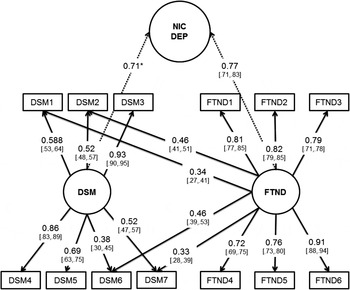
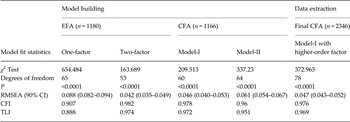
EFA (n = 1180 randomly selected smokers) suggested two latent variables (see Table 1 and Fig. 1); eigenvalues (7.301, 1.596, 0.901, 0.644, 0.523, 0.441, 0.389, 0.358, 0.290, 0.254, 0.146, 0.131 and 0.026) that accounted for 56% of the variance across all items. The observed factors each accounted for at least 27% of the variance in a single item. Based on the RMSEA, CFI, TLI and interpretability of factor loadings, the two-factor model provided the best fit for the data. The EFA results indicated that four DSM-IV symptoms (‘tolerance’, ‘withdrawal’, ‘activities foregone’ and ‘continued use despite problems’) cross-loaded (i.e. 2+ symptoms loaded at 0.300 or higher on multiple factors) on the first and second factors. The first factor (referred to as the DSM-IV factor) was indicated by all seven DSM-IV criteria. Factor 2 (referred to as the FTND factor) was indicated by the FTND items and the four cross-loading DSM-IV items. CFA (n = 1166 smokers) in the remainder of the sample indicated that the two-factor model with cross-loading items suggested by the EFA (i.e. CFA-Model-I) provided a good fit to the data with an RMSEA value of 0.046 and CFI and TFI values above 0.95 (see Table 1). We also compared the fit of the two-factor model with cross-loading items with the fit of a model with no cross-loading items (i.e. CFA-Model-II). The overall model fit of the two-factor model with no cross-loading items (CFA-Model-II) indicated that it provided a less parsimonious fit to the data when compared with the fit of CFA-Model-I, which included cross-loading items [i.e. the RMSEA increased (ΔRMSEA = 0.015) and the CFI decreased (ΔCFI = −0.018) for CFA-Model-II] (Cheung & Rensvold, Reference Cheung and Rensvold2002).
Confirmatory factor analysis (CFA) of Diagnostic and Statistical Manual of Mental Disorders, fourth edition (DSM-IV) and Fagerström Test for Nicotine Dependence (FTND) symptoms in the entire Study of Addiction: Genetics and Environment (SAGE) sample (Final-CFA-Model-I with higher-order factor). Each standardized path loading (with 95% confidence interval; CI) could not be dropped from the model without a significant loss in model fit. DSM1, Tolerance; DSM2, withdrawal; DSM3, using more than intended; DSM4, unsuccessful attempts to cut down; DSM5, great time spent using/recovering; DSM6, activities foregone; DSM7, continued use despite problems; FTND1, time to first cigarette; FTND2, difficulty refraining; FTND3, most difficult cigarette to quit; FTND4, cigarettes per day; FTND5, timing of greatest smoking frequency; FTND6, smoking while ill. Notation: * The unstandardized path loading from DSM to nicotine dependence (NIC DEP) was fixed to 1.00 in the Mplus model; thus the standardized loading presented does not have a standard error. The product of the standardized loadings on NIC DEP is equal to the phenotypic correlation between the two factors (r DSM-FTND = 0.545, 95% CI 0.50–0.60).

Model fit and loadings for two-factor EFA/CFA a

EFA, Exploratory factor analysis; CFA, confirmatory factor analysis; RMSEA, root mean square error of approximation; CI, confidence interval; CFI, comparative fit index; TLI, Tucker–Lewis index.
a The Table describes the fit indices and loadings from the EFA and CFA conducted using random, independent subsets of the full dataset, and the extraction using the full dataset. Two confirmatory factor models were fitted (Model I – based on the two-factor EFA solution, and Model II – a two-factor model that had separate factors each indicated by Diagnostic and Statistical Manual of Mental Disorders, fourth edition (DSM-IV)/Fagerström Test for Nicotine Dependence (FTND) items only.
Data extraction phase – factor scores of best-fitting models
Based on the results from the model-building phase of our approach, factor scores were extracted using the full dataset. Factor loadings in the CFA (based on CFA-Model-I from the model-building component) using the entire dataset ranged from 0.33 to 0.93 indicated that the factors captured between 10 and 80% of the variance in a given symptom (see standardized factor loadings in Fig. 1). The observed correlation between the DSM-IV and FTND factors in the full sample was 0.771 [95% confidence interval (CI) 0.712–0.831]. Given this high correlation, we fitted genetic models using a higher-order factor, ‘NIC DEP’. The higher-order factor was obtained by restructuring Final-CFA-Model-I into Final-CFA-Model-I with higher-order factor, such that ‘NIC DEP’ is indicated by the covariance between the FTND and DSM factors (see Fig. 1). Note that the fit of Final-CFA-Model-I without the higher-order factor is identical to the fit of Final-CFA-Model-I with the higher-order factor.
Variance in ND attributable to genotyped SNPs
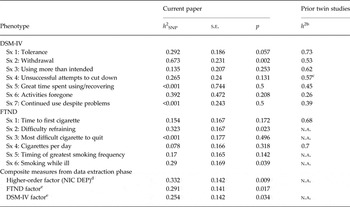
Table 2 presents the univariate additive effect of genotyped SNPs on individual DSM-IV and FTND symptoms and the NIC DEP factor extracted from CFA-Final Model-I with higher-order factor. Additive genetic effects varied from 0 to 67%. The largest effect on DSM-IV items was 67% for nicotine withdrawal. The largest significant effect amongst FTND items was 32% for ‘difficulty restraining from smoking in places where it is forbidden’. Focusing on the composite phenotype derived in the data extraction phase, our examination of additive genetic effects on the higher-order factor (‘NIC DEP’), representing the shared variance across both factors, indicated a SNP heritability of 33% (s.e. = 0.142, p = 0.009).
Proportion of variance explained by genome-wide SNPs across nicotine dependence measures a

SNP, Single nucleotide polymorphism; s.e., standard error; DSM-IV, Diagnostic and Statistical Manual of Mental Disorders, fourth edition; Sx, symptom; FTND, Fagerström Test for Nicotine Dependence; n.a., not available; NIC DEP, nicotine dependence; CFA, confirmatory factor analysis.
a The Table shows the univariate SNP heritability of DSM-IV and FTND indicators while scaling the estimates to population levels observed in Lessov et al. (Reference Lessov, Martin, Statham, Todorov, Slutske, Bucholz, Heath and Madden2004). Note that effects on composite measures have not been adjusted for variance on the underlying scale.
b Univariate twin heritability estimates from Lessov et al. (Reference Lessov, Martin, Statham, Todorov, Slutske, Bucholz, Heath and Madden2004).
c Estimates averaged across genders.
d Factor scores extracted from Final-CFA-Model-I with higher-order factor.
e Factor scores extracted from CFA-Final-Model-II.
Post-hoc analyses – examination of DSM and FTND factors without cross-loading items
To further understand the nature of the overlap between the FTND and DSM factors, genetic analyses were also conducted on separate FTND and DSM factor scores obtained from a CFA on the full dataset using the structure of CFA-Model-II from the model-building component. This allowed us to examine genetic effects and genetic covariance between the factors without them having cross-loading items. This was achieved using univariate and bivariate GREML models fitted to DSM-IV and FTND factors derived from the full data [i.e. CFA-Final-Model-II: χ2 = 680.48, degrees of freedom = 64, p < 0.0001, RMSEA = 0.064 (95% CI 0.060–0.068), CFI = 0.953, TLI = 0.943]. Presented in Table 2, additive genetic influences on the DSM-IV factor from CFA-Final-Model-II accounted for 29% (s.e. = 0.141, p = 0.017) of the variance of the factor. Likewise, additive genetic effects accounted for 25% (s.e. = 0.142, p = 0.034) of the variance of the FTND factor from CFA-Final-Model-II. The phenotypic correlation between the DSM-IV and FTND factors without cross-loading items was 0.752 (95% CI 0.71–0.79). The FTND and DSM-IV factors from CFA-Final-Model-II were highly correlated (r g-SNP = 1.00, s.e. = 0.084, p < 0.001), suggesting shared additive genetic influences on DSM-IV and FTND symptoms of ND. These findings indicated shared genetic effects across indicators of ND when reflected separately by each measure.
Discussion
This is the first study of its kind to use GREML to parse the additive genetic variance associated with ND as a multidimensional phenotype. The study also indicates the extent to which additive genetic influences on two notable indices of ND overlap. In doing so, we provide additional evidence to suggest that common genetic variance is the driving force behind the underlying liability to ND (i.e. the NIC DEP factor) as jointly measured by the DSM-IV and the FTND. We used powerful genome-wide tools to estimate the SNP heritability across multiple indices of ND in order to examine etiological and phenotypic heterogeneity. The additive effect of common SNPs for factor scores derived from our two ‘gold standard’ ND measures, the NIC DEP factor (33%), DSM-IV ND (29%) and FTND (25%), were each moderately high. In contrast, the additive effect of common SNPs for more discrete aspects of ND varied widely, ranging from 0 to 67% with the highest estimates associated with DSM-IV withdrawal (67%), DSM-IV tolerance (29%), DSM-IV difficulty quitting smoking (26%), DSM-IV foregoing other activities in order to smoke (39%), FTND difficulty refraining from smoking when it is forbidden (32%), and FTND smoking while ill (29%). First and foremost, these data reveal the utility of common SNPs to index the genetic liability to ND and build on a limited but growing body of work supporting GREML as a useful tool in studies of substance dependence and other complex traits (Vrieze et al. Reference Vrieze, McGue, Miller, Hicks and Iacono2013; Palmer et al. Reference Palmer, Brick, Nugent, Bidwell, McGeary, Knopik and Keller2015a ). In addition, these findings support the preponderance of evidence that ND is a multi-dimensional phenotype that is influenced by common genetic variants. Importantly, despite the range of the heritability estimates across DSM-IV and FTND measures, the effects attributed to common SNPs correlated highly across the DSM-IV and FTND derived factors. Thus, although phenotypic and etiological heterogeneity are present, our data demonstrate that discrete phenotypic aspects of ND share common underlying genetic risk.
Our estimates are consistent with one prior study using GREML to estimate SNP heritability for DSM-III ND diagnosis, which reported an aggregate SNP heritability of 36% in a sample of both related and unrelated individuals (Vrieze et al. Reference Vrieze, McGue, Miller, Hicks and Iacono2013). Together, these two studies have leveraged GREML to account for substantially larger genetic effects than prior genome-wide and candidate studies of smoking and ND. The effects of common SNPs appear to account for a relatively large proportion of genetic effects detected using traditional twin modeling approaches, suggesting that candidate and whole genome genetic association (including GREML) approaches focused on common SNPs will have utility for contributing to the understanding of ND genetic risk pathways. As illustrated by the present article and recent addiction studies (Vrieze et al. Reference Vrieze, McGue, Miller, Hicks and Iacono2013; Palmer et al. Reference Palmer, Brick, Nugent, Bidwell, McGeary, Knopik and Keller2015a , Reference Palmer, McGeary, Heath, Keller, Brick and Knopik b ), GREML holds unique promise for advancing the field to the extent that researchers find novel ways to parse the observed genetic variance to relevant genetic loci (either by function or prior knowledge). Likewise, the ability to examine the aggregate genetic effect allows for the explicit testing of the assumptions of GWAS. For example, Palmer et al. (Reference Palmer, McGeary, Heath, Keller, Brick and Knopik2015b ) recently confirmed the assumption of genetic homogeneity across DSM-IV indicators of alcohol dependence using genome-wide SNPs (Palmer et al. Reference Palmer, McGeary, Heath, Keller, Brick and Knopik2015b ), a question which future studies can help address for ND.
Our findings that SNP heritability estimates varied from very low to relatively high across various discrete ND measures are broadly consistent with prior work estimating heritability of item-level ND measures using traditional twin approaches. Work from Lessov et al. (Reference Lessov, Martin, Statham, Todorov, Slutske, Bucholz, Heath and Madden2004) examining genetic influences on DSM-IV criteria and two FTND items – time to first cigarette in the morning and CPD – found that additive genetic influences ranged from at least moderately (DSM-IV give up activities to smoke and DSM-IV smoking despite problems) to highly heritable (DSM-IV tolerance, DSM-IV withdrawal, FTND time to first cigarette, and FTND CPD) across the various indices. Although estimates differed across the two studies and overall tended to be higher in the Lessov biometric twin study, together findings support that genetic effects vary across ND dimensions and that withdrawal and tolerance may be the most genetically influenced indicators of ND in adults. Some of the genetic variance influencing these particular physiological ND traits is likely to be driven, at least partially, by the widely replicated genetic effects found within pharmacodynamic or pharmacokinetic genetic pathways, such as the relatively large effects found for nicotinic receptor gene variation on ND-related traits (e.g. Bloom et al. Reference Bloom, Hartz, Baker, Chen, Piper, Fox, Martinez, Hatsukami, Johnson, Laurie, Saccone, Goate and Bierut2014; Hancock et al. Reference Hancock, Reginsson, Gaddis, Chen, Saccone, Lutz, Qaiser, Sherva, Steinberg, Zink, Stacey, Glasheen, Chen, Gu, Frederiksen, Loukola, Gudbjartsson, Bruske, Landi, Bickeboller, Madden, Farrer, Kaprio, Kranzler, Gelernter, Baker, Kraft, Amos, Caporaso, Hokanson, Bierut, Thorgeirsson, Johnson and Stefansson2015). However, our estimates suggest that genetic variation due to common SNPs accounts for a much larger proportion of the variance in ND (25–33%) than has been accounted for in prior genetic association work (typically <5% with any particular gene or gene cluster). This discrepancy suggests that other genes and gene systems, beyond even those with the largest and most well-replicated effects, are also relevant to genetic models of ND.
Although prior work has supported shared genetic variance among ND phenotypes (Edwards et al. Reference Edwards, Maes, Pedersen and Kendler2011), importantly, ours is the first report to examine the correlation of genetic effects due to common SNPs across dimensions of ND. Although heritability estimates varied across ND measures, common SNP effects correlated highly across the DSM-IV and FTND factors, suggesting that common genetic risk underlies these correlated but distinct ND phenotypes. An implication of this finding is that by employing multiple phenotypes that share a known underlying risk dimension, we would improve both detection and replication of genetic association with common SNPs. The current findings suggest that, despite measurement issues in ND research, individual differences with respect to the DSM-IV and FTND symptoms are accounted for by the same set of common SNPs. While the FTND and DSM-IV clearly demonstrate differences in sensitivity to the various domains that make up the broader ND phenotype (Koob & Volkow, Reference Koob and Volkow2010), our findings of evidence for overlapping genetic effects across the two measures are indicative exclusively of common genetic substrates that are collectively a set of ND risk factors. However, they do not specifically delineate biological mechanisms/pathways (e.g. neuronal tissues and circuits) that are involved in ND. That said, our data support the presence of an underlying construct for ND and indicate that FTND and DSM-IV criteria are alternate manifestations of the set of behavioral, psychiatric and physical problems that can occur in relation to dependence on nicotine. As such, they share common risk factors and it is plausible that genetic associations from studies examining these various ND measures can be compared meaningfully.
Limitations
While the current study was able to maximize power by utilizing the largest, publicly available, and genetically informed sample on drug addiction, there are several limitations. Power analyses based on the current sample size indicated that we were well powered (over 90%) to detect heritability estimates of 0.40 or greater, which is one-half of the heritability of ND observed in twin studies. Despite the large standard errors, the observed point estimates have been shown to be consistent across sample sizes (Stanton-Geddes et al. Reference Stanton-Geddes, Yoder, Brikine, Young and Tiffin2013). Future studies with larger samples are needed to replicate these findings and to confirm the observed effects on individual symptoms of the DSM-IV and FTND scales. It should also be noted that the current findings are limited to common genetic variants; however, recent findings implicate a possible role for rare variants (Vrieze et al. Reference Vrieze, Feng, Miller, Hicks, Pankratz, Abecasis, Iacono and McGue2014; Olfson et al. Reference Olfson, Saccone, Johnson, Chen, Culverhouse, Doheny, Foltz, Fox, Gogarten, Hartz, Hetrick, Laurie, Marosy, Amin, Arnett, Barr, Bartz, Bertelsen, Borecki, Brown, Chasman, van Duijn, Feitosa, Fox, Franceschini, Franco, Grove, Guo, Hofman, Kardia, Morrison, Musani, Psaty, Rao, Reiner, Rice, Ridker, Rose, Schick, Schwander, Uitterlinden, Vojinovic, Wang, Ware, Wilson, Yao, Zhao, Breslau, Hatsukami, Stitzel, Rice, Goate and Bierut2015), suggesting the need for future whole-genome studies incorporating common and rare polymorphisms. Readers should also consider that SAGE is a selected sample of individuals (i.e. drug-addicted cases and controls). As such, these findings may not generalize to community and general population samples that might show different patterns of drug use and dependence problems. In most analyses, we utilized population-based prevalence rates to adjust the observed genetic variance on the liability scale so that our estimates of SNP heritability are generalizable to an unselected population; despite these efforts, we conservatively expect that the SNP heritability may be lower in the general (non-ascertained) population (Lee et al. Reference Lee, Yang, Goddard, Visscher and Wray2012). Future research, using larger epidemiological samples recruited for population representativeness rather than substance use, is needed to replicate the present findings. Lastly, although the SAGE study employed ‘gold standard’ ND measures (DSM-IV and FTND) in order to capture assessments that would be most generalizable across studies, discrete aspects of ND such as withdrawal severity, tolerance and difficulties with quitting were assessed with a single self-report item. To the extent these are important to the genetic etiology of multidimensional ND, more detailed and comprehensive assessments of these ND facets should be tested in future studies of the effects of common SNPs on ND. Further, additional ND-related phenotypes, such as a biological assessment of smoke exposure, would be informative, as studies have suggested that biological phenotypes like carbon monoxide levels may capture unique genetic variance to behavioral ND-related measures such as frequency of smoking (Bloom et al. Reference Bloom, Hartz, Baker, Chen, Piper, Fox, Martinez, Hatsukami, Johnson, Laurie, Saccone, Goate and Bierut2014).
Summary
In sum, our data suggest that between 26 and 33% of the variance in ‘gold standard’ ND measures is attributable to common SNPs. Further, although estimates of the additive effects of these common SNPs varied across the multidimensional ND phenotype, the genetic variance across multiple ND indicators was attributable to the same set of common SNPs, suggesting that discrete aspects of ND and subsets of dependent smokers share a common genetic etiology.
Supplementary material
For supplementary material accompanying this paper visit http://dx.doi.org/10.1017/S0033291716000453
Acknowledgements
Funding support for SAGE was provided through the National Institutes of Health (NIH) Genes, Environment, and Health Initiative (GEI) (U01HG004422). SAGE is one of the GWAS funded as part of the Gene Environment Association Studies (GENEVA) under the GEI. Assistance with phenotype harmonization and genotype cleaning, as well as with general study coordination, was provided by the GENEVA Coordinating Center (U01 HG004446). Assistance with data cleaning was provided by the National Center for Biotechnology Information. Support for the collection of datasets and samples was provided by the COGA (U10 AA008401), COGEND (P01 CA089392) and the FSCD (R01 DA013423). Funding support for genotyping, which was performed at the Johns Hopkins University Center for Inherited Disease Research, was provided by the NIH GEI (U01HG004438), the National Institute on Alcohol Abuse and Alcoholism (NIAAA), the National Institute on Drug Abuse (NIDA) and the NIH contract ‘High throughput genotyping for studying the genetic contributions to human disease’ (HHSN268200782096C). The datasets used for the analyses described in this paper were obtained from dbGaP at http://www.ncbi.nlm.nih.gov/projects/gap/cgibin/study.cgi?study_id=phs000092.v1.p1 through dbGaP accession number phs000092.v1.p1. The views expressed in this article are those of the authors and do not necessarily reflect the position or policy of the Department of Veterans Affairs.
Funding for authors of this study was provided by DA033302 (L.C.B.), DA023134 (V.S.K.) and AA021113 (R.H.C.P). NIAAA and NIDA had no role in the study design, collection, analysis or interpretation of the data, writing the manuscript, or the decision to submit the paper for publication.
Declaration of Interest
None.