Counselling parents with a fetus or newborn with complex CHD can be challenging given the amount and complexity of information to be conveyed regarding the defect, treatment options, prognosis, and the impact of this diagnosis on the quality of life of the child and the family. Reference Lee1 This is particularly the case when the CHD is life-threatening with unclear outcomes even with surgical or catheter-based treatments. In such cases where there is clinical equipoise, parents are ultimately tasked to make decisions that have profound implications for their child and their family. The manner in which physicians counsel and provide information can have a significant effect on parents’ outlooks and the choices they make. Reference Rempel, Cender, Lynam, Sandor and Farquharson2 While counselling guidelines in the American Heart Association’s Statement on the Diagnosis and Treatment of Fetal Cardiac Disease emphasise the importance of good communication and minimising personal bias, they also recognise the lack of provider training and education to facilitate such discussions and research to assess counselling and factors that contribute to effectiveness. Reference Lee1
The optimal model in situations where multiple medical choices are acceptable is grounded in shared decision-making between families and their medical providers. Reference Charles, Gafni and Whelan3–5 Shared decision-making is founded on principles of patient authority (respect for autonomy) and the additional feature of a child’s best interest (beneficence) when parents are surrogate decision-makers for their child. Reference Kon4 In this collaborative process, physicians bring expert knowledge and parents bring their values and preferences to achieve a decision that is best for the child and parents. 5 Achieving ideal shared decision-making may be challenging for parents of fetuses or infants with complex CHD. These parents interface with multiple care providers who often bring different perspectives. Reference Prsa, Holly, Carnevale, Justino and Rohlicek6 Second, given the complexity of information to be conveyed and emotions surrounding the decisions, it can be difficult for providers to fully engage parents in decision-making. Reference Boland, Graham and Légaré7
There has been increasing attention on eliciting parental perspectives to improve counselling and shared decision-making. Reference Chenni, Lacroze and Pouet8–Reference Kovacevic, Simmelbauer and Starystach12 However, there has been less investigation of provider perspectives on counselling and shared decision-making, particularly barriers and ways to support best practices. Reference Kane, Halpern, Squiers, Treiman and Mccormack13 Eliciting provider insights is necessary since optimal shared decision-making is by its very nature a collaborative endeavour between providers and patients particularly in such high stakes discussions such as these. Reference Carlsson, Melander Marttala, Mattsson and Ringnér20,Reference Delaney, Pinto and Ozanne21 The goal of this qualitative study was to determine providers’ perspectives regarding factors that are integral to shared decision-making with parents faced with complex CHD in their fetus or newborn; and barriers and facilitators for providers and parents to engage in effective shared decision-making.
Materials and methods
Study design
In this cross-sectional qualitative study using the grounded theory approach, we conducted semi-structured interviews to elicit responses regarding key topics, while also providing patients the opportunity to generate their own ideas and responses rather than choosing from those preconceived by the investigators. Reference Patton, Everitt and Howell14–Reference Crabtree and Miller16 Interviews were chosen to allow for individual provider schedules and to ensure that each provider fully shared their thoughts and opinions on shared decision-making with parents with a fetus or neonate with CHD. An interview guide was developed by the multidisciplinary research team with questions and probes around key areas relevant to counselling parents and supporting decision-making for parents. Questions were deliberately focused on primary research interests to maximise interview efficiency to overcome time as a barrier for participation. The main questions on the interview guide were organised around outcomes most important around decision-making for fetuses and infants with complex CHD (e.g., “What outcomes should be considered [by parents/providers] when making a decision about intervention or non-intervention?”); information parents need to make informed decisions for their fetus or infant with complex CHD (e.g., “What information do parents need from providers?”); information providers need from parents who have a fetus or infant with CHD (e.g., “What information do you need from parents to help support them in this process?”); barriers and facilitators to shared decision-making in practice (e.g., “What barriers are there when talking to families about their treatment choices?”); and resources and support providers need to effectively engage shared decision-making (e.g.,“Do you have any resources or support for engaging parents in the decision making?”; “What would be the barriers or facilitators of using decision aids in clinical practice”). As part of this last domain, providers were asked to list specific components they would like to see in a decision tool.
The study was approved by the Institutional Review Boards at the University of Utah, Primary Children’s Hospital, Ann & Robert H. Lurie Children’s Hospital of Chicago, Duke Children’s Hospital, and Children’s National Hospital.
Patients and procedures
Interviews were conducted with providers in varying fields of practice. Providers were recruited from four geographically diverse sites (Children’s National Hospital in Washington DC, Duke Children’s Hospital in Durham, NC, Ann & Robert H. Lurie Children’s Hospital in Chicago, IL, and Primary Children’s Hospital in Salt Lake City, UT) to incorporate regional variance in provider perspectives. The research team from each participating institution was asked to provide a list of providers within the following practice areas in their paediatric heart centre: paediatric cardiologists; paediatric cardiac intensivists; paediatric cardiothoracic surgeons; paediatric cardiovascular nurses, nurse practitioners, and physician assistants; social workers; and paediatric palliative care providers. These providers were then emailed an invitation to participate that included a brief description of the project goals and question domains that would be discussed. Those who responded were sent the consent form to be reviewed and/or returned before the interview. All patients provided written consent prior to the interview. Interviews were conducted from February, 2018 to March, 2019 by telephone or in-person. The interviews were conducted by two research team members (M.K. and R.D). M.K. had previous experience with qualitative interviewing and trained R.D. to complete a subset of interviews. All interviews were recorded and transcribed by a third-party transcription service. The interviewer took notes on overall themes and emergent findings. No additional recruitment was undertaken as an initial review by investigators indicated overall thematic saturation had been achieved.
Qualitative analysis
Data were formally analysed by the Qualitative Research Core at the University of Utah under the guidance of Dr Zickmund. The data were coded and analysed in the qualitative research software ATLAS.ti 8.0 (Scientific Software, Berlin, Germany) following the qualitative editing approach developed by Crabtree and Miller. Reference Crabtree and Miller16 The codes were created using the interview script using an open coding process with a grounded theory approach consistent with Crabtree and Miller’s philosophy: a process of developing codes for salient concepts as they emerge during the analysis process. The verbatim transcripts were coded by a master coder and a co-coder. The master coder coded all 31 transcripts, with 10 of those transcripts being coded with the co-coder. A formal adjudication process was used to ensure a consensus on the definitions of codes during the initial co-coding period. Reference Gaglio, Henton and Barbeau17 For specific recommendations for the decision support tool, transcripts were reviewed for specific examples/details within each theme identified to provide more direct information for future work/interventions.
Results
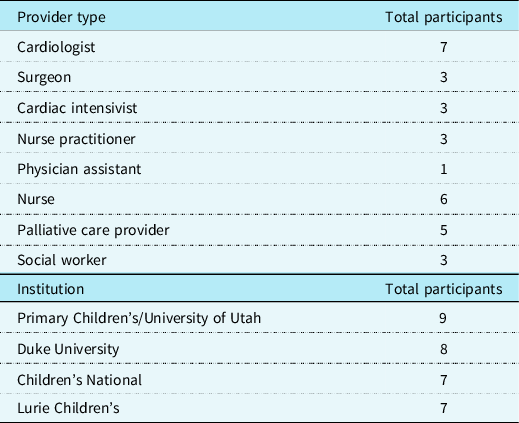
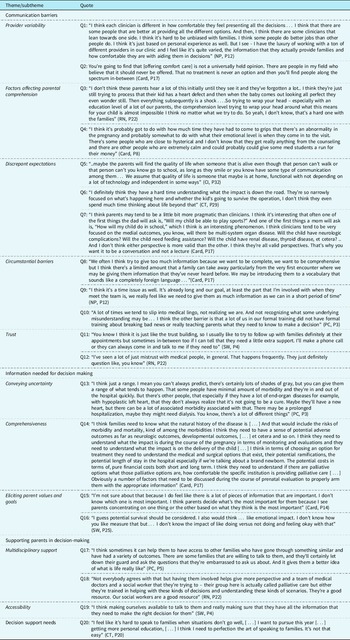
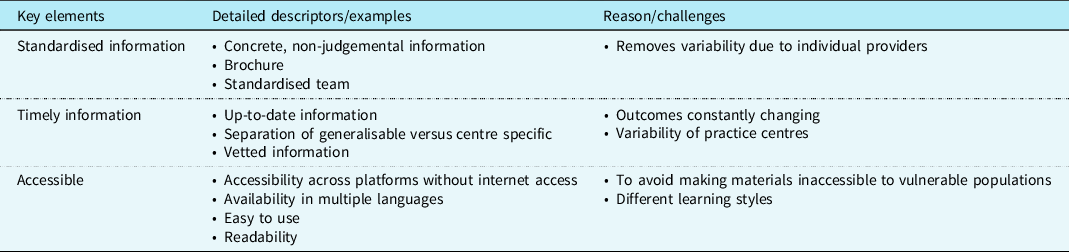
A total of 65 individuals whose names and contact information were provided by the four sites were invited by email to participate in the study; 40 responded with their willingness to participate and 31 completed interviews. Of those that completed interviews, 21 (68%) were female and 26 (84%) were non-Hispanic White. Participation by group and location are shown in Table 1. Interviews averaged 38 minutes (range 16–56). The largest group of providers interviewed were paediatric cardiologists (n = 7, Table 1), followed by nurses (n = 6) and paediatric palliative care providers (n = 5) and relative distribution was similar between sites. Key themes were organised around three main domains: barriers/facilitators to communication; information needed for decision-making; and supporting parent decision-making. These are further expanded below with reference to exemplar quotes (Q1, etc.) provided in Table 2. Providers’ thoughts on key components of an ideal decision tool were organised as main themes but are presented as an expanded list with specific examples and rationale (Table 3) rather than with exemplar quotes.
Interview patients by field and location of practice

Themes and subthemes with representative quotes from provider interview patients

Q = quote; P = provider; NP = nurse practitioner; PA = physician assistant; Card = paediatric cardiologist; CT = paediatric cardiothoracic surgeon; SW = social worker; RN = nurse; PC = palliative care team provider; CI = paediatric cardiac intensivist.
Provider recommendations for components of a decision support tool for parents

Barriers and facilitators to communication
Five themes around effective communication emerged including provider variability in how and what they informed parents, factors that affect parental comprehension or understanding of information provided, discrepant expectations between patients and providers regarding outcomes, circumstantial barriers such as time and complexity of information, and trust/relationship with providers (Table 2).
Provider variability
One of the key barriers recognised by almost all providers was the variability among providers in the information delivered and how it was conveyed. Some providers identified causes of this variability including lack of continuity in care providers, differences in when providers meet parents (before birth versus at the time of surgery), and inherent biases depending on provider experience and lens of practice (Table 2, Q1 and Q2). This variability results in a lack of uniformity in information shared and choices presented to parents in similar circumstances (i.e., whether comfort care or termination was presented for diseases such as hypoplastic left heart syndrome).
Factors affecting parental comprehension
Providers also shared concerns regarding factors that affect parental comprehension. While there was some variability among providers subtypes about what factors may influence parental understanding, almost all recognised that the amount and complexity of information they were trying to convey, baseline parental education, and parental emotional state at the time of communication were important factors to consider (Q3). Providers in all areas of specialisation affirmed that emotional reactions to a life-threatening diagnosis of complex CHD could significantly affect the ability of parents to process other information presented (Q4).
Discrepant expectations
Differences in expectations and perceptions of quality of life between parents and providers were frequently mentioned by providers. Specifically, providers felt they had different baseline definitions of an acceptable or reasonable “quality of life” than parents (Q5). Providers felt that parents often focus on short-term rather than long-term outcomes when presented with the diagnosis and treatment decisions and have difficulty understanding the “big picture” (Q6). Providers also recognised that they may focus more on medical outcomes in assessing quality of life (like time in the hospital or perioperative complications) compared to parents who often focus on aspects of activities of daily living (Q7).
Circumstantial barriers
Certain inherent barriers to communication were recognised across provider types. These specific barriers included the complexity and amount of information that providers felt they needed to convey for parents to achieve full comprehension of the CHD (Q8), the limited time they had to present this information (Q9), and the lack of comfort or preparation that providers sometimes felt with counselling on difficult topics (Q10).
Trust
Several providers also discussed that the presence of trust or lack of trust that parents had in providers could be both a facilitator and/or a barrier. Across specialties, they acknowledged the importance of building trust, relationships, and rapport with parents and the time required to develop such relationships (Q11–12).
Information needed for decision-making
The main themes that emerged around information that providers felt parents needed to engage in shared decision-making included the need to simultaneously be very comprehensive about possible outcomes while also conveying the uncertainty surrounding these possibilities; and the need to elicit values and goals from the parents perspective.
Comprehensiveness and conveying uncertainty
In discussing what information might be most important for parents to know, almost all providers mentioned survival, but also felt it was important for parents to fully comprehend the “full picture” of what their child’s and their family’s life might look like when living with complex CHD in the long term. However, they also recognised that this entailed discussing a “spectrum” of outcomes and the uncertainty surrounding them (Q13). Providers discussed that parents needed to be “armed with knowledge for decision making”. Some felt that to accomplish this, parents needed to have an in-depth understanding of everything – the disease, surgeries, potential short- and long-term outcomes, and ultimate quality of life (Q14).
Eliciting parent values and goals
On the other hand, other providers emphasised the need to learn more about what the family needed in order to provide them with the right information, particularly understanding that parents’ values, background, and goals of care were critical to what might be most important to them (Q15). This aligned with recognising the importance of understanding the emotional impact of decisions for parents and living with their choice (Q16). A few also acknowledged that clinicians may not always know what a family needed to hear most to help them with their decision.
Supporting parent decision-making
When discussing how to support parental involvement in decision-making three themes arose including support from practitioners beyond the clinical providers themselves; accessibility to these providers for parents; and the lack of resources and training for providers.
Multidisciplinary support
Providers felt that effectively engaging and supporting parents in shared decision-making required a multidisciplinary team that included palliative care providers, social workers, and religious chaplains. Many providers also repeatedly emphasised the importance of connecting parents to other families with children with CHD and/or parent support organisations both national and local to share experiences and “real-life perspectives” (Q17, Q18).
Accessibility
Other providers mentioned the importance of being easily accessible and approachable to parents including facilitating opportunities to follow-up or circle back. Most emphasised the need to ensure parents could communicate with their care team as needed during the decision-making process (Q19).
Lack of resources and training
Most providers used handouts, websites, and support groups (local and national) to provide information to parents in addition to counselling. However, they noted that they lacked the resources to support shared decision-making and some noted they could use additional training in skills for more effective communication (Q20).
Decision support tool requirements
When specifically asked to describe what components they would desire in a decision support tool to assist in counselling parents with fetus/neonates with complex CHD, providers stated the optimal decision support tool would contain: standardised, comprehensive, up-to-date information regarding relevant outcomes (which they acknowledged can be challenging to obtain); and accessibility of the tool to parents regardless of education, primary language, or Internet availability (Table 3). Almost all providers endorsed that a web-based decision aid would be helpful for parents if it were accurate and easy to use.
Discussion
In this qualitative study of providers who care for families affected by complex CHD across multiple institutions and multiple subspecialties, we elicited several key factors that influence effective communication and collaborative shared decision-making in practice. In doing so, we identified several actionable areas to be addressed to improve shared decision-making with parents faced with severe CHD in their born or unborn child. While some of our barriers and facilitators are similar to those previously identified by providers in shared decision-making literature, Reference Boland, Graham and Légaré7 the recognition of the role of provider variability and provider focus on informational rather than emotional aspects of these high stakes decisions is an important finding not only for paediatric cardiology but also to many other areas of medicine.
One important actionable area of improvement is achieving increased standardisation of information provided to parents. While variability in counselling has been previously reported, Reference Kon, Ackerson and Lo18 recognition of this variability by the providers themselves has not been directly acknowledged. Providers have their own biases about outcomes Reference Prsa, Holly, Carnevale, Justino and Rohlicek6 that influence the choices and perspectives they offer parents. This variability results in suboptimal communication, differences in care pathways offered and pursued, and exacerbates the stressful situation of parents trying to make the best choice for their fetus or child and themselves. Reference Sekar, Marcus, Williams and Boss19 While influencing provider variability directly may be challenging, parents can be provided standardised information on choices and outcomes using educational and decision support materials.
Many previous studies have focused on parent perspectives on shared decision-making and communication. Reference Neubauer, Williams, Donohue and Boss9,Reference Carlsson, Melander Marttala, Mattsson and Ringnér20,Reference Delaney, Pinto and Ozanne21 While we found that providers perceived a discrepant parental focus on short-term compared to the providers’ emphases on long-term outcomes, previous work has highlighted parents’ desire for more information related to long-term outcomes. Further, Arya et al found that parents rated information on quality of life as significantly more important than providers did. Reference Arya, Glickstein, Levasseur and Williams22 We also found similar to previous reports that perspectives on quality of life between providers and parents often differ. Reference Marino, Tomlinson and Drotar23 These discrepancies could be identified and addressed with prompts to elicit parents’ goals of care and information preferences. Reference Elwyn, Frosch and Thomson24
The amount and type of information to be shared in a short amount of time are perceived as barriers to effective communication and adequate shared decision-making from parents and providers alike. The nuances of CHD diagnoses and statistics related to outcomes can be difficult to convey at baseline and exacerbated if there are language, literacy, or numeracy barriers. Balancing the details versus the big picture can be challenging since parents have previously expressed a desire for more information than clinicians may provide, Reference Neubauer, Williams, Donohue and Boss9,Reference Arya, Glickstein, Levasseur and Williams22 with the caveat that the amount of information can be overwhelming and requires repetition. Previous work has found that the amount and manner in which this information is conveyed may be related to provider subspecialty. Reference Kon, Ackerson and Lo18 The type and scope of information shared may need to be driven more by family needs or desires. Ultimately, the amount or extent of information should not replace the parents’ agency in making a decision for their child and as noted in the interviews, counselling is “not meant to be a lecture” to teach the details of cardiac anatomy but “rather a conversation” allowing for the family to participate in a meaningful interaction with their providers. In addition, greater focus on the emotional and psychological support parents require in these challenging circumstances may be required. Providers often recognised that the emotional intensity of the situation could be a barrier to effective communication. Charles et al note that such vulnerabilities may make effective participation in decision-making difficult even if they feel well informed. Reference Charles, Gafni and Whelan3 Unfortunately, discussion of mechanisms to address the psychological and emotional aspects of these situations was lacking in our study though this may have been related to how interview questions were framed.
Finally, while providers acknowledge the importance of shared decision-making for parents faced with complex CHD, they often felt ill-equipped. Clinicians emphasised the importance of services such as social work, palliative care teams, and parent support groups as resources for families echoing parent preferences. Reference Carlsson, Melander Marttala, Mattsson and Ringnér20 However, misconceptions about the role of palliative care teams among paediatric cardiology providers can be barriers to effective collaboration with such services. Reference Balkin, Kirkpatrick and Kaufman25,Reference Kavalieratos, Mitchell and Carey26 Addressing these barriers and standardising inclusion of such support services in situations where parents are faced with such challenging decisions may be helpful. Reference Lowenstein, Macauley, Perko and Ronai27,Reference Davis, Bass, Humphrey, Texter and Garee28
Providers of all types expressed a desire for better educational and decision support materials. Accessible and accurate information for parents and providers is a critical gap since in the field of paediatric cardiology providers often lack sufficient, detailed evidence to guide decision-making. Reference Darst, Newburger, Resch, Rathod and Lock29 In this era of personalised medicine, longitudinal outcome data that incorporate other risk factors would be the most informative but are challenging to obtain without national registries or linked datasets. Reference Vriend, van der Velde and Mulder30,Reference Jacobs, Mayer and Mavroudis31 Using big data to make these data more readily accessible for clinicians and parents alike is a crucial area for continued work to facilitate shared decision-making. Reference Boland, Graham and Légaré7
Although our goal was to recruit a broad spectrum of providers, the study was limited by the types of providers and numbers of providers (particularly in subspecialties where the numbers of providers are few such as paediatric cardiothoracic surgery), which may impact the generalisability of results and limited our ability to make comparisons between provider types. While we recruited patients from four different centres, our findings may not be nationally representative. Furthermore, while preferences for communication and shared decision-making may be influenced by cultural background, socioeconomic status, and race and ethnicity, the majority of patients in this study were non-Hispanic White and potential differences based on cultural background or sociodemographic variables were not assessed. Providers who volunteered for interviews may have had particularly strong feelings regarding the topic compared to others in the field. Nonetheless, the use of interviews allowed us to collect more granular and in-depth perspectives from providers on this complex topic.
Conclusion
In conclusion, our findings provide a critical provider perspective on counselling, communicating, and participating in shared decision-making with parents faced with a new diagnosis of complex CHD in their fetus or neonate. We have also identified components of decision support that would lead to better parent–provider communication. To better support parents, it is critical that providers work to enhance communication (standardisation of information, aligning expectations, and building trust), engage parents in value elicitation, distil complex information to pertinent themes aligned with family values and goals concerning quality of life, and acknowledge and support parents in the emotional context of the diagnosis and decision-making process.
Acknowledgements
We would like to acknowledge the members of the Qualitative Research Core at the University of Utah (Rachel Andes, Grace Perry, Patrick Galyean, and Alex Bellenger) for their work in coding and developing the qualitative report for this work.
Financial support
This work was supported by the American Heart Association’s Strategically Focused Research Network – Children’s grant (17SFRN33660465). The funder did not participate in the work.
Conflicts of interest
None.
Ethical standards
The authors assert that all procedures contributing to this work comply with the ethical standards of the relevant national guidelines on human experimentation including the Belmont Report and with the Helsinki Declaration of 1975, as revised in 2008, and have been approved by the institutional committees specifically the Institutional Review Boards of the University of Utah, Lurie Children’s Hospital, Duke University, and Children’s National Hospital.