Introduction
In the last decades, the incidence of granting disability pension has increased considerably in several European countries and the USA, despite improvements in health and longevity observed during the same period (Organisation for Economic Co-operation and Development, 2003; Järvisalo et al. Reference Järvisalo, Anderson, Boedeker and Houtman2005; Social Security Administration, 2012). In a number of these countries, the increases were particularly large among young people (Organisation for Economic Co-operation and Development, 2003; Järvisalo et al. Reference Järvisalo, Anderson, Boedeker and Houtman2005; Social Security Administration, 2012). In Sweden, for example, the annual number of disability pensions granted to individuals below 30 years of age increased more than three-fold from 1931 to 6547 from 1995 to 2011 (Social Insurance Agency, 2012). This development exacerbates not only the risk of labour shortages and financial strain on society, but may also imply economical constraints and social consequences for young people.
Social protection systems, e.g. granting of disability pension, are generally designed to protect people against the risks of loss of income in the case of, for example, disease or injury (Social Insurance Agency, 2012). Still, disability pension is often granted to people with disorders, particularly common mental disorders, which are known to be positively affected by treatment and rehabilitation efforts and are potentially worsened by inactivity (Vingård et al. Reference Vingård, Alexanderson and Norlund2004; Kupfer et al. Reference Kupfer, Frank and Phillips2012). Disability pension might also be associated with social isolation and unhealthy life-styles, such as high alcohol and tobacco use (Sorvaniemi et al. Reference Sorvaniemi, Helenius and Salokangas2003; Claessen et al. Reference Claessen, Arndt, Drath and Brenner2010; Skogen et al. Reference Skogen, Knudsen, Mykletun, Nesvag and Overland2012). These findings might suggest that mental health deteriorates after receipt of disability pension. However, also the opposite might be true, namely that mental health improves after receiving a disability pension as psychological work demands are removed (Mantyniemi et al. Reference Mantyniemi, Oksanen, Salo, Virtanen, Sjosten, Pentti, Kivimaki and Vahtera2012). Despite the size of the problem and the obvious clinical implications, few studies, to date, have investigated mental health development before and after the granting of a disability pension (Overland et al. Reference Overland, Glozier, Henderson, Maeland, Hotopf and Mykletun2008; Oksanen et al. Reference Oksanen, Vahtera, Westerlund, Pentti, Sjosten, Virtanen, Kawachi and Kivimaki2011). The available evidence suggests that self-reported symptoms of depression and anxiety as well as prescription of antidepressants increase before receipt of disability pension, after which a decrease in these measurements is noted (Overland et al. Reference Overland, Glozier, Henderson, Maeland, Hotopf and Mykletun2008; Oksanen et al. Reference Oksanen, Vahtera, Westerlund, Pentti, Sjosten, Virtanen, Kawachi and Kivimaki2011; Laaksonen et al. Reference Laaksonen, Metsa-Simola, Martikainen, Pietilainen, Rahkonen, Gould, Partonen and Lahelma2012).
While the literature on adults is limited and mechanisms for trajectories in mental health before and after the granting of disability pension have not been disentangled yet, there are no such studies to date focusing on young people below the age of 30 years. The effect of a disability pension on mental health development might, however, differ for young compared with older age groups. Entering into the labour force and being able to earn one's own living are a major step in the transition into adulthood (Arnett, Reference Arnett2001), and to lack this transition could have a range of adverse consequences. Early marginalization associated with a granted disability pension will make it difficult to enter the labour market at a later stage. This could in turn lead to inactivity, social isolation, a sense of failure and a lack of meaning, which might adversely affect mental health (Waddell & Burton, Reference Waddell and Burton2006; Social Insurance Agency, 2007). There are therefore reasons to anticipate that mental health trajectories around the granting of a disability pension might show different patterns in young people as compared with older age groups.
Suicide attempt can be viewed as the outmost consequence of mental ill-health and represents a considerable public health problem in young people (Hawton et al. Reference Hawton, Saunders and O'Connor2012). We have recently shown that receiving a disability pension due to both somatic and mental disorders seems to increase a young person's risk of suicide attempt beyond the effects of his or her own socio-economic status, previous suicide attempts and parental risk factors (Jonsson et al. Reference Jonsson, Alexanderson, Kjeldgard, Westerlund and Mittendorfer-Rutz2013). This study also revealed that a half and one third of the young people with disability pension due to mental and somatic disorders who attempted suicide during the follow-up had attempted before being granted disability pension, respectively (Jonsson et al. Reference Jonsson, Alexanderson, Kjeldgard, Westerlund and Mittendorfer-Rutz2013). This raises several questions with regard to the adequacy of treatment received around the time of granting disability pension and calls for a more dynamic analytical approach able to model trajectories of suicide attempt before and after granting of disability pension due to both mental and somatic disorders. As suicide attempt and disability pension show different sex patterns (Hawton et al. Reference Hawton, Saunders and O'Connor2012), separate analyses of young women and men are warranted.
The incidence of the granting of disability pension among young people is among other factors affected by changes in social insurance policies (Allebeck & Mastekaasa, Reference Allebeck and Mastekaasa2004). Since the 1990s and particularly in 2003 policies for being granted disability pension when below the age of 30 years have changed considerably in Sweden (Social Insurance Agency, 2012). From 2003 onwards, disability pension for individuals below 30 years can be temporarily (maximum 3 years) granted if disease or injury has impaired the individual's work capacity or for delayed completion of upper secondary school (Social Insurance Agency, 2012). Before 2003, disability pension could be granted to young individuals, both temporarily and permanently. Several other conditions that are potentially relevant for research on disability pension and suicide attempt in young people have also changed during the last 20 years. These factors include the rates of in-patient care due to mental disorders and suicide attempt and unemployment in young people (Lager et al. Reference Lager, Berlin, Heimerson and Danielsson2012). Therefore, acknowledging temporal trends in research on disability pension and suicide attempt seems necessary. Still, we are not aware of any study on disability pension that has included an analysis of period effects to date.
The aim of the present study was therefore to investigate the risk of suicide attempt in young people in Sweden during the years preceding and the years following the granting of disability pension, and to see if these patterns differed across diagnosis, sex and the period of granting disability pensions.
Method
The study base consisted of all persons 16–30 years old and living in Sweden who were granted a disability pension (full or part time) during the years 1995–1997, 2000–2002 as well as 2005–2006 (n = 28 854). This design was chosen in order to enable the investigation of period effects, particularly due to temporal changes in social insurance regulations. Due to missing information on one covariate (parental education), 2230 individuals were excluded. The remaining 26 624 people were included in the analyses. Further analyses revealed no differences between the study group and the excluded individuals.
Register linkage
The following register data for the years between 1980 and 2010 were obtained and merged for each individual granted a disability pension in Sweden (including information on parents) from three public authorities:
-
(1) Statistics Sweden: age, sex, country of birth, education, family situation and area of residence from the Longitudinal Integration Database for Health Insurance and Labor Market Studies (LISA).
-
(2) The Social Insurance Agency: disability pension (date, grade and diagnosis) from the database on MicroData for Analysis of the Social Insurance (MIDAS).
-
(3) The National Board of Health and Welfare: date and cause of in-patient care due to mental disorders and suicide attempts, as well as data on completed suicides (date and cause) from the National Patient and Cause of Death registers, respectively.
Disability pension
If an individual had been granted a disability pension more than once during the 9-year exposure window, the first date was used in the analyses. For diagnosis-specific analyses we used the main diagnosis (of the index disability pension) according to the ninth and tenth revisions of the International Classification of Diseases (ICD-9 and ICD-10).
Suicide attempts
Suicide attempts were defined as in-patient care due to ICD-9 and ICD-10 diagnostic codes E950–E959 and X60–X84. Even cases with uncertainty about intention (E980–E989 in ICD-9 and Y10–Y34 in ICD-10) were considered. Uncertain and certain diagnoses were combined to limit temporal and regional variation in ascertainment routines and limit the underreporting of suicidal behaviour (Mittendorfer-Rutz et al. Reference Mittendorfer-Rutz, Rasmussen and Wasserman2004; Mittendorfer-Rutz & Wasserman, Reference Mittendorfer-Rutz and Wasserman2004). A sensitivity analysis of certain and uncertain suicide attempt established the comparability of the estimates. This combined outcome measure is hereafter referred to as ‘suicide attempt’. Suicide attempts were considered during the 4 calendar years before, the year of granting disability pension and the 4 years after. In case of repetition of suicide attempt during a particular calendar year, the attempt closest in time to the granting of disability pension was chosen.
Covariates
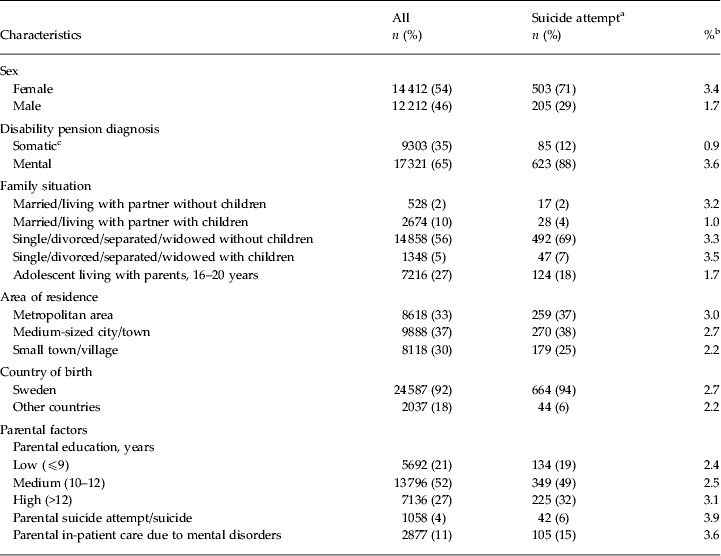
Time-varying covariates, like age, family situation (married/cohabiting/single with/without children), area of residence (Statistiska Centralbryån , 2003) and covariates not changing with time, e.g. country of birth, were measured on 31 December in the year preceding the year when disability pension was granted. Parental education was measured at the end of 1994, 1999 and 2004 for individuals receiving disability pension 1995–1997, 2000–2002 and 2005–2006, respectively. We used either maternal or paternal education, whichever was the highest, in accordance with the dominance principle, which has been shown to perform well in classifying families (Erikson, Reference Erikson2005). Information on parental in-patient care due to mental disorders and suicide attempts was used for the 8 years preceding the year of granting the offspring's disability pension. Parental suicides from 1980 until the index event (date of disability pension granting) were included. All covariates were categorized as indicated in Table 1. Age at disability pension was categorized in tertiles.
Descriptive statistics of 26 624 individuals between 16 and 30 years of age granted disability pension and those that attempted suicide

a During the year preceding the granting of disability pension.
b Proportion of suicide attempts for each characteristic.
c Including missing diagnoses (n = 200).
Statistics
The suicide attempts in the 9-year window around the granting of disability pension were modelled by repeated-measures logistic regressions (note that a maximum of nine measurements was used for each individual) using an unstructured correlation matrix for intra-person correlation. Crude risks as well as multivariate adjusted odds ratios (ORs) were computed. In the multivariate models, adjustments were made for age and diagnosis underlying the disability pension, calendar year, period, and all sociodemographic and parental covariates. To account for selective drop-out in the 4-year period after the granting of disability pension due to death (including suicide), all available information on covariates was used to predict death risk and the persons still alive were accordingly up-weighted to compensate for the selective drop-out. Sensitivity analyses were conducted to investigate the effect of this re-weighting and it was found to be of no practical importance. Interaction with time was computed with the likelihood ratio test. R version 12.2.2 was used for the analyses (http://www.r-project.org/).
Ethical approval
This study was approved by the regional ethical board of Karolinska Institutet, Stockholm, Sweden.
Results
During 1995–1997, 2000–2002 and 2005–2006, 26 624 individuals (54% female) between 16 and 30 years of age were granted a disability pension (Table 1). Most of the disability pensions were due to mental diagnoses (65%). The main diagnostic groups among these mental diagnoses were: neurotic, stress-related and somatoform disorders (13%), mental retardation (10%), behavioural and emotional disorders (9%), schizophrenia, schizotypal and delusional disorders (8%), affective disorders (8%) and personality disorders (7.5%) (data not shown). The majority of the disability pensioners were single without children (56%), living in medium-sized cities (37%) and born in Sweden (92%). With regard to the parental markers, most of the young disability pensioners had parents with medium-level education (52%), while 4% had a parent with previous suicidal behaviour and 11% a parent with previous in-patient care due to a mental disorder, respectively.
During the observation period, in total 2635 disability pensioners (9.9%) attempted suicide, 708 (2.6%) in the calendar year preceding the granting of disability pension. Most of those who attempted suicide the year preceding the granting of disability pension were women (71%) and got a disability pension due to a mental diagnosis (88%) (Table 1). In these suicide attempters, disability pension was mainly due to personality disorders (29%), affective disorders (16%) and neurotic, stress-related and somatoform disorders (13%) (data not shown). Compared with the whole group of disability pensioners, those with suicide attempt the year preceding the granting of disability pension had a higher proportion of parents with suicidal behaviour (6%) and in-patient care due to mental disorders (15%) (Table 1).
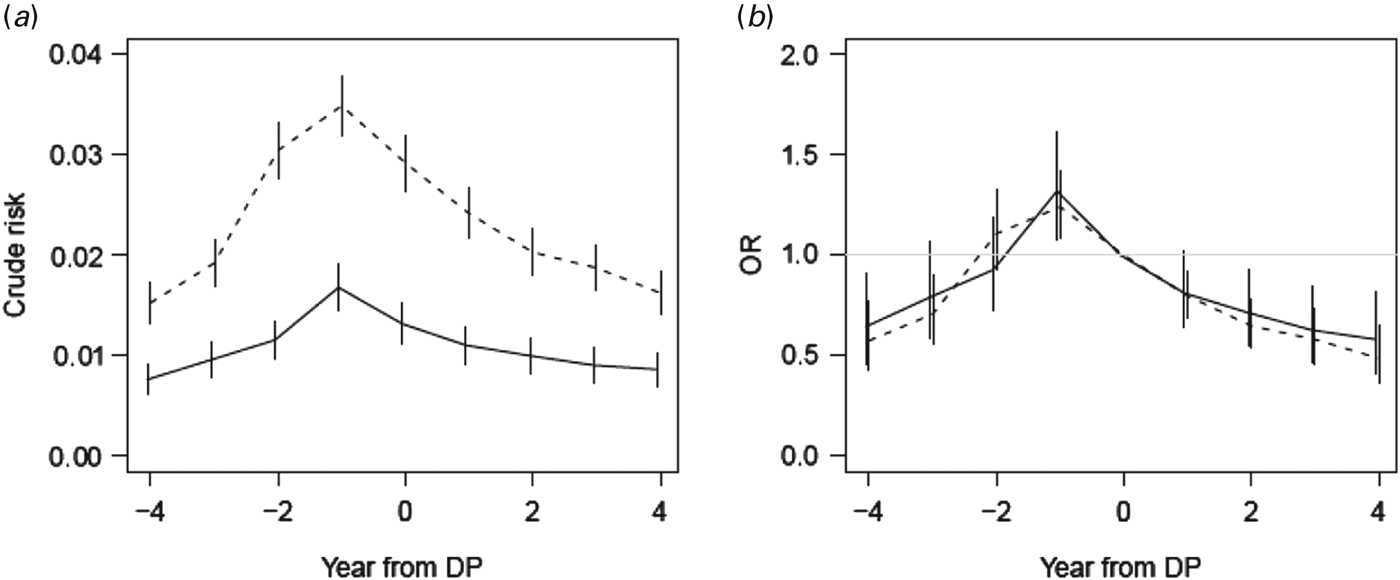
Fig. 1 shows crude risks and multivariate adjusted ORs for suicide attempt in relation to the year that disability pension was granted in women and men separately. The estimates were adjusted for age and diagnosis of disability pension, sociodemographic and parental covariates, calendar year and period. Adjustment for these covariates affected the estimates only marginally. Among both women and men the risks increased continuously up to the year preceding the granting of disability pension, when the risks dropped and continued to decline in the 4 years following the granting of disability pension. The risks in women were considerably higher than in men. The overall OR and 95% confidence interval (CI) for women attempting suicide compared with men was 2.49 (95% CI 2.26–2.75). The likelihood ratio test did not reveal any significant interaction with time, meaning that there was no difference in these trajectories in women compared with men over time (p = 0.32).
Crude risks (a) and odds ratios (ORs) (b) of suicide attempt in relation to year of disability pension (DP) receipt in women (- - -) and men (—). Error bars indicate 95% confidence intervals. The analyses for ORs were adjusted for age, diagnosis and calendar year and period of DP, sociodemographic and parental covariates and corrected for suicide deaths.

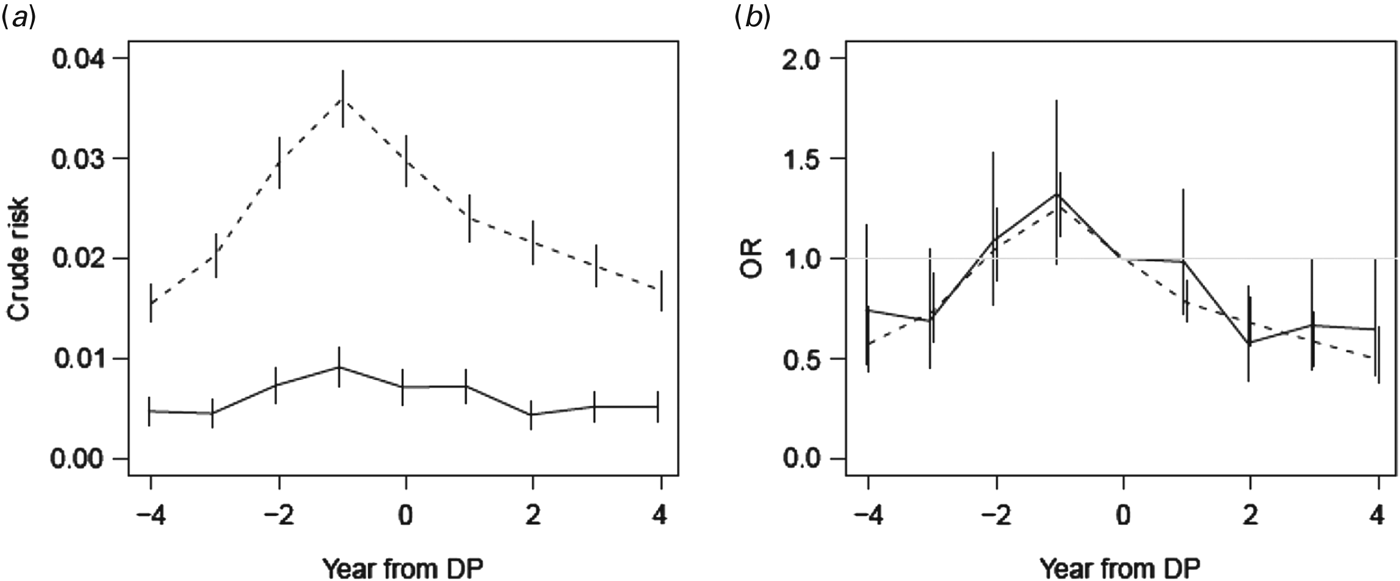
Similar patterns could also be found for trajectories of disability pension due to mental and somatic disorders (Fig. 2). Among persons who received a disability pension due to either mental or somatic disorders, suicide attempt risks increased during the pre-pension period, peaking in the year before disability pension and decreasing from the year of receipt of disability pension. Similar patterns were found in analyses of disability pensions due to all 10 chapters of mental disorders (data not shown). While overall multivariate adjusted ORs for disability pension due to mental disorders were considerably higher than those for somatic disorders (OR 3.86, 95% CI 3.37–4.42), there was no significant interaction of diagnosis with time (p = 0.33).
Crude risks (a) and odds ratios (ORs) (b) for suicide attempt in relation to year of disability pension (DP) receipt, split by diagnostic category for which DP was granted: mental disorders (- - -); somatic disorders (—). Error bars indicate 95% confidence intervals. The analyses for ORs were adjusted for age, sex, calendar year and period of DP, sociodemographic and parental covariates and corrected for suicide deaths.

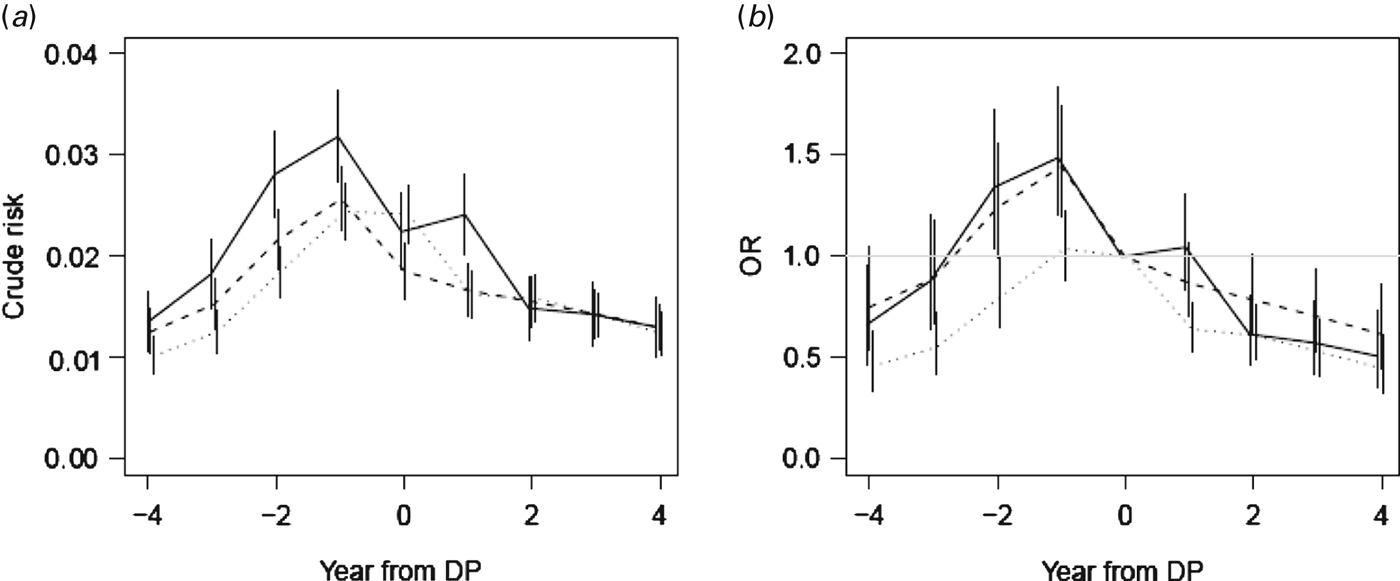
Fig. 3 shows the trajectories of risks and multivariate adjusted ORs of suicide attempt before and after receipt of disability pension for three different cohorts, namely those individuals who were granted disability pension during 1995–1997, 2000–2002 and 2005–2006, respectively. The highest risk of suicide attempt was observed in the earliest cohort (1995–1997), where also the largest drop after receipt of disability pension was observed. The lowest risk of suicide attempt was observed in the most recent cohort (2005–2006). The trajectories of these three different cohorts were significantly different (p interaction with time = 0.0012).
Crude risks (a) and odds ratios (ORs) (b) of suicide attempt in relation to year of disability pension (DP) receipt split into three different periods of DP receipts: 1995–1997 cohort (—); 2000–2002 cohort (- - -); 2005–2006 cohort (· · · · ·). Error bars indicate 95% confidence intervals. The analyses for ORs were adjusted for age, sex, diagnosis, sociodemographic and parental covariates and corrected for suicide deaths.

Discussion
The risk of suicide attempt was found to increase continuously up to the year preceding the granting of disability pension in young people; thereafter the risk dropped and continued to decline after the year that disability pension was granted. These trajectories were similar for women and men and for disability pension due to mental and somatic diagnoses, even if the multivariate ORs for suicide attempt for women and disability pension due to mental disorders were 2.5- and 3.8- fold higher than the ORs for men and disability pension due to somatic disorders, respectively. Trajectories of suicide attempts for the three different periods of the granting of disability pensions showed a significant interaction between the period of disability pension granting and time in relation to the year of the granting. The ORs of suicide attempt for young individuals granted a disability pension most recently (2005–2006) were lower than the ORs for those with disability pension granted in 1995–1997 and 2000–2002 and they showed the lowest drop in ORs after receipt of disability pension.
The main strengths of this study include the very large and population-based cohorts, the prospective design, virtually no loss to follow-up, and use of high-quality administrative registers (National Board of Health and Welfare, 2009; Ludvigsson et al. Reference Ludvigsson, Andersson, Ekbom, Feychting, Kim, Reuterwall, Heurgren and Olausson2011) that recorded exposure, confounders, and outcome independently from each other. The study included all young individuals who were granted a disability pension in Sweden during the chosen time period, which is unique in this research field to date and offered satisfactory statistical power for the analyses of a rare outcome like suicide attempt. Moreover, to the best of our knowledge, this is the first study to analyse trajectories of suicide attempt risk in young disability pensioners taking potential period effects into account. Some limitations of this study should also be noted. First, by considering only suicide attempts leading to in-patient care we have missed less medically severe suicide attempts, which have not come to the attention of the health care system (Ramberg & Wasserman, Reference Ramberg and Wasserman2000). Also, admission criteria for suicide attempt may have been subject to temporal changes, which were only partly considered by controlling for calendar year and period. Second, little is known about the validity of the diagnoses for disability pensions. Due to the remaining stigma of mental disorders (Lauber, Reference Lauber2008; Shrivastava et al. Reference Shrivastava, Johnston and Bureau2012) we assume a high validity of mental diagnoses on disability pension certificates, though. Finally, despite the use of an exceptionally large dataset with data of good quality providing information on several confounders, we had no access to important confounders such as alcohol and drug consumption.
The risk of suicide attempt increased continuously up to the year preceding the granting of disability pension, after which the risk dropped and continued to decline in the 4 years following the pension. These findings agree with recent evidence suggesting that self-reported symptoms of depression and anxiety as well as the prescription of antidepressants tend to increase before the receipt of a disability pension, after which a decrease in these measurements was noted (Overland et al. Reference Overland, Glozier, Henderson, Maeland, Hotopf and Mykletun2008; Oksanen et al. Reference Oksanen, Vahtera, Westerlund, Pentti, Sjosten, Virtanen, Kawachi and Kivimaki2011; Laaksonen et al. Reference Laaksonen, Metsa-Simola, Martikainen, Pietilainen, Rahkonen, Gould, Partonen and Lahelma2012). Most of these studies, however, suffer from different shortcomings as data have often been derived from selected segments of the work force or are restricted to self-reported data. To the best of our knowledge, this is the first study showing trajectories of suicide attempt risk in young disability pensioners using registers with national coverage. The observed highest risks of suicide attempt in the year preceding the granting of disability pension are most probably due to the acute medical severity of the underlying disorder, in most cases a mental disorder, around the time of the granting of a disability pension. An alternative explanation of these findings is that the occurrence of suicide attempts considerably contributes to and strengthens the decision to grant a disability pension. It is also likely that the process preceding the granting of a disability pension is so stressful that it increases the risk of suicidal behaviour in vulnerable individuals. Investigations testing these hypotheses are warranted.
The decline in suicide attempt risk after the granting of disability pension may be driven by a true improvement in mental health. Based on the current design of this study it is, however, not possible to ascertain if this is due to the receipt of a disability pension or to the natural course of the underlying disorder. Still, it has to be kept in mind that most of the underlying diagnoses of young disability pensioners are of mental disorders, which often continue into adulthood in the form of chronic conditions, residual symptoms, recurrent episodes and co-morbid conditions (Kessler et al. Reference Kessler, Berglund, Demler, Jin, Merikangas and Walters2005; Jonsson et al. Reference Jonsson, Bohman, Von Knorring, Olsson, Paaren and Von Knorring2011). Improvements in mental health after the granting of disability pension may also be associated with intensified health care efforts associated with the receipt of a disability pension. Recent studies, however, do not suggest that people granted a disability pension receive optimal health care (Honkonen et al. Reference Honkonen, Aro, Isometsa, Virtanen and Katila2007). The decrease in suicide attempt risks after the granting of disability pension might, however, also be an expression of relief from worrying about one's economic situation. Future studies should try to elucidate underlying causal mechanisms by applying adequate methodological approaches.
We found that young individuals who were granted a disability pension between 2005 and 2006, inclusive, had a lower risk of suicide attempt before disability pension granting than those being granted a disability at an earlier time period (1995–1997). Also the drop in suicide attempt risk after the receipt of disability pension was less steep for the more recent cohort. One likely explanation of our findings is that individuals with less severe medical conditions are granted disability pension in more recent cohorts as compared with earlier ones. Regulations in the social insurance system changed considerably during the study period, particularly in 2003, when less restrictive rules with regard to granting a disability pension for young people were introduced (Social Insurance Agency, 2012). The importance of further evaluating health and social consequences of changing social insurance regulations should here be stressed.
We found evidence for trajectories of increasing risk of suicide attempt culminating in the calendar year before the granting of disability pension in young individuals, after which the suicide attempt risk decreased. Future studies attempting to disentangle to what degree this decrease in suicide attempt risk is directly a consequence of being granted a disability pension, or simply a return to normal after a temporarily increased level of symptoms around the time of being granted the disability pension, are warranted. The study indicates that suicide attempt risk should be monitored among young people waiting to be granted a disability pension to enable individual preventive measures.
Acknowledgements
The work was financially supported by the Swedish Research Council (grant number 522-2010-2683) and by the Stockholm Stress Centre, a Forskningsrådet för Arbetsliv och Socialvetenskap (FAS) centre of excellence (grant number 2009–1758).
Declaration of Interest
None.