Introduction
Polarisation of ‘the steppe’ and ‘the sown’ is prominent in Eurasian scholarship, and fits intellectually alongside other dualistic categories that have deep roots in Western social science, such as ‘civilised/barbarian’, ‘state/tribe’ and ‘centre/periphery’. Even so, a growing body of archaeological, ethnographic and historical research across Eurasia reveals the variability in how steppe pastoralists and settled agricultural communities overlap, and how their relationships—or indeed their very categorisations—shift across space and time (Hann Reference Hann2016; Honeychurch & Makarewicz Reference Honeychurch and Makarewicz2016). Central Asia lies at the juncture of several different topographic, ecological, climatic and hydrological systems, as well as different socio-economic spheres broadly suited to settled agriculture and mobile pastoralism (Figure 1). The entanglement of these lifeways and the fluidity of farmer-pastoralist interaction in Central Asia dates back at least 4000 years—long before the emergence of bellicose horse-riding nomads or the rise of ‘shadow’ empires on the steppe (Christian Reference Christian2000). The farmer-pastoralist interaction that defined Central Asia's prehistory is best understood as inter-cultural contact, in which groups with different traditions and practices communicated, borrowed and assimilated ideas and material culture from each other.
Region of Central Asia as discussed in this article. Areas traditionally identified with farming-dependent Oxus communities and non-Oxus mobile pastoralists are shown, acknowledging that in both areas mixed agropastoral practices have occurred in the past and present.

The Murghab alluvial fan in southern Turkmenistan witnessed some of the earliest encounters between sedentary farmers and mobile pastoralists from different cultural spheres. During the late third and early second millennia BC, the Murghab was home to the Oxus civilisation and formed a central node in regional exchange networks (Possehl Reference Possehl2005; Kohl Reference Kohl2007). The Oxus civilisation (or the Bactria-Margiana Archaeological Complex) relied on intensive agriculture to support a hierarchical society and specialised craft production of metal and precious stone objects for prestige display and long-distance exchange (Sarianidi 1981; Hiebert Reference Hiebert1994). By c. 1800 BC (the local Late Bronze Age), the internal coherence of the Oxus civilisation began to break down, along with the inter-regional exchange networks; the settlement structure of the Murghab shifted from a tiered system of urban centres, villages and hamlets, to a more dispersed pattern of smaller-scale agricultural settlements (Salvatori 2008). Contemporaneous evidence for small campsites (with a distinct ceramic tradition) suggests an influx of mobile pastoralists from the Central Eurasian Steppe and foothills (Cerasetti Reference Cerasetti, Gubaev, Koshelenko and Tosi1998; Masson Reference Masson, Jones-Bley and Zdanovich2002; Cattani et al. Reference Cattani, Cerasetti, Salvatori, Tosi, Salvatori, Tosi and Cerasetti2008). This striking combination of the sites and material cultures of both late Oxus farmers and ‘steppe’ pastoralists spans more than 500 years of Murghab prehistory (Salvatori 2008; Rouse & Cerasetti Reference Rouse and Cerasetti2017).
The mixed farmer-pastoralist archaeological record of the Murghab has influenced competing interpretations of Later Bronze Age socio-political and economic relationships. Some scholars argue that the ‘collapse’ of the Oxus civilisation was at least partly due to the hostile incursions of nomads (Marushchenko Reference Marushchenko and Durdyev1956; Kuz'mina & Lyapin Reference Kuz'mina and Lyapin1984; Vinogradova & Kuz'mina Reference Vinogradova and Kuz'mina1996). Others suggest that pastoralists took advantage of the Murghab's crumbling power structure by moving into the area, but occupying only marginal, agriculturally unsuitable zones (P'yankova Reference P'yankova1993), or merging with the late Oxus farming populations (Masson Reference Masson, Jones-Bley and Zdanovich2002). These models broadly follow ‘trade or raid’ paradigms of farmer-pastoralist interaction, whereby the perceived shortages of pastoralist communities force them to rely on agriculturalists for subsistence, material and cultural inputs (Kroeber Reference Kroeber1947; Ferdinand Reference Ferdinand, Tapper and McLachlan2003; Potts Reference Potts2014). Such models may explain certain cases of Near Eastern pastoral economic specialisation, or historical contact scenarios between Eurasian steppe and agricultural communities on China's northern frontier (Lattimore Reference Lattimore1979; Barfield Reference Barfield, Alcock, D'Altroy, Morrison and Sinopoli2001; Alizadeh Reference Alizadeh and Szuchman2009; Khazanov Reference Khazanov and Szuchman2009). Near Eastern and Eurasian interaction paradigms, however, fit increasingly poorly with the archaeological evidence for early farmer-pastoralist encounters in southern Central Asia.
We present data from four Murghab pastoralist campsites dating to the third to second millennia BC (Figure 2), restricting our discussion to the materials and practices employed by Oxus-period pastoralists to navigate shifting social, political and economic networks. Our aim is to highlight how variable strategies broadly identified under the rubric of ‘agropastoralism’ can be teased apart to recognise mechanisms of social boundary-making. Individually, these four sites present chronologically and locally distinct snapshots of farmer-pastoralist interactions across different realms of exchange (e.g. subsistence, technology and ideology); they provide examples of how pastoralists and farmers mutually participated in each other's material and social norms. Together, these sites reveal how varied farmer-pastoralist engagement with technology and material culture did not lead inevitably to the assimilation of the two groups; rather, they worked consciously within existing systems of cultural practice to maintain distinct ‘farmer’ and ‘pastoralist’ identities, potentially over a 900-year period.
Location and chronology of the four mobile pastoralist campsites discussed. Selected Oxus-period (Bronze Age) sites and the Iron Age type-site of Yaz-tepe are shown for reference.

Interactions at four Murghab sites
The four sites exhibit archaeological features that differentiate them from Oxus sites and are suggestive of campsites associated with sheep or goat herding. The sites feature superimposed occupation surfaces with pakhsa (rammed-earth) floors, postholes, storage pits and hearths, indicating their repeated use for small, temporary lean-to, tent- or hut-like structures. This architecture, along with distinctive semi-subterranean ‘sunken dwellings’, has no parallels in Bronze Age Oxus farming communities, where above-ground, rectangular mud-brick or pakhsa structures were the norm (Sarianidi & Dubova Reference Sarianidi, Dubova, Sarianidi, Kozhin, Kosarev and Dubova2012). The spatial separation of various cooking, living and refuse areas is maintained through successive occupation episodes at these four sites—a common pastoralist organisational pattern (Boroffka et al. Reference Boroffka, Cierny, Lutz, Parzinger, Pernicka, Weisgerber, Boyle, Renfrew and Levine2002; Kuz'mina Reference Kuz'mina2007). Sheep and goat bone dominate faunal assemblages from the campsites, while the archaeobotanical assemblages are either relatively small or context-specific. In contrast, the faunal component at Oxus sites includes proportionally more cattle and greater diversity in species, while botanical remains demonstrate a relatively uniform mix of domesticated barley, wheat and pulses, with additional field weeds and wild shrubs (Moore et al. Reference Moore, Miller, Hiebert and Meadow1994; Sarianidi & Dubova Reference Sarianidi, Dubova, Sarianidi, Kozhin, Kosarev and Dubova2012).
Ceramics provide perhaps the most commonly (and often uncritically) cited evidence for distinguishing Later Bronze Age farmers and pastoralists in the Murghab (Figure 3). The co-existence of two distinct ceramic ware types across several hundred years is well documented (Sarianidi Reference Sarianidi1975; P'yankova Reference P'yankova1989, Reference P'yankova1993; Cattani Reference Cattani, Salvatori, Tosi and Cerasetti2008a; Kutimov Reference Kutimov, Berezkin and Shaw2014; Luneau Reference Luneau2014), with fine, wheel-made ware attributed to Oxus farmers and handmade coarsewares associated with mobile pastoralists (this latter type commonly called ‘steppe’ or ‘Incised Coarse Ware’ (ICW)). Significantly, petrographic and XRD/XRF analyses of Oxus finewares and pastoralist coarsewares in the Murghab demonstrate that, in some cases, both were made using the same local clays, but their production followed different technological and cultural traditions (Rouse Reference Rouse2015, and references therein). Hence, although the broad distinction may generalise a wider range of ceramic production and aesthetic choices, the long-standing use of these ceramics as proxies for ‘farmers’ and ‘pastoralists’ is a valid, if not entirely straightforward, way to approach complex social relationships (Rouse Reference Rouse2015).
Ceramic proxies traditionally used in the Bronze Age Murghab to identify farmer and pastoralist groups (line drawings by E. Muradova; coarseware vessel reconstruction and photograph by L. Cenci; all other photographs by authors).

Adji Kui 1 (c. 2210–1960 BC)
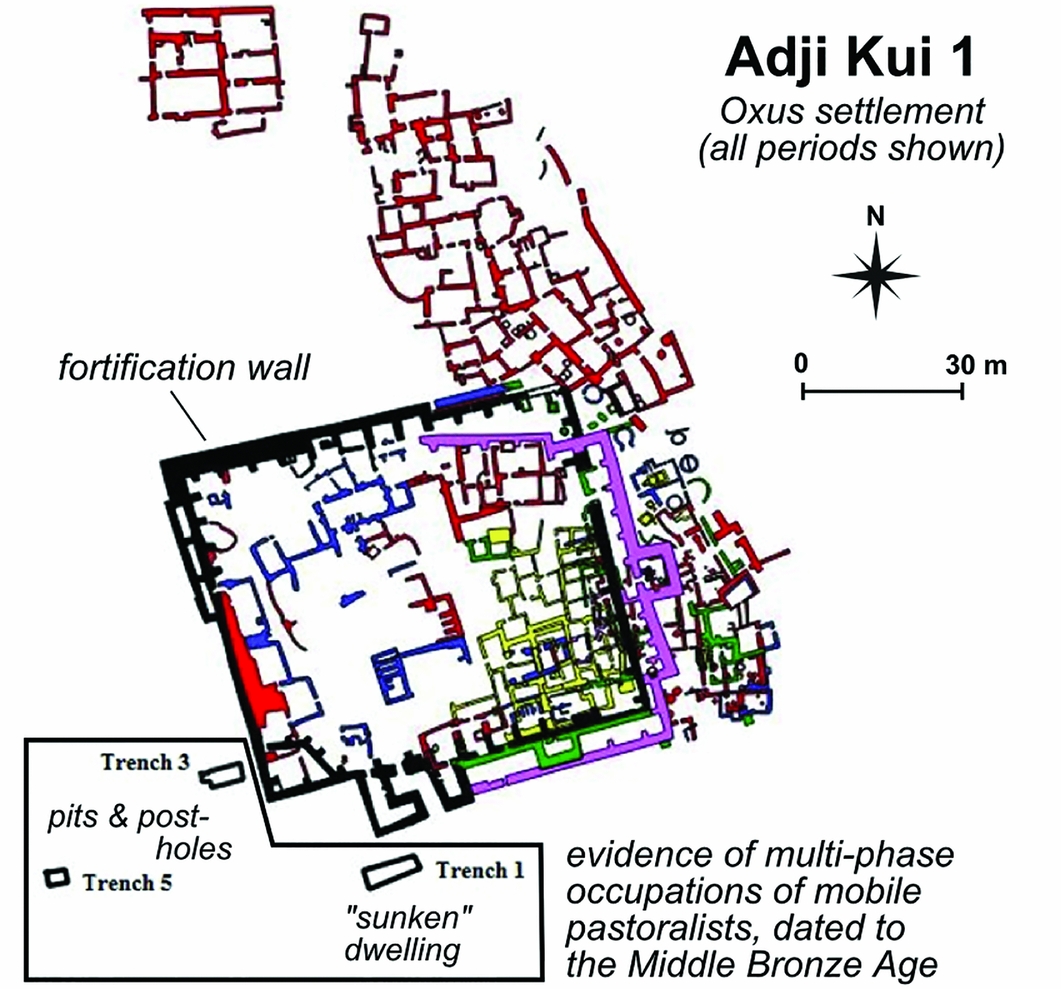
To date, a multi-phase campsite located immediately outside the Bronze Age farming settlement of Adji Kui 1 provides the earliest direct evidence for farmer-pastoralist interaction in the Murghab (Cerasetti et al. Reference Cerasetti, Rouse, De Nigris, Lhuillier and Boroffka2018). Three trenches opened in 2013 revealed a pastoralist semi-subterranean dwelling and an associated refuse area abutting the outer fortification wall of the farming settlement (Figure 4). The pastoralist occupation dates to the local Middle Bronze Age (Spengler et al. in press; Cerasetti et al. Reference Cerasetti, Rouse, De Nigris, Lhuillier and Boroffka2018), based on dating of a carbonised millet grain (3708±45 BP; LTL15740A: 2210–1960 BC at 94.2%; date modelled in OxCal v.3.5, using IntCal13 calibration curve (Reimer et al. Reference Reimer, Bard, Bayliss, Beck, Blackwell, Ramsey, Buck, Cheng, Edwards, Friedrich, Grootes, Guilderson, Haflidason, Hajdas, Hatté, Heaton, Hoffmann, Hogg, Hughen, Kaiser, Kromer, Manning, Niu, Reimer, Richards, Scott, Southon, Staff, Turney and Van der Plicht2013)). This time period coincides with both the height of the Oxus civilisation and the most substantial settlement phase at Adji Kui 1—when the site was composed of a central mound, craft production areas to the north and south, and a necropolis to the west (Salvatori Reference Salvatori2002: 107–108; Rossi Osmida Reference Rossi Osmida2007: 16). The physical proximity and overlapping dates of the pastoralist campsite and the walled farming settlement at Adji Kui 1 suggest that distinct groups of farmers and pastoralists were living together in essentially the same physical space, prior to periods traditionally associated with the decline in the Oxus cultural-political system.
Location of the Middle Bronze Age (c. 2210–1960 BC) pastoralist camp outside the fortified Oxus settlement of Adji Kui 1 (mapping by A. Orazov & G. Rossi Osmida; GIS preparation by I. de Nigris).

The pastoralists living outside of Adji Kui 1’s walls formed a distinct community from the Oxus farmers dwelling within, as reflected by their semi-subterranean dwellings and handmade coarseware (Cerasetti et al. Reference Cerasetti, Rouse, De Nigris, Lhuillier and Boroffka2018). There are signs that pastoralist behaviour was also adapted in subtle ways. The proximity of the campsite and its physical integration with a permanent, walled settlement is one example. Perhaps the most informative shift in pastoralist behaviour, however, is observed in the subsistence patterns of the campsite. Although there was a clear emphasis on sheep and goat remains, some cattle and small freshwater fish bones (Paracobitis sp.) were also identified (Cerasetti et al. Reference Cerasetti, Rouse, De Nigris, Lhuillier and Boroffka2018; Spengler et al. in press). Fishing in modern irrigation canals has been observed by the authors, and it was probably a supplementary subsistence activity in the past. Similarly, although the overall quantity of plant remains recovered was too low to argue that they formed a major dietary component for the pastoralists, a wide variety of species was recorded in the campsite deposits. These include cultivated grains such as barley, wheat and millet (Hordeum vulgare var. vulgare and var. nudum, Triticum aestivum/turigidum, Panicum miliaceum), legumes such as peas, grass peas, lentils, bitter vetch and fava beans (Pisum sativum, Lathyrus sativus, Lens culinaris, Vicia ervila, Vicia faba), oil crops (Lallemantia sp.), wild (possibly maintained) fruits and nuts (Prunus sp. Crataegus spp.), and wild herbs (Spengler et al. in press).
The co-presence of culturally distinct mobile pastoralists and settled farmers at Adji Kui 1 therefore appears to have influenced pastoralist eating habits. These changes, however, did not erase the overall distinctions still recognisable between the two communities in their everyday practices, modes of living and material identity. The remains from the Adji Kui 1 campsite may instead represent a re-shaping of what it meant to be a pastoralist in this time and place, and thus provides some of the first evidence for the drawn-out and conscious process of shifting practices along a spectrum broadly identified as ‘agropastoralism’.
Togolok 1 (c. 1880–1620 BC)
In 2014–2015, test excavations at the Oxus-period occupation mound of Togolok 1 (north mound, Middle–Late Bronze Ages) revealed a pastoralist campsite immediately post-dating Adji Kui 1 (directly dated by in situ barley grain to 3420±45BP (LTL15824A: 1880–1620 BC at 95.4%; date modelled in OxCal v.3.5, using IntCal13 calibration curve (Reimer et al. Reference Reimer, Bard, Bayliss, Beck, Blackwell, Ramsey, Buck, Cheng, Edwards, Friedrich, Grootes, Guilderson, Haflidason, Hajdas, Hatté, Heaton, Hoffmann, Hogg, Hughen, Kaiser, Kromer, Manning, Niu, Reimer, Richards, Scott, Southon, Staff, Turney and Van der Plicht2013)) (Cerasetti et al. in press). Here, the campsite layers were situated above 0.2m of soil that overlaid the remains of earlier mud-brick structures. This suggests that pastoralists set up camp at a depopulated or partially abandoned farming settlement. A deep test trench dug into the Togolok 1 mound undertaken in the 1980s indicates that the site was a prominent Oxus urban centre (Sarianidi Reference Sarianidi1990; see also Gundogdiyev & Salvatori Reference Gundogdiyev and Salvatori2005).
In addition to superimposed living surfaces with postholes, small storage pits and cooking hearths, the Togolok 1 campsite contained a 0.15m-thick layer rich in sheep and goat dung, carbonised plant remains, burnt ceramics and reed-impressed lumps of mud. This layer is interpreted as a small-sized animal pen, constructed of local vegetation in a similar manner to that of local contemporary herders (Cerasetti et al. in press). The pastoralist signature at Togolok 1 is also identifiable in the handmade coarseware present at the site.
At Togolok 1, the interaction of pastoralism and agriculture (if not pastoralists and farmers themselves) is again evident in subsistence shifts; while sheep and goat comprise the majority of faunal remains at the site, cattle and pig are also represented. Togolok 1 yielded a wider variety and overall abundance of domestic crops than the campsite at Adji Kui 1, with cereals (barley and wheat) and pulses/legumes (grass peas, lentils, peas and vetch) dominating the assemblage. The remains of a few fruits (grape pips (Vitis vinifera), a fragment of a Prunus sp. stone) were also identified (Cerasetti et al. in press).
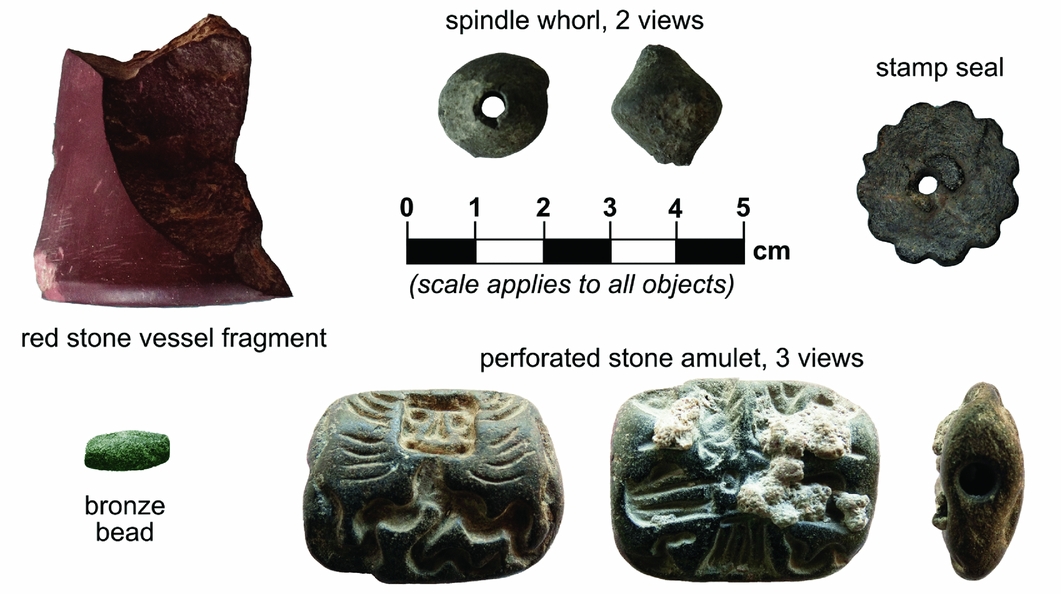
A number of small items that may indicate economic exchange with local farmers are unique to Togolok 1 among the campsites discussed here. Beads, spindle whorls, seals and amulets, stone vessels and anthropomorphic figurines that are relatively common in Bronze Age sedentary sites also feature in the Togolok 1 pastoralist camp deposits (Figure 5), but are rare or unknown at other pastoralist occupations (Arciero & Forni Reference Arciero, Forni, Ferrari, Pupulin, Ruffilli and Tomelleri2018). Spindle whorls in particular are suggestive of an exchange relationship involving animal products and textile production. In return, the pastoralists may have received personal adornments and grazing rights. The stamp seals and pieces of rope-impressed clay (which may represent sealings) also suggest that such exchanges may have taken place (Cerasetti et al. in press).
Small finds from the campsite at Togolok 1 (photographs by authors).

Ojakly (c. 1742–1440 BC)
The largest and most complex of the campsites discussed here is Ojakly—a multi-function, multi-phase site dating to the Late Bronze Age (Rouse & Cerasetti Reference Rouse and Cerasetti2014). Ojakly sits alone in the immediate landscape, and in terms of its physical relationship to the known agricultural zone of the Bronze Age Murghab, it represents the most isolated of the campsites featured here. Ojakly covers approximately 3ha, and three concentrations of surface material excavated in 2010 revealed two living areas and one ceramic production area.
The pastoralist signatures at Ojakly are well documented in the emphasis on sheep and goat for subsistence and the paucity of agricultural remains in food preparation and refuse contexts. The inhabitants’ cultural distinction from Oxus groups is clearly marked in their living arrangements and ceramics. Even so, certain practices related to the inhabitants’ production and use of ceramics indicate that they were familiar with behaviours and material forms that were important to late Oxus farming communities (Rouse & Cerasetti Reference Rouse and Cerasetti2014; Rouse Reference Rouse2015). First, the Ojakly pastoralists constructed a double-chambered kiln, similar in concept but different in form to the numerous pottery kilns found in nearly all Oxus settlements (cf. Dzhumanazarov Reference Dzhumanazarov, Sarianidi, Kozhin, Kosarev and Dubova2012) (Figure 6a). As the handmade coarseware that constituted 90 per cent of Ojakly's ceramics was not kiln-fired, there was little obvious need for this investment in ceramic production. In fact, the kiln appears to have collapsed during its first firing, sealing inside unfired, wheel-finished ceramics of a typical Oxus-tradition ‘potstand’ or mould-based form, wheel-finished but with a poorly levigated paste more similar to pastoralist handmade coarseware (Rouse & Cerasetti Reference Rouse and Cerasetti2014). These lay near the bottom of the kiln in a thick layer of ash (Figure 6b). The Ojakly kiln indicates experimentation on two levels—first in the (failed) construction of the kiln, and second in the mixture of ceramic form and production technique represented by the potstands.
a) The double-chambered kiln at Ojakly; b) unfired wheel-finished ‘potstands’ found in the ashy fill at the bottom of the kiln chamber (photographs and drawing by authors).

The second Oxus-influenced feature exhibited in the Ojakly ceramics is the use of small, straight-sided drinking cups, known from Oxus assemblages. Both imported wheel-finished Oxus examples and handmade coarseware versions are found in the Ojakly ceramics (Rouse & Cerasetti Reference Rouse and Cerasetti2014; Rouse Reference Rouse2015). The presence of imported cups is surprising, given that the Ojakly pastoralists had other means of consuming liquids and that other Oxus vessels could equally have been imported. We might therefore cautiously interpret the presence of imported drinking cups at Ojakly as evidence of meetings between farmers and pastoralists (perhaps for negotiating land use; cf. Hiebert & Moore (Reference Hiebert, Moore, Kosarev, Kozhin and Dubova2004) for a ‘steppe’ site near Gonur-tepe), or at least a pastoral ‘buying in’ to the aesthetics or behaviours that local farmers associated with these cups.
Overall, the kiln, the unfired ceramics and the imported drinking cups at Ojakly demonstrate an expanding conceptual realm for what the pastoralist inhabitants considered acceptable or useful pottery. Yet these represent limited and specific exchanges (i.e. technology sharing, beverage consumption) that did not undermine the general aesthetic or craft production of the site's dominant handmade coarseware assemblage. We might infer from this that the social position of pastoralists vis-à-vis farming communities was actively maintained and constructed through the materials and behaviours that they employed.
Chopantam (c. 1690–1260 BC)
Chopantam represents the most southerly Bronze Age pastoralist site excavated in the Murghab, as well as probably the latest chronologically of the sites investigated. As with Ojakly, Chopantam was a standalone campsite with a clear, non-Oxus pastoral signature. Excavated in 2001–2002 and 2006, the site comprises a multi-phase, semi-subterranean dwelling and an associated dug-out storage structure (Cattani 2008b) (Figure 7a). The ceramic assemblage includes predominantly handmade coarseware, but also wheel-shaped Oxus ware. The roofed storage area appears to have burned accidentally, sealing inside three charred Oxus storage vessels. These contained caches of processed free-threshing wheat, six-rowed barley (a mix of naked and hulled varieties), green pea, grass pea, lentil and broomcorn millet (Spengler et al. Reference Spengler, Cerasetti, Tengberg, Cattani and Rouse2014a) (Figure 7b). A grinding stone was also recovered. The combination of the site's location in the Bronze Age agricultural heartland and its proximity to a small artificial water channel of ancient date (Ninfo & Perego Reference Ninfo and Perego2006; Cattani 2008b) suggests that Chopantam's inhabitants were, to some degree, involved in agriculture. Even if such pursuits were seasonally limited, or if these mobile pastoralists were simply processing and consuming agricultural products traded from nearby farmers, these activities and the long-term occupation at the site, certainly suggest a different situation compared to the animal-based subsistence at Ojakly. Yet the overall pastoralist signature at Chopantam (seen in architecture and ceramics) indicates that this way of life persisted, even if agricultural pursuits were, to various degrees, incorporated into routine activities.
Semi-subterranean, multi-phase pastoralist dwelling at Chopantam (top) and stored grains recovered from the site's collapsed, burnt storage area (bottom) (top photograph from Cattani (2008b: fig. 9.9); bottom photograph by authors).

Discussion
The emerging archaeological evidence for farmer-pastoralist interaction in prehistoric Central Asia indicates variability in what was exchanged (ideas and material culture) and in the scale of these exchanges (geographically and temporally). Migration, colonisation and cultural diffusion have often been invoked to explain the similarities and differences in the material culture of these groups (e.g. Kohl Reference Kohl2002; Anthony Reference Antony2007; Sarianidi Reference Sarianidi2010). More recent scholarship, however, has sought conceptual frameworks to explain the overlaps and incongruences in the material record in terms of various types of exchange (e.g. ideological, technological or economic) rather than in the movement of people themselves (Wright Reference Wright and Lamberg-Karlovsky1989; Francfort Reference Francfort1994; Good Reference Good and Mair2006, Reference Good2010; Doumani & Frachetti Reference Doumani and Frachetti2012). In this sense, Frachetti's ‘non-uniform’ schema (2009, Reference Frachetti2012) offers a model of multi-scalar variability in Eurasian prehistoric social and material interactions by linking the circuits of everyday life and the broad regional spread of (dis)similar material culture. Local variability, regional patterning and movements of practices and ideas are also addressed specifically in research on Central Asian prehistory through Kohl's ‘shared social fields’ (Reference Kohl2008) and Lamberg-Karlovsky's ‘grammars of meaning’ (Reference Lamberg-Karlovsky and Lamberg-Karlovsky1989). Importantly, the sum of such archaeological interrogation is shifting inter-cultural interaction from a rudimentary explanation of the past to a subject of investigation in its own right. Two essential further steps required to understand Central Asian prehistory are to acknowledge the difference between meaning and meaningfulness in the interpretation of the archaeological record, and to deconstruct the motivations of culturally distinct pastoralist and farming groups for engaging (or not) with each other's materials, behaviours and social logics.
With regard to moving towards deconstructing motivations, the four sites discussed here offer evidence for the variability in the materials and ideas that pastoralists used to negotiate the overlapping social worlds that they encountered in the Bronze Age Murghab. First, the results indicate a cultural model of ‘being’ a pastoralist that was maintained actively over hundreds of years, in part by its material difference from that of local farmers. Second, the variability of materials, technologies and practices shared at these campsites suggests that no hegemonic power controlled trade relationships or regulated economic dependency between Oxus farmers and non-Oxus mobile pastoralists in the Murghab. Indeed, current data indicate that pastoralist occupation in the Murghab intensified during the waning of Oxus political centralisation, suggesting that the loosening of state-level structures provided the opportunity for intercultural interactions, rather than interactions being promoted or facilitated from the top. Finally, in the removal of broad-brush narratives that polarise ‘the steppe’ and ‘the sown’, and the integration of evidence suggesting that mobile pastoralists influenced the crop systems of farmers in southern Central Asia (Spengler et al. Reference Spengler, Frachetti, Doumani, Rouse, Cerasetti, Bullion and Mar'yashev2014b), these four sites allow us to recognise the means by which farmers and pastoralists re-shaped cultural institutions while reinforcing the meaningfulness of the associated social categories. Current work in the Murghab complements detailed studies of pastoralists in other Eurasian contexts (e.g. Frachetti Reference Frachetti2008; Rogers Reference Rogers2012; Honeychurch Reference Honeychurch2015) in beginning to unravel simplistic notions of broad cross-cultural exchanges in Eurasian prehistory and the political entities traditionally seen as directing them.
Compared with the anachronistic or geographically inappropriate models drawn from Near Eastern or Eurasian Steppe archaeology, Central Asian prehistory is defined by an incongruent variety of material, technological and social exchanges that cannot be explained by simplistic scenarios of dependency and diffusion. By virtue of their participation in multi-scalar networks of interaction, pastoralists in the Bronze Age Murghab were presented with the option to ‘buy in’ to different materials and practices of either (or both) the steppe or the sown world. The networks that these groups participated in would tie them into a set of broadly shared norms concerning the value placed on certain materials and practices (e.g. herding sheep or goats, building houses and ceramic production). If the sites discussed here, however, represent particular contexts of interaction, rather than a chronological trajectory, then we can also see how the actual practices of mobile pastoralism may not always have been as important as the meaning. That is, the meaningfulness of animals or pottery as signals tying these groups to more distant mobile pastoralists, or distinguishing them from Oxus farmers, did not have to be directly reflected in their meaning for everyday practice (their utility). Mobile pastoralism held a significance to the social life of the Bronze Age Murghab, and some pastoralists could maintain themselves as a community distinct from Oxus farmers even as they adapted along the spectrum of mixed agropastoralism, or experimented with new materials and ideas. The sites presented here demonstrate, in fact, that small changes in everyday behaviour (e.g. eating habits, pottery production) did not result in dissolving the distinction between pastoralists and farmers. The boundaries of social categories in a specific place and time were instead reshaped, perhaps especially for the pastoralists.
Reframing our understanding of sedentary-mobile relationships in prehistoric Central Asia is significant in that it encourages a wider focus on cultural interaction as the subject of research rather than as an explanatory framework for other Eurasian regions and periods. For one, it allows us to invert the notion of centre and periphery, and to reconsider our ideas of civilisation and boundaries, and the participants in their creation. In instances of inter-cultural contact, local communities were (and are) presented with opportunities to engage (or not) with new traditions, rules and social logics; their decisions have both ideological and material consequences. By focusing on the shifting sets of materials and practices in local contexts and their impact at larger scales, we can progress beyond the observation that social relationships are fluid and variable, and towards an understanding of how and why this malleability shaped human history in Eurasia.
Acknowledgements
The authors are very grateful to M.A. Mamedov of the Ministry of Culture of Turkmenistan for his support, and to R. Jepbarov of the same institution for help with fieldwork logistics. Additionally, we thank R. Arciero (University of Leiden) and L. Forni (University of Trieste), who were instrumental to excavations at Adji Kui 1 and Togolok 1.