Introduction
Worldwide squid populations are characterized by individuals living fast and dying young (Rodhouse et al., Reference Rodhouse, Pierce, Nichols, Sauer, Arkhipkin, Laptikhovsky, Lipiński, Ramos, Gras, Kidokoro, Sadayasu, Pereira, Lefkaditou, Pita, Gasalla, Haimovici, Sakai and Downey2014). This life pattern implies short life cycles, high metabolic rates, rapid growth in response to phenotypic plasticity, and marked sensitivity to changing environmental conditions (Jackson & Domeier, Reference Jackson and Domeier2003; Pecl & Jackson, Reference Pecl and Jackson2008). In addition, squid and other taxa of cephalopods display different ovulation patterns (Rocha et al., Reference Rocha, Guerra and González2001) employing highly flexible spawning strategies, determined by the environmental seasonality of each region throughout their distribution range (e.g. Pecl & Jackson, Reference Pecl and Jackson2008; Lin et al., Reference Lin, Xuan, Chen and Chen2018; Golikov et al., Reference Golikov, Blicher, Jorgensen, Malkusz, Zakharov, Zimia and Sabirov2019).
Therefore, the knowledge on the abundance and distribution dynamics has implications in the studies on the ecosystem structure and in squid fishery management (Rodhouse et al., Reference Rodhouse, Pierce, Nichols, Sauer, Arkhipkin, Laptikhovsky, Lipiński, Ramos, Gras, Kidokoro, Sadayasu, Pereira, Lefkaditou, Pita, Gasalla, Haimovici, Sakai and Downey2014; Doubleday & Connell, Reference Doubleday and Connell2018). Loliginidae (offshore squids) contribute to a significant part (529,000 tonnes) of worldwide squid catches (FAO, 2022). Three loliginid squids are the most frequently caught by artisanal fisheries in the Mexican Pacific: Lolliguncula diomedeae Hoyle, 1904, L. panamensis Berry, 1911, and L. argus Brakoniecki & Roper, Reference Brakoniecki and Roper1985 (Jereb et al., Reference Jereb, Vecchione, Roper, Jereb and Roper2010). However, only L. diomedeae and L. panamensis are abundant in the bycatch of the artisanal shrimp trawl fleet (Alejo-Plata et al., Reference Alejo-Plata, Cerdenares-Ladrón de Guevara and Herrera-Galindo2001; Arizmendi-Rodríguez et al., Reference Arizmendi-Rodríguez, Rodríguez-Jaramillo, Quiñónez-Velázquez and Salinas-Zavala2012a; Guzmán-Intzin et al., Reference Guzmán-Intzin, Alejo-Plata, González-Acosta and León-Guzmán2020). In consequence, these two squid species have been the subject of several biological studies (Sánchez, Reference Sánchez2003; Arizmendi-Rodríguez et al., Reference Arizmendi-Rodríguez, Rodríguez-Jaramillo, Quiñónez-Velázquez and Salinas-Zavala2012a; Guzmán-Intzin et al., Reference Guzmán-Intzin, Alejo-Plata, González-Acosta and León-Guzmán2020; León-Guzmán et al., Reference León-Guzmán, Alejo-Plata, Morales-Bojórquez and Benitez-Villalobos2020).
On the other hand, the Argus brief squid (L. argus), a squid species endemic to the eastern Pacific (Jereb et al., Reference Jereb, Vecchione, Roper, Jereb and Roper2010) has been studied mainly in regard to its taxonomy and biogeography, due to its lower abundance in catches (Granados et al., Reference Granados-Amores, Hochberg and Salinas-Zavala2013; Alejo-Plata et al., Reference Alejo-Plata, Urbano-Alonso and Ramírez-Castelán2016; Costa et al., Reference Costa, Sales, Markaida, Granados-Amores, Gales, Sampaio and Va2021). Currently, there are no studies addressing the reproductive biology of L. argus throughout its distribution range (Supplementary Table S1).
The marked increase in the abundance of L. argus from May 2017 to April 2018 in the Puerto Angel, Oaxaca region (southern Mexican Pacific) allowed studies on the reproductive biology of this species to be carried out.
Artisanal fishery is an important commercial activity on the Puerto Angel coast, and is based mostly on trolling lines, surface longlines, driftnets and surface gill nets. In particular, the local cephalopod fishery mostly targets Octopus hubbsorum (Alejo-Plata et al., Reference Alejo-Plata, Urbano-Alonso and Ramírez-Castelán2016), while loliginid squid catch serves for local consumption or is used as bait for sharks and other pelagic fisheries, in conjunction with spoon-fishing nets locally known as ‘chacalmata’. This study aims to provide data on the reproductive ecology of L. argus, with a focus on ovarian development and spawning patterns by means of both histological and oocyte size–frequency analyses.
Materials and methods
Study area
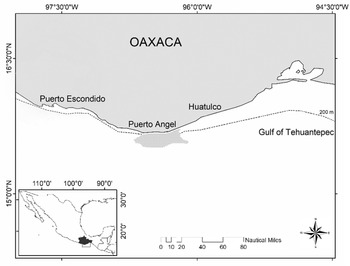
Puerto Angel lies on the coast of Oaxaca, in the western margin of the Gulf of Tehuantepec (Mexican Pacific). The continental shelf width varies from 106.8 km at the gulf to 17.8 km at Puerto Angel (Figure 1). The climate is characterized by a rainy season from May–October, and a dry season from November–April. During the dry season, strong winds known as ‘Tehuanos’ that originate in the Gulf of Mexico blow across the Isthmus of Tehuantepec, causing upwellings that increase biological productivity in this area (Trasviña & Barton, Reference Trasviña and Barton2008), while to the west of Puerto Angel, westerly surface winds are dominant (Reyes-Hernández et al., Reference Reyes-Hernández, Ahumada, López-Pérez and Malagón-Pimentel2019).
Study area. Dotted polygon represents artisanal fishing area in Puerto Angel Oaxaca, southern Mexican Pacific.

Satellite images clearly show the oceanographic conditions prevalent in the Gulf of Tehuantepec, with high chlorophyll a (Chl-a, a proxy of primary production) concentrations and a relatively low sea surface temperature (SST) due to strong vertical and entrainment mixing (Trasviña et al., Reference Trasviña, Barton, Brown, Velez, Kosro and Smith1995).
Data on sea surface temperature (SST, 1988–2019; NOAA ER SST V3b, https://psl.noaa.gov/thredds/catalog/Datasets/noaa.ersst/catalog.html), sea surface salinity (SSS, 2011–2015; NASA EOSDIS PO.DAAC, https://podaac.jpl.nasa.gov) and Chl-a concentration (https://marine.copernicus.eu/newsflash/oc-323-153 oceancolour_glo_chl_l4_nrt_observations_009_033) (Supplementary Figure S1) for L. argus bycatch were obtained by delimiting polygons around the fishing zone, using MATLAB® version 2006.
Sampling and processing
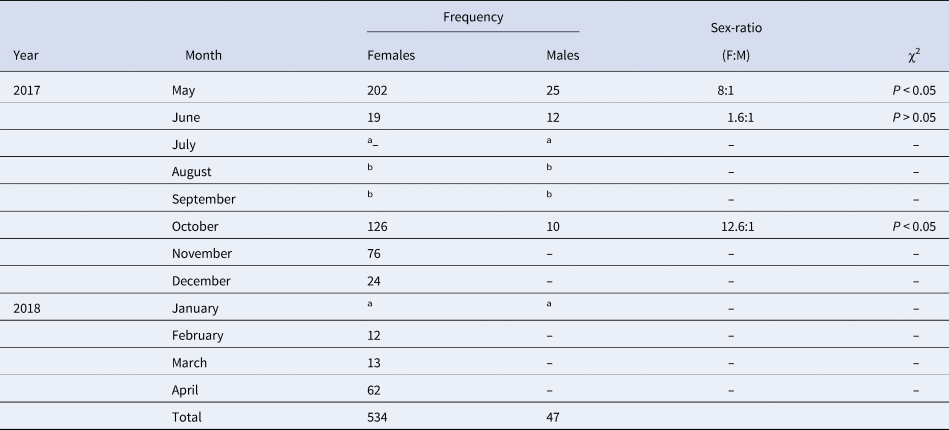
The squid samples were obtained from artisanal fishing activities carried out from May 2017 to April 2018. However, not all months were sampled due to adverse weather conditions that prevented fishing activities or due to an absence of squid coincident with two hurricanes and one earthquake that occurred in September 2017 in the Gulf of Tehuantepec area. Consequently, our results exclude samples from July–September (Table 1). We captured squid at about 5 km from the coast, using a spoon-fishing net. All the specimens were preserved in ice for transportation to the laboratory, identifying a total of 581 L. argus specimens, following the criteria of Brakoniecki & Roper (Reference Brakoniecki and Roper1985).
Number of females and males of Lolliguncula argus by month caught in Puerto Angel, Oaxaca, Mexico

a Samplings with no catches.
b Artisanal fishing activities were very limited.
The dorsal mantle length (DML) and total weight (W) were measured with a 0.01 mm precision digital calliper and weighing scales to the nearest 0.1 g, respectively. We determined sex by macroscopic observation of the gonads, which we removed and weighted to the nearest 0.01 g. Prior mating was confirmed by the presence of implanted spermatangia on the inner lining of immature female mantle cavity. Maturity stages were determined according to the scale proposed by Juanico (Reference Juanico and Cady1983), who classifies the squid as follows. Females: (I) Immature with presence of nidamental glands and a small translucent ovary; (II) Maturing with small nidamental glands and a translucent ovary containing small oocytes; (III) Mature with larger nidamental glands, an opaque-yellow ovary, presence of oocytes, and a visible oviduct; (IV) Spawning with presence of swollen and firm nidamental glands, an ovary full of oocytes (occupying half of the posterior mantle cavity), and a full oviduct; and (V) Post-spawning with flaccid or reduced nidamental glands, a flaccid ovary and oviduct with some immature oocytes, and remaining tissue.
The maturation stages for males were as follows. (I) Immature with absence of spermatophores in the spermatophoric sac; (II) Maturing with small, scarce spermatophores and visually distinguishable testis; and (III) Mature with abundant presence of well-developed spermatophores, and larger testis. Because squid males produce spermatangias continuously, it was difficult to discriminate them from spent individuals, thus in the framework of the present study spawning and spent males were pooled together and assigned maturity stage III.
To analyse gonad development, a section of each ovary was fixed in 10% formalin, dehydrated and cleared with citriSol™, and embedded in paraplast, to cut them in serial sections 7 μm thick using a Leica RM2145® manual rotary microtome (Leica Biosystems). Each section was stained following the haematoxylin-eosin procedure (Bancroft et al., Reference Bancroft, Stevens and Turner1996). The gonads were examined based on the oogenesis process outlined by Melo & Sauer (Reference Melo and Sauer1999); an evidence of ovulation was verified by observing the integrity of the surrounding follicles (Melo & Sauer, Reference Melo and Sauer2007).
Ovaries and oviducts were removed from 20 female specimens at different maturity stages (III, IV and V). Oocytes were isolated and counted in the three ovary subsamples (each weighing 0.05–0.07 g, measured to the nearest 0.01 mg), damaged oocytes were discarded. The larger diameter of each oocyte was recorded using a Zeiss® stereo microscope equipped with a digital camera and software for image analysis (Zen 2.3). The major axis length was recorded.
Data analysis
A χ2 test (P = 0.05) with Yates's correction was used to determine whether the sex ratio by month deviated from 1:1 (Zar, Reference Zar1999). The gonadosomatic index (GSI) was estimated following the equation GSI = Wg/W × 100, where Wg is the weight of the gonad and W the total weight of the squid. Data were tested for normality with the Shapiro–Wilk test. Since the data did not satisfy the normality assumption, the monthly variations were analysed using the non-parametric Kruskal–Wallis test (Zar, Reference Zar1999).
The length at which 50% of all specimens were sexually mature (L 50) was estimated for males and females separately using a logistic function and applying maximum likelihood (Haddon, Reference Haddon2001). The DML – (W) relationship was used to convert L 50 to W 50. All statistical analyses were carried out using the software Statistica v.7.0.
Results
Maturation and reproduction
A total of 581 L. argus individuals were collected during the nine months of sampling: 534 females (11.9–82.4 mm DML) and 47 males (16.0–68.2 mm DML). Females were clearly predominant (P < 0.05), the sex ratio was lower in June (1.5F: 1M, χ2 = 1.16, P > 0.05) (Table 1).
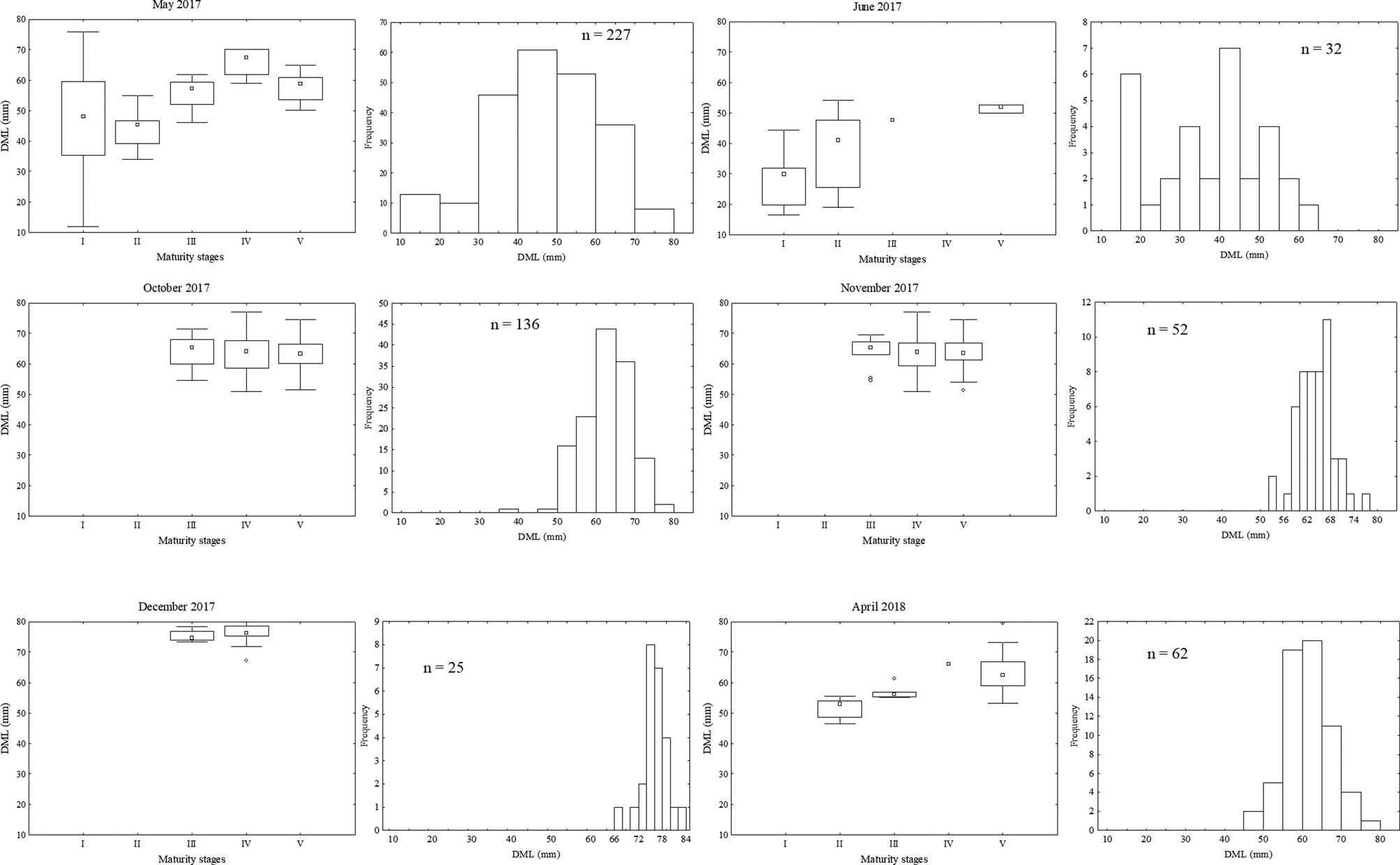
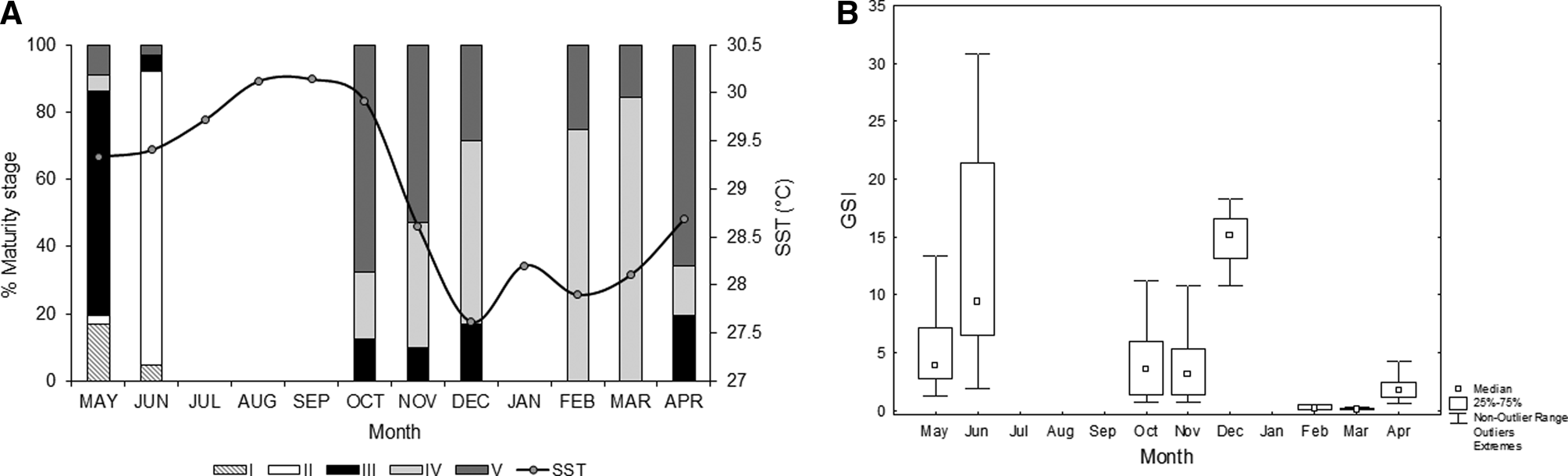
A total of 50.5% of examined females were at mature (III) and spawning (IV) stages, and 28.1% were post-spawning (V) (Table 2, Figure 2). The monthly proportions of maturity stages showed high reproductive activity from April–June and from October–December (Figure 2), coinciding with higher GSI values (Figure 3A, B); 70.2% of mature females showed spermatangia attached to the inner wall of the mantle cavity. Spawning females were present throughout the entire sampling period, with peaks of spawning activity in February and March, and from October–December; post-spawning females (V) were found throughout the entire sampling period (Figure 3A).
Length-frequencies by month (right) and maturity stages (left) for females Lolliguncula argus sampled from the Puerto Angel, Oaxaca, May 2017 to April 2018.

(A) Maturity classification of female Lolliguncula argus and sea surface temperature (SST) in geographic locations where L. argus specimens were caught; (B) Box plots of gonadosomatic indices (GSI). (I) immature, (II) maturing, (III) mature, (IV) spawning and (V) post-spawning.

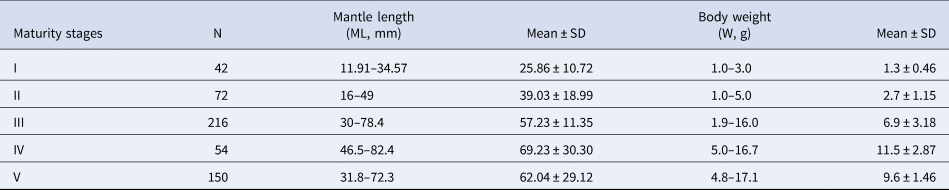
Body size in females Lolliguncula argus off Puerto Angel, Oaxaca, Mexico

The sexual maturity stage of females was not determined by specimen size. Nonetheless, females larger than 46.0 mm DML were starting to become sexually mature, while those at 50.0 mm DML had mature oocytes.
GSI differed significantly between squids at different stages of maturity (F (4, 815) = 248.6, P < 0.05). The monthly GSI values of females also exhibited significant differences (H (8, 581) = 410.67, P < 0.01) (Figure 3B).
Immature males (8.5%) were present in May and June, with a GSI value of 3.3–5.0. The monthly proportions of maturity stages showed high spawning activity in May and June (68.2%) and October (23.3%), with GSI values of 4.0–10 and 3.5–7.8, respectively.
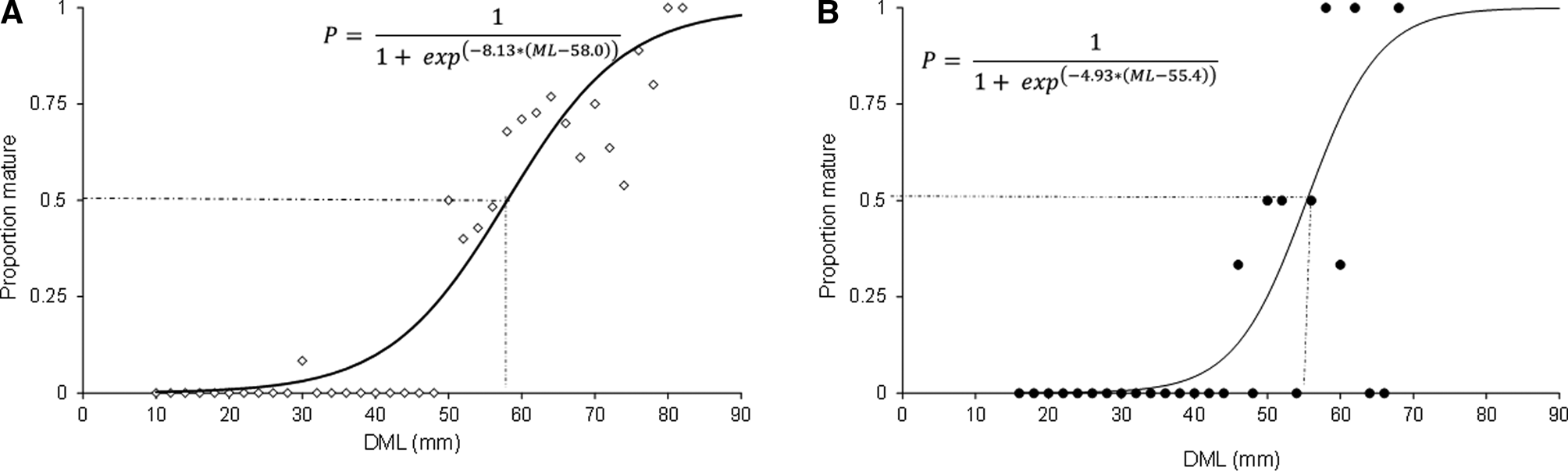
The estimated size at sexual maturity (L 50) was 58.0 mm DML (95% confidence interval, CI) for females and 55.4 mm DML (95% CI) for males. The estimated W 50 was 7.12 g for females and 5.46 g for males (Figure 4). Females mature at lengths ranging from 46.0–70.0 mm DML, and males mature at 50.0–65.0 mm DML. Two peaks of spawning were observed from May to June and in October (Figures 2 and 3).
Lolliguncula argus sampled from the Puerto Angel, Oaxaca. Proportion of mature specimens by length. (A) females, (B) males. Fitted curve illustrates the optima logistic maturation ogive fitted by maximum likelihood.

Oocyte development and spawning
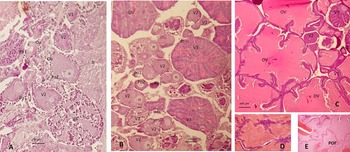
As oocyte maturation progresses, the ovary continues producing new primary oocytes (Figure 5A, B). In maturity stages IV and V, oogonia (0.08 mm), previtellogenic oocytes (1.2–1.55 mm), vitellogenic oocytes (1.55–2.9 mm), postvitellogenic oocytes (2.9–3.6 mm in diameter), and postovulatory follicles were found (Figure 5C–E). During these ovarian phases, oocytes between 2.9 and 3.6 mm in diameter fill the oviducts, indicating the presence of pre-spawning females.
Gonad development in female Lolliguncula argus sampled from the Puerto Angel, Oaxaca. (A) Primary growth (Previtellogenesis), Oo, oogonia; previtellogenic oocytes, Po1, Po2; (B) Secondary growth (Vitellogenesis), early vitellogenic oocytes, V1; late vitellogenic oocytes, V2 and V3; (C) Tertiary growth (Postvitellogenesis), ovulate oocytes, OV; (D) Early stage expulsion of follicle; (E) Postspawned, postovulatory follicle POF. A, atresia, fc, follicle cell, n, nucleus. Paraffin sections 7 μm, haematoxylin and eosin stain.

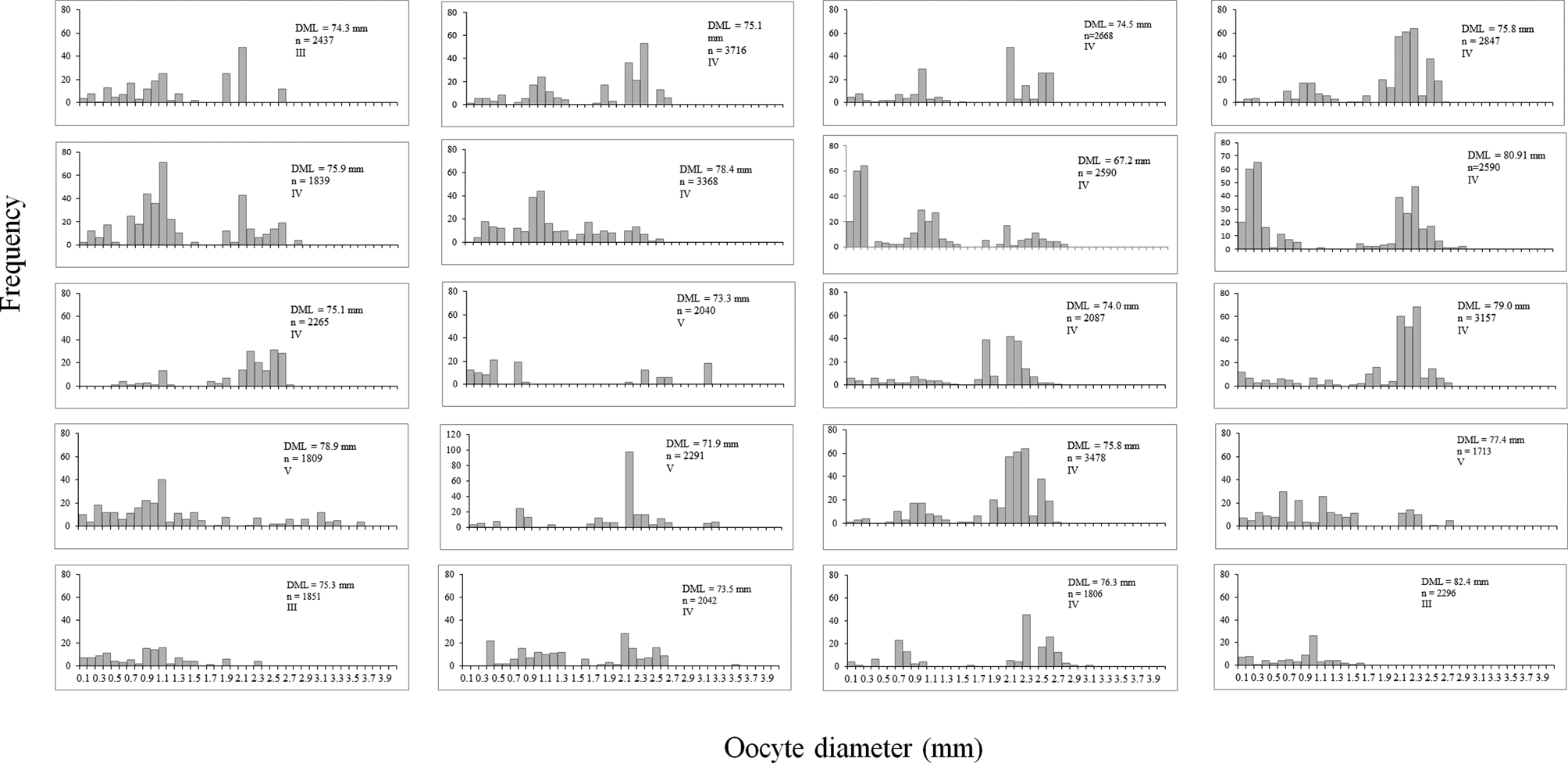
Gonad maturation was determined to show a pattern of group-synchronous ovulation, due to the predominance of small oocytes in maturity stages III and IV and the clear presence of batches (Figure 6). Morphologically and quantitatively (diameter) differentiated oocytes were observed in the ovary of L. argus at intermittent spawning events coincident with low temperature values (Figure 3A).
Lolliguncula argus females. Size-frequency distribution of whole oocytes in ovaries of 20 females (Stages III, IV and V).

Discussion
The seasonal distribution of the data collected over nine sampling months is the result of a higher proportion of mature squids in May–June and October; meanwhile the presence of small and immature squids from May–June suggests a first pulse of recruitment. The absence of juveniles (<10.0 mm DML) in the samples can be interpreted as a result of a low abundance of this size group; however, it is also likely to be due to the selectivity of the fishing gear used. One additional factor may be logistical limitations in analysing incidental catches of non-target species.
The maximum mantle length values for L. argus females (82 mm DML) and males (68.0 mm DML) reported here are larger than those of the squid species from the Gulf of California (females 39 mm DML and males 30 mm DML) (Jereb et al., Reference Jereb, Vecchione, Roper, Jereb and Roper2010). These differences could be explained by the low number of individuals previously recorded, as well as the fishing gear and depth of the catch; indeed, size and maturity of loliginids varies according to depth, temperature and dissolved oxygen (Rodrigues & Gasalla, Reference Rodrigues and Gasalla2008; Arizmendi-Rodríguez et al., Reference Arizmendi-Rodríguez, Salinas-Zavala, Quiñones-Velázquez and Mejía-Rebollo2012b; Guzmán-Intzin et al., Reference Guzmán-Intzin, Alejo-Plata, González-Acosta and León-Guzmán2020; León-Guzmán et al., Reference León-Guzmán, Alejo-Plata, Morales-Bojórquez and Benitez-Villalobos2020).
Sexual size dimorphism is well known in loliginids (Rodrigues & Gasalla, Reference Rodrigues and Gasalla2008). Males of Loligo spp. exhibit larger sizes than females (Perez et al., Reference Perez, De Aguiar and Oliveira2002; Olyott et al., Reference Olyott, Sauer and Booth2006; Moreno et al., Reference Moreno, Azevedo, Pereira and Pierce2007; Rodrigues & Gasalla, Reference Rodrigues and Gasalla2008), while females of L. argus (this study) and the other species of the genus Lolliguncula show larger maximum sizes than males, L. brevis (Martins & Perez, Reference Martins and Perez2007), L. panamensis (Arizmendi-Rodríguez et al., Reference Arizmendi-Rodríguez, Salinas-Zavala, Quiñones-Velázquez and Mejía-Rebollo2012b; Guzmán-Intzin et al., Reference Guzmán-Intzin, Alejo-Plata, González-Acosta and León-Guzmán2020) and L. diomedeae (León-Guzmán et al., Reference León-Guzmán, Alejo-Plata, Morales-Bojórquez and Benitez-Villalobos2020).
According to Pecl & Jackson (Reference Pecl and Jackson2008), coastal loliginid squids, such as L. argus, can tolerate and even thrive in warm sea temperatures, increasing their body sizes, and various species do show increased growth rates in warm waters. However, as evident here, populations of the same species show greater growth rates in tropical waters than in temperate waters.
During recent decades, the catch of squid as well as other cephalopods has increased globally, perhaps in response to fish stock depletion and environmental changes (Doubleday et al., Reference Doubleday, Prowse, Arkhipkin, Pierce, Semmens, Steer, Leporati, Lourenço, Quetglas, Sauer and Gillanders2016). This could explain the marked increase in abundance of L. argus during the most recent sampling events (two years) un the Puerto Ángel coast.
Loliginid squids are characterized by inshore spawning migrations (Sauer et al., Reference Sauer, Smale and Lipiñski1992; Hanlon & Messenger, Reference Hanlon and Messenger1996). The predominance of Argus brief squid females during the sampling period (P < 0.05) showed a close relationship with their reproductive behaviour. The low abundance of males has been associated with a natural death process after mating (Hanlon & Messenger, Reference Hanlon and Messenger1996). Therefore, the presence of mature males could indicate aggregations for mating. Various studies have demonstrated a close relationship between loliginid spawning aggregations and a male-biased sex ratio (Jackson & Forsythe, Reference Jackson and Forsythe2002; Perez et al., Reference Perez, De Aguiar and Oliveira2002; Arizmendi-Rodríguez et al., Reference Arizmendi-Rodríguez, Rodríguez-Jaramillo, Quiñónez-Velázquez and Salinas-Zavala2012a), whereas other loliginids (e.g. L. vulgaris) aggregate by sex in the vicinity of spawning areas (Sauer et al., Reference Sauer, Smale and Lipiñski1992). Due to the limited number of male specimens in this study, the size differences reported here need to be corroborated by studies with a larger sample size.
The presence of spermatangium patches within the mantle cavity in immature females indicates mating at early stages, possibly for ensure sufficient availability of sperm, as mating encounters between the sexes may be limited. Similar behaviour has been reported for other cephalopods such as Loligo plei (Rodrigues & Gasalla, Reference Rodrigues and Gasalla2008), Heteroteuthis dispar (Hoving et al., Reference Hoving, Laptikhovsky, Piatokowski and Önsoy2008), Bathyteuthis berryi (Bush et al., Reference Bush, Hoving, Huffard, Robison and Zeidberg2012), Octopus vulgaris (Cuccu et al., Reference Cuccu, Mereu, Porcu, Follesa, Cau and Cau2013), O. hubbsorum (Alejo-Plata & Gómez-Márquez, Reference Alejo-Plata and Gómez-Márquez2015) and Argonauta nouryi (Alejo-Plata & Martínez, Reference Alejo-Plata and Martínez2020). In these species, the spermatangia is retained in the mantle cavity until the spawning event.
To obtain higher precision in size-at-maturity evaluations, the results presented here were validated by means of a histological review of the ovaries, reducing the possibility of including immature and post-spawning females (e.g. DeMartini et al., Reference DeMartini, Uchiyama and Williams2000). The histological identification of the most advanced group of oocytes is an accurate indicator of the temporal and spatial spawning patterns of females (Melo & Sauer, Reference Melo and Sauer1999). Some immature Argus brief squid females exhibited sizes as large as fully mature female specimens, suggesting maturation events at different times and body sizes, while also indicating a bimodal distribution of adult size frequencies during the maturation phase.
The results of our study suggest that spawning and post-spawning stages in the Argus brief squid are characterized by oocyte growth in batches that include the presence of postovulatory follicles (POF) and atretic follicles, in addition to previtellogenic and vitellogenic oocytes. Meanwhile, the ovaries of mature females contained a range of oocyte sizes with a predominance of small oocytes throughout sexual maturation. The fact that some mature oocytes were found in mature and spawning females suggests that L. argus spawned in several batches within a relatively short period of time (intermittent spawning), as defined by Rocha et al. (Reference Rocha, Guerra and González2001).
The presence of different types of oocytes in the ovary of L. argus suggests that this species exhibits synchronous oocyte development by groups. This spawning pattern is common to other loliginid species with tropical distribution such as Loligo reynaudii (Sauer et al., Reference Sauer, Lipiñski and Augustyn2000), L. gahi (Laptikhovsky & Arkhipkin, Reference Laptikhovsky and Arkhipkin2001), L. panamensis (Arizmendi-Rodríguez et al., Reference Arizmendi-Rodríguez, Rodríguez-Jaramillo, Quiñónez-Velázquez and Salinas-Zavala2012a), L. brevis (Perez & Zaleski, Reference Perez, Zaleski, Rosa, O'Dor and Pierce2013) and L. diomedeae (León-Guzmán et al., Reference León-Guzmán, Alejo-Plata, Morales-Bojórquez and Benitez-Villalobos2020). The results reported here suggest that the occurrence of spawning and post-spawning squids may be related to low SST conditions occurring from October–March in the coast off Puerto Angel, when coastal currents are mainly south-eastward (Reyes-Hernández et al., Reference Reyes-Hernández, Ahumada, López-Pérez and Malagón-Pimentel2019). Squid are highly sensitive to temperature and therefore can be viewed ‘probably as climate change indicators’ (Pecl & Jackson, Reference Pecl and Jackson2008). To advance knowledge about L. argus and other tropical squid species, longer and simultaneous physical and biological time series collections are required.
Squid sampled directly from the catches of artisanal fisheries were exceptionally useful for establishing an understanding of several key aspects of the reproductive biology of L. argus, including important information about their spawning patterns. The presence of mature and spawning females suggests that this species extensively uses the coast of Puerto Angel as a reproductive area, exhibiting gregarious behaviour during spawning activity. Based on these results, the spawning behaviour of L. argus may constitute an opportunistic reproductive strategy in which individuals spawn at different times when the environment provides suitable conditions for doing so. The reproductive strategy reported here may be a response to suitable regional oceanographic conditions.
Supplementary material
The supplementary material for this article can be found at https://doi.org/10.1017/S0025315422000984
Acknowledgements
The authors thank the anonymous reviewers for their helpful comments that improve this manuscript. We are grateful to the artisanal fishermen from Puerto Angel, Oaxaca, who kindly allowed us to sample their catch, and to Ezequiel Rodríguez for help with field sampling. MCAP, CRH and AFGA thank the Sistema Nacional de Investigadores (SNI-CONACyT). AFGA also thanks the EDI and COFAA-IPN programmes. Joshua James Parker and Anna Cortesio for proofreading this manuscript. The authors declare there is no conflict of interest.
Financial support
This work was supported by the Consejo Nacional de Ciencia y Tecnología (CONACyT) (grant number PDCPN-2015-1740).