Introduction
The Model United Nations and the European Union Simulation, such as the one coordinated by the Institute for Eu Studies at SUNY and the Trans-Atlantic Consortium of European Union Studies and Simulations are two of the most effective and involved student simulations. These kinds of simulations are typically multi-day events involving hundreds of students. Both offer great opportunities for students to learn about international organizations and their political dynamics as well as the complexities of contemporary political issues. However, good simulations are not confined to long and administratively complicated events. The one-class simulation can also be a highly effective teaching technique. To help demonstrate this point, this article describes a simulation designed for a one-hour class session for a course in either Comparative Politics or American Government. This simulation shows how many important concepts can be conveyed without expending too much class time. It also provides a nice demonstration of how a topic that students typically find dull can be transformed into a dynamic exercise with concepts that students are more likely to understand and remember.
Like any simulation, students are assigned roles, research how they should act and decide, and examine the various sides of the simulation' political topic. There are common features between this simulation and the Shellman (2001) simulation, but instead of taking three days and “multitasking” as the valuable Shellman exercise does, the simulation proposed here is more streamlined, administratively less complex, and saves precious class time for other issues. It should also give instructors a good idea of how to construct other one-class simulations.
This simulation focuses on three themes: (1) the impact of electoral rules on the behavior of political parties; (2) the importance of third parties and the related comparisons between the two-party American system and the more common multi-party systems in other democracies; and (3) the tension between a party' desire to retain ideological purity and the practical objective of getting into government. Beyond these themes, the simulation also teaches students to understand polling data, how to use the Internet effectively, the value of diplomatic language and well-reasoned arguments, and, of course, why different parties believe in different things.
Duration, Class Size Limit and Classroom Preparation
With proper student preparation, the simulation can be completed in a one hour class session. This simulation is ideal for a class of 30 or fewer students, but can work quite well with a class of 40 to 50 students. Depending on the instructor' skill in handling large classes, it is also workable with a class of up to 100 students.
Regardless of class size, it may be necessary to reorganize (or remove) the classroom' chairs so that it is easier for students to circulate around the room as they carry out negotiations. If necessary and if conditions permit, students may conduct some of their negotiations outside—but still near—the classroom.
Simulation Preparation
The instructor should provide sufficient background (in readings and/or in lectures) on why different parties stand for different ideas and what makes some parties closer in outlook than others. Although this simulation is modeled after the German political system, extensive knowledge of Germany is not required. The instructor may modify the simulation to accommodate more parties or even different parties depending on the points the instructor wishes to emphasize. The background information provided by the instructor must also include a review of how proportional representation (PR) and plurality electoral systems work. As part of this review, the instructor should challenge students to consider which system is more democratic. Students who assume that American democracy is the “best” should consider why almost every democracy in the world has not chosen the American voting system and that PR systems may be more democratic in the sense that voices in Parliament may better mirror public opinion.
The five parties in this simulation are the Christian Democrats (CDU/CSU), Social Democrats (SPD), the Greens, the Free Democrats (FDP), and the Party of Democratic Socialism (former Communists). Information on these parties is available through many media including standard Comparative Politics textbooks. For an American Government course, the instructor will need to supply such materials in the form of either a class lecture or a reading assignment. Concise summaries of the Germany party system are found in Allen (2002), Dalton (2003), and Hauss (2003). Given the pace of change in Europe, updated editions of these or other books are recommended over time.
Students should also be required to enhance their background by using the Internet. This process adds another heuristic element to the simulation exercise. Students can be left to their own devices in searching the Internet or the instructor can provide specific web sites. The former approach has its merits (e.g., encouraging resourcefulness) but may excessively frustrate students less adept at using computers. Alternatively, the instructor may provide specific web sites such as the following:
Prior to the simulation, the instructor assigns each student to one of the aforementioned five parties. A short paper assignment may accompany the simulation but is not required. Having the written assignment due before the simulation ensures that students are prepared for the simulation. In the paper, students should demonstrate an understanding of their own party and how it relates to the other parties involved in the simulation as well as what kinds of compromises they are willing to make with a potential coalition partner. Students should also be able to critique the web sites that they visited, including evaluations of both the quantity and quality of information.
Background Information Provided to Students
Students will find it helpful to have some general comments that provide the context for the simulation. Consider making a handout of the following information.
In the United States, two parties dominate the political scene. This is a result of historical forces but also the result of the choice of voting system. The U.S. uses a single member district (or plurality) system in which a single candidate wins an entire district. With this kind of system, candidates (and parties) that get smaller percentages of the vote tend to fall by the wayside, and two parties dominate the system. This is not true in countries that use proportional representation (PR) as a voting method. When PR systems are used, many political parties can gain seats in the legislature.
In general, parliamentary seats in PR systems are assigned by the percentage of votes in a national election. For example, if the Green party won 20% of the national vote, it would get 20% of the seats in Parliament. Under a PR voting system, since many parties can get into parliament, the party or parties that dominate parliament and run the government depends on each party' success in the national election. If a single party gets 50% or more of the vote, it alone can control parliament and form a government. However, sometimes a single party cannot achieve 50% of the vote. In this case, two or more parties combine their efforts and form a coalition government.
The advantage of being in a winning coalition is that a party, especially a small one, can have a greater impact on government policy. Failing to get into a winning coalition denies this opportunity, but a party can retain its base of support by not compromising on issues vital to the party' raison d'etre. When parties join forces to form a coalition government they must make compromises on policies and on who fills important cabinet posts. Under these circumstances, political parties confront the tension between retaining their ideological purity and the practicalities of needing votes to get into government.
Specific Information About the Simulation
The instructor should also provide the following information to students so that they will have a more specific idea of how the simulation will work.
- In this simulation, the fictitious country of Europa uses a proportional representation voting system with a 5% minimum threshold. This means that for a party to get into Parliament, it must receive at least 5% of the vote in the national election. (In a departure from the real German political system, the hypothetical parliament in the simulation has only one house compared to Germany' Bundestag and Bundesrat.)
- You will be assigned to one of the following political parties, but will need to know what all of the parties stand for: Christian Democrats, Free Democrats, the Green Party, the Party of Democratic Socialism (former Communists), and the Social Democratic Party.
- Depending on the views of voters, your party may be required to form a coalition in order to gain majority control of Parliament and hence government. When considering which party would be a good coalition government partner, consider each party' policy orientation on many issues including its attitudes toward: government intervention in the economy, the relationship between the interests of the workers and the interests of businesses or industrialists, immigration, and the environment.
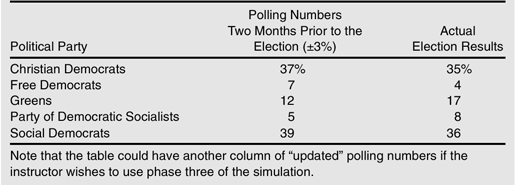
- The simulation begins two months prior to the national election. Recent polling suggests that no single party will win the election outright. These are the poll results with a ±3% error rate: (37%) Christian Democrats, (7%) Free Democrats, (12%) Greens, (5%) Party of Democratic Socialism, (39%) Socialists.
The Phases of the Simulation
Phase 1 (Pre-negotiations)
In this phase of the exercise, students meet together in their parties and devise their strategies. The instructor should post the location of each party in the classroom. These locations will be considered the “party headquarters.” The instructor gives students about 10 minutes to meet within their respective parties and develop a strategy for the simulation. During this time, students who are confused about what the parties stand for or what the polling numbers mean can be taught by their fellow students. It is useful, however, for the instructor to circulate among the groups to provide guidance without actually doing the students' work.
In the intra-party discussions, students in each group can be left to their own devices for deciding the group' strategy. Alternatively, a majority voting rule may be imposed. If instructors wish, they can require the groups to elect a party leader (or, realistically, in the case of the Greens, two party leaders) who can direct and facilitate the group' discussions. As for the substance of these discussions during this phase, each group of students must decide (a) who is a feasible coalition partner and (b) what their party will need to offer other parties wishing to help them win, such as certain ministerial roles and particular policy stances.
The instructor should watch out for two recurring problems during this phase of the simulation. First, it is important that instructors remind students to be realistic about why different parties would want to cooperate; often students want to focus uniquely on the polling numbers. The main reason, of course, is the need for help in getting into government, especially for small parties. The second problem also relates to students not making the simulation realistic enough. Before or during the pre-negotiations, the instructor should remind students to consider the five parties' attitudes toward government intervention in the economy, the relationship between the interests of the workers and the interests of businesses or industrialists, immigration, and the environment. Most students quickly recognize that certain coalitions are unrealistic. The former Communists' attitudes toward workers and the poor, for example, are incompatible with the attitudes of the Free Democrats. The Greens should understand that their favorable immigration stance is at odds with the more restrictive policies of the Christian Democrats. And, to offer another example, the Social Democrats should be wary of forming a grand coalition with the Christian Democrats. In the end, students should understand that their party' ideology will not be flexible enough to accept every party into a coalition.
Where there is room for compromise between or among parties, students may wish to offer government positions or policy support. The Social Democrats, for example, could offer the Greens the environmental ministry. The Christian Democrats could offer the Free Democrats looser business regulations or the post of finance minister. Or the Social Democrats could offer strengthened labor policy support in order to entice the Party of Democratic Socialism.
The instructor should also make sure that students don't forget the significance of the margin of error in the polling numbers. The instructor may wish to circulate among the groups and ask indirectly whether or not the students have incorporated this issue into their thinking.
Another important element of the prenegotiations phase is an administrative issue that helps the simulation run more smoothly. Before proceeding to the negotiations themselves, it is recommended that each party split into two subgroups— a step that takes little time. Depending on class size and the personalities involved, the size of each of these groups can vary. One subgroup stays in place to receive representatives from other parties; the other subgroup leaves to negotiate with other parties. During the negotiation phases, students should be crisscrossing the room in repeated searches for representatives of each party. So, it helps to have some students in place at their “party headquarters” to receive delegates from other parties. Without a “staffed” party headquarters, students from other parties may not know who belongs to the Free Democrats, for example, and resort to yelling above the many classroom discussions, “Where are the Free Democrats?!” As such, every party member should be prepared to negotiate fully whether the student stays at the headquarters or leaves to visit other party locations.
Phase 2 (Negotiations)
Bargaining takes place between parties interested in forming coalitions. It may take some time for students to get serious about negotiating, but they will. The duration of phase two is flexible depending on the length of the class session, but instructors should allot a minimum of 20 minutes to this phase.
At some point during this phase of the simulation, the instructor should call a time-out and allow the students to regroup within their own parties in order to assess how negotiations are going and to re-evaluate their strategies. This is a particularly helpful idea because each party, as noted above, was split into two subgroups (those who stay and those who leave the headquarters), and different negotiating points may have evolved within the two subgroups. After five minutes or so, the instructor can announce that negotiations can begin again.
The instructor should announce a time limit that is dependent on the length of the class period. In a onehour class session, 20 minutes is appropriate, or longer if Phase 3 (below) is not used. At the conclusion of the negotiation phase, the groups announce which, if any, coalitions have been formed.
Phase 3 (New Polling Numbers)
This optional—but very valuable— phase adds an element of realism to the simulation and occurs before students conclude their negotiations. The length of this phase is, again, dependent on class length. Ten or 15 minutes is appropriate for a one-hour class period. The instructor will need to get a feel for how close students are to forming coalitions; for Phase 3, it is imperative that the negotiations be halted before students have settled on coalition partners. At this point, the instructor announces that it is now just three weeks before the election and that new polling numbers have been released. These numbers can be manipulated by the instructor in many ways. For example, if instructors want to demonstrate the influence of the Greens, that party' numbers could increase. If instructors want to emphasize how the former Communists can still be important players in some European countries, they could increase the numbers for that party. Boosting the numbers for small parties will enhance their role in the simulation and drive home the point that small parties can thrive in PR systems but not in plurality systems.
Phase 4 (Results of Negotiations)
It is the day after the election. The instructor announces the results of the election, and students learn which coalition succeeded.
With polling numbers like those listed in Table 1 below, the Free Democrats and the Christian Democrats usually form a coalition. A second coalition is typically formed between the Social Democrats and Greens. The Party of Democratic Socialists may or may not be a part of this second coalition, depending on how students choose to negotiate.
Both the Green Party and the Free Democrats are typically courted strongly by the other parties, and both parties normally assume that they will have a seat in government. However, the election results provided in the table have denied one of these parties that opportunity (because the party did not pass the minimum 5% threshold). This outcome demonstrates yet again the value of rules in the electoral process.
Keep in mind, however, that all of the polling and election result numbers can be manipulated from semester to semester according to how the instructor wishes the simulation to proceed.
Debriefing the Simulation
One of the most valuable learning aspects of a simulation is the debriefing session. This is the opportunity to look back on the entire process and examine the main conceptual points that students should have learned along the way. It is best to hold the debriefing session immediately after the simulation while it is still fresh in people' minds. But if time does not permit, it can be held at the start of the next class period.
The debriefing process can be either instructor-led or driven by the students. The instructor-led method lets the instructor recap the main conceptual points for the students. Time should still be allowed for questions and discussion. This approach leaves the instructor in control, and can be a relatively quick process. Another option is to have students work in their groups (for about 5–10 minutes) to recap on their own the simulation' main points. After the time period is up, the instructor calls on each group in turn to present what they thought was a main point from the simulation. When all of the groups have weighed in on the subject, the instructor then fills in any gaps.
Whether the debriefing is instructoror student-led, the instructor should make sure that the class addresses the following key concepts:
- (a) Electoral rules have a big impact on the behavior of political parties. Students may be asked how different the simulation would have been, for example, without the 5% rule or, more importantly, with a plurality voting method.
- (b) Related to the first point, the simulation highlighted the relevance of third parties and the potential political impact they can have under PR rules. American students who are interested in, or members of, third parties in the U.S. should understand that their prospects for electoral success are severely hampered by the single-member-district voting rule. Students should be reminded that PR systems may be more democratic in the sense that they can allow more diverse voices in Parliament and thus better reflect public opinion. For example, the Green Party that gets 6% of the national vote in the U.S. will be much less influential than a Green Party with a similar showing in a PR system. It can be valuable, however, to discuss the consequences of a strong showing of a third party, like the Greens, in state or local elections in the U.S.
- (c) All parties, especially in PR systems, face tensions between the desire to retain ideological purity and the practical objective of getting into government. As part of this discussion, the instructor may explore the students' bargaining effectiveness among the coalition partners. Were some parties better than others at extracting concessions? For example, did the Social Democrats get support from the Greens without having to give the Greens any important ministerial posts? Were some individuals better negotiators than others? As sometimes happens in the simulation and in real life, very good negotiators can achieve results beyond what one would otherwise expect.
The instructor may also want to say a few words about why the actual election results were so different from the polling data two months prior to the election. The difference, for example, could be explained by protest votes, changes in voter attitudes (which could result from a variety of things), etc. The instructor should also remind students about why the 5% rule exists (and why it is not relevant in the U.S.), and restate the importance of sampling error in polls.
Finally, a useful way to conclude the debriefing session is to ask students to discuss (either as a class or in their respective groups) what was unrealistic about the simulation. This part of the exercise is valuable for both students and the instructor. Students may become aware of how their behavior during the simulation was inappropriate (e.g., Christian Democrats trying to court the former Communists). When students find aspects of the structure of the simulation unrealistic, the instructor can concur that some things are impossible to act out realistically (e.g. the entire process took one hour). However, student critiques can also provide the instructor with suggestions for making the simulation more realistic in the future.