Disavowal
Eight years after composing his hour-long chamber orchestra work in vain as a dismayed response to Austria's far-right resurgence in 1999–2000,Footnote 1 Georg Friedrich Haas wrote an essay announcing he no longer believed in a ‘social duty’ to compose music that ‘contributes to the humanization of society’.Footnote 2 The essay explains his change of heart as a result of disillusionment with his former ‘butterfly effect’ views of music's political efficacy. His reasoning appears to be that music is too semantically indeterminate to convey ideological intent:
The ideological background is marginal in comparison with the purely musical background. One doesn't actually hear whether Nono composed for the world revolution or Stockhausen for Sirius. Even more absurd would be the idea that a composed music could spread ideology, and I must say, I am happy this is the case. I am very glad that there is no danger of social effect. I even sometimes have the impression that mentioning ideology has a side effect not desired by the composer. In talking about the ideology that stands behind the music, one has something one can think about that actually skips over the mystery of the music. Put in commercial terms, ideology is thus an advertisement. This I would like to reject on principle for my music.Footnote 3
This passage touches on quite a few claims, but they are all tied to a central notion of music's ineffability: though (or perhaps because) no determinate meaning can be conveyed, there is always a surplus of meaning that cannot be captured by language, by ‘something that one can think about’. Settling for a given meaning mean no longer engaging with the music's sonic materiality in order to find meaning, foreclosing its endless openness to alternative interpretive possibilities. Emphasizing the political message behind a composition draws the wrong kind of attention: we reduce the music to its message. Advertising the message cheapens the mystery.
Of course, talking about how your music is full of mystery that overflows the bounds of easily digestible political messages is also a form of advertising – and that is exactly what Haas goes on to do in this 2008 essay. He writes that his change of heart was partly caused by the realization that his own political music, despite his best intentions, always ends up failing from an ideological point of view. He claims, though, that the ideological failures of his works are the result of their musical success – turning the insult into a compliment, given Haas's implicit conception of ideological directness and ineffable mystery as fundamentally opposed. Einklang freier Wesen/Aus freier Lust verbunden, for instance, fails in that Haas's strict compositional control, required to write ten solo pieces that could also be played simultaneously as an ensemble piece, goes against the spirit of the ‘harmonious union of individuals’ that he intended to represent. The opera Nacht, wherein lost ‘utopia’ is sung about as though singing about a lost lover, fails because it results in music that is too beautiful for its subject matter. And Haas calls in vain ‘almost blasphemous’ for representing the resurgence of fascistic ideologies with such ‘rich’ music.Footnote 4
There is something suspicious about this self-critique, even beyond its function as bragging disguised as self-deprecation. First, there is an apparent contradiction: how can music have ideologically incorrect meanings if it is too indeterminate to convey ideological intent in the first place? Perhaps the idea is that, while music does not intrinsically contain political content, a statement of ideological intent can lend music ideological meaning, to which standards of ideological appropriateness can then be applied. Still, it seems nonsensical to critique any music as ideologically problematic unless it is possible for some music to be ideologically unproblematic. And if it is possible, why not try harder to write such music, instead of giving up altogether?
Furthermore, the critique of in vain is simply not very compelling. The idea for in vain was that its formal plan, the repeated resurfacing of an initial state ‘believed to have been overcome’, would express a sense of hopeless frustration with the return of populist nationalism after all the progress that had been made since Nazism.Footnote 5 Haas thinks the piece is musically effective, in that the return of the opening's sinister, swirling vortexFootnote 6 of descending tempered scales – after it was presumed to have been overcome by serene, gorgeous overtone music – is felt as a catastrophic defeat rather than as a triumphant reprise. How can this vortex music be too ‘rich’ to represent fascism, if its return feels like a loss? Certainly it would be wrong to allege this music is too beautiful or too happy in any conventional sense: it is carefully crafted to sound like an ominous nightmare.
Perhaps Haas means it is simply too interesting and well crafted to do justice to the banality of contemporary populist nationalism. It takes some dazzling ensemble virtuosity to play these fast, polyrhythmic scales, and they engender a vertiginous and beguiling illusion of infinitely descending while going nowhere, a kind of unsynchronized Shepard scale effect.Footnote 7 But we could then respond that in vain’s dramatic arc requires a sufficiently compelling villain as foil to the sumptuous beauty of the overtone chords – indeed, given the apparent continuing appeal of xenophobic nationalism in the contemporary Western political climate, it seems fitting that the vortex music has an insidious appeal of its own. Moreover, in vain does not seem intended to directly incite revolution; its portrayal of failure is meant to express hopelessness and afford the audience a chance to mourn along with it – in essence, it is a lament. The function of a lament is less to represent with accuracy than it is to achieve an affective impact. The more powerful the music's evocation of loss and despair, the better it serves its ideological purpose. To insist nevertheless that it is problematic to use artistically meritorious music to represent something that does not deserve such representation, no matter how ideologically appropriate the overall effect, would commit Haas to a rather circular argument: such stringent standards of ideological integrity would be opposed to artistic quality by definition.
Some of Haas's recent comments suggest that he may well hold such stringent standards. Regarding his return to politically inspired music in 2013 with I can't breathe, Haas proudly declares he ‘gives no notes to the perpetrators’ of Eric Garner's execution. He even seems to reiterate the critique of in vain in a way that implies it really was about appropriate means of representation, saying ‘the music I gave to the demons of the past is just too beautiful’.Footnote 8 Both comments taken together seem to imply that the only solution to this problem of representation is simply to never represent evil, since (good?) music will inevitably aestheticize it, allowing it to be heard as inappropriately beautiful. But this simply returns us to the initial problem: because Haas defines artistic quality as ineffability, it is necessarily opposed to ideologically clear meaning. No representation of evil will ever be sufficient to the task, because no music worth composing – that is, music of mystery – can be guaranteed to mean only what it is ideologically required to mean. Amongst the endless proliferation of potential meanings that absolute sonic presence affords, there will always be some that contradict ideological intent. This, perhaps, is how to resolve Haas's self-contradiction: it is not that music either has no meaning or has the wrong meaning, but that it always means too much. The problematic richness of in vain is, therefore, a semantic richness.
Ironically, though, in vain is a suspiciously bad example: its ideological intent seems so integral to its formal design that finding conflicting meanings takes significant, intentional effort. The second and third sections of this article present a series of interpretive passes through the piece in order to demonstrate that such conflicting meanings only come into view when we uncover the inherently ethical dimensions of Haas's aesthetics. The second section establishes the clarity of an already quite rich ‘ideologically correct’ narrative interpretation of in vain. This clarity is obscured only when we begin to consider how the infamous moments of pitch-black performance lighting work as a tactic of defamiliarization, a central ethical project of modernist aesthetics. The third section uncovers a similar ethical project in the sonic realm by examining Haas's conflicted relationship with the label ‘post-Spectralist’. This sonic ethics then becomes the interpretive lens for three further passes through in vain, showing that progressively more nuanced consideration of the ethical significance of overtone chords is required if we are to arrive at a reading of in vain that substantively undermines its intended programmatic content. These reinterpretations show that if in vain is semantically rich in an ideologically problematic way, this is only because of a deeper ethical commitment to writing music that challenges us to become more critical listeners. This raises the central question to be addressed in the final section: why was this ethics left unmentioned in the 2008 essay? Why announce that you have given up the belief in a ‘social duty’ to improve the world with your music, if you still believe in an ethical imperative of defamiliarization?
Clarity and Darkness
First interpretive pass: successful failure
The programmatic function of in vain relies on opposed musical materials that draw on widely shared associations and conventions in order to provide an obvious affective contrast. The overtone music is perceived as a brave, beautiful new world overcoming the chaotic initial vortex, and each formal return of that vortex feels like a defeat, an inexorable slipping away of a paradise that had been within reach.Footnote 9 Besides the change in texture – from turbulent, overlapping descending runs in polyrhythmic semiquaver tuplets, to slowly evolving sustained chords moving at a glacial pace – in vain relies on contrasting harmonic material: the ultimate acoustic consonance of just-intonation ‘overtone chords’ overcomes the initial twelve-tone equal tempered (12tet) octatonic scales and ‘Wyschnegradsky chords’. These latter chords are cycles of interval class 5 and 6 inspired by earlier microtonal composer Ivan Wyschnegradsky's non-octavating 5.5 semitone cycles;Footnote 10 saturated with tritones and either minor ninths or major sevenths, they project chains of the (016) trichords emblematic of early twentieth-century atonality, serving as dissonant antipodes to the overtone chords. Robert Hasegawa has examined this contrast throughout Haas's oeuvre, concluding it is ‘not just a question of tuning, but a stark and expressive representation of incompatible worlds’.Footnote 11
The first ‘overcoming’ of the vortex begins with an ominous low brass swell into a semitone glissando, which triggers an explosion of forte scales (b. 29, 2′06″).Footnote 12 Having initially drifted relatively freely in register, this louder tempest starts locked in place, the beginning of its descending scales capped at a ceiling of C♯3. Eventually, the ambitus of each scale gradually creeps higher, but this second-order ascent also turns into a Shepard effect; the vortex is trapped, with no escape above or below. Meanwhile, quiet echoes of the glissando-swell appear. As the concert lighting dims, the scales fade out until background becomes foreground and the audience is left in pitch darkness with quiet, sustained Wyschnegradsky chords (b. 76, 5′22″). Glissando-swells step between adjacent chords, accompanied by non-glissando swells on the same starting pitch, resulting in microtonal dissonances similar to Giacinto Scelsi's ‘sound-splitting’.Footnote 13 This is agony in the etymological sense – as agon, struggle: the familiar 12tet universe is forcibly split open. String glissandi finally converge on a ppp overtone chord (p. 86, 9′07″), and a just-intonation harp enters to play three enigmatic phrases, as if heralding the arrival of a new world.
As full concert lighting slowly returns, a sequence of forty-one slow, sustained overtone chords unfolds.Footnote 14 The strange, ethereal beauty of the pure intonation and the serenely slow pace of the chords – allowing the rich sensuous presence of each one to be savoured as its own special moment – is complemented by progressively more lush orchestration, as though presenting ever more stunning snapshots of a utopia worlds away from the threatening vortex of the opening. Initially played softly sul ponticello by strings and restricted to four-note sets of unfamiliar high partials, the chords are enriched with added winds, warmer timbres, more interesting dynamic contours, parallel glissandi, and fuller excerpts of the overtone series. The brass join in at chord 22, beginning each chord with one of the established four-note sets before the rest of each overtone series fills in.
Before long, though, Wyschnegradsky chords quietly infiltrate the rests between chords (starting b. 201, 21′22″). As 12tet music seeps in, the overtone chords intensify, each one initiated with a cascading brass arpeggio, from the established tetrachord down through the overtone series to the fundamental. But the Wyschnegradsky chords fight back in kind: for instance, chord 32’s antiphonal overtone sforzandi are the most triumphant so far, yet as the alternating blasts accelerate they are pulled off course, slipping gradually into a Wyschnegradsky chord. The brass take their time with the arpeggio initiating chord 33, relishing each step down as its own moment, but now the Wyschnegradsky chords return with the same texture as in the dark section. These Wyschnegradsky interruptions take on more and more characteristics of the opening vortex music, and finally the overtone chords burn themselves out when the horns, in their haste to announce more overtones, play overtones from the next fundamental while the trombones stay behind (b. 315, 29′10″). On the third of these crunching dissonances, the full ensemble joins, generating such powerful acoustic interference that Haas marks difference tones in the score (b. 339, 30′43″). Utopia, struggling to be heard, shouts itself hoarse and is overpowered by the vortex.
All that progress has simply brought us back to where we started. This time, no dramatic swell sparks another overcoming. Instead, the chaotic scales of this vortex gradually decelerate and sync up to form a Wyschnegradsky Shepard scale – an even more stark depiction of motion without progress. After the scales grind to a halt (b. 413, 35′30″), the music sounds lost, with bare 12tet intervals passed around the ensemble, drifting like debris from the wound-down scales with little direction save for occasional swells or slides. Finally, the horns try to rebuild with ascending overtone arpeggios, as though reversing the descents will undo the previous defeat (b. 457, 39′34″). But this is an embattled, partial recovery: not only do accelerating and decelerating waves of pulsing Wyschnegradsky chords interrupt them, the overtone chords now oscillate between different fundamentals, the comma-sized discrepancies between their upper partials drawn out dramatically.
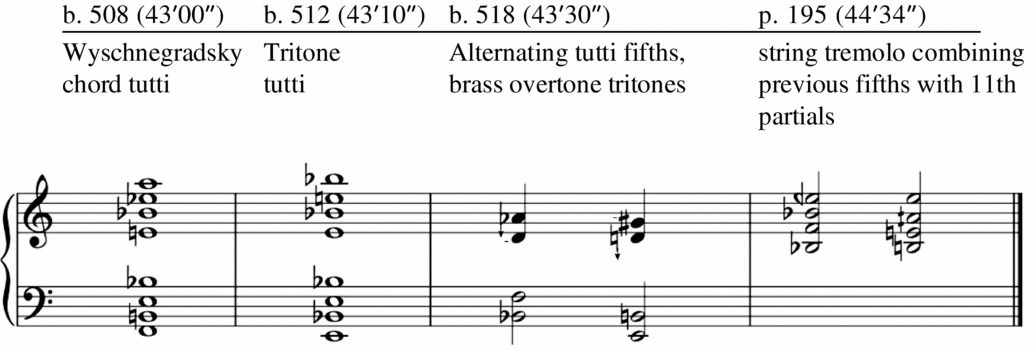
The lights dim again as overtone chords swing between tritone-related fundamentals (b. 507, 43′32″), a moment as full of foreboding as the similarly tritone-related dominant-seventh bells of the coronation scene in Boris Godunov. Pulsating Wyschnegradsky chords swell up, the darkness giving their acousmatic sound a quality of surging forward through space like an assault on the audience. The ensemble finally settles on a C overtone chord (p. 204, 48′15″), sustained for what feels like eternity, sumptuously orchestrated with a strong fundamental, pulsating winds, pulsed string glissandi ascending in overtone double-stops, and lightning-fast harp overtone glissandi up through the full overtone series. After four minutes, a final effect enters: startling tam-tam crashes, which then accelerate into a noisy roll that drowns out the overtones, allowing Wyschnegradsky chords to slip in under cover of a saturated spectrum and come blaring back in. Again, utopian overtones glow too bright and burn themselves out.
Following immediately after this snatching away of the piece's most stunning utopian vista, the final and most crushing failure begins as the lights gradually return, illuminating a soft series of overtone chords (p. 216, 54′13″). Strings slide upwards from chord to chord, but once the fundamentals fade in, it is clear these chords are actually descending. The descent accelerates gradually over several minutes until the chords slip out of sync and devolve into a final return of the vortex – this time, brought about not by external pressure by Wyschnegradsky chords, but from the momentum of the overtone motion itself. Tam-tam and brass announce more overtone chords breaking through the vortex, but as the vortex fades these chords, too, descend and accelerate into a vortex. The process starts a third time, but is cut off before the chords devolve – as though Haas could not bear to relive the painful process of watching utopia inexorably slip away one more time.
Second interpretive pass: darkness and affective richness
This final gesture could hardly be more effective in conveying a powerful sense of hopeless loss. The disillusioning effect of the fundamentals fading in, revealing that these upwards-sliding chords are really in a slowly snowballing descent, is not just sonic: with the return of the banal mundanity of regular concert lighting, these inevitably failing sounds lose the enchantment of darkness. The live acousmatic experience presents a rare demonstration of just how well we can detect spatial location from hearing alone. Sensory modalities blur further: the climactic overtone sonority on C seems to glow all the brighter in the darkness, as though only in the absence of light does the special inner light of just intervals appear.Footnote 15 This seems to have been critic Alex Ross's experience: the climax is ‘halo-like . . . shimmering . . . a glorious sheen, like a new dawn of tonality’, a ‘new kind of beauty [that] seems ready to come into the world’ yet ‘falters in the light of day’.Footnote 16
This magical darkness may resonate with romantic conceptions of night (think Tristan und Isolde), but seems opposed to Haas's own conception of night as ‘hopelessness and the loss of a grip on reality, with the plunging of the soul into darkness, and with the loss of utopias’,Footnote 17 something from which ‘bright moments . . . must always wrest themselves laboriously’.Footnote 18 And it is this more commonplace negative valence of darkness on which the ideologically correct narrative relies, treating darkness as enhancing the already-ominous character of the music. Darkness adds uncertainty to the first crucible section, rendering the dissonant slide-swells into sinister, invisible disturbances of the unsettling Wyschnegradsky haze. The return to light at the start of the overtone section is like reawakening from troubled dreams, as though the darkness were a tunnel one must pass through to arrive in new utopian terrain.Footnote 19 And while the second dark section includes the overtone apotheosis, conflict dominates the rest. The darkness makes this an extended nightmare voyage, from the tritone oscillations, through pulsating Wyschnegradsky assaults, through the speciously calm eye of the storm, to its devastating obliteration by gong noise and blaring dissonance. Darkness paradoxically enables a utopian listening experience while also signifying the traumatic loss of that experience.
We need not accept such a strict interpretive binary, but the more nuanced our interpretation gets, the more conflicted the ideological content becomes. The acousmatic experience of unpredictable, powerful sound in darkness is in excess of our descriptive capability; it is thrilling in the literal sense, titillating and sensual and exhilarating, yet terrifying and overwhelming – indeed, performances are always preceded by a test darkening, so that audience members who feel uncomfortable may leave while they still can. Remaining in the hall means trusting Haas. The listener is placed in a position similar to the religious believer who simultaneously trusts and fears the benevolent yet inscrutable will of an omnipotent creator, and indeed the use of metallic idiophone percussion in the dark phases invokes ritualistic tropes of worship. There is even an erotic element to the inseparability of pleasure and fear in response to helplessness: the shock of unforeseen sounds is itself pleasurable, and even the straightforward sensual pleasurableness of the sound is frightening, as though the subjective self could be lost in its sheer intensity.Footnote 20
In a word, darkness is the sublime – specifically, as Mark Hutchison has theorized it, Kant's dynamic sublime.Footnote 21 In distinction to the mathematical sublime – whereby the aesthetic faculties short-circuit in an attempt to grasp the infinite or impossible, like in vain’s sonic illusions of infinite descent – the dynamic sublime is the safe aesthetic appreciation of otherwise dangerous power. Hutchison positions the sublime as an anti-rational, anti-signifying element. Invoking more sinister examples of the sublime in Nazi musical propaganda (like Albert Speer's Lichtdom), Hutchison suggests an alternative to the programmatic opposition of overtones and temperament, reading the sublimity of the evoked utopias as a warning against blind faith in tempting master narratives.
Rich views of darkness need not reverse the polarity of in vain’s political message so directly. For example, we could draw on affect theory to present the acousmatic experience as a surge of pre-cognitive, embodied affective intensity, an intensity in whose semantic excess we could find the raw potential for radical resistance. Whatever the interpretation, what matters for my purposes here is that this polyvalence arises from darkness's challenge to our usual habits of listening, which is itself an ethical tactic. Farthofer argues that ‘the overriding of visual perception should sensitize the listener to the sound’, citing Haas's assertion that his desire to affect people with his music ‘succeeds more intensely and powerfully in darkness. Listening becomes more intentional, more self-aware [bewusster]’.Footnote 22 Hiekel interprets Haas's darkness as intensifying the disorienting effect of his music and thereby forcing an ‘immersion in the sound’, refocusing us on listening itself.Footnote 23
Bernhard Günther's programme note for the premiere of in vain also considers the disruption of normal concert lighting alongside Haas's disorienting musical effects, comparing listening to climbing stairs: the normal handrails and step sizes are ‘meant to keep you from thinking about your walking movements’, just as tempered scales and concert lighting are not meant to ‘draw the listener's attention to their peculiarity’.Footnote 24 The implication is Heideggerian: the disruptive effect of darkness is like the disruption of our usual physical engagements with tools, whereby what is usually phenomenally transparent or ‘ready-to-hand’ (Zuhanden) becomes ‘present-at-hand’ (Vorhanden) – the object of a potentially critical attention. Darkness is meant to break us out of a complacent relationship with sound, forcing perception to become intentionally engaged. It is thus part of the age-old modernist project of a defamiliarizing estrangement that calls norms into question by breaking them. To paraphrase Adorno: if the splinter in your eye is the best magnifying glass,Footnote 25 then no light at all is the best hearing aid.
If darkness disrupts the ideological clarity Haas thinks is ethically required, it does so only in service of yet another, more fundamental ethical imperative. As the next section will show, the same imperative guides Haas's microtonal palette. Overtone chords do double duty: they are heard symbols of utopia, following an imperative of programmatic clarity, an ethics of communication; they are also tools for utopian hearing, following an imperative to challenge complacent perception – an ethics of defamiliarization.
The ethical aesthetics of intonation
Given, as this section will argue, that it is a shared commitment to using overtone-derived chords towards ethical ends that unites him with the spectral movement, Haas's insistence that he not be grouped under the label ‘(post-)spectralist’ is noteworthy. Of course, as Hasegawa's thorough investigation into Haas's aesthetics has already shown, there are significant differences in compositional technique and lineage: as a microtonal composer, Haas's interest in the harmonic series is more like that of the American just intonation experimentalists, having more to do with intervallic properties than with spectrographic analysis.Footnote 26 Haas nevertheless does adopt one spectral technique, the ‘composing out’ or ‘projecting’ of acoustic phenomena (expanding sonic microstructure into macrostructural principles for musical forms): the dynamic swells that alternate between instrument groups are meant as a metaphorical evocation of the amplitude swells of acoustic beating.Footnote 27 Add to that the aural similarities – some sections of in vain call to mind spectralism's locus classicus, Gérard Grisey's Les Espaces acoustiques Footnote 28 – and the shared tendencies towards slowness, gradual change, and blocks of sonority with envelope-like evolving textures, and it may seem that Haas ‘doth protest too much’ against the association with spectralism.
Though Hasegawa is also suspicious of Haas's self-portrayal as independent of any schools or systems, he ultimately concludes Haas's pluralistic use of different tuning systems does represent a less systematic approach than his predecessors.Footnote 29 Nevertheless, Haas's rhetorical attempts to distance himself from spectral influence present a strawman of spectral composition – a caricature view under which Murail might argue even he and Grisey were never true spectralists. Haas's general definition of spectralism is ‘the attempt to transfer the results of acoustic analyses into the notes of the text’, an approach he critiques for two reasons.Footnote 30 First, instrumental synthesis results in a chord, not a fusion into a new timbre. Second, treating spectra as natural entities ideologically obscures the artistry of composition. As musical materials, instrumentally synthesized spectra are just as much artefacts as any other materials, requiring artistic control over their musical deployment. Haas even compares spectrographic analyses to serialist row tables, implying that spectra give an air of ‘scientific’ justification for a supposedly automatized system, one that speciously absolves composers of the burden of choice.Footnote 31 All these critiques miss their mark if applied to composers considered canonical ‘spectralists’. Murail stresses that he uses computer programs the way past composers used the piano: an assistant for composing by ear, not an automatic composition machine.Footnote 32 And Grisey was never naive enough to believe instrumental synthesis resulted in fusion, but rather a perceptually ambiguous middle ground between timbre and chord – thus Grisey's preference for the term ‘liminalist’.
Perhaps Haas's critique is not aimed at these composers, so much as at the abstract idea of spectralism as potentially reifying analysed spectra as ‘natural’ compositional foundations. Still, Haas ignores the sense in which liminal harmony-timbres are, as Brian Kane argues, ‘techniques of disorientation, which complicate and problematize the habitual comprehension of sound under pre-given cognitive categories and types’.Footnote 33 For Kane, this approach to pitch is part of a general spectral ethics of taking sound itself as a musical principle. This also involves the temporal dimension: spectralism models its continually evolving formal processes on the micro-dynamics of sound in order to bring those micro-dynamics into audibility.Footnote 34 This contrasts with approaching time as a container for sounds as discrete entities, which stifles their internal temporality, treating sounds as static building blocks and making salient only those properties (usually, those encoded in notation) through which we categorize them and relate them to each other. Tracing this ethics back through Schaeffer to Husserl, Kane argues that, rather than reifying sound itself as natural, this effort to free sounds from the categories into which they are squeezed is an attempt to
free myself from the conditioning created by my previous habits . . . It is not a question of a return to nature. Nothing is more natural than obeying the dictates of habit. [Rather,] it is a question of an anti-natural effort to perceive that which, previously, determined my consciousness without my knowing it.Footnote 35
It is this drive not to have my perception ‘determined’ by external causes ‘without my knowing it’ that is the central ethical impulse here: if doing the right thing depends on a capacity to judge what is right, an ethical agent must examine that capacity for signs of ingrained bias. ‘Askesis’, ethical self-discipline, begins with self-awareness.
If we read spectralists as using overtones to encourage critical self-awareness by revealing the inner life of sounds that is hidden by our predetermined listening categories, then we can read Haas's use of overtones as encouraging that same self-awareness by instead revealing a hidden world of qualitative differences in intonation quality. Haas attributes the ‘strength’ and ‘beauty’ of overtone-derived chords not to their quasi-timbral fusion, but to their just intonation – their having no acoustic beats – which, citing Murail, he compares to the lack of shadows cast when the sun is at its zenith.Footnote 36 His replacement of the spectrum with yet another optic metaphor calls to mind Hans Zender's assertion (in a lecture at Darmstadt the summer before in vain’s premiere) that for many listeners,
it is a revelation to discover that intervals like the just major third or natural seventh have a luminosity, which compared to the colour of a tempered interval is like a radiant red compared to a muddy red-brown.Footnote 37
Haas would disagree with Zender's view that temperament levels intervals into a ‘diffuse chromatic soup’Footnote 38 – Haas rejects the elevation of just intervals as ‘pure’, and does not think the world needs saving from temperament.Footnote 39 Yet overtones and their psychoacoustically unique properties still serve as a valuable tool for dismantling the specious naturalness of 12tet intervals. Even in the course of arguing for a view of Haas as a pragmatic pluralist and not an overtone partisan like Harry Partch or Ben Johnston, Hasegawa makes a similar point – suggesting that Haas, like James Tenney, treats just intonation as an aesthetics means (not an end) because it serves as a ‘perceptual archetype’.Footnote 40
Overtone chords, in short, are Haas's tool for encouraging utopian hearing, confronting listeners with sound that refines their appreciation of intonation and forces them to question their received listening categories. And as tools of utopian hearing, they serve even better as heard symbols of utopia – or so, at least, the next section will argue, in the first of three more interpretive passes through in vain. Over the course of these reinterpretations, however, we will see that the need to challenge complacent perception complicates and ultimately reverses the valences required by the political narrative.
Third interpretive pass: intonation and motion
One sense in which the ethical role of overtones reinforces their narrative role is through their inherent fragility. Just as in vain’s programme treats utopia as difficult to achieve and even more difficult to safeguard, the perception of just intonation relies on a precarious balance of conditions. Specifically, Haas stresses that hearing pure intervals as such depends on having enough time ‘to let the special intonation quality of the music “engage”’.Footnote 41 Given that some pure intervals might simply sound out of tune in relation to temperament, listeners need time to listen for the lack of beats and aurally orient the pitches to a heard or imagined fundamental. In addition to the fact that overtone perception itself takes time, there is the problem that changing overtone sonorities too quickly can result in cross relations. Haas cites the end of in vain as a demonstration: because the fundamentals are related by tempered steps, the ‘same’ pitch will be tuned as various partials over different fundamentals in quick succession, resulting in small microtonal voice-leading steps between chords. Haas's worry seems to be that such intervals, neither tempered nor pure, would be heard as irrational commas – and thus the notes involved would be given an ‘out-of-tune’ quality by their horizontal context, overpowering their sonic quality as overtones given by their vertical context.
Of course, this is a problem only because of the tempered relations between fundamentals. Though Haas claims he used only tempered fundamentals ‘to make it easy’ for himself, Hasegawa has shown how Haas had already found ways of using pivot tones in other pieces in the same period, enabling harmonic successions with logical connections between voices.Footnote 42 The choice to use 12tet fundamentals was thus an artistic decision, meant to give a deeper sense of inevitability to the narrative depiction of failure. At the end, the chords do not just speed up into a vortex – they demonstrate a perceptual failure, showing us that the overtone quality we have come to cherish is incapable of generating true harmonic motion. And the slowness of the long first overtone section is also tinged with melancholy: we luxuriate in sustained, isolated chords not simply to bask in utopian glimpses, but because harmonic motion is impossible. Stopping to savour each overtone chord is the only way of hearing them as overtones at all.
Günther's comparison to the vanitas genre of Renaissance still-life painting, which evoked the fragility of beauty and its vanity in the face of mortality, is thus more apt than he might have realized: appreciating the beauty of overtones necessitates freezing all harmonic motion into ‘nearly-still-life’. That includes melodic motion, too: the piece's only melodies are those in the harp at the end of the first dark phase – yet this singable, contoured motion is limited to one overtone collection per phrase, and even then the pure intervals in the harp's counterpoint pass by too quickly, making them difficult to hear as anything but out-of-tune relative to temperament. Presenting this counterpoint without first priming our ears relegates it to an uncanny liminal zone between just-tuned and mis-tuned. Announced by this enigmatic cipher of the limitations of harmonic motion, the brave new utopian world of overtones is doomed from the start.
Since harmonic connection between chords is forbidden, the only option for giving a formal trajectory to this first overtone section is to gradually increase the intensity of each particular overtone chord. This places a new spin on the ‘burnouts’ described in the first interpretive pass. Recall that the first pass read the failure of the first overtone section as externally caused: Wyschnegradsky chords kept slipping in, and the overtone chords’ attempt to keep them at bay escalated into a shouting match. Like Icarus flying too close to the sun, the increasingly radiant overtones overheat and burst into blazing mixed-fundamental dissonances. But now we see that this burnout was intrinsically fated: the more and more unstable extravagance of scoring is necessitated by the logic of overtone writing itself.
The climactic sonority on C could be viewed as the apotheosis of this burnout failure: sitting on a static chord for over four minutes requires intensification to maintain interest, but it is these intensifying elements that unsettle the sonority. The most obvious such element is the addition of tam-tam strikes that grow to overpowering noise. But the strings’ glissandi upwards from partial to partial are also treacherous: their continuous motion belies the underlying stasis, and they ultimately slide too high and onto the Wyschnegradsky chord that overpowers the overtones. Given that it is also upward string slides that initially mask the descending fundamentals after the final dark phase, we could read glissandi generally as dangerously illusory motion that obscures the underlying reality of enforced harmonic stasis.
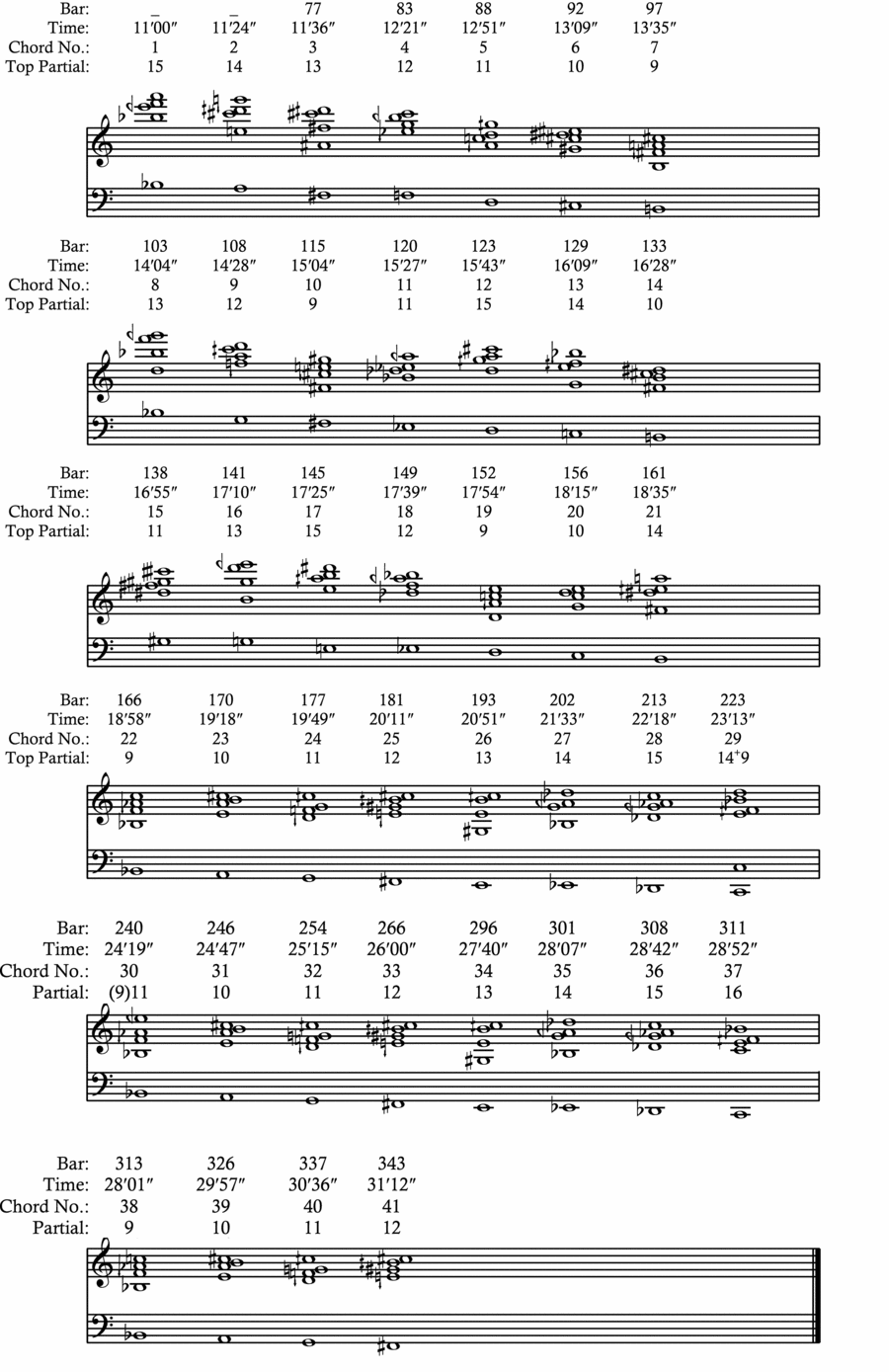
Even more treacherous is the motion underlying the first overtone section: these chords’ fundamentals descend by steps, putting even these first glimpses of utopia on the same shaky ground as the descending fundamentals that accelerate into the vortex at the end. Example 1 summarizes the pitch content of the first overtone section. It consists of five full rotations of a set of seven tetrachords in different orders, each with a distinct top voice selected from the ninth through fifteenth partials.Footnote 43 These tetrachords are initially presented by themselves, and through successive rotations more partials are added to the four core notes, which are usually kept prominent via orchestration and temporal emphasis.
Core tetrachords and their implied fundamentals in the first overtone section.Footnote 44

Haas's ordering of tetrachord types masks the scalar descent of fundamentals. The first rotation's descent in partials would seem to expose the descent of the implied fundamentals, but for the first few chords the gradual warming effect of orchestration, register, and more familiar lower partials is more salient than the descent itself, and for chords six and seven the addition of higher partials after the core tetrachord also distracts us from the voice leading. Rotations two and three scramble the order of the tetrachords, such that no trace of descending fundamentals is apparent from the chords’ overall registral contour. Finally, the fourth and fifth rotation (plus a failed attempt at a sixth) use ascending partials while the fundamentals descend, so that the chords hover in the same register. This disguises the fundamental descent, although now the upper voices are squeezed into a tight, densely microtonal space.
This ‘contrary motion’ of fundamental and partials is the section's undoing: when the brass finally combine partials from successive fundamentals, they are drawing on pitches inhabiting the same narrow range. This problem of microtonally congested register lurks in the background even before the dissonant clusters happen. The initiation of each chord by the brass in the fourth rotation – part of the intensification process made necessary by the negation of harmonic motion – might already enable long-range hearing of voice-leading relations between chords. In rotation five, the addition of overtone-arpeggios down from these initial tetrachords serves to highlight the fundamentals, which risks exposing their scalar descent. By chord 34, the overtone chords start trying to follow immediately on from one another without letting Wyschnegradsky chords interrupt, yet this risks allowing the dangerously irrational harmonic relations to become more apparent. Finally, the brass go too far and play these small microtonal intervals as simultaneities, culminating in the physically jarring climactic ‘difference tone’ cluster. Since the necessity to protect overtone perception by avoiding motion is the intrinsic cause of this first defeat, this perspective ultimately treats utopian hearing as enhancing the programmatic content: it goes even further than the first pass by arguing that the same inevitability underlying the final failure spells doom for the earlier failures as well.
Fourth interpretive pass: disrupting signification
The third interpretive pass has argued, then, that the conditions for the possibility of utopian hearing are so compositionally limiting that they make the collapse of heard utopias inevitable. But, as this fourth pass will argue, Haas must go beyond composing so that utopian hearing can take place, and instead actively work against the possibility that the listener will fail to recognize overtones as such, so that utopian hearing must take place.
That is, Haas must compose out a phenomenological reduction, just as Kane argues Grisey does in Partiels. Even in this supposedly automatic transcription of spectrograph into score, Grisey composes so as to actively strip away the baggage of preconceived categories to focus on the object itself:
this sonic event [the trombone spectrum] has the potential to be heard as tonal, and this possibility must be foreclosed by Spectralism . . . the chord cannot connote anything because connotation is itself the enemy for Spectralism. Sound has been confused with its representations. When the stretch of sound becomes connotative, it is pulled into a system of signification. It is no longer a sound heard as such.Footnote 45
For Kane, signification is transparent: we perceive right through the signifier to grasp the signified meaning, rather than notice the signifier in its own material presence. And if it is the material presence of the signifier in which we are to find that surplus that escapes categorization, then the transformative potential to make us confront our preconceptions relies on making the signifier opaque.
Kane proposes that Grisey disrupts signification by enacting that disruption over time. Grisey first offers the possibility of hearing the spectrum as a dominant ninth, then actively denies it through repetition (frustrating the expectation of resolution) and by bringing the upper partials into greater prominence. If, instead, a trombone spectrum emerged out of noise, ‘the entire teleology of reduced listening would be inverted’.Footnote 46 The initial dissonances would yield no indication of their derivation from the spectrum, failing to prime us to hear spectra as such; the gradual disappearance of dissonance would sound like the tuning-up of a dominant ninth chord. Backwards-Partiels would fail to force us to attend to the liminal spaces on the continuum from harmony to timbre.
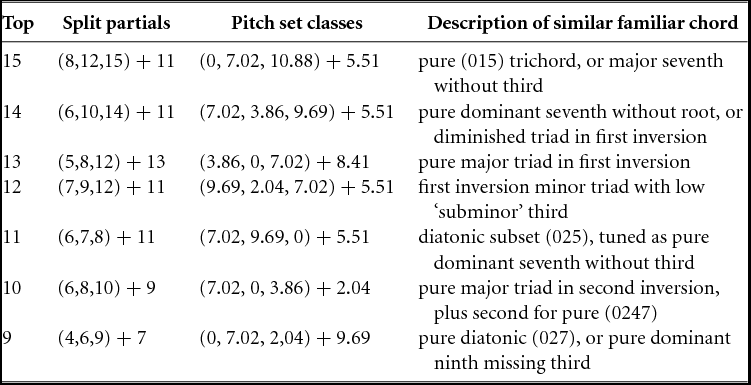
It may seem as though the overtone section of in vain makes exactly this mistake, since its trajectory is already constrained not to present utopia as easy to achieve: it has to begin with sparse intervals that could just sound mistuned compared to 12tet, and then slowly build to sonorities that could just be mistaken for tonal tertian chords. But the analogy is not exact: whereas Partiels only had to foreclose tonal signification for its chords, the ethical project of in vain requires a double negation, neither a tonal chord nor out-of-tune. Really hearing just intonation means recognizing the common beatless quality of all pure intervals, whether they involve lower partials or higher partials. If Haas were simply starting with unfamiliar high partials (potentially mistaken for mistuned dissonance) and moving away towards lower partials (potentially mistaken for tonal chords), then the reduction could fail. Instead, the initially strange tetrachords are expanded in both directions, the balance of higher and lower partials keeping us from making either mistake. In the first rotation, this balance is mostly achieved by the ordering of the tetrachords themselves, as Table 1 shows: though the first three chords contain progressively more ‘tonal’ subsets, they also include eleventh and thirteenth partials that stick out as obviously non-12tet; eleventh and seventh partials keep chords four and five from sounding like a minor triad and diatonic subset; and the nearly diatonic chords six and seven are embellished by partials added above the core tetrachord.
Analysis of tetrachords

Note: Each tetrachord can be heard as a just intonation version of a familiar 12tet trichord, plus an odd note out. The first column names the tetrachord by its highest partial; the second column splits the partials into three plus the odd one out; the third column rewrites partials as registrally ordered pitch class set classes, using integers for semitones, decimals for microtones, and fundamental = 0; and the fourth describes the excerpted chords as alterations of more familiar categories.
As the overtone section progresses, Haas continues actively encouraging just-intonation perception through a careful balancing act of different kinds of stabilizing and destabilizing forces. The second and third rotations also rely on added higher partials to keep the more rooted chords from becoming too familiar. Now, though, textural techniques and more striking dynamic envelopes are added to keep the overall sound of the chords sufficiently strange. Partials below the tetrachords are also added in, though from their introduction in chord eight they are often unsettled by a new element, several pitches sliding in parallel and then swelling in alternation with the rest of the chord. These glissando effects continue to estrange the by-now familiar tetrachords once the brass enter in the fourth rotation. The fuller and more rooted the chord, the more it can sustain strange effects and unfamiliar partials without failing to direct our ears to the quality of just intonation (and vice versa). The partial-saturated timbres of ponticello strokes in chord twenty-nine, the huge fused stacks of antiphonal sound in chord thirty-two, the upper partial halos of all the later chords starting with chord thirty: all are effects made possible by this balancing that trains our ears in utopian hearing.
And yet, all these techniques are the same destabilizing forces that the programmatic interpretation views as leading to defeat. This is a subtle but telling difference from the third interpretive pass, where the programmatically fated intensification process was a means of coping with compositional prohibitions on harmonic motion. Now, the intensification is directly required by the need to keep our perception on its toes. Encouraging utopian hearing means destabilizing the heard utopias, making strange and unstable the sounds that, programmatically, are supposed to be clearly positive symbols. The results of these interpretations are the same: heard utopia inevitably fails, as the narrative requires, because of the requirements of utopian hearing. But this time, the failure is due not to the shared fragility of heard utopia and utopian hearing, but to their fundamentally opposed goals – respectively, clarity and disruption of signification.
Fifth interpretive pass: the relativism of intonation
Though the fourth pass shows that the anti-signifying project of utopian hearing can enhance the narrative of failure, further exploration shows that utopian hearing ultimately demands a re-evaluation of the 12tet/overtone contrast on which the narrative relies. To return to a point made above (and by Hasegawa), Haas is a pluralist, not a partisan: overtones represent utopia not because their beatless ‘purity’ is inherently better, but because of their potential for revealing the inadequacy of our categories of hearing. Overtones are of instrumental value to this ethical project. Beatless intervals give us leverage on hearing more gradations in all intervals, beatless or not – as I myself discovered as an amateur violinist learning Haas's de terrae fine.Footnote 47 There is a world of phenomenological difference (and performance accuracy) between audiating, for instance, a neutral second as ‘somewhere in between a major and minor second’ and as ‘the interval between the eleventh and twelfth partials’.
The point of just intonation is to help us hear difference: after all, ‘beatless’ is a negative definition and is therefore relational, defined in contrast to intervals with beats. The emphasis on relationality and perceptual discrimination can be seen in Haas's primary polemical writing on microtones before in vain: he argues that it is not the microtonal composers who should explain themselves, but rather those who do not go beyond 12tet – because even outside of the Western avant-garde, microtonality is and always has been the norm, not the exception.Footnote 48 Besides the modern soundscape of overtones in the humming of motors and electronics, microtones appear everywhere: in ancient Greek theory, in pre-12tet Western music and many non-Western scales, and in the slight discrepancies of heterophonic music, including even the ‘vibrato-rich unison in string orchestras’.Footnote 49 To me, these remarks imply more than that composers ought to use microtones just because they are out there; rather, it seems composers have an ethical mandate to use microtones because sharpening our perception sensitizes us to the rich diversity of our sound environments.
From this perspective, cross-relations between distinct overtone series are not the categorically catastrophic bane of heard utopia that they appeared to be in the third interpretive pass. If the chords are changing too quickly for the notes involved in the cross-relation to be heard in relation to their respective fundamentals, then the resulting microtonal fluctuation will sound like mere intonation variations on the same note; and if the cross-relation is played as a simultaneity (as in the burnout clusters of the first overtone section), it will register as sheer dissonance. But if the notes involved in the cross-relation are heard in relation to their respective fundamentals – if they are each heard as having the quality of being a particular partial – then the interval relating them has meaning: it will sound like what it is, the comma separating particular partials of particular fundamentals.
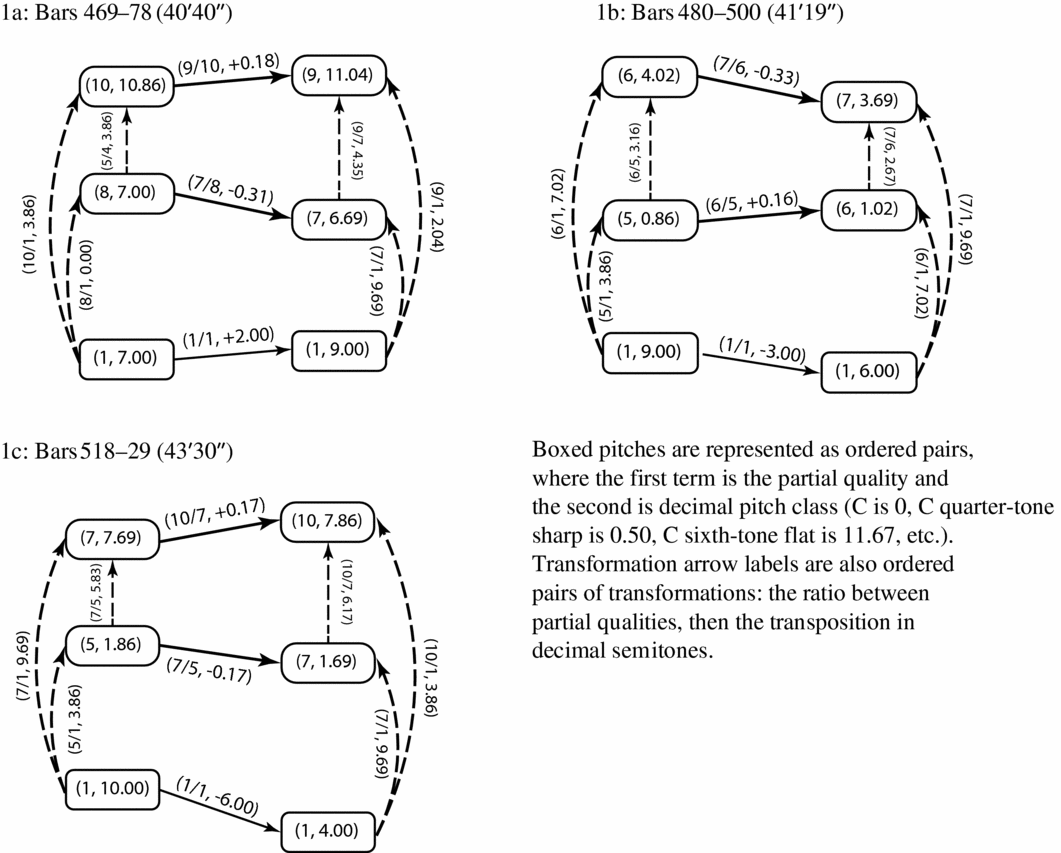
This is exactly what Haas aims for when he sets dyads from contrasting overtone series against each other in alternation during the section leading to the second dark phase. Figure 1 adapts Hasegawa's use of Steven Rings's ordered pair notation and transformational system to represent the three pairs of dyads.Footnote 50 On one hand, this allows side-by-side comparison of similar-sized intervals within the harmonic series, allowing us to hear the slight gaps when, for instance, 7:6 is nestled inside 6:5. On the other hand, this moment presents us with the gaps themselves as meaningful intervals, which Hasegawa calls the ‘emancipation of the comma’.Footnote 51 Indeed, I would go further than Hasegawa, who consigns these commas to the category of ‘sound-splitting’: the entire ethical project here is to train us to hear these not as microtonal variations on ‘the same note’, as in sound-splitting, but as distinct sonic objects. I would argue this point is implicit in Hasegawa's use of Rings's ‘qualitatively stretched intervals’:Footnote 52 like any transformations in group theory, Hasegawa's diagonal arrows (solid) are formally equivalent to composites of transformations that lead to the same target node. The dashed vertical arrows represent our hearing of the partials in relation to their own fundamentals, which allows us to hear these notes as partials, and thereby to apprehend the commas as meaningful intervals.
Transformations between oscillating mixed-fundamental intervals in the second overtone section.

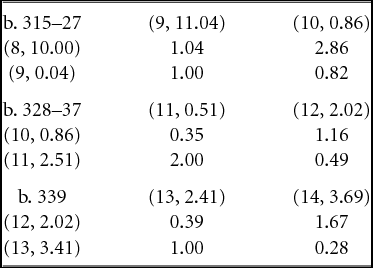
The special importance of these mixed-fundamental moments is clear from the way Haas scores them, dramatizing the emancipated commas’ emergence out of the less-comprehensible dissonant clashes that defeated the first overtone section (summarized in Table 2). He primes us to focus on partials in their own vertical contexts in bars 464–9, with swells between a pair of overtone chords on fundamentals a semitone apart. The following three pairs of dyads get progressively easier to hear, despite the Wyschnegradsky chords that seem to take advantage of the acoustic beating to slip in and interrupt. In the first pair, the intervals are simultaneous and thus dissonant (like the clashes from the first overtone section), though their staggered entrances let us hear them distinctly; the next pair initially presents the dyads simultaneously, then separates them into alternating brass swells grounded by soft fundamentals; the final pair gets the same brass swells with even more focused attention and repetition, including strong support from fifths added to the tritone-related fundamentals.
Matrices showing intervals formed by mixed-fundamental clusters at the end of the first overtone sectionFootnote 53

This reading, whereby cross-relations have transformative potential for our perception of microtones, seems to cut against the grain of Haas's own comments about cross-relations as destabilizing elements. Although these mixed-fundamental moments could still be reconciled with the political program – perhaps the second overtone section's revisiting of cross-relations is an attempt to learn from the mistakes of the past and arise phoenix-like from the ashes of the burnout – this view of cross-relations as ear-training opportunities causes less reconcilable clashes with the narrative at other points. In the final gradual accelerations of descending overtone chords into vortex scales, the irrational commas that supposedly ruin our perception of overtone quality are arguably easier to hear as overtone relations. Exact transpositions of a chord allow us to hear that the same vertical qualities are preserved. Stepwise parallel motion enhances the perception of verticality even more: voice-leading connects the same partials in each chord, and the parallel descending motion encourages auditory streaming in a way that is intimately connected with vertical fusion – as is clear not only from theories of auditory streaming, but even from time-honoured counterpoint rules against parallel perfect consonances. Indeed, far from dooming overtone perception to failure, the descending overtone scales afford overtone ear-training practice. Though there are certainly limits to perceiving any vertical quality when parallel motion gets fast enough (and performance accuracy may even break down before perceptual accuracy), we could still (admittedly facetiously) treat the end of in vain as a game: see how long you can keep perceiving particular overtones before the scales get too fast, and then see if you can do better on the next repetition.
This reversal constitutes a serious conflict between ethical imperatives: the very moment that must be experienced as a defeat in the political narrative is actually a victory for utopian hearing. Even worse, though, is that utopian hearing ultimately flattens and even partly reverses the programmatic valence of tempered and just intonation. Remember, the transformative value of overtones is not as an end, but as a means – a means to refine our perception of intonation qualities in general. This includes not just microtones, but 12tet intervals themselves. For Haas:
[acoustic] beating is not seen as a malady of musical practice, but rather as ‘a basic human need’. ‘That it is not the consonance with the proportions of the overtone row that is sought by the different musical traditions, but rather the deviation therefrom; not the fusion, but rather the friction’, is confirmed for Haas by numerous musical cultures . . . Twelve-tone temperament, for Haas, fascinates precisely because of its ‘wonderfully “false”, beating-rich major and dominant-seventh chords’.Footnote 54
This wonderful falseness of beating-rich 12tet chords, however, can only be fully appreciated when contrasted with beatless overtone chords. And if overtones are thus in service to enriching our hearing of 12tet intervals, it would seem that the narrative valences of intonation differences are flipped.
Since the tempered tritone is possibly the most significant 12tet interval throughout in vain (given its generative status in Wyschnegradsky chords), the dramatic intensity of the alternating-tritones moment that initiates the second dark phase may be due to its exploration of that tritone quality. The oscillating 7:5 and 10:7 tritones train us to perceive not just their own distinct microtonal sizes, but also those of all the other octave-bisecting intervals in the immediate context (depicted in Example 2): the ‘geometric’ octave division of the fourth and fifth, the logarithmic division of the 6-semitone tritone, the 5.83 and 6.17 semitone tritones, and – given the soft 11th partials in the strings – even the 5.5 and 6.5 semitone tritones out of which Wyschnegradsky himself constructed the non-octavating cycles that inspired Haas's 12tet chords.
Harmonic reduction of transition to second dark phase.

What this moment trains us to hear is not just the distinctive sizes of these intervals, but also their distinctive meanings: the 7:5 and 10:7 tritones have an orientation with respect to their fundamentals, whereas the tempered tritone's perfect logarithmic bisection of the octave has no orientation, making it paradoxically directionless.Footnote 55 There is something essentially tonal about the overtone tritones and something essentially atonal about the tempered tritone. And once sensitized to this, we can hear something quite fascinating in the Wyschnegradsky chords. Their 11- or 13-semitone intervals between tritones in different octaves serve as ‘altered octaves’ that enable the ‘unpitched fusion’ that Cramer identifies as Schoenberg's tool for creating his own, pre-spectral timbre-harmony.Footnote 56 It is as though we hear logarithmic octave division in all octaves at once without hearing any particular pitch classes, a staggering experience of height and depth divided into actively beating half-octaves.
Wyschnegradsky chords, that is, begin to sound utopian. And overtone chords begin to sound a bit dystopian. Cramer argues that Schoenberg avoided consonant chords because they would sound ‘too cold, too dry, expressionless . . . empty’ compared to the ‘full, sumptuous’ colours of dissonant chords;Footnote 57 perhaps something similar happens when beatless harmonic chords are set against beating 12tet dissonances. Maybe, just as Renaissance tastes found parallel perfect consonances too austere, there are hearings of in vain that find overtone chords similarly lifeless. For an auto-ethnographic perspective on such a hearing, I have begun to find something similar in my own perception of overtones. While I find that I always hear overtones as rich and sensuous when I can focus on particular partials and intervals, I sometimes find myself disliking the fused sound of the overtones during the final accelerating scales: there can be too much sickly sweetness, or nauseating vertigo, or even just a sense of empty bare perfect parallels. It even sometimes reminds me of the continuous falling harmonic drone of my family's vacuum cleaner's carpet attachment, which I distinctly remember being scared by as a young child.
This is not as flippant a point as it sounds: Haas himself believes his fascination with overtones ‘undoubtedly’ has a technological origin, since he grew up hearing a constant overtone chord emitted by the nearby power plant's transformer station.Footnote 58 While there are plenty of warmer, more humanized and expressive instances of overtones in contemporary soundscapes that could be cited, Haas writings keep returning to refrigerator hums and electric razor buzzing like an idée fixe.Footnote 59 Haas's recent opera Koma even uses overtone chords as the diegetic background noise of refrigeration units during a disturbing scene where lovers have sex around the titular anaesthetized body.Footnote 60 In some hearings, then, far from being a heard utopia whose loss we miss, the lifeless, beatless overtones in infinite descent might themselves be the oppressive condition, and the gradual slippage into a vibrantly dissonant swarming flurry of activity is felt as relief, not catastrophe.
Traces of anxiety
So, perhaps Haas is right: despite seeming to have a clear narrative that conveys a politically appropriate response to the return of rabidly xenophobic nationalism, in vain is too rich. But, as the close reading in the first section argued, Haas's critique only makes sense if ‘richness’ means semantic overabundance. And as the five preceding interpretive passes demonstrated, the slippages, obstructions, and reversals of ideologically correct meanings are only manifested when we interpret in vain in light of an ethical project, implied in Haas's writings and apparent in the piece itself: sound (and lighting) must be used to challenge our listening habits, revealing them as habits and forcing us to adopt a more critical self-awareness. Thus, the evidence Haas cites to defend his disavowal of political programme music – namely, that in vain failed its ideological aims – in fact seems to reveal the force of ethical imperatives to compose a certain way. If Haas still has commitments to an ethics of composition, why claim not to believe composers have any such ‘social duties’ to ‘contribute to the humanization of society’?
I would like to conclude by treating this less as a strictly exegetical question and more as a heuristic, an opportunity to speculate about this blind spot in Haas's essay in the hope of thereby finding some purchase on the tough issues facing politically minded composition. I am less interested in what was actually going through Haas's mind, why he himself ‘really’ neglected to mention his ethics in the essay, than I am in reading this as a symptomatic slip, a crack through which to observe new music's concerns with its own place in contemporary society. What if we view Haas not as simply failing to mention his ethics, but hiding it? What if his ethics of defamiliarization is being repressed? And if so, why repress it?
‘Ideology is thus an advertisement’
As a first attempt at an answer, we might continue the line of critique briefly mentioned in the first section: this declaration of disillusion with political programmes as marketing ploys is, itself, a marketing ploy, meant to imply that his music is much better than crass ‘propaganda’. Haas might be afraid to be perceived as a naive believer in using melodramatic programme music to change the world – especially given that critics already have a tendency to pigeonhole him as more an excessive, ‘theatrical’ neo-RomanticFootnote 61 than a hard-hitting ‘serious’ modernist. In that Haas needs to perform ‘an interest in disinterestedness’ as a means of self-promotion, we can see the essay as Haas's attempt to shape his own brand in the sense critiqued by Charles Wilson, who argues that Ligeti used his ‘double refusals’ (‘neither “modern” nor “postmodern”, neither “tonal” nor “atonal”’) as a means to secure his image as a quirky maverick.Footnote 62 Such ‘neither-norism’ is ‘uncritical discourse aimed at avoiding any explicit ideological commitment’, which gives composers a means ‘to assert their difference from other producers and create a new and distinctive position in relation to those already occupied’ in the artistic economy.Footnote 63 Wilson argues this valorization of individuality devalues the communal institutions that nurture artists and colludes with a commercial system wherein artists valued for their sheer uniqueness become interchangeable products.
Haas similarly uses the rhetoric of autonomy when he distances himself from labels such as spectral or microtonal. But if the 2008 essay's self-promotional disavowal of politics is to be understood as analogous to Ligeti's rhetoric, Haas's single refusal should have been double: advocating neither explicit political programmatic content nor art with no pretence to social or ethical responsibility. That is, Haas should have advertised his own ‘third way’: an ethics of defamiliarization. Indeed, portraying such ethics as a double refusal was a winning self-promotional strategy for Lachenmann:
it is not about listening to a kind of music that laments the sorry course of world events through scratching sounds; but neither is it about music that flees before this world into some kind of sound-exoticism. I am concerned with music . . . in which perception attempts to make the perceiving spirit conscious of the structures outside and within us, the very structures to which such musical composition is a reaction.Footnote 64
By the time of Haas's essay, Lachenmann had even elevated this ethics into an explicit political register, declaring in a 2008 lecture that democracy depends on a citizenry with the ‘sharp-eared communal consciousness’ that art ‘in its most intense manifestation’ can provide.Footnote 65 Professing an ethics of defamiliarization in the year 2008, it seems, would have been an effective self-promotional strategy.
Repressed anxiety
This means, then, that a critique like Wilson's cannot fully explain why Haas failed to defend his ethical aesthetics. Public image, though, may still have something to do with it: if Haas publicly disavows his former beliefs in writing explicitly political music because he is afraid to be seen as embarrassingly naive, then perhaps, consciously or not, he hides his beliefs about ethical composing because he would be even more embarrassed by them. The article would thus be a sleight of hand: Haas tilts at the windmill of an ethics of communicating political content in order to distract us from scrutinizing his deeper ethics of defamiliarization. He gets to project a worldly air of cool disillusioned maturity by denying one strawman position, while closely safeguarding another. And if this is the case, it seems Haas could only be so anxious to protect his compositional ethics from critique if, on some level, he really is worried that this ethics rests on an equally (or more) naive ‘butterfly-effect’ belief in changing the world through music.
After all, is it really so believable that modernist aesthetics is a form of virtue ethics? Is critical consciousness really so domain-neutral? Does improving our perception of microtonal nuance really lead to improving our perception of, say, racial injustice? Put this way, it sounds absurd to answer with an unqualified affirmative. If new music lovers are generally more progressive and better critical thinkers, this is more correlation than causation: even if training in questioning our ingrained aural categories translates into interrogation of our preconceptions in general, it likely does so only within the broader context of liberal education. To the extent that new music does provide ethical training, it only trains the audiences it can reach, audiences that largely already have access to other humanistic and artistic fields that refine ethical self-awareness. Haas may just be preaching to the choir.
Worse, maybe the preaching affords the choir – the complacent, complicit neo-liberal bourgeoisie – a cathartic chance for unearned self-congratulation. As Lachenmann put it, new music is in danger of becoming a temporary thrill that
has found its little niche in cultural life: as an official aesthetic challenge, as a popular roller-coaster ride. Its composer has become a celebrated, admirable and pitiful preacher in a desert of inconsolable dissonances. We view him as the occasional tourist-destination for those in need of frustration, and equally as the alibi for a tolerant intolerance.Footnote 66
Lachenmann is indicting explicitly programmatic political music here, but it is hard not to hear it as an even stronger indictment of an ethics of defamiliarization. Is Lachenmann (or Haas) any less a preacher in the desert of noise? Is utopian hearing any less a tourist destination than heard utopia – one, moreover, where we conveniently excuse ourselves from being exposed to any political ideas while appeasing our consciences with pretended ethical discipline?
My intent with such polemical questions is not to present my own evaluation of the social impact of new music, nor to dismiss the premise of utopian hearing as mere ideology. Rather, I want to flesh out the kind of doubts that may plague its practitioners, and to consider how such doubts might shape new music discourse from below the surface, even to the point of pushing composers to disavow the political altogether. Specifically, perhaps the 2008 essay is motivated by a desire to hide Haas's doubts. In critiquing an ethics of communication, Haas can present himself as believing that ethical composing in general is impossible; this lets him off the hook for justifying his composition ethically, thus protecting his deeper ethics, that of defamiliarization, from exposure to critiques under which it might crumble. To take this proposal into more boldly suggestive (though also necessarily more speculative) terrain: perhaps Haas's disavowal represents an unconscious recognition of the potential inadequacy of utopian hearing as ethical justification.
This unconscious recognition could be schematized using the Lacanian framework developed by Seth Brodsky, wherein modernism as a cultural milieu is caught up in a fantasy of traversing fantasy – though in my view Haas's essay is somewhat different here, in that one fantasy is used to avoid the traversal of another.Footnote 67 On one level, utopian hearing has the structure of a fantasy: defamiliarization becomes a master that authorizes the composition of new music by holding out the possibility of enhancing our critical self-awareness. Haas's traumatic recognition that this fantasy is just a fantasy – that authorization of new music as an ethical project is a fiction of this fantasy – must then be repressed by another fantasy on a higher level. Haas therefore presents himself as comfortable with the idea of living without a fantasy, without any master to authorize his musical aesthetics, by fantasizing the impossibility of such authorization – now (mis)construed as the impossibility of politically effective programme music. In other words, he fantasizes that he has already traversed the first fantasy of ethically justified composing and learned to live without an ethics – except that this secondary fantasy switches out utopian hearing for heard utopia. By attacking heard utopia as ineffective, he can assuage himself that ‘contributing to the humanization of society’ is impossible and that he need not justify his composition, all while avoiding any confrontation with his doubts concerning the inefficacy of utopian hearing as a continuing justification for composition. He gets to enjoy sincere adherence to an ethical project of defamiliarization, despite his ambivalence about that project, by pretending (on the basis of the failure of an entirely different project, that of programmatic expression) to enjoy needing no such project.
There may be one final anxiety hidden amidst all this fantasizing: that his own music speaks a truth he cannot bear to hear. I do not mean, exactly, that in vain’s ambiguity may be more ideologically correct than Haas would want to admit – though that may be true as well: in the complexity of our own contemporary political moment, with its debates over just what forces have been complicit in allowing far-right resurgences such as Trump and Brexit to happen, insistence on a black and white narrative seems dogmatic. Rather, perhaps in vain itself is the traumatic traversal of Haas's fantasy of utopian hearing, revealing it as utopian. As my interpretive passes argued, utopian hearing's success undermines heard utopia; but it also undermines itself. It is an Adornian commonplace that utopia must never be represented, unless represented as not-yet; if in vain really does improve our hearing and yet we arrive at no revelatory moral clarity, it is as though we are taken to the spot on the map marked ‘utopia’ and shown that there is no ‘there’ there (after all, utopia is u-topos, ‘no-place’). Perhaps, then, what in vain mourns, as much as anything else, is its own revelation of its inability to change the world.
For, certainly, in vain mourns. No matter how we feel about overtones and temperament, and no matter what we think those contrasts mean, the final cut-off – which I often experience with a visceral jolt, as if I am falling in a dream and wake myself up by instinctively bracing upon impact – always has a sense of lost utopia. An ineffably special experience has happened, and now it is gone. If in vain has any ethical power to change its audience for the better, maybe it is in this experience of sheer affective intensity, a ‘nocturnal paradise of sound [that] lingers in the mind’Footnote 68 even after it is lost, that it holds its most promising potential.