Research with English speakers has shown that children with specific language impairment (SLI) have specific difficulties marking verb tense and agreement not only when compared to age matched peers, but also when compared to younger language matched peers (Leonard, Reference Leonard1998; Rice & Wexler, Reference Rice and Wexler1996; Rice, Wexler, & Cleave, 1995). Their finite morphological markings for lexical verbs (i.e., past tense -ed, third person singular -s) and finite morphological markings for auxiliary verbs (i.e., BE and DO) are frequently ungrammatical. Lexical verb errors result in bare stem (i.e., root infinitive) usage, whereas copula and auxiliary verb errors result in omissions. Studies have consistently shown that verb marking appears to be more difficult than other grammatical morphemes (e.g., Bedore & Leonard, Reference Bedore and Leonard1998; Rice & Wexler, Reference Rice and Wexler1996). Thus, the finite verb deficits of these children have been characterized as a “delay within delay,” that is, a selective and extraordinary difficulty with tense and agreement marking in addition to general language learning difficulties (Rice, Reference Rice, Levy and Schaeffer2003). In particular, they have been interpreted as evidence for the existence of an extended optional infinitive stage in which affected children continue to use root infinitives for finite verbs (Rice & Wexler, Reference Rice and Wexler1996).
Because of the difficulty of children with these grammatical forms, a composite measure that includes percentage correct for past tense -ed, third person singular -s, auxiliary and copula BE, and auxiliary DO based on obligatory contexts, has been proposed as a clinical marker of SLI (Rice & Wexler, Reference Rice and Wexler1996; Rice, Wexler, & Hershberger, 1998). Most of these studies are based on monolingual English-speaking children. It is not yet known whether bilingual children, in particular Spanish–English children in the United States, will exhibit the same difficulties and to the same extent as monolingual children. These children may exhibit differences depending on the linguistic characteristics of their speech communities. For example, there are several varieties of English associated with Spanish-speaking communities in the United States (Fought, Reference Fought, Wolfram and Ward2006). These variants (labeled “Hispanic English” by several authors) show influence of Spanish in phonology (i.e., high vowels, final consonant omissions), lexical choices, and morphosyntax (Owens, Reference Owens1991; Wolfram, Reference Wolfram1974; Wolfram & Schilling-Estes, Reference Wolfram, Schilling-Estes, Wolfram and Schilling-Estes1998b; Zentella, Reference Zentella1997). Some of the grammatical structures of Hispanic English include use of a postnoun modifier for possessives (e.g., homework of my brother), nonobligatory use of plural (e.g., the girl are playing), nonobligatory use of regular past -ed (e.g., I talk to her yesterday), nonobligatory regular third person present tense (e.g., she eat too much), use of “no” before the verb for negation (e.g, she no eat candy), omission of subject pronouns (e.g., Father is happy. Bought a new car), and lack of inversion and auxiliary verbs in questions (e.g., Mary is going?), among others (Owens, Reference Owens1991). A few of these characteristics are “vestigial,” transferred from Spanish, such as the use of “no” (e.g., “You no smell no nasty air,” “I no used to it”).
Some of the “Hispanic English” features appear to converge with other nonmainstream dialects such as African American English, but they may come from a different origin. One example is deletion of past tense -ed. Hispanic English omits -ed, probably because of Spanish phonological influence resulting in consonant cluster reduction. In contrast, multiple negation (e.g., “She didn't tell me nothing about it”) may result from contact with nonmainstream dialects (Fought, Reference Fought, Wolfram and Ward2006; Ornstein-Galicia, Reference Ornstein-Galicia1981). Additional forms such as the use of “was” with plural subjects and final consonant deletion in clusters (e.g., tes’ for test) are observed in Chicano English as well as in Native American English and African American English speakers (Wolfram & Schilling-Estes, Reference Wolfram and Schilling-Estes1998a). Many speakers of Hispanic English are not bilingual (Fought, Reference Fought, Wolfram and Ward2006; Ornstein-Galicia, Reference Ornstein-Galicia1981); consequently, one cannot attribute these features to cross-language influence from Spanish.
There is a need for systematic descriptions of the performance of child Hispanic English speakers, in particular, the ways in which these English variants may manifest across different ability groups (i.e., children with and without LI). Without this information, features of Hispanic English may be mistaken for LI. Although Hispanic English is probably the native dialect for many Latino children in the United States, there is limited research examining frequency of use and contexts across different speech communities (Wolfram & Schilling-Estes, Reference Wolfram and Schilling-Estes1998a). It is possible that the same features that distinguish mainstream English speakers with LI also differentiate Hispanic English speakers with LI from their peers with typical language development (TLD). To our knowledge, there is no published research examining this issue directly.
In addition to the potentially different linguistic profiles of monolingual speakers of Hispanic English with LI, children who are bilingual (i.e., children who speak both Spanish and English) may also exhibit differences directly related to cross-linguistic influence. These differences may be more evident in learners of English as a second language (EL2) or in sequential bilinguals (i.e., bilinguals who learn their L2 after they learn their first language [L1]). Differences between bilinguals and monolinguals have been reported, although results have varied depending on the particular language skills or tasks examined (i.e., use of complex syntax, morphosyntactic accuracy, grammaticality judgments) and the specific ages or grade levels involved (Gathercole, Reference Gathercole, Oller and Eilers2002a; Paradis & Genesee, Reference Paradis and Genesee1996; Pearson, Reference Pearson, Oller and Eilers2002). For example, a comparison between 160 Spanish–English bilingual children and 80 monolinguals in Miami showed differences for morphosyntactic accuracy (i.e., well-formed grammar) in second and fifth grade and differences for complex syntax in second grade (Pearson, Reference Pearson, Oller and Eilers2002). Comparisons between Spanish–English bilinguals and monolinguals using grammaticality judgments for mass/count distinctions in English also indicated that the bilinguals lagged behind monolinguals in second grade (Gathercole, Reference Gathercole, Oller and Eilers2002a). Grammaticality judgments for Spanish gender showed better performance for monolinguals than bilinguals as well (Gathercole, Reference Gathercole, Oller and Eilers2002b). On both types of tasks the bilinguals took longer to match the performance of monolingual children. However, when comparing these groups on their ability to judge English sentences involving the extraction of embedded subjects (e.g., “Who did you say that came to the party?”), the results varied depending on socioeconomic status background and grade (Gathercole, Reference Gathercole, Oller and Eilers2002c). In addition, Paradis and Genesee (1996) found no cross-language differences in the grammatical attainments of simultaneous bilingual learners. Other studies indicated that bilingual children did not differ from monolingual children in their rate of acquisition or in their proficiency (Eilers, Oller, & Cobo-Lewis, Reference Eilers, Oller, Cobo-Lewis, Oller and Eilers2002).
Structural similarities and differences between the languages may have an effect on the strength of particular cues and may result in performance differences (MacWhinney, Reference MacWhinney and MacWhinney1987, Reference MacWhinney, Groot and Kroll1997), especially in L2 learners. For example, use of overt subjects in English may be problematic because Spanish is a null subject language. Spanish-speaking adults learning English showed decreased use of overt subjects during a free written composition task (Phinney, Reference Phinney, Roeper and Williams1987). Evidence of subject omissions in their written language suggested cross-linguistic influence from Spanish. Cross-linguistic influence seems to occur at points of typological difference between the two languages depending on the speaker's language dominance. A case study with a Cantonese child found that English subject omissions were only observed at a time in which the child was dominant in Cantonese (measured in number of words per utterance; Yip & Matthews, Reference Yip and Matthews2000). Thus, one may find greater rates of subject omissions in English learners compared to their English dominant or monolingual peers.
In addition to variations related to typological differences between the languages, bilingual children may demonstrate higher rates of overall grammatical errors compared to their monolingual peers as well. Bilingual children may exhibit a greater use of ungrammatical forms for a longer period of time (Dopke, Reference Dopke2000). Recent comparisons between young English as L2 learners (ELL) from a wide variety of language backgrounds (Korean, Mandarin Chinese, Spanish, Romanian, Cantonese, Arabic, Japanese, Dari, Farsi, Ukranian) and children with SLI showed that the grammatical accuracy of the ELL speakers may resemble that of children with SLI (Paradis, Reference Paradis2005), although the characteristics of their morphological errors may not be the same (Paradis, Reference Paradis2005).
These variations are likely to be demonstrated in bilingual children with LI, in particular when the two languages are not learned simultaneously from birth. However, there are no published reports comparing the performance of these children with that of monolingual children with LI. If the performance of bilingual children is susceptible to cross-linguistic influence, one may expect higher rates of ungrammatical forms in bilingual children with LI than in monolinguals with LI. Alternatively, if no differences are found, one may conclude that accuracy on verb morphology in English may be simply related to the child's level of proficiency attained in the L2.
A second possibility is that cross-linguistic influence will only be apparent for overt subject use. Exposure and use of null subjects in Spanish may lead to a greater frequency of subject omissions in English. Although ungrammatical subject case marking (i.e., use of the accusative pronoun him/her for the nominative he/she) and subject omission were found to be grammatical deficits in English SLI (Grela, Reference Grela2003; Grela & Leonard, Reference Grela and Leonard1997; Loeb & Leonard, Reference Loeb and Leonard1991), subject omission may be more frequent in bilingual children with LI because of cross-linguistic influence from Spanish.
In summary, most of English SLI research is based on children who are monolingual or who have limited exposure to an L2. Little is known about the characteristics of speakers of Hispanic English and the potential effects of cross-linguistic influence across ability groups. Recent research has shown that use of Hispanic English may vary across geographical regions (Gutiérrez-Clellen & Simon-Cereijido, 2007). The present study was designed to examine whether English finite morphology had the potential to differentiate children with and without LI within speakers who may be using features of Hispanic English. Because children who are bilingual may also exhibit differences directly related to cross-linguistic influence, the study also compared the performance of bilinguals and English learners to that of monolingual children. We predicted that bilinguals and English learners might exhibit greater rates of ungrammatical finite verbs and subject omissions than their monolingual peers.
METHOD
Participants
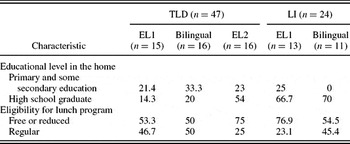
Seventy-one children were sampled from a larger study of preschool, kindergarten, and first grade classes in Southern California. Forty-seven children had TLD and 24 had LI (procedures for their identification are described later in this section). Most children were from low socioeconomic backgrounds, and children from low socioeconomic background were equally represented in each ability group. This was done because there is evidence that income level and maternal education are risk factors for language development (Dollaghan et al., Reference Dollaghan, Campbell, Paradise, Feldman, Janosky and Pitcairn1999; Jewkes, Reference Jewkes2005; Payne, Whitehurst, & Angell, Reference Payne, Whitehurst and Angell1994) and to ensure that the groups were comparable across these variables. School lunch program status was used as a metric for income level. Each school independently determined lunch program qualification status, which was based on family income and the number of occupants in the household. Table 1 shows the educational and income profiles for the TLD and LI groups. All children were from Mexican American descent. The participating children ranged in age from 4 years, 5 months (4;5) to 6;5, with a mean of 5;7 or 67 months.
Percentage of families of the children with typical language development (TLD) and language impairment (LI) in each category of educational level and eligibility for lunch program

Note: EL1, English as a first language speakers; EL2, English as a second language learner.
Procedures and criteria for establishing bilingual status
The bilingual status of the children was determined using parent and teacher reports based on previous research with these measures (Gutierrez-Clellen & Kreiter, Reference Gutierrez-Clellen and Kreiter2003). Parents or guardians were interviewed using a parent questionnaire that addressed the children's general language use across settings and interlocutors as well as history of developmental delay, hearing loss, or any concerns about speech or language skills. The parent questionnaire also served as a measure of exposure to and use of each language at home. Parents were asked to rate proficiency of each language spoken by each member of the household with whom the child had the opportunity to interact, and the child's language proficiency and use using a 5-point rating scale for each measure (0 = no use or proficiency, 4 = use all the time and nativelike proficiency). They also reported the number of hours the child interacted with each member of the household and the language spoken during those interactions. The children's teachers were also given a questionnaire to rate the participants’ use and proficiency of each language using the same 5-point scale. In addition, they provided an estimate of the percentage of time that the child was exposed to each language as a measure of input in school. To verify the accuracy of the questionnaire data (e.g., amount of input by language during the week; language exposure estimates across contexts at school), at least one-half of all questionnaires were independently rescored by a second bilingual research assistant. Item-by-item reliability checks yielded above 90% agreement between the two judges.
Children were determined to be English as a first language speakers (EL1) if they had (a) a minimum rating of 3 for English use and (b) minimal use and exposure to Spanish. Children were judged to be bilingual (B) if they had (a) a minimum of 20% of time exposed to both English and Spanish; (b) a minimum parent and teacher rating of 3 for English use; and (c) reported spoken Spanish, although with substantial difficulty. Children were identified as EL2 speakers if they had (a) a minimum parent rating of 3 for Spanish use and (b) reported spoken English, although with substantial difficulty. Using these criteria, parents and teachers agreed on the language status of the EL1 participants. However, some discrepancies between parents and teachers were observed for the classification of the bilingual and EL2 groups. Specifically, one child was given an English rating of 2 by the parent and a rating of 3 by the teacher. Whenever there were discrepancies between the two informants for English, we relied on the teacher's rating (based on Gutiérrez-Clellen & Kreiter's [2003] research using these questionnaires1). The ratings of the Spanish of the bilingual children with LI were not as reliable. Several of these children had high ratings of Spanish proficiency by the parent but low scores on their diagnostic Spanish assessments. Upon verification that the classification was accurate (based on clinical judgment and specific testing, see below) all the participants were included in the study.
Criteria for identification of children with LI
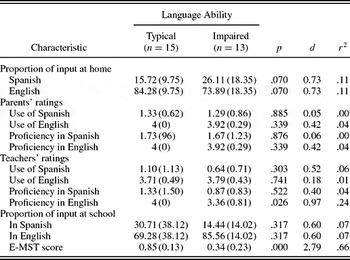
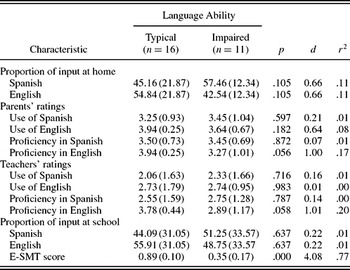
Given the fact that there are no valid standardized tests to identify bilingual children with language disorders, it would have been inappropriate to use available language tests as the standard for assigning children to ability groups. Therefore, the children were identified by the clinical judgment of trained bilingual speech–language pathologists based on clinical observations, as well as evidence of parent/teacher concern (Restrepo, Reference Restrepo1998). In addition, language ability was established using the English-Morphosyntax Test and the Spanish-Morphosyntax Test of the Bilingual English–Spanish Assessment specifically developed for bilingual children (Peña, Gutierrez-Clellen, Iglesias, Goldstein, & Bedore, Reference Peña, Gutierrez-Clellen, Iglesias, Goldstein and Bedore2007). Recent research indicated that children whose Spanish-Morphosyntax Test scores fell below 0.50 and whose English-Morphosyntax Test scores fell below 0.60 were accurately identified as LI (Gutierrez-Clellen, Restrepo, & Simon-Cereijido, Reference Gutierrez-Clellen, Restrepo and Simon-Cereijido2007; Gutierrez-Clellan & Simon-Cereijido, Reference Gutierrez-Clellen and Simon-Cereijido2007). These cutoff scores were used to verify the ability status of the participants. The scores of the EL1 children with LI (mean = 0.34, SD = 0.23) were significantly lower than the scores of the EL1 children with TLD (mean = 0.85, SD = 0.13), t (18.7) = 7.122, p = .000, d = 2.79, r 2 = .66.Footnote 2 The scores of the bilingual children with LI were also significantly lower (mean = 0.35, SD = 0.17) than those of their bilingual peers with TLD (mean = 0.89, SD = 0.10), t (25) = 10.521, p = .000, d = 4.08, r 2 = .77.
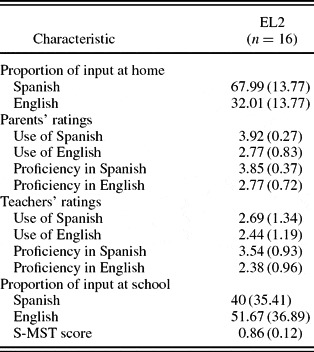
None of the children evidenced hearing impairments, mental retardation, emotional disturbance, motor difficulties, or neurological deficits, according to parent report and school records. Both the children with LI and their typically developing peers were recruited from the same classrooms and schools. The children with TLD were learning their language(s) without difficulty based on parent and teacher reports as well as clinical observation. Further details on the characteristics of the sample are described in Tables 2–4.
Means (standard deviations) of the amount of language input and ratings of use and proficiency for the English as a first language (EL1) participants (N = 28)

Means (standard deviations) of the amount of language input and ratings of use and proficiency for the bilingual participants (N = 27)

Means (standard deviations) of the amount of language input and ratings of use and proficiency for the English as a second language (EL2) speakers

There were 15 EL1 children with TLD (EL1TLD; 7 boys, 8 girls), 16 bilinguals with TLD (BTLD; 11 boys, 5 girls), 13 EL1 speakers with LI (EL1LI; 9 boys, 4 girls), 11 bilinguals with LI (BLI; 8 boys, 3 girls), and 16 typical EL2 children (5 boys, 11 girls).
Experimental procedures
Performance on verbs and subject use was evaluated using narrative samples elicited with wordless picture books: “Frog, Where Are You?” (Mayer, Reference Mayer1969) and “One Frog Too Many” (Mayer, Reference Mayer1975). The spontaneous narratives were audio recorded, and transcribed by a bilingual research assistant using the Systematic Analysis of Language Transcripts computer program (Miller & Chapman, Reference Miller and Chapman2000). All Spanish–English mixed utterances and utterances with unintelligible words were excluded from the analysis. Only English finite declarative sentences were coded for finite verb morphology: third singular -s, past tense -ed, auxiliaries BE and DO, and copula BE. The language samples contained an average of 50 utterances: EL1TLD, mean = 51; bilingual TLD, mean = 56; EL1LI = 41, bilingual LI = 52, and EL2 = 50. The number of utterances ranged from 6 to 109 utterances. Obligatory contexts were identified and the proportion of correct use for each morpheme was calculated by dividing the number of finite verbs with correct morphological markings by the total number of opportunities. A finite verb morphology composite score based on the total proportion of correct use of these markers was also obtained. Because English finite declarative sentences require a lexical or a pronominal subject, whenever the subject was not present the sentence was marked as missing a subject. The proportion of correct use of subjects was calculated by counting the number of overt subjects and dividing it by the total number of obligatory contexts. Proportions of correct finite verb and correct subject use were arcsine transformed before conducting statistical analyses. Grammatical code reliability was obtained from three coders who independently coded 20% of the transcripts. Coding reliability based on the item-by-item percentage of agreement was 94%. The remaining discrepancies were resolved by consensus.
To compare the EL1 groups with and without LI (i.e., EL1TLD, EL1LI) and the bilingual children with and without LI (i.e., BTLD, BLI), a 2 (Language Ability) × 2 (Bilingual Status) analysis of variance (ANOVA) was conducted for both correct finite verb morphology and correct subject use. Independent t tests were used to compare the performance of the EL2 speakers to the bilingual groups (i.e., BTLD, BLI) and to the EL1LI group. All statistical analyses were conducted with an α error set at <.05.
RESULTS
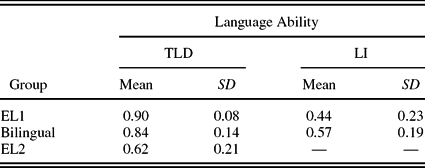
Both EL1 and bilingual groups with LI demonstrated significant difficulties with English verb morphology and subject use compared to their peers with TLD (see Table 5). The results indicated significant ability differences for correct verb finiteness marking, F (3, 55) = 23.66, p = .000, η2p = .58, but no differences for bilingual status, F (1, 55) = .030, p = .862, η2p = .001, or ability by bilingual status interaction, F (1, 55) = 3.788, p = .06, η2p = .069.
Means and standard deviations of the percentage of correct verb use across groups
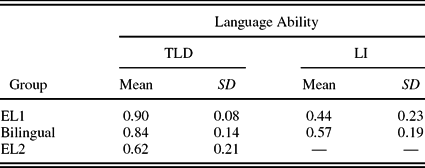
Note: EL1, English as a first language speakers; EL2, English as a second language learner; TLD, typical language development; LI, language impairment.
The verb accuracy of the EL2 group was compared to that of the BTLD, the EL1LI, and the BLI groups separately. As expected, the EL2 mean was significantly lower than the BTLD mean, t (30) = 3.672, p = .001, d = 1.29, r 2 = .27. Although the EL2 children had a higher level of accuracy than the EL1 children with LI, t (27) = 2.199, p = .037, d = .81, r 2 = .14, their verb use did not differ from that of the bilingual children with LI, t (25) = .682, p = .502, d = .25, r 2 = .01.
Given the fact that the lack of significant bilingual status differences may be related to substantial variability within the bilingual groups (see Table 5), a post hoc chi-square analysis was conducted to compare the number of children that reached mastery across groups. Children's performance was classified as having reached mastery of verb marking using 85% accuracy as criterion for achieving mastery. Overall, there were significant differences in mastery across groups, χ2 (4) = 30.083, p < .000. Eighty percent (12/15) of the EL1 children with TLD and 62.5% (10/16) of the bilingual children with TLD reached 85% mastery. This result was because of the fact that there were six bilingual children who scored below the mastery criterion, but this difference was not statistically significant, χ2 (1) = 1.151, p = .283. In contrast, no EL1 child with LI, and only 9% of the bilingual children with LI, and 18.75% of the EL2 speakers exhibited mastery using 85% accuracy as criterion.
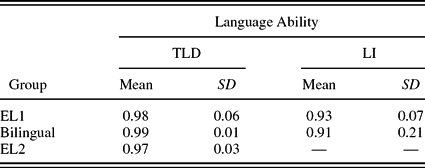
Correct use of overt subjects was analyzed in a separate 2 (Language Ability) × 2 (Bilingual Status) ANOVA. Results showed significant differences between the EL1 children with LI and TLD: F (1, 55) = 12.69, p < .0008, η2p = .199, but no bilingual status effects, F (1, 55) = .770, p = .384, η2p = .015, or ability by bilingual status interaction, F (1, 55) = .002, p = .966, η2p = .000. To compare the number of children who mastered correct subject use across groups, a chi-square analysis was also explored using the 85% criterion. However, no trends were observed, χ2 (4) = 4.513, p < .341. Most children reached 85% mastery of subject use (93% of the EL1TLD group, 100% of the BTLD group, 100% of the EL2 speakers, 85% of the EL1 children with LI, and 91% of the BLI group).
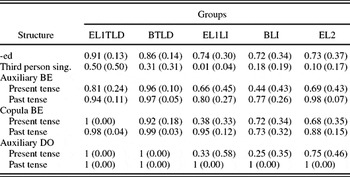
Table 6 shows the correct subject use of the TLD groups (EL1, bilingual, and EL2 children) and the groups with LI (EL1LI, BLI). The children with LI had a lower rate of overt subject use compared to their EL1 and B peers with TLD. In contrast, the EL2 children appeared to have a high level of accuracy (.97), similar to the EL1 and BTLD groups. This observation is in marked contrast with their limited skills on overall verb finiteness (see Table 5). As Table 7 shows, the difficulties with verb use of the EL2 children were similar to those of the children with LI. An inspection of the accuracy rates across verb forms suggests that both the LI and EL2 groups had specific difficulty with third person singular as well as present tense auxiliary BE, DO, and copula verbs. Omissions of past tense -ed were not as common; nor were errors for past tense in auxiliary BE, DO, or copula verbs. However, this finding may be a methodological artifact based on the way that past tense is coded using spontaneous language data. In spontaneous narratives, speakers may switch from past tense to present tense as a discourse strategy to engage the listener in the main events of the story. Thus, the procedure for determining when there is an obligatory context for past or present tense is difficult to ascertain. To address these potential ambiguities, the tense of the verb in the sentence preceding a verb indicated the context for the tense to be required in the target verb. For example, if a root infinitive was used following a sentence in the past tense, it was coded as missing past tense -ed marking. If a root infinitive followed a present tense sentence, the root infinitive was coded as missing a third person singular -s marking.
Means and standard deviations of the percentage of correct subject use across groups
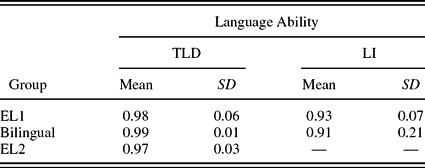
Note: EL1, English as a first language speakers; EL2, English as a second language learner; TLD, typical language development; LI, language impairment.
Means (standard deviations) of the proportion of correct verb use across participant groups

Note: EL1TLD, English as a first language speakers with typical language development; EL1LI, English as a first language speakers with language impairment; BTLD, bilingual speakers with typical language development; BLI, bilingual speakers with language impairment; EL2, English as a second language learner.
DISCUSSION
This investigation was designed to evaluate the performance of EL1 children with and without LI, bilinguals with and without LI, and typical EL2 speakers on verb finiteness marking and nominative subject use. The first aspect of this research was to determine whether the same features that identify English speakers with LI (i.e., verb finiteness marking) also differentiate EL1 speakers with LI from their typical peers. The results indicated that EL1 children with LI had significantly lower verb accuracy rates than EL1 controls with TLD. These differences were also significant when the bilingual children with and without LI were compared. These results replicate previous findings reported in the English SLI literature. The significant difficulties with finiteness morphemes (i.e., -s, -ed, auxiliary and copula BE, and auxiliary DO) exhibited by the affected children support findings from previous research with monolinguals, which found that affected monolinguals in English, French, and German were significantly worse than control group peers for finiteness marking morphemes (Rice et al., Reference Rice, Wexler and Cleave1995, Reference Rice, Wexler and Hershberger1998; Rice & Wexler, Reference Rice and Wexler1996). The same clinical markers reported for English LI seem to be applicable also to bilingual English LI, and provides evidence for the existence of an extended optional infinitive stage in which affected children continue to use root infinitives for finite verbs (Rice & Wexler, Reference Rice and Wexler1996).
In our sample, third person singular -s was the morpheme showing the lowest correct use, followed by auxiliary DO, auxiliary BE, and past tense -ed (see Table 7). In contrast, previous studies of spontaneous language of monolingual children with LI showed difficulties in this order: -ed < -s < aux BE < aux DO (Rice et al., Reference Rice, Wexler and Cleave1995). These discrepancies may be related to differences in the number of obligatory contexts available when using spontaneous language data. Future studies using elicited probes would be needed to corroborate these results.
The finite verb accuracy rates of the EL1 children with LI and the BLI group appeared to be consistent with the accuracy rates reported by Rice, Wexler, and Hershberger for their affected monolinguals. The majority of lexical verb errors consisted of root infinitives errors, that is, verbs without obligatory morphological endings (e.g., “He jump high. He jumps high”). For lexical verbs, very few commission errors were recorded. The majority of auxiliary verb errors were also omission errors (e.g., “He __ walking. He is walking.”). However, it is important to note that these profiles are based on children who were sampled in the Southwest region of the United States (i.e., southern California). Speakers of Hispanic English sampled from the northeastern United States may show verb finite errors related to nonmainstream dialect use and as a result, differences between groups may be less pronounced. In fact, recent research examining the clinical accuracy of a morphosyntactic measure with southwestern and northeastern children showed that the measure had poor specificity with northeastern speakers compared to the good accuracy rates obtained with southwestern speakers (Gutierrez-Clellen & Simon-Cereijido, Reference Gutierrez-Clellen and Simon-Cereijido2007). The use of dialect-based features appeared to underestimate the grammatical skills of children with TLD; as a result, the measure could not be used to rule out LI in these children. Future research examining verb finiteness marking in speakers sampled in the northeastern United States will be needed to evaluate this issue further.
In the second aspect, we speculated that if bilingual children are susceptible to cross-linguistic influence, they should demonstrate reduced finite verb accuracy or lower use of obligatory overt subjects, compared to monolinguals. The results did not support this prediction. The bilinguals did not differ from the EL1 children on these measures, perhaps because of the large variability within the groups and the small size of the samples. When we examined the number of children that achieved mastery on English verb finiteness, the typically developing bilingual children appeared to lag behind their monolingual peers, but this difference was not significant either. Thus, based on these findings we do not have conclusive evidence of cross-linguistic influence on English verb finiteness. This may be related to at least two possibilities. One is the fact that the verb morphologies of the two languages do not share a common core of features. In Spanish, each verb is marked for tense, person, number, and mood, whereas in English, verbs can occur without tense or person markings. Additional research with other language pairs (e.g., Italian and Spanish) will be needed to investigate whether cross-linguistic transfer is more likely to occur in languages that have a common core of morphological features.
The second possibility relates to the fact that the bilinguals in this study were dominant in English. As reported by Yip and Mathews (2000), cross-linguistic influence from the L1 may be apparent when the L1 is the dominant language. In the present study, neither of the two bilingual groups was dominant in Spanish. This explanation may be supported by the comparisons with the EL2 speakers. This group was dominant in Spanish and showed a greater rate of ungrammatical finite verbs than the EL1 children. However, their verb errors in the L2 may simply reflect the level of proficiency reached in their L2 because we did not find cross-linguistic influence for overt subject use, a feature that differentiates the two languages typologically. The EL2 speakers had a surprisingly high level of accuracy in their use of subjects, despite their clear difficulties with verb finiteness marking.
Neither the bilingual children nor the EL2 children appeared to show a greater rate of subject omissions compared to their monolingual peers. In addition, most children in each of these groups had reached mastery for subject use. Thus, these results do not support the hypothesis of cross-linguistic influence from Spanish to English for subject use. English learners may be more reluctant to omit subjects because they know that English does not have a rich agreement morphology compared to Spanish. If verb inflections are not marked, the referent must be marked using pragmatically appropriate means such as an overt subject. The EL2 children may have applied their L1 knowledge of pragmatics to avoid use of null subjects in their English referring expressions. These findings are congruent with a study of bilingual children who speak another pair of null and nonnull subject languages (Inuktitut and English; Zwanziger, Allen, & Genesee, Reference Zwanziger, Allen and Genesee2005). In both studies, English subject use was rapidly learned by the children. Another interpretation is related to the directionality of transfer. Cross-linguistic transfer is thought to occur from a more economical language A to a less economical language B, regardless of language dominance (Sorace, Reference Sorace2004). Spanish subjects may be more complex and “less economical” than English subjects, because of syntactic, semantic, or pragmatic restrictions. For example, subject ellipsis is not grammatical in sentences such as “entrói y Juani se sentói”-∅ came in and Juan sat down. Verb semantics constraints the use of preverbal or postverbal subjects. That is, unaccusative verbs prefer postverbal subjects (“llegó la carta,” “arrived the letter”), whereas unergative verbs prefer preverbal subjects (“el perro corre,” “the dog runs”). Spanish subject use is also controlled by pragmatic restrictions. Overt subjects that refer to a previously introduced referent are not obligatory as they are in English. If Spanish subject use is more complex or less economical than English subjects, children would be less likely to use null subjects when speaking English.
Finally, we focused on the effects of cross-linguistic influence for the bilingual children with LI to see if cross-linguistic influence might be more apparent in children who have a language learning impairment. However, the results indicated no differences between the bilingual children with LI and the monolingual children with LI on any of the measures. There were no Ability × Bilingual Status interaction effects either. Bilingual children with LIs do not appear to be hindered by their exposure and use of an L2. The similarities in performance between affected bilingual and affected EL1 speakers corroborate previous findings with French–English bilinguals. Affected French–English bilinguals had deficiencies that were consistent with the performance of affected French monolingual and affected English monolingual participants (Paradis, Crago, Genesee, & Rice, Reference Rice, Levy and Schaeffer2003).
Subject omissions were very infrequent across groups, and the bilingual children with LI did not show more English subject omissions than their monolingual peers with LI. These results replicate results with the bilinguals with TLD. It is important to note, however, that the language sampling methods used (i.e., spontaneous narratives) limited the size of the language samples analyzed and the opportunities to produce overt subjects. The inclusion of conversational samples may reveal a more complete assessment of subject use than the analysis of narrative samples can offer. Future studies with larger language samples elicited in different conditions will be needed to corroborate the present results.
The findings of the present investigation should also be interpreted in the context of the procedures used to characterize the bilingual participants. In this study, the bilingual children were compared on their dominant or best language (i.e., English). When children are compared in their weaker language, such as it was shown with the EL2 group, it is likely one will find reduced verb accuracy. Our results indicated that the accuracy rates of the EL2 children were significantly lower than the other groups, and resembled the performance of affected children. Future research with bilinguals should ensure that group comparisons address differences in dominance. This will be needed to make interpretations about the effects of bilingualism on language performance across domains. Similarly, applied research with affected children who are bilingual should consider dominance in the identification of the disorder. Children whose English is the weaker language have the potential to be misdiagnosed as impaired in that language.
Based on the grammatical measures investigated (verb finiteness, subject use), we did not find evidence of any particular vulnerabilities that could be attributed to a child's bilingualism. For the age ranges studied, bilinguals with LI do not appear to have greater difficulty with learning two languages compared to children who are only learning one language. Longitudinal research will be needed to evaluate the developmental trajectories of these children over time and across language domains.
ACKNOWLEDGMENTS
This project was partially supported by NIDCD Grant 1-DC-8-2100 and NIH/NIGMS SDSU MBRS Program Grant 5 R25 GM58906-06.