Introduction
Radiotherapy aims to deliver a sufficient radiation dose to destroy cancer cells contained in a very precisely defined target volume. Furthermore, this therapy should cause as little damage as possible to the surrounding healthy tissues. The accuracy of the patient’s positioning for radiotherapy is one of the most important parts of the treatment process. Hence, immobilisation devices are utilised to immobilise the patient and to reproduce the patient position after treatment simulation. However, external devices positioned between the linear accelerator radiation source and the patient’s body, such as the treatment couch or immobilisation devices, may significantly alter the dose distribution. Reference Olch, Gerig and Li1
Many immobilisation devices are available in radiotherapy. Their goal is to improve the reproducibility of patient positioning during treatment sessions. Immobilisation devices are strong, rigid, light and radio-translucent. Reference Meara and Langmack2–Reference Zhang, Gao and Bai4 They are made of low-density materials, such as carbon fibre or foam components. The insertion of these devices into the treatment protocol may have implications for skin dose. These devices are not systematically taken into account in the dose calculation.
Several studies conducted on the treatment couch effect concluded that treatment couch tops cause remarkable beam attenuation, ranging from 4 to 9%. Reference Teke, Gill, Duzenli and Popescu5–Reference Gerig, Niedbala and Nyiri10 It is also been shown that immobilisation devices may change dose distribution by increasing the dose received by the skin and reducing planned tumor dose. Reference De Puysseleyr, De Neve and De Wagter11,Reference Kuo-Wei, Jian-Kuen, Shiu-Chen, Yen-Wan and Jason Chia-Hsien12 Treatment planning systems usually require the contouring of the external patient body by setting a physical density threshold. Reference Chen, Peng and Gu13 Clinically, immobilisation equipment has not been generally included or calculated into the external body contour since there is no standard practice to insert immobilisation devices into the external body contour. Reference Olch, Gerig and Li1,Reference Alyssa, Kristine, Tamara, Nishele, Ashley, Daniel and Douglas14,Reference Oulhouq, Zerfaoui, Bakari, Rrhioua, Machichi and Berhili15
In 2014, The American Association of Physicists in Medicine (AAPM) had recommended in Task Group 176 that whenever possible, the couch top and immobilisation devices dosimetric effects should be included in dose calculations. Reference Olch, Gerig and Li1 This study investigates the dosimetric effect of treatment carbon fibre couch for the Elekta iBEAM® Evo Extension 415 (Elekta AB, Stockholm, Sweden) and three different commercially available immobilisation devices used in practice to facilitate patient set up, the Klarity Breastboard R610-2ECF, the Bionix Butterfly Board and the CIVCO Vac-Lok vacuum bag, for three energies 6 MV, 10 MV and 18 MV. In this respect, we evaluated the Xio treatment planning system’s (TPS) (Elekta AB, Stockholm, Sweden) accuracy in reproducing the attenuation measurements due to couch and each immobilisation device. This was achieved by comparing measured attenuation with dose calculated taking into account the fibre couch and immobilisation device in the external body contour. Calculations were performed using three different algorithms, FFT convolution (Fast Fourier transform convolution), Fast superposition and superposition algorithms, which are available in the Xio TPS.
Materials and Methods
The measurements were carried out in a phantom designed to simulate a water equivalent medium. Water equivalent RW3 30 × 30 cm2 slabs with 1 cm thickness (PTW-Freiburg, Germany) were used to create a homogeneous cubic slab phantom. One of the slabs contained a cavity designed to hold a 0·6 cm3 ionisation chamber in the centre of the slab. The thickness tolerance of these slabs is ± 0·5 mm. The iBEAM® Evo Extension 415 (Elekta AB, Stockholm, Sweden) and three different immobilisation devices were used in this task. A Klarity Breastboard R610-2ECF (Klarity Medical Products, Heath Ohio, USA), this has a superior carbon fibre composition with a wood base, and it can be positioned at different angles. The Bionix Butterfly Board (Bionix®, Toledo, Ohio, USA) is made of carbon fibre and is used for positioning patients receiving radiation therapy for lung cancer treatment. The CIVCO Vac-Lok vacuum bag (CIVCO Radiotherapy, Orange City IA, USA) consists of an airtight plastic bag containing polysterol microspheres, from which the air is evacuated through a self-sealing quick-release valve to create a rigid and secure support around the patient ensuring identical positioning from one session to another. It is used for patients who may not be able to cooperate during treatment, such as children and elderly patients.
Attenuation measurements were made using an IBA farmer-type ionisation chamber (FC65-P) and an IBA DOSE 1 electrometer (IBA Dosimetry, Schwarzenbruck, Germany). The chamber was placed in the centre of the phantom to make it coincide with the isocentre. A computed tomography (CT) scan of the phantom was obtained using a General Electrical Medical Systems (OPTIMA CT 580) scanner (General Electric Company, Fairfield, Connecticut, USA). First, scans were obtained without and with the fibre couch, then with the fibre couch and each immobilisation device considered in the study. CT scans were scanned with the standard settings for patient treatment with a slice thickness of 2·5 mm.
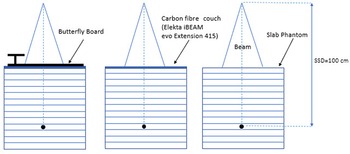
During the acquisition process and before adding any devices to the slabs, the phantom (set of slabs) was aligned with the isocentric laser of the scanner directly on the slab that contained the ionisation chamber. This allows for the identification of the scan centre and reproduces the same phantom position, using the room lasers to identify the isocentre of the linear accelerator. The CT images were transferred into the TPS (Xio) to create dosimetric plans for each simulated treatment setup. Several treatment plans were created. The first plan was calculated so that the external contour includes only the phantom, while the second plan was calculated to include the phantom and the fibre couch in the external contour. For the rest of the plans, the outer contour contained the immobilisation devices (Figure 1).
Experimental set-up used to quantify the table and immobilisation devices effect on dose distribution using slab phantom.

An ELEKTA synergy linear accelerator (Elekta AB, Stockholm, Sweden) was used to produce all beams in this study. This study was carried out for a sample 3D conformational radiation therapy field of 10 × 10 cm2. For each plan, a 10 × 10 cm2 size field was created at a depth of 10 cm at a SAD (Source-Axis Distance) of 100 cm and irradiated with 2 Gy (Figure 1) using three energies 6 MV, 10 MV and 18 MV. The dose was calculated by the TPS Xio using three different algorithms, Superposition, Fast Superposition and FFT convolution.
Through applying the same energy and field size, ionisation readings were taken. Relative attenuations of each immobilisation device with fibre couch were calculated. Reference Zhang, Gao and Bai4 Attenuation is defined in equation 1 as
 $${\rm{Attenuatiuon}}\; = \;{{{{\rm{D}}_{nd}} - {{\rm{D}}_{pd}}} \over {{{\rm{D}}_{nd}}}}{\rm{*}}100\% $$
where Dpd represents the dose measured with the beam passing through the fibre couch and the immobilisation device. Dnd represents the dose measured, while the beam did not intersect the fibre couch and the immobilisation device.
Taking into account the fibre couch and the immobilisation device in the external body contour, dose calculations from the three algorithms were evaluated using the percentage deviation (PD) between the measured and calculated doses, defined in equation 2, and taking the measurements dose as the reference dose.
 $${\rm{PD}}\; = \;{{\left( {{{\rm{D}}_c} - {{\rm{D}}_{mea}}} \right)} \over {{{\rm{D}}_{mea}}}}{\rm{*}}100\% $$
where Dcal is the calculated dose of each algorithm, and Dmea is the measured dose at the same point in the phantom.
Results
A total of five plans were created for each energy calculated by the three algorithms and combination of different devices. The first one was calculated so that the external contour includes only the phantom. The second plan was calculated to include the phantom and the fibre couch in the external contour. For the third, fourth and the fifth plans, the outer contour contained respectively one of the three immobilisation devices (Figure 1).
The difference between the measured and calculated doses for the phantom slab without an immobilisation device is shown in each table’s first row (Tables 1, 2 and 3). These results indicate that the measurements agree within 0·5% of the dose calculated by the three algorithms of Xio TPS. While the PD deviation percentage results, for the phantom when the fibre couch and immobilisation device were included in the body structure are shown on the other rows.
Percentage deviation of the couch with and without the immobilisation devices for three different algorithms, 6 MV

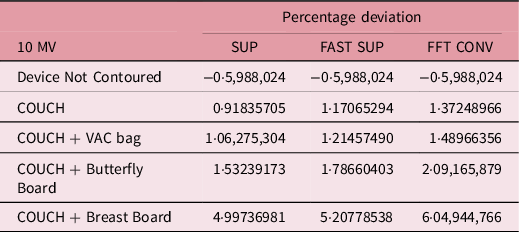
Percentage deviation of the couch with and without the immobilisation devices for three different algorithms, 10 MV

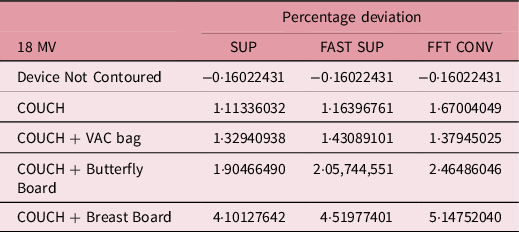
Percentage deviation of the couch with and without the immobilisation devices for three different algorithms. 18 MV

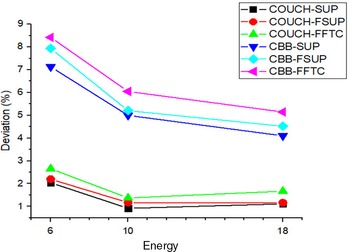
Analysis of the PD between the case when the fibre couch and devices are not contoured and then contoured shows significant differences. For 6 MV, 10 MV and 18 MV, a slight increase in the PD was calculated for the fibre couch only, the couch with a vacuum bag and the butterfly board compared to the attenuation calculated when the couch and any devices are not contoured. But a notable increase of the PD was observed for the couch with the breast board for all three of the algorithms, which increased from 0·2 to 7·13% (Figure 2).
Comparison between the fibre couch and Breast Board + Couch CBB, deviation percentages for the three Xio algorithms.

The couch attenuation measured for 6 MV beam energy reached 3%. When the other immobilisation devices were added on the couch, the butterfly board, for example, in which the beam penetrated into the longest trace, the attenuation was more pronounced and did reach 5·8% for 6 MV and 4·8% for 18 MV (Table 4). For the Breast Board, the attenuation reached 14% for 6 MV (Figure 3). It should be noted that the dose calculation was found to be more accurate in the superposition algorithm than in the other two. Hence, considering the combination of the couch and an immobilisation device in the dose calculation, this increased the PD difference between the three algorithms.
Comparison between measured attenuation, of the couch with and without the immobilisation devices, for three different energies 6 MV, 10 MV and 18 MV

Comparison between measured attenuation for three different energies 6 MV, 10 MV and 18 MV.

If a 2% is added to calculate the TPS’s uncertainty, Reference Fraass, Doppke and Hunt16 then the total uncertainty may be higher than these attenuation results. These values are much greater than those recommended by the ICRU. That is to say, the overall accuracy of the radiation dose delivered to the patient must be less than 5%. Reference Papanikolaou, Battista and Boyer17
Discussion
Previous studies investigating the impact of carbon fibre couch tops on treatment planning Reference Zhang, Gao and Bai4,Reference Ahn, Park and Kim18,Reference Njeh, Parker and Spurgin19 showed that the presence of fibre couch between the patient and beam significantly alters dose calculation. In this work, the dosimetric effect of the fibre couch with and without three different immobilisation devices was investigated.
The current study has shown that the inclusion of the fibre couch and immobilisation device in the body structure improves the accuracy of the dose calculation within clinical tolerance levels. Thus, considering beam attenuation when the treatment field passes through the devices seems to be crucial in determining dose calculation.
The results show that a lower energy produces the most pronounced couch effect, in the sense that it decreases when the energy increases. In fact, it is noted that the attenuation became less serious for the 18 MV energy than the 6 MV and 10 MV one. The reason is that the lower energy beam has the highest absorption rate. Therefore, the bolus effect is enhanced.
In addition to that, it has been realised that the effect of the fibre couch was more severe when an immobilisation device is added to it, than that of the couch alone, especially for the low energy in which the attenuation has become more noticeable. Moreover, the dose difference could be more pronounced for the treatments with the posterior beams, if the dose calculation does not take into account the couch and the immobilisation devices, mainly in the case of breast cancer.
The immobilisation devices used in this study were designed to be as radiotranslucent as possible, while providing the strength and rigidity required for patient immobilisation.
A previous study has shown that the attenuation measured for the iBEAM Evo Extension 415 carbon fibre table is higher than those declared by Elekta and can reach 3·7%, almost one point five times of the couch attenuation declared, which they claim concerns a gantry angle of 180°. Reference Zhang, Gao and Bai4 However, most results of the current study, when immobilisation devices were not introduced into the outer body contour, were within 2%, with the main exception for the breast board. Where none of the three algorithms results were less than 4%, there was a remarkable increase of the percentage deviation, for the FFT Convolution algorithm compared to the Superposition and the Fast Superposition algorithms, in which the maximum difference is 6·04%, in the case of 10 MV energy for example.
The large differences for the breast board are caused by the board’s central region, which is crossed by the field. The breast board is made of a wooden base or a solid carbon fibre base support. Although there is no standard planning in breast radiation therapy that allows the tangential field to pass directly through the board’s base region, except for the posterior fields, which can be used to treat the axillary region, and they can pass through the base support. Ignoring the breast board and the fibre couch in the dose calculation can change it. Therefore, if a beam passes through the breast board’s base support, it may cause dosimetric effects and lead to a significant error in the dose.
For the vacuum bag Vac-Lok that forms a custom mold on the fibre couch and slab phantom, based on the results from percentages attenuation, it is noted that the fibre couch PD became closer to the attenuation of the vacuum bag and fibre couch. The same remark applies to the butterfly board. For all primarily low-density immobilisation devices (butterfly board and vacuum bag) in addition to fibre couch, the percentage difference between the calculated and measured doses increased slightly for the FFT convolution algorithm.
This study was carried out only for a sample 3D conformational radiation therapy field of 10 × 10 cm2. For other treatment techniques like volumetric modulated arc therapy, the processing of small targets by FFF (Flattening filter free) beams using small segments is too demanded. Therefore, the dosimetric effect of the table and immobilisation devices such as thermoplastic masks on the small field should also be investigated. However, to assess the dosimetric effect of immobilisation devices and carbon fibre couch on the small field, a smaller sensitive volume chamber than the one considered in this study should be used.
Conclusion
In this study, the dosimetric effects of the carbon fibre couch iBEAM Evo Extension 415 with and without three immobilisation devices; on the dose calculation of conformal three-dimensional radiation therapy were calculated and evaluated. Tolerance levels have been respected for certain dose calculations, which do not include the fibre couch with or without immobilisation devices. Errors of up to 8% in the dose calculation were obtained for the beams passing through the fibre couch and the breast board’s base support region.
Due to the significant attenuation differences of the beam by the fibre couch and immobilisation devices, it is concluded that ignoring the device in the dose calculation is not appropriate. Hence, the fibre couch and immobilisation device should be included within the external body contour to account for the TPS calculation algorithms dose attenuation.
Acknowledgements
None.