


In Australia, Aboriginal and Torres Strait Islander people experience chronic health conditions, including diabetes, obesity and cardiovascular disease, at disproportionate rates compared to the non-Indigenous population (Vos, Barker, Stanley, & Lopez, Reference Vos, Barker, Stanley and Lopez2007a, Reference Vos, Barker, Stanley and Lopez2007b). Factors contributing to this unacceptable health gap include historical, political and socioeconomic marginalisation and negative assumptions about Indigenous peoples, all of which can result in intergenerational discriminatory practices that have a profound effect on health and wellbeing (Eckermann et al., Reference Eckermann, Dowd, Chong, Nixon, Gray and Johnson2006) and can limit access to appropriate housing, transport, jobs and health care services (Australian Institute of Health and Welfare, 2011). It has been reported that a well-trained health workforce will help to secure and sustain health improvements for Aboriginal communities (Andersen, Reference Andersen2009). Diet and lifestyle modification is a key component of the prevention and management of chronic health conditions that Indigenous people experience, and dietitians and nutritionists can play an important role in communicating this information. However, there is evidence that many dietitians and nutritionists lack confidence to work in Indigenous health (Wilson, Reference Wilson2011) and would benefit from further training in order to do so more confidently and effectively. This is a pattern that has also been observed in other allied health professions (Bennett, Zubrzycki, & Bacon, Reference Bennett, Zubrzycki and Bacon2011; Stedman & Thomas, Reference Stedman and Thomas2011; Thomas, Gray, & McGinty, Reference Thomas, Gray and McGinty2011). Therefore, one challenge for tertiary courses training dietitians and nutritionists is how to best equip new graduates with the skills to effectively work with Aboriginal and Torres Strait Islander peoples (Edwards, Reference Edwards2005).
There is a clear directive from the Australian government that health-based university courses include teaching of Indigenous health (Commonwealth of Australia, 2000). Recommendation 29 in the Health is Life: Report on the Inquiry into Indigenous Health (Commonwealth of Australia, 2000, p. xxiii) proposes that:
Within two years, all undergraduate and post-graduate health science courses should include an effective cross cultural awareness component, as well as dealing in detail with the current health status of Indigenous Australians and the factors which have contributed to their ongoing social and cultural disadvantage.
This recommendation has been supported by two further Australian government reports that outlined how Indigenous health can be addressed in the university system (Behrendt, Reference Behrendt2012; Bradley, Noonan, Hubert, & Scales, Reference Bradley, Noonan, Hubert and Scales2008). Teaching Indigenous health enables inclusion of Indigenous perspectives in the curriculum, which is important to make a useful contribution to improving the health of Indigenous peoples (Herbert, Reference Herbert2010). This also makes higher education more attractive and accessible to Indigenous students, because these students are presented with an education that ‘demonstrates a respect for Indigenous people, their knowledges and epistemologies’, which enables students to achieve self-determination and use education as a tool of empowerment (Herbert, Reference Herbert2010, p. 30). Many dietitians and nutritionists work in government-funded settings in which Indigenous health is a priority (Australian Government Department of Social Services, 2013) and it is therefore important that they are adequately trained to work effectively with Aboriginal and Torres Strait Islander peoples. Hence, there is an opportunity for tertiary institutions to review their programs and consider best ways to teach Indigenous health in Nutrition and Dietetics courses.
The Dietitians Association of Australia (DAA) requires entry-level dietitians to have basic skills to work in Indigenous health. The current DAA competencies for entry-level dietetic practice in relation to Indigenous health (DAA, 2009) include:
1. Understands what is meant by cultural awareness with respect to the Aboriginal and Torres Strait Islander and Culturally and Linguistically Diverse (CALD) communities and is aware of the skills required for communicating in a culturally respectful way;
2. Has a working knowledge of the nutrition issues and diet-related diseases impacting on the health of Aboriginal and Torres Strait Islanders and people from CALD communities; and
3. Has an awareness of the current policy and implementation frameworks for Aboriginal and Torres Strait Islander and CALD communities.
These are different to previous versions of the DAA competencies; for example, the 1994 DAA competencies did not refer specifically to Indigenous health (DAA, 1994). Despite the mention of Aboriginal and Torres Strait Islander health in the current DAA competencies, there is a lack of published literature about teaching Indigenous health in Nutrition and Dietetics courses in Australia, including what is taught, how the curriculum is assessed for adequacy, and alignment with these competencies. A review of nine DAA accredited courses in 2005 showed that two integrated Indigenous health issues across the curriculum, while seven included discrete lectures or tutorials about Indigenous health (Edwards, Reference Edwards2005). New graduate dietitians and nutritionists have previously reported that the current DAA competencies do not include the necessary attributes for working with people from other cultures, particularly Aboriginal and Torres Strait Islander people (Phillips, Ash, & Tapsell, Reference Phillips, Ash and Tapsell2000). Importantly, these were the previous DAA competencies (1994), which did not include any specific reference to Aboriginal and Torres Strait Islander health (DAA, 1994), and whether the same is true since the revision of the competencies in 2009 remains uncertain.
At Flinders University, students in the Bachelor of Nutrition and Dietetics (BND) and Master of Nutrition and Dietetics (MND) programs have the opportunity to undertake a community/public health, clinical and/or food service placement in the Northern Territory, where contact with Indigenous people is likely. In 2011, multiple placement educators provided formal feedback to the placement topic coordinators and reported that students would benefit from further training at university to undertake placements in Indigenous communities. In order to address this, a revision of the Indigenous health elements of the BND and MND curricula was undertaken. The aim of this research was to review the BND and MND curricula and make suggestions for what could be improved. A secondary aim was to describe the process used to do this, as suggestions for ways forward may be applicable to nutrition and dietetics courses at other universities, or indeed other health-related programs.
Methods
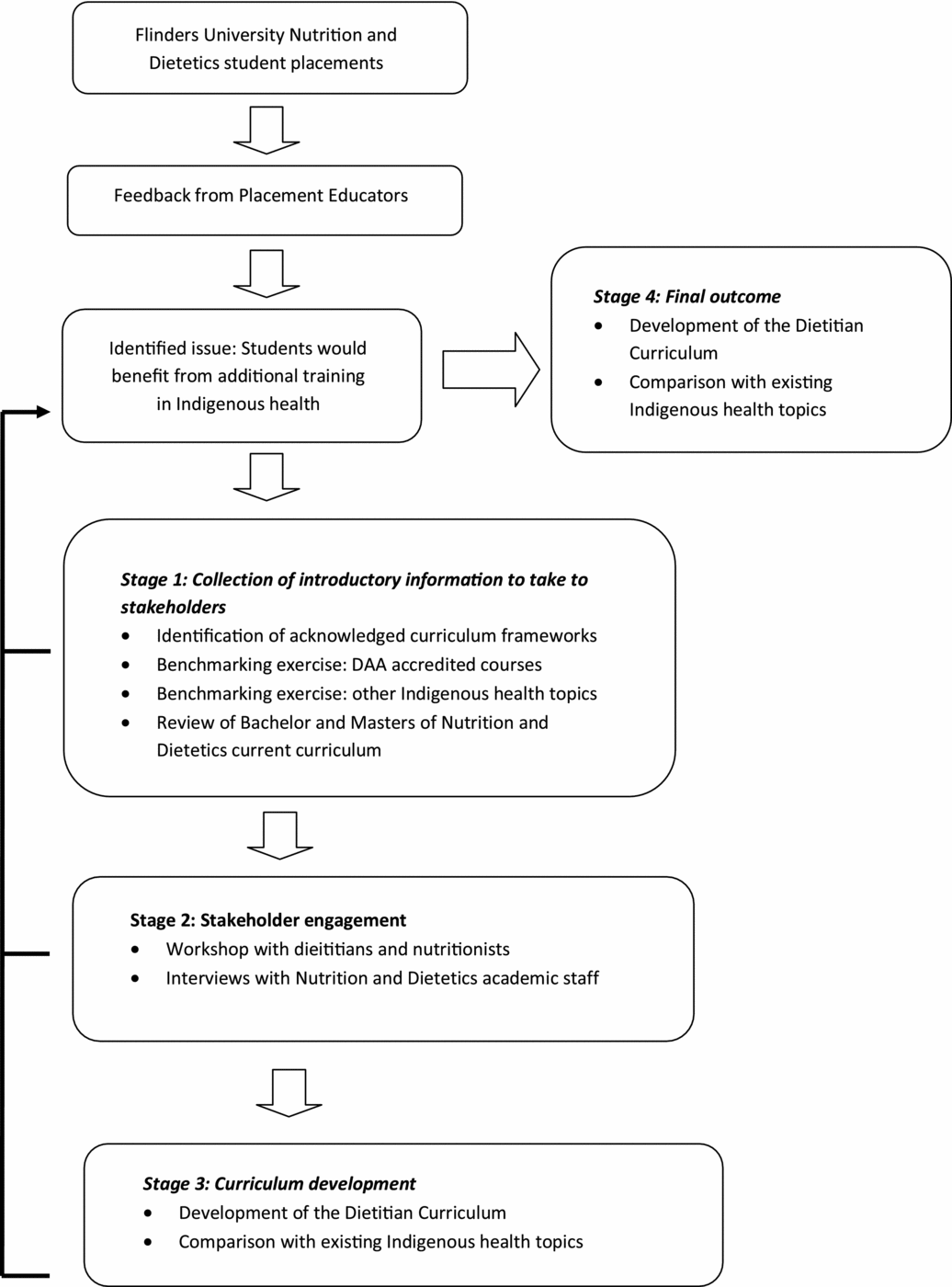
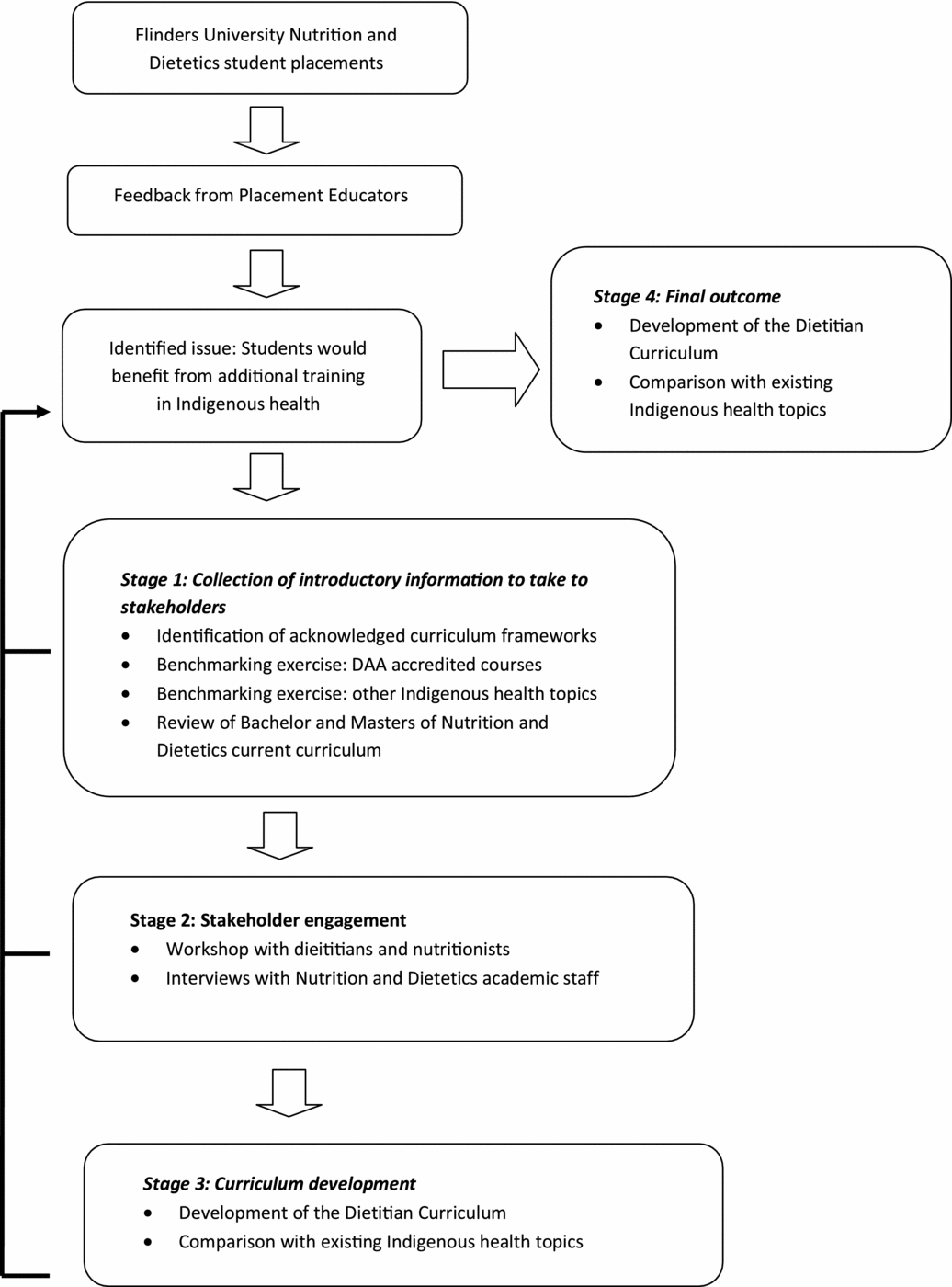
In this study, we used an action research process to review the BND and MND curricula and make suggestions for change. Action research was considered a suitable methodology because it aims to achieve change; it seeks to involve stakeholders to co-create knowledge relevant to local contexts; it is reflective, practical and cyclical in nature; and it seeks to solve real-world problems (Denzin & Lincoln, Reference Denzin, Lincoln, Denzin and Lincoln2011). This enabled the research team to work in partnership with the placement educators who had originally identified the issue, local dietitians and nutritionists who had an understanding of the local context, and university academic staff who teach Indigenous health, as well as those who teach BND and MND students. These stakeholders were all willing to be involved in the application of the results, another feature of action research (Denzin & Lincoln, Reference Denzin, Lincoln, Denzin and Lincoln2011). The cyclical nature of action research, with earlier cycles informing later cycles, enabled us to obtain multiple perspectives on the issue and progress to a final, agreed-upon action. Figure 1 presents the research process within an action research framework and the Methods and Results sections are organised under the headings of Figure 1.
Action research process used to review the Nutrition and Dietetics curriculum
Stage 1: Collection of Introductory Information to Take to Stakeholders
Stage 1 of the action research process involved collecting background information that provided further context around the general issue of teaching Indigenous health to allied health and nutrition and dietetics students, with a view of ultimately discussing this information with stakeholders in the next stage of the action research process.
Identification of acknowledged curriculum frameworks. Acknowledged and endorsed curriculum frameworks for teaching Indigenous health were identified and reviewed. This included the Committee of Deans of Australian Medical Schools (CDAMS) Indigenous Health Curriculum Framework (CDAMS, 2004), 15 Approaches to Indigenous Teaching (Asmar, Reference Asmar2011) and Review of Higher Education Access and Outcomes for Aboriginal and Torres Strait Islander People (Behrendt, Reference Behrendt2012).
Benchmarking exercise: DAA accredited courses. A benchmarking exercise was undertaken to ascertain what curriculum, if any, other DAA accredited Nutrition and Dietetics courses across Australia included about Indigenous health. This involved using university and course websites to look at course and topic details and, where necessary, contacting course coordinators to obtain further information about the topic content of courses.
Benchmarking exercise: Other Indigenous health topics. The benchmarking exercise was also used to identify Indigenous health topics taught at Flinders University and whether any of these would be suitable for Nutrition and Dietetics students. In undertaking this process, the authors met with staff at the Poche Centre for Indigenous Health and Well-Being and the Centre for Remote Health at Flinders University to discuss possible options as they teach Indigenous health topics in Adelaide and Alice Springs respectively.
Review of BND and MND current curriculum. Curriculum documentation for all BND and MND topics was reviewed. This included topic outlines and student course manuals. This information was read in detail and all references to Indigenous health were recorded.
Stage 2: Stakeholder Engagement
Workshop with dietitians and nutritionists. In September 2012, 12 dietitians and nutritionists from South Australia and the Northern Territory were invited to take part in a workshop in Alice Springs with staff from Flinders University. The meeting in Alice Springs was co-facilitated by the Centre for Remote Health staff. These dietitians and nutritionists were chosen because all or most of their work role encompassed Indigenous health and they were recognised leaders in this area. These dietitians and nutritionists were considered to be important stakeholders for the action research process as they were able to comment on practical and real-world issues about working in Indigenous health. Obtaining perspectives from individuals working across a variety of geographical locations was considered important, and hence the invited dietitians and nutritionists worked across urban, regional, rural and remote settings in both South Australia and the Northern Territory. The purpose of this meeting was to talk to dietitians and nutritionists about what they thought was important to be covered in a curriculum on Indigenous health for BND and MND students. As these dietitians and nutritionists supervised students and worked in Aboriginal health themselves, they were well equipped to comment on what needed to be incorporated into curricula and to be involved in the action research process. At this stage, it was unclear whether a new topic would be developed, an existing topic would be introduced as a core topic, or Indigenous health would be incorporated across the existing BND and MND curricula. A workshop was chosen to allow face-to-face discussion between Flinders University staff and dietitians/nutritionists, as well as a number of informal presentations.
The full-day workshop included a Welcome to Country by a local Aboriginal Elder, presentations from staff at the Centre for Remote Health and Poche Centre for Indigenous Health and Well-Being about Indigenous health topics, a presentation from the researcher about current coverage of Indigenous health issues in the BND and MND curricula, and time for discussion among the group about what else was needed. Lines of inquiry for discussion at the workshop included:
1. Thinking about curriculum in Indigenous health for nutrition and dietetics — what should be included?
2. Thinking about teaching and assessment methods.
Detailed notes were taken by two researchers to capture the discussion, and this information was used to inform proposed changes to curriculum.
Interviews with Nutrition and Dietetics academic staff. Nutrition and Dietetics academic staff from Flinders University were another important group of stakeholders in the action research process because they teach BND and MND students and therefore have a good idea of current student issues and would be affected by any changes to the curriculum. All academic staff in Nutrition and Dietetics at the time of the research were invited by email to participate in an informal, semi-structured interview (n = 9). Qualitative interviews were chosen to enable in-depth, open-ended exploration of the topic. Interview questions were based upon three areas of inquiry:
1. Clarification of existing curriculum in the topics each staff member taught, related to Indigenous health, identified by the review of curriculum documentation in Stage 1;
2. Views on potential opportunities to increase the curriculum related to Indigenous health in the topics that they taught; and
3. Their thoughts, views and concerns (if any) about teaching Indigenous health.
Extensive notes were taken by the researcher during the interview under the headings of these three areas of inquiry and this information was used to inform proposed changes to curriculum and resources required by academic staff in order to make these changes.
Stage 3: Curriculum Development
Development of the Dietitian Curriculum. The outcomes of Stages 1–2 were used in Stage 3, which was the development of a proposed curriculum that represented and summarised the key points considered crucial to develop students’ understanding of Indigenous health and food and nutrition (referred to in this article as the ‘Dietitian Curriculum’). This curriculum was primarily informed by views of the dietitians and nutritionist stakeholders attending the workshop in Alice Springs in Stage 2.
Comparison of the Dietitian Curriculum with existing Indigenous health topics. The Dietitian Curriculum was compared to semester-long Indigenous health topics already taught at Flinders University, all current Nutrition and Dietetics topics, and the information provided from academic staff through interviews. In particular, the Dietitian Curriculum was mapped against the semester-long topic ‘Indigenous Health for Health Sciences’ taught by the Poche Centre for Indigenous Health and Well-Being, to assess whether the Dietitian Curriculum adequately covered the core concepts in this topic. This topic was considered a gold standard for the types of concepts to teach nutrition and dietetics students as it was designed to teach allied health students about Indigenous health. This comparison was done using a framework that enabled comparison of the key areas of the Dietitian Curriculum with the overarching topic objectives and week-by-week objectives of the Indigenous Health Topic.
Stage 4: Final Outcome
The information gleaned from Stages 1–3 was used to make the final decision about a course of action for teaching Indigenous health to BND and MND students at Flinders University.
Results
Stage 1: Collection of Introductory Information to Take to Stakeholders
Identification of acknowledged curriculum frameworks. The acknowledged and endorsed curriculum frameworks provided information to critically evaluate the data collected from workshops and academic interviews to map a way forward. Specifically, these documents provided information on: guiding principles to teaching Indigenous health, suggested subject areas, pedagogical principles most likely to contribute to successful curriculum design and delivery, a process for curriculum development, recommendations for teaching Indigenous and non-Indigenous students at university level, and approaches to teaching cultural safety.
Benchmarking exercise: DAA accredited courses. At the time of the study there were 20 courses accredited by the Australian Dietetics Council at 14 universities (nine bachelor degrees, ten masters degrees and one postgraduate diploma). From a review of each course website, it was identified that 19 of the 20 courses had a public health nutrition topic where some Indigenous issues were covered. Detail on curriculum content, however, could not be obtained from all of the websites. Fourteen emails were sent to course coordinators of Nutrition and Dietetics programs to obtain more information. Eight replies were received. The majority of replies indicated that one-off lectures or tutorials (between 1 and 3 hours) were held to teach students about Indigenous health. These varied from one to three sessions through the degree and were usually part of the public health/community nutrition topic, but in some universities also occurred in dietetic counselling, nutritional status and communication topics. One university indicated they were working closely with their Indigenous health school to map the curriculum. Two courses at masters level indicated that students generally undertook studies about Indigenous health at undergraduate level.
Benchmarking exercise: Other Indigenous health topics. Three Indigenous health topics were identified that are taught to undergraduate students at Flinders University by the Poche Centre for Indigenous Health and Well-being. These topics are ‘Indigenous Health for Health Sciences’, ‘Indigenous Health for Nurses’ and ‘Indigenous Health for Midwives’. Another topic, ‘Social determinants of Indigenous Health’, is taught at postgraduate level. All of these topics are one semester in length and are based on a similar curriculum, with a focus on cultural safety and a critical reflective approach.
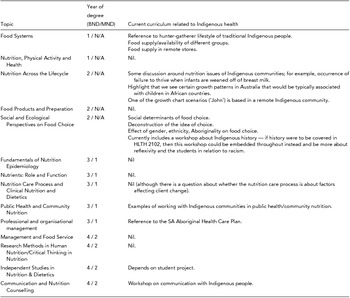
Review of BND/ MND current curriculum. All (15) topics across 4 years of Nutrition and Dietetics study were reviewed. Seven currently include some curriculum related to Indigenous health. Table 1 shows these 15 topics and what they currently cover about Indigenous health.
Current Curricula Related to Indigenous Health in Bachelor (BND) and Masters (MND) of Nutrition and Dietetics Topics

Stage 2: Stakeholder Engagement
Workshop with dietitians and nutritionists. Nine of the invited dietitians and nutritionists attended the workshop. Two were male; three were from South Australia and six from the Northern Territory. Two worked in an urban setting, four in remote settings and three in regional settings. Discussion with dietitians and nutritionists at the workshop revealed nine areas considered to be important to cover when teaching Indigenous health to Nutrition and Dietetics students. Other discussion during the workshop included potential case studies to use in teaching, potential assessment tasks, curriculum delivery (including offers from dietitians and nutritionists to be involved in teaching), and available teaching resources.
Interviews with nutrition and dietetics academic staff. Informal interviews were held with nine academic staff teaching Nutrition and Dietetics at Flinders University. All staff were female and held positions varying from lecturer to professor. They had worked at Flinders University for between 5 and 15 years. One staff member commented via email due to time constraints.
Academic staff were supportive of teaching Indigenous health to nutrition and dietetics students. However, they identified two concerns: first, that discussion of Indigenous issues in isolation in individual topics, without a wider framework connecting these issues, or a foundation of context for students to consider them within, could appear tokenistic; and second, that they lacked experience in teaching students about Indigenous health issues and were concerned about the effect of this. For example, one educator highlighted that while she was aware that Indigenous issues such as the role of history and social circumstances were important, she was not confident enough to transfer information to students in a way that would not perpetuate stereotypes or negative images of Indigenous people.
Stage 3: Curriculum Development
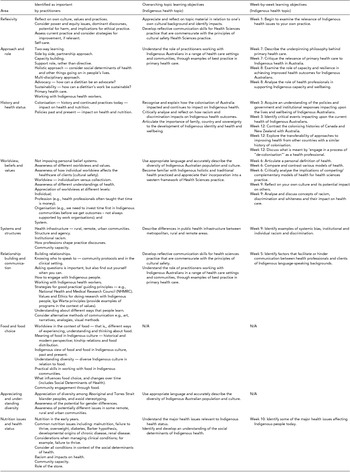
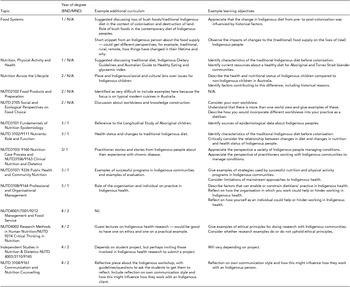
Development of the Dietitian Curriculum. The nine areas identified by the dietitians and nutritionists at the workshop, considered to be important when teaching Indigenous health, were used to develop the Dietitian Curriculum (Table 2). These nine areas were considered to be important for graduating dietitians and nutritionists to have demonstrated in order to practise effectively in Indigenous health. Specific examples of learning objectives that students would be required to meet in order to demonstrate competence in these areas are provided in the final column of Table 3.
Nine Areas Identified by Dietitians and Nutritionists to be Important When Teaching Indigenous Health to Nutrition and Dietetic Students (the Dietitian Curriculum), Mapped Against Example Learning Objectives from the Poche Centre for Indigenous Health and Well-Being's Topic, ‘Indigenous Health for Health Sciences’

Suggestions for New Curricula in Bachelor (BND) and Masters (MND) of Nutrition and Dietetics Topics, Including Learning Objectives

Comparison of the Dietitian Curriculum with existing Indigenous health topics. The Dietitian Curriculum was compared to the topic ‘Indigenous Health for Health Sciences’, taught to undergraduate students at Flinders University by the Poche Centre for Indigenous Health and Well-being, using a comparison framework. This comparison framework included the nine areas of the Dietitian Curriculum and corresponding overarching and week-by-week learning objectives for the Indigenous health topic. Key issues covered in this topic include cultural safety, policies past and present, historical and contemporary impacts, intercultural communication, Indigenous health in a global context, and models of health. Due to the concerns identified by academic staff that discussion of Indigenous issues in isolation in individual topics, without a wider framework connecting issues, could appear tokenistic, it was particularly important to review this topic and consider whether it was suitable for Nutrition and Dietetics students. Discussions with staff from the Poche Centre who teach these topics and review of curriculum documentation identified that the pedagogy on which the topic is based is consistent with pedagogic principles for teaching Indigenous health identified in the literature review (Asmar, Reference Asmar2011; CDAMS, 2004); for example, teaching in pairs, encouraging students to question assumptions and established ‘facts’, utilising personal experience (Asmar, Reference Asmar2011), using a strengths-based model, and involving Indigenous people in curriculum development (CDAMS, 2004). The second two columns of Table 2 demonstrate how the comparison between the Dietitian Curriculum and the Indigenous health topic was undertaken. When the Indigenous health topic was mapped against the Dietitian Curriculum, the Dietitian Curriculum was found to broadly cover all nine areas except ‘food and food choice’ and ‘nutrition and health status’.
It was proposed that in order to cover ‘food and food choice’ and ‘nutrition and health status’, additional curriculum about Indigenous health that specifically addressed these areas would be incorporated into existing nutrition and dietetics topics. Suggestions for new curriculum were made for all 14 topics, including proposed activity, learning objectives, area addressed, potential readings and resources, how to implement the proposed activity, and proposed assessment tasks. Additional suggestions were also made about incorporating other areas of the Dietitian Curriculum into existing topics. Examples are provided in Table 3, topic by topic, and include example learning objectives. Please note that Table 2 does not cover all topics studied by students when completing the BND and MND, nor does it include all proposed additional curricula and learning objectives.
Stage 4: Final Outcome
The information collected in the benchmarking exercise of DAA accredited courses, the literature review, interviews with academic staff, the benchmarking exercise of other topics at Flinders University, the review of the Flinders University Nutrition and Dietetics curriculum and the meeting with dietitians and nutritionists (including the Dietitian Curriculum) was used to make a decision about how Indigenous health is taught to Nutrition and Dietetics students at Flinders University. Due to the good coverage of the Dietitian Curriculum, the strength of the pedagogy of the Indigenous health topic and the concerns of academic staff about the need for a foundation for students, it was decided that all students studying the BND would undertake the semester-long Indigenous health topic ‘Indigenous Health for Health Sciences’ in the first year of study. It was also decided that this would be complemented by teaching of Indigenous health and nutrition across the Nutrition and Dietetics course that would address issues of food, food choice and nutritional status in Indigenous communities. In particular, the focus on coming to see Indigenous health through a self-reflective process was a highly regarded characteristic of the topic ‘Indigenous Health for Health Sciences’ and consequently, the topic was instated as a core topic for the BND program. Further discussion is being held about how to incorporate this learning for MND students who have not studied previous topics about Indigenous health; for example, a self-study package.
Discussion
This paper used an action research framework to review the BND and MND curricula at Flinders University for teaching in Indigenous health, and suggest strategies for improvement. As outlined in Figure 1, this involved a four-stage action research process and included collection of a variety of information, stakeholder engagement, curriculum development and decision about a final outcome. The process could be used by other universities and health disciplines looking to review and/or improve the Indigenous health content of their curriculum.
The approach proposed for Nutrition and Dietetics courses in this article reflects the importance of students obtaining a solid foundation in Indigenous health. The core topic ‘Indigenous Health for Health Sciences’ that BND students will undertake will act as a foundation or underpinning for the coverage of issues specifically related to Indigenous nutrition in later years of the BND and MND. This foundation is vital if students are going to appreciate and be able to see the wider context in which nutrition practice, and health care with Indigenous peoples, takes place. This was described by Ewan, Paul, and Bloom (Reference Ewen, Paul and Bloom2012) as:
What is missing in health sciences education is a broad and foundational understanding of the contexts in which Indigenous people and health professionals meet and interact (with, in most cases, limited previously shared experience), and the consequent impacts of these contexts on health and health care outcomes.
Furthermore, Herbert (Reference Herbert2010, p. 16) argues that if universities are going to provide leadership in the creation of a more equitable society, then enhancing cross-cultural understanding across all discipline areas of a university by having a mandatory Indigenous studies program with a minimum of one subject per year is required for all graduates of Australian universities. This topic will contribute to the cultural safety of dietetic graduates from Flinders University. Culturally safe graduates are able to engage in self-reflection and to reflect on themselves and their own practices (Ryder, Yarnold, & Prideaux, Reference Ryder, Yarnold and Prideaux2011). Cultural safety acknowledges that improving equitable access to health care (for ethnically diverse groups, not just Indigenous Australians) is ‘not just a matter of what members of the dominant culture do with “others” but what they should do with “themselves”’ (Ryder et al., Reference Ryder, Yarnold and Prideaux2011, p. 781). Therefore, students will be facilitated to reflect on their own attitudes and biases, and whether these promote or compromise the health of Indigenous people (Durey et al., Reference Durey, Wynaden, Thompson, Davidson, Bessarab and Katzenellenbogen2012).
The benchmarking exercise of dietetic courses at other universities showed that the majority of courses used one-off lectures or tutorials (between 1 and 3 hours) to teach students about Indigenous health. Therefore, it seems that for the majority of Nutrition and Dietetics courses at Australian universities, there is a general lack of curriculum space dedicated to Indigenous health, despite this being an identified public health priority. Considering this, we acknowledge that it might not be possible for all Nutrition and Dietetics courses to include a semester-long Indigenous health topic as a core component of study, as is the approach that Flinders University has chosen to take. In situations where this is the case, we would encourage courses and programs to think about alternative ways in which similar learning objectives might be met by students by the end of the program, and how they could increase and build on what is currently being done. From this review and at the time of this study, it seems including a core, semester-long Indigenous health topic, taught through an Indigenous health unit, is unique to Flinders University among Nutrition and Dietetics courses within Australia.
The interviews with academic staff highlighted that some staff did not feel equipped to teach Indigenous health. It has been documented that teachers influence their students; in particular, participants at all levels of the educational system contribute to knowledge production in a variety of ways through discussions, problem solving, and engagement in everyday activities (Akena, Reference Akena2012). Knowledge is shaped not only as it is continuously interpreted, processed and reinterpreted in the interactions among instructors and learners in educational settings, but also through the experiences and understandings brought in from outside schooling (Akena, Reference Akena2012). Furthermore, discomfort and anxiety can arise among both students and staff when culture, identity and Indigenous health issues are discussed (McDermott, Reference McDermott2012). Therefore, it is vital that professional development occurs in order to support academic staff in the role of delivering Indigenous curriculum, in order to support both academic staff and student learning and development about Indigenous health.
A major strength of this process was the involvement of stakeholders; for example, dietitians and nutritionists working in Indigenous health. This reflects the action research process, as while part of the research, the dietitians and nutritionists also became stakeholders and contributed to the final outcome (Stages 3 and 4). The Dietitian Curriculum developed has strength because it reflects practitioner experience and is therefore practice-based. Practitioner input into development of health curricula has been reported elsewhere; for example, when developing competencies for a Master of Public Health degree, the public health community was consulted through progress reports and invitations to respond with comments (Calhoun, Ramiah, Weist, & Shortell, Reference Calhoun, Ramiah, Weist and Shortell2008). Similarly, a curriculum framework for clinical prevention and population health in nursing was developed by a taskforce that included representatives from clinical areas, including nursing and nurse practitioners (Allan, Stanley, Crabtree, Werner, & Swenson, Reference Allan, Stanley, Crabtree, Werner and Swenson2005). However, it must be noted that a small number of dietitians and nutritionists from two states and territories were involved in developing the Dietitian Curriculum. While this met the needs of our study and the sample was representative for our purpose, it may limit the relevance of the curriculum to different geographical areas. However, comparison of the Dietitian Curriculum to the topic ‘Indigenous Health for Health Sciences’, which was broadly designed for allied health students, showed there to be a good match between the two, suggesting that this may not be the case and the findings may well be transferable to other settings, locations and dietetic programs.
Other strengths included scrutiny of Nutrition and Dietetics topic documentation and involvement of academic staff from Nutrition and Dietetics about their ideas and concerns and discussions with educators from the Poche Centre for Indigenous Health and Wellbeing, who were able to provide insight into teaching Indigenous health to students and practitioners. However, a limitation of this process was the lack of extensive involvement of Indigenous people in the review and development of the curriculum. Involving Aboriginal and Torres Strait Islander people in decision making around Indigenous health curriculum design, delivery and evaluation is paramount. The professional, historical, social, cultural and community experiences that these people bring will enhance students’ learning experiences (CDAMS, 2004). Therefore, it is important that further work is done to include the perspectives of Indigenous people in curriculum design and delivery when teaching Indigenous health to BND and MND students at Flinders University. One approach that could be taken to develop curriculum about food and food choice, and nutrition and health status, to be incorporated into Nutrition and Dietetics topics further, is using a learning circle of Nutrition and Dietetics academic staff and Indigenous health specialists to review and develop teaching materials (Nash, Meiklejohn, & Sacre, Reference Nash, Meiklejohn and Sacre2006). Indigenous health specialists could include Indigenous health departments within Flinders University and key Aboriginal health organisations within South Australia. Furthermore, while pedagogy for Indigenous teaching was used to make recommendations on improving the Nutrition and Dietetics curriculum, further work could be done to map exactly how curriculum across Nutrition and Dietetics topics incorporates and addresses recommended pedagogy (Asmar, Reference Asmar2011; CDAMS, 2004). More in-depth, evidence-based studies are needed to understand the impact of Indigenous pedagogy on student learning (Biermann & Townsend-Cross, Reference Biermann and Townsend-Cross2008). Therefore, it is important that this process is evaluated before and after the changes to the curriculum are implemented. For students, this could include discussion about what students think about their own needs and preferred learning strategies in relation to Indigenous perspectives (Nash et al., Reference Nash, Meiklejohn and Sacre2006). These suggestions could be incorporated into the action research process (Figure 1) as extra steps to follow by other universities seeking to undertake a similar process. In addition, the limitations of the benchmarking exercise across DAA accredited courses, including accessing all programs and the limited information available from a few only, must be acknowledged.
In conclusion, Flinders University appears to be leading the way in recognising that learning about Indigenous health is relevant for all dietitians, regardless of where they work. By focusing on the training of culturally safe dietitians who can act as role models within the dietetic profession and as advocates for Indigenous health, all universities can actively contribute to improving health outcomes for Australia's Indigenous peoples.
Acknowledgments
The authors would like to acknowledge staff from the Poche Centre for Indigenous Health and Well-Being at Flinders University for their assistance with review of the Indigenous health topic and their input into the research process. They would also like to acknowledge the dietitians and nutritionists from South Australia and the Northern Territory who had input into the development of the Dietitian Curriculum, and staff from the Centre for Remote Health (Alice Springs) for assistance with planning and hosting the consultation workshop.
About the Authors
Annabelle Wilson is a Research Fellow at the Adelaide Poche Centre for Indigenous Health and Well-Being and the Discipline of Public Health at Flinders University. She received her PhD in 2012. She is also an Accredited Practising Dietitian and has worked with Aboriginal communities across Australia in rural, remote and urban settings. She has a strong commitment to ethical practice and working in partnership with Aboriginal people and communities.
Kaye Mehta is Senior Lecturer in the Nutrition and Dietetic program at Flinders University in South Australia. She teaches social nutrition, public health and community nutrition. Kaye worked for more than 20 years as a dietitian-nutritionist in community settings prior to teaching, and established herself as a leader in community nutrition in South Australia. Over those years she developed, implemented and evaluated nutrition promotion programs, primarily with low-income communities, including unemployed young people, Aboriginal people and first-generation Italian people. Her research interests include nutrition program evaluation, social determinants of food choice, and critical literacy on the food system.
Jacqueline Miller is a Senior Lecturer in Nutrition and Dietetics at Flinders University. She is the course coordinator for the Masters of Nutrition and Dietetics and also coordinates the Communication and Counselling topic.
Alison Yaxley is a Lecturer in Nutrition and Dietetics at Flinders University and an Accredited Practising Dietitian. She was awarded her PhD in 2014 for an investigation of unintentional weight loss in older adults. Alison is also the Nutrition and Dietetics liaison with Charles Darwin University and coordinates teaching of nutrition to cross-institutional students from those programs.
Jolene Thomas is a lecturer in Nutrition and Dietetics at Flinders University. She teaches the topics Nutrition and Dietetics, Clinical Nutrition and Dietetics and Food Service: Theory and Practice. Jolene's research interests lie in the areas of vascular nutrition, wound healing, and nutrition in older adults.
Kathryn Jackson is a lecturer in Nutrition and Dietetics at Flinders University. Her teaching interests are in the areas of nutritional biochemistry, sports nutrition and the interrelationships between nutrient intakes and physical activity.
Amanda Wray is an Accredited Practising Dietitian and responsible for teaching of clinical nutrition and communication and coordinates student placements involving individual case management. She is also responsible for facilitating transition into University for year 1 students admitted to the Bachelor of Nutrition and Dietetics at Flinders University.
Michelle Miller is an Advanced Accredited Practising Dietitian and Head of Nutrition and Dietetics at Flinders University. She teaches nutritional epidemiology and research methods to students in both Nutrition and Dietetics programs at Flinders University. She also regularly supervises Honours and research higher degree students, primarily in the area of rehabilitation, aged care and clinical nutrition.