An important question centering on bilingualism and second language acquisition is how words in one language are cognitively organized and processed in relation to words in the other language. A previously dominant view of the cognitive architecture of the bilingual lexicon is that bilinguals were believed to have two separate lexicons governed by a control mechanism so that bilinguals do not generally experience interference from one language to the other (Macnamara & Kushnir, Reference Macnamara and Kushnir1971; Scarborough, Gerard & Cortese, Reference Scarborough, Gerard and Cortese1984). However, more recent evidence has shown that bilingual processing is non-selective, not only in the auditory modality (Weber & Cutler, Reference Weber and Cutler2004), but also in the visual modality (Dijkstra, Timmermans & Schriefers, Reference Dijkstra, Timmermans and Schriefers2000; Duyck, Van Assche, Drieghe & Hartsuiker, Reference Duyck, Assche, Drieghe and Hartsuiker2007; Van Hell & Dijkstra, Reference Van Hell and Dijkstra2002; van Heuven, Dijkstra & Grainger, Reference van Heuven, Dijkstra and Grainger1998; van Heuven, Schriefers, Dijkstra & Hagoort, Reference van Heuven, Schriefers, Dijkstra and Hagoort2008). Thus, it becomes clear that both languages are active when only one language is being attended in various language tasks (Brysbaert, Reference Brysbaert2003). This leads to the conclusion that the two linguistic systems are actively interacting with each other during language processing and are integrated at some level in the bilingual lexicon.
One way to test the dynamics of cross-language influence is to use the masked priming paradigm, where a bilingual is presented with a prime word in one language immediately followed by a target word in the other language and is instructed to respond to the target word. By measuring the effect of the prime on the target, one can interpret the cross-language connections of the bilingual lexicon (Forster & Jiang, Reference Forster and Jiang2001). In the masked priming paradigm, the prime is very briefly presented (40–60ms), so that the subject is not aware of the existence of the prime when instructed to make a lexical decision on the target. Previous masked translation priming studies have demonstrated a priming asymmetry in processing translation equivalents, in which an L1 prime could facilitate processing of a translation-equivalent L2 target, but not vice versa (e.g., Davis, Sanchez-Casas, Garcia-Albea, Guasch, Molero & Ferre, Reference Davis, Sanchez-Casas, Garcia-Albea, Guasch, Molero and Ferre2010; Dimitropoulou, Duñabeitia & Carreiras, Reference Dimitropoulou, Duñabeitia and Carreiras2011a; Finkbeiner, Forster, Nicol & Nakamura, Reference Finkbeiner, Forster, Nicol and Nakamura2004; Gollan, Forster & Frost, Reference Gollan, Forster and Frost1997; Jiang, Reference Jiang1999). These findings were usually obtained with late bilinguals. This priming effect from L1 to L2 has been interpreted in terms of linkages between translation equivalents at a lexical semantic level. One might attribute the lack of priming from L2 to L1 to bilinguals’ inability to process L2 primes within such a short time. However, this cannot be true because L2-L2 repetition priming was reliably observed in both Chinese and Hebrew in lexical decision (e.g., Gollan et al., Reference Gollan, Forster and Frost1997; Jiang, Reference Jiang1999). If the translation equivalents are linked at the semantic level, it is logical to think that L2-L1 priming should also be observed, given the presence of within L2 priming (Jiang & Forster, Reference Jiang and Forster2001; Finkbeiner et al., Reference Finkbeiner, Forster, Nicol and Nakamura2004).
Recently, there have been some studies reporting priming effect of similar magnitude in both directions for lexical decision in highly proficient bilinguals (Duñabeitia, Dimitropoulou, Uribe-Etxebarria, Laka & Carreiras, Reference Duñabeitia, Dimitropoulou, Uribe-Etxebarria, Laka and Carreiras2010; Duñabeitia, Perea & Carreiras, Reference Duñabeitia, Perea and Carreiras2010; Perea, Duñabeitia & Carreiras, Reference Perea, Duñabeitia and Carreiras2008). These bilinguals were within-script: namely, their two languages both used an alphabetic script. It is unclear whether the script would be a factor modulating cross-language masked priming. In fact, Nakamura, Dehaene, Jobert, Bihan, and Kouider (Reference Nakamura, Dehaene, Jobert, Le Bihan and Kouider2005) suggest that a serial posterior-to anterior axis of the ventral visual system appears to be structured similarly across readers of different orthographies but is also partially modulated by the specific requirements of scripts. At the functional level, they suggest that masked priming effects could differ due to the different phonological encoding of different scripts. That is, a prime in a logographic script vs. an alphabetic script could generate different priming patterns. In the case of cross-script bilinguals, L1-L2 priming has been consistently observed (e.g., Gollan et al., Reference Gollan, Forster and Frost1997; Jiang, Reference Jiang1999; Finkbeiner et al., Reference Finkbeiner, Forster, Nicol and Nakamura2004), while L2-L1 priming was only observed in Wang (Reference Wang2013) in lexical decision with highly proficient balanced Chinese–English bilinguals. Importantly, even with translation priming observed in both directions, L1-L2 priming was stronger than L2-L1 priming.
It is argued that Chinese–English translation equivalents are interconnected at the semantic/lexical level, which is the source for the translation priming effect (Forster & Jiang, Reference Forster and Jiang2001; Jiang, Reference Jiang1999; Wang & Forster, Reference Wang and Forster2010; Wang, Reference Wang2007). Given the handful of studies showing priming effects in lexical decision in both language directions, the majority of studies have consistently reported L1-L2 priming, but not vice versa (e.g., Davis, et al., Reference Davis, Sanchez-Casas, Garcia-Albea, Guasch, Molero and Ferre2010). To explain the priming asymmetry, several accounts have been offered. One is straightforward: lack of proficiency in L2 results in less automatic processes compared to L1; therefore, there is no L2 effect on L1. However, this does not seem to be the case because within L2 priming was consistently reported in the literature (Gollan et al., Reference Gollan, Forster and Frost1997; Jiang, Reference Jiang1999). In addition, Dimitropoulou, Duñabeitia and Carreiras (Reference Dimitropoulou, Duñabeitia and Carreiras2011b) demonstrated that L2 proficiency did not modulate priming effects. Another proposal, not so straightforward, is that for late L2 learners, the L2 lexicon is not stored in the same memory system as the L1 lexicon (Jiang & Forster, Reference Jiang and Forster2001; Witzel & Forster, Reference Witzel and Forster2012). This view is supported by the findings that L2-L1 priming can be obtained in an episodic memory task, but not in lexical decision. A third account, the Sense Model account, attributes the asymmetry to the differences in the semantic representations of L1 and L2. According to the Sense Model, the absence of L2-L1 priming is due to the less richly semantically represented L2 compared to L1 (Finkbeiner et al., Reference Finkbeiner, Forster, Nicol and Nakamura2004; Wang & Forster, Reference Wang and Forster2010). This account predicts that bilinguals, given balanced language experiences in L1 and L2, should produce translation priming in both directions. This is consistent with the findings in Wang (Reference Wang2013), where priming was obtained in both directions with proficient balanced bilinguals who had similar language experience in L1 and L2, but only in the L1-L2 direction with proficient unbalanced bilinguals in lexical decision.
One related issue, but never investigated in these studies, is the possible role of variation in the degree of awareness of the prime. This may be largely irrelevant for within-language repetition priming, but may be critical for cross-language translation priming. A hotly debated issue in the masked priming literature is to what extent subliminal stimuli can be processed semantically (Dehaene et al., Reference Dehaene, Naccache, Clec’H, Koechlin, Mueller, Dehaene-Lambertz and Bihan1998). Kouider and Dupoux's (Reference Kouider and Dupoux2004) proposal of partial awareness suggests that awareness is not an all-or-none notion; rather, there is a state of partial awareness in which participants can identify part of the visual stimuli; for instance, they can identify certain letters or fragments of an English word in the masked presentation but are very poor at identifying the entire stimulus. One assumption of this argument is that pictures or words are complex hierarchically organized stimuli that are represented at several levels of detail (in the case of words the levels would range from features to letters of phonemes to the whole word) and that particular masking conditions will affect certain levels of representation but not others. Partial awareness is opposed to global awareness, in which the stimulus is identified at all processing levels. Under the condition of partial awareness, participants may use the letters or features that they have perceived to reconstruct what the stimulus is. Once the stimulus has been reconstructed, it can be semantically processed, giving rise to the appearance of unconscious semantic activation. From this point of view, the priming asymmetry may simply reflect the fact that partial awareness of an L2 prime may be much weaker than for an L1 prime.
The variable that directly relates to the unconscious semantic activation is the prime duration. Priming effects have been observed for prime durations as short as 28ms in a semantic categorization task (Frenck-Mestre & Bueno, Reference Frenck-Mestre and Bueno1999). In contrast, it has been demonstrated that a semantic priming effect in lexical decision is consistently found for prime durations longer than 50ms, but absent at SOAs of 33ms or 43ms (Perea & Gotor, Reference Perea and Gotor1997; Perea & Rosa, Reference Perea and Rosa2002; Rastle, Davis, Marslen-Wilson & Tyler, Reference Rastle, Davis, Marslen-Wilson and Tyler2000). Interestingly, the strength of the semantic priming effect does not gradually decrease with a corresponding decrease in prime duration but virtually disappears below 50ms. This might suggest that 50ms may represent some kind of boundary condition that determines whether semantic priming is obtained or not. For example, Hector's (Reference Hector2005) unpublished dissertation demonstrates that semantic priming was obtained with prime durations of 55 and 60 ms, but not 42 ms in lexical decision. These results suggest that semantic activation needs to reach a certain level to obtain a semantic priming effect in lexical decision and the critical prime duration for partial awareness of English primes for native speakers may be around 50ms. Furthermore, Kouider and Dupoux (Reference Kouider and Dupoux2004) argued that masked cross-modal and semantic priming effects are obtained only with participants who demonstrate partial awareness of the prime, whereas this is not the case when priming is due to similarity of form.
It seems clear that translation priming across languages with different scripts and phonology is semantic in nature, in the sense that the only way to link the two languages is at the conceptual level. The aforementioned arguments about the awareness of the masked primes lead us to speculate that translation priming might also depend on whether bilingual participants are partially aware of the masked primes, either in L1 or L2. It seems reasonable to suppose that the threshold of partial awareness for English primes is higher for L2 speakers than for English native speakers, due to different degrees of familiarity of the linguistic stimuli and the script across these two populations. Along the same line of argument, the threshold of partial awareness for Chinese primes could be lower than for English primes for Chinese–English bilinguals, which could explain why a 50ms prime duration was not sufficient to produce L2-L1 priming, but was good enough to produce priming from L1 Chinese prime to L2 English targets. Previous translation priming studies have employed an SOA of 50ms in both L1-L2 and L2-L1 directions (e.g., Gollan et al., Reference Gollan, Forster and Frost1997; Jiang, Reference Jiang1999; Finkbeiner et al., Reference Finkbeiner, Forster, Nicol and Nakamura2004). If the threshold of partial awareness of L2 primes is higher than that of L1 primes and the degree of prime awareness is critical in producing translation priming, it is clear why L2-L1 priming may be absent in lexical decision. Therefore, it is important to ensure that the prime reaches the same degree of partial awareness in either direction, but is not identifiable.
In the current study, an attempt is made to measure the relation between prime duration and partial awareness in L1 and L2, with the aim of adjusting the duration of the L2 prime so that it is comparable to an L1 prime in terms of partial awareness. If differential partial awareness in L1 and L2 is responsible for the priming asymmetry, then the asymmetry should disappear under the condition where partial awareness is equated across languages. Thus, a key issue is how to measure partial awareness comparably in languages with different scripts. The most obvious method would be to use a two-alternative forced-choice technique, in which participants are asked to guess which alternative is more likely to be the prime. This procedure could be carried out in both languages to determine the degree of awareness of the prime. One problem with this procedure is that performance would also depend on how similar the two alternatives are, and any comparison across languages requires that this similarity must be held constant. For example, if the prime is “horse”, we might expect poorer performance if the alternatives were orthographically similar (e.g., “horse–house”), phonologically similar (e.g., “horse–course”), or semantically similar (e.g., “horse–pony”) compared to alternatives that are quite unrelated (e.g., “horse–garden”). But if the prime is 马 (Chinese for “horse”), how could the alternatives be designed so that they are equivalent to the English alternatives?
Semantic Discrimination Task
The solution to this problem of cross-language equivalence is to eliminate orthographic and phonological factors by using alternatives that vary in their semantic overlap with the prime, but neither of which is actually the prime. Thus, the alternatives for the prime “horse” might be “donkey–ocean”. If the prime activates the semantic properties for “horse”, then the overlap with the properties of “donkey” will be greater than the overlap with the properties of “ocean”, and therefore “donkey” would be selected as being more likely to be the prime. Performance now cannot be influenced by the orthographic or phonological similarity of the alternatives. Comparability across languages is now achieved by using the Chinese translations of “donkey” and “ocean” as alternatives. So, if the prime is 马, the alternatives would be “驴-洋”. Assuming that these are good translations, then performance in either language will depend on the strength of semantic activation produced by the prime. If L1 and L2 demonstrate different degrees of semantic activation, we can then determine how long the L2 prime needs to be presented in order to generate the same degree of semantic activation as that generated by a 50ms L1 prime.
Experiment 1A. Semantic Awareness Measure
The purpose of this experiment was to measure the partial awareness of L1 and L2 primes in Chinese–English bilinguals in a two-alternative forced-choice task, where the participant must identify which alternative was closer in meaning to the prime. If performance in L1 and L2 differed significantly at the prime duration of 50ms, it could be hypothesized that the absence of L2-L1 translation priming might be related to insufficient semantic activation of L2 masked primes.
Method
Participants
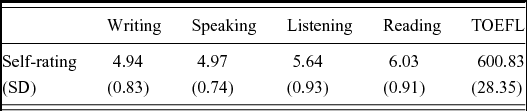
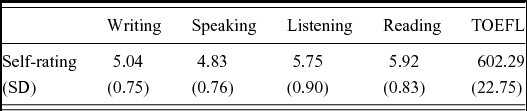
Thirty-six Chinese–English undergraduate and graduate bilinguals were recruited from the University of Arizona for this experiment. All of them were native speakers of Chinese and had spent at least a year and a half in the USA for academic purposes by the time of testing. Participants had received a minimum of 8 years of formal English instruction in China before they came to the USA. In addition, they all obtained a score of at least 550 in TOEFL (max score of 677) to be admitted to the University of Arizona. This is an indication that they were all fairly advanced L2 English speakers. The mean age of participants was 24.6. In a language questionnaire, they were asked to rate their English proficiency on a 1–7 Likert scale in 4 skills: listening, reading, speaking and writing. In addition, they provided their TOEFL scores for undergraduate or graduate school admission (see Table 1). All the participants were paid $6 for their time.
Means (SD) based on 36 participants’ self-rating of their language skills on a 1–7 Likert scale (1 = very poor and 7 = native like) and Means (SD) of TOEFL scores in Experiment 1A

Materials and Design
The experimental items (see Appendix A) consisted of a set of English words and their Chinese translation equivalents adapted from Wang and Forster (Reference Wang and Forster2010) and the Longman dictionary of contemporary English: English-Chinese (Zhu & Deng, Reference Zhu and Deng1998). A total of 240 sets of three Chinese words – 720 Chinese words in total – were selected for use as high-frequency nouns. Among these, there were 48 three-character words, 591 two-character words, and 81 one-character words; each set consisted of three words of the same number of characters. None of these Chinese words overlapped with any of the items in Experiment 2; each word had a unique English translation. Correspondingly, a total of 240 sets (720 English words in total) were used as English stimuli. Within each set of three words, one served as the prime word and the two others as response alternatives. One of the alternatives was semantically related to the prime word; the other was neither semantically related to the prime word nor the response alternative. The semantic relation was either categorical (magazine and novel) or associative (black and white). For instance, if the prime was the word “cat” then the two response alternatives “dog–gun” might have been used. When constructing the Chinese items, it was ensured that the three words within each set (trial) were of the same length (i.e., the same number of characters). Additionally, 10 sets of translation pairs were selected as practice items.
Bilingual participants were tested with both Chinese and English stimuli presented in blocks, but each translation pair was presented only once either in Chinese or English (within-subject design). During the experiment, participants were presented with a total of 240 trials, half in Chinese and half in English. Care was taken so that no alternatives were semantically related within trials or across trials. Two counterbalanced lists (List A & B) were constructed so that half of the English trials would be in Chinese on the other list and half of the Chinese trials would be in English on the other list. For example, on one list ‘cat’ was the prime with two alternatives ‘dog gun’; on the other list the Chinese translation of ‘cat’, namely 猫, was the prime with two alternatives that were translations of ‘dog gun’, namely 狗 枪。 Within each list, English and Chinese blocks were separately presented to participants, with an additional block of practice items either in English or Chinese prior to the testing trials. Within each block, trials were presented randomly. Because participants were presented with both English and Chinese in the same experiment, in order to control the language switch effect, the order of language presentation was counterbalanced. That is, for List A, half of the participants were tested with Chinese blocks first and then English blocks; while the other half were tested with English blocks first and then Chinese. The same procedure was applied to List B. Taken together, four lists were constructed so that every set of items in both Chinese and English was tested with the same amount of participants, while the order of language presentation was counterbalanced.
Within each Chinese block there were five conditions that were defined by the masked prime durations: 40ms, 50ms, 60ms, 70ms and 80ms. Every block consisted of an equal number of trials (12) under each condition. Because translation priming was reliably observed from L1 to L2 in lexical decision when the prime duration was 50ms, it was logical to measure participants’ semantic awareness starting from the prime duration at 40ms where participants might be able to semantically interpret the L1 Chinese stimuli. The same design was applied to English blocks, except that the trials were presented at prime durations of 50ms, 60ms, 70ms, 80ms and 90ms. 50ms was used as the starting measure for English trials because bilinguals usually failed to produce L2-L1 priming at 50ms in lexical decision (e.g., Gollan et al., Reference Gollan, Forster and Frost1997; Jiang, Reference Jiang1999, Forster & Jiang, Reference Forster and Jiang2001).
Procedure
The presentation conditions in both languages mirrored the conditions used in previous cross-language lexical decision tasks (e.g., Finkbeiner et al., Reference Finkbeiner, Forster, Nicol and Nakamura2004; Gollan et al., Reference Gollan, Forster and Frost1997; Jiang, Reference Jiang1999). This was done to ensure that the primes in the current experiment would be presented under the same conditions as those in the previous studies. The English trial started with a forward mask ‘########’ of 500ms followed by an English prime word at one of the various prime durations, immediately followed by a backward mask ‘&&&&&&&&’ presented for 150ms, followed by a 500ms blank before the two alternatives (presented for 500ms) appeared on the screen for response. In the Chinese presentation, a different forward mask and backward mask were used to maintain a similar masking effect. To mirror the cross-language priming condition used in previous studies (i.e., Chinese character primes followed by English letter strings), each trial started with a 500ms forward mask of an ancient Chinese character ‘贔贔贔贔贔’ immediately followed by a prime word at different prime durations; then the prime was replaced by an English non-word ‘BREMOTHE’ for 150ms followed by a 500ms blank before the presentation of the two response alternatives (500ms).
Participants were given written instructions in Chinese about the experimental conditions. They were told to choose which of two words was semantically related to a briefly presented prime word. It was explained that sometimes they might not be able to identify the prime, but it was nevertheless necessary to make the best guess as to which alternative was correct. For example, being presented with an English trial such as the following: ‘######## ➔ magazine ➔ &&&&&& ➔ novel apple’, participants were instructed to choose the response alternative (novel) that was semantically related to magazine. The same procedure was applied to Chinese stimuli.
The alternatives were presented side by side, and if the correct alternative appeared on the left side, participants were instructed to press the left key on the button box; if the response word was on the right, they would press the right key. Feedback was not provided after each trial. Within each block, every condition consisted of an equal number of left and right responses. Participants could rest in between the blocks if they chose to do so.
Participants were randomly assigned to each list. The presentation of blocks was fixed during the experiment. Trials were randomly ordered within each block.
Upon completion of the experiment, participants reported that they were able to identify more Chinese stimuli than English ones. All of them stated that they were able to identify the prime word in either language if the prime duration was long enough and that identifying English masked primes was more difficult than Chinese ones.
Results and Discussion
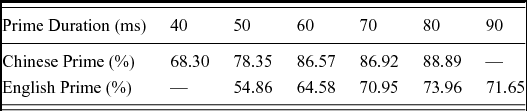
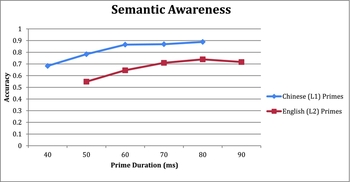
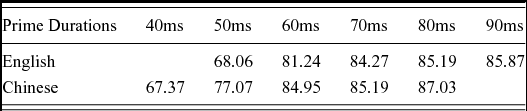
Performance was evaluated by analyzing the accuracy rates produced by the bilingual participants at different prime durations in both English and Chinese. Table 2 and Figure 1 show the mean accuracy rates at each prime duration in Chinese and English. As shown in Table 2, as the prime duration increases, accuracy rates increase in both languages. As expected, performance in Chinese (L1) surpassed that in English (L2). Under the same prime duration (50ms, 60ms, 70ms or 80ms), paired-sample t-tests revealed significant differences between English and Chinese: t(35) = 8.40, p < .001 at 50ms; t(35) = 7.06, p < .001 at 60ms; t(35) = 5.74, p < .001 at 70ms; t(35) = 6.71, p < .001 at 80ms. At a prime duration of 50ms, bilinguals were able to perform correctly on 78% of the trials in L1 Chinese, whereas they performed correctly on only 55% in L2 English. This shows a significant difference in performance between Chinese and English when the prime duration was 50ms; 55% correct answers in L2 English demonstrate that bilinguals were able to guess English primes at a level only slightly above chance.
Mean accuracy rates (in percentages) under each prime duration in Chinese and English (40ms, 50ms, 60ms, 70ms and 80ms for Chinese stimuli; 50ms, 60ms, 70ms, 80ms and 90ms for English stimuli) (Experiment 1A).

Chinese–English bilingual participants’ performance (Accuracy Rates) as a function of the prime duration in both Chinese and English (Experiment 1A).

Planned comparisons of 50ms Chinese primes with various prime durations in English showed that the significant difference between Chinese and English started to disappear when English primes were presented for 80ms and 90ms: t(35) = 1.40, p = 0.11 > .05 for Chinese primes at 50ms compared to English primes at 80ms; and t(35) = 1.83, p = 0.09 > .05 for Chinese primes at 50ms compared to English primes at 90ms. Therefore, the comparable prime duration based on similar error rates across languages was 80ms for English when the Chinese primes were presented for 50ms.
The current experiment provides evidence for the different degrees of semantic activation in the early automatic processes of L1 and L2, but confirms that proficient bilinguals were able to effectively process L2 primes at prime durations of 60ms, 70ms, 80ms and 90ms. However, bilinguals performed very close to chance at 50ms for English L2 primes, suggesting that they were not as effective for that prime duration. Two factors can contribute to this difference: one is that bilinguals’ L2 is not as proficient/dominant as their L1 so that they require longer prime durations to make the semantic interpretations; the other is that the duration of a Chinese word might not require the same exposure duration as an English word to reach the similar/same level of semantic activation. To understand whether language proficiency and/or the script play a role in the cross-language difference, it is necessary to investigate how native speakers of English perform in this task.
Experiment 1B. Semantic Awareness Measure of Monolingual English Speakers
Method
Participants
Eighteen native speakers of English, undergraduates enrolled at the University of Arizona, were recruited for this experiment. All of them received one course credit for participation.
Materials and Design
Only half of the English items used in Experiment 1A were selected for Experiment 1B in order to compare bilinguals’ and monolinguals’ performance on the same items. Therefore, a total of 120 sets of English trials were used to test English native speakers.
The design was the same as in Experiment 1A, except that the native participants were only presented with English stimuli, including 120 randomly presented trials in addition to practice items.
Procedure
The same as in Experiment 1A, except that native participants were given written instructions in English.
Results and Discussion
Performance was evaluated by analyzing the accuracy rates generated by the native English participants at different prime durations (50ms, 60ms, 70ms, 80ms, and 90ms). If participants produced well above 50% correct answers given a prime duration, they were considered effectively making semantic interpretations of the masked primes under that prime duration.
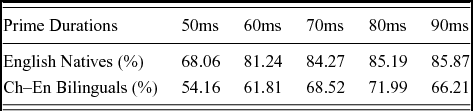
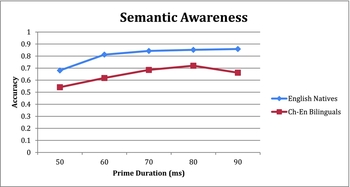
Table 3 and Figure 2 show the means of the accuracy rates at different prime durations in processing English words by native speakers and Chinese–English bilinguals. Note that the accuracy rates from bilingual participants were calculated only on the items used in Experiment 1B, so that two groups of participants were compared by the performance on the same set of items. Both groups produced more than 50% correct trials under all prime durations and showed decreasing error rates as the prime duration increased. Under each prime duration, the performance significantly differed between the two groups in two sample t-tests: t(34) = 3.64, p < .001 at 50ms; t(34) = 5.51, p < .001 at 60ms; t(34) = 3.87, p < .001 at 70ms; t(34) = 4.33, p < .001 at 80ms; t(34) = 5.47, p < .001 at 90ms, indicating that English native speakers processed the primes more effectively than bilingual participants. At the prime duration of 50ms, bilinguals performed correctly on 54% of the trials, whereas native speakers achieved 68%. These results demonstrated the contrast in language automaticity between proficient L2 speakers and natives of English.
Mean accuracy rates (in percentages) in English under each prime condition (50ms, 60ms, 70ms, 80ms) and type of participants (Experiment 1).

Native speakers vs. Chinese–English bilinguals’ performance (Accuracy Rates) as a function of the prime duration in English (Experiment 1).

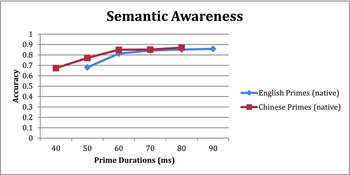
In comparing the performance of native Chinese readers and native English readers, Chinese items used in Experiment 1A were selected to match their English equivalents in Experiment 1B for analysis. Table 4 and Figure 3 demonstrate the means of the accuracy rates at each prime duration in processing Chinese and English words by native speakers. When the prime was presented for 50ms, native readers of Chinese performed better than native English readers, but two sample t-tests show that the difference was not significant: t(34) = 1.83, p = 0.08 > 0.05. This similar pattern was observed when the prime was 60ms: t(34) = 0.78, p > 0.05; 70ms: t(34) = 0.2, p > 0.05 and 80ms: t(34) = 0.51, p > 0.05. These results show that native speakers of English and Chinese did not perform significantly differently on briefly presented words in their native languages, in spite of the script difference. This suggests that the difference in performance at 50ms between English L2 readers and native English readers might be caused by less familiarity in L2 stimuli rather than the script itself. The comparable prime durations for bilinguals to process L2 English primes as effectively as native speakers when they process 50ms English primes, measured by accuracy rates, are 70ms or 80ms, according to Table 3.
Mean accuracy rates (in percentages) in English for native speakers of English and in Chinese for native speakers of Chinese under each prime duration (in milliseconds) (Experiment 1).

English native speakers vs. Chinese native speakers’ performance (Accuracy Rates) as a function of the prime duration in their native languages (Experiment 1).

Does an increased L2 prime duration restore the L2-L1 priming effect in lexical decision?
Experiment 1 presents evidence showing that the degrees of automaticity in processing primes did not differ between bilinguals and native speakers in their native language, but was significantly different between the two languages used by bilinguals. These results encourage us to think that the asymmetry in lexical decision might be due to the reduced automaticity in L2 compared to L1. A direct test of the hypothesis is to equate the prime duration across languages on the basis of their level of performance in the semantic discrimination task and investigate whether L2-L1 priming is restored by increasing the prime duration accordingly in a lexical decision task. The following experiment serves this purpose.
Experiment 2. Lexical Decision in both L1-L2 and L2-L1 Directions
The purpose of this experiment is to investigate whether both L1-L2 and L2-L1 priming could be obtained by adjusting the prime durations so that the prime awareness in each language was comparable. Specifically, the research question is whether symmetric translation priming effects would be obtained for Chinese–English bilinguals if a prime duration of 80 ms was used with L2 English primes.
Method
Participants
Twenty-four Chinese–English bilinguals from the same subject pool as in Experiment 1A were recruited for this experiment. In fact, most of the participants in Experiment 2 were the same as those in Experiment 1A. As in Experiment 1A, they were asked to rate their language skills and report their TOEFL scores in a questionnaire (see Table 5). All the participants were paid to participate in the study.
Means (SD) based on 24 participants’ self-rating of their language skills on a 1–7 Likert scale (1 = very poor and 7 = native like) and Means (SD) of TOEFL scores in Experiment 2

Materials and Design
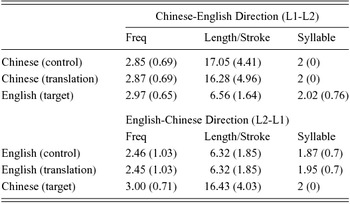
The experimental items (see Appendix B) were selected from Jiang (Reference Jiang1998) and Wang and Forster (Reference Wang and Forster2010), given that the translation equivalence was established among similar subject pools. In order to test the priming effects in both L1-L2 and L2-L1 directions, a between-item comparison procedure was adopted. Therefore, 60 pairs of translations were randomly selected in L1 recognition preceded by masked L2 primes in lexical decision (L2-L1), while the remaining 60 pairs were tested from L1 to L2. This gave rise to 60 word items in each test of different priming directions. To balance the YES and NO responses in lexical decision, 60 Chinese non-words and 60 English non-words were selected in the L2-L1 and L1-L2 direction respectively. The Chinese non-words were illegal combinations of two Chinese characters. All of the Chinese words and non-words were two characters long and all the characters were orthographically distinct from each other. The English non-words were illegal and pronounceable letter strings, matching the word items in length. In addition, 120 English words were selected from CELEX (Baayen, Piepenbrock & Gulikers, Reference Baayen, Piepenbrock and Gulikers1995) as unrelated primes for Chinese word targets or primes for Chinese non-word targets. They were matched with the English translation primes for frequency, concreteness and length. Similarly, 120 two-character Chinese words were selected from an online frequency list of Chinese characters (McEnery & Xiao, Reference McEnery and Xiao2005) as unrelated primes for English word targets or primes for English non-word targets, matching with the Chinese translation primes for frequency, concreteness and length. A summary of the lexical characteristics of different conditions is presented in Table 6.
Stimulus Characteristics of Experiment 2

Note: Freq is the mean (SD) logarithm of frequency per million words; Length/Stroke is the mean (SD) number of letters for English or strokes for Chinese; Syllable is the mean (SD) number of syllables.
Half of the critical targets per list were preceded by their translation equivalents and half were preceded by an unrelated prime. Two counterbalanced lists were constructed in each direction, such that if a target was preceded by its translation prime on List A, it was preceded by its unrelated prime on List B and vice versa. No target word or prime word was repeated within lists. Within each list, there were 10 practice trials, including 5 YES responses and 5 NO responses, prior to the experimental trials that were evenly divided into 2 blocks. Thus each block consisted of 30 word and 30 non-word trials, which were randomly presented. The presentation of each trial in both directions was consistent with the standard masking procedure used in previous studies (e.g., Forster & Davis, Reference Forster and Davis1984; Gollan et al., Reference Gollan, Forster and Frost1997; Jiang, Reference Jiang1999). Therefore, in the L1-L2 direction, each trial started with a 500ms forward mask, 贔贔贔贔, followed by a 50ms Chinese prime and then replaced by a 500ms English word target; in the L2-L1 direction, each trial started with a 500ms forward mask, ######, followed by a 80ms English prime and then replaced by a 500ms Chinese target. Critically, an increased prime duration of 80ms was adopted in the presentation from L2-L1. Appropriate fonts and sizes across languages are necessary to ensure the masking effects in both directions. Therefore, the Chinese characters were presented in SimSun font, Size 12; while the English letters were in Courier New, Size 13.5. It was ensured that the forward mask was no shorter than the primes.
To summarize, the design is a 2×2 within-subject factorial design, with Language Direction (L1-L2 vs. L2-L1) and Prime (translation vs. unrelated) as interested independent variables.
Procedure
Participants were randomly assigned to each list and tested in both directions. Before each test, they were given a written instruction in the language to be tested as targets. They were told to make a YES or NO response about the visual stimulus on the computer screen. For the English targets, they were asked to decide whether the letter string formed a word (e.g., house) or a non-word (e.g., roolter). When making a lexical decision in Chinese, they were asked to decide between a word (a meaningful character combination, like 苹果 [apple]) and a non-word (a meaningless character combination, like 晓托). If the presented stimulus was a word, they had to press the YES button, and press the NO button if it was a non-word. They were encouraged to make a decision as accurately and quickly as possible. They could rest in between the blocks if they wished.
Upon completion of the experiment, participants were debriefed and only two of them reported that they were able to see or identify some primes during the experiment.
Results and Discussion
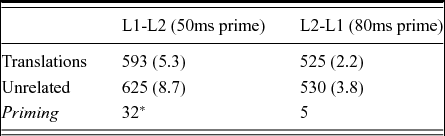
Subjects who made errors on more than 25% of the trials and those who reported seeing some primes were excluded from the analysis. Twenty out of 24 subjects were included in the final analysis. Reaction times longer than 1500ms or less than 300ms (1.14%) were excluded in analysis, as were trials on which an error occurred (5.04%). Mean response times and error rates for Chinese targets and English targets under each condition are presented in Table 7.
Mean Lexical Decision Times (in milliseconds) and Error Rates (in percentages) to word targets in L1-L2 and L2-L1 directions (Experiment 2)

* t = 4.58 > 2
To ensure that participants (N = 20) recruited in the current experiment were of similar proficiency in English with those (N = 36) recruited in Experiment 1A, two sample t-tests were conducted to compare the means of both groups in their self-ratings and TOEFL scores. T-tests revealed no significant differences between groups in either language skills or TOEFL scores: t(46) = 0.35, p > .05 for TOEFL; t(41) = 0.11, p > .05 for reading skills; t(41) = 0.85, p > .05 for listening skills; t(38) = 0.11, p > .05 for speaking skills; t(43) = 0.95, p > .05 for writing skills. These results validate the comparison between Experiment 1 and 2.
Statistical analyses were performed using a linear mixed-effects model (Baayen, Reference Baayen2008; Baayen, Davidson & Bates, Reference Baayen, Davidson and Bates2008). Unlike more traditional ANOVAs, mixed-effects models take raw unaveraged data as input and incorporate both random effects of participants and items within a single analysis. The fixed-effect factors were Prime Type (translation primes vs. unrelated primes) and Language Direction (L1-L2 vs. L2-L1). Subjects and items were random effects. Prior to fitting a mixed-effects model, the data (RTs) were transformed using a reciprocal transformation in order to minimize the effects of positive skew. This transformation is recommended over a log transformation as being more suitable for reaction times (Kliegl, Masson & Richter, Reference Kliegl, Masson and Richter2010). The lmer function from the lme4 package (version 1.1–7) in R was used (version 3.1.0; CRAN project; The R Foundation for Statistical Computing, 2008). The procedure employed was as follows: an initial model was fitted including the fixed effects (Prime Type and Language Direction) and random intercepts for subjects and items. A second more complex model was also applied which included random slopes for both subjects and items. We then conducted a likelihood ratio test to determine whether the data justified the addition of random slopes. However, we will only report the random slopes analysis if (a) it is justified by model comparison and (b) it alters our conclusions. Following standard conventions, any t-value greater than 2.0 was deemed significant.
The overall mixed-effects analysis of the RTs showed main effects of Prime Type (t = 4.72) and Language Direction (t = 8.52), as well as interaction of Prime Type and Language Direction (t = 2.57). A subsequent model including random slopes for the Prime Type factor provided a better fit, χ2 (18) = 251.9, p < .001, but the main effects and the interaction were still significant (Prime Type, t = 4.27, Direction, t = 3.88, Prime Type x Direction, t = 2.34). In addition, the results showed that the bilingual participants responded to L1 Chinese targets much faster than L2 English targets and made fewer errors in their L1 than L2.
Restricting the analysis to just the L1-L2 direction (using a prime duration of 50ms), the mixed-effects analysis of the RTs (including random slopes for Prime Type) showed that there was a significant effect of translation priming (t = 4.58). Contrary to the hypothesized awareness account, there was no significant priming in the L2-L1 direction, even though the prime duration had been increased to 80ms (t = 1.24). The critical result is that the asymmetry in lexical decision was observed again even with a duration of 80ms for L2 primes, which indicates that the absence of L2-L1 priming is not due to the limited duration of the L2 prime.
General Discussion
To summarize, Experiments 1 and 2 were designed to determine whether the absence of L2-L1 priming in unbalanced cross-script bilinguals was due to differential partial awareness of the prime. Translation priming is clearly semantic in nature, and it has been suggested that masked semantic priming requires partial awareness of the prime. A prime duration of 50 ms may be sufficient to achieve partial awareness in L1, but not in L2. The procedure we followed was to use a semantic discrimination task that would allow a systematic comparison of semantic awareness across languages. Not surprisingly, Experiment 1A found that performance improved as the prime duration increased in both languages and that performance was significantly better in L1 than in L2 at every prime duration (50ms, 60ms, 70ms and 80ms). These results indicate that it takes bilinguals more time and effort to process L2 masked primes than their L1 counterparts. Parallel to this finding, Experiment 1B showed that native English speakers performed significantly better than proficient L2 bilinguals at each prime duration. At a prime duration of 50ms, which is used in most translation priming studies, Chinese–English bilinguals were unable to discriminate which of two alternatives was closer semantically to the prime when it was an English word (i.e., 55% accuracy rates, slightly above chance), but were reasonably accurate with Chinese primes (i.e., 78% accuracy rates). However, when the prime duration was increased to 80 ms, then accuracy on L2 primes was increased to a level comparable to performance on L1 primes at 50ms. It is thus logical to think that an 80ms prime duration should be used with L2 primes in order to get equivalent semantic activation in L2 to that in L1. Therefore, Experiment 2 was designed to test whether an increased prime duration in L2 (80ms) could increase the effectiveness of L2-L1 priming in lexical decision, and perhaps eliminate the priming asymmetry. The results showed robust L1-L2 priming, but no L2-L1 priming with the same participants.
The implication of these results is that the failure to obtain L2-L1 priming in unbalanced bilinguals is not due to reduced partial awareness of L2 primes. Presumably, it is not due to reduced semantic activation levels either, because performance in the semantic discrimination task was well above chance with an 80 ms prime, yet no L2-L1 priming was observed. In other words, translation priming does not depend on partial awareness of primes.
Although cross-script translation priming is obviously semantic in nature, it might involve a different mechanism from semantic priming occurring within a language. If semantic priming depends on partial awareness of masked primes, as proposed by Kouider and Dupoux (Reference Kouider and Dupoux2004), the underlying mechanism should be attributed to the degree to which the results of semantic processing of the prime reach consciousness. This is consistent with Neely and Keefe's (Reference Neely and Keefe1989) retrospective account of semantic priming, as priming depends on whether the target word is perceived to be related in meaning to the prime. If translation priming is a retrospective effect, we should be able to observe priming given a longer L2 prime duration, because the way we measured semantic activation in L1 and L2 was a retrospective process, in which participants made their choices in the two-alternative forced choice task by selecting the target that was semantically related to the prime. Therefore, our results can be taken to suggest that translation priming is different from semantic priming due to the special relation between L1 and L2.
Alternatively, we can speculate that translation priming is prospective, rather than retrospective. The mechanism of translation priming is more like automatic spreading activation (Neely, Reference Neely1977; Posner & Snyder, Reference Posner and Snyder1975): the prime activation alters the status of the lexical representation of its counterpart in the other language as the target, so that it is recognized faster. This is an automatic process based on the visual input, but not dependent on partial awareness. That is, a more automatic processing from form to semantics in L1 can facilitate the recognition in L2, but a less automatic processing in L2 would fail to facilitate the recognition of L1; thus producing no priming in the L2-L1 direction. This automaticity depends on readers’ proficiency in the language, rather than the prime duration. Therefore, increasing partial awareness of the prime doesn't help in the cross-language case.
This prospective view is consistent with the argument proposed by Midgley, Holcomb and Grainger (Reference Midgley, Holcomb and Grainger2009) and Hoshino, Midgley, Holcomb and Grainger (Reference Hoshino, Midgley, Holcomb and Grainger2010) in explaining the nature of translation priming. In their ERP studies, both N250 and N400 components were found to be modulated by L1-L2 translation priming, which was taken to demonstrate that the semantic activation of L1 primes influenced the activation of form-level representations in recognizing L2 targets.
However, what remains to be explained is why L2 primes fail to produce semantic activation in a lexical decision task, but not in a semantic discrimination task such as that used in Experiment 1A. One possible explanation is provided by the Sense Model. The L2 prime is processed adequately in both lexical decision and semantic categorization tasks, but priming depends on the proportion of the target word's senses that are primed. This proportion is low in lexical decision, but high in semantic categorization (Finkbeiner et al., Reference Finkbeiner, Forster, Nicol and Nakamura2004; Wang & Forster, Reference Wang and Forster2010; Wang, Reference Wang2013). The other possibility is the Episodic L2 hypothesis, which argues that the L2 prime activates episodic memory, not lexical memory, and hence the target needs to be represented in episodic memory to produce priming (Jiang & Forster, Reference Jiang and Forster2001; Witzel & Forster, Reference Witzel and Forster2012). It is also important to note that these two explanations are built upon one assumption, which is, L2 is learned later in a bilingual's life. Late L2 learners tend to rely on L1 senses to build L2 semantics, especially if language learning occurs in foreign/second language classrooms. This could be different from early L2 bilinguals or simultaneous bilinguals as these bilinguals tend to have equal access to L1 and L2 in the same environment and can develop L2 semantics quite independently.
To date, given the majority of cross-language priming studies that demonstrated a priming asymmetry (see Dimitropoulou et al., Reference Dimitropoulou, Duñabeitia and Carreiras2011b, for review), some studies have reported within-script L2-L1 translation priming with highly proficient bilinguals (e.g., Duñabeitia et al., Reference Duñabeitia, Dimitropoulou, Uribe-Etxebarria, Laka and Carreiras2010; Perea et al., Reference Perea, Duñabeitia and Carreiras2008). In addition, there is only one reported study (Wang, Reference Wang2013), demonstrating cross-script L2-L1 priming in lexical decision with balanced simultaneous Chinese–English bilinguals. As pointed out by Hoshino et al. (Reference Hoshino, Midgley, Holcomb and Grainger2010), the change in script creates optimal conditions for prime word processing due to less orthographic interference from the target word, compared to within-script primes, and the more salient cues to language membership. This is supported by their ERP findings with Japanese–English bilinguals showing that the emergence of L1-L2 translation effects occurred about 100 ms earlier compared to the French–English bilinguals in Midgley et al. (Reference Midgley, Holcomb and Grainger2009). Following this, the important question to ask is whether L2-L1 cross-script priming with late bilinguals is non-existent in lexical decision, or whether it is simply weaker than L1-L2 priming, in some cases, so weak as to be undetectable. One possibility is that significant L2-L1 priming requires very high proficiency in L2. However, Dimitropoulou et al. (Reference Dimitropoulou, Duñabeitia and Carreiras2011b) obtained L2-L1 cross-script priming with Greek–English late bilinguals, but found that priming was unrelated to L2 proficiency, even when L2 proficiency was quite low. On the other hand, the same authors failed to obtain any L2-L1 cross-script priming with Greek–Spanish late bilinguals (Dimitropoulou et al., Reference Dimitropoulou, Duñabeitia and Carreiras2011a). They attributed the failure to obtain L2-L1 priming in previous studies to the lack of statistical power. This seems unlikely in the current study, since the increased prime duration should have amplified any possible L2-L1 priming effect, but we still found no priming.
The important point perhaps is not whether it is ever possible to obtain L2-L1 priming in lexical decision, but rather to explain why it is reliably observed in tasks such as semantic categorization or episodic recognition. Either there is something about the lexical decision task that blocks L2-L1 priming, or there is something about both the semantic categorization and episodic recognition tasks that allow L2-L1 priming. The Sense Model assumes that the category itself plays a critical role (missing in lexical decision), but is unable to explain why L2-L1 priming occurs in an episodic recognition memory task (Jiang & Forster, Reference Jiang and Forster2001; Witzel & Forster, Reference Witzel and Forster2012). On the other hand, the Episodic L2 hypothesis assumes that lexical decision taps into the wrong memory system to obtain L2-L1 priming, but is unable to explain why L2-L1 priming occurs in a semantic categorization task (Finkbeiner et al., Reference Finkbeiner, Forster, Nicol and Nakamura2004; Wang & Forster, Reference Wang and Forster2010; Wang Reference Wang2013). Further progress on this issue is unlikely without a deeper understanding of these task differences in bilingual lexical processing.
Finally, a brief note about the semantic discrimination task used in Experiment 1A. This task was intended as a measure of partial awareness, yet participants who were performing well on this task still maintained that they did not see the prime, and were simply guessing. If we accept their own reports, then this task was not measuring awareness at all. Instead it was measuring the extent to which the semantic properties of the prime had been activated. Viewed in this way, the failure to obtain L2-L1 priming is even more puzzling. The reason for the absence of priming cannot be attributed to weak connections between L2 words and their semantic properties.
Supplementary Material
For supplementary material accompanying this paper, visit http://dx.doi.org/10.1017/S1366728914000650.