Introduction
Taxonomy is the scientific manifestation of humans’ tendency – attributable to a basic need to reduce complexity by grouping alike-things to understand the world (Powys, Reference Powys1929) – to describe, name and organize, with the purpose of giving meaning to our perceptions. Thus, the description, classification and estimation of biodiversity has been one of civilization's endeavours for over 5000 years (Simonetta, Reference Simonetta2003; Wheeler, Reference Wheeler2004; Zhang, Reference Zhang and Polaszek2010). We now recognize between ~5.0 ± 3 million eukaryotic species globally (Costello et al., Reference Costello, May and Stork2013a), of which ~226,000 are marine (Appeltans et al., Reference Appeltans, Ahyong, Anderson, Angel, Artois, Bailly, Bamber, Barber, Bartsch, Berta, Błażewicz-Paszkowycz, Bock, Boxshall, Boyko, Brandão, Bray, Bruce, Cairns, Chan, Cheng, Collins, Cribb, Curini-Galletti, Dahdouh-Guebas, Davie, Dawson, De Clerck, Decock, De Grave, de Voogd, Domning, Emig, Erséus, Eschmeyer, Fauchald, Fautin, Feist, Fransen, Furuya, Garcia-Alvarez, Gerken, Gibson, Gittenberger, Gofas, Gómez Daglio, Gordon, Guiry, Hernandez, Hoeksema, Hopcroft, Jaume, Kirk, Koedam, Koenemann, Kolb, Kristensen, Kroh, Lambert, Lazarus, Lemaitre, Longshaw, Lowry, Macpherson, Madin, Mah, Mapstone, McLaughlin, Mees, Meland, Messing, Mills, Molodtsova, Mooi, Neuhaus, Ng, Nielsen, Norenburg, Opresko, Osawa, Paulay, Perrin, Pilger, Poore, Pugh, Read, Reimer, Rius, Rocha, Saiz-Salinas, Scarabino, Schierwater, Schmidt-Rhaesa, Schnabel, Schotte, Schuchert, Schwabe, Segers, Self-Sullivan, Shenkar, Siegel, Sterrer, Stöhr, Swalla, Tasker, Thuesen, Timm, Todaro, Turon, Tyler, Uetz, van der Land, Vanhoorne, van Ofwegen, van Soest, Vanaverbeke, Walker-Smith, Walter, Warren, Williams, Wilson and Costello2012); although another ~½ million to ¾ million marine eukaryotic species may exist but be undescribed (Appeltans et al., Reference Appeltans, Ahyong, Anderson, Angel, Artois, Bailly, Bamber, Barber, Bartsch, Berta, Błażewicz-Paszkowycz, Bock, Boxshall, Boyko, Brandão, Bray, Bruce, Cairns, Chan, Cheng, Collins, Cribb, Curini-Galletti, Dahdouh-Guebas, Davie, Dawson, De Clerck, Decock, De Grave, de Voogd, Domning, Emig, Erséus, Eschmeyer, Fauchald, Fautin, Feist, Fransen, Furuya, Garcia-Alvarez, Gerken, Gibson, Gittenberger, Gofas, Gómez Daglio, Gordon, Guiry, Hernandez, Hoeksema, Hopcroft, Jaume, Kirk, Koedam, Koenemann, Kolb, Kristensen, Kroh, Lambert, Lazarus, Lemaitre, Longshaw, Lowry, Macpherson, Madin, Mah, Mapstone, McLaughlin, Mees, Meland, Messing, Mills, Molodtsova, Mooi, Neuhaus, Ng, Nielsen, Norenburg, Opresko, Osawa, Paulay, Perrin, Pilger, Poore, Pugh, Read, Reimer, Rius, Rocha, Saiz-Salinas, Scarabino, Schierwater, Schmidt-Rhaesa, Schnabel, Schotte, Schuchert, Schwabe, Segers, Self-Sullivan, Shenkar, Siegel, Sterrer, Stöhr, Swalla, Tasker, Thuesen, Timm, Todaro, Turon, Tyler, Uetz, van der Land, Vanhoorne, van Ofwegen, van Soest, Vanaverbeke, Walker-Smith, Walter, Warren, Williams, Wilson and Costello2012; Costello et al., Reference Costello, May and Stork2013a). But how much do we understand about each of the ‘alike-things’ – the species and the higher taxa – that have been described, and how much more can we expect to learn? Imprecision in estimates of species richness has been ascribed to a penurious understanding of taxonomy as a scientific discipline and its foundations (McGregor Reid, Reference McGregor Reid and Polaszek2010; Wheeler, Reference Wheeler and Polaszek2010), and to the so-called taxonomic impediment, i.e. insufficient jobs and funding for taxonomists resulting in fewer publications than possible and limited advancement of knowledge (Wheeler, Reference Wheeler2004; de Carvalho et al., Reference de Carvalho, Bockmann, Amorim, Brandão, de Vivo, de Figueiredo, Britski, de Pinna, Menezes, Marques, Papavero, Cancello, Crisci, McEachran, Schelly, Lundberg, Gill, Britz, Wheeler, Stiassny, Parenti, Page, Wheeler, Faivovich, Vari, Grande, Humphries, DeSalle, Ebach and Nelson2007; Patterson, Reference Patterson and Polaszek2010). Misunderstanding taxonomy, and the taxonomic impediment, appear to be a part but not all of the challenge; past practices in taxonomy and new publishing practices also haunt the present.
Misunderstanding taxonomy
The misunderstanding of taxonomy is not, for the most part, a misunderstanding of the value of taxonomic findings or their implications for other scientific disciplines and society (Krupnick & Kress, Reference Krupnick and Kress2003; Bouchet et al., Reference Bouchet, Le Guyader and Pascal2009; Wheeler et al., Reference Wheeler, Knapp, Stevenson, Stevenson, Blum, Boom, Borisy, Buizer, de Carvalho and Cibrian2012; Sluys, Reference Sluys2013). Rather, the misunderstanding is an under-appreciation of the conceptual and epistemological framework of taxonomy (Wheeler & Valdecasas, Reference Wheeler and Valdecasas2007; Wheeler, Reference Wheeler2009; Roger, Reference Roger2012; de Carvalho et al., Reference de Carvalho, Ebach, Williams, Nihei, Trefaut Rodrigues, Grant, Silveira, Zaher, Gill, Schelly, Sparks, Bockmann, Séret, Ho, Grande, Rieppel, Dubois, Ohler, Faivovich, Assis, Wheeler, Goldstein, de Almeida, Valdecasas and Nelson2013) and long-standing derogation of the non-experimental or descriptive sciences, such as taxonomy, palaeontology, astronomy and in part ecology and geology (e.g. see Rogers, Reference Rogers1958; Wheeler & Valdecasas, Reference Wheeler and Valdecasas2005). Contemporary taxonomic publications commonly lack clear hypotheses and structured conceptual frameworks (Agnarsson & Kuntner, Reference Agnarsson and Kuntner2007; de Carvalho et al., Reference de Carvalho, Bockmann, Amorim, Brandão, de Vivo, de Figueiredo, Britski, de Pinna, Menezes, Marques, Papavero, Cancello, Crisci, McEachran, Schelly, Lundberg, Gill, Britz, Wheeler, Stiassny, Parenti, Page, Wheeler, Faivovich, Vari, Grande, Humphries, DeSalle, Ebach and Nelson2007, Reference de Carvalho, Ebach, Williams, Nihei, Trefaut Rodrigues, Grant, Silveira, Zaher, Gill, Schelly, Sparks, Bockmann, Séret, Ho, Grande, Rieppel, Dubois, Ohler, Faivovich, Assis, Wheeler, Goldstein, de Almeida, Valdecasas and Nelson2013; Wheeler & Valdecasas, Reference Wheeler and Valdecasas2007); examples of the latter include publications that state taxonomy's aim to generate a comprehensive biodiversity census through the identification of species (Costello et al., Reference Costello, May and Stork2013a, Reference Costello, Wilson and Houlding2013b; but see Godfray, Reference Godfray2002; Boero, Reference Boero2010). Taxonomy has thus earned a reputation as a descriptive discipline rather than a hypothesis-driven science (de Carvalho et al., Reference de Carvalho, Bockmann, Amorim, Brandão, de Vivo, de Figueiredo, Britski, de Pinna, Menezes, Marques, Papavero, Cancello, Crisci, McEachran, Schelly, Lundberg, Gill, Britz, Wheeler, Stiassny, Parenti, Page, Wheeler, Faivovich, Vari, Grande, Humphries, DeSalle, Ebach and Nelson2007; Wheeler, Reference Wheeler2009; McGregor Reid, Reference McGregor Reid and Polaszek2010), even though the products of taxonomy – scientific names and species descriptions – are rigorously testable hypotheses. For example, the discovery of a new taxon is a testable hypothesis, which should not be seen as a one-off endeavour; species descriptions are enriched and improved over time as taxonomists sequentially increase knowledge of characters, which should not be only morphological, and their interpretation (Popper, Reference Popper1959; Agnarsson & Kuntner, Reference Agnarsson and Kuntner2007; de Carvalho et al., Reference de Carvalho, Bockmann, Amorim, Brandão, de Vivo, de Figueiredo, Britski, de Pinna, Menezes, Marques, Papavero, Cancello, Crisci, McEachran, Schelly, Lundberg, Gill, Britz, Wheeler, Stiassny, Parenti, Page, Wheeler, Faivovich, Vari, Grande, Humphries, DeSalle, Ebach and Nelson2007; Wheeler, Reference Wheeler2009).
In addition, taxonomy has been confounded with other sciences. The ‘New Systematics’ (Huxley, Reference Huxley1940) provides an intriguing example. In this book, Huxley settled on the foundations for modern population biology, emphasizing experimental studies at the species level and below, which were reasonable scientific solutions for finding answers to emerging evolutionary questions, such as what are the processes driving speciation and mechanisms driving changes in allele frequencies (Darlington, Reference Darlington and Huxley1940; Timofeeff-Ressovsky, Reference Timofeeff-Ressovsky and Huxley1940). The aims and methods for the emerging science were quite different from those established by taxonomic epistemology but, at the same time, Huxley advocated for a more integrative taxonomy and new methods (Gilmour, Reference Gilmour and Huxley1940).
Subsequently, Hennig (Reference Hennig1966: 7, 32) also advocated for a more integrative approach – holomorphology, a precursor of ‘character congruence’ or ‘total evidence’ (Higgins, Reference Higgins, Raynal-Roques, Roguenant and Prat2005) – emphasizing the importance of detailed morphology, anatomy, ethology, physiology and different stages of metamorphosis, polymorphism and multi-phasic life histories (Hennig, Reference Hennig1966: 7) in a multidimensional framework. The approach placed taxonomy, nomenclature and classification into an imperfect but developing evolutionary–cladistic model-based framework (Nelson, Reference Nelson1989), further integrating and blurring the lines between classification, taxonomy and systematics. While rapid technological advances have rejuvenated the fields of systematics and taxonomy with newer sources of data (e.g. short fragments of DNA, high-throughput sequencing), controversies and debates have persisted for more than a decade about how to accommodate the new data in the taxonomic framework. The debate pitched an holistic and synthetic taxonomy – building on the theoretically and inferentially rich evolutionary–cladistic or ‘phylogenetic systematics’ framework of Hennig (Reference Hennig1966) – against a mid-century view of taxonomy as a mere service for enumerating, identifying and tracking names of species (Wheeler, Reference Wheeler2008). The debate conflated the value of developing approaches that provided greater resolution through integration of many types of data, including sequences, with the ease of rapidly acquiring more data of generally high resolving power, i.e. only sequences (Wheeler, Reference Wheeler2008).
The proposition to replace taxonomy with other sciences and methods – e.g. due to the conflation of phylogenetic analyses, including oftentimes superficial morphology, with rigorous synthetic taxonomy (Wheeler, Reference Wheeler2004, Reference Wheeler and Polaszek2010) – belies a poor understanding of taxonomic outcomes and aims (Wheeler, Reference Wheeler2004; Pace et al., Reference Pace, Sapp and Goldenfeld2012). For example, the implementation of DNA barcoding as a tool to delimit species instead of as a method for identifying species (Wheeler, Reference Wheeler2005; Boero, Reference Boero2010; Pires & Marinoni, Reference Pires and Marinoni2010; Schlick-Steiner et al., Reference Schlick-Steiner, Arthofer and Steiner2014), or the proposal that phylogenetic taxonomy (de Queiroz, Reference de Queiroz1992) specifically the PhyloCode (Cantino & de Queiroz, Reference Cantino and de Queiroz2004) replace the current rank-based Linnaean system and ICZN (Wheeler, Reference Wheeler2004; Patterson et al., Reference Patterson, Remsen, Marino and Norton2006; Patterson, Reference Patterson and Polaszek2010; Platnick, Reference Platnick2011). Rather, these are complementary approaches: phylogeny improves hierarchical classification, and taxonomy provides a means for integrating information about, and efficient communication of biological entities to a diverse audience (Wheeler, Reference Wheeler2004).
The taxonomic impediment
Addressing the taxonomic impediment has been a focus of multiple agencies and grant programmes (e.g. Partnerships for Enhancing Expertise in Taxonomy (PEET, NSF-USA), Distributed European School of Taxonomy (DEST-EU), Global Taxonomy Initiative) for at least two decades, indicating the seriousness with which the impediment is considered to have impinged on the growth and progress of taxonomy (Wheeler, Reference Wheeler2005, Reference Wheeler2009; de Carvalho et al., Reference de Carvalho, Bockmann, Amorim, Brandão, de Vivo, de Figueiredo, Britski, de Pinna, Menezes, Marques, Papavero, Cancello, Crisci, McEachran, Schelly, Lundberg, Gill, Britz, Wheeler, Stiassny, Parenti, Page, Wheeler, Faivovich, Vari, Grande, Humphries, DeSalle, Ebach and Nelson2007). However, some authors claim the taxonomic impediment is non-existent (Costello et al., Reference Costello, May and Stork2013a, Reference Costello, Wilson and Houlding2013b). For example, Costello et al. (Reference Costello, Wilson and Houlding2013b) emphasized the growing number of people describing species and justified the small number of published species descriptions as a consequence of a limited number of species that remain to be discovered. Yet, these general trends, which are influenced strongly by well-known species-rich taxa such as birds and mammals (Joppa et al., Reference Joppa, Roberts and Pimm2011; Scheffers et al., Reference Scheffers, Joppa, Pimm and Laurance2012), are not true for all taxa. Likewise, reported trends in the number of taxonomists may over-emphasize the contributions of multiple authors and thus inflate the number of ‘taxonomists’.
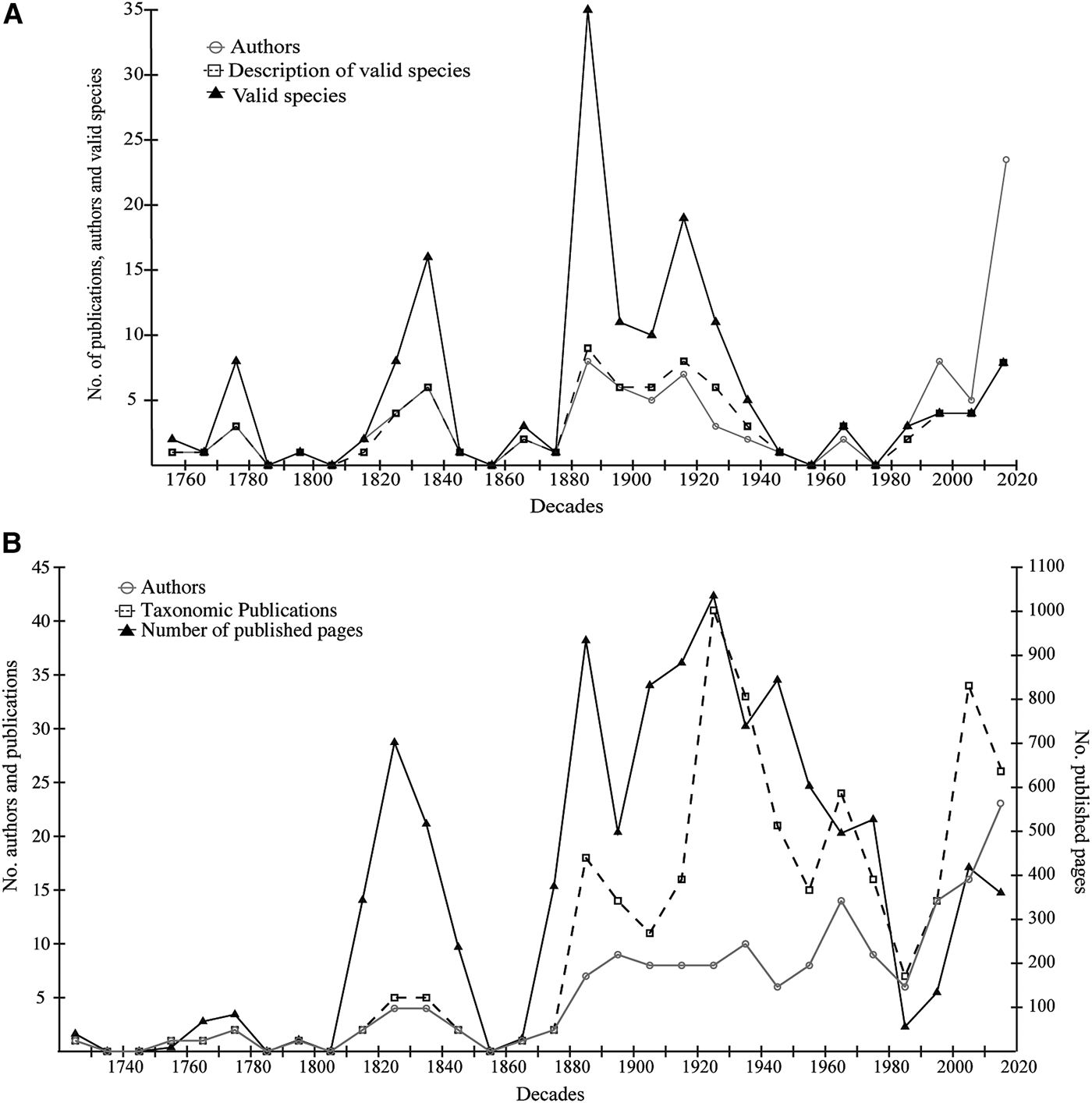
A review of the taxonomic literature on scyphozoan jellyfishes, for example – itself a moderately known taxon (~59th percentile of percentage-known taxa listed by Appeltans et al., Reference Appeltans, Ahyong, Anderson, Angel, Artois, Bailly, Bamber, Barber, Bartsch, Berta, Błażewicz-Paszkowycz, Bock, Boxshall, Boyko, Brandão, Bray, Bruce, Cairns, Chan, Cheng, Collins, Cribb, Curini-Galletti, Dahdouh-Guebas, Davie, Dawson, De Clerck, Decock, De Grave, de Voogd, Domning, Emig, Erséus, Eschmeyer, Fauchald, Fautin, Feist, Fransen, Furuya, Garcia-Alvarez, Gerken, Gibson, Gittenberger, Gofas, Gómez Daglio, Gordon, Guiry, Hernandez, Hoeksema, Hopcroft, Jaume, Kirk, Koedam, Koenemann, Kolb, Kristensen, Kroh, Lambert, Lazarus, Lemaitre, Longshaw, Lowry, Macpherson, Madin, Mah, Mapstone, McLaughlin, Mees, Meland, Messing, Mills, Molodtsova, Mooi, Neuhaus, Ng, Nielsen, Norenburg, Opresko, Osawa, Paulay, Perrin, Pilger, Poore, Pugh, Read, Reimer, Rius, Rocha, Saiz-Salinas, Scarabino, Schierwater, Schmidt-Rhaesa, Schnabel, Schotte, Schuchert, Schwabe, Segers, Self-Sullivan, Shenkar, Siegel, Sterrer, Stöhr, Swalla, Tasker, Thuesen, Timm, Todaro, Turon, Tyler, Uetz, van der Land, Vanhoorne, van Ofwegen, van Soest, Vanaverbeke, Walker-Smith, Walter, Warren, Williams, Wilson and Costello2012) – demonstrates the two trends found by Costello et al. (Reference Costello, Wilson and Houlding2013b): the number of authors describing new scyphozoan taxa has increased as well as the number of new species being described (Figure 1). However, the changed ratio, from 4.3 and 2.7 species/author during the decades of 1880s and 1910s to 0.25 species/author during recent decades (2000–2010), can be interpreted alternatively as a symptom of changing publication norms (Ioannidis et al., Reference Ioannidis, Klavans and Boyack2018) rather than a consequence of completeness of taxonomic inventories as inferred by Costello et al. (Reference Costello, Wilson and Houlding2013b). Changing publication norms in turn call into question the meaning of a ‘taxonomist’ sensu Costello et al. (Reference Costello, May and Stork2013a, Reference Costello, Wilson and Houlding2013b): being an author on a taxonomic publication does not necessarily equate with being an active scientist working as a taxonomist. Other possibilities exist: authors may be bringing different expertise, sharing logistical or other costs generated by taxonomic research, and other plausible explanations. However, when 27 authors describe only seven species in seven years (Bayha & Dawson, Reference Bayha and Dawson2010; Galil et al., Reference Galil, Gershwin, Douek and Rinkevich2010; Nishikawa et al., Reference Nishikawa, Ohtsuka, Mulyadi, Mujiono, Lindsay, Miyamoto and Nishida2014; Piraino et al., Reference Piraino, Aglieri, Martell, Mazzoldi, Melli, Milisenda, Scorrano and Boero2014; Kolbasova et al., Reference Kolbasova, Zalevsky, Gafurov, Gusev, Ezhova, Zheludkevich, Konovalova, Kosobokova, Kotlov, Lanina, Lapashina, Medvedev, Nosikova, Nuzhdina, Bazykin and Neretina2015; Scorrano et al., Reference Scorrano, Aglieri, Boero, Dawson and Piraino2016; Bayha et al., Reference Bayha, Collins and Gaffney2017), aspects of the International Code of Zoological Nomenclature are being neglected – notably Recommendation 50A – which gains significance in light of bibliometric analyses. If ‘only … some of the authors … are directly responsible for the [species description, those] author(s) … should be identified explicitly’ while ‘co-authors of the whole work who have not had such direct responsibility for the name should not automatically be included as authors of the name’ (ICZN, 1999). Simply following Recommendation 50A might alone be sufficient to change the ratio to nearer 2–3 authors per species, and essentially eradicate the apparently substantial (but superficial) gains in taxonomic expertise made during the last decade (Figure 1).
Graphical review of the history of Discomedusae taxonomy. (A) Number of publications and authors involved in describing 156 valid species of Discomedusae from 1750 to 2017. The cumulative number of authors is 96 with 81 publications up to December 2017. The maximum number of authors occurs between 2010–2017 (24 authors), and the highest number of described species and publications (35 and nine, respectively) happens during the 1880s. Results are based on taxonomic classification by Kramp (Reference Kramp1961) and updated according to Daly et al. (Reference Daly, Brugler, Cartwright, Collins, Dawson, Fautin, France, McFadden, Opresko, Rodriguez, Romano and Stake2007) and Morandini & Marques (Reference Morandini and Marques2010); references of species described between 2000–2017 are shown in Table 1. (B) All taxonomic publications on Discomedusae from 1720–2017. The maximum number of publications and published pages (41 and 1035, respectively) is reached in the 1920s. The maximum number of authors (24) occurs between 2010–2017. A total of 316 taxonomic publications and 292 authors were retrieved from Zoological Records (Web of Science, Thomson Reuters), SCOPUS (Elsevier B.V.), and Biodiversity Heritage Library (Encyclopedia of Life) search engines using Topics searches for: Taxonomy + [Scyph* or Jellyfish* or Medus*], filtered: NOT topic: Hydro* + Cubo* + Ctenoph* + Fungi. Records from the 18th century (1720–1800) were added manually, using the references provided in Haeckel (Reference Haeckel1879), Vanhöffen (Reference Vanhöffen1888) and Mayer (Reference Mayer1910). The resultant searches were concatenated into a single file and cleared of duplicates. Publications focusing exclusively on Coronatae were excluded.

Ghosts of taxonomies past
Additional challenges for modern taxonomy can be illustrated by review of the history of Scyphozoa. Classification of scyphozoan species, as for many other marine invertebrates, was established using criteria designed with macro-morphological characters in mind. These morphological criteria resulted in five orders – Coronatae, Semaeostomeae, Rhizostomeae, Stauromedusae and Cubomedusae (Mayer, Reference Mayer1910; Hyman, Reference Hyman1940; Kramp, Reference Kramp1961). Later, the cubomedusae and stauromedusae were elevated into the classes Cubozoa and Staurozoa on the bases of morphological, life history and, in the case of Staurozoa, molecular data (Werner, Reference Werner1973; Marques & Collins, Reference Marques and Collins2004; Collins et al., Reference Collins, Schuchert, Marques, Jankowski, Medina and Schierwater2006). Within the class Scyphozoa, morphological phylogenies suggest the presence of two monophyletic groups: Coronatae and Discomedusae – the latter including semaeostomes and rhizostomes (Stiasny, Reference Stiasny1921; Uchida, Reference Uchida1926; Marques & Collins, Reference Marques and Collins2004; Van Iten et al., Reference Van Iten, Leme, Simoes, Marques and Collins2006) – which was confirmed by molecular studies (Dawson, Reference Dawson2004; Collins et al., Reference Collins, Schuchert, Marques, Jankowski, Medina and Schierwater2006; Zapata & Robertson, Reference Zapata and Robertson2007; Bayha et al., Reference Bayha, Dawson, Collins, Barbeitos and Haddock2010; Kayal et al., Reference Kayal, Bentlage, Collins, Kayal, Pirro and Lavrov2012). The more species-rich clade within the class is the Discomedusae, with 157 species currently described (cf. 60 in Coronatae; Mianzan & Cornelius, Reference Mianzan, Cornelius and Boltovskoy1999; Daly et al., Reference Daly, Brugler, Cartwright, Collins, Dawson, Fautin, France, McFadden, Opresko, Rodriguez, Romano and Stake2007).
Publication trends suggest that we might divide the history of the taxonomy of Discomedusae into three periods (Figures 1B & 2). The first period – 1720s–1930s – is a period in which taxonomists of Discomedusae flourished and ocean-wide expeditions resulted in prominent monographs and taxonomic publications (Linnaeus, Reference Linnaeus1758; Forskål, Reference Forskål1775; Péron & Lesueur, Reference Péron and Lesueur1809; Agassiz, Reference Agassiz1862, Reference Agassiz1865; Haeckel, Reference Haeckel1879, Reference Haeckel1880; Fewkes, Reference Fewkes1881; Lendenfeld, Reference Lendenfeld1887; Agassiz & Mayer, Reference Agassiz and Mayer1898a, Reference Agassiz and Mayer1898b, Reference Agassiz and Mayer1902; Bigelow, Reference Bigelow1904, Reference Bigelow1909, Reference Bigelow1913; Mayer, Reference Mayer1904, Reference Mayer1906; Maas, Reference Maas1907). During this period, naturalists’ endeavours discovered and described ~90% of the Discomedusae species known by 2010 (Appeltans et al., Reference Appeltans, Ahyong, Anderson, Angel, Artois, Bailly, Bamber, Barber, Bartsch, Berta, Błażewicz-Paszkowycz, Bock, Boxshall, Boyko, Brandão, Bray, Bruce, Cairns, Chan, Cheng, Collins, Cribb, Curini-Galletti, Dahdouh-Guebas, Davie, Dawson, De Clerck, Decock, De Grave, de Voogd, Domning, Emig, Erséus, Eschmeyer, Fauchald, Fautin, Feist, Fransen, Furuya, Garcia-Alvarez, Gerken, Gibson, Gittenberger, Gofas, Gómez Daglio, Gordon, Guiry, Hernandez, Hoeksema, Hopcroft, Jaume, Kirk, Koedam, Koenemann, Kolb, Kristensen, Kroh, Lambert, Lazarus, Lemaitre, Longshaw, Lowry, Macpherson, Madin, Mah, Mapstone, McLaughlin, Mees, Meland, Messing, Mills, Molodtsova, Mooi, Neuhaus, Ng, Nielsen, Norenburg, Opresko, Osawa, Paulay, Perrin, Pilger, Poore, Pugh, Read, Reimer, Rius, Rocha, Saiz-Salinas, Scarabino, Schierwater, Schmidt-Rhaesa, Schnabel, Schotte, Schuchert, Schwabe, Segers, Self-Sullivan, Shenkar, Siegel, Sterrer, Stöhr, Swalla, Tasker, Thuesen, Timm, Todaro, Turon, Tyler, Uetz, van der Land, Vanhoorne, van Ofwegen, van Soest, Vanaverbeke, Walker-Smith, Walter, Warren, Williams, Wilson and Costello2012).
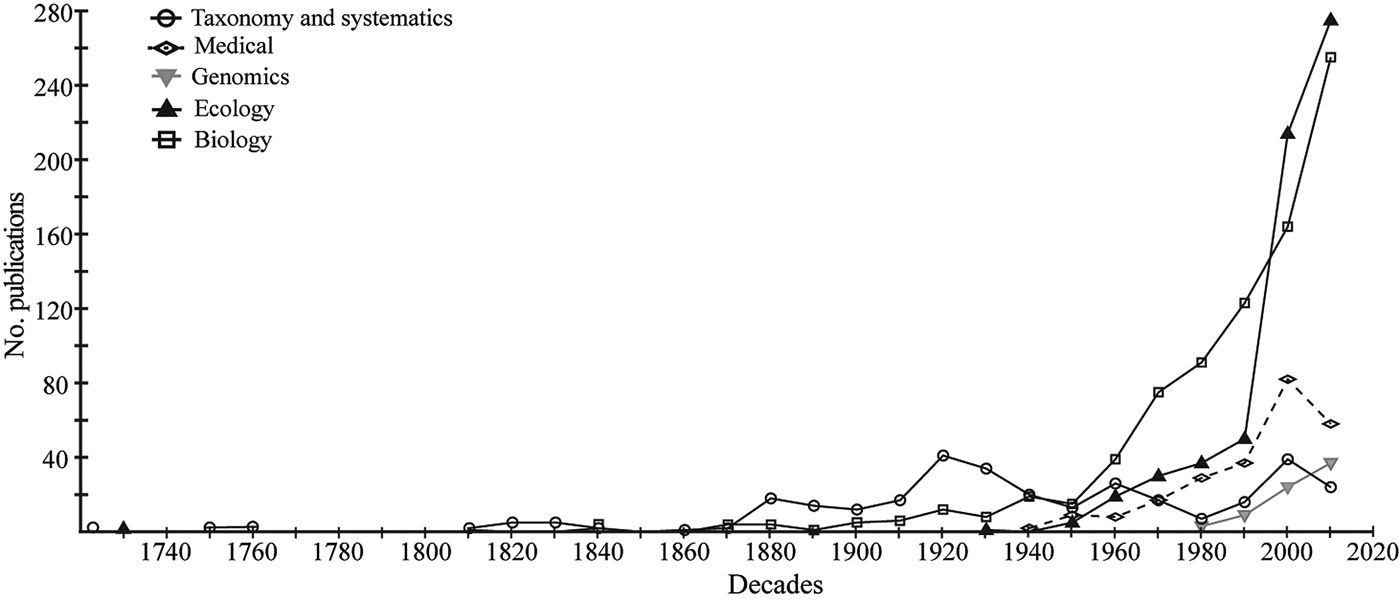
Overview of major research topics addressing Discomedusae through time. The total number of publications is 2094. Total number of publications per topic: Taxonomy including systematics (323), Biology (826), Ecology (631), Medical (242) and Genomics (73). The maximum number of taxonomic and systematic publications is reached during the decades of 1920s and 1930s; meanwhile, the maximum of biological and ecological publications is reached between 2010–2017. Genomic publications appear in the middle of the 1980s and increase afterward. Medical publications increase since the 1970s. The information was generated using Zoological Records (Web of Science, Thomson Reuters), SCOPUS (Elsevier B.V.) and Biodiversity Heritage Library (Encyclopedia of Life). We ran four searches: (1) Taxonomy [Ecology (2), Biology (3) or Genomics (4)] + [Scyph* or Jellyfish* or Medus*], filtered: NOT topic: Hydro* + Cubo* + Ctenoph* + Fungi. Records for ‘Medical’ research (toxicology and envenomation) were gathered from the Biology search. The search results were concatenated into a single file and cleared of duplicates. Publications focusing exclusively on Coronatae were excluded.

The early decades were beset by a creative tension. Luminaries such as Haeckel (Reference Haeckel1879) described more than 35 new species, though 10% of his descriptions were made using a single specimen or very damaged specimens; his illustrations were artistically incomparable but perhaps largely useless for a taxonomic review (Gould, Reference Gould2000; Stephens & Calder, Reference Stephens and Calder2006). Vanhöffen (Reference Vanhöffen1888, Reference Vanhöffen1902, Reference Vanhöffen1908) recorded 149 species worldwide; though his detailed descriptions and artistic illustrations clarified only some of the previous species descriptions (e.g. Stomolophidae, Pelagiidae, Catostylidae). In addition, morphological nomenclature used to describe diagnostic characters varied by author, leading to inconsistency in the description of species.
Nonetheless, by the end of this period (1910s–1930s), a taxonomic revolution had been realized. Although publication rates had begun to decline, the large synthetic works of the 1910s–1930s have become the classical reference publications and taxonomic reviews with detailed descriptions, informative illustrations and diagrams, and improved standardization of diagnostic characters and nomenclature (e.g. Mayer, Reference Mayer1910; Stiasny, Reference Stiasny1920, Reference Stiasny1921, Reference Stiasny1922, Reference Stiasny1938, Reference Stiasny1940; Uchida, Reference Uchida1926, Reference Uchida1935; Rao, Reference Rao1931). As a result of the standardization in the taxonomy of the group, the 149 species of Discomedusae described by Vanhöffen (Reference Vanhöffen1888) were refined to 93 species plus 34 ‘varieties’ by Mayer (Reference Mayer1910). These taxonomic publications reflected the understanding of the taxonomic necessities of the time: the inclusion of more morphological characters, description of intraspecific morphological variation, and foundations for delimiting species (e.g. Bigelow, Reference Bigelow1910; Mayer, Reference Mayer1910; Light, Reference Light1914, Reference Light1921; Stiasny, Reference Stiasny1922, Reference Stiasny1933, Reference Stiasny1935, Reference Stiasny1938, Reference Stiasny1940; Uchida, Reference Uchida1926, Reference Uchida1933, Reference Uchida1935; Figure 2).
The second period – decades 1940s–1980s (Figures 1 & 2) – saw persistently few taxonomic publications, descriptions of species, and taxonomists (Figures 1 & 2). Relatively few researchers continued taxonomic research (Uchida, Reference Uchida1947; Kramp, Reference Kramp and Odhner1948, Reference Kramp1952, Reference Kramp1955a, Reference Kramp1955b, Reference Kramp1968; Russell & Rees, Reference Russell and Rees1960; Russell, Reference Russell1962, Reference Russell1967, Reference Russell1970; Segura-Puertas, Reference Segura-Puertas1984; Larson, Reference Larson1986) and the decline was in part presaged by the death of previously prodigious authors, such as A. Agassiz (1835–1910; Goodale, Reference Goodale1912) and A.G. Mayer (1868–1922; Stephens & Calder, Reference Stephens and Calder2006); others retired or otherwise departed subsequently: G. Stiasny (1877–1946; Vervoort, Reference Vervoort1950), H. Bigelow (1879–1967; Redfield, Reference Redfield1976), P.L. Kramp (1887–1975; Anonymous, 1975). Moreover, taxonomy often became separated from other aspects of biology (e.g. Kramp, Reference Kramp1955a, Reference Kramp1955b, Reference Kramp1961; Larson, Reference Larson1986; but see Russell, Reference Russell1970). The last major taxonomic revision (Kramp, Reference Kramp1961) eliminated all nomen dubium species, synonymized all the described varieties, formalized 140 described species of Discomedusae, and remains the primary classification in use today (Mianzan & Cornelius, Reference Mianzan, Cornelius and Boltovskoy1999; Daly et al., Reference Daly, Brugler, Cartwright, Collins, Dawson, Fautin, France, McFadden, Opresko, Rodriguez, Romano and Stake2007). Meanwhile, this period saw the rise first of the ‘new systematics’ (Huxley, Reference Huxley1940), then phenetics (Sokal & Sneath, Reference Sokal and Sneath1963), then cladistics (Hennig, Reference Hennig1966) and growing numbers of species concepts which may have focused or reflected interest in other areas of study. Taxonomic classification did, however, provide a stable framework for researchers who became primarily interested in other aspects of Discomedusae such as reproduction, life cycles, physiology, feeding behaviour and ecology (e.g. Calder, Reference Calder1972, Reference Calder1982; Hamner & Hauri, Reference Hamner and Hauri1981; Colley & Trench, Reference Colley and Trench1983; Larson, Reference Larson1987; Malej, Reference Malej1989; Strand & Hamner, Reference Strand and Hamner1988; Figure 2).
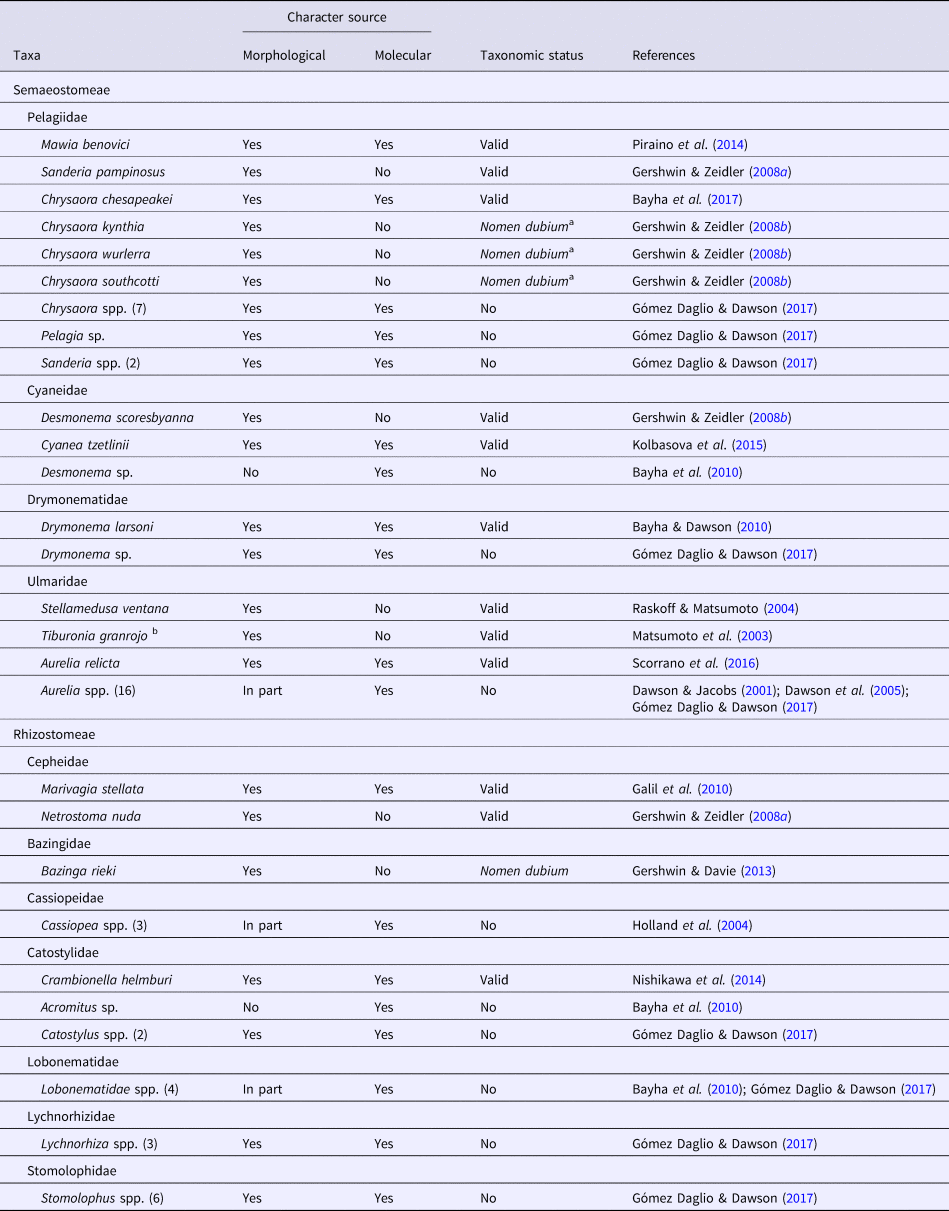
The last period – 1990s – present (Figure 2) – began with a resurgence in traditional morphological taxonomy in the 1990s (e.g. Galil et al., Reference Galil, Spanier and Ferguson1990; Larson, Reference Larson1990; Martin et al., Reference Martin, Gershwin, Burnett, Cargo and Bloom1997), then expansion and quantification of morphological characters in a statistical framework in the early 2000s (e.g. Dawson, Reference Dawson2003, Reference Dawson2005a, Reference Dawson2005b, Reference Dawson2005c), but increasingly has become linked with advances in molecular analyses. Although the first molecular analysis dates back to Zubkoff & Linn (Reference Zubkoff, Linn and Markert1975), Greenberg et al. (Reference Greenberg, Garthwaite and Potts1996) conjoined morphometric and allozyme analyses using the case study of Aurelia. Their results, which suggested multiple distinct lineages, were corroborated by DNA sequence-based phylogenetic analyses of at least six cryptic species (Dawson & Jacobs, Reference Dawson and Jacobs2001). During the 2000s, molecular data became increasingly readily available and resulted in transitional publications addressing key taxonomic problems relating molecular to morphological diversity of Discomedusae, particularly the presence of cryptic species (Dawson & Jacobs, Reference Dawson and Jacobs2001; Holland et al., Reference Holland, Dawson, Crow and Hofmann2004; Dawson, Reference Dawson2005a, Reference Dawson2005b, Reference Dawson2005c, Reference Dawson2005d). Studies also gave continuity to unsolved questions regarding the systematics and taxonomy of Discomedusae by moving from using a single type of data (e.g. morphological data: Gershwin & Collins, Reference Gershwin and Collins2002; Marques & Collins, Reference Marques and Collins2004; Morandini & Marques, Reference Morandini and Marques2010; Straehler-Pohl et al., Reference Straehler-Pohl, Widmer and Morandini2011; molecular data: Bayha et al., Reference Bayha, Dawson, Collins, Barbeitos and Haddock2010) to using multiple datatypes (e.g. molecular and morphological data: Dawson, Reference Dawson2003; Reference Dawson2005a, Reference Dawson2005b, Reference Dawson2005c; Holst & Laakmann, Reference Holst and Laakmann2014; Swift et al., Reference Swift, Gómez Daglio and Dawson2016; Gómez Daglio & Dawson, Reference Gómez Daglio and Dawson2017). Descriptions of 16 new species of Discomedusae have been published since 2000, nine (~55%) of which exclusively used morphological characters (Matsumoto et al., Reference Matsumoto, Raskoff and Lindsay2003; Raskoff & Matsumoto, Reference Raskoff and Matsumoto2004; Gershwin & Zeidler, Reference Gershwin and Zeidler2008a, Reference Gershwin and Zeidler2008b; Gershwin & Davie, Reference Gershwin and Davie2013) and seven (~45%) morphological plus molecular data (Table 1). Thus, after three periods of discovery, synonymization and applying new approaches, we estimate Discomedusae species richness may be as much as three-fold the number of formally described species (157 per Collins et al., Reference Collins, Jarms and Morandini2018). This estimation is founded, in part, on the discovery of new lineages using molecular data (e.g. ~36 molecular species in place of 12 morphospecies, Table 1) and on new discoveries in under-explored regions (26 species; Gómez Daglio & Dawson, Reference Gómez Daglio and Dawson2017) and is in the range of prior estimates (two-fold: Appeltans et al., Reference Appeltans, Ahyong, Anderson, Angel, Artois, Bailly, Bamber, Barber, Bartsch, Berta, Błażewicz-Paszkowycz, Bock, Boxshall, Boyko, Brandão, Bray, Bruce, Cairns, Chan, Cheng, Collins, Cribb, Curini-Galletti, Dahdouh-Guebas, Davie, Dawson, De Clerck, Decock, De Grave, de Voogd, Domning, Emig, Erséus, Eschmeyer, Fauchald, Fautin, Feist, Fransen, Furuya, Garcia-Alvarez, Gerken, Gibson, Gittenberger, Gofas, Gómez Daglio, Gordon, Guiry, Hernandez, Hoeksema, Hopcroft, Jaume, Kirk, Koedam, Koenemann, Kolb, Kristensen, Kroh, Lambert, Lazarus, Lemaitre, Longshaw, Lowry, Macpherson, Madin, Mah, Mapstone, McLaughlin, Mees, Meland, Messing, Mills, Molodtsova, Mooi, Neuhaus, Ng, Nielsen, Norenburg, Opresko, Osawa, Paulay, Perrin, Pilger, Poore, Pugh, Read, Reimer, Rius, Rocha, Saiz-Salinas, Scarabino, Schierwater, Schmidt-Rhaesa, Schnabel, Schotte, Schuchert, Schwabe, Segers, Self-Sullivan, Shenkar, Siegel, Sterrer, Stöhr, Swalla, Tasker, Thuesen, Timm, Todaro, Turon, Tyler, Uetz, van der Land, Vanhoorne, van Ofwegen, van Soest, Vanaverbeke, Walker-Smith, Walter, Warren, Williams, Wilson and Costello2012; 10-fold: Dawson, Reference Dawson2004).
Summary of new described and undescribed taxa in Discomedusae, published since the beginning of the 21st century, when molecular tools became broadly available for Scyphozoa. The criteria under the character source are based only on the type of data; we did not assess the quality, quantity or analyses used to delimit the species. The molecular species considered are those referred to in taxonomic or systematic publications. Parenthetical numbers indicate the number of distinct ‘species-level’ lineages defined per genus

a Taxonomic status revised by Morandini & Marques (Reference Morandini and Marques2010).
b Molecular characters published but not used as part of the description.
Yet, few of the recently discovered new species have been described taxonomically (but see e.g. Scorrano et al., Reference Scorrano, Aglieri, Boero, Dawson and Piraino2016). While absence of description is commonplace when non-morphological characters are used to delimit and identify species (Schlick-Steiner et al., Reference Schlick-Steiner, Seifert, Stauffer, Christian, Crozier and Steiner2007; Pante et al., Reference Pante, Schoelinck and Puillandre2014), the practice underestimates recent taxonomic advances (Figures 1 & 2). Reciprocally, revision of family-level arrangements in the classification and taxonomy of Discomedusae has left many questions unanswered when published without molecular evidence (e.g. Gershwin & Zeidler, Reference Gershwin and Zeidler2008b; Straehler-Pohl et al., Reference Straehler-Pohl, Widmer and Morandini2011; Gershwin & Davie, Reference Gershwin and Davie2013). The resulting instability in the systematics and taxonomy of the group and generally poor knowledge about the congruence of information in different types of data has resulted in incorrect assignation and identification of species (e.g. Mawia benovici Avian et al., Reference Avian, Ramsak, Tirelli, D'ambra and Malej2016; see Gómez Daglio & Dawson, Reference Gómez Daglio and Dawson2017). These apparitions of taxonomy's past must be exorcised.
The ghost of taxonomy's future
It may be informative, therefore, to consider again the ~45% of recently described species, which used both morphological and molecular criteria (Bayha & Dawson, Reference Bayha and Dawson2010; Galil et al., Reference Galil, Gershwin, Douek and Rinkevich2010; Nishikawa et al., Reference Nishikawa, Ohtsuka, Mulyadi, Mujiono, Lindsay, Miyamoto and Nishida2014; Piraino et al., Reference Piraino, Aglieri, Martell, Mazzoldi, Melli, Milisenda, Scorrano and Boero2014; Kolbasova et al., Reference Kolbasova, Zalevsky, Gafurov, Gusev, Ezhova, Zheludkevich, Konovalova, Kosobokova, Kotlov, Lanina, Lapashina, Medvedev, Nosikova, Nuzhdina, Bazykin and Neretina2015; Scorrano et al., Reference Scorrano, Aglieri, Boero, Dawson and Piraino2016; Bayha et al., Reference Bayha, Collins and Gaffney2017). These publications, perhaps for the first time since Huxley's (Reference Huxley1940) ‘new systematics’ – notwithstanding Russell's (Reference Russell1970) tome on British scyphomedusae – meet the criteria for an integrative taxonomy of Scyphozoa and offer a renaissance in scyphozoan taxonomy (Dawson, Reference Dawson2005d). While the idea to integrate multiple data types (e.g. behavioural, morphological, ecological, physiological, molecular, etc.) to delineate species boundaries and to promote synthesis from across multiple disciplines has existed for at least several decades (e.g. Hennig, Reference Hennig1966; Kluge, Reference Kluge1989; Miller & Wenzel, Reference Miller and Wenzel1995; Higgins, Reference Higgins, Raynal-Roques, Roguenant and Prat2005); a pivotal point in the theory and principles of taxonomy was the formal call for ‘integrative taxonomy’ sensu lato by Dayrat (Reference Dayrat2005). The consequent amendment in concepts, methods and nomenclature has been the subject of multiple debates (Valdecasas et al., Reference Valdecasas, Williams and Wheeler2008; Goldstein & DeSalle, Reference Goldstein and DeSalle2010; Padial & de La Riva, Reference Padial and De La Riva2010; Schlick-Steiner et al., Reference Schlick-Steiner, Steiner, Seifert, Stauffer, Christian and Crozier2010, Reference Schlick-Steiner, Arthofer and Steiner2014). Several publications evince efforts to follow this integrative approach, particularly investigations that use molecular knowledge to address riddles that morphological approaches were unable to solve, such as the discovery and identification of cryptic species (Packer et al., Reference Packer, Gibbs, Sheffield and Hanner2009; Klarica et al., Reference Klarica, Kloss-Brandstätter, Traugott and Juen2012; Jörger & Schrödl, Reference Jörger and Schrödl2013). These efforts are, at least in marine taxa, focused on economically and ecologically important, well-known taxa such as hexacorallians, molluscs, crustaceans, cetaceans and fishes (Teletchea, Reference Teletchea2010; Appeltans et al., Reference Appeltans, Ahyong, Anderson, Angel, Artois, Bailly, Bamber, Barber, Bartsch, Berta, Błażewicz-Paszkowycz, Bock, Boxshall, Boyko, Brandão, Bray, Bruce, Cairns, Chan, Cheng, Collins, Cribb, Curini-Galletti, Dahdouh-Guebas, Davie, Dawson, De Clerck, Decock, De Grave, de Voogd, Domning, Emig, Erséus, Eschmeyer, Fauchald, Fautin, Feist, Fransen, Furuya, Garcia-Alvarez, Gerken, Gibson, Gittenberger, Gofas, Gómez Daglio, Gordon, Guiry, Hernandez, Hoeksema, Hopcroft, Jaume, Kirk, Koedam, Koenemann, Kolb, Kristensen, Kroh, Lambert, Lazarus, Lemaitre, Longshaw, Lowry, Macpherson, Madin, Mah, Mapstone, McLaughlin, Mees, Meland, Messing, Mills, Molodtsova, Mooi, Neuhaus, Ng, Nielsen, Norenburg, Opresko, Osawa, Paulay, Perrin, Pilger, Poore, Pugh, Read, Reimer, Rius, Rocha, Saiz-Salinas, Scarabino, Schierwater, Schmidt-Rhaesa, Schnabel, Schotte, Schuchert, Schwabe, Segers, Self-Sullivan, Shenkar, Siegel, Sterrer, Stöhr, Swalla, Tasker, Thuesen, Timm, Todaro, Turon, Tyler, Uetz, van der Land, Vanhoorne, van Ofwegen, van Soest, Vanaverbeke, Walker-Smith, Walter, Warren, Williams, Wilson and Costello2012). Many other taxa remain neglected. For example, the economic and ecological importance of scyphozoan jellyfishes has been increasingly recognized in recent decades (Graham & Bayha, Reference Graham, Bayha and Nentwig2007; Purcell et al., Reference Purcell, Uye and Lo2007; Kitamura & Omori, Reference Kitamura and Omori2010; Hamilton, Reference Hamilton2016; Hays et al., Reference Hays, Doyle and Houghton2018) but, relative to investment in other areas of study, there remains a taxonomic impediment today (Figure 2).
Building on the broader perspective hinted at by the ‘new systematics’ of 80 years ago (Huxley, Reference Huxley1940) and 10 years of advocacy for ‘integrative taxonomy’ (Dayrat, Reference Dayrat2005; Dawson, Reference Dawson2005d; Schlick-Steiner et al., Reference Schlick-Steiner, Steiner, Seifert, Stauffer, Christian and Crozier2010), there is much to be gained by integrating different sources of data in taxonomy. Importantly, the integration of multiple lines of evidence can result in the robust identification of new lineages that may be unclear from one datatype alone (Gómez Daglio & Dawson, Reference Gómez Daglio and Dawson2017). Moreover, the foundations for ecological and biogeographic studies depend on correct species identification, delimitation and description, which also remain necessary to communicate and contextualize evolutionary patterns of species.
The taxonomic crisis does exist (Wheeler, Reference Wheeler2005, Reference Wheeler2009; de Carvalho et al., Reference de Carvalho, Bockmann, Amorim, Brandão, de Vivo, de Figueiredo, Britski, de Pinna, Menezes, Marques, Papavero, Cancello, Crisci, McEachran, Schelly, Lundberg, Gill, Britz, Wheeler, Stiassny, Parenti, Page, Wheeler, Faivovich, Vari, Grande, Humphries, DeSalle, Ebach and Nelson2007; Tancoigne & Dubois, Reference Tancoigne and Dubois2013) and it has remained palpable in marine taxa, as demonstrated by our review of Discomedusae, until the present day. However, as the 21st century progresses, we can expect a dramatic increase in the quantity of data available from novel technologies (e.g. large-scale sequencing, digitization of morphological data) and so a dramatic increase in information available for taxonomy. With so many more people becoming involved in taxonomic publications, there is potential also for expansion of taxonomic expertise. We advocate for the epistemology of biodiversity sciences, and taxonomy, in particular, to be more widely understood, so that the gains in information can translate into advances in taxonomy: the theory, principles, methods and rules for naming, describing, identifying and classifying living organisms. An integrative approach, which challenges us to reconcile molecular and morphological outcomes, provides the intellectual tension necessary to improve theories and concepts regarding species delimitation, boundaries and identifications. It also can engage researchers not traditionally intrigued by taxonomy, thus increasing understanding of biodiversity more holistically. If the community can capitalize on this opportunity, then a century after the last peak in activity, we may yet enter another golden age of scyphozoan taxonomy.
Author ORCIDs
Liza Gómez Daglio, 0000-0003-0072-954X; Michael N Dawson, 0000-0001-7927-8395.
Acknowledgements
We thank Mira Parekh, Lauren Schiebelhut, Holly Swift and Sarah Abboud for their comments on earlier versions of the manuscript. Allen Collins, Francisco García de León and Steven Haddock enriched the manuscript with comments and discussions.
Financial support
LGD is grateful for a UC MEXUS PhD fellowship, Graduate Dean's Dissertation Fellowship (UC Merced) and support from a National Science Foundation Revisionary Syntheses in Systematics grant (DEB-0717078) to MND and A. G. Collins.