


Interest in the interplay between emotion and language has seen rapid growth in recent years. Psycholinguistic studies in this field have mostly focused on the modulation of word processing by emotional content, which is commonly defined in terms of valence and arousal. Valence indicates the hedonic value of an experience, ranging from negative to positive, whereas arousal indicates the degree of activation that it produces, ranging from calming to exciting (Bradley & Lang, Reference Bradley and Lang1999). Studies have consistently shown that emotional content affects word processing (e.g., Kousta, Vinson, & Vigliocco, Reference Kousta, Vinson and Vigliocco2009; Kuperman, Reference Kuperman2015; Kuperman, Estes, Brysbaert, & Warriner, Reference Kuperman, Estes, Brysbaert and Warriner2014; Rodríguez-Ferreiro & Davies, Reference Rodríguez-Ferreiro and Davies2019; Vinson, Ponari, & Vigliocco, Reference Vinson, Ponari and Vigliocco2014; see Hinojosa, Moreno, & Ferré, Reference Hinojosa, Moreno and Ferré2019, for an overview), although findings concerning the specific effects of positive and negative valence are mixed, with some reports of facilitative effects restricted to positive words (e.g., Kissler & Koessler, Reference Kissler and Koessler2011; Kuperman et al., Reference Kuperman, Estes, Brysbaert and Warriner2014), whereas others extend this to negative words (e.g., Kousta et al., Reference Kousta, Vinson and Vigliocco2009; Vinson et al., Reference Vinson, Ponari and Vigliocco2014). Similarly, arousal has been shown to interact with valence in some studies, but in others has been seen to be independent of it (see Citron, Weekes, & Ferstl, Reference Citron, Weekes and Ferstl2014, for an overview). Such discrepancies in the literature might be explained in part by differences in the lexical and semantic variables taken into account for the selection (and matching) of experimental materials.
To obtain experimental stimuli, researchers exploring the effect of emotion on language typically use normative studies in which large numbers of words are characterized in terms of valence and arousal. A variety of such studies have appeared over the last decade, providing affective ratings for different languages (e.g., Eilola & Havelka, Reference Eilola and Havelka2010; Ferré, Guasch, Moldovan, & Sánchez-Casas, Reference Ferré, Guasch, Moldovan and Sánchez-Casas2012; Guasch, Ferré, & Fraga, Reference Guasch, Ferré and Fraga2016; Hinojosa, Martínez-García, et al., Reference Hinojosa, Martínez-García, Villalba-García, Fernández-Folgueiras, Sánchez-Carmona, Pozo and Montoro2016; Moors et al., Reference Moors, De Houwer, Hermans, Wanmaker, Van Schie, Van Harmelen and Brysbaert2013; Redondo, Fraga, Padrón, & Comesaña, Reference Redondo, Fraga, Padrón and Comesaña2007; Soares, Comesaña, Pinheiro, Simões, & Frade, Reference Soares, Comesaña, Pinheiro, Simões and Frade2012; Stadthagen-Gonzalez, Imbault, Pérez-Sánchez, & Brysbaert, Reference Stadthagen-Gonzalez, Imbault, Pérez-Sánchez and Brysbaert2017; Võ, Jacobs, & Conrad, Reference Võ, Jacobs and Conrad2006; Warriner, Kuperman, & Brysbaert, Reference Warriner, Kuperman and Brysbaert2013). However, none of these studies has taken into account the fact that words can have more than one meaning, that is, that they can be semantically ambiguous (e.g., cataract is an ambiguous word, in that it can mean both “eye disease” and “waterfall”). More specifically, there are words that have distinct, unrelated meanings (so-called homonymous words; e.g., bat) and words that have different but interrelated meanings (so-called polysemous words; e.g., twist). Normative affective studies have not taken this fact into account. The usual procedure is to collect ratings for large sets of words by asking participants to estimate their valence or arousal without making the words’ meanings explicit. Thus, for the valence dimension, participants would be presented with the word cataract and asked to rate it on a scale ranging from 1 (highly unpleasant word) to 9 (highly pleasant word). Ratings would then be averaged across participants to obtain the normative value for that word in terms of valence. This may not be the most appropriate approach for ambiguous words, in that it is unclear what participants do when asked to rate the affective properties of a word with more than one meaning. They might take into account each meaning and produce a rating that is an average value of the properties of the distinct meanings, or, by contrast, they might consider only the properties of the more common or dominant meaning. In any case, both possibilities would lead to inaccurate estimates, because it is unlikely that all the meanings of an ambiguous word have the same affective value. Moreover, in cases such as cataract, the different meanings have opposite affective properties (the meaning “eye disorder” has a negative value whereas that of “waterfall” has a positive one). It should be noted that this is not a phenomenon restricted to affective properties: the potential ambiguity of words has been also overlooked in normative studies on semantic properties such as concreteness (e.g., Brysbaert, Warriner, & Kuperman, Reference Brysbaert, Warriner and Kuperman2014), imageability (e.g., Davies, Izura, Socas, & Domínguez, Reference Davies, Izura, Socas and Dominguez2016), familiarity (e.g., Guasch, et al., Reference Guasch, Ferré and Fraga2016), and sensory experience (e.g., Hinojosa, Rincón-Pérez, et al., Reference Hinojosa, Rincón-Pérez, Romero-Ferreiro, Martínez-García, Villalba-García, Montoro and Pozo2016).
Such neglect is striking if we consider the large number of ambiguous words that exist in any language (e.g., it is estimated that approximately 44% of English words are ambiguous; Britton, Reference Britton1978) and also the interest that these words have had for psycholinguists over decades (e.g., Adriaens, Small, Cottrell, & Tanenhaus, Reference Adriaens, Small, Cottrell and Tanenhaus1988; Eddington & Tokowicz, Reference Eddington and Tokowicz2015; Simpson, Reference Simpson1984). The reason for such interest is that semantic ambiguity depicts a one-to-many mapping between orthography and semantics (e.g., Hino & Lupker, Reference Hino and Lupker1996), and hence the study of the phenomenon has contributed to a better understanding of language processing. For instance, it has helped to elucidate how orthography and semantics interact during word processing (Balota, Ferraro, & Connor, Reference Balota, Ferraro, Connor and Schwanenflugel1991; Hino & Lupker, Reference Hino and Lupker1996; Pecher, Reference Pecher2001) and how contextual information guides the retrieval of semantic information (Klepousniotou, Reference Klepousniotou2002; Onifer & Swinney, Reference Onifer and Swinney1981; Swinney, Reference Swinney1979).
It is worth mentioning here that the scientific study of semantic ambiguity involves some methodological challenges, and several of these have still not been fully addressed. Perhaps the most crucial of these is how to characterize ambiguous words correctly. Determining the ambiguity status of a word is not a simple task. In order to decide whether a word is ambiguous or not, as well as what kind of ambiguity it carries (i.e., ambiguity between unrelated [homonymy] or related meanings [polysemy]), first we need to estimate the number of meanings (NOM) that it has and, in case there is more than one meaning, the relatedness of meanings (ROM). Although there are several different methods to do so, all have some weaknesses and limitations (see Haro, Ferré, Boada, & Demestre, Reference Haro, Ferré, Boada and Demestre2017). In brief, there are two main approaches to estimate NOM and ROM. One is based on the linguistic knowledge of the speakers (i.e., subjective methods; e.g., Kellas, Ferraro, & Simpson, Reference Kellas, Ferraro and Simpson1988; Nelson, McEvoy, Walling, & Wheeler, Reference Nelson, McEvoy, Walling and Wheeler1980), and the other is based on the information provided by dictionaries (i.e., objective methods, e.g., Jastrzembski, Reference Jastrzembski1981; Rodd, Gaskell, & Marslen-Wilson, Reference Rodd, Gaskell and Marslen-Wilson2002). It should be noted that previous research suggests that using one or the other of these approaches may result in different NOM values for the same word (Ferraro & Kellas, Reference Ferraro and Kellas1990; Gernsbacher, Reference Gernsbacher1984), and lead to opposite experimental results (Haro & Ferré, Reference Haro and Ferré2018). In particular, the studies that used dictionary measures to calculate NOM values found a disadvantage for ambiguous words over unambiguous words in the lexical decision task (e.g., Armstrong & Plaut, Reference Armstrong, Plaut, Love, McRae and Sloutsky2008; Rodd et al., Reference Rodd, Gaskell and Marslen-Wilson2002); instead, those studies that used NOM ratings based on participants’ knowledge reported the opposite finding (e.g., Haro & Ferré, Reference Haro and Ferré2018; Hino, Kusunose, & Lupker, Reference Hino, Kusunose and Lupker2010; Pexman, Hino, & Lupker, Reference Pexman, Hino and Lupker2004).
Apart from correctly estimating NOM and ROM, researchers interested in ambiguity have to match the distinct conditions of their experiments in many lexical, semantic, and affective variables that affect word processing. This is particularly important in that semantic ambiguity interacts with some of them (Jager & Cleland, Reference Jager and Cleland2016; Syssau & Laxén, Reference Syssau and Laxén2012; Tokowicz & Kroll, Reference Tokowicz and Kroll2007). To obtain the values for those variables, researchers rely on the normative studies mentioned above. However, as we have noted, such databases only contain a single value for each word in the reference variable, without distinguishing between different meanings.
In the present study we aim to fill at least part of this gap by collecting meaning-dependent affective (valence) ratings for a set of Spanish ambiguous words. There are only a few existing norms that have used a similar approach, by disambiguating the meaning of ambiguous words to obtain ratings for each meaning in different lexicosemantic variables. All these studies have focused on English. For instance, Bird, Franklin, and Howard (Reference Bird, Franklin and Howard2001) collected imageability and age of acquisition ratings for a set of 110 noun–verb homographs (disambiguated by the word “a” or “to” preceding them). Gilhooly and Logie (Reference Gilhooly and Logie1980) gathered ratings for imagery, age of acquisition, familiarity, and concreteness for 387 ambiguous words (disambiguated by dictionary-based definitions of each meaning). In turn, Khanna and Cortese (Reference Khanna and Cortese2011) obtained age of acquisition estimates for a large set of ambiguous words (n = 1,208), including both homographs and homophones (disambiguated by definitions based on free association norms). Finally, Scott, Keitel, Becirspahic, Yao, and Sereno (Reference Scott, Keitel, Becirspahic, Yao and Sereno2019), who collected ratings for a large set of English words on nine dimensions (i.e., arousal, valence, dominance, concreteness, imageability, familiarity, age of acquisition, semantic size, and gender association), identified a set of 379 ambiguous words within the data set for which they obtained meaning-dependent estimates (the words were presented together with another word referring to one of their meanings).
The above studies represent a step toward a better characterization of the semantic–affective properties of ambiguous words, although significant issues remain to be addressed. On the one hand, such studies have not examined the relationship between affective–semantic variables and ambiguity variables, such as meaning dominance. On the other hand, they have not explored in depth the relationship between the ratings of the disambiguated forms of the words (i.e., the words were presented together with information concerning the meaning to which they refer) and the non-disambiguated forms (i.e., the words were presented in isolation, without any meaning cue). One exception is Gilhooly and Logie (Reference Gilhooly and Logie1980), who found that the correlation with isolated word ratings was higher for the rating of the dominant meaning than for the ratings of the nondominant (subordinate) meanings. Scott et al. (Reference Scott, Keitel, Becirspahic, Yao and Sereno2019), in turn, carried out an informal examination of the data and observed that although isolated word ratings tended to be closer to the ones of dominant meanings than subordinate meanings, this was not true in all the cases. However, the authors could not draw strong conclusions because they lacked any independent measure of dominance.
In the present study, we aimed to address the above issues by presenting meaning-dependent valence ratings for a set of 252 Spanish ambiguous words. This is the first normative study in Spanish where word meaning is disambiguated. We chose an affective variable due to our interest in the study of the interplay between emotion and language. Furthermore, we focused on valence because of the inconsistencies in the literature with respect to this variable (Kousta et al., Reference Kousta, Vinson and Vigliocco2009; Kuperman et al., Reference Kuperman, Estes, Brysbaert and Warriner2014; Larsen, Mercer, Balota, & Strube, Reference Larsen, Mercer, Balota and Strube2008; Vinson et al., Reference Vinson, Ponari and Vigliocco2014). It might be that ambiguous words with different valence values for each meaning have been included in previous studies, making it difficult to know in each case whether participants were processing the intended meaning. This might have contributed to the discrepancies noted above.
An additional aim of the study was to explore in depth the relationship between affective and ambiguity variables and to examine which is the best estimate of the valence value of isolated words. To that end, we collected valence ratings for the words presented in isolation (i.e., non-disambiguated) and included information about several relevant ambiguity variables. It should be noted that a large number of words and ambiguity measures of the present database come from the study of Haro et al. (Reference Haro, Ferré, Boada and Demestre2017), which provides both subjective and objective ambiguity measures for a sample of 530 ambiguous and unambiguous words. The study includes two subjective NOM measures: NOM ratings obtained by asking participants to choose the appropriate number of meanings for a word using a numerical scale (0 = no meaning, 1 = one meaning, 2 = more than one meaning), and an ambiguous/unambiguous categorization made by a group of judges on the basis of the word associates generated by participants. With regard to objective NOM measures, the study provides the number of dictionary definitions and the number of dictionary senses for each word. It also contains two subjective ROM measures, each one obtained by using a different approach. One of them was obtained by asking participants to choose the appropriate ROM value for an ambiguous word by using a numerical scale, ranging from unrelated meanings to related meanings (i.e., the same procedure employed by Hino, Pexman, and Lupker, Reference Hino, Pexman and Lupker2006; ROM2). The other (novel) measure was obtained by presenting each ambiguous word paired with a lexical associate related to one of its meanings (e.g., SIREN-sea and SIREN-ambulance) and asking participants to estimate the degree of relatedness between those two meanings (ROM1). Therefore, some of the above ambiguity measures were incorporated into the present database (i.e., number of meanings and relatedness of meanings) as well as a new measure, which was a dominance index. Finally, a set of 252 unambiguous words (i.e., words with a single meaning) were also included. We collected ratings of the same variables as for ambiguous words (except for cases in which this did not make sense, such as relatedness of meanings). The aim was to provide researchers with a large set of well-characterized unambiguous words to which ambiguous words could be compared in future research.
The present database is of potential use to researchers interested in the relationship between emotion and language or in ambiguity processing. For instance, it will be extremely useful in studies where ambiguous words are presented in context, and hence their meaning has to be disambiguated. It will also benefit those working on natural language processing, discourse analysis, or sentiment analysis. Likewise, it will be available for studies on bilingualism and second language learning, as well as cross-language studies. Beyond its application in these areas of psycholinguistic research, the database might also serve as a useful new resource for applied work. Ambiguous words have a role in several contexts such as clinical (e.g., Angwin, Dissanayaka, McMahon, Silburn, & Copland, Reference Angwin, Dissanayaka, McMahon, Silburn and Copland2017; Dearing & Gotlib, Reference Dearing and Gotlib2009; Mogg, Bradbury, & Bradley, Reference Mogg, Bradbury and Bradley2006; Taler, Klepousniotou, & Phillips, Reference Taler, Klepousniotou and Phillips2009), educational (e.g., Degani & Tokowicz, Reference Degani and Tokowicz2010; Kaplan, Fisher, & Rogness, Reference Kaplan, Fisher and Rogness2009), legal (e.g., Schane, Reference Schane2002) and biomedical fields (e.g., Stevenson & Guo, Reference Stevenson and Guo2010). In the clinical context, for example, ambiguous emotional words could be used as an indirect measure to differentiate between populations, such as people with/without depression (Mogg et al., Reference Mogg, Bradbury and Bradley2006) or people with/without dementia (Taler et al., Reference Taler, Klepousniotou and Phillips2009). Turning to the educational context, we note that ambiguity (e.g., Degani & Tokowicz, Reference Degani and Tokowicz2010; Fang & Perfetti, Reference Fang and Perfetti2019) and emotionality (e.g., Altarriba & Basnight-Brown, Reference Altarriba and Basnight-Brown2011; Ferré, Ventura, Comesaña, & Fraga, Reference Ferré, Ventura, Comesaña and Fraga2015) are two variables that influence learning. For instance, Degani and Tokowicz (Reference Degani and Tokowicz2010) found that ambiguous words are harder to learn than unambiguous words. Furthermore, in a series of follow-up studies, they also found that such difficulty was modulated by the degree of relatedness between meanings (Bracken, Degani, Eddington, & Tokowicz, Reference Bracken, Degani, Eddington and Tokowicz2017) and the way in which both meanings were introduced to the learner (together or apart; Degani, Tseng, & Tokowicz, Reference Degani, Tseng and Tokowicz2014). In contrast, Ferré et al. (Reference Ferré, Ventura, Comesaña and Fraga2015) demonstrated that emotional content facilitates the acquisition of words in a foreign language, especially when those words were abstract, abolishing the typical disadvantage found for abstract words. Hence, characterizing the interaction between ambiguity and emotionality is clearly relevant for the field of novel vocabulary learning.
Method
Participants
A total of 634 Spanish native undergraduate students (M = 21.00 years; SD = 4.25; 487 women) from the Universitat Rovira i Virgili (URV, Tarragona, Spain) and the Universidade de Santiago de Compostela (USC, Santiago de Compostela, Spain) participated in the study. They were obtained mostly from the same population as the participants of Haro et al. (Reference Haro, Ferré, Boada and Demestre2017). Participants were recruited using convenience-volunteer sampling. They gave informed written consent and received academic credits for their participation.
Procedure and measures
Overview of the procedure
The database was developed following a series of steps. First, a pool of potential Spanish ambiguous words were identified by consulting previous studies (Armstrong, Tokowicz, & Plaut, Reference Armstrong, Tokowicz and Plaut2012; Armstrong, Zugarramurdi, Cabana, Lisboa, & Plaut, Reference Armstrong, Zugarramurdi, Cabana, Lisboa and Plaut2016; Clifton, Reference Clifton2015; Gawlick-Grendell & Woltz, Reference Gawlick-Grendell and Woltz1994; Gorfein, Viviani, & Leddo, Reference Gorfein, Viviani and Leddo1982; Haro et al., Reference Haro, Ferré, Boada and Demestre2017). Second, only ambiguous words that seemed to have two different meanings were selected, relying on definitions drawn from the electronic version of the Diccionario de la Lengua Española (Real Academia Española, 2014; http://dle.rae.es/). Third, ambiguous words in which the second meaning was probably unknown, according to the authors’ intuitions, were discarded. Following these three steps, 410 Spanish ambiguous words remained. Then, to discover whether these words were psychologically ambiguous (i.e., people know that they have more than one meaning),Footnote 1 two subjective ambiguity measures were collected (lexical associates and NOM), with 158 words being consequently discarded. For the final set of 252 ambiguous words, ROM and valence ratings were collected. Regarding valence, three different ratings were considered for each word: (a) valence of the word presented in isolation, (b) valence of the word presented together with the definition of one of their meanings, and (c) valence of the word presented together with the definition of the other meaning.
Furthermore, in order to facilitate the comparison of ambiguous and unambiguous words in future research, we included an equal number of unambiguous words in the database. To that end, we initially incorporated 136 unambiguous words from the database of Haro et al. (Reference Haro, Ferré, Boada and Demestre2017) and 150 potentially unambiguous words identified from the whole corpus of the emoFinder online search engine (Fraga, Guasch, Haro, Padrón, & Ferré, Reference Fraga, Guasch, Haro, Padrón and Ferré2018). After NOM ratings were collected, 34 unambiguous words were discarded in order to have the same number of unambiguous and ambiguous words in the data set (i.e., 252).
As stated above, a large number of the words and measures of the present database come from the study of Haro et al. (Reference Haro, Ferré, Boada and Demestre2017). In order to collect the data for the new words included in our study, we strictly followed the same procedure and used the same instructions for each variable as Haro et al. (Reference Haro, Ferré, Boada and Demestre2017). Taking this into account, together with the fact that participants were obtained virtually from the same population, we were able to include all those words in the same data set.
In all the cases in which new ratings were collected, it was done online, by using TestMaker (Haro, Reference Haro2012). For these new ratings, the following three-step trimming procedure was applied to each questionnaire, resulting in the removal of some participants from the analyses (the N reported in each variable is the number of valid responses after the trimming procedure). First, the questionnaire was checked, looking for participants in which data recording problems occurred (e.g., duplicated responses or missing data), 13 participants being eliminated for that reason. Second, the data were graphically analyzed in order to detect aberrant or random response patterns (e.g., giving the same response to all the stimuli), 1 participant being eliminated for that reason. Third, the Pearson correlation between the data of each participant and the mean of all participants was calculated. As a result, 21 participants who had low indexes were eliminated (r < .40): values close to zero were interpreted as idiosyncratic response patterns that do not represent the general trend, while negative values were attributed to an interpretation of the scale in the opposite direction.
Overview of the measures
The main measures of the present norms are number of dictionary entries and senses, number of lexical associates, NOM, ROM, valence of words presented in isolation, and valence of each meaning. Secondary measures derived from the principal ones are emotionality, a dominance-subordination index (DSI), and an index of the relative emotionality of meanings (IREM). A summary of all these measures can be seen in Table 1.
Description and source of each measure included in the database
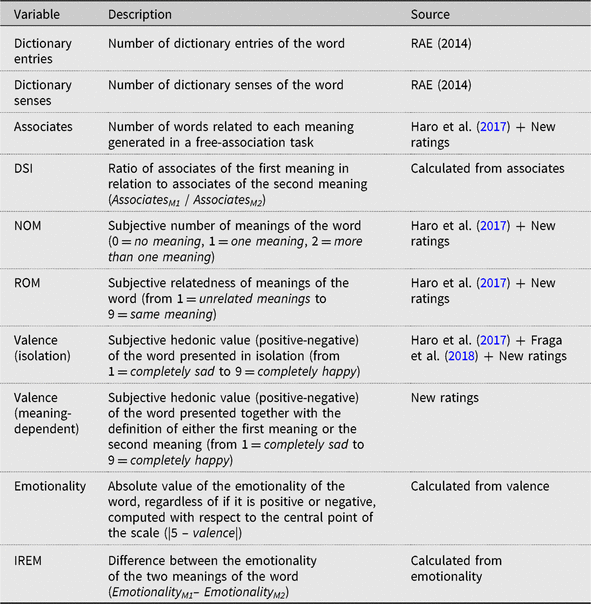
Note: DSI, dominance-subordination index. M1, first/dominant meaning. M2, second/subordinate meaning. NOM, number of meanings. ROM, relatedness of meanings. IREM, index of the relative emotionality of meaning.
First measure of ambiguity: Number of dictionary entries and senses
To provide an objective measure of ambiguity, the number of dictionary entries and senses (irrespective of whether all the senses were listed in a single dictionary entry or not) of the electronic version of the Diccionario de la Lengua Española (Real Academia Española, 2014; http://dle.rae.es/) were included for each word in the data set.
Second measure of ambiguity: Associates
The associates of 221 of the 410 Spanish ambiguous words were directly obtained from the raw data of Haro et al. (Reference Haro, Ferré, Boada and Demestre2017). For the remaining 189 words, new data were collected. These 189 words were randomly distributed in two questionnaires, and 50 participants (M = 22.50 years; SD = 4.54; 45 women) were asked to write the first word that came to mind after reading each word. Two of the authors categorized each associate produced by the participants as (a) related to one of the two meanings previously considered, (b) related to another meaning not considered in the selection, or (c) not clearly related to one or the other meaning. This task was first performed individually, and the two judges met later to compare their results and discuss discrepancies (three associates was the maximum accepted discrepancy). The values included in the database were obtained by recounting the number of produced associates that could be associated to each meaning. For example, considering the Spanish word arca (ark/coffer) 23 associates were generated for one of the meanings (17 participants produced Noé [Noah], 3 participants produced barco/a [boat], 1 participant produced animales [animals], 1 participant produced mar [sea], and 1 participant produced biblia [Bible]), whereas only 1 associate was generated for the other meaning (i.e., 1 participant produced arcón [chest]). Hence, for the Spanish word arca, we can say that ark is the dominant meaning (i.e., the one that has more associates) and coffer is the subordinate meaning (i.e., the one that has fewer associates).Footnote 2 As a result of the overall process, 24 words were removed because the associates generated were not clearly related to one or the other meaning (e.g., for the Spanish word basurero, most of the associates did not permit a distinction between the two meanings, dustman and dumpster). In addition, 26 words were eliminated because the associates revealed a third meaning that was not taken into consideration during the selection of the words (e.g., for the Spanish word granito, apart from the expected meanings of granite and acne, some participants also generated associates for the unexpected meaning of small particle).
An DSI of meanings was calculated through the division of the number of associates related to the first or dominant meaning by the number of associates related to the second or subordinate meaningFootnote 3: an index of 1 would mean that the two meanings have the same number of associates, hence both meanings are balanced (e.g., as is the case with the two meanings of the Spanish word genio [gifted/magician]); an index of 2 would mean that the dominant meaning has twice as many associates as the subordinate meaning; an index of 3 would mean that the dominant meaning has three times as many associates as the subordinated meaning; and so on.
Third measure of ambiguity: NOM
The NOM of 221 of the 410 Spanish ambiguous words was directly obtained from the database of Haro et al. (Reference Haro, Ferré, Boada and Demestre2017), and for the remaining 189 words new data were collected. These 189 words were randomly distributed in three questionnaires, including the same number of fillers (half of them were unambiguous words [e.g., geología {geology}] and the other half were nonwords [e.g., frubdión]). A total of 67 participants (M = 23.28 years; SD = 7.38; 49 women) were asked to decide if each string of letters had no meaning (coded as 0), one meaning (coded as 1), or more than one meaning (coded as 2). At a later time, this procedure was repeated for the unambiguous words included in the database in order to check that they had a single meaning: the NOM of 136 of the 286 unambiguous words was taken directly from the database of Haro et al. (Reference Haro, Ferré, Boada and Demestre2017), and NOM ratings for the remaining 150 potentially unambiguous words were obtained through questionnaires (N = 20 participants), in which we included nonword fillers.
In order to decide which of the 410 Spanish ambiguous words were psychologically ambiguous (i.e., they had more than one meaning for the participants), two criteria had to be met: (a) at least one associate had to be generated for the subordinate meaning (note that cases with 0.5 associates in the subordinate meaning were included, because one of the judges, but not the other, considered that there was one associate related to that meaning), and (b) the NOM had to be equal to or higher than 1.40. This was the same NOM criterion to distinguish between ambiguous and unambiguous words as that employed in previous studies (e.g., Haro, Comesaña, & Ferré, Reference Haro, Comesaña and Ferré2019; Haro & Ferré, Reference Haro and Ferré2018; Hino et al., Reference Hino, Pexman and Lupker2006). A total of 108 words were rejected because they did not meet both criteria. Taking those words, together with the 24 words eliminated because they had several associates that could not be clearly related to one of the meanings, and also the 26 words that were eliminated because they had associates related to a third meaning, the final number of ambiguous words included in the data set was 252. Regarding unambiguous words, we removed from the data set a word whose NOM was higher than 1.40 (tabique [septum/partition]). Apart from that word, 33 out of 286 potentially unambiguous words were discarded in order to have the same number of unambiguous and ambiguous words in the data set (i.e., 252). To do that, we followed rational criteria (e.g., words that had a NOM lower than 1, suggesting that these words are relatively unknown or infrequent).
Measure of ROM
The ROM of 183 of the 252 Spanish ambiguous words were taken directly from the ROM1 data of Haro et al. (Reference Haro, Ferré, Boada and Demestre2017), and for the remaining 69 new data were collected. All the words were presented in a single questionnaire. Each word was presented together with the most frequent associate generated for each meaning (e.g., the Spanish word órgano [organ] was presented with the associates cuerpo [body] and música [music]). Twenty-six participants (M = 20.62 years; SD = 1.86; 23 women) were asked to decide the degree of relationship between the two meanings of the ambiguous word indicated in the word pair on a 9-point scale (ranging from 1 = unrelated meanings to 9 = same meaning).
Measure of the valence of words in isolation
Following the same instructions and procedures of the published databases (e.g., Guasch et al., Reference Guasch, Ferré and Fraga2016), the Spanish adaptation of the Self-Assessment Manikin was used in order to obtain the valence rating of each ambiguous word when presented in isolation. The 252 words were randomly distributed in eight questionnaires, including the same number of unambiguous words (e.g., ajedrez [chess]) in each questionnaire as fillers. A total of 200 participants (M = 21.09 years; SD = 4.07; 161 women) rated the valence of the words on a 9-point scale (ranging from 1 = completely sad to 9 = completely happy).
Valence ratings for unambiguous words were directly taken from the following sources with the help of the emoFinder online search engine (Fraga et al., Reference Fraga, Guasch, Haro, Padrón and Ferré2018): Ferré et al. (Reference Ferré, Guasch, Moldovan and Sánchez-Casas2012), Guasch et al. (Reference Guasch, Ferré and Fraga2016), Haro et al. (Reference Haro, Ferré, Boada and Demestre2017), Hinojosa, Martínez-García, et al. (Reference Hinojosa, Martínez-García, Villalba-García, Fernández-Folgueiras, Sánchez-Carmona, Pozo and Montoro2016), and Stadthagen-González et al. (Reference Stadthagen-Gonzalez, Imbault, Pérez-Sánchez and Brysbaert2017).
Measure of the valence of each meaning (meaning-dependent valence)
In order to obtain the valence of each meaning separately, the Self-Assessment Manikin was again used. However, in this case, words were not presented in isolation. Instead, they were presented together with the definition of either the dominant meaning or the subordinate meaning. The definitions were adapted from the electronic version of the Diccionario de la Lengua Española (Real Academia Española, 2014; http://dle.rae.es/) and the electronic version of the dictionary of the El Mundo newspaper (http://www.elmundo.es/diccionarios/, no longer available), by keeping the length and difficulty of the definitions as uniform as possible (although a rigorous match was not performed). Participants were instructed that some of the words could have more than one meaning, and that they had to evaluate the valence of each word considering only the meaning that was indicated by the definition (see Appendix A).
The 252 words were randomly distributed in eight questionnaires, each word appearing in two of these: in one questionnaire, the word appeared with the definition of the dominant meaning, and in the other questionnaire, it appeared with the definition of the subordinate meaning. A total of 236 participants (M = 20.16 years; SD = 2.98; 173 women) rated the valence of the words on a 9-point scale (ranging from 1 = completely sad to 9 = completely happy).
The emotionality for each meaning was calculated by subtracting the valence of that meaning to the middle point of the valence scale (i.e., 5), and was reported as the absolute value. Values in this variable range from 0 = the meaning is completely neutral (e.g., the dominant meaning of segundo [second], which refers to the “time unit” meaning) to 4 = the meaning is extremely emotional (e.g., the subordinate meaning of viola [viola/rapes], which refers to the present tense of the verb “to rape” and has an emotionality value of 3.86). For each word, an IREMFootnote 4 was calculated through the subtraction of the emotionality of the subordinate meaning to the emotionality of the dominant meaning: an index of 0 means that both meanings are equally emotional (e.g., cinturón [belt/seatbelt]), while positive values indicate that the dominant meaning is more emotional than the subordinate meaning (e.g., mata [kills/bush]) and negative values indicate that the subordinate meaning is more emotional than the dominant meaning (e.g., terminal [airport terminal/terminal illness]).
Availability of the norms
The database can be downloaded from http://psico.fcep.urv.cat/exp/files/huete_et_al_emo_amb_database.xlsx as an Excel file, in which the following columns can be found: Word (word in Spanish), Ambiguity_status (whether the word is ambiguous or unambiguous), Dictionary_entries (number of dictionary entries), Dictionary_senses (number of dictionary senses), NOM (mean number of meanings), ROM (mean relatedness of meanings), Associates_M1 (number of associates generated for the dominant meaning), Associates_M2 (number of associates generated for the subordinate meaning), DSI (dominance-subordination index), Valence_isolation_m (mean valence of the word presented in isolation), Valence_isolation_sd (standard deviation of the valence of the word presented in isolation), Valence_M1_m (mean valence of the word presented together with the definition of the dominant meaning), Valence_M1_sd (standard deviation of the valence of the word presented together with the definition of the dominant meaning), Emotionality_M1 (emotionality of the dominant meaning), Valence_M2_m (mean valence of the word presented together with the definition of the subordinate meaning), Valence_M2_sd (standard deviation of the valence of the word presented together with the definition of the subordinate meaning), Emotionality_M2 (emotionality of the subordinate meaning), IREM (index of the relative emotionality of meanings), Definition_M1 (Spanish definition of the dominant meaning), Definition_M2 (Spanish definition of the subordinate meaning), and Source (indicates whether the word was taken from the database of Haro et al., Reference Haro, Ferré, Boada and Demestre2017, or it was a new word).
Results
All analyses were conducted with IBM SPSS Statistics (version 25) and JASP (version 0.9.2.0). Where applicable, the critical level of significance was α = .05. In cases where the data seriously violate the assumptions of the parametric tests (e.g., a distribution that does not meet the normality criteria), their nonparametric equivalents were used (e.g., the Mann–Whitney U test instead of the independent samples t test, or Kendall’s τ correlation instead of the Pearson correlation). In the BayesianFootnote 5 analyses, the default options in JASP were left unchanged.
Reliability
Following Guasch et al. (Reference Guasch, Ferré and Fraga2016), the intraclass correlation coefficient (ICC; for an overview of this coefficient, see Koo & Li, Reference Koo and Li2016) was computed for each questionnaire in order to obtain an index of interrater reliability of each measure. More specifically, the type of ICC used was the two-way random effects based on the absolute agreement of multiple raters. The ICCs were all significant (all p < .001), supporting the reliability of the data: ICC = .93–.95 for valence in isolation (M = .94, SD = .01), ICC = .96–.98 for valence with the definition of each meaning (M = .97, SD = .01), ICC = .98–.99 for NOM (M = .98, SD = .01), ICC = .93 for ROM.
Ambiguity measures
The descriptive statistics of ambiguous and unambiguous words are represented in Table 2.
Descriptive statistics of the 252 ambiguous words and the 252 unambiguous words included in the database

Note: All values are rounded to the last decimal. Val, valence in isolation. Ent, number of dictionary entries. Sen, number of dictionary senses. NOM, number of meanings. ROM, relatedness of meanings. DSI, dominance-subordination index. MNVR, minimum number of valid responses when questionnaires were used.
Comparison between ambiguous and unambiguous words
The validity of the a priori arbitrary cutoff point established to differentiate between ambiguous and unambiguous words (i.e., a NOM value of 1.40) was reinforced by the significant differences observed in objective ambiguity measures, such as the number of dictionary entries, U = 19216.00, z = –10.81, p < .001, r rb = .39, BF 10 = 6.68 e+8, and the number of dictionary senses, U = 5009.50, z = –16.49, p < .001, r rb= .84, BF 10 = 2.52 e+11.
Correlation between objective and subjective measures of ambiguity
The correlations between the different measures of ambiguity are presented in Table 3. The pattern of correlations found reveals that most of the ambiguity variables are significantly correlated, supporting the validity of those variables as indices of ambiguity. This pattern is similar to that found by Haro et al. (Reference Haro, Ferré, Boada and Demestre2017). The only difference is that number of senses and ROM are not significantly correlated in the present database. Such discrepancy may be explained by a methodological difference: while in the study of Haro et al. (Reference Haro, Ferré, Boada and Demestre2017) ROM was collected for both ambiguous and unambiguous words, in the present study it was collected for ambiguous words only. If we take into account that excluding unambiguous words restricts the range/variability in both number of senses and ROM values (unambiguous words tend to have lower values of number of senses and higher values of ROM than ambiguous words), it is not surprising that the correlation diminishes (for a reminder of how range restriction decreases correlation coefficients, see, for example, Goodwin, & Leech, Reference Goodwin and Leech2006). If we remove all the unambiguous words from the data of Haro et al. (Reference Haro, Ferré, Boada and Demestre2017), the correlation between number of senses and ROM drops from r (530) = –.39, p < .001 to r (386) = –.08, p = .111.
Kendall’s tau correlation coefficients (first value) and the respective BF10 (in parentheses) between objective and subjective measures of ambiguity

Note: All values are rounded to the last decimal. Ent, number of dictionary entries. Sen, number of dictionary senses. NOM, number of meanings. ROM, relatedness of meanings. aThe correlations with ROM were only conducted with the ambiguous words (N = 252), but the correlation between the other variables were conducted with all the words (N = 504). **p < .01. ***p < .001.
DSI
The values of the DSI range from 1 (i.e., the two meanings of the word have the same number of associates) to 48 (i.e., the dominant meaning of the word has 48 times more associates than the subordinate meaning). As shown in Table 2, the mean DSI for the ambiguous words included in the database is M = 8.28. However, because the distribution of this variable is far enough from normality (p < .05 in Kolmogorov–Smirnov test and visual inspection of histogram and Q-Q plots), the mean is not a good measure of central tendency in this case (see Field, Reference Field2017, Chapter 1). Consequently, the median and the other quartiles are chosen to describe that variable: 1.84 as first quartile, 3.95 as second quartile, and 11.95 as third quartile. Ambiguous words of the first rank (i.e., DSI ≤ 1.84) can be considered as being balanced in terms of ambiguity. Ambiguous words of the second (i.e., 1.84 < DSI ≤ 3.95), the third (i.e., 3.95 < DSI ≤ 11.95), and the fourth ranks (i.e., DSI > 11.95) can be considered as being slightly, moderately, and extremely unbalanced, respectively. It is important to note that this categorization is arbitrary and is only used for descriptive purposes.
Valence measures
Emotional categorization of the words in the database
Following previous studies (e.g., Ferré et al., Reference Ferré, Guasch, Moldovan and Sánchez-Casas2012), the 9-point valence dimension was divided to form three categories: negative (i.e., valence < 4), neutral (i.e., 4 ≤ valence ≤ 6), and positive (i.e., valence > 6). Concerning unambiguous words, three types are distinguished according to that division: negative, neutral, and positive words. Their descriptive statistics are represented in Table 4. Regarding ambiguous words, nine types are distinguished as a result of the combination of the three valence categories for each meaning: negative-negative, negative-neutral, negative-positive, neutral-negative, neutral-neutral, neutral-positive, positive-negative, positive-neutral, and positive-positive words (see Figure 1). The descriptive statistics of these words are represented in Table 5.
Descriptive statistics of the 252 unambiguous words by emotional categories

Note: The value indicated is the mean of all the stimuli in each condition and the standard deviations are in parentheses. Neg, negative. Neu, neutral. Pos, positive. Val, valence in isolation. Ent, number of dictionary entries. Sen, number of dictionary senses. NOM, number of meanings.
Distribution of ambiguous words in the affective space defined by the valences of the dominant meaning and the subordinate meaning. Emotional categories are based on the division of the 9-point valence dimension as follows: negative (i.e., valence < 4), neutral (i.e., 4 ≤ valence ≤ 6), and positive (i.e., valence > 6).

Descriptive statistics of the 252 ambiguous words by emotional categories

Note: The value indicated is the mean of all the stimuli in each condition and the standard deviations are in parentheses. Neg-neg, negative-negative. Neg-neu, negative-neutral. Neg-pos, negative-postive. Neu-neg, neutral-negative. Neu-neu, neutral-neutral. Neu-pos, neutral-positive. Pos-neg, positive-negative. Pos-neu, positive-neutral. Pos-pos, positive-positive. Val, valence in isolation, Val-M1, valence of the dominant meaning. Val-M2, valence of the subordinate meaning. Ent, number of dictionary entries. Sen, number of dictionary senses. NOM, number of meanings. ROM, relatedness of meanings. DSI, dominance-subordination index. IREM, index of the relative emotionality of meanings.
The distribution of unambiguous words in the distinct emotional categories reveals that most of the words belong to the neutral category (Table 4). The same pattern is observed if we look at the valence of the dominant meaning of ambiguous words (Table 5). However, if we consider both the dominant and the subordinate meaning and the distribution of ambiguous words into the nine emotional categories, some interesting patterns emerge. On the one hand, quite a lot of ambiguous words have meanings with different valence. In our classification, more than half the words (54.37%) have incongruent valence between their meanings, while the other words have congruent valence (i.e., negative-negative, neutral-neutral, positive-positive). On the other hand, it should be noted that among the 252 words, 115 of them have at least one positive meaning, while only 75 of them have at least one negative meaning. These results are consistent with a positive bias in language, as reported in several studies (see Dodds et al., Reference Dodds, Clark, Desu, Frank, Reagan, Williams and Megerdoomian2015, for instance).
Prediction of valence in isolation
Four linear regression models were created to explore which of the following variables best predicted the values of valence in isolation: (a) the valence of the subordinate meaning alone, (b) the valence of the dominant meaning alone, (c) the arithmetic mean of the valences of both meanings, and (d) the weighted mean of the valences of both meanings in function of the number of associates (i.e., dominance). The results of these models are presented in Table 6.
Linear regression models for the prediction of valence in isolation
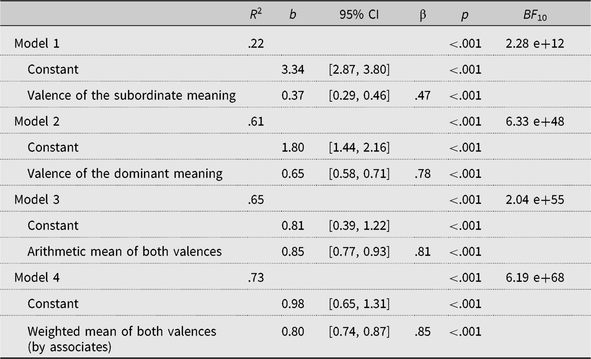
Note: All values are rounded to the last decimal. In all models, N = 252.
As can be seen in Table 6, the four models significantly predicted the values of valence in isolation, although there were small differences between the last three models in the amount of explained variance (R 2). To examine if those differences were significant, the Pearson correlation coefficient of each model was compared to the others by using the web version of cocor (Diedenhofen & Musch, Reference Diedenhofen and Musch2015). The results revealed that the Pearson correlation coefficient of Model 1 was significantly smaller than that of Model 2 (difference of 0.31, 95% confidence interval; CI [0.20, 0.42]), z = 5.62, p < .001, Model 3 (difference of 0.34, 95% CI [0.27, 0.41]), z = 9.07, p < .001, and Model 4 (difference of 0.38, 95% CI [0.29, 0.48]), z = 7.98, p < .001. Focusing on the other three models, the Pearson correlation coefficient of Model 4 was significantly larger than that of both Model 2 (difference of 0.08, 95% CI [0.05, 0.11]), z = 5.31, p < .001, and Model 3 (difference of 0.05, 95% CI [0.02, 0.08]), z = 2.87, p = .004; meanwhile, no significant differences were observed between Models 2 and 3 (difference of 0.03, 95% CI [–0.02, 0.08]), z = 1.21, p = .226. Taking all this into account, it seems that both the valence of the dominant meaning alone and the arithmetic mean of the valences of both meanings explain quite well the valence of the word in isolation (60.60% and 65.08% of the variance, respectively), and they do it much better than the valence of the subordinated meaning alone (22.24% of the variance). However, the best predictor of the valence ratings in isolation is the weighted mean of the valence of both meanings considering the number of associates (explaining the 72.81% of the variance).
In order to illustrate the superior predictive capacity of the weighted valence of both meanings on valence values in isolation, the valences of the word in isolation, the dominant meaning, and the subordinate meaning of some ambiguous words are represented in Figure 2 (inspired by Figure 2b of Scott et al., Reference Scott, Keitel, Becirspahic, Yao and Sereno2019).
Distribution of the three valences (valence of the word in isolation, of the dominant meaning, and of the subordinate meaning) of some ambiguous words. Two example ambiguous words are presented for each category (e.g., metro and lima for the neutral-neutral category). In each category, the first example is a case where the valence of the word presented in isolation is very similar to the valence of the dominant meaning, while this is not the case for the second example.
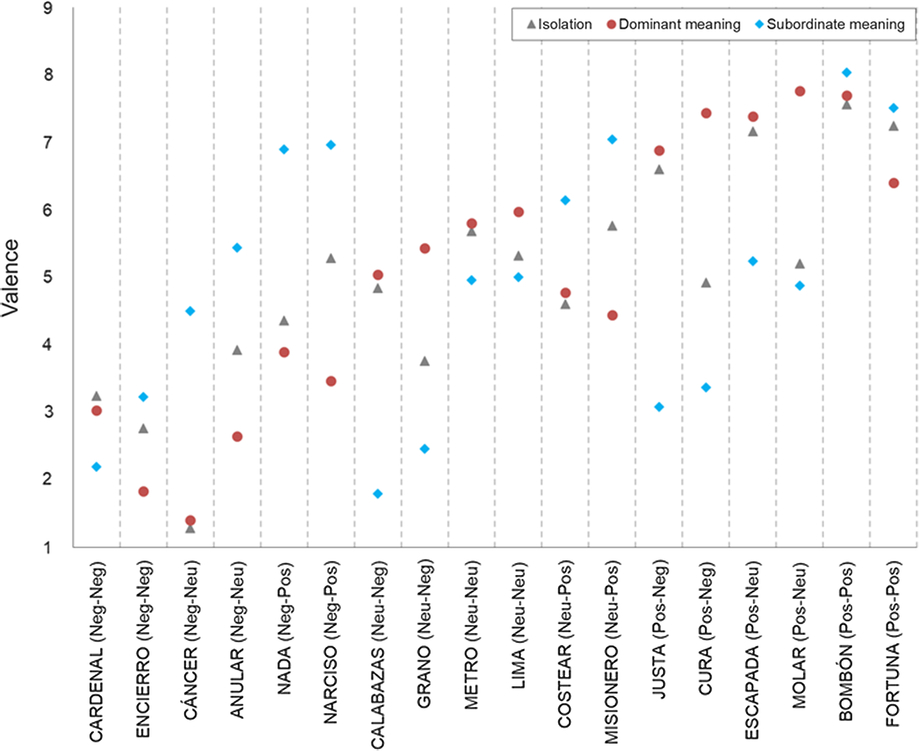
The above findings show that, in order to predict the values of valence in isolation, it is not enough to consider only the valence of the dominant meaning: both meanings should be considered, taking into account their dominance. Unfortunately, our analyses do not allow us to establish which of the following possibilities has been the responsible of this result: (a) participants have taken the two valences of the meanings of ambiguous words into account and made mental averages of them, or (b) there were two groups of participants with extreme opposite values (i.e., a group of participants focused on one meaning and another group focused on the other meaning). The only way to examine this issue is to ask the participants directly at the end of the rating task what has been the strategy followed for each word. Such an approach may be very informative for our understanding of the processing of language ambiguity. If future studies reveal that people take both meanings into account (Possibility a), this would give support to the idea that the different meanings of ambiguous words are activated when they are presented in isolation (in line with the exhaustive access/search model; see, for instance, Cai & Vigliocco, Reference Cai, Vigliocco, Thompson-Schill and Wixted2018; Lin & Chen, Reference Lin and Chen2015). Due to the characteristics of the task, we could not know if such activation was automatic or rather due to a conscious search process. Further research with other speeded tasks may shed light on this issue.
Limitations and conclusions
The present database includes meaning-dependent affective (valence) ratings for 252 Spanish ambiguous words. Before highlighting the main implications of this study, we would like to mention a possible limitation, which is related to the use of definitions for the meaning-dependent valence rating task.Footnote 6 On the one hand, it may be that participants rely on the definition more than on the feeling produced by the word itself (especially for the subordinate meanings, which could be unknown by some of the speakers). On the other hand, the definitions themselves have an affective content, which can have affected ratings. As for the first issue, there is no way to know with the present design the number of cases where participants did not know the subordinate meaning. However, researchers interested in the study of emotion and ambiguity may use the dominance index provided in the database to avoid selecting highly unbalanced words for their experiments. In this way, they would be sure that the valence ratings for each meaning refer to something previously known by the speaker. As for the second issue, the effect of the affective content of definitions on word valence ratings cannot be avoided. A negative word has a negative meaning. Consequently, its definition has a negative valence. Another possibility would have been to use an associate to each meaning instead of its definition. However, most associates can be emotionally charged too. Another problem with this approach is that the type of associates and their associative strength can greatly differ between the two meanings of ambiguous words.
Apart from the above limitation, the present study has produced several relevant findings that have clear implications for research on both ambiguity and emotionality. First, the analysis carried out has shown that a high amount of ambiguous words have meanings with different valence. This fact is especially relevant for studies on affective processing, which include ambiguous words, as it could be the case that some of them have two meanings with different valence values, and this could affect results (e.g., a facilitative effect of positive valence on word processing might not be found if there are several words in the experimental set in which the content of both meanings is not positive). Second, many of the ambiguous words that are highly ambivalent in terms of the valence of their meanings are rated as neutral when presented in isolation. Thus, of the 20 words with meanings of opposite affective valence (i.e., negative-positive and positive-negative), 14 have a neutral range (4–6) in the isolated estimate. It is important to bear this in mind, as there is a risk that these words might be included as neutral in studies if only valence in isolation is considered. Third, and probably the most relevant contribution of the present work, the study demonstrated that the valence rating of an ambiguous word in isolation is better explained by a weighted average of the valence of its two meanings in terms of their dominance (i.e., number of lexical associates). It should be noted, however, that the valence of the dominant meaning alone predicts also quite well the valence of the isolated ambiguous words. Overall, the present findings have consequences both for basic studies (e.g., relationship between emotion and language, ambiguity processing, etc.) and applied work (e.g., cognitive and emotional biases in emotional disorders, second language learning, etc.).
Supplementary material
To view supplementary material for this article, please visit https://doi.org/10.1017/S014271641900050X
Acknowledgments
This work was supported by Grants PSI2015-63525-P (MINECO/FEDER) and Ref 2017PFR-URV-B2-32 from the Universitat Rovira i Virgili.
Appendix A. Instructions used for valence ratings of words with the definition of one of the two meanings
Spanish (original)
Page 1
A continuación se te presenta un conjunto de palabras que tendrás que evaluar mediante el Maniquí de Auto-Evaluación (MAE).
Observa que el MAE dispone de una escala que va desde 1 hasta 9. Utiliza estos valores para evaluar cada palabra en la dimensión AGRADO de acuerdo con los siguientes criterios:
Si la palabra te hace sentir completamente triste, la evaluarás con un 1.
Si te hace sentir completamente alegre, la evaluarás con un 9.
Si no te hace sentir ni alegre ni triste, sino neutral, la evaluarás con un 5.
Puedes utilizar otros valores si la palabra te hace sentir un poco triste (3) o un poco alegre (7). Observa que también puedes evaluar tu nivel de alegría o tristeza utilizando otros valores (2, 4, 6, 8) situados entre las figuras.
Page 2
Algunas palabras pueden hacer referencia a más de un concepto. Por ello, junto a cada palabra se presenta una definición para acotar con cuál de sus significados debes trabajar. Debes valorar el agrado de la palabra solo en relación al concepto/significado que se indica en la definición. Imagina el siguiente ejemplo con la palabra caña:
CAÑA – Instrumento utilizado para pescar que lleva en el extremo más delgado una cuerda de la que pende el sedal con el anzuelo.
La mayoría de la gente evaluaría esta palabra en valores medios de la escala, ya que no es ni agradable ni desagradable, sino más bien neutra. Otros significados posibles para esta palabra serían “caña de cerveza,” “caña de azúcar,” o “caña de chocolate.” No debes tener en cuenta estos significados para responder: debes evaluar el agrado de la palabra solo pensando en el concepto/significado de la definición.
English (translated, example changed for illustrative purposes: We did not use English ambiguous words in any questionnaire)
Page 1
You will be presented with a set of words. You are asked to rate them using the Self-Assessment Manikin (SAM).
Note that the SAM has a scale that ranges from 1 to 9. Use these values to rate each word in the PLEASANTNESS dimension according to the following criteria:
If the word makes you feel completely sad, then you should rate it with a 1.
If the word makes you feel completely happy, then you should rate it with a 9.
If it makes you feel neither happy nor sad, but neutral, you should rate it with a 5.
You can use other values if the word makes you feel a little sad (3) or a little happy (7). Note that you can also rate your level of happiness or sadness by using other values (2, 4, 6, 8) between these figures.
Page 2
Note that some words can refer to more than one concept. For this reason, a definition is presented together with each word to indicate which of its meanings you should rate. You have to evaluate the word’s pleasantness only in relation to the meaning that is indicated by the definition. Imagine the following example with the word “bar”:
BAR – Long straight piece of metal or other materials.
Most people would rate this word on the values in the middle of the scale, as it is neither pleasant nor unpleasant, but rather neutral. Other possible meanings for this word would be “pub” and “musical compass.” You do not have to take these meanings into account in order to answer: you have to rate the word’s pleasantness only in thinking about the meaning/concept indicated by the definition.



