Introduction
Ixodid ticks are important vectors of several pathogens that negatively impact the health of animal and human populations worldwide, and are considered a major constraint to livestock production (Jongejan and Uilenberg, Reference Jongejan and Uilenberg2004). There are at least 80 indigenous tick species in South Africa and 13 of these are capable of transmitting pathogens to livestock and dogs, whereas seven species excrete toxins with their saliva (Horak et al., Reference Horak, Heyne, Williams, Gallivan, Spickett, Bezuidenhout and Estrada-Peña2018). Tick-borne diseases of particular concern in South Africa are heartwater in cattle, sheep and goats caused by Ehrlichia ruminantium, African and Asiatic redwater in cattle caused by Babesia bigemina and Babesia bovis, respectively, Corridor disease in cattle caused by buffalo-derived Theileria parva and canine babesiosis in dogs caused by Babesia rossi. Of major concern to farmers in the Karoo is an often fatal paralysis in sheep caused by a toxin secreted by the Karoo paralysis tick, Ixodes rubicundus, while in parts of the Eastern Cape Province, ticks that cluster around the feet of Angora goats can lead to secondary bacterial infection and severe lameness (Horak et al., Reference Horak, Heyne, Williams, Gallivan, Spickett, Bezuidenhout and Estrada-Peña2018). Twenty-three species have been recorded attacking humans, and seven have been incriminated in transmitting pathogens to humans. These pathogens include Rickettsia africae, the cause of African tick-bite fever and the virus responsible for Crimean-Congo haemorrhagic fever (Horak et al., Reference Horak, Heyne, Williams, Gallivan, Spickett, Bezuidenhout and Estrada-Peña2018).
Small stock and cattle play an important role in rural farming communities, not only as source of protein and transactions, but also as means of transport, stored wealth and insurance against emergencies (Randela, Reference Randela, Anandajayasekeram, Rukuni, Babu, Liebenberg and Keswani2007; Jongejan et al., Reference Jongejan, Berger, Busser, Deetman, Jochems, Leenders, De Sitter, Van der Steen, Wentzel and Stoltsz2020). In a study among small-scale farmers, ticks were perceived as a major cause of mortality (Jongejan et al., Reference Jongejan, Berger, Busser, Deetman, Jochems, Leenders, De Sitter, Van der Steen, Wentzel and Stoltsz2020), and ticks cost the South African agriculture more than ZAR 500 million per annum in direct and indirect losses, with the costs of acaricides alone estimated at ZAR 80 million in 1994 (Randela, Reference Randela, Anandajayasekeram, Rukuni, Babu, Liebenberg and Keswani2007).
In view of their veterinary as well as medical importance, knowing which characteristics of host populations or their habitat influence the composition, diversity and abundance of tick assemblages is an important aspect of disease management as well as wildlife conservation (Huang et al., Reference Huang, Bininda-Emonds, Stephens, Gittleman and Altizer2014; Esser et al., Reference Esser, Foley, Bongers, Herre, Miller, Prins and Jansen2016).
Similar to numerous parasites, several ticks are able to infest a range of host species. Determination of the degree of host sharing and factors contributing towards possible parasite host switching will assist in predicting pathogen transmission between host species (Ruiz-Fons et al., Reference Ruiz-Fons, Acevedo, Sobrino, Vicente, Fierro and Fernández-de-Mera2013; Huang et al., Reference Huang, Bininda-Emonds, Stephens, Gittleman and Altizer2014; Esser et al., Reference Esser, Foley, Bongers, Herre, Miller, Prins and Jansen2016; Stephens et al., Reference Stephens, Altizer, Ezenwa, Gittleman, Moan, Han, Huang and Pappalardo2019). This is especially relevant given that global climate change will likely lead to local changes in climatic constraints that affect the distribution of ticks among hosts.
Tick species in South Africa vary with respect to their host associations. The adults of 16 South African tick species have broadly been classified as specialists, having a preference for hosts belonging to a particular order, suborder or family, whereas nine species are considered generalists (Horak et al., Reference Horak, Heyne, Williams, Gallivan, Spickett, Bezuidenhout and Estrada-Peña2018). The immature stages of four species exhibit a definite host preference while those of nine species are generalists (Horak et al., Reference Horak, Heyne, Williams, Gallivan, Spickett, Bezuidenhout and Estrada-Peña2018). However, tick species composition may vary within host species among habitats as well as among host species in the same habitat (Horak et al., Reference Horak, Heyne, Williams, Gallivan, Spickett, Bezuidenhout and Estrada-Peña2018, Reference Horak, Boomker, Junker and Gallivan2021).
The adults of several tick species infest large wildlife hosts and cattle, whereas the immature stages of some of these infest large hosts as well as murid rodents, hares, elephant shrews, guineafowls and smaller ground-frequenting birds (Horak et al., Reference Horak, Heyne, Williams, Gallivan, Spickett, Bezuidenhout and Estrada-Peña2018). Although abundances differ, nearly all 26 tick species that have been collected from cattle in South Africa have also been collected from medium-sized to large antelope and from wild bovids, and in fact all 26 species have also been collected from elands (Horak et al., Reference Horak, Heyne, Williams, Gallivan, Spickett, Bezuidenhout and Estrada-Peña2018). With the exception of Rhipicephalus sanguineus (introduced on dogs millennia ago) and Rhipicephalus microplus (introduced on cattle early in the 1900s), the remaining species are indigenous and those found on domesticated animals are considered a spill-over from wildlife rather than vice versa.
Recognition of the ecological and epidemiological importance of investigating factors that drive tick parasitism on host species has resulted in a number of studies. Several of these did, however, focus on small mammals, whereas large mammals received little attention (Ruiz-Fons et al., Reference Ruiz-Fons, Acevedo, Sobrino, Vicente, Fierro and Fernández-de-Mera2013). To better understand the mechanisms that cause the distribution patterns observed in South Africa, we analysed the similarity in ixodid tick assemblages of three wildlife and three livestock species, including small-bodied as well as large-bodied hosts, in a nature reserve and on an adjacent farm both situated in the Great Fish Noorsveld of South Africa.
In particular, we asked (a) whether wild hosts belonging to different species harbour similar tick infracommunities; (b) whether conspecific hosts harbour similar tick infracommunities in natural (reserve) and anthropogenic (farm) habitats and (c) whether co-occurring wildlife and livestock harbour similar tick infracommunities. To answer the first question, we compared species composition of tick infracommunities among three species of very distantly related wild hosts, namely helmeted guineafowls (Numida meleagris), scrub hares (Lepus saxatilis) and greater kudus (Tragelaphus strepsiceros), co-occurring in a nature reserve. We focused on larval and nymphal stages only, because adult ticks usually attack large hosts, and thus taking adult stages into account would make the results for guineafowls and scrub hares, on the one hand, and kudus, on the other hand, incomparable. To answer the second question, we compared the species composition of tick infracommunities within host species (for helmeted guineafowls, scrub hares and kudus) between the reserve and bordering farm. Larval and nymph stages only were taken into account for intraspecific comparison in guineafowls and scrub hares, whereas all stages were considered for kudus. To answer the third question, we compared the species composition of tick infracommunities in wildlife and livestock co-occurring on the farm. This was done separately for animals of different size classes. We analysed similarity in tick species composition among (a) relatively small hosts (guineafowls, scrub hares and Angora goat kids) and (b) relatively large hosts (kudus, adult Angora goats, yearling Dorper sheep and yearling cattle). Only larval and nymph stages were considered for small-bodied hosts and all stages were considered for large-bodied hosts.
Materials and methods
Survey sites and survey animals
Surveys were conducted on the farm ‘Bucklands’ (now Bucklands Private Game Reserve; −33.1072° south, 26.7075° east) and the adjacent Andries Vosloo Kudu Reserve (AVKR; −33.1061° south, 26.7756° east), which has subsequently been incorporated in the Great Fish River Reserve (GFRR). Both are situated in Great Fish Noorsveld (formerly classified as Valley Bushveld), which forms part of the Albany Thicket Biome in the Eastern Cape Province in the south-east of South Africa (Mucina and Rutherford, Reference Mucina and Rutherford2006). In addition to species-rich grass flora, succulent thicket (Euphorbia spp.) of low-to-medium height is interspersed with sclerophyllous bush clumps, groups of succulent shrubs and patches of rhizomatous herbs. Rainfall in this region is non-seasonal, with a mean annual precipitation in the range of 360–500 mm. Mean monthly temperatures reduce to a minimum of 2.1°C in winter, which is largely frost-free and attain a maximum of 39.6°C in summer (Mucina and Rutherford, Reference Mucina and Rutherford2006).
Bucklands is 5480 ha in extent and at the time of sample collection, shared a common 11 km boundary with the AVKR, which was 6497 ha in extent. The farm was stocked with 185 cattle, approximately 300 Dorper sheep and 4000 Angora goats. It also contained an estimate of 300 free-ranging kudus and 80 bushbuck (Tragelaphus scriptus). The cattle, sheep and goats were confined to separate large camps. The cattle were dipped or sprayed at 2–4-weekly intervals with an acaricide and the sheep and goats were treated with the same compound at 4-weekly intervals, a practice that had been followed for several years. The survey calves were kept in a separate camp with four cattle that were treated only with an acaricide when their tick burdens were judged excessive. The survey sheep and goats ran with the regular farm flocks of sheep and goats, but were not treated with an acaricide during the 12 weeks prior to slaughter. The AVKR contained approximately 450 kudus, 80 bushbuck, 140 eland (Tragelaphus oryx), 50 red hartebeest (Alcelaphus buselaphus) and 100 African buffaloes (Syncerus caffer). Large numbers of scrub hares and helmeted guineafowls were present on both properties.
Between May 1984 and January 1985, 17 guineafowls were shot in the reserve, and between February 1985 and January 1987, 41 guineafowls, 42 scrub hares and 16 kudus were shot in the reserve and 37 guineafowls, 45 scrub hares and 9 kudus were shot on the farm (Horak and Fourie, Reference Horak and Fourie1991; Horak et al., Reference Horak, Spickett, Braack and Williams1991c, Reference Horak, Boomker, Spickett and De Vos1992). Between February 1985 and January 1987, 46 yearling cattle as well as 48 yearling Dorper sheep and 48 adult Angora goats were killed in pairs on the farm (Horak et al., Reference Horak, Knight and Williams1991a, Reference Horak, Williams and Van Schalkwyk1991b; Horak, Reference Horak1999), and between September 1986 and November 1988 two successive groups, each consisting of 26 Angora goat kids, were killed in pairs on the farm (Horak et al., Reference Horak, Knight and Williams1991a). Ticks were collected from all these animals, identified and counted as described by Horak et al. (Reference Horak, Heyne, Williams, Gallivan, Spickett, Bezuidenhout and Estrada-Peña2018). Briefly, the hides of kudus, cattle and goats were cut in half and all adult ticks were collected, identified and counted and then multiplied by two. Subsamples of the washing and scrubbing material collected from these animals and from scrub hares were examined for immature ticks and the totals were multiplied accordingly. All adult ticks on scrub hares were collected, identified and counted. All the ticks collected from guineafowls were identified and counted.
Data analyses
We applied an analysis of similarities (ANOSIM) (Clarke and Green, Reference Clarke and Green1988; Clarke et al., Reference Clarke, Gorley, Somerfield and Warwick2014) to compare similarity in tick species composition (a) between host species within either the reserve or the farm and (b) within host species between the reserve and the farm. ANOSIM operates on a matrix of similarities between samples (i.e. tick species composition on each individual host). Consequently, prior to these analyses, the matrices of the Bray–Curtis similarities (Bray and Curtis, Reference Bray and Curtis1957) in tick species composition between each pair of individual hosts were constructed. The null hypothesis of ANOSIM is that there are no differences in species composition between the groups of samples (among host species or between reserve and farm). The ANOSIM test statistic, R, can never technically be lower than −1 and greater than 1. R equals 1 if all samples within a group (e.g. host species or habitats in our case) are more similar to each other than any replicates from groups. R is close to 0 if the null hypothesis is true, so that similarities of samples between and within groups are, on average, the same. Each analysis was based on 999 permutations and carried out using the routine ANOSIM implemented in the Primer-7 program (Clarke and Gorley, Reference Clarke and Gorley2015). Prior to analyses, the data entries (number of ticks of any stage of a given species on each host individual) were fourth root-transformed and standardized within a sample (i.e. a host individual) by total abundance. To visualize dissimilarity in species composition of tick infracommunities, we applied non-parametric multidimensional scaling (NMDS) with a matrix of pairwise between-localities Bray–Curtis similarities in tick species composition as input data. This was done using the function ‘metaMDS’ of the package ‘vegan’ (Oksanen et al., Reference Oksanen, Blanchet, Friendly, Kindt, Legendre, McGlinn, Minchin, O'Hara, Simpson, Solymos, Stevens, Szoecs and Wagner2020) implemented in the R statistical environment (R Core Team, 2021). We then identified those tick species that primarily accounted for differences between infracommunities among hosts or within a host between the reserve and the farm. This was carried out by decomposition of Bray–Curtis similarity into contribution of each species using the routine SIMPER implemented in the Primer-7 program (Clarke and Gorley, Reference Clarke and Gorley2015).
Results
The prevalence and mean abundance of 11 tick species collected from hosts in both the reserve and on the farm are summarized in Supplementary Tables S1 and S2, providing detailed information on the variation of infestation. Two species belonged to the genus Amblyomma, one to the genus Haemaphysalis, two to the genus Hyalomma, one to the genus Ixodes and seven to the genus Rhipicephalus. The adults and/or the immature stages of ten of these species infested three or more host species, the exception being Rhipicephalus oculatus, the adults and immature stages of which infested only scrub hares. Three species, Haemaphysalis elliptica, Hyalomma truncatum and Ixodes pilosus have not been included in the tables because of the small numbers recovered.
All the kudus examined in the reserve were infested with the adults and immature stages of Haemaphysalis silacea, the adults of Rhipicephalus glabroscutatus, and the immature stages of Amblyomma hebraeum, which also infested all the guineafowls and scrub hares examined in the reserve (Supplementary Table S1). All kudus examined on the farm were infested with the adult and immature stages of H. silacea, as well as the adults of Rhipicephalus appendiculatus and R. glabroscutatus. In addition, all calves were infested with the immature stages of H. silacea. No adult ticks of any species infested all six host species, whereas the immature stages of A. hebraeum, Amblyomma marmoreum, H. silacea, R. appendiculatus, Rhipicephalus evertsi evertsi and R. glabroscutatus were collected from all the host species examined on the reserve and farm.
The most abundant species of adult ticks collected in the reserve were H. silacea (1825), followed by R. glabroscutatus (1587) and A. hebraeum (716); whereas the most abundant species of immature ticks were A. hebraeum (50 295) followed by R. glabroscutatus (21 753) and H. silacea (19 572). The most abundant species of adult and immature ticks collected on the farm were R. glabroscutatus (3356 and 48 427, respectively) followed by H. silacea (1708 and 32 119, respectively) and R. appendiculatus (1460 and 25 650, respectively).
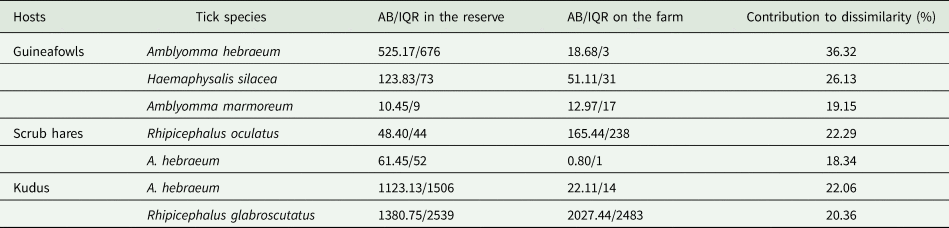
Individual hosts of all three wild species in the reserve harboured dissimilar tick infracommunities when compared to the farm, with species composition on guineafowls and kudus differing between the reserve and the farm to a greater degree than was the case for scrub hares (R = 0.48, R = 0.50 and R = 0.31, respectively; P < 0.01 for all three). Tick species contributing the most to dissimilarity between the reserve and the farm are presented in Table 1. The abundance of A. hebraeum on all three hosts was consistently higher in the reserve compared to that on the farm (Table 1).
Tick species that contributed most to dissimilarity in species composition of tick infracommunities between the reserve and the farm in three wild host species

AB, average abundance (prior to transformations; based on immature stages in small hosts and adults and immature stages in large hosts; see text for explanation); IQR, interquartile range.
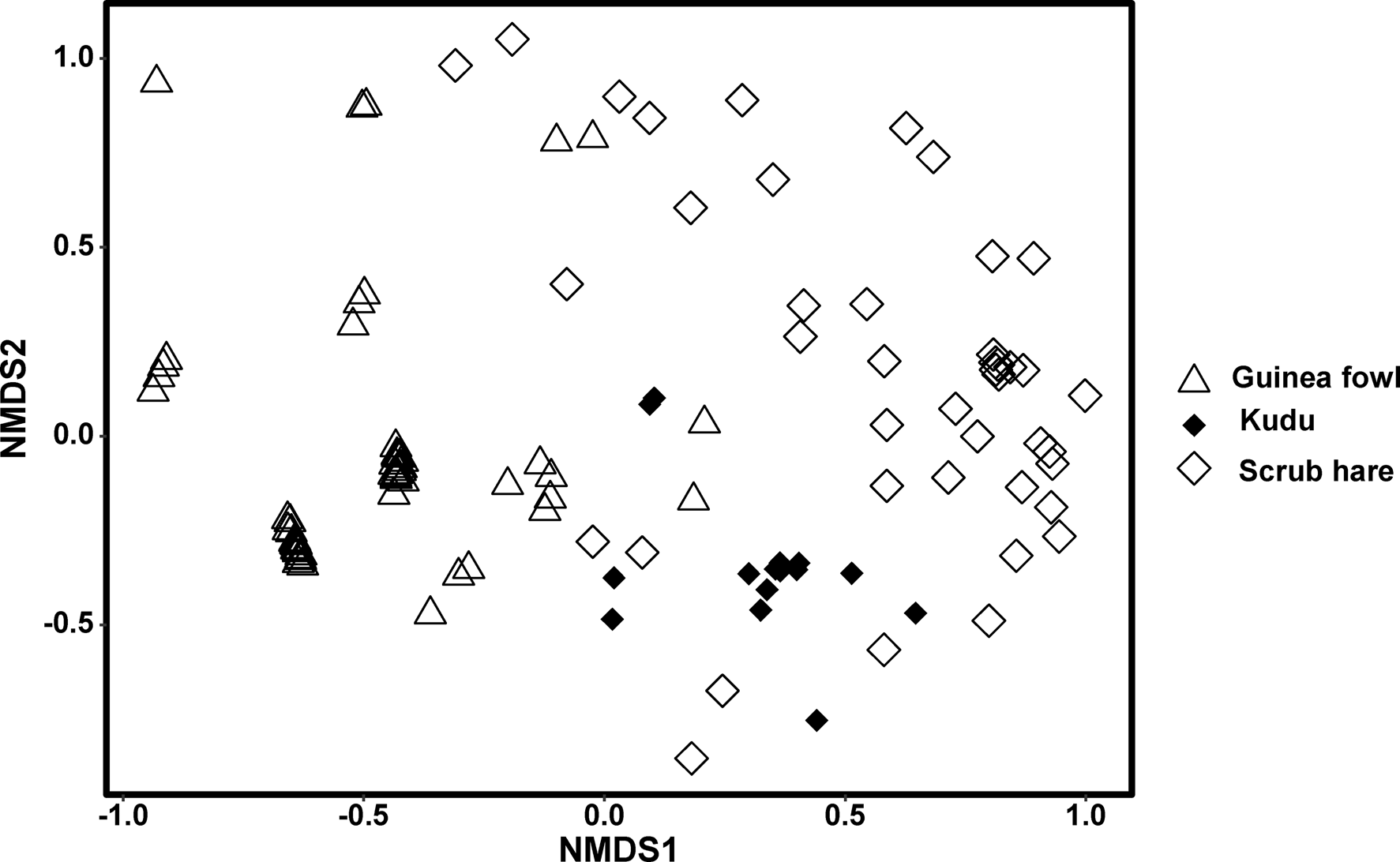
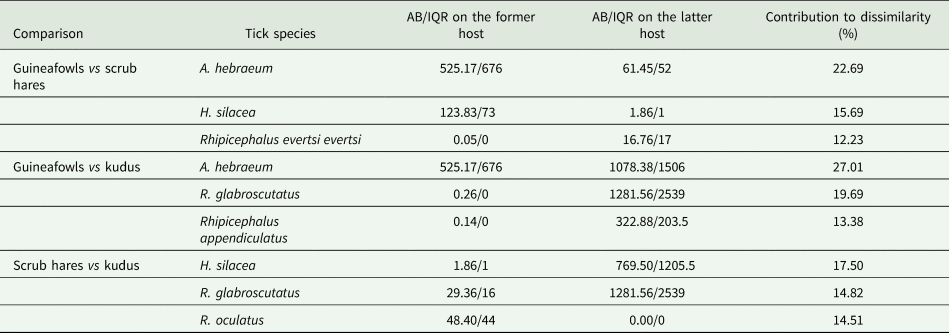
Within the reserve, species composition of tick communities differed significantly between host species (R = 0.74; P < 0.001). Dissimilarities between guineafowls and both mammals were the greatest (between guineafowls and scrub hares, R = 0.82; between guineafowls and kudus, R = 0.77; P < 0.001 for both), whereas tick assemblages between scrub hares and kudus differed to a lesser but still significant degree (R = 0.34, P < 0.01). The ordination diagram of NMDS confirms that tick species composition differed most strongly between guineafowls and scrub hares (Fig. 1). Differences between the tick assemblages of guineafowls and scrub hares were due to a greater abundance of A. hebraeum on birds, whereas the opposite was the case for the difference between guineafowls and kudus. Differences between scrub hares and kudus were due to a greater abundance of H. silacea and R. glabroscutatus and the absence of R. oculatus on kudus (Table 2).
Multidimensional scaling distribution of tick infracommunities based on Bray–Curtis similarity in three wild host species in the reserve.

Tick species that contributed most to dissimilarity in species composition of tick infracommunities between three wild host species in the reserve

AB, average abundance (prior to transformations; based on immature stages only; see text for explanation); IQR, interquartile range.
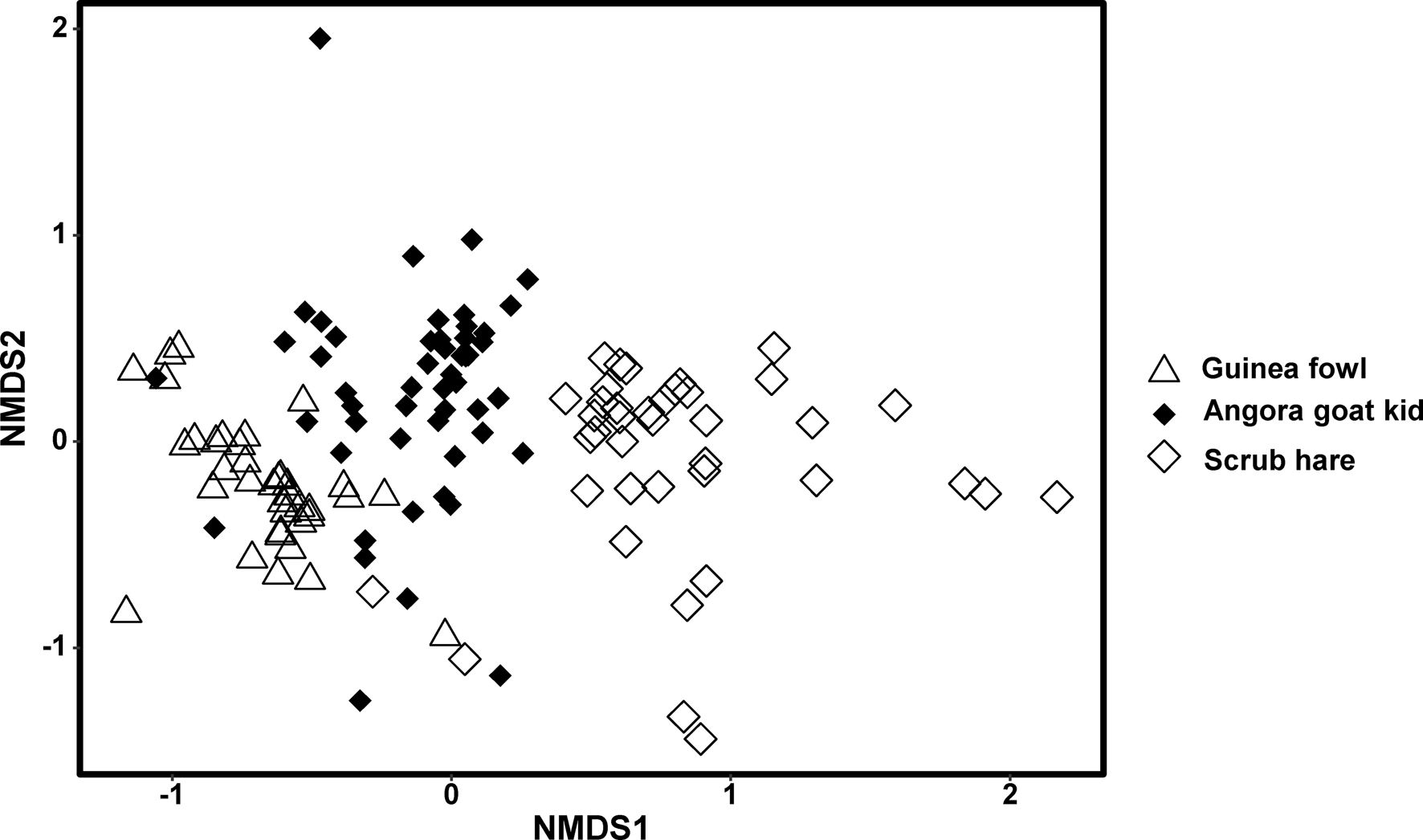
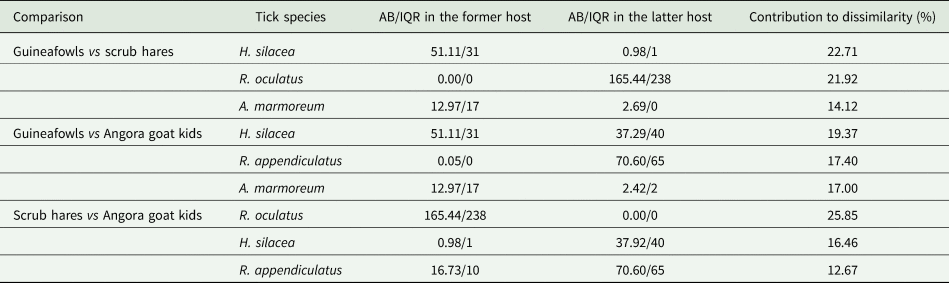
Tick species composition differed significantly among the three small-bodied farm inhabitants (R = 0.60, P < 0.001). Pairwise dissimilarity was the greatest between guineafowls and scrub hares (R = 0.84, P < 0.001) and less between both wild hosts and the Angora goat kids (R = 0.48 and R = 0.55, respectively; P < 0.001 for both). The ordination diagram of tick assemblages demonstrates that species composing the communities harboured by Angora goat kids range between those harboured by both guineafowls and scrub hares, suggesting that kids are suitable hosts for some but not other tick species characteristic for wild hosts (Fig. 2; Table 3).
Multidimensional scaling distribution of tick infracommunities based on Bray–Curtis similarity in three small-bodied host species on the farm.

Tick species that contributed most to dissimilarity in species composition of tick infracommunities between three small-bodied host species on the farm

AB, average abundance (prior to transformations; based on immature stages; see text for explanation); IQR, interquartile range.
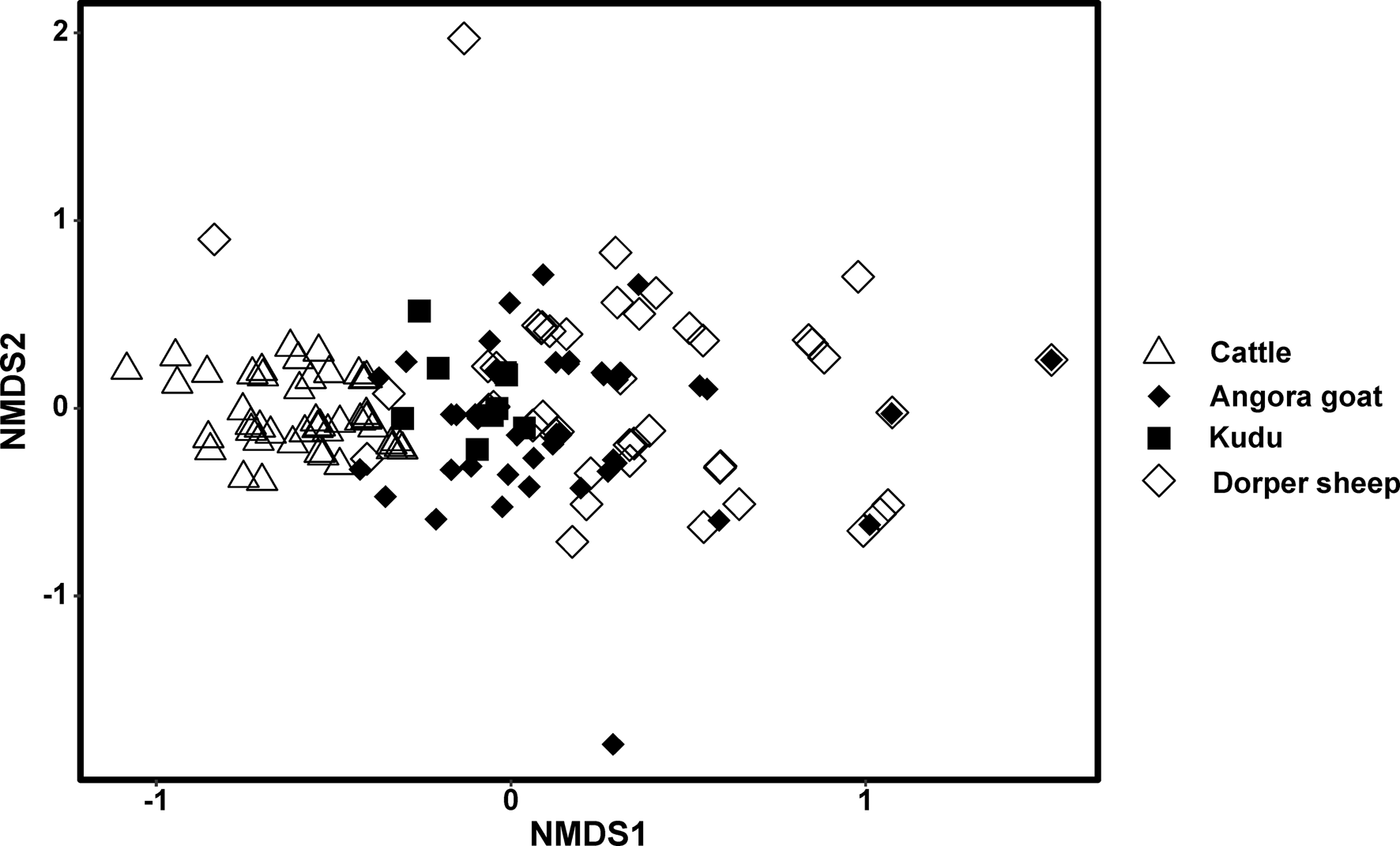
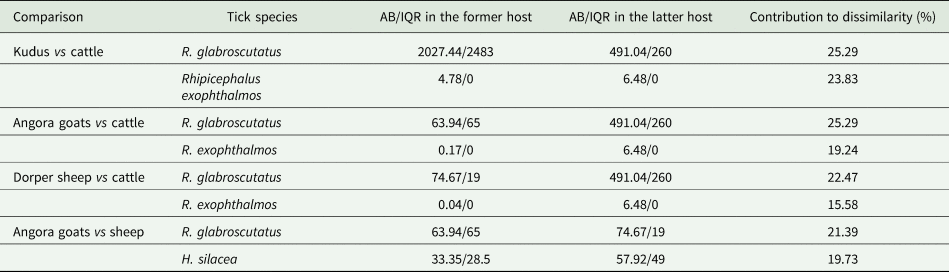
Although total dissimilarity among large-bodied hosts on the farm was significant (P < 0.001), the R value was not very high (0.37). This was because no significant dissimilarities in species composition of tick assemblages were found between kudus and Angora goats or Dorper sheep (R = −0.16 and R = −0.06, respectively; P > 0.70 for both). Dissimilarity in tick assemblages between Angora goats and Dorper sheep was also not high, albeit significant (R = 0.16, P < 0.01), whereas species composition of tick assemblages harboured by cattle differed substantially from that of kudus, Dorper sheep and Angora goats (R = 0.70, R = 0.61, and R = 0.49, respectively; P < 0.001 for all three). This is supported by the distribution of infracommunities in the ordination diagram of NMDS (Fig. 3). Dissimilarity in tick species composition between cattle and other hosts was mainly due to the high abundance of R. glabroscutatus and Rhipicephalus exophthalmos on the former, although it is noteworthy that the abundance of R. glabroscutatus on kudus far exceeded that on cattle (Table 4).
Multidimensional scaling distribution of tick infracommunities based on Bray–Curtis similarity in four large-bodied host species on the farm.

Tick species that contributed most to dissimilarity in species composition of tick infracommunities between four large-bodied host species on the farm

AB, average abundance (prior to transformations; based on adults and immature stages; see text for explanation); IQR, interquartile range.
Discussion
All three wild host species in the reserve harboured different tick communities compared to those on the farm, with the differences between the two habitats being more pronounced for guineafowls and kudus compared to that for scrub hares. On all three wild hosts, A. hebraeum was the one tick species consistently more abundant in the reserve compared to on the farm (Table 1). Amblyomma hebraeum is the vector of E. ruminantium, the cause for heartwater (Horak et al., Reference Horak, Heyne, Williams, Gallivan, Spickett, Bezuidenhout and Estrada-Peña2018), an often fatal disease in cattle, sheep, goats, blesbok and springbok. Angora goats are particularly susceptible, hence the intensive treatment with acaricides on the farm and several other farms in the region. It is likely that the continued use of acaricides on livestock on the farm did reduce the density of all life-stages of A. hebraeum to the extent where even free-ranging, untreated hosts, such as guineafowls, scrub hares and kudus, did not encounter this tick as freely as their counterparts in the reserve. In fact, with the exception of the period of minimum abundance from October to February, the numbers of free-living A. hebraeum larvae collected at monthly intervals from the vegetation in three habitats sampled in the reserve were 10–100 times higher than those collected in similar habitats on the farm (Petney and Horak, Reference Petney and Horak1987). Furthermore, the prevalence of A. hebraeum in all three wild hosts was lower on the farm when compared to the reserve (Supplementary Tables S1 and S2).
Notably, the 46 cattle examined during the study were never treated with an acaricide while they were on the farm and acquired fairly large burdens of immature and adult A. hebraeum, indicating that the tick was still a threat if treatment was discontinued. Because of the acaricidal treatment only the wild hosts on the farm were capable of maintaining the A. hebraeum populations. Any domestic host represented a ‘dead end’ with the adult and immature ticks being killed by the acaricide and thus removed from the population. Consequently, approximately 90% of the ungulate hosts on the farm represented a ‘dead end’ for A. hebraeum. A comparison of the total burdens of immature A. hebraeum on the guineafowls and scrub hares and the total burdens of the kudus in the reserve with those on the same animals that were shot in exactly the same months on the farm shows that the burdens of the guineafowls in the reserve were 25 times larger than those on the guineafowls on the farm, 150 times larger on the hares in the reserve than on the farm and 60 times larger on the kudus in the reserve than on the farm. Furthermore, eland, buffaloes and bushbuck that co-occurred in the reserve are also suitable hosts for the immature stages and adults of A. hebraeum (Horak et al., Reference Horak, Heyne, Williams, Gallivan, Spickett, Bezuidenhout and Estrada-Peña2018); hence they added to the pool of available maintenance hosts in the reserve. This is in accordance with observations by Ostfeld and Keesing (Reference Ostfeld and Keesing2000) that host community composition can influence tick densities.
Contrary to A. hebraeum, the average abundance of R. oculatus was 3-fold higher on scrub hares on the farm compared to that in the reserve and contributed the most to the dissimilarity in tick species composition for this host (Table 1). Adults and immature stages are specialists infesting members of the family Leporidae (Horak et al., Reference Horak, Heyne, Williams, Gallivan, Spickett, Bezuidenhout and Estrada-Peña2018). Similarly, the average abundance of R. glabroscutatus on kudus was almost twice as high on the farm when compared to the reserve. One possible explanation might be the reduced competition from other tick species, particularly A. hebraeum, several of which also attach around the feet (de MacIvor and Horak, Reference MacIvor and Horak1987). Alternatively, previous studies have demonstrated an effect of environmental conditions, such as vegetation structure and landscape cover, and of host community composition on tick ecology and densities (Dantas-Torres et al., Reference Dantas-Torres, Chomel and Otranto2012; Rynkiewicz and Clay, Reference Rynkiewicz and Clay2014). Agricultural activities related to livestock and grazing management on the farm might have introduced changes to the environment and co-occurring host species that were advantageous to some but not to all tick species.
Within the reserve, we found significant differences between the tick assemblages of all three wild hosts. These dissimilarities were most pronounced between guineafowls and the two mammalian species, especially between guineafowls and scrub hares. Interestingly, although A. hebraeum contributed the most to the dissimilarity between both pairs of hosts, the ratio of abundance was reverse: the abundance of immature stages of A. hebraeum was distinctly higher on guineafowls than on scrub hares, but much lower on guineafowls than on kudus (Table 2). Kudus sustained twice the average burden of A. hebraeum when compared to guineafowls. To the same effect, kudus also harboured drastically higher numbers of R. appendiculatus and R. glabroscutatus compared to guineafowls. A number of studies have established host body size as an important determinant of tick abundance, with larger hosts carrying larger tick burdens, partially because they offer a larger habitat and more resources, or are less at risk of exsanguination by high tick numbers (Jellison and Kohls, Reference Jellison and Kohls1938; Gallivan and Horak, Reference Gallivan and Horak1997; Poulin, Reference Poulin2004; Esser et al., Reference Esser, Foley, Bongers, Herre, Miller, Prins and Jansen2016). This link between host body size and tick abundance might also explain the higher numbers of H. silacea and R. glabroscutatus observed on kudus when compared to scrub hares. Both these species contributed more to the dissimilarity of tick assemblages between scrub hares and kudus than even the absence of the leporid specialist R. oculatus on the latter host.
Three species accounted for 50% of the dissimilarities between the species composition of tick infracommunities on guineafowls vs scrub hares. As mentioned above, A. hebraeum was more abundant on guineafowls, and the same was true for H. silacea. Conversely, R. evertsi evertsi had higher numbers on scrub hares. As to the reasons for this variance, we can only speculate. Factors that influence host susceptibility are, for example, tick resistance, habitat use and host behaviour (Gallivan and Horak, Reference Gallivan and Horak1997). Although scrub hares are mainly active at night, feeding at sundown (Skinner and Chimimba, Reference Skinner and Chimimba2005), guineafowls are diurnal (Hockey et al., Reference Hockey, Dean and Ryan2005). Immature stages of ticks are sensitive to water stress (Esser et al., Reference Esser, Foley, Bongers, Herre, Miller, Prins and Jansen2016). Thus, the temperature tolerance of the immature stages of various tick species or their preferred times of questing to avoid dehydration, might influence which hosts they are likely to encounter. In addition, tick species have developed adaptations to their hosts, such as variation in the size of certain mouth parts, that allow some tick species to attach to hosts or sites on the host that are characterized by greater skin thickness or firmness (Izdebska and Cydzik, Reference Izdebska and Cydzik2010). Furthermore, hair vs feathers might also influence the suitability of scrub hares compared to guineafowls as hosts for a given tick species, in the same sense as hair length has been shown to effect tick attachment in Nguni cattle (Marufu et al., Reference Marufu, Qokweni, Chimonyo and Dzama2011).
On the farm, tick community composition differed significantly between the three small-bodied hosts, and, similar to what was observed in the reserve, the greatest dissimilarity was found between guineafowls on the one hand and scrub hares on the other hand. However, with the exception of H. silacea, which contributed most to the dissimilarity, the tick species responsible for the difference between guineafowls and scrub hares were not the same as in the reserve. The second largest contribution to the dissimilarity was R. oculatus, whose distribution is limited to leporid hosts, followed by A. marmoreum another ixodid tick with distinct host preferences. Although the immature stages of A. marmoreum are generalists, and were, in fact, present on individuals of all host species examined in the reserve as well as on the farm, the adults are specialists, preferring members of the family Testudinidae (Horak et al., Reference Horak, Heyne, Williams, Gallivan, Spickett, Bezuidenhout and Estrada-Peña2018). Consequently, only immature stages of this tick were collected during this study, and of all the hosts examined in both habitats, its prevalence as well as abundance was the lowest on scrub hares. Again, this might reflect the nocturnal activity pattern of scrub hares, or could be due to differences in habitat use or social behaviour (Gallivan and Horak, Reference Gallivan and Horak1997), with scrub hares being solitary (Skinner and Chimimba, Reference Skinner and Chimimba2005), whereas guineafowls often occur in large flocks (Hockey et al., Reference Hockey, Dean and Ryan2005).
The tick assemblages of Angora kids occupied an intermediate position between those of scrub hares and guineafowls. In both host pairs, R. appendiculatus was one of the main tick species contributing to dissimilarity, with Angora kids supporting higher burdens compared to scrub hares or guineafowls; other than the latter two hosts, Angora kids also harboured adult R. appendiculatus (Supplementary Table S2). This is of epidemiological interest in so far, as R. appendiculatus transmits buffalo-derived T. parva from buffaloes, which are asymptomatic, to cattle, causing Corridor disease (Horak et al., Reference Horak, Heyne, Williams, Gallivan, Spickett, Bezuidenhout and Estrada-Peña2018), necessitating the slaughter of cattle on the infected farm and quarantine of the surrounding farms. However, considering all hosts examined on the farm, it is clear that of the wild hosts, kudus are the main maintenance hosts for immature stages. Similarly, all large-bodied livestock species harboured large numbers of immature stages of R. appendiculatus, combined with high prevalence (Supplementary Table S2). This is in agreement with Horak et al. (Reference Horak, Heyne, Williams, Gallivan, Spickett, Bezuidenhout and Estrada-Peña2018), who defined R. appendiculatus as a generalist, the adults and immature stages of which infest a wide variety of hosts.
Considering large-bodied hosts on the farm, there was a low, but significant, dissimilarity between the tick assemblages of Angora goats vs Dorper sheep, driven mainly by R. glabroscutatus and H. silacea, both of which had lower abundances on the Angora goats (Table 4). Although the immatures of H. silacea are generalists, the adults seem to prefer browsing tragelaphine antelopes such as kudus (Horak et al., Reference Horak, Heyne, Williams, Gallivan, Spickett, Bezuidenhout and Estrada-Peña2018). Therefore, one might have expected to find a higher prevalence and/or abundance of adults of this parasite on Angora goats, which are mainly browsers, but will graze on pasture (Horak et al., Reference Horak, Knight and Williams1991a). This variation in feeding behaviour between the goats and sheep does, however, not seem to have increased infestation with adults on the Angora goats when compared to the Dorper sheep; prevalence in the former was 35.4%, with a mean abundance of 1.02 ± 0.25, vs 31.3% with a mean abundance of 1.04 ± 0.31 in the latter (Supplementary Table S2).
The composition of tick infracommunities on calves differed significantly from all other large-bodied hosts, with R. glabroscutatus and R. exophthalmos contributing the most to these differences. None of the large-bodied hosts harboured immature stages of R. exophthalmos, which were limited to guineafowls and scrub hares. Its adults were consistently more abundant on cattle compared to the remaining hosts, likely as a result of larger hosts being able to accommodate larger tick burdens (Gallivan and Horak, Reference Gallivan and Horak1997; Poulin, Reference Poulin2004). Rhipicephalus glabroscutatus, which attaches around and between the hooves, was more abundant on cattle when compared to Angora goats and Dorper sheep, but reached much higher numbers on kudus compared to on cattle. With calves and kudus being more evenly matched in size, other factors linked to parasite abundance might come into play, such as the structure of the feet and hooves. Furthermore, as mentioned above, variations in skin thickness (Izdebska and Cydzik, Reference Izdebska and Cydzik2010) and hair length (Marufu et al., Reference Marufu, Qokweni, Chimonyo and Dzama2011) have been invoked as reasons for differences observed in tick parasitism between host species. In addition, cattle are grazers, whereas kudus are browsers, which might lead to differences in their exposure to the life stages of various tick species questing at different heights (Short et al., Reference Short, Floyd, Norval and Sutherst1989). Gallivan and Horak (Reference Gallivan and Horak1997) reported lower adult tick burdens in grazers than in browsers and mixed feeders. Adult R. glabroscutatus are of veterinary importance, especially in Angora goats, as they cluster around and between the hooves, resulting in foot abscesses and severe lameness (MacIvor and Horak, Reference MacIvor and Horak1987).
One of the tick species that occurred in generally low numbers but whose immatures and adults had a wide host basis in the reserve as well as on the farm was Hyalomma rufipes, a tick of medical importance. Hyalomma rufipes is the vector of the virus that causes Crimean-Congo haemorrhagic fever in humans (Horak et al., Reference Horak, Heyne, Williams, Gallivan, Spickett, Bezuidenhout and Estrada-Peña2018). Hares, which may be asymptomatically infected with the virus, support populations of immature stages and the ensuing adult ticks infect humans either via bite wounds or by being squashed with unprotected hands or while working with livestock.
In conclusion, although we are aware that this is a retrospective study and the situation of tick infestation could have changed since the late-1990s, a large number of tick species that typically infest wild animals in South Africa, have successfully made the host-switch to livestock, where livestock can either serve as a host to the immature stages, adults or both. Not only in South Africa, the wildlife–livestock interface has become more and more interwoven and game as well as livestock are often translocated over large distances as part of agricultural or conservation activities. Combined with the fact that wild hosts and livestock can serve as maintenance hosts for each other's tick parasites as well as their associated pathogens, this should therefore be an important consideration in disease management planning.
Supplementary material
The supplementary material for this article can be found at https://doi.org/10.1017/S0031182022000129.
Data
All data generated or analysed during this study are included in this published article. The datasets used and/or analysed are available from the corresponding author upon reasonable request.
Acknowledgements
The Division of Nature Conservation of the Cape Provincial Administration and Mr W.A. Phillips of the farm ‘Bucklands’ placed the animals at our disposal. Misters P.D. Burdett, M.M. Knight and E.J. Williams assisted with the necropsies and collection of the ticks. This is publication no. 1108 of the Mitrani Department of Desert Ecology, Israel.
Author contributions
IGH, KJ and BRK conceived the study. IGH collected the material and identified the ticks. BRK analysed data. IGH, KJ and BRK wrote the manuscript.
Financial support
This research was funded by the Meat Board, the Mohair Board, the South African Nature Foundation, Rhodes University and the Foundation for Research Development.
Conflict of interest
The authors declare there are no conflicts of interest.
Ethical standards
All applicable institutional, national and international guidelines for the care and use of animals were followed.