Introduction
Otitis media with effusion (OME) affects 80 per cent of children worldwide and is the most common cause of deafness in children.Reference Gates, Klein, Lim, Mogi, Ogra and Paparella 1 It is characterised by fluid collection in the middle-ear space behind an intact tympanic membrane in the absence of signs and symptoms of acute inflammation; OME persisting for more than three months is defined as chronic.Reference Gates, Klein, Lim, Mogi, Ogra and Paparella 1 Chronic OME is the second most common ear disorder in childhood, after acute otitis media.
Obesity is another global health problem; its prevalence has tripled in the last decade, including in children. Although obesity has a number of well-known co-morbidities (such as cardiovascular disease and diabetes), the only otolaryngological co-morbidity yet defined is gastro-oesophageal reflux disease. Interestingly, a few studies have now shown a relationship between obesity and OME, either acute or chronic,Reference Kim, Park, Cha and Yeo 2 – Reference Kuhle, Kirk, Ohinmaa, Urschitz and Veugelers 5 which seems reasonable because both diseases have some similar immunological alterations. Moreover, gastro-oesophageal reflux disease can accompany obesity and might predispose to OME.
This study aimed to investigate the relationship between chronic OME and obesity in children, including potential effects of either adenoid or tonsillar hypertrophy on that relationship. It includes a more detailed anthropometric evaluation compared with those described previously.
Materials and methods
The study included 60 children with chronic otitis media with effusion (OME; the study group) who were evaluated at the Otolaryngology Clinic, Inonu University, and 86 healthy sex- and age-matched children without any chronic disease (the control group) who were evaluated for mild upper respiratory infections at the Pediatric Clinic, Inonu University. The age range was 2–10 years.
Children in the study group had OME symptoms persisting for more than three months, including dullness, retraction, abnormal air-fluid levels and hypervascularisation of the tympanic membrane, along with a type B tympanogram. Children with past or present ear problems and/or adenoid or tonsillar hypertrophy were excluded from the control group.
To determine the degree of hearing loss, those children with chronic OME who were able to cooperate underwent pure tone audiometry with an AC40 clinical audiometer (Interacoustics, Eden Prairie, Minnesota, USA). Endoscopy was used to assess the presence of adenoid hypertrophy. Adenoid hypertrophy was classified into quartiles according to the choanal obstruction rate: 0–25 per cent, 25–50 per cent, 50–75 per cent and 75–100 per cent. Tonsillar hypertrophy was defined as the presence of tonsils outside the tonsillar fossa.Reference Friedman and Hwang 6
Height and weight measures for each child were used to calculate the body mass index (BMI), weight for height value and weight z score.Reference Lahti-Koski, Gill, Kiess, Marcus and Wabitsch 7 The BMI was calculated by dividing the weight (in kilograms) by the height (in metres) squared and evaluated according to national percentile curves. Children with a BMI greater than or equal to the 85th percentile were considered overweight and those with a BMI greater than or equal to the 95th percentile were considered obese.Reference Friedman and Hwang 6 To calculate the weight for height value, weight (in kg) was divided by the ideal weight for height and multiplied by 100. Children with weight for height values above 120 were considered obese.Reference Lahti-Koski, Gill, Kiess, Marcus and Wabitsch 7 To calculate the weight z score, the median weight was subtracted from the actual weight (in kg) and then divided by the standard deviation. Children with weight z scores above + 2 were considered overweight or obese.Reference Lahti-Koski, Gill, Kiess, Marcus and Wabitsch 7
The study was approved by the Ethical Committee of the Faculty of Medicine, Inonu University. The parents of all children provided informed consent.
Statistical analysis was performed using unpaired t-tests, one-way analysis of variance, chi-square tests and Pearson correlation tests in IBM SPSS Statistics software version 13.0 (Chicago, Illinois, USA). A p value of less than 0.05 was considered statistically significant. The Shapiro − Wilk normalisation test showed a normal distribution (p > 0.05).
Results
The mean age was 6.34 ± 0.3 years in the study group and 6.33 ± 0.2 years in the control group, (p = 0.872). Of the 60 children with chronic otitis media with effusion (OME), 37 were boys (62 per cent) and 23 were girls (38 per cent); 29 (48 per cent) had unilateral involvement and 31 (52 per cent) had bilateral involvement. There were no significant differences in sex distribution (p = 0.154) and mean age (p = 0.412) for unilateral vs bilateral involvement. The 41 patients (68 per cent) with chronic OME who underwent pure tone audiometry had a total of 69 affected ears (28 in children with bilateral involvement, 13 in children with unilateral involvement). The mean sensorial hearing loss was 27.17 ± 1.6 dB for left ears and 27.18 ± 1.6 dB for right ears (p = 0.99).
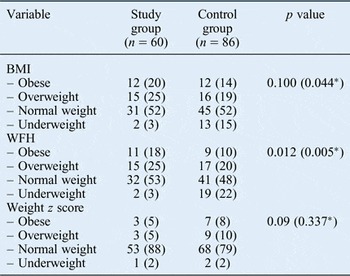
The mean weight z score value was 0.72 ± 0.1 in the study group and 0.64 ± 0.2 (p = 0.872) in the control group. There were significant differences in the distribution of children classified according to weight for height percentiles as underweight, normal, overweight and obese between the study and control groups (p = 0.012; Table I). When overweight and obese children were evaluated together, more striking differences in the weight for height distribution were found between the study and control groups (p = 0.005; Table I). There were also significant differences in the distribution of children classified by nutritional status (i.e. according to BMI percentiles) between the study and control groups (p = 0.044).
Between-group comparison of nutritional status

Data are n (%). *Value for overweight and obese patients evaluated together. BMI = body mass index; WFH = weight for height
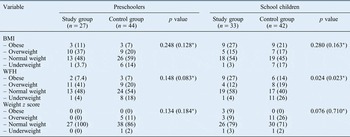
When children were subdivided into 2 age groups (preschoolers, 24–60 months; school children, 62–120 months), the mean z score did not differ significantly between the study and control groups. In preschoolers, the mean z score was 0.67 ± 0.2 in the study group and 0.42 ± 2.1 in the control group (p = 0.431). In school children, the mean z score was 0.87 ± 0.3 in the study group and 0.76 ± 0.2 in the control group (p = 0.756). In children classified according to weight for height values as underweight, normal, overweight or obese, significant differences in distribution between the study and control groups were found only in school children (Table II).
Comparison of nutritional status in preschoolers and school children

Data are n (%). *Value for overweight and obese patients evaluated together; BMI = body mass index; OME = otitis media with effusion; WFH = weight for height
In children classified according to nutritional status, there were no significant differences in distribution between those with unilateral vs bilateral involvement (p = 0.368). Similarly, the mean weight z score did not differ between those with unilateral vs bilateral involvement (p = 0.858).
All 60 patients with chronic OME had adenoid hypertrophy: when classified into quartiles, the choanal obstruction rate was 0–25 per cent in 22 patients (37 per cent), 25–50 per cent in 14 patients (23 per cent), 50–75 per cent in 14 patients (23 per cent) and 75–100 per cent in 10 patients (17 per cent). Only 36 patients (60 per cent) had tonsillar hypertrophy, of various degrees.
Nutritional status did not significantly differ by the degree of adenoid hypertrophy. The presence of adenoid or tonsillar hypertrophy did not correlate with nutritional indices. For the 60 patients with chronic OME (all had adenoid hypertrophy), the mean weight z score was 0.65 ± 0.2 for those with a choanal obstruction rate of 0–25 per cent, 0.91 ± 0.3 for those with a rate of 25–50 per cent, 0.79 ± 0.4 for those with a rate of 50–75 per cent and 0.49 ± 0.4 for those with a rate of 75–100 per cent (p = 0.809). The mean weight z score was 0.62 ± 0.2 for the 36 patients with tonsillar hypertrophy and 0.86 ± 0.3 for the 24 patients without (p = 0.405).
Discussion
Alterations in cytokine levels, increased plasminogen activator factor inhibitor-1 (PAI-1) levels, Eustachian tube dysfunction and gastro-oesophageal reflux disease are all thought to play a role in developing otitis media with effusion (OME).Reference Gates, Klein, Lim, Mogi, Ogra and Paparella 1 , Reference Smirnova, Kiselev, Gnuchev, Birchall and Pearson 8 Interestingly, these factors also either play a role in the pathogenesis of obesity or are associated with it. The similarity of cytokine profiles (e.g. tumour necrosis factor-alpha (TNFα), interleukin-1 beta (IL-1β), IL-6, IL-8) in obese individuals and OME patientsReference Smirnova, Kiselev, Gnuchev, Birchall and Pearson 8 – Reference Bastard, Maachi, Lagathu, Kim, Caron and Vidal 11 suggests a relationship between these conditions. Furthermore, PAI-1 levels are high in mucoid effusions; PAI-1 is also produced by adipose tissue and its levels are elevated in obese individuals.Reference Idell, Zwieb, Kumar, Koenig and Johnson 12 – Reference Skurk and Hauner 14 Gastro-oesophageal reflux disease is also commonly associated with obesity.Reference Miura, Mascaro and Rosenfeld 15 , Reference Pashankar, Corbin, Shah and Caprio 16
Another interesting link between obesity and OME is the probable role of Ostmann's fatty tissue in Eustachian tube function.Reference Aoki, Sando and Takahashi 17 Therefore, adipose tissue growing around the Eustachian tube and nasopharynx might predispose obese individuals to developing OME. Finally, OME might induce changes in taste perception via middle-ear cavity inflammation, thus contributing to obesity.Reference Lee and Yeo 18 A recent study suggested that a significantly lower sweet and salty taste perception in chronic OME patients might be related to paediatric obesity.Reference Shin, Park, Kwon and Yeo 4
In 2007, the first study into the relationship of childhood obesity and OME reported a higher BMI in children with OME than in healthy childrenReference Kim, Park, Cha and Yeo 2 : 41.9 per cent of children with OME were obese (a strikingly high rate) but the obesity rate in the control group was not reported. In 2010, the second study into the relationship of childhood obesity and OME found that 7.1 per cent of the children with OME were underweight, 21.4 per cent were overweight and 17.8 per cent were obese; the prevalence of obesity was higher in the study group than in the control group (10.5 per cent).Reference Kim, Park, Byun, Park, Cha and Yeo 3 A recent population based survey of school children reported that obese children had more healthcare provider contact for otitis media and a higher odds ratio of repeated suppurative otitis media.Reference Kuhle, Kirk, Ohinmaa, Urschitz and Veugelers 5 That same survey found that the presence of chronic adenoid or tonsillar disorder did not change the association between obesity and otitis media.
The present study found that overweight or obesity was more common in the study group than in the control group when assessed by both BMI (p = 0.044) and weight for height values (p = 0.005). Furthermore, the mean z score was higher in children with chronic OME, although not significantly so.
There were no significant differences in nutritional indices (i.e. BMI percentiles) between preschoolers and school children in the control group. Interestingly, however, there was a significant difference in weight for height values between preschoolers and school children in the study group. Clearly, that difference was not due to a higher prevalence of overweight or obesity in children with chronic OME, but rather to a higher prevalence of underweight in healthy children. The same result was found in the whole-group analysis, although the results were not statistically significant (Table I). Nevertheless, underweight is a reality in developing countries.
A recent study evaluating food intake in children with or without OME found that OME was not associated with BMI or with total calorie and protein intake; however, in children with a healthy weight, each 10 per cent increase in fat calories or total calories was associated with an increasing likelihood of developing OME.Reference Choi, Sim, Kim and Lee 19 It was concluded that a high-fat diet was associated with OME and might be a confounding factor in the relationship between obesity and OME.Reference Choi, Sim, Kim and Lee 19
-
• Obesity and otitis media with effusion have similar immunological alterations
-
• A detailed anthropometric evaluation of the relationship between chronic otitis media with effusion and childhood overweight or obesity was performed
-
• The effects of adenoid or tonsillar hypertrophy on the relationship were investigated
-
• The prevalence of overweight or obesity was higher in children with chronic otitis media with effusion
-
• Neither the presence of adenoid or tonsillar hypertrophy nor the degree of adenoid hypertrophy was associated with overweight or obesity
Adenoid hypertrophy has been reported in children with OME and is thought to play a role in OME development.Reference Marseglia, Poddighe, Caimmi, Marseglia, Caimmi and Ciprandi 20 A recent study showed that grade 4 adenoid hypertrophy was significantly more common in children with OME than in those without.Reference Acharya, Bhusal and Guragain 21 However, the presence of adenoid hypertrophy occluding more than 50 per cent of the airway passage was not associated with OME in children (affected, 40 per cent; those with lower grade adenoid hypertrophy, 60 per cent). Instead, the degree of hypertrophy of laterally placed adenoids is thought to be more important in OME; unfortunately, this feature is not included in grading scales. In the present study, the presence of either adenoid or tonsillar hypertrophy did not correlate with nutritional indices. Notably, children with a choanal obstruction rate of 75–100 per cent and those with tonsillar hypertrophy had the lowest weight z scores (though the difference was not significant); nonetheless, this finding suggests that airway obstruction might interfere with weight gain. In a previous study of prepubertal children, energy intake, the weight z scores and height z scores were all higher at six months after adenotonsillectomy.Reference Selimoğlu, Selimoğlu and Orbak 22
Conclusion
The prevalence of overweight or obesity is higher in children with (vs those without) chronic otitis media with effusion. However, the current evidence cannot discriminate between whether overweight or obesity is a risk factor for developing chronic otitis media with effusion, or vice versa.