Well over 1 million women undergo cesarean sections (C-sections) per year in the United States.Reference Sung and Mahdy1 The more common complications following C-sections include hemorrhage, endometritis, and surgical site infections (SSIs).Reference Sung and Mahdy1 Consistently recognized risk factors for SSIs following C-sections include elevated BMI, presence of diabetes mellitus, emergency surgery, and chorioamnionitis.Reference Krieger, Walfisch and Sheiner2–Reference Ali, Kassahun, Rade and Atnafu7 Other reported risk factors for SSIs include pregnancy-related hypertension, premature rupture of membranes, less than 7 prenatal visits, tobacco use, and increased surgery duration.Reference Krieger, Walfisch and Sheiner2,Reference Schneid-Kofman, Sheiner, Levy and Holcberg3,Reference Ketcheson, Woolcott, Allen and Langley5–Reference Ali, Kassahun, Rade and Atnafu7 In addition, patients in lower income regions have higher rates of SSIs.Reference Farid Mojtahedi, Sepidarkish and Almukhtar9
Several measures have been implemented to reduce the risk of SSIs following C-sections. Antibiotic prophylaxis has become a standard of care for C-sections; cefazolin is regarded as the agent of choice.Reference Ali, Kassahun, Rade and Atnafu7,Reference Olsen, Butler, Willers, Devkota, Gross and Fraser10 Increasing the dose of cefazolin to 3 g for patients with BMI >30 kg/m2 (or weight >120 kg) and the addition of azithromycin have been shown to be beneficial in some, but not all studies, and are not firmly endorsed in current guidelines.Reference Scheck, Blackmore, Maharaj, Langdana and Elder11–Reference Mahomed, Seeto, Norton and Zhu16 In addition, the development of “bundles” that emphasize preoperative (chlorhexidine shower and wipes, vaginal cleansing with povidone-iodine) and intraoperative (clippers for hair removal, double gloving and changing prior to closure) have contributed to lower rates of SSIs.Reference Davidson, Enns, Dempster, Lundeen and Eppes15,Reference Mahomed, Seeto, Norton and Zhu16 Postoperatively, data regarding the use of negative pressure wound therapy have been conflicting, and this therapy is not widely recommended.Reference Mahomed, Seeto, Norton and Zhu16,Reference Tuuli, Liu and Tita17 Patient education regarding wound care following discharge from the hospital is widely encouraged.Reference Davidson, Enns, Dempster, Lundeen and Eppes15
In this report, we document the rates and risk factors for SSIs following C-sections among women seeking healthcare in a large safety-net hospital system in New York City.
Methods
Eleven public safety-net hospitals that belong to the NYC Health and Hospitals System serve patients primarily of low socioeconomic status in the boroughs of the Bronx, Brooklyn, Manhattan, and Queens. All are acute care facilities with academic affiliations.
Line listings of patients who underwent C-sections, including those who developed SSIs, in the calendar year 2023, were obtained from the National Healthcare Safety Network (NHSN) databank. SSIs were categorized as superficial incisional, deep incisional, or organ/space according to NHSN definitions.
Student’s t-test was used to compare continuous variables, and Fisher’s exact test and χ 2 analysis were used to compare categorical values. To determine if there were additional risk factors for SSIs other than those recognized by NHSN, propensity score matching was used to establish a control group of patients without SSIs for the patients with SSIs. The following variables were matched: age, body mass index (BMI), diabetes, surgery duration, American Society of Anesthesiology (ASA) score, and wound class. A chart review was performed to obtain clinical data, including a review of social worker notes to obtain social and psychiatric information.
To try and identify risk factors involving our particular population of patients, regression analysis was used involving all patients undergoing C-sections. The following variables were included in the regression analysis: age, BMI, duration of surgery, diabetes mellitus, ASA score, wound class, impact of the presence of an OB-GYN residency program, and surgery at a Bronx location.
The test-based method was employed to compare rates.18 Analysis of variance, logistic regression analysis, and propensity score matching were performed using SPSS®.
This study was approved by the SUNY Downstate Medical Center Institutional Review Board and the NYC Health and Hospitals Systems to Track and Approve Research program.
Results
A total of 4,642 C-sections were performed among the 11 NYC Health + Hospitals system in 2023. There were 73 SSIs identified and classified as follows: 49 superficial incisional primary, 6 deep incisional primary, and 18 organ/space (8 endometritis, 6 other reproductive tract infection, and 4 intra-abdominal infection). SSIs were detected during the same admission in 7 and following discharge in 66 (33 during outpatient visit and 33 during a repeat hospitalization).
Comparison to a propensity score–matched control group
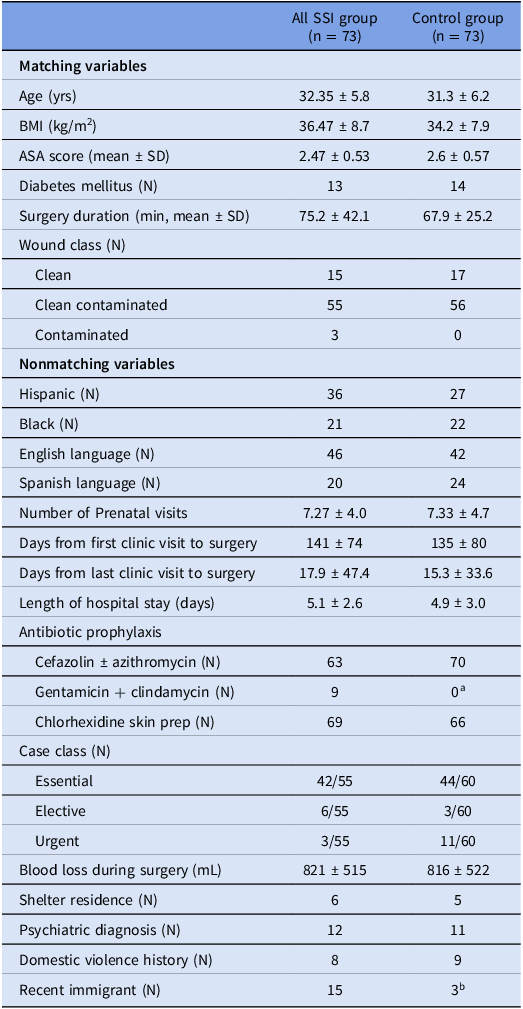
Propensity score matching using 6 variables was performed to create a control group for the patients with SSIs (Table 1). There was no difference in ethnicity or race between the SSI and control groups. Cefazolin, with or without azithromycin, was the mainstay antibiotic used for prophylaxis in both groups; of the 48 SSI patients with a BMI >30 kg/m2, 6 received 3 g of cefazolin, compared to 8 of 46 such patients in the control group. However, significantly more patients in the SSI group received gentamicin plus clindamycin for preoperative prophylaxis (Table 1). Doses of gentamicin received ranged from 1.79 to 3.58 mg/kg. There were 51 obstetricians who performed the surgeries on the 73 SSI patients, compared to 52 in the control group. Sixteen patients with SSIs had surgery performed by 4 obstetricians; these same obstetricians cared for 11 patients in the control group.
Comparison of 73 patients with surgical site infections and a propensity-matched control group

a P = .003
b P = .004
Access to healthcare was similar in both groups, including the number and timing of prenatal visits. The control patients were seen 14.70 ± 15.05 days following discharge. The patients with SSIs had a scheduled appointment 8.18 ± 8.58 days following discharge, but because of the development of the infection, they were actually seen 7.1 ± 7.05 days after discharge.
Virtually all patients in both groups were insured under a Medicaid Funded Network; 3 patients in the SSI group and 2 patients in the control group were uninsured or had emergency Medicaid. The number of patients with a concomitant psychiatric disorder and the number that resided in a shelter were similar in both groups. However, there were more patients identified as recent immigrants in the SSI group (20.5% vs 4.1%, P = .004). Among the SSI patients, the number of prenatal visits in the 15 recent immigrants was 5.53 ± 3.44, compared to 7.72 ± 3.98 for the remaining 58 SSI patients (P = .04). Among the 15 recent immigrants, 14 infections were detected following discharge from the hospital.
Examination for risk variables for SSIs
Among the 4,642 patients, logistic regression analysis, involving 8 variables, was performed to determine risk factors associated with SSIs. Three variables were found to be significantly associated with SSIs: ASA score, surgery in a hospital without an OB-GYN residency program, and residence in the Bronx.
Impact of ASA score
Among the 4,569 patients without an SSI, 3,180 (69.6%) had an ASA score of 2, compared to 37 of the 73 (50.7%) of the patients with SSIs (P = .0008). Conversely, 1,266 (27.7%) of the patients without an SSI have an ASA score of 3, compared to 35 (47.9%) of the patients with SSIs (P = .0002).
Impact of OB-GYN residency program
Of the 4,569 patients without an SSI, 3,070 (67.2%) and 1,499 (32.8%) had surgery in a hospital with and without an OB-GYN residency program, respectively. In contrast, 39 (53.4%) and 34 (46.6%) of the 73 patients with SSIs had surgery in a hospital with and without an OB-GYN residency program, respectively (P = .02). The 4 hospitals without a residency program were located in the boroughs of Bronx, Brooklyn, and Manhattan. The rate of infection in these hospitals was 22.0 per 1,000 surgeries; this rate was driven by the 3 hospitals with the highest rates of infection in the 11-hospital system. In comparison, the rate of infection in the remaining 7 hospitals with OB-GYN residency programs was 13.0 per 1,000 surgeries (P = .03).
Impact of living in the Bronx
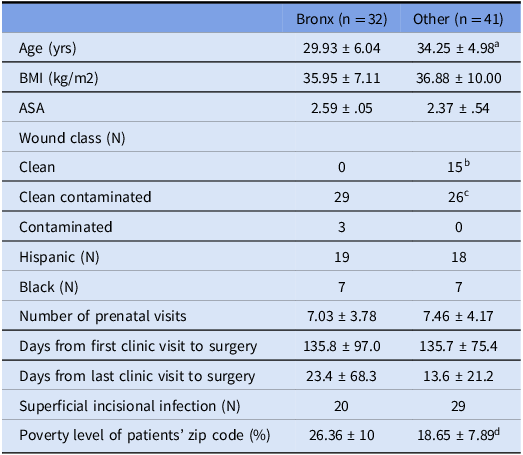
For patients residing in the Bronx, the rate of infection following surgery was 22 per 1,000 surgeries, compared to 13.2 per 1,000 surgeries for the other boroughs (P = .03). Compared to the other boroughs, patients in the Bronx with SSIs were more likely to be younger and have clean contaminated wounds, and less likely to have clean wounds, than the other borough patients (Table 2). Patients in the Bronx with SSIs lived in zip codes with significantly higher poverty levels than patients in the other boroughs. When the infection rate for hospitals in each borough was correlated with the zip code poverty level of their patients, there was a significant relationship (P =.03) between borough infection rate and poverty level (Figure 1).
Comparison of patients with surgical site infections from the Bronx versus other boroughs of New York City

a P = .002
b P<.001
c P = .01
d P<.001
Relationship between hopsital infection rate by borough and residence poverty level of their patients with surgical site infections.

Discussion
The goal of this study was to observe the incidence and risk factors of developing SSIs following C-sections among an underserved urban population. Our results revealed several key insights into the epidemiology of SSIs in a predominantly low socioeconomic patient population.
Reported rates of SSIs following C-sections have ranged from 2.7%–7% in North AmericaReference Vallejo, Attaallah, Shapiro, Elzamzamy, Mueller and Eller4,Reference Ketcheson, Woolcott, Allen and Langley5,Reference Farid Mojtahedi, Sepidarkish and Almukhtar9 to 6.9% in the United KingdomReference Erritty, Hale and Thomas6 to 11.9%–12.5 in Africa.Reference Ali, Kassahun, Rade and Atnafu7,Reference Farid Mojtahedi, Sepidarkish and Almukhtar9 Approximately 60% are detected after discharge from the hospital, and 90% of SSIs are superficial incisional infections.Reference Erritty, Hale and Thomas6,Reference Ali, Kassahun, Rade and Atnafu7 In our report, during the calendar year 2023, the SSI infection rate was 1.57% among the 11-hospital network, with 90% detected after discharge from the hospital. Although our overall SSI rate was low, it was disconcerting that 25% of our infections were organ/space infections, which are associated with greater clinical consequences.
A propensity-matched control group, using 6 clinical variables and derived from the same population of patients of low socioeconomic status, was remarkably similar to the group with SSIs, suggesting most pre- and perioperative procedures are appropriate.Reference Davidson, Enns, Dempster, Lundeen and Eppes15 One area of discordance was in the use of perioperative antibiotic prophylaxis; only patients with SSIs received gentamicin and clindamycin. In addition, the dosing of the gentamicin was below the recommended 5 mg/kg for all patients, suggesting an area of potential improvement.14 Only 12% of eligible patients with SSIs received 3 g of cefazolin preoperatively, similar to the control group. Although not a firm recommendation in current guidelines, this also suggests another area of potential improvement.14
Multiple risk factors have been documented for the development of SSIs following C-sections, including increased BMI, smoking and substance abuse, diabetes, hypertension, prior births, emergency surgery, and chorioamnionitis.Reference Krieger, Walfisch and Sheiner2–Reference Ketcheson, Woolcott, Allen and Langley5,Reference Ali, Kassahun, Rade and Atnafu7,Reference Killian, Graffunder, Vinciguerra and Venezia8,Reference Olsen, Butler, Willers, Devkota, Gross and Fraser10 Our analysis identified several other risk factors for the development of SSIs. Notably, higher ASA scores, which predict a patient’s risk of surgery and anesthesia based on their preoperative health, were a significant predictor. Nearly half of our patients with SSIs had an ASA score of 3, indicative of a severe systemic disease at the time of C-section. Obstetric patients with severe preeclampsia, complicated gestational diabetes, or requiring anticoagulation are typically categorized as having an ASA score of 3.19 Although not commonly recognized as a risk for SSI in the obstetric population, patients with an elevated ASA score should be considered at higher risk for SSIs following C-section.
An unexpected risk factor for the development of an SSI was having the C-section performed in a hospital without an OB-GYN residency program. All 11 hospitals in the NYC Health + Hospitals system have major academic affiliations with medical schools in the NYC area. Three of the 4 hospitals without an OB-GYN residency program had the highest rates of infection in our system. Although prior studies have suggested increased risk for infection following C-sections performed at major university hospitals, we are not aware of other studies examining the impact of OB-GYN residency programs on SSIs.Reference Olsen, Butler, Willers, Devkota, Gross and Fraser10 This certainly deserves further investigation; because most infections developed after discharge from the hospital, differences in discharge planning and follow-up should especially be examined.
Considering that 90% of the SSIs were identified approximately 1 week post-discharge, discharge planning protocol, education, and follow-up support should be examined. Also, while most surgical “bundles” emphasize pre- and perioperative management strategies, it has become also important to incorporate infection control measures in postoperative wound care management. The importance of postoperative wound care management has been receiving increasing attention. Patient participation and empowerment in wound care have been emphasized.Reference Tartari, Weterings and Gastmeier20,Reference Allegranzi, Zayed and Bischoff21
Beyond the hospital setting, several factors are being recognized as risk factors for SSIs. Women who are homeless, or who are uninsured, are more likely to receive inadequate care and have more complications.Reference Yamamoto, Gelberg and Needleman22,Reference Wilson-Mitchell and Rummens23 Compared to those with private insurance, women with Medicaid have higher rates of infection following C-sections.Reference Yi, Perkins and Kazakova24 In our study, involving women with nearly exclusive Medicaid coverage, we found a strong and direct correlation between the poverty level of the woman’s neighborhood and the risk for SSI. Residence in low-income neighborhoods has been found to be a risk for SSIs following colon surgery (but not hysterectomies).Reference Qi, Peacock, Luke, Barker, Olsen and Joynt Maddox25 Compared to a control group, we also found an overrepresentation of recent immigrants in the group that acquired SSIs following C-sections. Increased attention and resources for women who reside in areas of high poverty or who are recent immigrants must be explored in order to reduce the risk of SSIs among this population.
This study has several limitations. Both the SSI group and control group consisted of patients served by public safety-net hospitals; this may have minimized the differences in risk factors. Comparison to a population of women in a higher socioeconomic status may yield additional risk factors. Additionally, the potential for unmeasured confounders, such as variations in preoperative education, surgical technique, and individual patient compliance with postoperative care instructions, should be considered.
In conclusion, our study underscores the multifaceted nature of SSI risk following C-sections, with significant contributions from patient health status, institutional practices, and socioeconomic factors. By identifying high-risk groups and modifiable risk factors, targeted strategies to mitigate SSI risk and enhance the quality of obstetric care in safety-net hospitals can be developed. Addressing the broader social determinants of health, particularly in underserved areas, will be crucial in reducing SSIs and improving overall maternal health outcomes.
Acknowledgments
We would like to kindly acknowledge the Department of Medicine at NYC Health + Hospitals/Kings County for providing the opportunity to conduct this research. Acknowledgments are also extended to the Department of Obstetrics and Gynecology at NYC Health + Hospitals/Jacobi for their support in this project.
Financial support
None reported.
Competing interests
All authors report no conflicts of interest relevant to this article.