1. Increasing cooperation with recurring frictions
For the past 44 years, since Korea and Japan normalized their relationship in 1965, cooperative ties between the two countries have leaped forward. In 1965, the total number of Korean and Japanese visiting the other country was approximately 10,000 a year. In 2007, this number climbed to 4.84 million people, which means that more than 12,000 Korean and Japanese people were entering either of the two countries each day. As of the first half of 2008, 4,192 flights are scheduled to connect Japanese and Korean cities per month on average.Footnote 1 In 1965, bilateral trade between the two countries was only $240 million. In 2006, the trade value surged to $78.5 billion. Not only that, the ‘Korean Wave’, or hallyu, has become so widespread that many Japanese housewives and youngsters are now captivated by Korean movie stars. Indeed, examples of deepening ties between Korea and Japan are abundant in every facet of life.
However, frictions between the two countries continue to linger and we find more, not fewer, instances of history-related tensions since the mid-1990s. History textbook controversies, Yasukuni shrine visits, and Dokdo/Takeshima disputes galvanize both the Korean and Japanese public. Anti-Japanese sentiments in Korea are not necessarily on the rise, but reactions to Japanese provocations are becoming increasingly intensified (Park, Reference Park2008a). Also, unlike the Cold War period, when both Korea and Japan antagonized North Korea, the two countries have acquired diverging perceptions of the North Korean threat during the past decade.
There is no doubt that cooperation has increased and deepened over the past few decades, but frictions continue to persist. Which direction is the relationship between Korea and Japan heading? Is cooperation between the two guaranteed? Or is conflict unavoidable? To put it briefly, where can we go from here? These are profound questions that this article attempts to address.
As for the pattern of cooperation and conflict between Korea and Japan, opinions are divided and empirical realities are mixed and complex. Assuming that theory can act as a guiding light to navigate through uncertainties, I would like to address this puzzle from an analytical standpoint.Footnote 2 I will apply contemporary international relations theories – realism, liberalism, and constructivism – to the pattern of cooperation and conflict in Korea–Japan relations with a view of interpreting the mixed signals from a theoretical angle. After reviewing both optimistic and pessimistic positions drawn from diverse perspectives, I would like to work on a synthesis that rests on cautious optimism.
2. Contending perspectives and mixed signals
There is still no solid consensus on the pattern of cooperation and conflict in Korea–Japan relations. While there exist high hopes for upgraded and future-oriented ties between the two countries, troubles that distort these ties have not faded away.
As a background to the unfolding realities of recent years, this article highlights logical and empirical grounds for both optimism and pessimism regarding prospects for future ties between Korea and Japan. In this way, realists, liberalists, and constructivists prescribe different versions of cooperation, as well as conflict between the two countries.
Realist optimism
Realists are interested in power-centered relationships among countries. Positional interests at a system level, defined by the capabilities of a state, are for them the guiding principles of international relations. In a system where world government does not exist, a nation's pursuit for survival, and the security dilemma derived from it, shapes the nature of interstate relationships. The problem of relative gains makes it difficult for countries to cooperate with each other (Powell, Reference Powell and Baldwin1993). Realists are relatively pessimistic about cooperation among countries. However, as Jervis (Reference Jervis1988) argues, cooperation is possible under the security dilemma.
Optimists in the realism school hint at the possibility of ‘muted’ conflicts between Korea and Japan. Grounds for optimistic realists stem mostly from US engagement, since Korea and Japan are two key allies of the United States. Owing to their indirect security connection through the United States, the security dilemma between Korea and Japan is muted. Korea and Japan may fall into the trap of friction from time to time, but they are highly unlikely to clash with each other. The two countries are what Victor Cha calls ‘virtual allies’ (Cha, Reference Cha1999).
Realists also take seriously the role of the United States in managing the relationship between the two countries. Utilizing the quasi-alliance model, Cha (Reference Cha1999) claims that Korea and Japan are likely to cooperate when the US signals a withdrawal of its security commitment. Both nations fear being abandoned by the United States and they are more prone to cooperate if the US ever does leave. In contrast with Cha who advocated the gradual finality option as US strategy, Woo (Reference Woo2003) and Yoon (Reference Yoon2007) suggest that Korea and Japan are more likely to cooperate when the US actually engages. In any case, optimists in the realist school highly appreciate the positive function of the US security nexus in managing Korea–Japan relations.
Optimists in the realist camp also focus on the limited strategic aims of Japan. Unlike those who argue Japan's superpower orientation, Soeya (Reference Soeya2005) maintains that Japan has been, is, and will continue to be a middle power, especially in the security arena. Although Japan's economic stature is ranked number two in the world, he argues, Japan will remain a country of reserved middle power diplomacy without super power orientation. Korea, another middle power, can feel comfortable about a Japan that is confined to limited strategic purposes.
Also, in terms of military capability, realist optimists imply that Japan will not easily equip itself with global power projection capability (Lind, Reference Lind2004). Because of its national security culture, Japan is not likely to arm itself with nuclear weapons, aircraft carriers, and intercontinental ballistic missiles (Hughes, Reference Hughes2007). Furthermore, even though Japan's military capability has been upgraded, Japan will not carelessly categorize Korea as an enemy. Korea and Japan have more reason to cooperate in any possible regional contingencies.
A closer look at the realities, however, suggests that cooperation is not fully guaranteed. Unlike the rational expectations of realist optimism, the possibility of unwanted and unintended military conflicts between Korea and Japan cannot be discounted. Escalation of frictions concerning Dokdo/Takeshima is a possible area of concern. In 2006, when Japan dispatched a coastal guard ship to the Dokdo area, crisis was imminent. Military tension is probable in the context of rising nationalism related to territorial sovereignty. Emotional conflicts charged with nationalist fervor, if not controlled properly, can lead to irrational behaviors.
The perception, not the reality, of Japan as a rapidly emerging regional military power can reshape the mindset of the Korean people. Ongoing suspicions over Japanese intent, as well as a lack of fully fledged trust in Japanese intentions can lead to spirals of prolonged conflict between the two countries. An assertive and proactive Japan may serve US interests in East Asia (Green, Reference Green2007), but Japan as an active state can generate rising tensions with its neighbors, including Korea (Arase, Reference Arase2007: 582). Without transparency and accountability to neighboring countries, a Japanese assertive move, especially in the security arena, could bring about a vicious cycle of suspicion and loss of confidence between the two.
Realist pessimism
Pessimists in the realist school look at the role of the United States in Korea–Japan relations in a different way. Unlike optimists who generally appreciate the positive impact of US engagement, pessimists imply that the US has little control over bilateral issues between Korea and Japan. The US cannot force the two countries to cooperate with each other. Nor can the US prevent frictions between the two. The role of the US is important, but it is not a determinant of the Korea–Japan relationship (Yoon, Reference Yoon2007). In particular, the US cannot solve conflicts between Korea and Japan stemming from the legacy of the past. In contrast with Cha's prediction, conflicts may deteriorate if the US hints at the possibility of pulling out from the region.
Pessimists also notice the lack of trust among Koreans regarding Japanese strategic intent. From the structural realist standpoint, it would not be unusual at all for a country like Japan, with its immense economic capability, to transfer its power resources to the military domain (Waltz, Reference Waltz1993). In the diplomatic arena, Japan aspires to be a global partner to the United States. Accordingly, international security has become an integral part of the Japanese Self Defense Forces’ mission. Previously unheard of arguments for an autonomous Japan are now surfacing more frequently in the country (Samuels, Reference Samuels2007). However, Koreans interpret Japan's purpose as driven by the revisionist temptation and feel uneasy about a Japan that is militarily active.
Much more alarming are the diverging strategic aims between the two countries after the Cold War (Pempel, Reference Pempel2008). With regard to North Korea, South Korea has been employing a so-called sunshine policy to engage the North, with an expectation for opening and reform of the regime. On the other hand, Japan acquired a new sense of threat from North Korea after the kidnap of Japanese citizens, missile launches, and nuclear development. Unless properly coordinated, diverging threat perceptions between Korea and Japan can be a strong candidate for escalating conflicts between the two (Park, Reference Park2008c).
However, those who are inclined to support realist pessimism tend to over exaggerate the skewed interpretation of Japanese defense buildup and its domestic political atmosphere.
Japan is not necessarily pursuing the goal of becoming a revisionist super power in the region. It is much more likely to follow the British model of a coalition partner with the United States, which is not a harmful course for Korea (Inoguchi and Bacon, Reference Inoguchi, Bacon, Ikenberry and Moon2008). Japan is perceived as a perilous gambler if we turn our ears to the voices of right-wing people in the Japanese political arena. However, right-wingers are not a majority in Japan. Nor are their voices reflected in policy decisions as is often claimed. Also, despite an elevated role for Japan in international security and other global businesses, Japan is not likely to give up its peaceful orientation as well as civilian control of the military.
Furthermore, in the foreseeable future, Korea and Japan will have more to gain from defending together than from pursuing independent strategic goals. Their perceptions of threat from North Korea and China may vary, but Korea and Japan have much to lose unless they cooperate with each other in Northeast Asia. After the election of President Myung Bak Lee, Korea has adopted a policy of strengthening security ties with the US and Japan, while considering the North Korean nuclear threat as a serious security dilemma for both Korea and the Northeast Asian region. In particular, if the US fails to recognize the North Korean nuclear question as a priority issue, while passing the buck to China in taming North Korea, which may or may not bear significant fruit, the rise of shared threat perception would likely bring Korea and Japan closer in the security arena in the future.
A tightening security alliance between the US and Japan is not a source of concern for Korea. Rather, the security commitment of the US to Japan works as a pacifying element for the security dilemma between Korea and Japan. Without the US security commitment, Korea and Japan might look to balance each other (Cha, Reference Cha1999; Yoon, Reference Yoon2007; Park, Reference Park2008c). Therefore, the US security provision in the region should be welcomed, not only for the stability of the entire region but also for the stable management of the bilateral relationship between Korea and Japan.
Liberal optimism
There are three strands of liberalism (Keohane, Reference Keohane and Baldwin1993: 271). One is commercial liberalism that links economic interdependence with peace. Republican liberalism believes that democracies are more peaceful than non-democracies. Sociological liberalism asserts the transformative effect of transnational contacts and coalitions on national attitudes and definitions of interests (Nye, Reference Nye1988: 246). Liberals in general present an optimistic view about international relations. Liberal optimists believe in the so-called pacifying power of the three related and mutually reinforcing causal mechanisms: economic interdependence, international institutions, and democratization (Friedberg, Reference Friedberg2005: 12).
Economic interdependence is widely known as a factor facilitating cooperation among nations (Copeland, Reference Copeland1996). Keohane and Nye argued earlier that cooperation is likely to emerge when interdependence deepens among nations (Keohane and Nye, Reference Keohane and Nye1977). If we follow this logic, Korea and Japan are the most likely candidates for bilateral cooperation. Trade interdependence is considerable between the two countries.Footnote 3 As of 2006, the total amount of trade reached $78.4 billion. Out of that figure, Korea's exports to Japan constituted $26.5 billion, while imports from Japan were $51.9 billion. Japan is the largest import partner to South Korea and constitutes its third largest export partner. Japan is also the second largest investor in Korea, after the United States.
Liberals also take note of the nature of a regime, especially the effects of democratization. Those who advocate the democratic peace theory suggest that democracies do not fight each other (Russet, Reference Russet1993). Korea and Japan are two of the most mature democratic countries with market economy systems in East Asia. On account of the similar quality of the two governments and their economic systems, Korea and Japan are assumed to have little incentive to fight each other. Masao Okonogi argues that the two countries, which had frictions over regime types in the past, have developed into partners that share similar consciousness, following Korea's democratization and economic growth (Okonogi, Reference Okonogi2007: 63–65). Shared regime quality makes it possible for Korea and Japan to be associated through multilayered civil society networks, which work as a firm foundation for transnational collaboration (Kimiya, Reference Kimiya, Kim and Lee2006: 386–7).
The third element for liberal optimism is the role of international institutions. International institutions help to improve communication between states, reducing uncertainty about intentions, and increasing the capacity of governments to make credible, binding commitments to one another (Keohane, Reference Keohane1984; Martin and Simmons, Reference Martin and Simmons1998). Liberal optimists note that Korea and Japan join multiple, multilayered, and multifunctional international institutions together. Due to their co-affiliation in international institutions, Korea and Japan have acquired habits of cooperation through regularized norms of international society. In addition to working closely in international institutions like the United Nations, World Trade organization, and International Monetary Fund, Korea and Japan have overlapping membership and a close working relationship in various regional institutions like Asia-Pacific Economic Cooperation (APEC), ASEAN Regional Forum (ARF), Asia Europe Meeting (ASEM), ASEAN Plus Three (APT), East Asia Summit (EAS), and Northeast Asia Summit. Also, Korea and Japan have developed cooperative spirits regarding the Korean peninsula question through the Korea Energy Development Organization (KEDO), Trilateral Coordination and Observation Group (TCOG), and the Six Party Talks. Through multiple institutional connections, Korea and Japan have learned how to adapt to international situations in an accommodative manner.
Despite these optimistic prescriptions, counterfactual assumptions can also be presented.
First of all, the spill-over effects of economic interdependence can hardly be absolutely guaranteed. Liberal optimists presume that economic cooperation, if fully developed, is expected to lead to positive effects in other issue areas. However, the fact of the matter is that, despite increasing economic interdependence, frictions regarding historical contentions have not submerged. Voluminous trade transactions between the two countries in 2005 did not act as a safety valve that prevented territorial controversy from surfacing. The troublesome fact is that no one can authoritatively judge where the threshold of positive conversion lies. It is certain that economic interdependence produces an ameliorative mood for continuing cooperation, but it does not necessarily preclude the trading partners from engaging in conflict.
Second, there is no denying that war is less likely among democracies. But this does not mean that democracies are conflict free. Political leaders in a democratic setting are not immune from conflictive claims between countries. More often than not, democratic leaders are sensitive to public opinion of domestic constituencies. If opinions prevail in a way that corners political leaders into standing upright, democratic leaders would be mired into serving domestic political interests at the expense of improving foreign relations.Footnote 4
Furthermore, despite regularized institutional interactions between the two countries, there are no binding rules that the Korean and Japanese leaders should expect a penalty for unacceptable behavior. Institutional interactions have not been fully internalized yet. It is still highly probable that Korean and Japanese leaders respond to domestic political opinions rather than to an institutional mandate for cooperation that might be merely symbolic. Koizumi, at times, relied on a populist tactic of resisting the requests of Asian neighbors for the purpose of elevating his political appeal within the public.Footnote 5 Despite his risk-taking diplomatic strategy, Koizumi's popularity did not decline despite a worsened relationship with Korea.Footnote 6
In general, liberal optimism can account for the long-term upward progress in Korea–Japan relations. However, liberal optimism has limited explanatory power in accounting for why there are still recurring cycles of friction. Despite, not because of, the presence of liberal elements, Korea and Japan have at times been immersed in conflict.
Liberal pessimism
Liberals tend to be optimistic in general, but not all liberals are so positive. In the context of East Asia, pessimistic liberals suggest that the lack, or underdevelopment, of liberal elements is the root cause of the problems. From a realist standpoint, Aaron Friedberg (Reference Friedberg1993) argues that the lack, not the malfunction, of pacifying liberal elements in East Asia can work as a stumbling block for cooperation. As a result, he claims, East Asia is ripe for rivalry rather than cooperation. In other words, liberal moments have not yet arrived. At best, the development of liberal elements is in the incipient stage.
If one adopts a pessimistic liberal perspective, dependence, not interdependence, matters. Deepening interdependence does not necessarily secure an equal footing in terms of vulnerability and sensitivity.Footnote 7 A country with an imbalanced sense of vulnerability would be cautious in unconditionally enhancing the level of cooperation. Korea's huge trade deficit is a good example.Footnote 8 Although the existence of a trade deficit does not preclude the possibility of cooperation, it can work as a stumbling block for deepening collaboration.Footnote 9
Furthermore, because Korea and Japan are democratic countries, they are more apt to be vulnerable to changing public opinion. Sensitivity to public opinion can lead to unexpected troubles, distorting images and perceptions about the other which can significantly lower the potential for cooperation between countries. As Jervis implies, emotions and perceptions intervene in international politics (Jervis, Reference Jervis1976).
Jones and Smith argue, in connection with regional integration, that Asia is only making process, not progress (Jones and Smith, Reference Jones and Smith2007). Although institutional arrangements have been made, trust building and credible commitments have not taken root to the point of reducing uncertainties among nations. Asian countries, including Korea and Japan, are making ritualistic commitments rather than trying to produce tangible results of cooperation.
One does not have to be overly pessimistic, though, because of the immature development or lack of liberal elements. First, unlike the seemingly laggard development of institutions, institutional cooperation in East Asia is virtually intensifying. Among ASEAN Plus Three countries, of which Korea and Japan are a part, intraregional trade and investment are growing; institutional collaboration is becoming more multilayered; agendas for cooperation are becoming more concrete; and leaders meet more frequently than ever before (Kim, Reference Kim2008). Analysis of the internal processes of institutional cooperation attests to the fact that Korea and Japan are institutionally bound.
Second, dependence and interdependence are not mutually exclusive. Since economic transactions are not exclusively bilateral, global export targeting can weaken the effects of dependency. As Korea imports parts, machinery, and materials from Japan, the deficit is likely to snowball as Korean exports to third countries grow. In other words, economic growth by developing cooperative projects is still possible, although a country may be more reliant upon other parties in terms of their export markets as well as import sources. In reality, Korea illustrates a case of dependent development in its trading regime (Haggard, Reference Haggard1990).
Democracy may function negatively because of the overriding weight of public opinion. However, public opinion is not stagnant, but varying. Public opinion can turn sour for a certain period of time, but then the furor settles down and discussion returns to a normal tone with the passage of time. A high number of exchanges and transactions in diverse arenas can also tame the elements of conflict between two countries.Footnote 10
In general, liberal pessimists are worried about the underdevelopment, immaturity, or lack of the pacifying liberal elements between Korea and Japan.
Constructivist optimism
Constructivists highlight the subjective, or intersubjective, side of international relations, as well as the interactive composition of realities. Socially constructed identities as well as culturally defined norms work as guiding principles of international relations (Wendt, Reference Wendt1992).
Some constructivists highlight perceptions, identities, and socially constructed norms, but they still remain optimistic about the future of the Korea–Japan relationship. They shed light on the softening nature of interaction between the two countries.
First of all, elevated images and perceptions about each other have been grounds for optimism. In the process of long-term interaction between Korea and Japan, people have developed positive images about the other party. Prejudices and biases are being dismantled, though gradually. One can hardly find a Japanese person who calls a Korean as ‘chosenjin’, which was common in the past. Likewise, there are few instances of Koreans calling a Japanese person as ‘chokkbari’, which was a pejorative slang term. Korean Kimchi, which was thought to be a disgusting-smelling food from an unknown country, is easily found in local supermarkets in Japan. Japanese tourists wander around the city of Seoul without reservation in speaking Japanese in public.
Second, despite socially shared mental barriers like anti-Japanese feelings, initiatives for future-oriented ties between Korea and Japan have been repeatedly raised by almost every Korean President since the mid-1990s (Park, Reference Park2008a). This signifies that people in both countries are ready to accept such rhetoric. J.J. Suh (Reference Suh2007) suggests that even the conflictive dialogue about past history between Korea and Japan can develop into a regional communicative dialogue. For him, dialogue in any form is better than the lack of dialogue. According to Suh, the gradual learning process can serve as a springboard for a better future.
These optimistic prescriptions, however, cannot be justified as they are. There remain lingering concerns despite optimistic signals.
First, although perceptions about each other have been improving, they can worsen at any time. Positive perceptions have not become solidly rooted or unchangeably consolidated. When the ties between the two countries become turbulent, especially related to the emotionally sensitive history issues, negative perceptions surge to the surface.Footnote 11 Emotional nationalism is just sleeping rather than disappearing.
Also, initiatives for future-oriented ties between Korea and Japan have often degenerated into conflict in the middle or at the end of a presidential term. President Kim Young-Sam of Korea adopted a future-oriented initiative between Korea and Japan. But, around 1995 when Japanese cabinet members commented on the legality of Japan's past Korean annexation and the positive effects of the colonial rule, conflicts were set off. While in office, Kim Dae-Jung and Keizo Obuchi constructed a solid friendship to upgrade bilateral ties, but even the Kim Dae-Jung administration took a very critical stance toward Japan when the Yoshiro Mori and Junichiro Koizumi cabinets endorsed the review in 2001 of a textbook that contained right-wing elements. Roh Moo Hyun started with future-oriented agendas toward Japan and even said during a summit in Jeju in July 2004 that he would not raise the history issue during his tenure. However, as soon as the Dokdo issue came to the fore around March 2005, the Korea–Japan relationship turned extremely volatile.
An effort to educate a new version of history to the next generation of Japanese is a fresh source of conflict between the two countries. Japanese conservatives try to revise textbooks in a way that resurrects national prestige and pride, while denouncing the negative side of the past. This entails the possibility of widening the perception gap between Koreans and Japanese. This may lead to an extended ‘hardening’ across generations.
Constructivist pessimism
What shapes the fate of relationships in constructivist theory are not interactions themselves but the nature and quality of the interactions. Pessimists in the constructivist circle focus on the ‘reinforcing’ effects of images and perceptions (Friedberg, Reference Friedberg2005). Socially constructed identity prevents East Asian countries from moving forward in various areas of cooperation (Berger, Reference Berger, Berger, Mochizuki and Tsuchiyama2007). According to Thomas Berger, in the post-Cold War context, collectively shared memories work as a negative factor that disrupts the relationships among East Asian countries (Berger, Reference Berger, Ikenberry and Mastanduno2003). ‘Wounded nationalism’ finds its way into conflicts among nations in East Asia. Korean identity that is founded on anti-Japanese sentiment is an everlasting source of conflict and friction between Korea and Japan (Park, Reference Park, Hasegawa and Togo2008b).
Constructivists also shed light on the hardening effects of rituals in repeated interactions. Politically symbolic rituals can strengthen misperceptions among nations. The Yasukuni shrine visits by Japanese prime ministers are a good example. For the Japanese leaders, visiting the Yasukuni shrine may be a political ritual to satisfy conservative domestic constituencies. In the eyes of the Koreans and Chinese, however, the same ritual can be interpreted as a political gesture to justify the war and colonialism of the past, since A-class war criminals are enshrined in the Yasukuni shrine. This daunting perception gap between Japan and Korea has served as a barrier to the betterment of ties.
The unexpected development of crises and events can also mold negative perceptions in the course of interaction among nations. We find numerous occasions when Japanese political leaders’ remarks have exacerbated the problematic aspects of the relationship between Korea and Japan. For example, a few Japanese leaders repeatedly argue that Japan actually contributed many positive, not only bad, things to Korea during the colonial period.Footnote 12 On the part of the formerly victimized nation, this remark implies that Japan is not genuinely apologetic for the wrongdoings in the past. More often than not, Japanese arrogance makes Korean prejudice against its neighbor worse, which eventually escalates any existing conflicts between the two countries.
Despite the legitimacy of constructivist pessimists’ claims, it is noteworthy that, in both Korea and Japan, those who distort perceptions in a negative way do not make up the majority in either society. Rather, the vast majority of Koreans and Japanese still aspire to an upgraded partnership between the two countries. A gradual increase in positive perceptions toward the Koreans among the Japanese, which is verified by an opinion survey conducted by the Cabinet Office of Japan, shows the changed perceptions among the Japanese. In public opinion polls conducted by the Cabinet Office in Japan, the ratio of Japanese who have favorable feelings toward Korea steadily increased from 35.8% in 1996, 50.3% in 2001, to 57.1% in 2008. On the other hand, the ratio of Japanese who do not feel favorable toward Korea decreased from 59.9% in 1996, 45.5% in 2001, to 40.9% in 2008.Footnote 13
Also noteworthy is the dwindling negative emotional responses in Korea to Japanese actions. In times past, if Japan provoked the Korean side, demonstrations on the street would surge over an extended period of time in widely dispersed areas. Nowadays, however, anti-Japanese demonstrations are confined to limited areas such as in front of the Japanese embassy in Seoul. They do not proliferate into other areas, nor do they continue for a long period of time. Emotional responses may surge at one point, but they evaporate after a while.
Another comforting sign is the trend that issue linkage between past history and today's cooperative agendas is becoming remote, not closer. In the mid-1990s, if an issue relating to the two countries’ historical past surfaced, both governments would refuse to talk and would discontinue their cooperative projects by linking the history issue with other issues. But recently, the history issue has been contained separately from other cooperative projects. The year 2005, which was a Korea–Japan friendship year celebrating the fortieth anniversary of diplomatic normalization, is a good example. In 2005, the Dokdo/Takeshima controversies between Korea and Japan imperiled the smooth progress of the relationship. But, even in the middle of that conflictive controversy, most projects celebrating the fortieth anniversary proceeded as planned.
3. A synthesis: grounds for cautious optimism
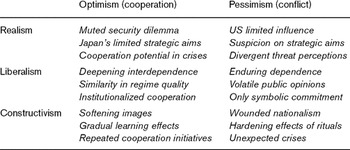
We have reviewed contending perspectives and mixed signals related to the future of the Korea–Japan relationship. Table 1 shows varying projections about the pattern of cooperation and conflict between the two countries by different streams of theories.
IR theories and the pattern of cooperation and conflict between Korea and Japan

How then can we interpret diverging trends? As a single element does not prevail over the others, the complex combination of mixed empirical evidence suggested above can produce different patterns of cooperation and conflict between Korea and Japan. Testing the case against the historical realities of the Korea–Japan relations enables us to make a comprehensive evaluation.
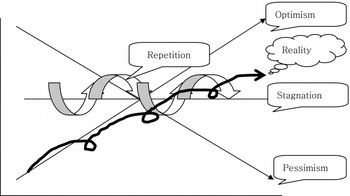
If pessimistic elements had been dominant, Korea–Japan relations would have deteriorated over time. Indeed, if the pessimists’ predictions were right, rather than moving forward, Korea–Japan ties would have degenerated into prolonged conflict. In other words, Korea–Japan relations would show a downward spiral.
Without the promise of optimism, Korea–Japan relations would have remained stagnant or flat over time, without showing signs of any change, backward or forward. If historical animosity worked as a primary variable in influencing the bilateral ties between Korea and Japan, the two countries would be antagonists for longer periods of time without showing any signs of cooperation.
Another possible combination of mixed empirical realities could have shaped the ties between Korea and Japan as the repetitive cycle of conflict and cooperation, without showing upward development. If the forces of optimism and pessimism are working almost equally, cooperative momentum would emerge but conflictive elements would offset that momentum. Simple repetition of the cycle of conflict and cooperation would be the outcome.
If the optimistic elements prevailed over time, Korea–Japan relations may have illustrated a linear upward movement in a single unbroken line. Cooperation uninterrupted by frictions may represent the case in point. However, in reality, the relationship between the two countries has often been interrupted by turbulent periods when frictions rose to the surface. Still, these frictions became subdued after the momentary conflict subsided. In other words, frictions are not a constant feature of the relationship, nor are they the representative feature.
While Korea–Japan relations generally move in an upward direction, the two countries have often faced unexpected and unintended cycles of frictions. Therefore, what we see in reality is long-term progress in an upward movement interrupted by recurring frictions in the short-term (see Figure 1).Footnote 14
Predictions about the Korea–Japan relationship by contending perspectives Historical development of Korea–Japan relations proves this case in point. Though there have been twists and turns represented by spirals of conflict between the two countries, their relationship has improved over time.

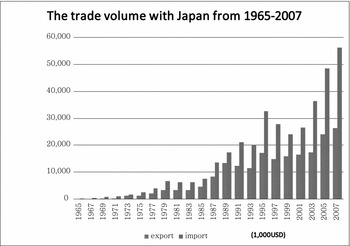
Figure 2 suggests that trade volume between Korea and Japan has increased drastically over time. Not only have exports between the two countries expanded, but imports have also increased voluminously.
Trade volume between Korea and Japan
Source: Korean International Trade Association, each year.

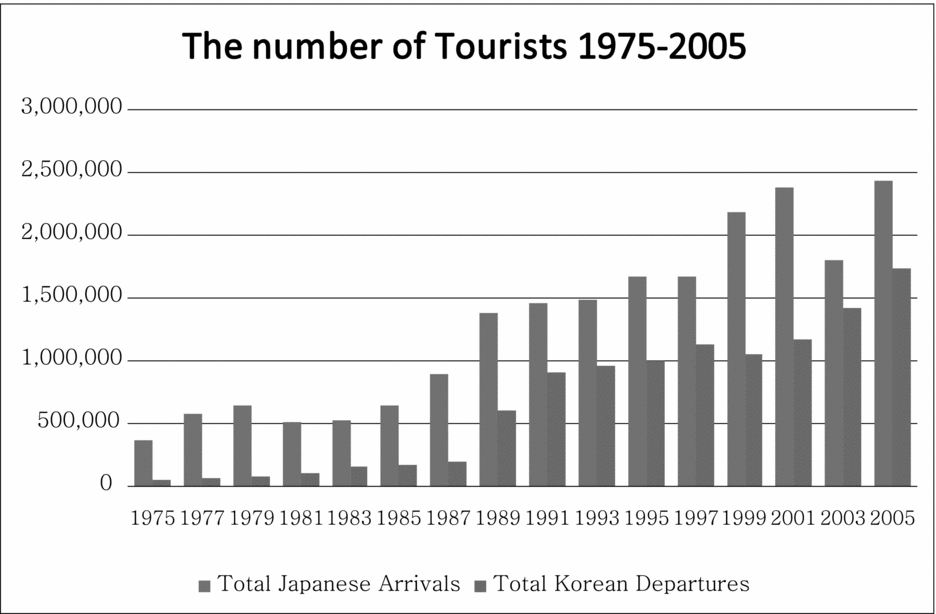
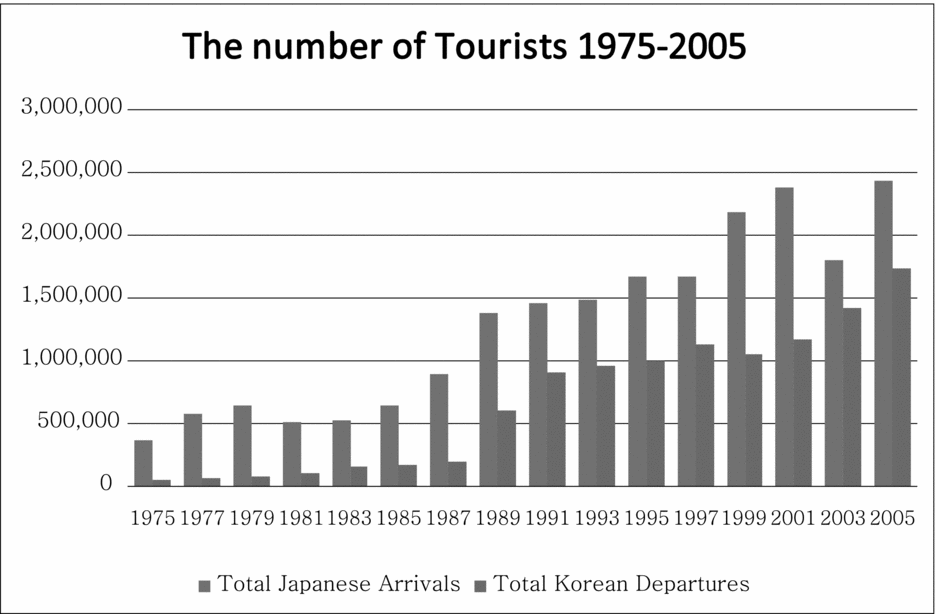
Figure 3 illustrates that human transactions between Korea and Japan have continuously increased over time. Though there have been exceptional periods when the number of tourists has been reduced, in general Koreans and Japanese have never stopped crossing their borders due to the sporadic frictions experienced.Footnote 15
Number of tourists between Korea and Japan
Source: Korea Tourism Organization, each year.
From 1948 until 1989, Korean presidents visited Japan a total of only five times. In contrast, from 1990 to 1999, Korean presidents visited Japan on six occasions. Also, Japanese prime ministers reciprocated these visits by travelling to Korea six times (Ministry of Foreign Affairs and Trade, 2007: 113–15). In a single year, 2008, the Korean President and the Japanese Prime Ministers met, either in a bilateral or in a multilateral setting, at least five times on official occasions.Footnote 16 In 1998, the Korean and Japanese Foreign Ministers conducted seven meetings. In 2007, the Foreign Ministers had ten bilateral or trilateral, including the Chinese, meetings in and out of Korea. If we take a closer look at the Foreign Ministers’ meetings in 2007, the nature of Korea–Japan relations in the contemporary setting is easier to grasp. Korean and Japanese Foreign Ministers met in a bilateral setting only twice. They convened three times in the ASEAN+3 setting, either between the two or including the Chinese Foreign Minister. They also had separate foreign ministers’ meetings through the United Nations, APEC, ASEM, and ICI. The other occasion was in Jeju, where Korean, Japanese, and Chinese Foreign Ministers met to prepare for the coming three nations’ summit meeting. This attests to the fact that issues requiring mutual consultation have increased significantly. At the same time, it demonstrates that Korea–Japan's cooperation is not confined to the bilateral setting.
Korea–Japan cooperation also takes place in a more unusual arena, through military exchange. After the first North Korean nuclear crisis, the Korean and Japanese defense ministries regularized their defense ministers’ reciprocal annual visits from 1994. At the same time, the defense ministries of the two countries established director-general level policy dialogue starting in 1994. From 1998, it developed into a security dialogue, including foreign ministry officials. In addition, the Korean Navy and the Japanese Naval Self Defense Forces have been conducting port calls since 1994.Footnote 17 Also, in the process of comprehensively reviewing North Korea policy in 1999, Korea and Japan became regular participants in the Trilateral Coordination and Oversight Group (TCOG), together with the United States. Furthermore, since 2001, the Korean defense ministry began sending two military academy cadets to the Japanese National Defense University as exchange students. Korea and Japan have also worked closely with each other under the Six Party Talks framework to pursue the common goal of denuclearizing North Korea.
In the social realm, the number of Korean students studying in Japan increased from 14,925 in 2001, 16,992 in 2004 and to 19,022 in 2005. As of 2007, 113 local cities in both countries have established sister relationships. As of 2004, 196 Korean universities have established exchange partnerships with 487 universities in Japan, while 407 Korean elementary and junior high schools concluded exchange agreements with their Japanese counterparts. Taking advantage of the working holiday visa programs, 7,199 Japanese visited Korea and 3,410 Koreans spent time in Japan between 2004 and 2006 (Ministry of Foreign Affairs and Trade, 2007: 150–2).
This empirical evidence supports the case that Korea–Japan relations are making steady progress towards deeper, heightened, and multilayered cooperation. We have justifiable reasons to believe that current cooperative trends toward an upgraded strategic partnership will not be easily reversed. This provides us with grounds for optimism.
However, this does not necessarily mean that we should have no concerns about the future prospects for the Korea–Japan relationship. There are many hurdles that both nations need to overcome. Forces of nationalism, though submerged at ordinary times, can be reawakened. New identity building in the direction of escalating national pride can hurt the feelings of neighbors. Remarks or rituals serving domestic political constituencies can easily provoke the other party. If not properly managed, repeated interaction can fortify misconceptions or biases already held by the people.
Yet, even in areas of potential conflict, situations are improving. In Korea, one can hardly find massive anti-Japanese demonstrations any more, except in front of the Japanese embassy in Seoul. Though historical controversies or territorial disputes galvanize the nation, emotional responses do not last long and tend to evaporate in a short period of time. Also, issue linkage between historical issues and other areas of cooperation are on the decline.
If political leaders in both countries remain cautious, mutual provocations can be prevented or at least managed. If leaders of both countries agree to control the pace and depth of conflict, it is not impossible to manipulate the situation to the benefit of both Korea and Japan. Post-Koizumi Japanese prime ministers have been warily watchful about the situational developments regarding historical controversies.Footnote 18 This low-key profile has contributed to the amelioration of relations with Korea after the Koizumi era. Also, the advent of conservative leadership in Korea, under Myung Bak Lee, has been instrumental in upgrading the relationship with Japan. This is why we remain cautious but not necessarily pessimistic.
Whether Korea and Japan can maximize the effects of optimism while they effectively minimize the impacts of pessimism will determine the nature of the ties between the two countries. An optimistic future does not arrive naturally or automatically. Neither do pessimistic elements decrease with the passage of time. A cooperative future should be what countries in the region make of it, as anarchy is what states make of it (Wendt, Reference Wendt1992).
4. Conclusion
In the Korea–Japan relationship, cooperation has long been coupled with conflicts and tension. Due to the sporadic interception of frictions between the two countries, it looks as if Korea and Japan are always conflict-ridden. If we suppose cooperation is, at all times, conflict free, the relationship between Korea and Japan may not have made progress so far. However, conflicts among close neighbors are normal and should not be seen as atypical.Footnote 19 Considering the development of cooperative ties at all levels, Korea–Japan relations are definitely making progress, though frictions persist. Their relationship may be characterized as long-term progress repeatedly bothered by short-term frictions.
Cooperation is not promised between the two, nor is it guaranteed. However, we can find irreversible trends of improved cooperation over time. Socio-economic transactions have been increased. Mutual perceptions have ameliorated drastically. Shared regime quality and lifestyle assimilation are taken for granted. Despite, not because of, historical antagonism, areas of cooperation between Korea and Japan are expanding. Furthermore, these areas of cooperation between the two countries are not confined to bilateral issues. Regional and global agendas are mutually shared and commonly pursued. Habits of cooperation have been developed in legitimized institutional contexts.
This does not mean that the roots of potential conflict have disappeared. Lingering suspicions, submerged nationalist sentiments, and sporadic surges of extremism remain. Indeed, they are like scattered mines in the field of cooperation. Conflicts between Korea and Japan may be unavoidable. However, it may be manageable as long as the leaders of the two countries can clearly identify and carefully manage the harmful effects of the negative elements. This is why we can remain cautiously optimistic about the future of the Korea–Japan relationship.
About the author
Cheol Hee Park is currently an associate professor at the Graduate School of International Studies (GSIS) at Seoul National University.