Introduction
Acupuncture is a component of traditional Chinese medicine that involves the stimulation of specific points on the body's surface (‘acupoints’) to elicit therapeutic effects (Koski, Reference Koski2011). Stimulation is typically via needles; however, there are many variants, including electroacupuncture, acupressure, injection acupuncture, and moxibustion acupuncture (Xie and Preast, Reference Xie and Preast2007). Acupuncture's use as an alternative or complementary therapy in human beings has increased in popularity; in 2007, it was estimated that 14 million Americans had used acupuncture, up from approximately 8 million in 2002 (Zhang et al., Reference Zhang, Lao, Chen and Ceballos2012). Acupuncture has been recommended as a treatment for a variety of conditions in animals, including arthritis, behavioral problems, hip dysplasia, cancer, and Cushing's syndrome (Koski, Reference Koski2011).
Within the scientific literature, there has been controversy regarding the efficacy of acupuncture in people and animals (Habacher et al., Reference Habacher, Pittler and Ernst2006; Madsen et al., Reference Madsen, Gøtzsche and Hróbjartsson2009). Systematic reviews provide a scientifically defensible method for evidence-based decision making, offering a transparent and scientifically rigorous method of collating and synthesizing evidence from the scientific literature (Sargeant et al., Reference Sargeant, Kelton and O'Connor2014). The authors of the only published systematic review of veterinary acupuncture to date were unable to draw conclusions, due to the predominance of case reports and editorials, which are of low evidentiary value for assessing the efficacy of a treatment, and the small number of clinical trials, which were generally of low quality (Habacher et al., Reference Habacher, Pittler and Ernst2006). It has been 10 years since that systematic review was published, and there is a need for an updated synthesis of the evidence.
Developing a research question for a systematic review related to the efficacy of an intervention involves the definition of four key elements (the ‘PICO’ terms): the participants or population to be studied (‘P’), the treatments or interventions being evaluated (‘I’), the comparison group(s) (‘C’), and the outcomes to be measured (‘O’) (Higgins and Green, Reference Higgins and Green2011). Acupuncture is a broad term that includes many treatment methods that have been used for a wide array of conditions (Koski, Reference Koski2011). Thus, many potential PICO questions could be asked in a systematic review of the efficacy of veterinary acupuncture, each with potential differences in the quality and quantity of literature available.
A scoping review can be conducted to identify areas where a sufficient body of literature may exist to support a systematic review (Arksey and O'Malley, Reference Arksey and O'Malley2005). Unlike a systematic review, which is typically limited to the examination of one treatment for one condition in a single species, a scoping review identifies and categorizes all of the evidence related to a broad subject. The framework for scoping reviews initially described by Arksey and O'Malley (Reference Arksey and O'Malley2005) includes five steps: identifying the research question; identifying relevant studies; study selection; charting the data; and collating, summarizing, and presenting the results. In contrast to a systematic review, a scoping review does not include data extraction of the results of the included studies, a risk of bias assessment, or synthesis of the evidence. However, scoping reviews provide a transparent and replicable means of describing the literature on a topic and often are a useful first step to identifying specific topics for a systematic review. Our objective was to conduct a scoping review of the evidence for efficacy of acupuncture in companion animals.
The research question was: ‘What is the current body of evidence addressing the efficacy of acupuncture in companion animals?’
Methods
This review followed the framework developed by Arksey and O'Malley (Reference Arksey and O'Malley2005). Prior to initiating this scoping study, the research group agreed to follow the Arksey and O'Malley framework, and the review question and the approach to undertaking the review were determined. However, a detailed protocol was not finalized a priori.
Identifying the research question
The objective was to describe the literature that had been published related to the efficacy of acupuncture in companion animals. For the purposes of this review, companion animals included horses, dogs, and cats. All outcomes, types of acupuncture, and study types were considered relevant.
Identifying relevant studies
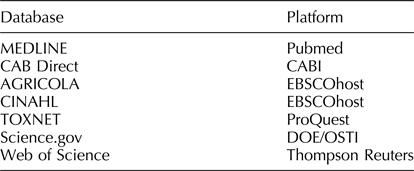
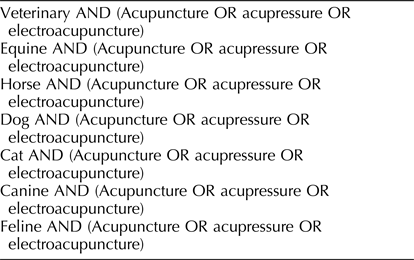
Seven electronic databases were searched for relevant articles within the published and gray literature (Table 1). Seven search strings were entered into each of the selected electronic databases (Table 2). Searches were conducted from January 26–29, 2014, with an update to the search on June 6, 2015. There were no restrictions with regard to date or country of publication. Although the resources for article translation were not available, there were no restrictions on language of publication at the search stage. Citations identified were imported into RefWorks Reference Management Software (ProQuest LLC, Ann Arbor, MI, 2012) and duplicate citations were removed using the ‘Close’ and ‘Exact match’ tools in RefWorks. The remaining articles were then exported to Microsoft Excel 2013 (Microsoft Office Professional Plus 2013, Version 15.0.4779.100) for relevance screening.
Electronic databases and platforms used to search for all relevant literature on veterinary acupuncture using predefined search terms

Search terms used in each of seven discrete search strings for this scoping review, entered into each electronic database

Study selection
Relevance screening was conducted in two stages; the first based on title and abstract, and the second based on the full article. Articles were independently screened by two reviewers at both levels of screening. A pretest using the titles and abstracts of 100 articles was performed. Cohen's κ was calculated on the pretest results to determine agreement between reviewers; if agreement was poor (κ < 0.80) differences were discussed and resolved before reviewing all articles. Reviewers met periodically to compare relevance screening results for all articles. Any differences were discussed and resolved by consensus.
Two questions were used to determine if an article was relevant: ‘Does the article address acupuncture as a therapeutic or preventive intervention?’ and ‘Does the article pertain to dogs, cats, or horses with the outcomes measured in live animals?’. These questions restricted our results to include only those articles that examined the efficacy of acupuncture in three common companion animal species. A therapeutic intervention was defined as an intervention intended to reduce the signs, severity, or duration of a clinical condition. A preventive intervention was defined as any intervention intended to prevent the onset of a clinical condition. Both questions were used in each stage of screening to determine relevance.
Studies investigating mechanism of action were excluded. Mechanistic studies were defined as studies in which no disease condition was investigated and that were, instead, focused on how acupuncture might work. Books were included in the review if they focused on veterinary medicine and included one of the following phrases in the title: acupuncture, acupressure, electroacupuncture, moxibustion, traditional Chinese medicine, complementary medicine, alternative medicine, or Chinese medicine.
If it was unclear whether a citation met our inclusion criteria during the title/abstract screening, that citation was included in the second stage of screening. However, if it was not clear from the title or abstract, which species was studied, but the article was published in a human medical journal, the citation was excluded, as it was assumed that it included only human participants.
After the first stage of screening, full manuscripts were obtained for articles deemed potentially relevant. Full-text articles were accessed from library holdings, library journal subscriptions, and open-access sources such as Google Scholar. Articles that could not be accessed from these sources were requested via the University of Guelph inter-library loan system. If the full manuscript was not found following these steps but an abstract was available, then categorization was undertaken based on the abstract. Citations for which neither the full manuscript nor an abstract could be obtained were excluded. Non-English papers were excluded if categorization could not be completed with an English abstract. Reviewers met frequently to compare screening results and to resolve conflicts.
Charting the data
Categorization of each article was conducted using a form constructed in Microsoft Access (Microsoft Office Professional Plus 2013, Version 15.0.4779.100). Reviewers were trained using an instruction document developed by the review team. Categorization was conducted by two independent reviewers and differences were resolved by consensus. The data collected included publication type, species studied, indication for use, outcome categories, and acupuncture method.
Collating, summarizing, and reporting the results
All articles were categorized by publication type. Publication types included: narrative reviews, systematic reviews, experimental studies, hypothesis testing observational studies, case reports, case series, conference proceedings, textbooks, and editorials/commentaries/testimonials/letters to the editor. Narrative reviews were defined as reviews that did not follow the steps of a systematic review. Systematic reviews were defined as a literature reviews that used a systematic method for identifying, selecting, and summarizing the results from multiple research studies. Experimental studies were defined as studies in which the investigator controlled allocation of study subjects to one of at least two treatment groups. Experimental studies included both non-randomized controlled trials (non-RCTs) and RCTs, although extraction of information on whether randomization was used was beyond the scope of this review. Hypothesis-driven observational studies were defined as studies in which the investigator did not control allocation of study subjects to treatment groups, but in which there were at least two treatment levels (i.e., acupuncture group and control group). Hypothesis-driven observational studies thereby included, but were not limited to, cross-sectional studies, cohort studies (selected based on treatment status or population), and case–control studies. A case report was defined as a detailed report of the diagnosis, treatment, symptoms, and follow-up of a single patient. A case series included more than one case. Conference proceedings were defined as a collection of academic papers or abstracts in the context of a conference that had at least one entry that met our inclusion criteria. A textbook was any book that met the inclusion criteria for this review. The remaining study types referred to publications that were not reports of primary research studies, but rather expressed the opinion of a writer or editor about another article (editorials), provided comments or annotations about a published article (commentaries), described the testament of the owner/caretaker of a patient that had experienced acupuncture treatment (testimonials) or comprised a letter sent to a journal detailing a concern from the journal's readership (letters to the editors).
Experimental studies, hypothesis-testing observational studies, case reports, and case series were further categorized by species studied, indications for use, outcome categories, and the acupuncture methods used. Categories for indications for use and outcome categories were determined a priori to the categorization stage. However, as the review progressed, additional indications for use and outcome categories were added as needed. These categories were designed to be general, due to the diversity of studies investigating acupuncture. Outcomes were not classified further as direct or indirect.
Indications for use included: pain, anesthesia, musculoskeletal, gastrointestinal, inflammation/infection, neurologic, respiratory, renal, hepatic, ocular, behavioral, wound healing, and cancer. Outcome categories included: cardiovascular parameters, blood parameters, and physiological parameters. Cardiovascular parameters included heart rate, blood pressure, and any measure of cardiac function as measured by electrocardiogram. Blood parameters included any blood count, such as white blood cell counts, and measures such as concentrations of inflammatory marker. Physiological parameters were outcomes that did not directly measure the clinical condition of interest, but that were considered associated with the condition and were not classified as cardiovascular or blood parameters. Examples of these outcomes included histological findings and rectal and skin temperature. This method of categorizing outcomes could result in a single study being included in multiple categories for indications for use or outcomes.
Acupuncture method categories included: traditional acupuncture, defined as any acupuncture treatment performed using only dry needles or described only as ‘acupuncture’; electroacupuncture, defined as acupuncture needles stimulated by electricity; acupressure, defined as the application of force at acupoints, without the use of needles (Werntoft and Dykes, Reference Werntoft and Dykes2001); moxibustion acupuncture, defined as the burning of mugwort near or on acupoints (Gang et al., Reference Gang, Wu and Chuan1997); injection acupuncture, defined as the injection of fluids such as anesthetics at acupoints (Feng-Wu, Reference Feng-Wu2001); laser acupuncture, defined as the use of a laser at acupoints (Zhang et al., Reference Zhang, Lu and Wang1990); and gold implant acupuncture, defined as the insertion of small gold pieces just below the skin at acupoints (Jaeger et al., Reference Jaeger, Larsen, Søli and Moe2006).
Results
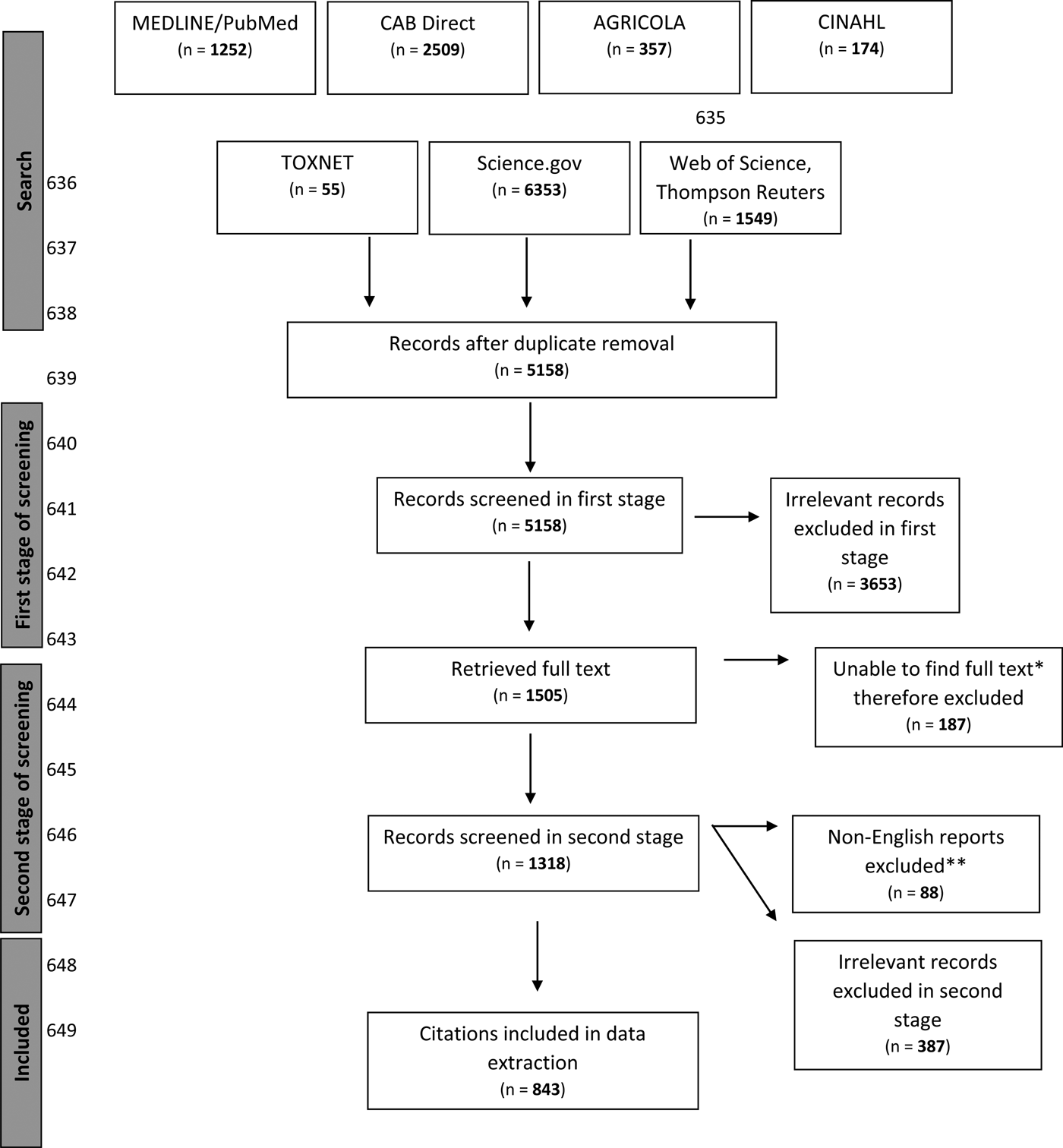
Searches of the selected databases identified 5,158 references after removing duplicates (Fig. 1). Title and abstract screening excluded 3,653 articles, and full-text screening excluded another 662 articles. Of the citations excluded during full-text screening, 361 did not address acupuncture as a therapeutic or preventive intervention; 26 did not investigate acupuncture in cats, dogs, or horses with outcomes measured in live animals; 187 articles could not be acquired; and 88 references were not published in English. The remaining 843 citations underwent categorization.
Scoping review flow chart detailing the process of study inclusion: search results, two stages of screening and final articles included. *Unable to find full text and categorization was not possible based on abstract. **Non-English reports that were able to be categorized based on English abstract or summary were included.

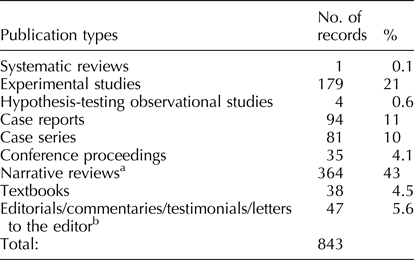
The most common type of publication was the narrative review (n = 364) (Table 3). The search also identified 179 experimental studies, four hypothesis-driven observational studies, and 175 case reports/case series.
Publication type for 843 citations included in a scoping review on the efficacy of veterinary acupuncture

a Any review article that is not a systematic review.
b Includes entries in scholarly and non-scholarly journals.
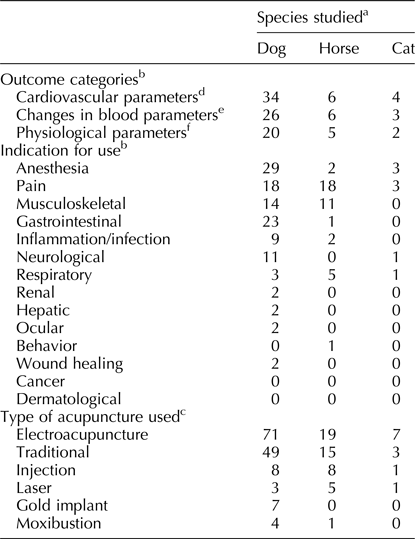
Table 4 displays the study characteristics of the experimental studies by species. Of these, 136 studies examined one or more outcomes in dogs, 56 examined horses, and 17 studied cats. The most common outcome category was cardiovascular parameters, which were often used as surrogate measures of pain or discomfort, or as a method to gauge the degree of anesthesia (43 studies). Changes in blood parameters were investigated in 34 studies. These outcomes were used as surrogate measures of conditions such as inflammation and infection. Physiological parameter outcomes were identified in 27 studies. These numbers may differ from totals in Table 4 as one study may have multiple species.
A total of 179 experimental studies included in a scoping review of veterinary acupuncture characterized by species, outcome category, indication for use, and type of acupuncture used

a Multiple studies included more than one species of interest.
b Some studies measured multiple outcome categories and/or indications for use.
c More than one type of acupuncture was used in multiple studies.
d Cardiovascular parameters included any measure of cardiac performance, such as heart rate or blood pressure.
e Blood parameters included any blood cell count and inflammatory markers.
f Physiological parameters were outcomes that were not direct clinical measures of a condition but were associated with the condition, such as histological findings or skin temperature.
The most common indications for acupuncture use included pain, anesthesia, musculoskeletal conditions, and gastrointestinal conditions (Table 4). Citations categorized as anesthesia investigated the role of acupuncture in reducing the amount of anesthetic required to induce or maintain general anesthesia (34 studies). Musculoskeletal conditions were investigated in 25 studies; this category included arthritis, hip dysplasia, and lameness. Gastrointestinal conditions comprising gastric motility abnormalities and irritable bowel syndrome were investigated in 24 studies. In addition, conditions related to infection and inflammation were investigated in 11 studies, neurological conditions in 11 studies, respiratory conditions in eight studies, and reproductive conditions in seven studies. A smaller number of studies investigated renal or liver conditions (four studies), ocular disorders (two studies), behavior (one study), and wound healing (one study). No experimental trials investigating acupuncture's effects on cancer in companion animals were identified.
Experimental trials employed electroacupuncture (96 studies), traditional acupuncture (60 studies), injection acupuncture (18 studies), laser acupuncture (nine studies), gold implant acupuncture (seven studies), and moxibustion acupuncture (four studies) (Table 4).
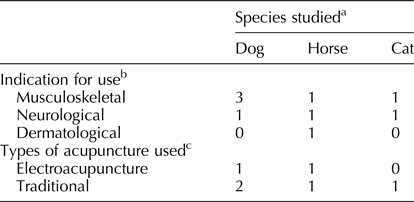
Only four hypothesis-driven observational studies were identified (Table 5). Dogs and horses were the most commonly studied species. The indications for use were neurologic musculoskeletal and dermatologic conditions.
Four hypothesis-testing observational studies included in a scoping review of veterinary acupuncture characterized by species, outcome category, indication for use, and type of acupuncture used

a Multiple studies included more than one species of interest.
b Studies may have investigated multiple indications for use.
c More than one type of acupuncture was used in multiple studies.
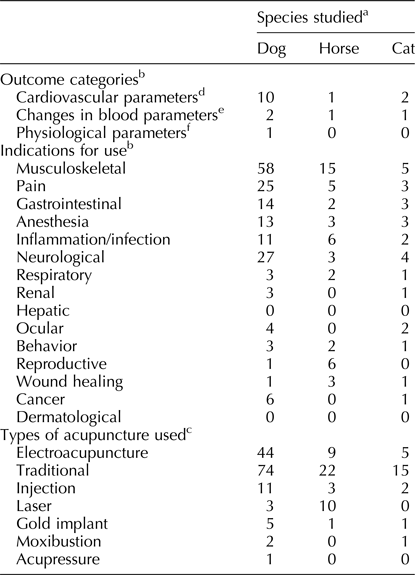
Table 6 displays the study characteristics for the case reports and case series. The most common species studied was the dog. The majority of the case reports and case series examined musculoskeletal conditions (74 studies). Neurological conditions and pain were also studied in a relatively large number of case reports and case series (31 and 33 studies, respectively). Traditional acupuncture was employed most frequently (103 studies), and acupressure least often (one study). These numbers may differ from totals in Table 6 as some studies examined multiple species.
A total of 175 case reports/series included in a scoping review of veterinary acupuncture characterized by species, outcome category, indication for use, and type of acupuncture used

a Multiple studies included more than one species of interest.
b Some studies measured multiple outcome categories and/or indications for use.
c More than one type of acupuncture was used in multiple studies.
d Cardiovascular parameters included any measure of cardiac performance, such as heart rate or blood pressure.
e Blood parameters included any blood cell count and inflammatory markers.
f Physiological parameters were outcomes that were not direct clinical measures of a condition but were associated with the condition, such as histological findings or skin temperature.
Discussion
This scoping study provided a broad overview of the available literature pertaining to the efficacy of acupuncture in companion animals, including a description of the types of studies published, the companion animal species studied, the indications for use of acupuncture, and the outcome categories measured. Prior to this report, only one systematic review of veterinary acupuncture had been published (Habacher et al., Reference Habacher, Pittler and Ernst2006), the authors of this review were unable to draw conclusions about the efficacy of acupuncture for any condition. The current scoping review revealed gaps in the literature, and identified species and indications for acupuncture use, for which there may be a sufficient number of experimental trials to support a systematic review.
A comprehensive search was conducted to identify publications without restrictions based on the type of publication, the indication for use, the outcomes measured, or the type of acupuncture employed. Although a large proportion of the identified citations were not relevant, the aim of the search in a scoping review is to identify, with high sensitivity, all potentially relevant literature (Arksey and O'Malley, Reference Arksey and O'Malley2005).
The previously conducted systematic review identified 31 RCTs and non-RCTs (Habacher et al., Reference Habacher, Pittler and Ernst2006). Nine of these trials were not eligible for the current scoping review, because the investigated species were cattle, pigs, or sheep. Only one of the remaining 22 trials was not identified by our search (Still et al., Reference Still, Davies and Matzner1998). Two of the studies included in the previous systematic review did not have control groups and therefore were classified as case series in the current scoping review. An additional two studies were excluded from our scoping review, because they investigated the mechanism of action of acupuncture. An additional 75 experimental studies were identified through our search, which were published before May 2004 and were the final search data of the systematic review. These 75 studies could potentially have been eligible for the Habacher et al. (Reference Habacher, Pittler and Ernst2006) systematic review. Discrepancies in search results may be due to differences in search terms, the possibility that some of the older studies were not indexed until after May 2004, and differences in the databases used. Our search included additional databases (i.e., CAB Direct, AGRICOLA, TOXNET, Science.gov, and Web of Science), but did not include four of the databases used by Habacher et al. (Reference Habacher, Pittler and Ernst2006): Embase, Amed, Japana Centra Revuo Medicina, and Chikusan Bunken Kensaku. The current scoping review identified 87 relevant experimental studies published since May 2004. Another difference between our protocol and that used by Habacher et al. (Reference Habacher, Pittler and Ernst2006) was the inclusion of injection acupuncture studies in, which also may have contributed to the differences in the number of experimental studies identified by the two reviews.
Informing the scientific component of clinical decision-making requires examining evidence in a critical manner. Evidence pyramids illustrate the hierarchy of scientific evidence for evaluating the efficacy of interventions under real world conditions (Pandis, Reference Pandis2011; Sargeant et al., Reference Sargeant, Kelton and O'Connor2014). Systematic reviews and meta-analyses of RCTs are at the top of those pyramids. They provide a scientifically defensible method for collecting evidence, examining methodological quality, and synthesizing the results of multiple studies (Pandis, Reference Pandis2011). These reviews provide the best evidence for evaluating efficacy, because they minimize bias by following a rigorous methodology for the identification and evaluation of studies (Higgins and Green, Reference Higgins and Green2011). As previously discussed, our scoping study identified a single published systematic review (Habacher et al., Reference Habacher, Pittler and Ernst2006).
The next-highest level of evidence is experimental studies, with RCTs providing higher evidentiary value than experimental studies that do not employ a formal random process for allocating study subjects to treatment groups (Sargeant et al., Reference Sargeant, Kelton and O'Connor2014). Random sequence generation plays a pivotal role in reducing selection bias (Higgins and Green, Reference Higgins and Green2011), thereby speaking to the quality of evidence. However, in this scoping review, experimental studies were not further categorized as RCTs and non-RCTs, as evaluating the quality of evidence for each study was beyond the scope of the protocol.
Some indications for acupuncture use, which may have a sufficient body of experimental studies to support synthesis using a formal systematic review, include anesthesia, pain, musculoskeletal conditions, gastrointestinal conditions, and neurologic conditions. However, these topic areas are quite broad, and there may be differences in the efficacy of acupuncture within a topic area. For instance, ‘musculoskeletal conditions’ would include specific conditions like arthritis and hip dysplasia, which may respond differently to acupuncture as an intervention. Therefore, future systematic reviews will need to further refine the description of the indication for use. The most commonly studied animal in experimental studies was the dog; there does not appear to be a body of experimental evidence to support a systematic review in other species for any indication, with the possible exception of musculoskeletal diseases in horses.
Another important issue for subsequent systematic reviews is the differences in the outcomes measured and in the acupuncture methods used among studies focusing on the same indication for use. When there is heterogeneity between studies in the outcome or acupuncture methods, it is difficult to summarize findings across studies as they may not be directly comparable. In addition, some of the reported outcomes were surrogate outcomes, which are less clinically relevant than direct outcomes (Guyatt et al., Reference Guyatt, Oxman, Kunz, Woodcock, Brozek, Helfand, Alonso-Coello, Falck-Ytter, Jaeschke, Vist, Akl, Post, Norris, Meerpohl, Shukla, Nasser and Schunemann2011). Instruments for summarizing the strength of evidence such as GRADE (Grading of Recommendations, Assessment, Development, and Evaluation) generally do not include surrogate outcomes for this reason (Guyatt et al., Reference Guyatt, Oxman, Vist, Kunz, Falck-Ytter, Alonso-Coello and Schünemann2008). Our results indicate that future systematic reviews of the efficacy of acupuncture could focus on dogs as the study population; however, they may be challenging to perform due to the diversity of specific disease conditions or indications for use, types of acupuncture, and the outcome measures reported.
Hypothesis-testing observational studies (including cohort, case–control, or cross-sectional designs) can be useful when a RCT is not possible due to ethical or financial restrictions (Cockcroft and Holmes, Reference Cockcroft and Holmes2003). However, observational designs are more prone to bias compared to RCTs. While confounding bias is a concern for all hypothesis-driven observational designs, cohort studies are the most similar to an experimental design and therefore provide the highest evidentiary value of the observational designs. In addition to confounding, case–control studies also are prone to recall bias and cross-sectional studies do not provide evidence of a temporal relationship, making it impossible to assess whether the exposure preceded the outcome. For these reasons, RCTs are preferred for evaluating efficacy when they are financially possible and ethical, which should be the case for acupuncture as an intervention.
A large number of case reports and case series were also identified; these studies do not have a comparison group and, therefore, are not an appropriate study design to compare efficacy between treatment groups. These reports can be helpful in identifying new diseases, reporting adverse effects of treatment, and documenting rare diseases (Aronson and Hauben, Reference Aronson and Hauben2006; Wiwanitkit, Reference Wiwanitkit2011). Editorials and commentaries are also not suitable for determining efficacy as they reflect the opinion and experience of the author. They are, however, useful for sharing information and indicating gaps in previously published literature. Although none of these designs are appropriate for evaluating the efficacy or effectiveness of acupuncture as an intervention, we included a description of these studies in our scoping review to provide an indication of their frequency in the acupuncture literature.
A number of potentially relevant conference proceedings were also identified. Conference proceedings may describe results from primary research studies that are not available elsewhere; for instance, Snedeker et al. (Reference Snedeker, Totton and Sargeant2010), reported that less than half of the abstracts related to food safety that were reported in conference proceedings were published in indexed journals within 4 years. However, conference abstracts may not include the level of detail necessary to allow their inclusion in systematic reviews (O'Connor et al., Reference O'Connor, Anderson, Goodell and Sargeant2014).
In this scoping review, narrative reviews represented the largest category of literature identified. In contrast to systematic reviews, narrative reviews generally do not follow a defined framework, such as that described in the Cochrane Handbook for Systematic Reviews of Interventions (Higgins and Green, Reference Higgins and Green2011). The methods used to identify and select the literature are seldom reported, and there is seldom any formal risk of bias assessment (Mulrow, Reference Mulrow1987; Sargeant et al., Reference Sargeant, Torrence, Rajić, O'Connor and Williams2006). Thus, it is difficult for the reader to judge the scientific validity of narrative review articles. The same considerations apply to textbooks, which tend to mirror the narrative review approach.
Ideally, multiple studies should be used to determine efficacy. Studies vary in their design, methodological quality, and populations studied (Garg et al., Reference Garg, Hackam and Tonelli2008). Study design and quality can affect the robustness of evidence, and population characteristics can affect the generalizability of individual findings to clinical practice. In addition, a single study demonstrating a statistically significant effect may not represent the true effect. The widely used P value of 0.05 for statistical significance means that in an infinite number of trials, we would expect to observe significant results in up to 5% of the studies by chance alone, if the null hypothesis of no association were true for the population. Thus, 1 out of every 20 studies may report statistically significant results by chance alone, when there is no actual difference in treatment efficacy. This is a type 1 error where the null hypothesis is true but is rejected (Moore and McCabe, Reference Moore and McCabe1998). Additionally, in many biological studies a power of 0.80 is used and that power level dictates that there is a 20% probability of type 2 errors (Moore and McCabe, Reference Moore and McCabe1998). These errors constitute a failure to reject the null hypothesis when it is false. In an infinite number of studies, we would expect to see type 2 errors in four out of every 20 studies when power is set at 0.80. These issues illustrate the need to examine multiple studies when evaluating efficacy, and systematic reviews offer a structured and transparent method for evaluating the quality of evidence (Garg et al., Reference Garg, Hackam and Tonelli2008).
Many reviews of veterinary acupuncture recommend its use in the treatment of cancer, renal or liver conditions, behavioral disorders, ocular conditions, and wound healing (Inada et al., Reference Inada, Gomes, do Brito, de Lima, dos Santas and Ruiz1990; Szathmary, Reference Szathmary1996; Berschneider, Reference Berschneider2002; Robinson, Reference Robinson2007; Koski, Reference Koski2011). However, there were few trials investigating these conditions among the included studies, indicating a need for further research in these areas.
Scoping reviews do not extract outcome data nor do they evaluate the quality of the literature. For those reasons this review did not attempt to draw conclusions regarding efficacy. This review was also limited by the exclusion of studies for which we were unable to locate full manuscripts and the exclusion of studies that were not published in English. It is not known whether non-English articles evaluated the same topics, or whether they would find the same results. Given the relatively large number of citations that were not published in English, future scoping reviews or systematic reviews in this area should include resources for language translation.
Another limitation of this review is the lack of searching Asian Databases such as: Japana Centra Revuo Medicina and Chikusan Bunken Kensaku; these databases were included in the search conducted in the previous published review (Habacher et al., Reference Habacher, Pittler and Ernst2006). Although this may have resulted in failure of our search to identify some relevant publications, particularly for non-English articles, the searched databases did encompass a large number of information sources, and, if non-English papers had English abstracts, they would have been categorized based on the abstract. Any citations that were not also indexed in one of the searched databases would not have been included in this review.
A large majority of the publications on companion animal acupuncture were non-experimental, and many of the non-experimental studies did not employ a control group (e.g. editorials, case reports). Several conditions for which acupuncture has been recommended in the literature were associated with few or no experimental studies. Among the experimental studies identified, a high degree of variability was reported with regard to the type of acupuncture employed, the indications for use, and the outcomes reported, creating a heterogeneous body of evidence. In spite of these issues, there are multiple subcategories of experimental studies for which a systematic review may be informative. Future high-quality trials are needed focusing on the efficacy of acupuncture, with consistent and clinically relevant outcome measures, so that synthesis of evidence to inform clinical decision-making is possible and reliable.
Acknowledgements
The authors would like to thank Jim Brett for his assistance in developing a search strategy. The authors would also like to thank Mai Pham for her assistance in locating full manuscripts.