Yesterday
A brief history of (Polar) time
The polar regions, consisting of both the Arctic and Antarctica, were long unexplored by Europeans until the 16th and 17th centuries, respectively. It’s likely Antarctica had been seen by Māori people as early as the 7th century, and many indigenous people lived in or near the Arctic centuries before Europeans even accepted the Earth as spherical (Royal Museums Greenwich, n.d.; van der Watt, Reference van der Wattn.d.). Until the late 19th century, the majority of Arctic exploration was focused on finding a navigable route by sea to increase shipping productivity. Throughout the 18th and 19th century, notable names such as James Cook, Henry Hudson, William Barents, Vitus Bering, Semyon Chelyuskin, Robert Peary, and Fridtjof Nansen made significant breaches into the region until 1909 when Robert Peary became the first to achieve the North Pole (American Polar Society. n.d.). Starting in 1925, the new form of Arctic exploration became the airplane, leading to explorers such as Roald Amundsen, Douglas MacMillan, and Richard Byrd all attempting to fly to the North Pole (American Polar Society, n.d.). It is disputed who among them was the first to achieve this success in 1926, but others would continue to attempt it, some never returning from their journey.
Cook was the first European to cross the Antarctic Circle in 1773 (Royal Museums Greenwich, n.d.). In 1837, Jules-Sébastien-César Dumont d’Urville discovered the Adelie Coast, and in 1839, James Clark Ross discovered what is now called the Ross Ice Shelf (Britannica, n.d.). Carsten Borchgrevink from Norway was among the first to overwinter on the Antarctic mainland in 1899 (Royal Museums Greenwich, n.d.). The true age of Antarctic exploration started in 1901, when Robert Falcon Scott led a British expedition with Earnest Shackleton and Edward A. Wilson that ended 410 miles from the geographic South Pole (Royal Museums Greenwich, n.d.). In 1910, the ultimate race began, when Scott departed on yet another South Pole attempt and discovered he was in a race against Norwegian Roald Amundsen. In the end, Amundsen arrived first on 15 December 1911. Almost 5 weeks later on 18 January1912, Scott arrived at the South Pole and discovered he was too late. On 29 March 1912, a mere 11 miles from the final supplies cache, Scott and the rest of his team would perish (Royal Museums Greenwich, n.d.). The rest of the 20th century would see countries establishing permanent bases and eventually enact the Antarctic Treaty in 1961 which directs the continent only be used as a natural reserve, “devoted to peace and science,” (Royal Museums Greenwich, n.d.).
A brief history of (Polar) time: women’s edition
Now for the other side of the story: it may be apparent that all of the notable adventurers from the height of polar exploration are men. Like nearly all other spaces throughout history, women were excluded from polar exploration. Most summaries of the history of both the Arctic and Antarctic don’t even mention the achievements of women. The first recorded non-indigenous woman to explore the Arctic was Soviet marine geologist Marie Vasil’evna Klenova who participated in expeditions between 1925 and 1935, closely followed by American explorer Louise Arner Boyd who began research expeditions in 1931 (Kalemeneva & Lajus, Reference Kalemeneva and Lajus2018). Klenova later became the first female scientist to lead a marine expedition in the Arctic in 1929 (Kalemeneva et al., 2018). Louise Arner Boyd, nicknamed “Queen of the Arctic,” self-financed her own missions in order for her to map the area and study the topography of the region (Isaksson & Ryell, Reference Isaksson and Ryell2023). Originally venturing on tourist trips, Boyd fell in love with the region and began to record her observations. She began to be seen as a legitimate researcher by the Norwegian polar elite only after assisting in the search for the downed airplane of the famed Roald Amundsen (Isaksson & Ryell, Reference Isaksson and Ryell2023).
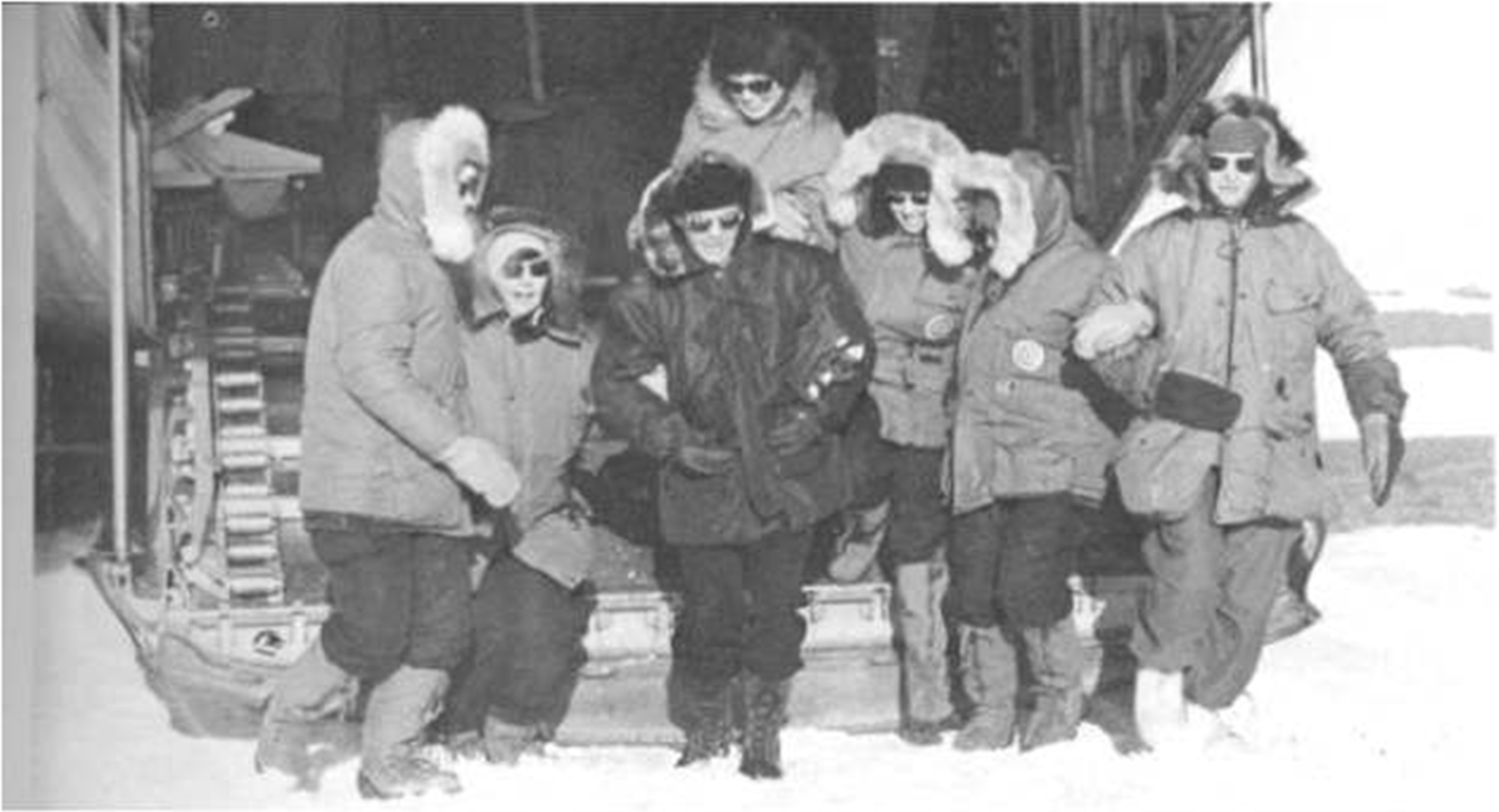
The first recorded woman to step foot on Antarctica, Caroline Mikkelsen, did so in 1935, approximately a century after men began to set foot on the continent (Royal Museums Greenwich, n.d.). In 1947, the Ronne Antarctic Research Expedition to the Antarctic interior set out with two women aboard the ship, Jackie Ronne, wife of leader Finn Ronne and listed as “Recorder” on the expedition manifest, and Jenny Darlington, wife of expedition pilot Harry Darlington (Ronne Antarctic Research Expedition. n.d.). In 1969, Pam Young, Jean Pearson, Lois Jones, Eileen MacSaveney, Kay Lindsay, and Terry Tickhill were the first women to step foot at the South Pole; all six women linked arms and walked off the plane together, shown in Figure 1, so that no single woman had the claim of being “the first” (“First women at Pole.” n.d.). This is an appropriate example of how women work together to achieve things in polar research.
First women to the South Pole (“First women at Pole.” n.d.).

Historical barriers to women in polar research
There are many reasons women were historically excluded from polar research. The primary sources of exclusion are education access and both prejudice and sexism. Throughout all of history, women have been viewed as “lesser,” incapable of performing tasks the same or as well as men. Women were largely exempted from higher education until the 1900s; only those with fortunes and freedom were able to breach the wall of education (recall Boyd self-financing her expeditions.) In 1969, the same year, women first visited the South Pole; 9.2% of US doctoral degrees awarded in science and engineering fields were awarded to women (Vetter, Reference Vetter1981, December). And even once, women gained access to higher education that it was no guarantee they would continue advancing; Klenova, Soviet scientist and one of the first female Arctic researchers, never advanced beyond being the head of a research group despite a lifetime of qualifying work (Kalemeneva et al., 2018). Irene Peden, an associate professor of engineering and the first US woman to work in the Antarctic interior in 1970, recalls the first women to study on the Antarctic coast had a reputation of not being “productive” since they had not published any of their results by the following year (an accelerated timeline in academic publishing) (Rothblum, Weinstock, & Morris, Reference Rothblum, Weinstock and Morris1998). Peden later published her results as quickly as she was able so she could avoid this stereotype.
Part of why women were not granted equal education access is because of prejudice against women and general sexism. This is especially relevant in extreme environments. When Peden was preparing to deploy her first time she encountered opposition to her participation from a Naval commander who claimed there was “no ladies’ room on the military flight, no ladies’ room in the Antarctic” (Rothblum et al., Reference Rothblum, Weinstock and Morris1998). An Australian study found that only 52% of women in Antarctica in the 1990s felt they were treated no differently due to their gender (Nash, Nielsen, Shaw, King, Lea, & Bax, Reference Nash, Nielsen, Shaw, King, Lea and Bax2019). Women aren’t “hard” enough, or the feminine idea of women doesn’t match the hard-edged, rugged image of polar exploration. In an interview in 1939, Boyd said “When I first went to the Arctic, people definitely seemed to feel, and openly told me so, the Arctic was a place only for men,” (Isaksson & Ryell, Reference Isaksson and Ryell2023). These biases have existed as long as women have been pushing barriers, it’s no surprise they were present in some of the last frontiers.
Women leaders in polar research and exploration
Despite women not having much of a presence in the polar regions for most of history, it didn’t stop some women from pushing boundaries and making their mark. Ann Bancroft is one such woman; in 1986, she joined the Steger International Polar Expedition, traveling 1,000 miles on dogsled to the North Pole and thus becoming the first woman in history to make the journey (Ann Bancroft Foundation. n.d.). In 1992, Bancroft was the leader of the American Women’s Trans-Antarctic Expedition, her first excursion as a formal leader, and found herself regularly doubting her decisions. Bancroft was forced to make the call to abandon the expedition upon reaching the South Pole due to a team-member’s injury and commented on how difficult a decision it was to make: “Once I had determined that… I was able to lift some of that burden that I had been feeling, although I was devasted” (Rothblum et al., Reference Rothblum, Weinstock and Morris1998). It is worth noting even in “failure” of their mission, Bancroft became the first woman in history to reach both the North and South Pole. In addition to the pressure of a successful mission, Bancroft struggled with the weight and anticipation of the women around the world cheering for them. The group dynamic of the expedition was studied by Gloria Leon, a professor of psychology at the University of Minnesota. Leon found the team was more likely to experience stress related to the well-being of the other members than of previously studied co-ed groups (Leon & Maki Kahn, Reference Leon and Maki Kahn1994). In the North Pole expedition, Bancroft participated in (also observed by Leon) the primary stressors of the group were environmental, which contrasted with the all-women team’s stressors (Leon & Maki Kahn, Reference Leon and Maki Kahn1994). Leon recalls one goal of Bancroft’s was that in having the team being exclusively women the result would allow the team to feel they had more input in final decisions even though Bancroft would maintain final authority (Rothblum et al., Reference Rothblum, Weinstock and Morris1998). This style of thinking aligns with the communal style of leadership commonly employed by women leaders. In Bancroft’s case, it resulted in a team with good overall morale and strong bonds.
Today
Despite their late arrival to the regions, women have made substantial progress in their contribution to polar research in recent years. Today, the proportion of women has increased substantially but remains low; in 2019, the ratio of men to women in the United States Antarctic Program (USAP) was almost two to one (Lucibella, Reference Lucibella2019, October). Given roughly 3200 people deploy every year to Antarctica, both researchers and support staff, it demonstrates how many women participate every year in Antarctica, and that is just in the United States program (NSF.gov. n.d.).
Modern women in polar research
Photographer Acacia Johnson noted Antarctica was unlike other remote expeditions she’d attended because usually she’s the only woman on the team but her Antarctic team was half women [17]. Since the 1990s, women have held important positions at research stations such as chief scientist and station manager, and there have been countless extended winter deployments. Jeanne Edwards, an electrical engineer at the University of Wisconsin–Madison, has been deploying to Antarctica since 1993 in a variety of technical roles. She has spent 4 winters and 3 summers on the continent, almost 5 years total of ice time (J. Edwards, interview, 31 October 2023). A lot has changed since her initial deployment, including some women’s clothing now being available for participants (though most jackets are currently still “unisex.”) Women do not face pressure to prove themselves experienced or capable in the way they did years ago; when Edwards deployed for her first time many men questioned her abilities, one even asked how she passed the psychiatric test to which she responded, “The same way as you, I lied” (J. Edwards, interview, 31 October 2023).
Not only women benefit from participating in polar activities. It’s been proven that diversity of peoples in any capacity is beneficial. In this case, women tend to have qualities that lead to more successful execution of missions as well as better overall team morale. On the 1986 Steger International Polar Expedition to the North Pole, male team members remarked how Bancroft’s presence removed their urge to compete with one another and allowed them to more easily express their emotions rather than bottle them up (Rothblum et al., Reference Rothblum, Weinstock and Morris1998). Bancroft’s leadership style on the Antarctic traverse is an example of the communal leadership style commonly associated with women; communal leadership (defined as friendly, selfless, expressing concern for others) is especially effective in high-stress situations as it reinforces the idea that the group is working as a single unit to accomplish a shared goal (Eagly, A. H., Johannesen-Schmidt, M. C., & van Engen, M. L. Reference Eagly, Johannesen-Schmidt and van Engen2003). As a result, the group members of the Antarctic traverse gave a high ranking to their leader’s decisions (Leon & Maki Kahn, Reference Leon and Maki Kahn1994). In contrast, men tend to employ agentic leadership (defined as assertive and self-determining), which can lead to conflict when team members have opposing opinions. The coleader of the 1986 North Pole expedition later expressed his greatest disappointment as “the lack of heart and the lack of compassion and sensitivity in the group as a whole,” which aligns with reported conflicts that arose over the leader’s navigational decisions throughout the mission (Leon & Maki Kahn, Reference Leon and Maki Kahn1994).
Another form of leadership well-suited for Antarctic work is the participative (defined as democratic and collaborative) style because leaders should be primarily focused on group maintenance and individual needs; participative leadership incorporates the importance in involving team members in the decision-making process (Godwin, J. R. Reference Godwin1987). Women are more likely to employ participative leadership methods because it allows them to better bypass any negative impressions that can present in co-ed teams lead by women (Eagly et al., Reference Eagly, Johannesen-Schmidt and van Engen2003). In Antarctic stations, it has been found that team climate is directly attributed to leader effectiveness; this is not unique to Antarctic stations but is especially relevant for an environment in which workers live and work together (Schmidt et al., Reference Schmidt, Wood and Lugg2004).
Remaining barriers
Despite all of the gains women have made since the 1960s, there remain many barriers to women having equitable representation in these spaces. A study in Great Britain found that girls are similarly likely as boys to study STEM subjects; however, they do not continue to study advanced-level science (Watts, Reference Watts2014). Then, for the few women who go on to conduct research, they average fewer published papers than men (Sugimoto, Reference Sugimoto2013). An analysis conducted between 2008 and 2012 found that women achieve fewer than 30% of partial authorships (where their name appears as an author on a publication,) where men achieve more than 70% of partial authorships (Sugimoto, Reference Sugimoto2013). For first-authorships, men outnumber women nearly two to one (Sugimoto, C. R. Reference Sugimoto2013). When evaluating the most frequently cited researchers, women are underrepresented by nearly 29% (Chan & Torgler, Reference Chan and Torgler2020). Even if one were to ignore publications and focus on the proportion of women scientists the numbers are abysmal. By country, Finland has the greatest proportion of women scientists at 20.45%, while the worldwide average of women scientists is 11.83% (Chan & Torgler, Reference Chan and Torgler2020). Not only are women lagging in pursuing advanced degrees for research but also they are less likely to publish the research they do conduct. When women do not have published research, it impacts their ability to seek funding opportunities for new projects, further limiting their ability to progress in their field.
Women in polar research face a severe culture that still mirrors the masculine ideals of the early explorers. McMurdo Station, the largest station in Antarctica and the primary base for the USAP, resembles an old mining town perched on a hill overlooking McMurdo Sound. The atmosphere is similar to what one would expect on a construction site; it seems that profanity and heavy equipment go hand-in-hand. This environment can make it difficult for women to feel comfortable or welcome. This is especially relevant given the alarming statistics of reported sexual harassment and assault within the USAP. Of 290 women within the USAP surveyed, 72% stated sexual harassment was a problem and 47% stated sexual assault was a problem (National Science Foundation, Office of Polar Operations, United States Antarctic Program, 2022, June 22). McMurdo Station is reported to be the worst because it has the most people but the other stations and field camps are not immune to this behaviour. Men are not immune to these experiences, and some men have reported to experience sexual assault and harassment; however, women are, in general, the primary victims of these incidents. Only 20% of surveyed men in the program who earn more than $150,000 believe sexual assault is a problem with more than 33% stating they don’t know if sexual assault is a problem (National Science Foundation, Office of Polar Operations, United States Antarctic Program. 2022, June 22). For lower-income earning men, these statistics are reversed. Unfortunately, there are countless stories about instances of sexual harassment, stalking, as well as physical and sexual assault at US Antarctic stations. While the base isn’t the boys club, it remains in an environment that radiates hostility; women are understandably wary of pursuing career paths that may put them in these unsavoury and potentially dangerous situations.
Tomorrow
Polar research programs have historically had many issues and while there are still plenty of barriers to women equally participating there are improvements being implemented that are making the experience more positive for women.
Efforts to improve gender diversity
As women’s representation is booming all over the world so is it in polar fields. Improvements are being made across the field, both small and large. HongKum Lee, formerly the director of the Korean Polar Research Institute and one of the first women leaders of any polar institute, made sure to purchase field equipment that was sized appropriately for female participants (Starkweather, Seag, Lee, & Pope, Reference Starkweather, Seag, Lee and Pope2018). This is a safety improvement as well as a quality-of-life improvement. New funding opportunities in the field are requiring cross-disciplinary research, strong collaborations, and plans for communicating research to diverse communities in addition to research qualifications; these requirements benefit women researchers who may not have the traditional research path (Hindshaw, Mariash, Vick-Majors, Thornton, Pope, Zaika, Lenz, Nielsen, & Fugmann, Reference Hindshaw, Mariash, Vick-Majors, Thornton, Pope, Zaika, Lenz, Nielsen and Fugmann2018). Within the Association of Polar Early Career Scientists (APECS), 59% of members identify as women (Hindshaw et al., Reference Hindshaw, Mariash, Vick-Majors, Thornton, Pope, Zaika, Lenz, Nielsen and Fugmann2018). In fact, women make up the majority of leadership within APECS which may indicate that women early career researchers are seeking out additional leadership opportunities to which they do not have access within their home organization (Hindshaw et al., Reference Hindshaw, Mariash, Vick-Majors, Thornton, Pope, Zaika, Lenz, Nielsen and Fugmann2018). This also indicates younger organizations such as APECS, formed in 2007, may be more progressive in their programs than more established, or more traditional, organizations such as SCAR. In 2016, the Scientific Committee on Antarctic Research (SCAR) Open Science Conference hosted an event celebrating women in Antarctic Research; a feature of this event was a Wikibomb of biographies of the over 150 women who have participated in or supported Antarctic research (Scientific Committee on Antarctic Research, n.d.). Due to this Wikibomb, there are now more women Antarctic researchers on Wikipedia than there are men. More recently, in honour of the 10th anniversary of International Day of Women and Girls in Science on February 11, 2025, the SCAR Equity, Diversity, and Inclusion Action Group will highlight a different woman in Antarctic science on the 11th of each month (Scientific Committee on Antarctic Research, n.d.). At the Polar 2018 Open Science Conference, more than 300 participants attended a panel for women in polar research where it was noted only 5% of the attendees were male. While the large overall attendance indicated significant interest in how to succeed as a woman in polar research, this demonstrates that women need support from their colleagues and organizations but can be forced to seek that support elsewhere (Starkweather et al., Reference Starkweather, Seag, Lee and Pope2018). Events such as the Polar Open Science Conference and organizations such as APECS will be critical for polar researchers to build relationships and open doors for women who yearn for adventures on the ice.
The “Hero Factor”
Luckily for these research programs, women are more likely to return to field work simply due to the fact that it’s incredibly exciting. There is a “hero factor” that comes with going to adventurous places such as Greenland or Antarctica. As anyone who has visited the ice will say, Antarctica is an incredible landscape that captures the wonder of all who step foot in the region. Jeanne Edwards said she likes working in Antarctica because “the work is really fun with a lot of hands-on” work (J. Edwards, interview, 31 October 2023). She recalled how the most mundane activities and tasks become challenging and interesting due to the difficulty of the environment and the lack of resources compared to the same work up north. Despite a lot of the unpleasant behaviour in the stations, it is also a unique opportunity to socialize with people from different backgrounds and places. Personnel can consist of meteorite hunters, ice drillers, helicopter pilots, penguin biologists, galley staff, and heavy equipment operators. Most places don’t offer the opportunity to casually spend time with such a diverse group of professionals and it adds to the mystique of the field; one never knows what will happen or what to expect because it’s always different. These experiences are what bring people back despite the rugged and sometimes cruel culture.
Conclusion
The history of women fighting for equitable access to polar regions is long and ongoing. Many difficult trails have been blazed, and many difficult obstacles remain. Women such as Louise Arner Boyd, Marie Vasil’evna Klenova, and Ann Bancroft will one day be joined by many other titans in their fields, but they need to first be in the field to join them. Simply relying on the excitement of participating may not be enough if issues such as sexual harassment and assault or gendered prejudices aren’t addressed and mitigated. By excluding women, the entire field of polar research is done a disservice; diverse backgrounds and perspectives are one of the greatest assets for achieving grand things and is the most likely to result in scientific progress. Panelists of the Polar 2018 Open Science Conference stated: “If you aren’t being consciously inclusive, you are likely being unconsciously exclusive” (Starkweather et al., Reference Starkweather, Seag, Lee and Pope2018). But women are still pushing to be seen and heard in polar research and will continue to push for their contributions to be recognized. Iceland and Norway both have women Senior Arctic Officials representing them on the Arctic Council (Arctic Council, n.d.). Women are leading prominent Antarctic research programs such as the British Antarctic Survey and the Alfred Wagner Institute of Germany (Scientific Committee on Antarctic Research, n.d.). In February 2024, Dr. Jean Cottam Allen was appointed the acting director of the Office of Polar Programs within the National Science Foundation, which oversees both Arctic and Antarctic research for the United States (National Science Foundation, 26 February 2024). Women taking on these key leadership positions is an indication initiatives to support women in this field are effective. And women know they’re working on something special: Edwards recalls after her first deployment somebody told her “You’re helping to change things in the world,” (J. Edwards, interview, 31 October 2023). Every woman that has participated in advancing polar research has contributed to changing the world simply by being there. Their very presence is shaping the culture and paving the way for more women to join them, and as long as women are in polar regions, they will continue to have an impact and change things for the better.
Competing interests
The author(s) declare none.