Digital Victorian studies, as the field might be called, has entered a new generation of endeavor. Of course, many older digital Victorian projects remain online and continue to be important resources for scholars working in a variety of areas. In the pantheon of the older projects we might include: The Victorian Web (Landow; 1987–2012),Footnote 1 a long-standing project that presents an array of images and texts linked to the Victorian era as nodes in a complex network; the Rossetti Archive (McGann; 1993–2008), a comprehensive digital collection of Dante Gabriel Rossetti's poetry, prose, and visual art as well as diverse contextual materials; NINES (2003-present), a nineteenth-century digital resource aggregator that facilitates integrated searching across a variety of sites and that provides peer review for relevant scholarly projects; the Old Bailey Online (Hitchcock; 2003–15), a large-scale venture that, among other things, makes available digital images and fully searchable, structured text of the 190,000 pages that constitute the Old Bailey Proceedings; and Nineteenth-Century Serials Edition (ncse) (Brake; 2005–08), a rigorous edition of six nineteenth-century periodicals and newspapers that explores the issue of modeling nineteenth-century serials in digital form. Many other such projects might also be added.Footnote 2 However, the rapid advance of web-based technologies has recently propelled the development of digital Victorian studies in multiple directions at once. The concurrent rise of digital humanities has also ensured that Victorian scholars now have ever more exciting options for creating and analyzing digital Victorian materials and ever more sophisticated questions for interrogating the process by which those materials are created.
An eagle eye's survey of current work in the field highlights the multiple modes in which digital Victorian studies today operates. Relevant work include large-scale commercial ventures such as Gale's Nineteenth Century Collections Online (2011-present), which bills itself as “[t]he most ambitious project ever undertaken to digitise primary source collections from the ‘long’ nineteenth century” (home page); important scholar-led projects of all sizes, many of which (but not all) have been “federated” by NINES;Footnote 3 computational tools, such as Natalie Houston's Visual Page application (2015); a forthcoming virtual 3D model of Queen Victoria's Buckingham Palace garden pavilion (Fyfe et al.; 2016); notable research by Pete Capuano, Dan Cohen, Natalie Houston, Matt Jockers, Jim Mussell, and Matt Rubery; Veronica Alfano and Andrew Stauffer's edited collection Virtual Victorians (2015); the innovative and newly redesigned online journal 19: Interdisciplinary Studies in the Long Nineteenth Century (Fraser and Burdett; 2005-present), whose most recent issue focuses on “The Nineteenth-Century Digital Archive” (2015); numerous ongoing debates captured under Jim Mussell's guidance in the Digital Forum (2009-present) of the Journal of Victorian Culture; the highly-collaborative V21 blog (2015-present); and a one-day conference titled “Victorian Periodicals Through Glass: Reflections on the Theory and Practice of Digitising Nineteenth-Century Newspapers and Magazines” (2016).
All of this work provides important indices of the field and demonstrates that such work can advance our knowledge of and access to materials from the Victorian era, but also be innovative in its own right from the perspective of digital humanities theory and praxis. The projects reviewed below, in turn, in the present author's estimation, represent solid examples of such recent digital Victorian scholarship and model either the present or the future of advanced work in the field. The review begins with projects with a large and open remit such as the Discovering Literature and BRANCH, moves to projects with more modest and defined aims like the Yellow Nineties Online and the Olive Schreiner Letters Online, then continues to an edition of a single work produced by the Livingstone Spectral Imaging Project. The essay concludes with a look at two radically different projects, the Periodical Poetry Index and Livingstone Online, both of which point to new directions for digital Victorian scholarship. For each of these projects, the essay walks through scope, content, features, and functionality (including browse and search optionsFootnote 4 ), then cites the project's contributions to the field plus, as relevant, the project's limitations. The essay closes with some general reflections on the overall state of digital Victorian studies.
Before proceeding, however, a few words about this essay's scope and selection criteria are necessary. To define “recent work,” this review focuses on significant digital Victorian scholarship either launched or concluded in the last five years. In order to balance breadth with depth, the review limits the discussion to published projects available from a stable web address (URL) that have either a considerable or exclusive focus on any aspect of Victorian literature, culture, and history. Finally, the review targets open-access scholar- and archive-led initiatives, rather than pay-for-access projects led by commercial interests.Footnote 5 Although gray areas remain, these criteria create a reasonable scope, but do exclude work that might as easily have found a place below. Alternately, this review opens the door to further discussion, particularly in the form of one or more complementary reviews that might target recent scholarship by digital Victorianist theorists, critics, and/or developers, or, separately, explore major commercial projects with significant Victorian content.Footnote 6
The British Library’s Discovering Literature: Romantics and Victorians (2014-present), the first project under consideration here, enables users to explore a rich selection of items drawn from the library's holdings. The site states that it offers “1,200 Romantic and Victorian literary treasures, new insights by 60 experts, 25 documentary films, 30 inspirational teachers’ notes and more” (home page). These figures underscore the breadth of material available from the site.Footnote 7 The array of materials signals that the site aims towards a broad user base, while perusal of the digital collection indicates that the primary target is a general audience, although specialists will also find much to interest them.Footnote 8
The site relies on a number of strategies to bring users into contact with the content. Users have the option to engage in full-text searching (followed by metadata-based faceted searching), or to browse via seven categories, with half focusing on primary content (authors, works, themes, collection items) and the rest on secondary resources (articles, videos, teaching resources). These diverse categories further the objective of addressing multiple audiences. That said, the site does not aim to separate primary and secondary content, but to intertwine the two in a manner that ultimately frames images and transcriptions of original items through a critical lens. Scholarly essays, for instance, alternate paragraphs of critical prose with linked windows that take users directly to the site's image viewer and, as a result, sequential images of original collection items.
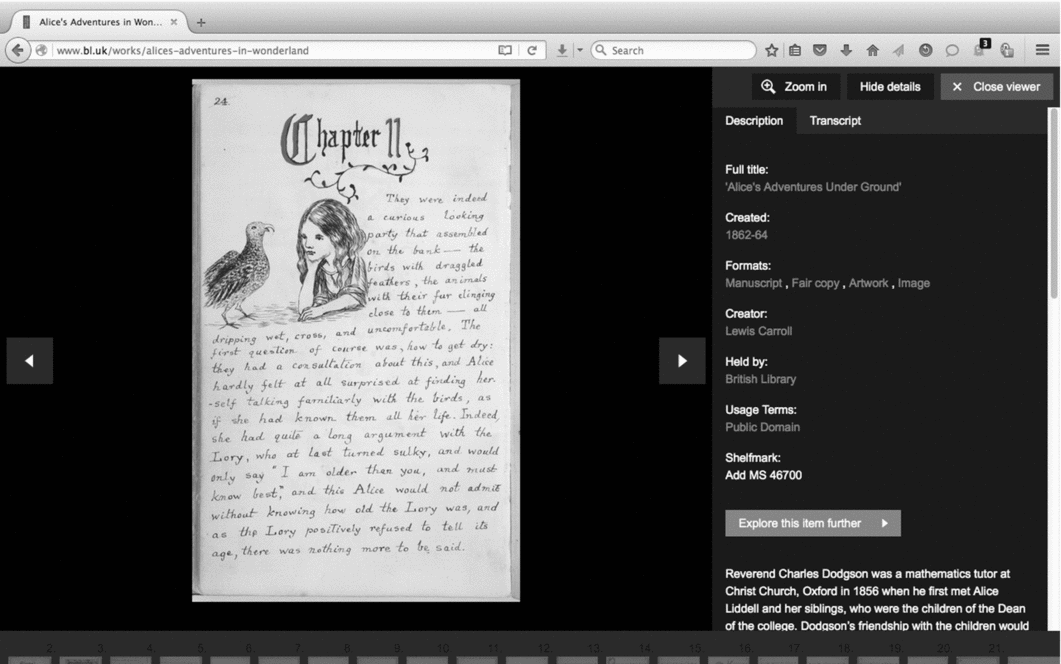
The selection of items is extraordinary, as one might expect from a British Library site. There are images of the manuscripts of, for instance, Alice's Adventures in Wonderland, Jane Eyre, Middlemarch, and The Importance of Being Earnest, to name a few, as well as images of an assortment of important print editions (Figure 11). The library has also employed an important tactic to address multiple audiences. For longer manuscripts, the site's manuscript viewer displays only a few key pages, but those with a specialist interest can follow embedded links to the library's “Turning the Pages” initiative, which presents collection items in full. Additionally, the library has called on a range of leading critics to provide the contextual essays and to narrate the videos. As a result, the site's materials reflect the library's world-class holdings and the first-class scholarship of the critics.
Discovering Literature: Romantics and Victorians: a leaf from the manuscript of Alice's Adventures in Wonderland as presented through the British Library's image viewer. © The British Library Board.

Discovering Literature makes a number of important contributions to digital Victorian studies. The site's design and content diversity represent the most important such contributions. The creators of the site have given careful attention to developing a site whose aesthetic dimensions, navigational capabilities, and critical materials reflect the richness of the core primary content. There are lavish, colorful illustrations throughout the site; multiple routes to the materials; and texts, images, and videos that set the library collection items in broader historical and biographical contexts. The image viewer also deserves praise for its graceful presentation format, ease of use, and integrated provision of bibliographical and critical materials.
The site's limitations fall into two principal areas. First, despite the richness of the primary and secondary content, users will find it difficult to extract the content from the British Library interface. For instance, the site offers no options for easily downloading individual or multiple images for study or analysis. Users can only view images through the viewer or right click and save them in a cumbersome one-by-one fashion. Second, the “About the Project” page provides only minimal technical information. The page does not identify the creators of the site by name, or define any of the standards by which the underlying data was created, or outline the plans for preserving this data long term, or discuss the overall objectives of the project. As a result, users must infer such information from other parts of the site. In other words, the library has not capitalized in full, as yet, on the opportunity it has to educate users not only about the period in question, but also about the technologies used to deliver materials from this period to a global audience.
BRANCH: Britain, Representation, and Nineteenth-Century History (Felluga; 2012-present), like the British Library site, takes a large scale approach to its subject. BRANCH differs in its near exclusive emphasis on secondary materials. The site offers users a large collection of illustrated essays that together constitute “a free, expansive, searchable, reliable, peer-reviewed, copy-edited, easy-to-use overview of the period 1775–1925” (home page) plus a small selection of prose that explores the digital humanities dimensions of BRANCH. Leading critics working across this period have authored the period-specific pieces, with some 150 authors (of an expected 300) contributing to date. The scale of the individual essays runs the gamut from encyclopedia-length pieces (1,000 words) to pieces that might likewise appear in a scholarly journal (10,000 words). For authors, therefore, the site offers a chance to publish essays in a peer-reviewed context without significant restriction and of a length appropriate to the subject matter. This range also ensures that the site will cater to a variety of academic and popular audiences.
Dino Felluga, the site's director, has designed the site not only to overview the period through critical texts and historical images, but also to facilitate users capitalizing upon diverse thematic connections among the essays. In some cases, multiple essays take up or will take up the same topic. In other cases, the disciplinary backgrounds and/or geographical diversity of the authors (who come from history, art history, and English departments around the world) create both links and distributed perspectives. Felluga's site thus seeks to capitalize on the means by which given essays branch off from one another:
BRANCH offers users an innovative approach to history itself, suggesting that any given bit of historical information can branch outward in often surprising directions. Rather than provide a linear timeline of history from the perspective of the victors, I wish to provide a history that comes closer to what Walter Benjamin famously termed jetztzeit or “the time of the now,” an impacted history that explores the messy uncertainties and possibilities of any given historical moment. (Felluga, “About”)
The site achieves these links, most importantly, at the thematic level.
BRANCH deploys two principal methods and one secondary method for connecting content. The first method uses assigned (rather than auto-generated) topic clusters that fall under eight themes to group the essays and enable browsing: 1) culture, 2) empire and the world, 3) history and time, 4) identity, 5) meta-critical discussions of event or temporality, 6) politics, government, political economy and bureaucracy, 7) science and technology, and 8) war, rebellion, and revolution. The site then divides these clusters into additional subclusters. BRANCH also provides access to the essays through a timeline that either ties essays to a specific historical moment or graphically presents them as spanning a longer period.Footnote 9 Finally, users can browse newer essays through a carousel that appears at the bottom of the home and timeline pages.
BRANCH makes several significant contributions to digital Victorian scholarship. Through the use of distributed peer-review (effectively scholar-based crowd sourcing), Felluga has demonstrated that a vast yet rigorous digital project can be developed despite a limited budget. The selection of critics and the production method has also ensured that the essays are of a uniform high quality. The “About” section draws on an essay by Felluga that originally appeared in Critical Quarterly and provides a succinct yet rich introduction to both the objectives of the project and the broader critical and technological contexts for these objectives. Finally, the tab-based design of the site is simple, yet easy to navigate and so encourages repeat user visits.
Users interested in manipulating the site's underlying data or in learning about the technical development of the site, however, will find limitations. Since Felluga hired Performant Software Solutions, a commercial company, for site development, Felluga's role in the complex decision process that ultimately shaped the technical implementation of the site is not clear. The site itself contains little information about its specific use of Wordpress (a content management system) as a publishing platformFootnote 10 or about plans in place to maintain the site long term. The essays are XML-based, suggesting that textual content has been marked up (i.e., coded) in a manner that would facilitate sophisticated sorting and searching, but the site does not detail its coding guidelines or make the essays (whether individually or collectively) available for users in XML format. Most importantly, the site's search function does not appear to take advantage of any specialized markup or even metadata (only full text searching is possible). It is also not clear if the coding of the essays would allow for automated harvesting in a manner that might enhance the site's functionalities and, indeed, enable auto-generated branching in future phases of development. Finally, although the site plots the distribution of its authors on a global map, a lack of links between this map and the essays themselves represents a missed opportunity for creating an additional, dynamic browsing option.
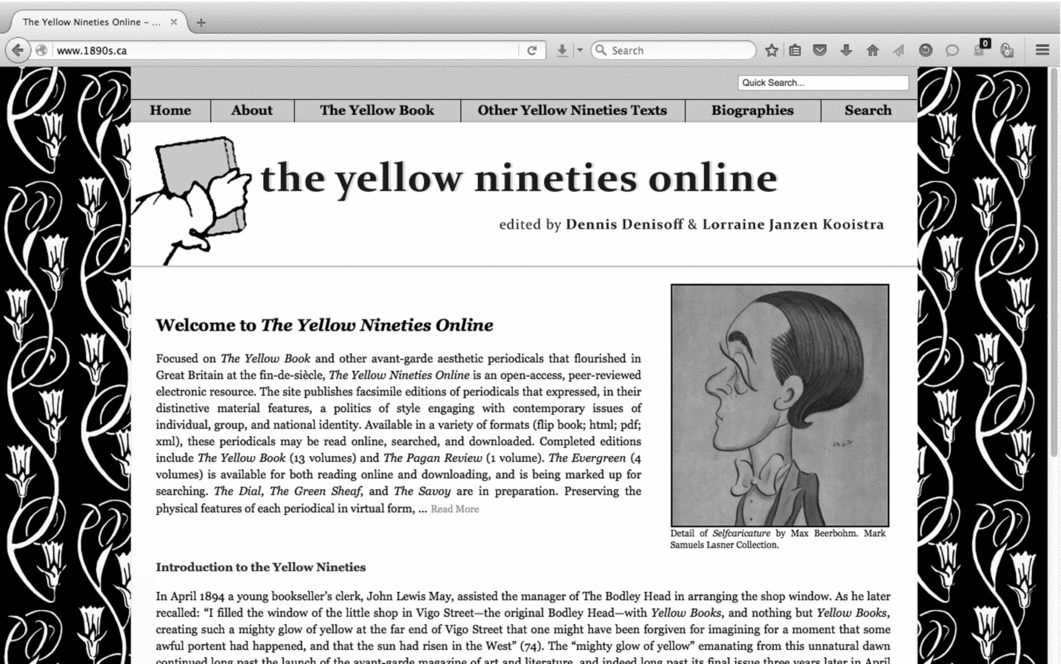
The Yellow Nineties Online (Denisoff and Kooistra; 2011-present), in contrast to the previous two sites, sets its scope to a more limited set of materials (Figure 12). The site focuses on “The Yellow Book and other avant-garde aesthetic periodicals that flourished in Great Britain at the fin-de-siècle” (home page) and seeks to develop critically edited and annotated facsimile editions of these periodicals. This focus narrows the audience primarily to academics. To date, the editorial team led by Dennis Denisoff and Lorraine Janzen Kooistra has completed editions of The Yellow Book (13 volumes) and The Pagan Review (1 volume). The Evergreen (4 volumes) and The Pageant (2 volumes) are available for reading and downloading; marked-up, searchable editions are in preparation. The site includes peer-reviewed critical biographies of individuals associated with the periodicals or involved in their production, and a small but rich collection of critical essays on the development of the site. There are also basic and advanced search sections, the latter of which allows users to constrain searches by genre and additional metadata-based filters.Footnote 11
Yellow Nineties Online home page. Published by permission.

Every aspect of the site demonstrates rigorous scholarly care. The site's intuitive, dropdown menu-based design ensures that, from the home page, users are no more than two or three clicks from the primary and secondary content. The central column of textual and visual content relies on three-tone combination of colors (black, white, yellow), while the column's black and light yellow borders incorporate designs similar to those on Aymer Vallance's art-nouveau playing cards featured in second volume of the Yellow Book. The site thus encourages exploration through an elegant layout that reflects the aesthetic sensibilities of the primary content and so that skillfully marries form with substance.
The site presents its primary historical materials in several ways. For the Yellow Book, the star of the show, the site includes a critical introduction to each of the thirteen volumes plus four types of downloadable electronic versions of the volumes themselves. The digital modeling of the periodicals in these electronic versions is uniformly excellent; the multiple download options enable users to engage with the materials in a comprehensive manner.Footnote 12 Users can thus, online or locally, study the periodicals as textual and material objects or engage in advanced digital processing. The site also makes available electronic versions of promotional materials for the Yellow Book, contemporary reviews, an overview essay, and a bibliography. The one volume Pagan Review receives similar treatment minus the critical essay and bibliography, while the other periodicals appear only as electronic versions limited to the individual volumes themselves.
Finally, the site also contains a user-friendly selection of critical materials on project standards, methods of production, and objectives for collaboration. The editors link this provision to the primary content under scrutiny because, on their reading, “the aesthetic periodicals of the long 1890s anticipate key conceptual and methodological concerns of electronic scholarship” (home page, with “Welcome” section expanded). The essays themselves not only reflect on the process of developing the site, but also set individual team member efforts against broader developments in the field. Additionally, the section on “Editorial Principles” outlines overall project goals, while a subsection on “Technical Decisions” deftly walks through specifications of storage, backup, imaging, encoding, searching, and interface creation.
Thanks to this rich array of materials, the Yellow Nineties Online demonstrates best practice for digital Victorian sites in a manner matched by few peer projects. The site shows that such projects can focus in a rigorous manner on primary content, while also meeting international standards for digital development, preservation, documentation, and transparency. The site caters to Victorianist users by providing easily-accessible versions of the primary and secondary content, but also ensures that digitally-oriented practitioners can readily explore the site's enabling technologies and draw on the site's primary data as needed. Most importantly, the site implicitly indicates the importance of program planning. The project team has clearly worked to set an appropriate scope for each phase of project development, and this forethought has in turn allowed the team to balance analysis and editing of the primary materials with appropriate attention to and reflection on underlying digital methodologies.
The Olive Schreiner Letters Online (Stanley; 2008–2012) likewise builds on first-class scholarship, but differs from the previous sites because it is not an open-ended project. The site, now complete, has a defined core objective of producing rigorous, annotated scholarly transcriptions of the 5000 letters Schreiner wrote between 1871 and 1920. The site provides five principal options for browsing subsets of these letters. Users can study those letters that the project editors have identified as most essential or browse the collection by 1) repository, 2) topic, 3) letter recipients and other key figures mentioned in the letters, and 4) letters identified after the project ended. The site also includes basic searching and an advanced search page that combines full-text, metadata, and textual markup searching. This robust set of options enables the site to accommodate the needs of a diverse user base, both academic and general.
The project team, under the guidance of Liz Stanley, has produced rich annotations for the site's materials. Every part of the site opens with a concise page or section that outlines the objectives and scope of that part, and additional such annotations appear as users drill down. Each curated sets of materials in “Essential Schreiner” and “Letters by Topic,” for instance, has a brief introduction that provides an overview of the given set, while the section on “Letters, Collections, Archives” introduces each contributing repository and describes the scale of its relevant holdings. Such general annotations point to the care with which the project team has constructed the entire site, but also orient users on specific data sets. Links to individual letters include basic metadata (title, date, repository, and shelfmark), preview the first few lines of the letters, and provide keyword summaries. The letters themselves open with extended metadata, including permissions information, and are generated from the underlying XML files. The interface thus presents the letters line by line as laid out on the manuscript page, while all references to individuals link to the relevant page in the “Dramatis Personae” section. The letters also close with annotations from the editors as relevant.
The combination of these features enables the Olive Schreiner Letters Online to succeed as an integrated whole that demonstrates admirable scholarly attention, breadth, and detail at each level. In doing so, the site creates a uniform user experience for both general audiences and specialists that foregrounds the primary historical materials. The tradeoff appears in what the site doesn't provide. The site relies almost wholly on text and presents only a handful of decontextualized manuscript images, although the side-by-side presentation of images and transcriptions has become an almost de facto standard in such projects. The site also limits technical information to a few subsections of the misleadingly named “Project Publications & More!” section. There users can meet the editorial team or read a single essay on the editorial process or walk through a glossary of “Key Ideas & Theories” that have shaped the project. However, for more detailed information on the site's history and objectives, users have to turn to the now abandoned first version of the site at a different URL.Footnote 13
The Livingstone Spectral Imaging Project, particularly the “multispectral” critical edition of David Livingstone's 1871 Field Diary (Wisnicki; 2011–2013), takes a different approach in documenting its methodology. Indeed, the project's contributions to digital Victorian studies lie, first, in its application of state-of-the-art spectral imaging technology to recover otherwise invisible text from Livingstone's diary, and, second, in the manner in which project invites users into its inner workings. This use of spectral imaging technology represents the first such application for the study of any nineteenth-century British literary manuscript. Spectral imaging relies on photographing an object, such as a manuscript, under multiple wavelengths of light ranging from ultraviolet (UV) through the visible color spectrum to the near-infrared, then applying various processing algorithms to enhance features of interest. Often this occurs by creating pseudocolor (false-color) representations of the object that foreground or suppress targeted object elements.
Livingstone composed his diary over the pages of an old newspaper and used ink concocted from a local African clothing dye to write his text. Over time, Livingstone's ink faded from red to orange-yellow, while the underlying newsprint remained black. As a result, in the present day two factors combine to curtail the diary's legibility. Livingstone's faint ink barely stands out from the underlying, yellowed newspaper pages, and the continuing prominence of the newsprint considerably interferes with reading what can be seen of Livingstone's text.
To counter these issues, the project team, led by the present author, used spectral image processing to minimize the visibility of the newsprint, while concurrently converting Livingstone's ink into a highly legible set of darker colors that reveal the text of the diary for the first time in 140 years. The resulting critical edition presents the full transcribed and annotated text of the diary, plus multiple spectrally enhanced images of the diary, the option for detailed searches of the 1871 Field Diary text based on specialized markup (metadata and full-text site searching are not possible), an array of supporting critical materials, and a project history that tracks the project's methodology end-to-end with text, images, and downloadable project documents. Additionally, the related Livingstone Spectral Imaging Archive (Wisnicki; 2011–2012) offers unmediated download access to all the core and supplemental data files upon which the critical edition relies.
The diary itself, which has never before been published in its full and unabridged form,Footnote 14 includes new evidence about Livingstone's imbrication in a slave trading massacre he witnessed in Central Africa. In tracking Livingstone's actions before and after that massacre, the diary also records details of a key turning point in the history of European colonization in Africa. Livingstone's decision, after the massacre, to turn back from his explorations set the stage for his meeting with Henry M. Stanley, which in turn launched the latter's career and eventually laid the groundwork for the colonization of the Congo. As a result, the edition combines historical significance with the application of cutting-edge technology and does so, at a baseline level, with before and after images of Livingstone's diary that make the point to both general and specialist audiences.
The successful application of spectral imaging technology offers promise for the textual study of other problematic nineteenth-century British documents, such as redacted Byron letters held by the National Library of Scotland. In a new spectral imaging project on another Livingstone diary, the project team has also begun to demonstrate that spectral imaging can reveal otherwise invisible manuscript material elements such as after-the-fact additions and page topography, thereby opening new directions for the use of the technology.Footnote 15 Finally, the project's combined emphasis on transparency, documentation, and access to data files also distinguish it from peer digital Victorianist projects. Indeed, the project tests the limits of what can or should be documented and made available in endeavors of this sort, as Matt Rubery has noted in his review of the site for NINES.
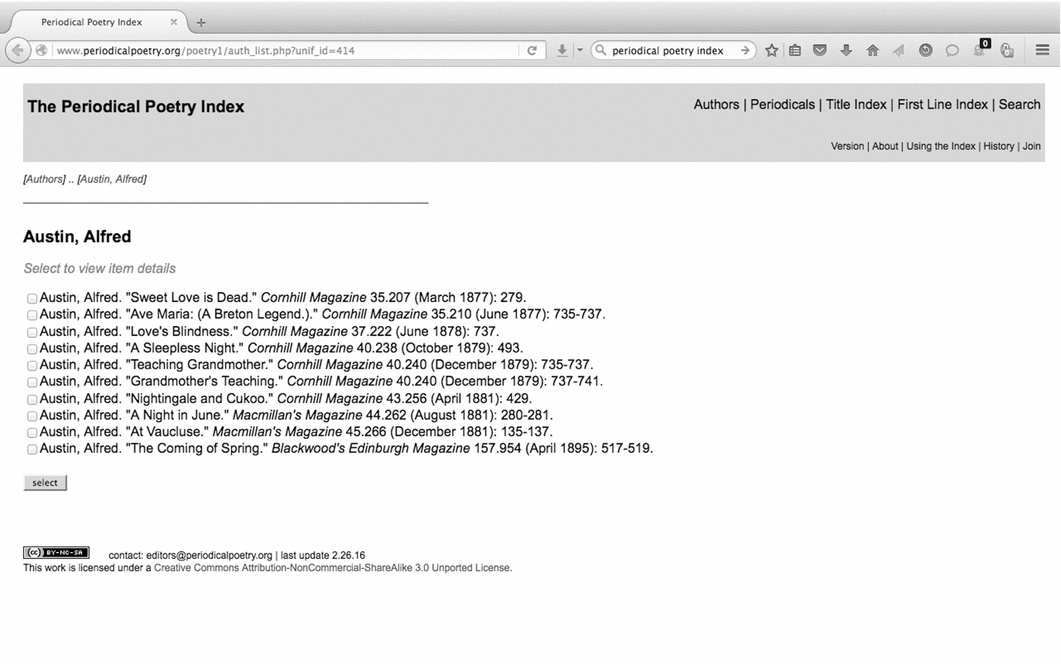
In closing, a look at two projects that point to potential futures for digital Victorian studies may prove useful. The first, the Periodical Poetry Index (Houston, Lawrence, and Patrick, Index; 2010-present), offers users “a research database of citations to English-language poetry published in nineteenth-century periodicals, including texts by nineteenth-century British and American poets, poets from earlier periods, and poems in English translation” (home page) (Figure 13). With this approach, the site aspires to fill a gap created by the decision to exclude poetry from the Wellesley Index to Victorian Periodicals, but also differs from the Wellesley in “focusing on the poem as it is published in the periodical, rather than author identification and provenance” (Houston, Lawrence, and Patrick, “History,” Index).Footnote 16 At present, the database includes about 1200 poems from three periodicals (Blackwood's Edinburgh Magazine, Cornhill Magazine, and Macmillan's Magazine) with more periodicals in the works.Footnote 17 The emphasis on periodical materiality makes the site most useful to academics, particularly those with an interest in poetry; the site's focus on poetry also complements the interest of many other digital Victorian projects on prose or illustrations.
The Periodical Poetry Index: Sample author entry (Alfred Austin). Published by permission.

The site, co-directed by Natalie Houston, Lindsy Lawrence, and April Patrick, provides five ways to access the poems. Users can browse by author (name, pseudonym, or initials), periodical (volume, issue, date), title, and first line of each poem, or can search by imposing one or more facets drawn from the metadata (there are no options for keyword searching of any sort). Any of these browse and search paths eventually take users first, to a bibliographic citation for the selected poem; second, to additional item details; and, finally, to images of the pages of the specific periodical volume in which the poem appears, as digitized and archived by the Hathi Trust Digital Library. Such direct access to primary materials is possible because the Hathi Trust, a “partnership of academic & research institutions,” offers “a collection of millions of titles digitized from libraries around the world” (Hathi Trust, home page). As a result, the overall trajectory results in study of the poem as originally published on the page of the periodical and in the volume of the periodical as a whole since links are always to periodical volumes not specific poems. More broadly, the site promotes research and discovery by the relationships it foregrounds through indexing and by recontextualizing the poems within the original print objects.
The Periodical Poetry Index delivers its content through an exceptionally minimalist site. The site combine a gray rectangular header (with links to the site's main sections) with an otherwise lavish use of whitespace that, whether intentionally or not, recalls the whitespace that surrounds a poem on the printed page. The webpages deploy only a single font (Arial) with variation achieved through vertical spacing, font size, and formatting, and by alternating black, gray, and hyperlinked blue text. The underlying framework relies on a custom-built solution using PHP pages and a MySQL database,Footnote 18 with research for this site performed, as the directors note, via “free, web-based resources, specifically Hathi Trust, Google Books, and Google Forms” (Houston, Lawrence, and Patrick, “History,” Index). The integration of these elements creates a user-friendly site that makes its content easy to navigate, find, and sort, and that places emphasis on supporting the user's research goals.
From the perspective of this review, the Periodical Poetry Index embodies a successful, yet fully self-empowered digital humanities venture. The site's directors have developed the project with little or no funding, and the site demonstrates how an initiative with few resources can dramatically increase its scope by drawing on (i.e., linking to) open-access large-scale data created by other projects, in this case the Hathi Trust. This model of digital humanities praxis points the way for other scholars who may have vision, but otherwise lack the financial basis to develop their digital projects along more established lines by, for instance, themselves carrying out digitization of primary source materials. Most importantly, the index also holds great as yet largely untapped potential due to its production of raw data on the publication of poetry in the nineteenth-century periodical press. Such data, in future phases of work, might become the basis for innovative computational analysis or visualization, areas that scholars working in digital Victorian studies are only beginning to explore.Footnote 19
The second project this essay takes up in closing, Livingstone Online (Wisnicki; 2005-present; previous version: 2005--15), focuses on developing an archive of images, transcription, and metadata related to David Livingstone, with core data supplemented by an array of critical and documentary materials (Figure 14). The project represents a long-running venture, founded initially by Chris Lawrence. The first phase developed for five years (2005–10), with the scope of the project ever broadening to encompass materials from multiple archives. The present author joined the project at the end of this phase, just before a failed grant bid put the project on public hiatus for three years. Lawrence passed directorship to the present author in 2013, when the Livingstone Online relaunched due to a newly funded initiative, LEAP: The Livingstone Online Enrichment and Access Project (2013–16).
Livingstone Online home page: David Livingstone (stooping) appears among African, Arab, and American traveling companions. CC BY-NC 3.0. Underlying illustration: “Lithograph of Henry Morton Stanley and David Livingstone on the River Ruzizi.” © Wellcome Library, London. CC BY 4.0.

This shift, itself an uncommon transition in leadership in terms of digital humanities projects, has enabled a redevelopment of the site and reconceptualization of its critical approach, hence its inclusion here. The project team has increased in number and has taken on a much more interdisciplinary, international character, with collaborators now in England, Scotland, the United States, and South Africa. The site has also begun to reflect critically on its representations of a colonial archive, partly thanks to the addition of Megan Ward as co-director. From a focus on Livingstone, the individual, the site has shifted to recontextualizing Livingstone within the nineteenth-century internationally collaborative contexts in which he operated. The site echoes this historical focus on collaboration with, first, a critical look at the collaborative work to preserve Livingstone's legacy over time and, second, a parallel effort to take users “behind the scenes” of the revitalized Livingstone Online itself. Complementing these discursive turns, the project team has redeveloped the form of the site from the ground up in order to cater to the expectations of a broad modern audience.
As a result, the beta version of the new site (published June 2015) balances textual illumination via critical and documentary materials with visual representation in the form of contemporary and historical images. Every essay has been critically edited; every illustrative image has been selected after careful reflection; every documentary material has been strategically chosen (the site provides access to a curated collection of 300 such items). Moreover, when completed in 2016, the site will combine these elements with access to some 10,000 images of original manuscripts, several thousand pages of transcriptions, and nearly 3000 bibliographic records, thereby becoming the largest repository of its kind dedicated to any historical British traveler to Africa. There will also be options for searching combinations of full text, metadata, and marked up transcriptions, and for browsing via standard catalogue, addressee, repository, timeline, and geolocation.
On the present author's reading, this project points to the future of digital Victorian studies in a handful of ways. First, Livingstone Online demonstrates how a digital project designed and defined in one context might be sustained long term through transition in leadership and redirection, rather than dying a quiet death on the internet as many such long-term digital projects do. Second, the project underscores that with appropriate support – in this case, a combination of generous public funding and collaborator initiative that exceeds any funding provided – digital Victorian projects might not only meet international archival standards, but also critically engage with their role as digital mediators of history. Finally, Livingstone Online highlights the need for digital Victorian projects to conceive of their audience in broad terms, general and specialist, old and young, and to pursue development with these multiple groups in mind. The larger the potential impact for such projects, Livingstone Online suggests, the easier it becomes to justify funding, an otherwise chronic issue for digital humanities projects.
The collection of projects under review here, therefore, outlines the ongoing evolution of digital Victorian studies. These projects range in size and address diverse audiences. The projects often (but not always) couple large-scale data sets built to international standards with top-level scholarship and, in the best cases, critically reflect on the use of the digital medium and capture the particulars of their digital practices via solid documentation. The proliferation of open source, user-friendly tools and publishing platforms has begun to make a positive impact on digital Victorianist endeavor, as has attention to long-term preservation and computational analysis. As a result, these projects, when set alongside the eagle's eye critical context cited at the start of this essay, indicate that the overall field of digital Victorian scholarship remains robust.
However, given the current historical moment, such digital Victorianist research is by no means exploding, as one might expect. Digital scholarship represents but one current among many in the larger field of Victorian studies. Interest among Victorianists in digital initiatives remains high, as evidenced by large attendance numbers at relevant conference panels or, to cite a recent example, the decision to open the NAVSA 2015 conference with a session on the digital humanities. Yet considerable factors likewise pull in the other direction. The legitimacy of digital humanities scholarship, Victorianist or other, in tenure and promotion evaluation remains an issue, with the result that scholars often feel reluctant to pursue such projects. A look at recent higher education hiring trends also reveals an ongoing decrease in the number of Victorianists hired each year. Fewer positions means an expanding need for scholars that look more like traditional Victorian generalists. Finally, reluctance to engage in digital humanities development – which can involve a steep learning curve for the uninitiated and, ultimately, require more effort and resources that traditional scholarship – also continues to be a problem. Whether time will diminish the impact of these factors remains an open question.