“There is no Ivorian ‘miracle’ because a miracle, like a bet, is prepared, is conditioned, is measured, is decided and is carried out through sheer will and perseverance.” – Félix Houphouët-BoignyFootnote 1
IntroductionFootnote 2
How does comparison shape what we know? During the 1960s and early 1970s, it was in vogue among social scientists to study Ghana and Côte d’Ivoire together. One of the late twentieth century’s most well-known sociologists, Immanuel Wallerstein, declared the neighboring countries “a ‘natural’ opportunity for comparison.”Footnote 3 Yet several decades of scholarship have undermined the premise; nothing is natural in acts of knowledge production.
This article reveals the hidden history of the comparison’s construction, and how its optics shaped, at once, Ivorian self-hood and Africanist social science. I show that both Ivorian national identity and studies of Ghana and Côte d’Ivoire as a “natural” pairing took from the same source: a perceived temporal disjuncture between a Gold Coast/Ghana that is “ahead” and a Côte d’Ivoire that is “behind” on the linear march to modernization.
To do so, I focus on the “West African Wager,” a high-profile meeting between the leaders of Ghana (Kwame Nkrumah) and Côte d’Ivoire (Félix Houphouët-Boigny) that took place in Abidjan in April 1957. Before a distinguished crowd, Nkrumah and Houphouët placed a bet as to whose political strategy would reap more rapid rewards. Two of the most well-known political figures on the continent, they represented contrasting approaches towards African development. Nkrumah advocated for political sovereignty as a pre-requisite of economic independence. Appropriately, in April 1957 Nkrumah came to the wager as the first Prime Minister of independent Ghana. Houphouët instead maintained that formal independence would only undermine the ability of Africans to access the human and material resources necessary for development. At the time, Côte d’Ivoire was still a territory in the federation of French West Africa (FWA), and Houphouët was determined that it remain ensconced in a Franco-African political structure. The wager that the two leaders placed, then, was about which political and economic approaches would most efficiently lead to development, their shared goal. A decade hence, Houphouët declared, the winner would be judged.
Quickly, the bet took on dramatic overtones. Once political independence in Côte d’Ivoire became a foregone conclusion (by 1958), the polarization of the early independence period super-charged the stakes of the wager. No longer was the bet over what political form development should take, but rather whose postcolonial strategy would accrue greater success. The wager operated at multiple levels. As individuals, Nkrumah and Houphouët presented a compelling story of political rivalry.Footnote 4 Regionally, they headed opposing blocs, Nkrumah’s Casablanca group striving for a union of independent African states and Houphouët’s Monrovia group resisting the cession of sovereignty for pan-African integration. On the global level, the Cold War’s ideological contest washed the bet with its colors, transforming the two African leaders into standard bearers for socialist and capitalist development models. The wager had laid bare an axis alongside which African countries were obliged to position themselves. Fed by the ideological contests of the early 1960s, it came to represent an iconic moment of clashing geopolitical visions.
The 1957 wager thus emerged as a signal event in modern African history. Over time, it has also become a well-worn hook upon which social scientists have hung their comparative analysis. Yet the event itself has never been adequately historicized. Drawing on an exciting archival discovery, I argue that the wager was politically staged and strategically invoked as a primordial act of Ivorian national myth-making. By setting up Côte d’Ivoire as a competitor with Ghana, and himself as a rival of Nkrumah, Houphouët launched himself and his territory into the international spotlight. The same justifications for comparison that suited the needs of social scientists during the first decades of African independence could also fulfill the wishes of a skilled politician.
Comparison as Social Science
It was Immanuel Wallerstein who inaugurated the tradition of Ghana-Côte d’Ivoire comparative social science. In 1956, when he set off for his doctoral dissertation research, both countries were still under formal colonial control. By the time Columbia University conferred his degree in 1959, Ghana had become independent and Côte d’Ivoire was set to inaugurate its statehood the following year. Wallerstein’s thesis would be published, in 1964, with the title The Road to Independence: Ghana and the Ivory Coast.
There were structural factors that lent ballast to the comparison. Both countries had overwhelmingly agricultural economies dominated by the same export crop, cocoa. Politically, they boasted centralized party-states with a strongman at the top. Geographically, both were relatively small territories covered by tropical forests in the south and drier savannah conditions in the north. These divides echoed religious and educational ones, as both territories had higher rates of (Western) education in the coastal south among majority-Christian populations and lower rates of education among predominantly-Islamic populations in the north. Ethnic and linguistic diversity characterized them both; Akan populations straddled the border between them. Compellingly similar, the two new nations had a key historical difference: Ghana had been colonized by the British and Côte d’Ivoire by the French. With such a constellation of variables, the pair offered tremendous comparative appeal.
It was a comparison, however, that went one-way. That is to say, it was structured on Ghana’s terms, with Côte d’Ivoire only legible in the matrix of association with its eastern neighbor. Wallerstein, when asked how he settled on the Ghana-Côte d’Ivoire pairing, replied (personal communication, 30 October 2017):
I chose Ghana because at the time it was the West African state in the lead for being the first to become independent. Any other choice would have been bizarre. And the Ivory Coast (…) was the obvious comparison. The only other one would have been Senegal and Senegal was in most ways a special case. There was also the fact that the Ivory Coast was the HQ, so to speak, of the RDA.Footnote 5
Ghana was therefore Wallerstein’s original object of study, with Côte d’Ivoire slotted in to afford a comparative perspective.
Aristide Zolberg, who published the first English monograph on independent Côte d’Ivoire, also came to his topic by way of Ghana. Or more precisely, by way of his advisor, David Apter, whose Gold Coast in Transition (1955) was a foundational work of Africanist study in the United States.Footnote 6 Apter sought a student who would develop, in the context of a former French colony, the ideas that he had set forth for the then-British Gold Coast. Zolberg, who was born in Belgium and lived until he was sixteen in exile in France, was the perfect graduate student for the job. When Apter suggested Zolberg head to Abidjan, Zolberg was utterly stumped. Albeit a native Francophone, he had never heard of Côte d’Ivoire.Footnote 7 What was true for Wallerstein was true for Apter’s student: the route to Abidjan in Anglophone academia seemed somehow to pass through Accra.Footnote 8
Accra, that is, and Chicago. When Apter suggested Zolberg study Côte d’Ivoire, it was during the first year of Apter’s tenure at the University of Chicago. Indeed, Zolberg became the first graduate student sponsored by the University of Chicago’s newly-formed Committee on the Comparative Study of New Nations, whose founding members included, among others, David Apter and Clifford Geertz. In his memoir, Geertz would eulogize the New Nations Committee as a “formidable enterprise (…) a scholarly community with a style and a standpoint, something less than a school but more than a talking shop.”Footnote 9 Fully-funded by the Carnegie Corporation, the Committee’s explicit mission was to deploy universal categories in order to develop systematic comparison that would enlighten American policy with regard to the Third World.Footnote 10 It became the hub of the scholarly energies that would solidify the Ghana-Côte d’Ivoire pairing.
Philip Foster was another associated member of the Committee. His highly-regarded Education and Social Change in Ghana (1965), like David Apter’s work, was a pioneering attempt to apply the modern tools of social science to analysis of African politics and society. Foster explicitly focused on Ghana because he saw it as “a bell-wether for many of the other emerging African states” and argued that study of Ghana’s experiences would shed light on “the lot of many other countries, even outside Africa.”Footnote 11 Like Apter, Foster saw in Côte d’Ivoire a stellar candidate to extend the work he had done on Ghana. Between 1964 and 1966, he would co-write, with Rémi Clignet (an educational sociologist at nearby Northwestern), several articles that compared the two countries’ educational policies.Footnote 12 They would also, in 1966, publish a monograph devoted exclusively to the study of Ivorian education. The terrain was explicitly chosen to test “certain hypotheses” that Foster had developed by studying “the adjoining nation of Ghana.”Footnote 13 Ghana ever its neighbor’s metric.
In 1971, the efforts of the Committee on the Comparative Study of New Nations culminated in Perspectives on Modernization: Ghana and the Ivory Coast, a volume jointly edited by Zolberg and Foster, with an introduction penned by Wallerstein. The publication grew out of two previous meetings: a panel at the 1967 African Studies Association’s annual meeting co-chaired by Wallerstein and Zolberg and a two-day conference in March 1969 at the University of Chicago which was attended, prominently, by David Apter.
The 1960s was thus a period of tremendous intellectual activity around the Ghana-Côte d’Ivoire comparison by a small group of specialists who came to see the latter through the lens of the former.Footnote 14 Following Perspectives on Modernization, the flurry of scholarship around the comparison died down, reflecting general disenchantment with modernization theory. A perceived temporal disjuncture between the two countries structured this prolific social science output. Peering from the heights of Accra, the academician cast about for a suitable parallel. Throughout, Côte d’Ivoire was pitched as a foil to Ghana’s story, a Ghana-in-progress. Wallerstein had affirmed the pairing a “natural” one. But what if the very comparison that shaped this social science had purposefully been manipulated?
The West African Wager
Analysts have misunderstood this key moment in the era of African independence. It is generally portrayed as an event in which both leaders are equally implicated, reported to have taken place but never adequately historicized.Footnote 15 The origins of the encounter remain unexamined. How, actually, did this remarkable wager come about?
An archival discovery in an unexpected place divulges the wager’s hidden history. The convention amongst analysts interested in the bet has been to cite documents found in the French colonial archives in Aix-en-Provence. Recently, the “crossed gazes” of colonial officialdom have led to the realization by historians that “indirect colonial archives” can shed light on extra-imperial territories.Footnote 16 In this case, a six-page memo found among French diplomatic records regarding independent Ghana challenges the inherited narrative of the wager.Footnote 17 Corroborated by Ghanaian newspaper reports, this document reveals that Houphouët-Boigny deliberately engineered the encounter. Like any true act of political theatre, it was brilliantly staged.
Agency for the wager is often ascribed directly to Nkrumah.Footnote 18 But this is a story in which the Ghanaian is only indirectly the star. While he may have adapted to the circumstances, they were not of his making, nor was the wager of political consequence for him. Ghanaians were more upset about the circumstances of his departure than the events that took place abroad. The tactician of the wager, and for a long time its beneficiary, was one Houphouët-Boigny.
- Roots of the Comparison, pre-1957
Before turning to the April 1957 wager, let me briefly point to the precursors of the comparative logic that linked the Gold Coast and the Ivory Coast well before 1957.
First, there is a pre-colonial layer to this story, which lends the pairing resonance beyond “high” political circles. At independence, about one-quarter of Côte d’Ivoire’s population could count themselves as Akan or Akan-related societies – the ethno-linguistic group that dominated the Gold Coast.Footnote 19 Houphouët, himself the son of a Baoulé chief, traced his family origins back to the Ashanti kingdom and the eighteenth-century flight of Queen Pokou across the Komoé river.Footnote 20 When addressing a Ghanaian counterpart – including on the evening of the bet – he never failed to invoke the “special links” between the two countries.Footnote 21 Akan-descended Ivorians acknowledge these historic ties even today: “our origin is Ghana,” people will say, “we are Ghanaians.”Footnote 22
Thus, preceding the colonial overlay of comparison, present-day Ghana to some extent symbolized the “roots” of Ivorians who identified as Akan. We owe a striking historical irony to this history of pre-colonial migration: Nkrumah, who was born closer to the Ivorian border than to Accra, and Houphouët-Boigny were the only two African leaders at independence able to converse in a non-European language.Footnote 23
During the nineteenth century, British and French colonizers created the containers that would become the Gold Coast and the Ivory Coast. By the 1930s, the instinct of inter-imperial competition had spurred what some historians of colonialism have termed “crossed gazes.”Footnote 24 Territories on the frontline of imperial divides, especially, were imbued with a comparative urge: who did empire best? The desire to delineate a French and a British colonial system corresponded with the need to cultivate so-called “showcase” colonies, possessions that displayed the ideals of the imperial tradition that they supposedly epitomized. In Africa, the Gold Coast – the continent’s most prosperous colony, with its pro-British elite, relatively high levels of education and agricultural exports – was Britain’s undisputed choice.Footnote 25
The Second World War forced European empires in Africa to reframe their presence on the continent.Footnote 26 One such effort was the Colonial Office’s 1947 Caine-Cohen report, which mapped out a four-stage pathway to self-rule beginning with local, democratic government. Its implementation in the Gold Coast became an explicit model for “the official mind of French colonialism,” as the French grew to appreciate that “progressive administration devolution was to become part of a more subtle strategy for continued control.”Footnote 27 Accordingly, in 1951 (following the RDA’s disaffiliation with the French Communist Party), Côte d’Ivoire emerged as the site to “showcase” the French Union, France’s own post-war attempt to reform empire.Footnote 28 The pairing of the Gold Coast and the Ivory Coast during the 1950s – these “old” and “new” showcase colonies – thus had a deeply imperial logic to it.
Given the antecedents of pre-colonial migrations and colonial rivalry, it should not surprise us that the Gold Coast loomed large in Houphouët’s imagination. Indeed, at critical junctures in his political career, he was explicitly referring to the Gold Coast as a model.Footnote 29 In March 1946, for example, he pointed to Côte d’Ivoire’s neighbor for evidence to support his signature law, which would end forced labor in the French empire. Addressing the French National Assembly he drew attention to the productivity of free labor on Gold Coast farms:
The example of the Gold Coast is there to condemn irrefutably forced labor. English Blacks were able to produce five times more than all the colons and African planters of Côte d’Ivoire using only voluntary labor, and yet we continue to make believe that it’s impossible to have the same results in a French territory when it’s exactly the workers of these [French] territories that go to the Gold Coast to rent out their services to the planters.Footnote 30
A few years later, in July 1952, Houphouët again drew a parallel with the Gold Coast to justify a major policy choice, the RDA’s aforementioned disaffiliation with the French Communist Party. He praised Nkrumah’s willingness to work with the Conservative British government of 1951 – engaged in, for example, the brutal Malayan emergency – as analogous to the RDA’s pragmatism. Writing publicly of his admiration for Nkrumah’s approach, Houphouët asked: “Did Kwame refuse to collaborate with the Conservatives who replaced Labour in power? He raised no battle cry against the British…Kwame acts. He has his feet on the ground. He does not dream.”Footnote 31 Repeatedly, Houphouët invoked developments in the British “showcase” to burnish his own actions. The trend would culminate with the wager of spring 1957.
- Staging the Wager
In early 1957, Nkrumah was a global celebrity. He was the leader of sub-Saharan Africa’s first sovereign nation, whose independence had been celebrated on 6 March. The whole world tuned in to the spectacle of an African nation lowering the Union Jack and hoisting a flag whose bold tricolor had a proud black star at its center. Ghana would shine brightly, the North Star in a constellation of independent and free African peoples.
Orchestrating such a show had taken its toll. During Ghana’s independence day celebrations, Nkrumah had turned to M.C. Renner, the French chargé d’affaires in Ghana, and admitted that he needed a vacation.Footnote 32 It wasn’t only the French reputation for languorous holidays that led Nkrumah to confess his exhaustion. He had in mind a destination for which he would need Renner’s assistance: Kankan, in northeastern Guinea, located in French West Africa. Nkrumah wanted to pay his respects to Cheikh Fanta Madi, a widely-respected religious authority and frequent counselor who had passed away in 1955, while also strengthening his ties with Guinea’s rising political star, Sékou Touré. In 1951, when Nkrumah, then a proto-head of state of the Gold Coast, had sought to visit Fanta Madi, he had been deported by French authorities.Footnote 33 This time, as Ghana’s prime minister, he sought to avoid a diplomatic scandal.
Renner, anxious not to repeat France’s error, quickly got to work. He contacted the High Commissioner of French West Africa, Gaston Cusin, asking for authorization of Nkrumah’s visit. Cusin was eager to help; he offered his own airplane and diplomatic counselor, Roger Chambard, to accompany the Ghanaian premier, “with every possible discretion” – an important detail. Because Nkrumah had stressed to Renner, above all else, his wish for privacy: “Mr. Nkrumah emphasized the purely private nature of his visit and insisted that his plan not be disclosed.”Footnote 34 Having been at the center of so much public attention, Nkrumah sought a break from the spotlight. Nkrumah planned a nine-day visit, with a pause in Abidjan to re-fuel. Preparations for the trip were undertaken with utmost discretion.
It was with outrage, then, that the Ghanaian press exploded when Reuters Paris wired a telegram confirming the details of Nkrumah’s first foreign trip just days before his departure. The Daily Graphic, Ghana’s leading newspaper, indignantly announced that it “would expect to get news about our Prime Minister’s movement not 3,000 miles away from Paris but from Accra.”Footnote 35 A columnist asked whether the Information Services were “proud that they have succeeded in pulling a fast one on the nation?”Footnote 36 The bungled communication troubled the Daily Graphic’s editors. When contacted by reporters, none of the government divisions, not the External Affairs Ministry, nor the Prime Minister’s Secretariat, seemed to be aware of the upcoming trip.
Of equal concern was the trajectory the news had followed, making Accra into a news backwater, and infringing on its own news sovereignty: “[the report] travelled half way round the world. But still the people of Ghana did not know about their own Premier’s intended trip – the first time he was to leave the new nation.” Above all, the press lamented the mysterious nature of the trip: “What is the reason for this conspiracy of silence? What was there to hide, in any case?” and “WHY ALL THE SECRECY IN ACCRA?”Footnote 37
Though the press was up in arms that far-away Paris had informed Ghanaians about Nkrumah’s travel plans, the source of the leak revealed itself much closer to home. According to the Daily Graphic, the report “was flashed from Abidjan to Paris, from Paris to London and then from London to Accra by Reuters news agency.”Footnote 38 Masked by the imperial circuits along which it traveled, the news of Nkrumah’s trip had thus originated about five-hundred kilometers west of the Ghanaian capital, in neighboring Côte d’Ivoire.
Desirous of grafting onto Nkrumah’s renown, Houphouët had taken the tried and true route to vaulting himself (and his territory) into the Anglophone limelight: via Accra. At a press conference on 28 March, held on the eve of elections throughout French West Africa that the RDA would sweep, Houphouët announced Nkrumah’s impending visit to Abidjan. The news broke in Accra on Monday April first; Nkrumah was set to depart that Friday.
While at first glance it would appear logical for Houphouët to inform the public of Nkruamh’s visit, the chain of command was not in fact so clear. Houphouët, as the leader of the RDA in the federation of French West Africa and in the territory of Côte d’Ivoire, had multiple roles. He was both a deputy in the National Assembly in Paris (where he served as a Minister in the cabinet of Prime Minister Guy Mollet) and president of Côte d’Ivoire’s territorial assembly. In addition to his national/federal and territorial posts, he also served as the mayor of Abidjan. However, all this should not obscure the fact that in April 1957, Côte d’Ivoire was still a territory in the federation of French West Africa. The constitutional referendum of autumn 1958, which would establish the French Community, was more than a year away. Diplomatic protocol would have either the French governor of the territory of Côte d’Ivoire (Ernest de Nattes) or the aforementioned High Commissioner of FWA (Cusin) announcing the visit of a foreign head of state. The Ivorian was not, strictly speaking, an official representative of France in external affairs.
But it was Houphouët who leaked Nkrumah’s visit to the press on 28 March.Footnote 39 One can only imagine the thoughts running through Nkrumah’s head as Houphouët welcomed him to Côte d’Ivoire, stating what an honor it was that “Dr. Nkrumah should have chosen Abidjan for his first visit abroad since his own country achieved independence [emphasis added].”Footnote 40
- Waging the Wager
On Friday 5 April, Nkrumah’s airplane touched down at the Port-Bouët airport in Abidjan. The enormous crowd that had been gathering since early morning rushed forth. Cries of “Freedom!” and “Ghana!” drowned out the formal honors music emanating from the military band that the French government had organized for the occasion. Women clad in brightly-colored Ghanaian independence cloths danced in welcome as drummers filled the tarmac with their rhythms.Footnote 41 The crowd was in such a frenzy that Nkrumah and his entourage (including the Ministers of Housing and Public Works, who, it can be inferred, were last minute additions to the travel party) had difficulty making it to the cavalcade of official vehicles awaiting them. “Charming disorder,” as Sékou Touré, also present at the airport, described it.Footnote 42 French motor police surrounded the open car in which Nkrumah rode with Houphouët, the better to be seen by the eager public lining the streets.
From Port-Bouët, the motorcade made its way to Cocody, “a new suburb, where each house is more modern than the next.” Nkrumah was taken to one of the biggest new villas, where a guard of honor, “dressed in splendid red,” kept diligent watch (a far cry from the discretion Nkrumah had been seeking). Streams of visitors stopped by to leave their greetings for the new premier, some laden with gifts of goats, chickens, and ivory carvings.Footnote 43 The power of Nkrumah’s celebrity was undeniable. Houphouët, ever savvy, would be quick to convert the Ghanaian’s mega-wattage in his favor.
The following day, Saturday, a lunch reception was held at Côte d’Ivoire’s magnificent, and brand-new, Territorial Assembly. It was a grand affair: about sixty Ivorian RDA delegates, representatives of French West Africa including Côte d’Ivoire’s Governor Ernest de Nattes, and notables from the Ghanaian, French, and Ivorian communities of Abidjan were in attendance. The press was there, too, including correspondents from Le Monde, West Africa and the Daily Graphic. All told, more than one hundred distinguished guests were present.
Houphouët spoke first. Curiously, the “die was cast” before Nkrumah even replied.Footnote 44 Houphouët acknowledged that though Ghana’s recently-minted sovereignty was “truly tempting,” he had to tell Nkrumah, “frankly, that we have chosen another experience (…) that of the Franco-African Community.” Close cooperation with France, Houphouët wagered, would more rapidly contribute to the “human and social emancipation of Africa” than Ghana’s outright independence. Nkrumah, who agreed that he and Houphouët were “in pursuit of the same goal,” namely the rapid development of their respective territories, underscored that they had chosen “different means [to achieving it].”
Witnesses of the event report Nkrumah’s passion and even fury as he delivered a “veritable defense speech [‘plaidoyer’] for the independence of African peoples.”Footnote 45 Ghanaian attendees, who were dressed, as was their new premier, in fabulous kente cloths, cheered him on. But no text survives of Nkrumah’s improvised oration. The only recorded version we have is that translated into French by the High Commissioner’s diplomatic counselor, who deliberately “rounded out a lot of sharp edges.”Footnote 46 At the conclusion of Nkrumah’s speech, whose provocations had been lost in substance if not in style on the majority of the Francophone audience, Houphouët declared that, “a bet had been opened.”Footnote 47 In ten years’ time, the world could judge the results.Footnote 48
Meanwhile, Houphouët and Nkrumah had the entire afternoon to get through. Alluding to his lunchtime remarks, Houphouët took Nkrumah on a tour of the development projects that French financial and technical capacity had made possible in Abidjan. Without the metropole, argued Houphouët, Africa could not modernize. Accompanied by Abidjan’s Director of Public Works, M. Dillier, the two leaders toured the deep port of Abidjan and the Vridi Canal that had catalyzed the Ivorian economy after its construction in 1951.Footnote 49 In Plateau, the city’s commercial district, Nkrumah first learned about the railway that connected Abidjan to the interior of FWA, terminating at Ouagadougou.Footnote 50
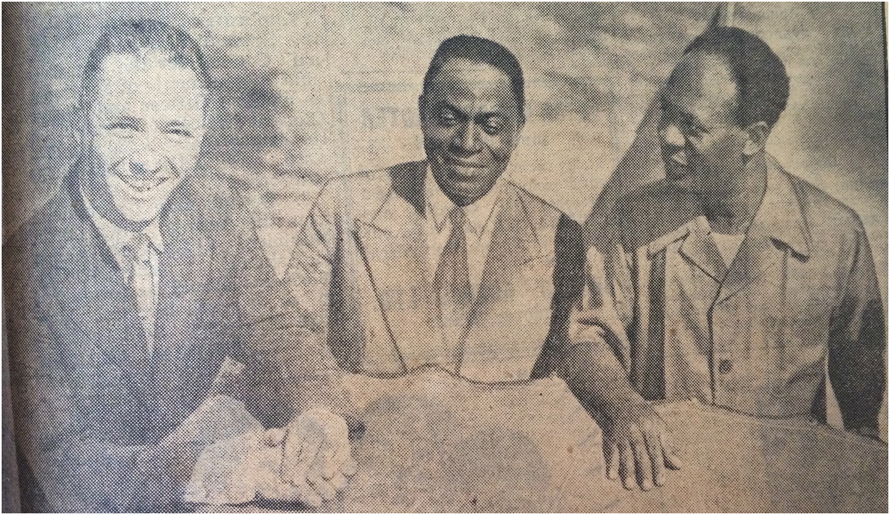
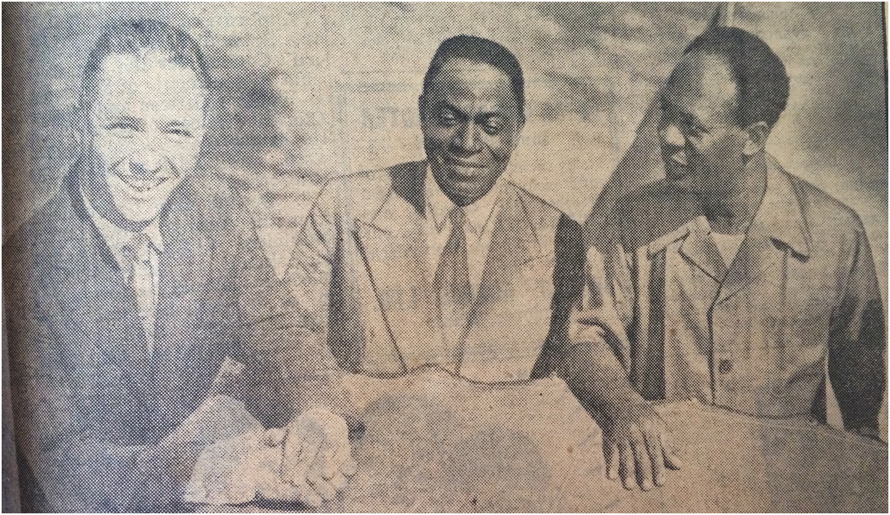
Of particular significance was the next infrastructure landmark: the Félix Houphouët-Boigny bridge that linked Plateau and Treichville – the city’s historic “French” and “African” quarters – and which had not yet been opened to the public. Riding alongside the bridge’s namesake, Nkrumah became the first official guest to make the crossing, charged with symbolism of Houphouët’s “bridging” two worlds.Footnote 51 Arrived at Treichville, “enthusiasm knew no bounds,” as Ghanaians living in Abidjan – drawn largely, it should be remembered, by the economic possibility of the city’s thriving port – gathered to cheer their new head of state.Footnote 52 The tour had had its effect. So impressed was Nkrumah by Abidjan’s infrastructure, that he later asked Renner to invite Dillier for a meeting in Accra to discuss opening a canal at Assinie (Figure 1).Footnote 53
From right to left: Kwame Nkrumah, Félix Houphouët-Boigny, and M. Dillier (Abidjan’s Inspector of Public Works). They are Touring the Port of Abidjan in a Launch. Source: “P.M’s Triumph in Abidjan,” Daily Graphic, 8 April 1957.
The following morning, Nkrumah left for Kankan in the company of Touré. He returned Saturday, 13 April, when it was his turn to offer a lavish luncheon in thanks for his stay in French West Africa. Afterwards, Nkrumah headed to Grand Bassam where the Ghanaian community had organized a libation ceremony in his honor. Chief Augustin Kouassi welcomed Nkrumah at the Hotel Pariba. Dressed all in white, Nkrumah addressed the rapturous crowd in Nzema, mounting a commanding image of himself as pan-African savior who eschewed the colonial territorialism epitomized by Houphouët’s politics.Footnote 54
A visit to the museum and a private dinner at the Governor’s residence formally closed Nkrumah’s visit. The morning of Sunday 14 April found him back in Accra, having concluded the one and only trip he would make to Abidjan as premier. Referencing the grandeur of Nkrumah’s tour, and perhaps hinting at its surprise genesis, one of Nkrumah’s entourage dryly observed that though the trip was intended as a private one, “the reception was such that it was difficult to imagine what would have happened if it had been a state visit.”Footnote 55
- Capitalizing on the Wager
Rapidly, the bet came to dominate the narrative of Nkrumah’s time in French West Africa. First reported by the Western press on 13 April (by both West Africa and Marchés Tropicaux du Monde), the exchange between Houphouët and Nkrumah was buried in the text.Footnote 56 But by the time Le Monde’s correspondent, André Blanchet, published his take four days later, the wager had become the headline of Nkrumah’s visit.Footnote 57 Blanchet cast the encounter in dramatic tones:
Two great destinies will meet for a few hours, two conceptions of Africa confront themselves through these two men who knew how to turn [their visions] into reality [“prévaloir dans la réalité”] and to personify [these conceptions] in themselves: the ideal of a complete independence, accomplished one month prior by Kwame Nkrumah in accordance with Great Britain; that of a Franco-African community, ratified by millions of Africans who, from Dakar to Brazzaville, voted for the party of Houphouët-Boigny. (…) How to not have the feeling that at the meeting of [these] two leaders, all of Africa is present, and that on their conversation will depend, to a certain extent, the political evolution of the black world?Footnote 58
Before the end of the year, books by two prominent colonial officials that detailed and publicized the bet had appeared.Footnote 59 It is significant that the earliest writing on the bet came from high-ranking officials in the French colonial establishment. Both Paul-Henri Siriex, who had been the Governor of Guinea in the early 1950s, and François Mitterand, former Colonial Minister, had vested interests in prolonging French presence in Africa. But in the fast-moving landscape of the late 1950s, the shape that that presence would take was mercurial, and its future equally uncertain. By drawing attention to the bet, Siriex and Mitterand amplified Houphouët-Boigny’s assertion that a Franco-African community was a desirable political form. The interwar logic of imperial “crossed gazes” had resurfaced in the moment of colonial dénouement. In Siriex and Mitterand’s accounts, Nkrumah and Houphouët came across as ciphers for British and French approaches to ceding metropolitan power, distilling again the old conflict of who did empire best.
The importance of the comparison for the French official mind is evident in a confidential document prepared in December 1957 for administrators about to take up their posts in Côte d’Ivoire: “happily for us [e.g. the French colonial ministry],” the document reads, “the results of Nkrumah’s politics have been rather disappointing.” In granting internal autonomy to Côte d’Ivoire, the Loi-cadre “appears [to be] an effective parry – and for once, a precautionary [one] – likely to pull the rug out from under [‘couper l’herbe sous le pied de’] Mr. N’Krumah.”Footnote 60 The French saw the ongoing contest between formal independence and continued political association, between British and French empire, between Nkrumah and Houphouët, as one tipping in their favor.
Crafted by Houphouët’s cunning and given credence by French politicians, the wager provided a powerful narrative device to frame Ivorian development. Houphouët personally referred to it in an important speech in May 1959, affirming his role in its construction: it was he who had cast down the gauntlet.Footnote 61 When he met Nkrumah at the 1963 Organization of African Unity conference, Houphouët is said to have repeated the bet.Footnote 62 In retrospect, the “audacity” of the wager was played up.Footnote 63 Ghana was so far ahead of its western neighbor in 1957 that Côte d’Ivoire’s “catching up” appeared all the more impressive.
During Côte d’Ivoire’s economic “miracle” of the 1960s and 1970s, the wager took on quasi-prophetic proportions. Ghana’s economic malaise and political instability only accentuated Abidjan’s glittering rise. While Nkrumah’s fall in 1966 – just shy of the ten-year deadline – appeared to clinch Houphouët’s victory, the loss of one principal rival threatened to hollow out the wager of meaning. Yet it was precisely after 1966, at the peak of Ivorian good fortune, that the wager began to gain traction in popular and academic writing. Interviewed in April 1971, Houphouët reflected on what he called “the famous wager.” Musing on Nkrumah’s shortcomings he concluded, smugly, that though “[Nkrumah] criticized the Ivory Coast. Now I have more money.”Footnote 64 By the early 1970s, multiple authors could refer to Côte d’Ivoire as the “winner,” giving the narrative extra heft.Footnote 65 Comparison with Ghana had been harnessed in the service of Ivorian exceptionalism.
In a long article in 1965, Côte d’Ivoire’s national newspaper observed that, “this bet [had] entered into our political perspectives.”Footnote 66 It is more fruitful to understand the bet as an expression of Houphouët’s larger political vision than as an external event to be integrated into it. Behind the urge to set up a comparison with Ghana – the colonial “showcase” of West Africa – was his overarching and oft-repeated desire to make of Côte d’Ivoire “a modern and model state.”Footnote 67 By displacing Ghana, Côte d’Ivoire could take up the mantle of regional standout. By “surpassing” their neighbors, a special Ivorian self-image could be crafted, one that depended not on ethnic or linguistic unity – which was out of the question for West Africa’s most heterogeneous territory – but on a sophistication unique to their status as “modern and model.”Footnote 68 There was no better yardstick, in 1957, than Côte d’Ivoire’s globally-celebrated neighbor to mark Abidjan’s ascendance.
The social scientists in Chicago thought so too. Within the decade, the défi had gained enough traction to show up in the title of Wallerstein and Zolberg’s 1967 African Studies Association panel on Ghana and Côte d’Ivoire that they named, appropriately enough, “The Challenge.” And in 1971, when Wallerstein asserted the “naturalness” of the comparison, he hastened to add that the “second inspiration” for the pairing “was the famous challenge (…) made in April 1957.”Footnote 69 In many ways, Wallerstein reflected, for the work that he and his colleagues had done, the wager had been “a guiding picture.”Footnote 70
The Rise and Fall of Akan Studies
We have thus seen how, in 1960s American social science and in the construction of Ivorian selfhood, comparison with Ghana was a key means by which Côte d’Ivoire was rendered visible. This third section examines how the comparison changed over time, as fortunes on either side of the border waxed and waned.
The early 1970s was the era of Ivorian triumphalism. Riding the wave of “one of the highest economic growth rates in the world,” the state undertook massive investments in infrastructure development and prestige projects (like the luxurious Hôtel Ivoire which boasted one of the continent’s first ice skating rinks).Footnote 71 Echoing this hubris, a monograph published in 1974 by a student of Zolberg’s warned readers that “[c]onclusions derived from the Ivory Coast case may be historically out of phase when applied to other states, but they will apply in the near future [emphasis added].”Footnote 72 Côte d’Ivoire was now the regional pace-setter. The story of Côte d’Ivoire’s “overtaking” of Ghana’s lead was dramatic enough to seep into the popular press, whose superficial treatments of the comparison crowned Abidjan the clear victor.Footnote 73
It was not just Ghana that looked shoddy in comparison with its western neighbor. Côte d’Ivoire’s success was the outlier in a region which, a decade after the high hopes of independence, was suffering chronic political instability, economic hardship and the erosion of civil society and social services. This did not look like the linear progress that the modernization theorists had expected to see. What had gone wrong?Footnote 74
Disillusionment with the signature methodology of the 1960s had set in; by the early 1970s, Chicago’s New Nations Committee – aorta of the Ghana-Côte d’Ivoire comparison – had been dissolved.Footnote 75 Skepticism about the “naturalness” of the pairing emerged, and the very categories deployed to compare the two countries were called into question.Footnote 76 Radical critiques of neo-colonialism by authors such as Samir Amin and Walter Rodney were altering the questions asked by social scientists.Footnote 77 What if the wager, rather than being won or lost in West Africa, had been decided by actors in Europe and North America?Footnote 78 Moving beyond Africanist studies, it was, interestingly, Immanuel Wallerstein, who would mount the most expansive challenge to modernization theory upon the 1974 publication of the first volume of his World Systems theory opus.Footnote 79 Evident in the work of scholars such as Rodney and Wallerstein was a turn to deeper history to understand the present.Footnote 80 The historical shallowness of 1960s social science scholarship now seemed inadequate to understand global inequalities. A new category, more satisfactory than the nation-state approach, would have to emerge to account for modernization theory’s blind spots. That category would be Akan studies.
At the same time that modernization theory was floundering, Ivorian economic success had created the conditions for an explosion of anthropological research on Ivorian cultures by a young generation of promising French scholars.Footnote 81 One of these, Emmanuel Terray, in Côte d’Ivoire on a coopération contract, helped found the University of Abidjan’s Institut d’Ethnosociologie (IES), which functioned for decades as a successful center of high-level scholarship.Footnote 82 After Terray’s forced departure, the IES was led by Claude Pairault until, on 30 June 1973, an Ivorian, Georges Niangoran-Bouah, took up the directorship.Footnote 83 The Ivoirisation of a key post at the University of Abidjan – long dominated by French faculty – signaled an important development.
Niangoran-Bouah believed passionately that it was the task of Africans to conduct scientific research on their own societies.Footnote 84 As a scholar who had struggled to “re-become African” after his Parisian education, Niangoran-Bouah, the son of a “mixed” Akan couple, looked to what he saw as his historical roots.Footnote 85 Now the head of the IES, he was in a position to alter the metropolitan orientation of one of the University of Abidjan’s most prestigious structures.Footnote 86 And just as Houphouët in the 1950s had inherited a political landscape influenced by the Gold Coast model, in the early 1970s, the most vibrant example of scholarship by and about Africans was to be found at the University of Ghana-Legon (and, in particular, the Institute of African Studies).Footnote 87 Research at Legon, Ivorian academics admitted, “had taken a large lead, especially in the domain of Akan studies” when compared to the University of Abidjan’s “weak organization.”Footnote 88 Among intellectuals, Ghana’s “aheadness” still held regional sway.
Since the early 1970s, Niangoran-Bouah had sought to broaden the conventional definition of who could accurately be classed as “Akan.”Footnote 89 His ideas clashed with Ghanaian scholar Adu Boahen, who maintained a “rigid interpretation” of who (and where) “Akan” denoted. In response to Niangoran-Bouah, Boahen had developed a classification system to distinguish the “pure” Akan from their “impure” brethren.Footnote 90 Niangoran-Bouah’s disputed Boahen’s notions of Akan “purity,” arguing for an expansive definition that included the Baoulé and lagoon areas of Côte d’Ivoire.Footnote 91 His was an intellectual project to inscribe Ivorians into a regional legacy of power, which had historically radiated from the Ashanti heartland. Extending the net of “Akan” societies to include Ivorian peoples would bind modern-day Côte d’Ivoire to this historical prestige.
In January 1974, the debate between Niangoran-Bouah and Boahen was conducted live, at a major, week-long conference in Bondoukou, an Ivorian town just five kilometers from the Ghana border. The conference, now all but forgotten, was a ground-breaking moment in the decolonization of African studies. The event grew out of contacts cultivated by researchers based in Côte d’Ivoire who had travelled to the Accra to discuss their work on Akan societies with Ghanaian scholars.Footnote 92 Betraying Niangoran-Bouah’s perspective, the conference was titled, “The Shared Populations of Côte d’Ivoire and Ghana.” Its mission, explicitly, was to “reconstitute the lost unities,” introduced by “artificial borders.”Footnote 93 Co-sponsored by the Universities of Abidjan and Ghana, the conference allowed researchers from Francophone and Anglophone traditions of scholarship to come together to interrogate a shared, precolonial history. Teams of translators – including American graduate students doing their fieldwork at the University of Abidjan – facilitated the exchanges.Footnote 94 A second conference, held in Kumasi, Ghana, the following year, would mirror the Ivorian meeting.
No further inter-university conferences took place. I suspect that the University of Ghana, whose financial straits had reached dire levels, was unable to continue the momentum.Footnote 95 Yet the legacy of these conferences has had lasting, if unexpected, effects. In the early 1980s, an American graduate student, Raymond Silverman, discovered the thick tomes of the conference proceedings in the library at Legon. Silverman, who was studying a historic community now divided by the political frontier, was impressed by the possibility of scholarly dialogue across national borders that the conferences represented. A few years later, during a conversation with anthropologist Judith Timyan, Silverman brought up the 1970s conferences. Both agreed that reestablishing a dialogue between scholars working on Ghana and Côte d’Ivoire would be a valuable enterprise. The result, in 1988, was the founding of the Akan Studies Council (ASC).Footnote 96
The effort was unsustainable. Insufficient interest on behalf of French and Ivorian colleagues particularly plagued the initiative. In 1993, the ASC was re-constituted as the Ghana Studies Association. Like the scholarship of the 1960s, the nation-state had been reasserted as the relevant category of analysis (this time around, its component parts would be thoughtfully questioned). Unlike that earlier scholarship, connection to Côte d’Ivoire appeared less and less relevant for students of Ghana, as the pendulum had swung back in the latter’s favor. Indeed, an assessment of the wager, published in the same year as the Ghanaization of the Akan Studies Council, declared a “Reversal of Fortune.”Footnote 97
Houphouët’s canny move to measure Côte d’Ivoire alongside Ghana suffered, at least for the moment, retrenchment. The decision to Ghanaize the ASC was taken at the 1993 African Studies Association meeting, held in early December. It was a meaningful historical coincidence. The last day of that 1993 ASA conference, 7 December, was the day of the Ivorian statesman’s passing.
Comparison in Crisis
Being “modern and model” is hard to keep up. In 1978, the World Bank published a report entitled “The Challenge of Success,” which warned, presciently, that Côte d’Ivoire’s impressive economic growth would be difficult to maintain.Footnote 98 Nevertheless, the country’s sense of self was buoyed by the persistent struggles of its neighbors. In 1984, a journalist could still conclude that, “whatever the Ivory Coast’s remaining shortcomings, it has won ‘the great wager’ with Ghana.”Footnote 99 By the end of the twentieth century, that verdict was increasingly under fire.Footnote 100
Long-term economic decline has thrown Ivorian self-image into crisis. Michael McGovern relates pointed indicators of Côte d’Ivoire’s fall from grace: GDP per capita (adjusted for purchasing power parity) in 2004 that is one-half what it was in 1978 and a “precipitous drop” of eighteen spots on the UN’s Human Development Index between 1990 and 2006.Footnote 101 Today, Côte d’Ivoire no longer appears the wager’s unqualified “winner.” Recent comparisons – not least by Ivorians themselves – put Ghana decidedly back on top.Footnote 102 Indeed, a half-century later, it is clear that “the outcome of the famous wager (…) depends on when one makes the assessment.”Footnote 103
The wager was an early manifestation of Houphouët’s strategy to fashion Ivorian national identity in relation to the country’s neighbors. As Côte d’Ivoire stumbled economically, that contradistinction took on an ominous edge. Ivorians began to perceive differently the tremendous migration to Côte d’Ivoire, which had been encouraged under conditions of prosperity, but now helped provoke a xenophobic discourse around ivoirité (Ivorianness). First proposed as a term in a 1974 poem, ivoirité only took on its full valence in the 1990s, following Houphouët’s death and the succession struggle that ensued.Footnote 104
Georges Niangoran-Bouah, whose interest in ethnic classification we have already encountered, was one of ivoirité’s principal exponents. Locked in a struggle with Adu Boahen to expand notions of “Akanness” during the flourishing 1970s, by the hard times of the 1990s he was working to restrict access to ivoirité.Footnote 105 In 1996, then Director of Cultural Heritage at the Ministry of Culture, Niangoran-Bouah published a list of the founding ancestors present in 1893, “at the moment when Côte d’Ivoire was born.”Footnote 106 However, his conception of ivoirité encompassed more than simply ancestral origins. One of the four criteria for being a “pure Ivorian” [ivoirien de souche], he argued, was to have “the same lifestyles (culture and civilization).”Footnote 107 For him, ivoirité evoked a sophisticated way of being in the world that migrants from surrounding countries did not possess. Houphouët’s formulation of Ivorians as “modern and model” is evident in Niangoran-Bouah’s ethno-nationalist conception, which maintains a clear distinction between the behavior of the Ivorian and the other. The xenophobia that characterized discussions around ivoirité in the mid-1990s generated a real social pressure to distinguish oneself from the migrant. Recent studies by anthropologists Sasha Newell and Mike McGovern demonstrate how this relational national identity has taken root in contemporary Côte d’Ivoire.
Newell explores how Ivorian youth “bluff” modernity, seeking to prove themselves the “right” kind of Ivorian in a context of profound anxiety about who that is. “The central act of identity production for Abidjan’s young men,” writes Newell, is “a display of the cultural mastery of the symbols of modern identity, differentiating them from ‘untrue’ Ivorians incapable of making such distinctions.”Footnote 108 With economic recession eroding youth’s access to the “real” goods of modernity, the capacity to “bluff” it has itself become an attribute of authenticity. Though reconfigured, and sometimes “counterfeit,” being “modern” persists as being Ivorian.
McGovern, writing about Côte d’Ivoire’s civil conflict in the early 2000s, asks why the antagonisms “failed” to break out into full-scale war. He sees the internalized element of “model” in Ivorian self-image as the vital break on mass violence:
Ivorians themselves were keen to preserve the idea they had of themselves as being sophisticated, a self-definition that was often made in distinction to citizens of neighbouring countries. Especially striking in this regard is the way that in instances of extreme violence, even the opposing parties in the Ivorian conflict often agreed that such “barbarity” could not have been undertaken by Ivorians, and thus must have been the work of mercenaries, typically said to be from Liberia (…) actors risk finding themselves disqualified from the field of political legitimacy if they cross certain thresholds of societally determined notions of decency and ‘civilisation’ [emphasis added].Footnote 109
The insights of Newell and McGovern affirm, in the ways that Ivorians have come to understand themselves, the resilience of Houphouët’s political vision. To embody ivoirité is to demonstrate a sophistication that is supposedly beyond the reach of your neighbors. It is in this sense that the wager between Houphouët and Nkrumah was a foundational act of Ivorian national identity. Comparison with Ghana made Côte d’Ivoire.
Conclusion
Throughout the twentieth century, a perceived temporal disjuncture between Côte d’Ivoire and Gold Coast/Ghana has conditioned how scholars have understood Côte d’Ivoire and how some Ivorians have understood themselves. With the “West African wager,” Houphouët latched onto Ghana and Nkrumah’s celebrity, thus vaulting his territory out of the flatness of federation and making it visible on its own terms. Social scientists were lured in, and a comparative tradition of scholarship – guided by assumptions of the “naturalness” of the pairing – flourished during the 1960s. Subsequent disillusion with modernization theory’s key assumptions altered the nature of the comparison. The very category of the nation-state that been used to establish its baseline no longer seemed to hold. Africanists searched for deeper, historical explanations that would account for Africa’s malaise in the 1970s.
Côte d’Ivoire’s status as economic anomaly in this period accentuated its sense of self as “exceptional,” for which the wager provided an excellent metric. Its economic miracle influenced Ivorian scholars, like Niangoran-Bouah, to inscribe Côte d’Ivoire in the “great” histories of the region, principal among them that of the Ashanti. The rise and fall of Akan studies was thus an Africanized response to the comparative social science literature that had seen Abidjan through the lens of Accra. When Côte d’Ivoire’s fortunes waned, its sense of self, predicated on its having “bypassed” its neighbors, was thrown into crisis. It is the act of comparison that has made Côte d’Ivoire legible to itself and to others.
This article has not been about the bet. It has been about the ways that juxtaposition has shaped what we know, how we are seen and how we see ourselves. The bet today, just as it was sixty years ago, has been a convenient way to tell the story. But it has also, in important ways, made the story. Thus, as Steve Smith observes, it might well be the analyst who has won the West African wager.Footnote 110 The winners, but perhaps also the dupes. By echoing the comparative tradition launched by Houphouët in April 1957, it appears that many social scientists, myself in primis, have taken the bait.
Elisa Prosperetti is a PhD candidate in History at Princeton University. She is currently writing her dissertation on the transnational history of postcolonial education in Ghana and Côte d’Ivoire, tentatively titled, Education for Development: Going to School in Postcolonial West Africa (1950–1980). Her research focuses on the connected histories of development, schooling, and citizenship. E-mail: elisap@princeton.edu