Electronic Cigarettes: The Perceptions of Pharmacists and Physicians
Electronic cigarettes, also known as e-cigarettes, are a type of electronic nicotine delivery system (ENDS) that has been increasing in popularity among adults and adolescents in recent years. In 2007, e-cigarettes were introduced to the US market without Food and Drug Administration (FDA) regulation. While manufacturers of e-cigarettes may advertise their product as a form of smoking cessation, there is insufficient evidence to support this claim. The long-term health-related outcomes associated with e-cigarette use remain unknown, and little data exists concerning associated adverse effects. It is important for pharmacists, physicians and other healthcare professionals to be mindful of the practice of e-cigarette use and to be prepared to provide the appropriate education to their patients.
While the number of conventional cigarette smokers in the US continues to decline, the opposite is true with e-cigarette users. Since 2010, there has been an increase in the use of e-cigarettes, which has corresponded with an increase in the product's marketing. Although representative national data is limited, surveys show that from 2010 through 2013, the number of first-time adult users of e-cigarettes increased from 3.3% to 8.5% (Orellana-Barrios, Reference Orellana-barrios, Payne, Mulkey and Nugent2015). In the adolescent population, similar trends have also been observed. From 2011 to 2014, the use of e-cigarettes increased from 1.5% to 13.4% in high school students and from 0.6% to 3.9% in middle school students (Arrazola, Reference Arrazola, Singh, Corey, Corinne, Linda and Benjamin2015; Centers for Disease Control, 2013). Another recent survey showed that e-cigarette usage among high school students has skyrocketed from 1.5% in 2011 to 16% in 2015 (U.S Food and Drug Administration, 2016).
Most adult and adolescent users of e-cigarettes concurrently smoke conventional cigarettes. During 2013, 76.8% of the people who had recently tried e-cigarettes also admitted to smoking conventional cigarettes (Hajek, Reference Hajek, Etter, Benowitz, Eissenberg and McRobbie2014). Adults have also reported using e-cigarettes as a cessation tool and as a safer alternative to traditional cigarettes. Data has shown conflicting results when evaluating the use of e-cigarettes as a cessation device. A recent longitudinal study surveyed adults in major US metropolitan areas regarding their use of novel tobacco products. In this study, participants were surveyed at baseline and three years later. Follow-up interviews revealed that those who used e-cigarettes daily (classified as “intensive users”) were six times more likely to report that they had quit smoking than those intermittent or non-users of e-cigarettes (Biener & Hargraves, Reference Biener and Hargraves2015). In contrast, a study conducted on cancer patients who were enrolled in a tobacco cessation program indicated that patients who used e-cigarettes were twice as likely to be smoking at follow-up as compared with their counterparts that did not use e-cigarettes (Borderud et al., Reference Borderud, Li, Burkhalter, Sheffer and Ostroff2014). Using the Fagerstrom Test for Nicotine Dependence, this study supported the premise that e-cigarette users were also more nicotine dependent (Borderud et al., Reference Borderud, Li, Burkhalter, Sheffer and Ostroff2014). The US FDA and the American Lung Association support the use of the seven approved pharmacologic therapies in combination with counselling as the most effective means to help patients achieve smoking cessation. These associations do not support the use of e-cigarettes (American Lung Association, 2015).
Healthcare professional involvement is vital to successful smoking cessation and treatment of tobacco use. The United States Public Health Service (USPHS) Clinical Practice Guidelines for treating tobacco use and dependence advocate that, due to the chronic nature of tobacco dependence, repeated interventions are performed by every healthcare provider who encounters a patient who uses tobacco. Pharmacists and physicians, who work in ambulatory practice settings are, therefore, accessible providers who can educate patients on the long-term risks of smoking and encourage them to initiate the process that will lead them to a smoke-free life. Pharmacists and physicians can help patients develop cessation plans and provide recommendations for lifestyle changes and pharmacologic therapies. Due to the increasing popularity of e-cigarettes, pharmacists and physicians will be called upon to serve as informational resources for patients seeking advice on the product as well as care providers for patients who use them. However, due to the scarcity of clinical data, many pharmacists and physicians may be under-informed on e-cigarettes and their associated risks of use.
An assessment of pharmacists’ and physicians’ perceptions of e-cigarettes supports the advancement of practice by identifying gaps that may exist in product awareness, popularity of use and risks to patient health. This study survey promotes a better understanding of current opinions amongst pharmacists and physicians on e-cigarette products, and provides consensus on whether further steps should be taken to increase product training and information dissemination.
Method
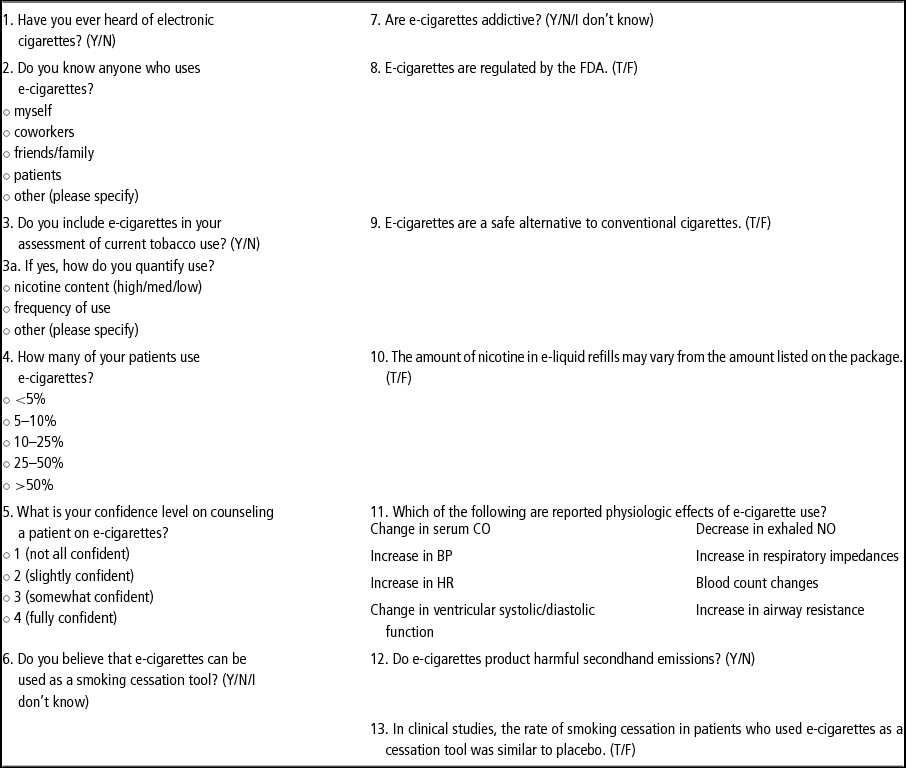
This study utilised a survey methodology. Identical surveys composed of 13 questions were hand delivered by the student researchers to both pharmacist and physician groups. The survey encompassed a variety of questions assessing the healthcare professional's familiarity with e-cigarettes and their prevalence in the patient care setting. Survey questions are available for reference in Table 1. Additionally, a goal of this study was to provide information to pharmacists and physicians on the prevalence and safety of e-cigarettes. In order to achieve this objective, any participant who was interested in receiving additional information on the topic was asked to provide an email address when returning their survey. By providing this email address, an educational electronic handout outlining relevant counselling points on e-cigarettes was provided to further improve awareness. This handout was created by the student researchers utilising reputable review articles and sources, such as recent articles published in The Lancet and Chest. This handout was reviewed and approved by the pharmacist faculty member prior to dissemination. In addition to receiving information on e-cigarettes, participants who provided an email address were also sent an electronic $5.00 gift card to either Amazon or Starbucks.
Survey assessment items

Pharmacists were identified by using the global positioning system on mobile devices. This method identified and located community pharmacies within 15 miles of the primary researchers’ university address. To locate family medicine physicians, the Pennsylvania Academy of Family Physician's website was utilised to identify physician practices also within a 15 mile radius of this same address. When time permitted, pharmacists and physicians were encouraged to complete the survey, while survey distributors were present. If participants were unable to complete the survey while the surveyor was present, a pick-up time was established or a fax number was provided to return completed surveys. All data from the surveys were compiled into an Excel spread sheet. A coding system was used as to not include participant identifiers (email addresses) on the spread sheet.
Additionally, each subject received an informed consent form, which outlined the purpose of the study and explained the scope of the data requested. As the survey was anonymous, participants were not required to sign or return a copy of this consent form. This study was approved by the Institutional Review Board under expedited review.
Participant Selection
Demographically and for inclusion in the study, pharmacists were required to be currently practicing community pharmacists. Geographically, the pharmacies were only selected if their pharmacy location was within a 15-mile radius of Pittsburgh, PA. Inclusion criteria for physicians required that they currently be practicing in family medicine with practice sites located within a 15-mile radius of Pittsburgh, PA. Participants excluded from the study included pharmacists that provided indirect patient care or worked in an acute care setting. Physicians were excluded if they provided indirect patient care or practised in a specialised area of medicine. Also, no pharmacist or physician was permitted to complete the survey more than once.
Objectives
The primary objectives of this study were to evaluate pharmacists’ and physicians’ perception and knowledge of e-cigarettes, including their comfort level in counselling patients on these products. The study also aimed to assess if, and to what extent, these healthcare professionals collected patient e-cigarette usage as a marker of tobacco use status. The final objective of the study was to provide pharmacists and physicians with pertinent information on e-cigarettes that could be shared with patients.
Successful attainment of the research objectives was achieved through the assessment of the following research questions:
-
1. Are pharmacists and physicians aware of and knowledgeable about e-cigarettes?
-
2. Are pharmacists and physicians aware of (the previous lack of) regulatory parameters associated with e-cigarette composition and manufacturing?
-
3. At what rate do pharmacists and physicians encounter patients that use e-cigarettes?
-
4. Do pharmacists and physicians ask about e-cigarette use when assessing a patient's smoking status, and if so, how do they quantify e-cigarette usage?
-
5. Are pharmacists and physicians aware of the adverse physiological effects associated with e-cigarette use?
-
6. Do pharmacists and physicians believe that e-cigarettes may be used as a cessation tool?
Survey responses were analysed utilising descriptive and inferential statistics, as appropriate. Percentages were utilised for each assessment item on the survey in order to identify trends.
Results
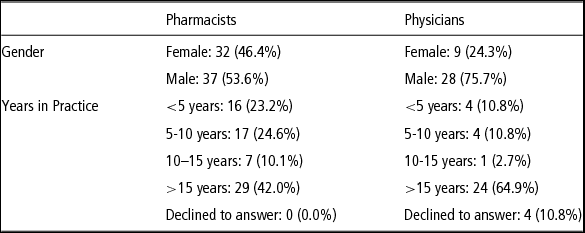
Data was collected and analysed from a total of 69 pharmacist and 37 physician surveys. Participant demographics are noted in Table 2. Based on the number of practices within the study vicinity, a total of 75 surveys were distributed to pharmacists (response rate = 92.0%), and a total of 109 surveys were distributed to physicians (response rate = 33.9 %). Each responding participant completed the survey in its entirety.
Study population demographics

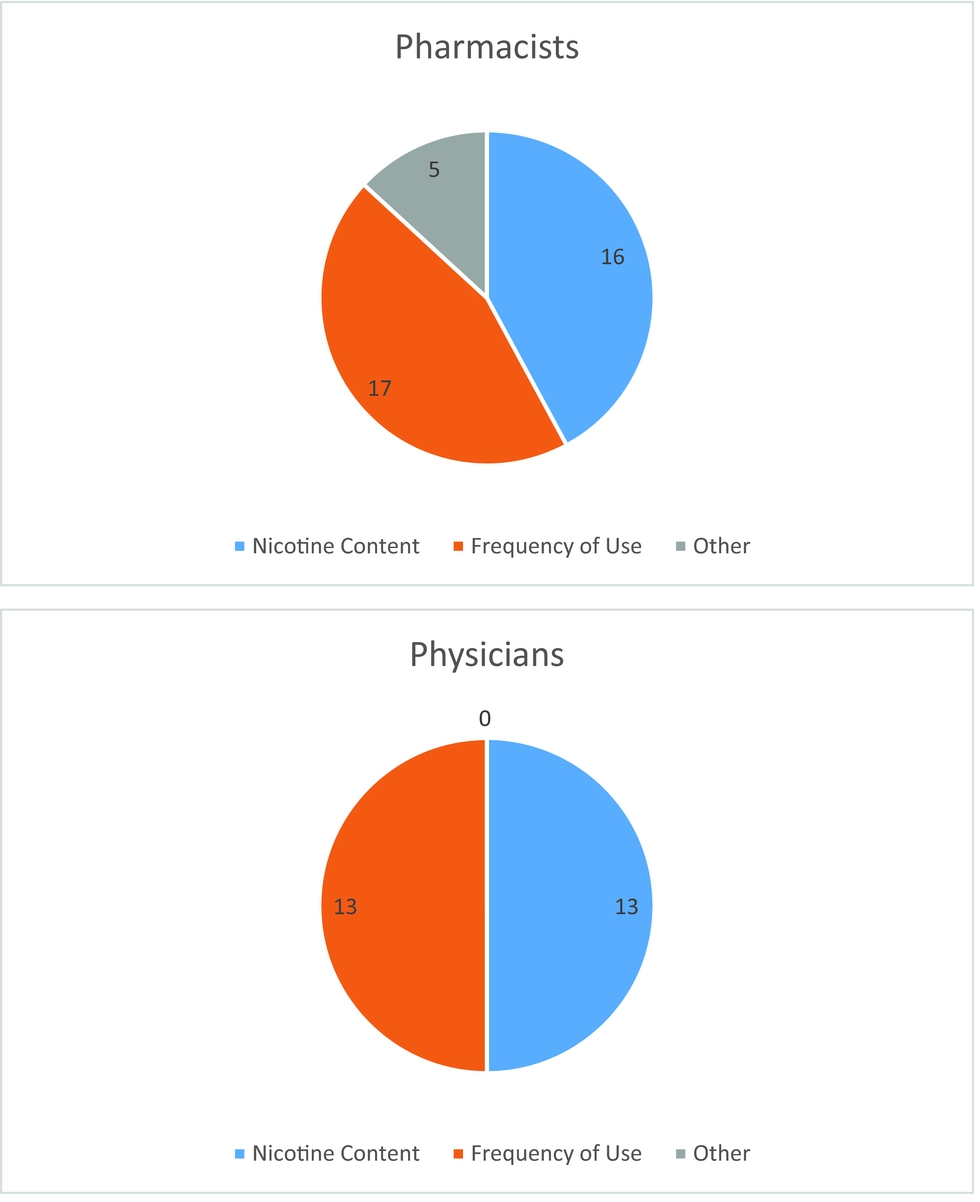
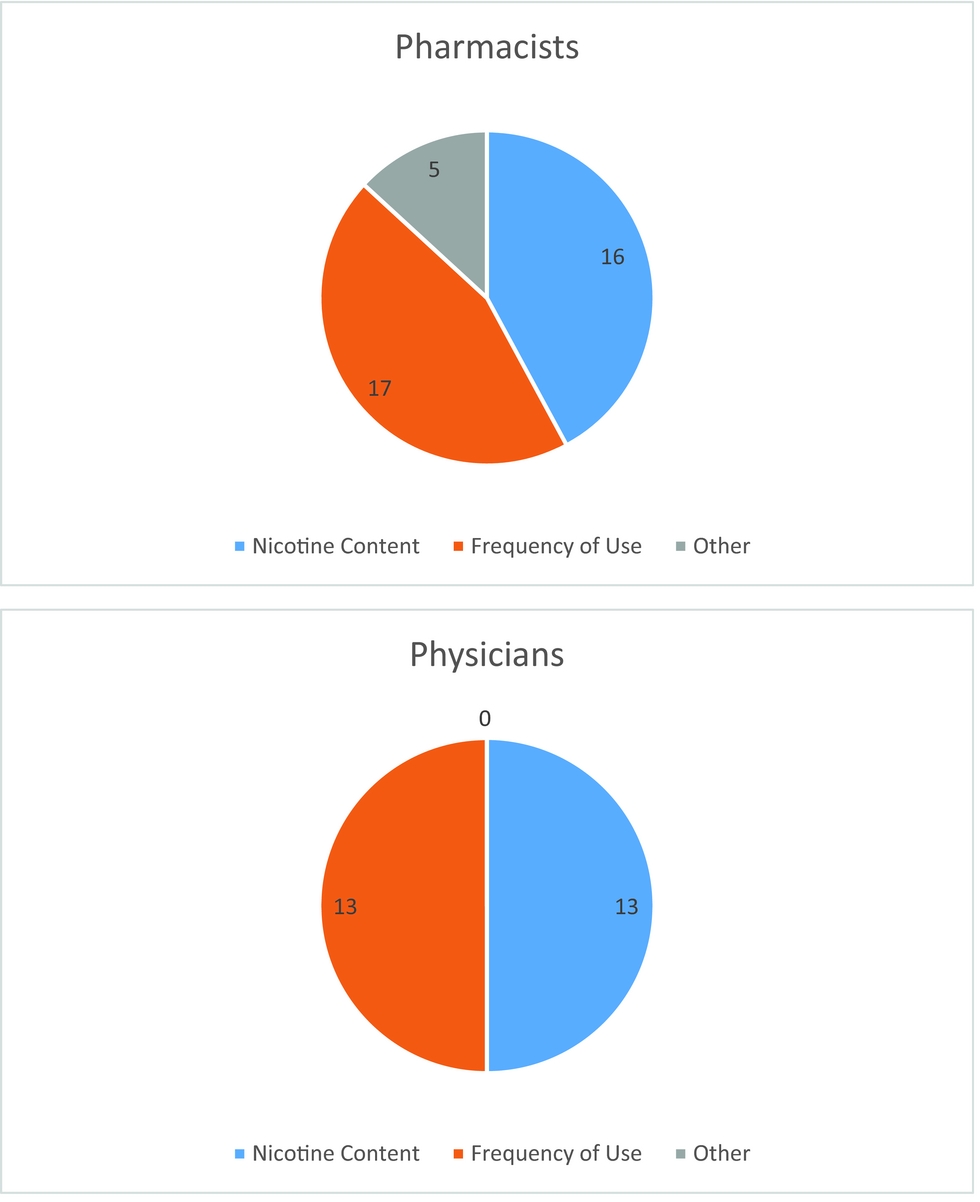
Survey responses revealed that all participating pharmacists and physicians had heard of e-cigarettes prior to the study. When asked if they knew anyone who used e-cigarettes, 92.7% (n=64) of pharmacists and 91.9% (n=34) of physicians responded affirmatively. Of these e-cigarette users, 18 (26.1%) and 28 (75.7%) were categorised as patients (i.e. not personal acquaintances) by the pharmacists and physicians, respectively; however, <5% were personal patients of the survey responder. Despite awareness of patients utilising e-cigarettes, only 38 pharmacists (55.1%) and 26 physicians (70.3%) included these products in their assessment of patient tobacco use. (Figure 1) depicts the ways in which e-cigarette usage was assessed and quantified by each practitioner.
Means of E-Cigarette Use Assessment. *Note: Pharmacist participants who answered “other” did not specify the method used for e-cigarette assessment.
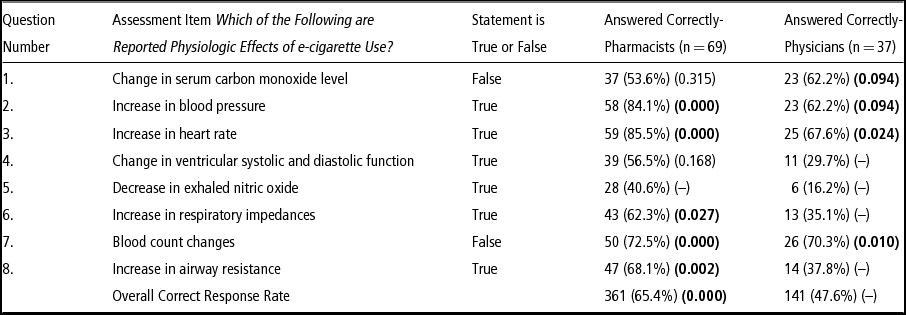
One of the main study objectives was to assess pharmacist and physician knowledge of e-cigarettes. To do this, question # 11 on the study survey provided participants with a table of potential physiologic effects that could be attributed to e-cigarette use, and were asked to check statements regarding e-cigarettes that they believed to be true. Of the eight items included in this table, six were true statements. None of the responding participants, pharmacists or physicians, correctly selected all six of the correct statements. Table 3 illustrates the number of correct responses provided by the pharmacists and physicians. Since true/false question types, such as those on this survey questionnaire subject to guessing, the results in Table 3 were compared to the expected value for random chance (50%) using Fisher's exact F-test. An alpha value of 0.10 was specified as the threshold for statistical significance. Based on this alpha value and the sample sizes of the participant groups, the hypothesis tests have 80% power to detect proportions 13% and 17% higher than the benchmark for the pharmacists (n=69) and physicians (n=37), respectively. The probabilities that the responses are ≤ 50% appear as entries below the survey results. Bold entries signify that the results are statistically significant and confirm that the responses were not generated by random guessing with at least 90% confidence. Only response rates ≥ 50% were tested for significance.
Pharmacist and physician knowledge of E-cigarette physiologic effects

The analysis confirms that the physicians understood that carbon monoxide is a toxin produced by the combustion of tobacco products and is the root cause of changes in serum carbon monoxide levels (62.2%, p=0.094). Further, 68% of the physicians that answered this question correctly reported having 15 or more years of experience. The majority of pharmacists (53.6%) also answered this question correctly, but the response rate was not statistically significant (p=0.315).
Both groups responded similarly to choices 2–5 on study survey, question 11 which referred to increases in blood pressure and heart rate, change in ventricular systolic and diastolic function, and decrease in exhaled nitric oxide. The majority of physicians and pharmacists answered choices 2 (increase in blood pressure) and 3 (increase in heart rate) correctly, but neither group was statistically greater than the 50% benchmark for choices 4 (change in ventricular systolic and diastolic function) and 5 (decrease in exhaled nitric oxide). The pharmacists performed well on choices 6 through 8 (increase in respiratory impedances, blood count changes and increase in airway resistance), scoring 62.3% (p=0.027), 72.5% (p=0.000) and 68.1% (p=0.002), respectively. The physicians answered choice 7 (blood count changes) correctly (70.3%, p=0.010), but scored less than 50% for choices 6 (increase in respiratory impedances) and 8 (increase in airway resistance).
A final assessment of the overall knowledge of the physiological effects of e-cigarette use was determined by pooling the correct responses for all choices to this study survey question to determine the average correct response rate for each group. The combined correct responses for the pharmacists resulted in an average of 65.4% (p=0.000), where the corresponding average for physicians was 47.6%.
Other questions on the study survey assessed participant knowledge of e-cigarettes using true/false questions. Study survey question 12 asked respondents whether or not e-cigarettes produced harmful second-hand emissions. Sixteen pharmacists (23.2%) responded yes, whereas only five physicians agreed (13.5%). Next, responses were gathered in the form of a true/false question as to whether the amount of nicotine in e-liquid refills varies from the amount listed on the package (study survey question 10). The majority of respondents (65 pharmacists and 33 physicians) answered that they found this statement to be true (94.2% and 89.2%, respectively). Lastly, participants were asked whether or not e-cigarettes were regulated by the FDA (study survey question 8), to which 62 pharmacists (89.8%) and 36 physicians (97.3%) responded that they were not.
This study also sought to assess the perceptions of pharmacists and physicians on whether e-cigarettes could be utilised as a smoking cessation tool. To meet this aim, study survey question 6 directly asked participants this question. A total of 23 (33.3%) of pharmacists and 22 (59.5%) of physicians believed that they could be used in this regard; 29 pharmacists (42.0%) and 8 physicians (21.6%) did not believe that e-cigarettes could be used as a smoking cessation tool; and 17 pharmacists (24.6%) and 7 physicians (18.9%) were unsure.
Three other study survey questions were included for the purpose of indirectly assessing participant perceptions on e-cigarettes and their role as a smoking cessation tool. Study survey question 7 asked participants whether they believed e-cigarettes were addictive. The majority of pharmacists (51, 73.9%) and physicians (26, 70.3%) believed that they were addictive. A total of 17 pharmacists (24.6%) and 11 physicians (29.7%) were unsure, and only one pharmacist believed that e-cigarettes were not addictive (1.5%). Study survey question 9 asked whether e-cigarettes were a safe alternative to conventional cigarettes. Here, responses were divided among the answer choices, although both pharmacists and physicians felt most strongly that more research in this area was needed (30 pharmacists or 43.5% and 14 physicians, 37.8%). Study question 13 asked participants whether the rate of smoking cessation with e-cigarette usage was similar to placebo in clinical studies. A total of 45 pharmacists (65.2%) and 125 physicians (67.6%) believed this statement to be true, whereas 24 pharmacists (34.8%) and 12 physicians (32.4%) answered that it was false.
Lastly, through study survey question 5, participants were asked to rate, on a scale of 1–4, their confidence on counselling a patient on the use of e-cigarettes. Only two pharmacists (2.9%) and five physicians (13.5%) rated themselves as fully confident.
Discussion
Due to the rapid increase in prevalence of e-cigarette use, it is important to assess the knowledge and awareness of healthcare professionals, who will be encountering patients seeking advice and guidance relating to this topic. For this initial study, pharmacists and physicians working in ambulatory practice were selected to participate due to their frequent, direct patient contact. Through this survey, gaps in knowledge, specifically relating to the physiologic effects of e-cigarette products, were identified in both the pharmacist and physician groups. Given the nicotine content found in most e-cigarettes, it was not surprising that both pharmacists and physicians correctly identified the physiologic effects of increased blood pressure and heart rate from e-cigarette use. The only other knowledge question that was answered correctly by both groups with statistical significance was the lack of blood count changes caused by e-cigarettes. The overall lack of knowledge of physiologic effects related to e-cigarette use, paired with the complete lack of confidence of counselling patients on e-cigarettes, warrants further education of these healthcare professionals.
Survey results also showed that e-cigarette use is not always documented as a measure of smoking status and, when it is documented, there is a lack of consistency. As the prevalence of e-cigarette usage is expected to increase, documentation of use of these products is important in ascertaining a patient's estimated nicotine intake. In addition, assessment of the amount and frequency of use is important in helping to recommend appropriate dosages of approved pharmacologic cessation aids. Manufacturers of e-cigarettes do not provide educational materials to this regard, and it is the stance of several professional health organizations that these agents not be used as cessation devices. This results in limited education available to providers seeking to include these devices in their assessment of patient's tobacco use status or counsel patients on their use. It is the author's hope that with further education on the topic of e-cigarettes, more providers will begin to include these in their tobacco status assessment.
The majority of pharmacist and physician respondents stated that e-cigarettes were not regulated by the FDA (89.9% pharmacists; 97.3% physicians) which, at the time the study was conducted, was true. However, in May 2016, the FDA finalised a rule extending regulatory authority to cover ENDS. This regulation will enact a federal law prohibiting retailers from selling ENDS to people under the age of 18, prevent misleading claims, communicate potential risks and evaluate ingredients in these products. While this regulation promotes further control of these products, the FDA expects that manufacturers will continue selling their products for up to two years while they submit, and an additional year while the FDA reviews, a new tobacco product application. Therefore, it still remains of the utmost importance that healthcare professionals remain vigilant to the use of these products in their patients, and up-to-date on all clinical, physiological, and regulatory changes concerning their use.
Strengths of this study include the participation of both pharmacists and physicians, which allowed for a broad assessment of healthcare professionals involved in ambulatory patient care. An obstacle to the study was reaching the anticipated number of survey participants. The study projected a survey collection of 200 total surveys; however, due to the student researcher's timeframe, survey collection was stopped after 3 months. This study was also geographically limited to participants practicing within 15-mile radius of Pittsburgh, PA, which provided a cross-sectional snapshot of a small region
Conclusion
Future research on electronic cigarettes in general, and specifically assessing healthcare professional's knowledge and patient involvement regarding their use, is still needed. Potential research topics in this area could include educational interventions on e-cigarettes for healthcare professionals and their resulting influence on patient assessment and care, as well as further research into the impact of the new FDA regulations on e-cigarettes and other novel forms of nicotine delivery systems.
Acknowledgements
None.
Financial Support
This work was supported by the Pennsylvania Pharmacists Association Educational Foundation (internal grant number G1600042).
Conflict of Interest
None.
Ethical Standards
The authors assert that all procedures contributing to this work comply with the ethical standards of the relevant national and institutional committees on human experimentation and with the Helsinki Declaration of 1975, as revised in 2008.