Introduction
There is a continuous increasing trend in the global prevalence of dementia, with 24.3 million people being already affected by dementia and 4.6 million people being newly diagnosed with dementia every year (Prince et al., Reference Prince, Acosta, Castro-Costa, Jackson and Shaji2009). The highest increase in the prevalence of dementia in the elderly population is expected in South Korea than in any other country in the world. The elderly population aged 65 years or more accounts for 11.8% of the total population (Statistics Korea, 2012). The prevalence of dementia was 8.4% in 2008, and it is expected to increase to 9.6% by 2030 and to 13.2% by 2050 (Cho et al., Reference Cho2008).
Peoples’ knowledge about an illness is associated with their illness-related behaviors (Lee et al., Reference Lee, Lee and Diwan2010). A higher level of knowledge about symptoms of Alzheimer's disease was associated with increased intentions to seek information on the diagnosis and use healthcare services (Werner, Reference Werner2003). Individuals who have more knowledge about dementia are more likely to acknowledge early symptoms and seek professional help during its onset (Ho and Woo, Reference Woo2013). It was also reported that the perceived stigma, poor knowledge, and poor attitude toward dementia were related to a lower rate of early screening or further diagnostic test and treatment (Teel, Reference Teel2004; Boustani et al. Reference Boustani, Justiss, Frame, Austrom, Perkins and Cai2011; Hurt et al., Reference Hurt, Burns, Brown and Barrowclough2012). Previous studies on the knowledge about dementia in South Korea were performed among family members of dementia patients (Yong et al., Reference Yong, Kim and Yang2010), female volunteer participants who were active in public service (Choi, Reference Choi2005), elderly population aged 60 years or older (Kim, Reference Kim1999) and 65 years or older (Han, Reference Han1994). However, these studies targeted only a specific population instead of covering general population with a wide range of age as well as males and females. Although the knowledge about dementia has been assessed in various Asian lay populations, such as Chinese-American immigrants (Ho and Woo, Reference Woo2013), Korean-American immigrants (Lee et al., Reference Lee, Lee and Diwan2010), healthy Singaporeans (Tan et al., Reference Tan, Hong, Luo, Lo and Yap2012), and the general public of Japan (Arai et al., Reference Arai, Arai and Zarit2008), there has been no such investigation for overall lay population in South Korea in spite of very rapidly increasing burden of dementia in this country (Park et al., Reference Park, Eum, Bold and Cheong2013).
Therefore, the objective of the study is to (1) investigate the knowledge of dementia among laypersons aged 10 years or older, and (2) examine the association between the socio-demographic characteristics and knowledge about dementia in South Korea.
Methods
Participants
A self-administered questionnaire survey was applied to individuals aged 10 years or older who visited 25 public community health centers in Seoul, South Korea between June and November 2011. In South Korea, public community health centers based on Regional Public Health Act have taken charge of the matters of health prevention, promotion, education, and chronic and contagious diseases’ management in all ages, which are to be executed within the area of jurisdiction of the pertinent local government (Regional Public Health Act, 2010). We recruited participants with a wide range of age, even including teenagers in order to provide some suggestions for developing various age-appropriate strategies to improve the perception and knowledge of dementia and to reduce social stigma attached to dementia. Two thousand one hundred eighty-nine (78.2%) participants of 2,800 individuals who were initially contacted by the study team responded to survey on a voluntary basis; no statistical sampling procedures were carried out. This study was conducted as part of the “Seoul Dementia Management Project,” a community-based dementia management system in Seoul, South Korea (Lee et al., Reference Lee, Sung and Lee2011). Informed consent was obtained from each participant in the survey.
Questionnaire
Dementia knowledge was measured by modifying the Korean version of Dementia Knowledge Questionnaire developed for lay people (Cho et al., Reference Cho2008; Kim et al., Reference Kim, Kim and Sung2011). Questionnaire consisted of four parts with a total of 12 items: three questions on the causes of dementia, three questions on the symptoms, four questions on the prevention and treatment of dementia, and two questions on the knowledge of caregiving. The participants answered true (=1) or false (=0) for each item. If the answer was correct, one point was given. Therefore, the total score ranged from 0 to 12 points, such that a high score indicated a high level of knowledge. Also, it included demographic information of the respondents (gender, age, and education) and three additional questions about interest in dementia, exposure to dementia-related information, and type of specific information sources. Interest in dementia was assessed by asking the question: “How much are you interested in the issues related to dementia?,” and exposure to dementia-related information was defined as a prior experience, obtaining information from mass media, internet, families or relatives, or educational materials.
In the present study, moderate reliability of knowledge measure was evident (Cronbach's α = 0.61). Regarding validity, the content validity of the questionnaire was examined by five experts with clinical and research experience in the fields of psychiatry and gerontological nursing; and in criterion validity using the known group comparison, the mean knowledge scores measured by this questionnaire were significantly higher for 148 nursing students, who indicated that they had been exposed to the principles of dementia in undergraduate level (mean ± SD = 10.3 ± 1.24: unpublished data), than the general population (mean ± SD = 9.0 ± 2.08; p < 0.001).
The self-administered questionnaire was completed under the supervision of survey researchers before response was completed. This study was approved by the Ethics Committee of the Seoul National University Hospital of South Korea.
Statistical analysis
Descriptive statistics, including mean, standard deviation, and percentage, were used to describe demographic data and knowledge scores. To compare the knowledge scores between subgroups based on participants’ characteristics, the Mann–Whitney U test and the Kruskal–Wallis test were used. Before comparing the scores, the Kolmogorov–Smirnov test was conducted to determine the normality of distribution of the mean knowledge scores. The knowledge scores were not normally distributed (p < 0.001), and therefore non-parametric tests (Mann–Whitney U and Kruskal–Wallis tests) were used to compare mean scores between subgroups. IBM SPSS for Windows 20.0 program was used for statistical analyses. Statistical significance was set at p < 0.05 with two-side tests.
Results
General characteristics of study participants
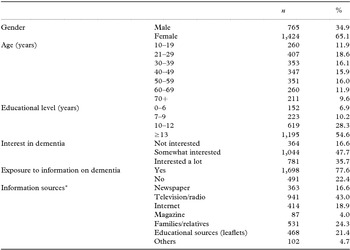
Study participants included 1,424 women (65.1%) and 765 men (34.9%). According to the distribution by age, 407 participants (18.6%) were in the 21–29 years age group, which was the highest number of participants in an age group, and 211 persons (9.6%) were in the 70 years or older age group. Of the included respondents, 83% answered that they were “interested in the issues related to dementia.” With respect to experience of exposure to information on dementia, 1,698 respondents (77.6%) answered “yes,” while 491 (22.4%) answered “no.” Sources of information among the respondents who answered “yes” were “television or radio” in 941 participants (43.0%), which was the highest number of participants, followed by “families or relatives” in 531 participants (24.3%), “educational sources” (booklets and leaflets) in 468 participants (21.4%), and “the Internet” in 414 participants (18.9%), when multiple responses were allowed (Table 1).
Subject characteristics (n = 2,189)

Note: *Multiple responses from respondents who were exposed to information on dementia.
Knowledge about dementia
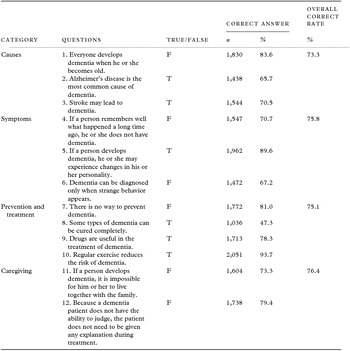
The mean total knowledge score was 9.0 ± 2.1 points out of 12 points (median 9 points, range 1–12 points), which can be translated to 75 points on the 100-point scale. Percentage of correct answers to each question ranged widely from 47.3% (lowest) to 93.7% (highest), which showed variability in the level of knowledge of dementia. Question regarding the benefits of regular exercise for dementia prevention was receiving the highest of correct answer rate (93.7%), followed by the question about possibility of personality change in person with dementia (correct answer rate: 89.6%). However, the question about the presence of curable dementia obtained the lowest correct answer rate (47.3%), and only 65.7% of the participants reported that Alzheimer's disease is the major cause of dementia (correct answer). Percentage of overall correct answers to the questions regarding “causes” and “prevention and treatment” of dementia was relatively low, and the mean percentage of correct answers was 73.3% and 75.1% respectively (Table 2). In addition, percentage of correct answers to questions regarding the knowledge about dementia was divided into two subgroups according to age: <60 years versus ≥60 years was presented in supplementary Table S1 (Table S1 is available as supplementary material attached to the electronic version of this paper at www.journals.cambridge.org/jid_IPG).
The number and percentage of correct answers to questions regarding the knowledge about dementia

Association between socio-demographic characteristics and knowledge about dementia
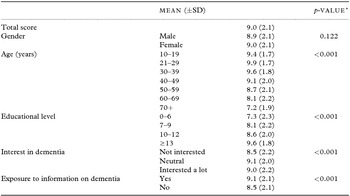
The dementia knowledge score was not statistically different between men (8.9 ± 2.1 points, median 9 points, range 2–12 points) and women (9.0 ± 2.1 points, median 9 points, range 1–12 points; p = 0.122). In contrast, the scores significantly decreased with an increase in age (p < 0.001). The knowledge scores were significantly higher in higher educational subgroups than in lower subgroups (p < 0.001).
As expected, the knowledge scores of dementia were different depending on the degree of interest in dementia or exposure to information on dementia. The dementia knowledge score for respondents who answered that they were “not interested” was 8.5 ± 2.2 points, the dementia knowledge score for respondents who answered that they were “somewhat interested” was 9.1 ± 2.0 points, and the dementia knowledge score for respondents who answered that they were “interested a lot” was 9.0 ± 2.2 points (p < 0.001). Also, the knowledge about dementia in participants who had exposure to information on dementia (mean ± SD: 9.1 ± 2.1) was significantly higher than that in participants who did not have exposure to information on dementia (mean ± SD: 8.5 ± 2.1; p < 0.001; Table 3).
Relationship between knowledge scores and demographic characteristics

Note: *p < 0.05 by the Mann–Whitney U test and Kruskal–Wallis non-parametric test.
Discussion
The study showed that the knowledge about dementia among the general public ranged from a score of 1 to 12 points, with a mean of 9.0 points out of the possible 12 points. Although laypersons had a fair knowledge of dementia, more than half of the respondents (52.7%) reported that dementia is not treatable and one-third of the participants did not know that Alzheimer's disease is the most common cause of dementia.
There is a major misconception that dementia is an inevitable part of aging (Saad, Reference Saad2012). In previous studies conducted in South Korea, 72.3% of 124 residents aged 65 years or older (Han, Reference Han1994), and 78.8% of 204 elderly people aged 60 years or older (Kim, Reference Kim1999) considered that dementia was a disease. Studies from other countries showed that 66.2% of the Turkish residents who did not have dementia and were aged 70 years or older (Sahin et al., Reference Sahin, Gurvit, Emre, Hanagasi, Bilqic and Harmanci2006), 48.0% of the 329 healthy laypersons who visited a public hospital in Singapore (Tan et al., Reference Tan, Hong, Luo, Lo and Yap2012), and 45% of the 1,531 Shanghai residents (Li et al., Reference Li, Fang, Su, Liu, Xiao and Xiao2011) regarded dementia as a part of normal aging process. In this study, only 16.4% of the respondents misrecognized dementia as a part of normal aging process. This result can be explained by the fact that the study population included relatively younger participants who were less than 40 years of age (46.6% of overall participants), and the percentage of this study participants having 13 or more years of education was 54.6%, whereas percentage of highly educated participants in previous studies was relatively low. That is, one-fifth of the participants were educated for nine or more years (Sahin et al., Reference Sahin, Gurvit, Emre, Hanagasi, Bilqic and Harmanci2006), the percentage of sample with tertiary/diploma level was 25.2% (Tan et al., Reference Tan, Hong, Luo, Lo and Yap2012), and the percentage of participants with university education was 23.1% (Li et al., Reference Li, Fang, Su, Liu, Xiao and Xiao2011).
However, after considering only those persons who were 60 years of age or older, the percentage of participants who reported that dementia is a part of the normal aging process was increased to 23.4% (Supplementary Table S1). This result indicates that the misconception about dementia in the elderly population has not improved compared with that in previous studies conducted in the 1990s in South Korea (Kim, Reference Kim1990; Han, Reference Han1994). Our findings demonstrated that dementia education should be targeted to the elderly people for improving the knowledge about dementia in South Korea.
With respect to the knowledge about dementia symptoms, the rates for incorrect knowledge varied from 10.4% to 32.8%. In particular, approximately two-thirds of the participants misunderstood that strange behavior is a necessary symptom for the diagnosis of dementia. The rates of misperceptions about dementia symptoms were similar to those in previous studies that included Asian ethnic participants (Ayalon and Arean, Reference Ayalon and Arean2004; Lee et al., Reference Lee, Lee and Diwan2010; Woo, Reference Woo2013). We need to make an effort to increase the knowledge about dementia symptoms because a higher level of knowledge of symptoms is likely to lead to timely diagnosis of dementia and initiation of continuous treatment (Werner, Reference Werner2003).
In this study, one-fifth of the participants did not have recognition of drug treatment for dementia. When considering only those participants who were 60 years of age or older, 28.9% did not know about the drug therapy for dementia (Supplementary Table S1). This finding was similar to the one in previous data, in which 17% of the elderly adults (Fujishiro et al., Reference Fujishiro, Umegaki, Suzuki, Nakamura, Hirakawa and Iquchi2005), 31.4% of the respondents (Lee et al., Reference Lee, Lee and Diwan2010), and 37.8% of the general public (Arai et al., Reference Arai, Arai and Zarit2008) knew about the drug therapy for dementia. Therefore, there is still significant need for education to improve laypersons’ understanding about the drug therapy for dementia.
In terms of the relationship between socio-demographic characteristics and knowledge about dementia, this study showed that the level of dementia knowledge was negatively associated with age and positively with education level. The findings were consistent with those from a previous study: The level of dementia knowledge was negatively associated with increasing age and positively with higher education level (Li et al., Reference Li, Fang, Su, Liu, Xiao and Xiao2011). However, some other studies did not show any difference in the level of dementia knowledge according to age and education level (Sahin et al., Reference Sahin, Gurvit, Emre, Hanagasi, Bilqic and Harmanci2006; Tan et al., Reference Tan, Hong, Luo, Lo and Yap2012). This finding might be explained by the fact that the range of age and education level of the participants of those studies was relatively narrow, as they targeted only the older people (Sahin et al., Reference Sahin, Gurvit, Emre, Hanagasi, Bilqic and Harmanci2006) or just categorized patients into less than 65 years of age and 65 years or older (Tan et al., Reference Tan, Hong, Luo, Lo and Yap2012).
About half of the respondents (52.7%) had a wrong understanding regarding the curability of some types of dementia. In addition, about one-fifth (21.7%) of the participants did not know that drug treatment is useful for dementia management. The results suggest that it is urgently needed to provide more correct information about dementia treatment because it is critical to increase the rate of early diagnosis and treatment of dementia. Information on the actions that persons need to take when their family members are suspected to have a dementia should also be provided. Such type of knowledge could contribute to reduce the overall severity of dementia patients (Brookmeyer et al., Reference Brookmeyer, Gray and Kawas1998) and the burden of caregivers (Banerjee and Wittenberg, Reference Banerjee and Wittenberg2009) in a community by increasing early diagnosis and treatment of dementia.
This study has some limitations. First, we selected study participants through non-probabilistic sampling from the individuals who visited public community health centers. Therefore, our findings might be vulnerable to selection bias and should be cautious to generalize the results, although this study covered a large number of community individuals with a wide range of age. In addition, because this study sample was confined to an urban setting (Seoul), the knowledge scores of dementia might be higher than in representative population, including both urban and rural residents in South Korea. Finally, although we discussed about the current results by comparing those from other studies conducted in the past, this is a cross-sectional study and could not assess longitudinal changes in the knowledge about dementia.
Nevertheless, this is one of the rare attempts to assess the knowledge of dementia in a large community population with a very wide age range. Knowledge and perception of dementia is a continuing issue, and improvement strategies are necessary to be established where gaps of knowledge lie among carers, healthcare professionals, and the general public (Spector et al., Reference Spector, Orrell, Schepers and Shanahan2012). We suggest that further educational programs and campaigns are needed to improve the knowledge of dementia, more focusing on older population as a target audience and emphasizing the causes and treatments of dementia as educational contents.
Conflict of interest
None.
Description of authors’ roles
Dong Young Lee planned the design and carried out the supervision of all parts of this study. Hyun-Ju Seo analyzed the data and prepared a draft and revision. Mi Ra Sung collected the data and performed statistical analysis. All authors read and approved the final manuscript.
Supplementary material
To view supplementary material for this article, please visit http://dx.doi.org/10.1017/S1041610214001896.
Acknowledgments
This study was supported by a grant from the Seoul Metropolitan Center for Dementia (SMCD), South Korea.