Hypoplastic left heart syndrome is one of the most severe CHDs. Reference Shenoy and Parness1 Despite advances in surgical and postoperative management, outcomes after the Norwood procedure are still associated with high mortality and morbidity. Reference Ohye, Schranz and D’Udekem2,Reference Mascio, Irons and Ittenbach3 Our centre has targeted surgical and perioperative care and has set itself the goal of dissecting the individual areas of medical and surgical treatment of hypoplastic left heart syndrome Reference Ono, Kido and Wallner4–Reference Staehler, Ono and Schober6 . The aim is to understand the subtle changes in the patient’s condition that can affect the overall outcome. One of the main issues we have encountered is the limited somatic development of patients between the Norwood procedure and bidirectional cavopulmonary shunt. Infants with single ventricle physiology are at greater risk of growth failure and malnutrition. Reference Wolovits and Torzone7–Reference Van den Eynde, Bartelse and Rijnberg9 Especially in infants with hypoplastic left heart syndrome, many studies have shown that weight-related factors such as low birth weight, low weight at Norwood, and low weight-for-age z-score after Norwood are associated with poorer outcomes. Reference Chan, Bellsham-Revell, Duggan, Simpson, Hulse and Bell10–Reference Steward, Ryan-Wenger, Harrison and Pridham14 Often, lower weight or lower WAZ has been shown to be associated with higher mortality, neurological impairment, or delayed somatic development. Reference Chan, Bellsham-Revell, Duggan, Simpson, Hulse and Bell10–Reference Steward, Ryan-Wenger, Harrison and Pridham14 The current challenge is reducing mortality after cardiac surgery and managing morbidity and overall child development in terms of nutrition and neurodevelopment. Reference Staehler, Ono and Schober6 Poor growth could negatively impact on several factors, including the need for readmission and the outcome of any planned second surgical intervention. Reference Wolovits and Torzone7 This led to the question of whether catch-up growth could be achieved by improving caloric intake and feeding protocols. In this regard, children with single ventricle physiology struggle to balance caloric and fluid intake. Reference Brief, Guimber and Baudelet8 Therefore, we aimed to measure caloric intake in the early post-Norwood period and its effect on postoperative growth. In addition, we aimed to clarify how weight-for-age z-score is influenced beyond the intermediate period and to elucidate if low weight-for-age z-score is a risk for mortality during staged surgical palliation.
Materials and methods
Ethical statement
This study was approved by the Institutional Review Board of the Technical University of Munich (approved number of 2022-305/20-S-KH on 2nd of June 2020). Because of its retrospective nature, the need for individual patient consent was waived.
Patients and data collection
We included 153 patients who underwent the Norwood procedure for hypoplastic left heart syndrome and its variants at our centre between January 2012 and December 2020 and whose postoperative nutrition profiles were available. Medical records included baseline morphology, demographics, and pre-, intra-, and postoperative data using electronic and paper chart reviews. During the interstage period, the patients obtained outpatient follow-up with paediatric cardiologists. Most of the patients living in Germany received a home monitoring programme. Patients’ caregivers were instructed in measuring and documenting the patient’s percutaneous oxygen saturation, heart rate, weight gain, and feeding protocol at least twice a week. Parents were informed that resting percutaneous oxygen saturation less than 70%, weight loss of 30 g, or failure to gain 20 g of weight for three days should be considered critical and in the respective case, a call to the hospital should be made.
Operative techniques
The details of operative techniques for neonatal Norwood procedure are described in our previous reports. Reference Ono, Kido and Wallner4,Reference Piber, Ono and Palm5 The Norwood procedure is performed under standard cardiopulmonary bypass) with hypothermic circulatory arrest. Selective cerebral perfusion has been performed since 2009. The selection of Modified Blalock-Taussig shunt or right ventricular to pulmonary artery conduit depended on the surgeon’s preference. Modified Blalock-Taussig shunt was most frequently placed with a 3.5 mm heparin-coated Gore-Tex tube. Right ventricle to pulmonary artery conduit was mostly placed with a 5-mm ring-reinforced Gore-Tex conduit (all patients except one who received a 6-mm ring-reinforced Gore-Tex conduit). The proximal anastomosis has been performed by a dunk technique since 2012. The stage II procedure consisted of a bidirectional cavopulmonary shunt, as described in our previous reports. Reference Schreiber, Cleuziou, Cornelsen, Hörer, Eicken and Lange15 Indication for tricuspid valve surgery was illustrated in our previous report. Reference Ono, Mayr and Burri16
Nutrition and feeding protocols
There are clear nutritional guidelines for neonates, but not specifically for cardiac surgery patients. The 2018 ESPGHAN/ESPEN/ESPR/CSPEN guidelines on paediatric parenteral nutrition state that neonates only need about 40 kcal/kg/d in the acute postoperative period. Reference Joosten, Embleton, Yan and Senterre17 At our institution, we start total parental nutrition on day 3 or 4, depending on the clinical condition, starting with only 6 x 5 ml orally for gastric protection. Only after thoracic closure and reduction or termination of analgesic sedation, oral nutrition is increased. As for feeding via an elemental diet tube, our patients are fully or partially probed with a nasogastric tube as long as they are hospitalised, depending on their general condition. Patients are usually only discharged when they can drink everything orally themselves; discharge with a nasogastric tube is limited to individual cases.
Echocardiography
Paediatric cardiologists reviewed the archived echocardiogram images from pre-, and post-Norwood procedures and assessed the systemic ventricular function (VF) and atrioventricular valve regurgitation. The systemic VF was qualitatively graded by eyeballing as normal = 0, slightly = 1, mildly = 2, moderately = 3, or severely reduced = 4. Atrioventricular valve regurgitation was graded as described in our previous study. The degree of atrioventricular valve regurgitation was determined by the width and length of the regurgitation jet (none = 0, trivial = 1, mild = 2, moderate = 3, and severe = 4).
Statistical analysis
Categorical variables are presented as absolute numbers and percentages. The chi-square test was used for categorical data. Continuous variables are expressed as medians with interquartile ranges. Independent sample t-test was used to compare normally distributed variables. Mann–Whitney U test was used for variables that were not normally distributed. Risk factors for impaired WAZ were assessed using uni- and multivariate linear regression models. For multivariate analysis, variables with a significance level of less than 0.1 in the univariate analysis were entered into the multiple linear regression models. Final models were derived by the forward and backward stepwise selection procedure. P-values <0.05 were considered significant. Survival following bidirectional cavopulmonary shunt was estimated using the Kaplan–Meier method, and differences between groups were determined using log-rank test. Data analysis was performed using SPSS version 28.0 for Windows (IBM, Ehningen, Germany) and R-statistical software (state package).
Results
Patient characteristics and perioperative data
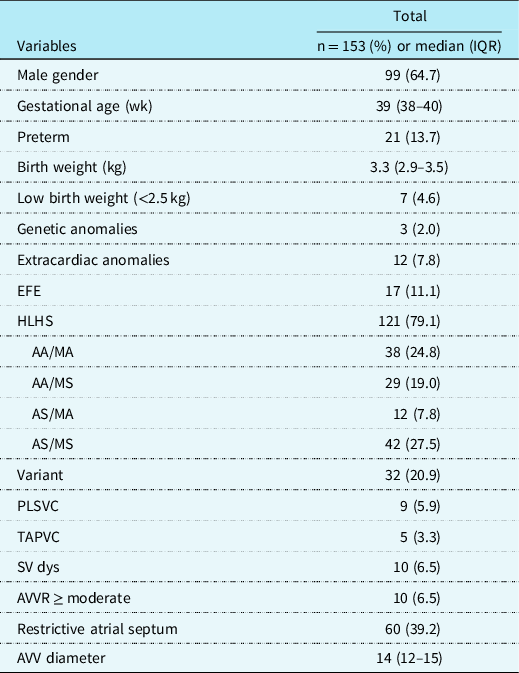
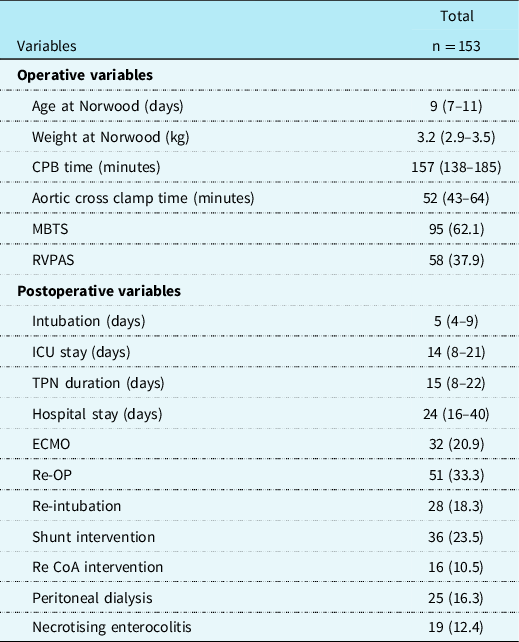
Patient characteristics are shown in Table 1. Median gestational age and birth weight were 39 (38–40) weeks and 3.3 (2.9–3.5) kg, respectively. Diagnosis included 121 (79%) hypoplastic left heart syndrome and 32 (11%) patients with variants. Operative- and postoperative variables are shown in Table 2. Median age and weight at Norwood were 9 (7–11) days and 3.2 (2.9–3.5) kg, respectively. Modified Blalock-Taussig shunt was used in 95 (62%) patients and right ventricle to pulmonary artery conduit in 58 (38%). Postoperatively, the median length of intubation, ICU, and hospital stay were 5 (4–9), 14 (8–21), and 24 (16–40) days, respectively. A total of 21 patients died within the first 30 days after the procedure, which was recorded as early deaths. At hospital discharge, no patient had gastrostomy, and 5 patients had enteral feeding using an elemental diet tube.
Patient characteristics.

AA = aortic atresia; AS = aortic stenosis; AVV = atrioventricular valve; AVVR = atrioventricular valve regurgitation; EFE = endocardial fibroelastosis; HLHS = hypoplastic left heart syndrome; MA = mitral atresia; MS = mitral stenosis; PLSVC = persistent left superior vena cava; SV dys = single ventricle dysfunction; TAPVC = total anomalous pulmonary venous connection.
Operative- and postoperative variables.

AXC = aortic cross clamp; CoA = coarctation of aorta; CPB = cardiopulmonary bypass; ECMO = extracorporeal membrane oxygenation; ICU = intensive care unit; MBTS = modified Blalock-Taussig shunt; RVPAS = right ventricle to pulmonary artery shunt; TPN = total parental nutrition.
Post Norwood caloric intake and progression of weight for age z-score
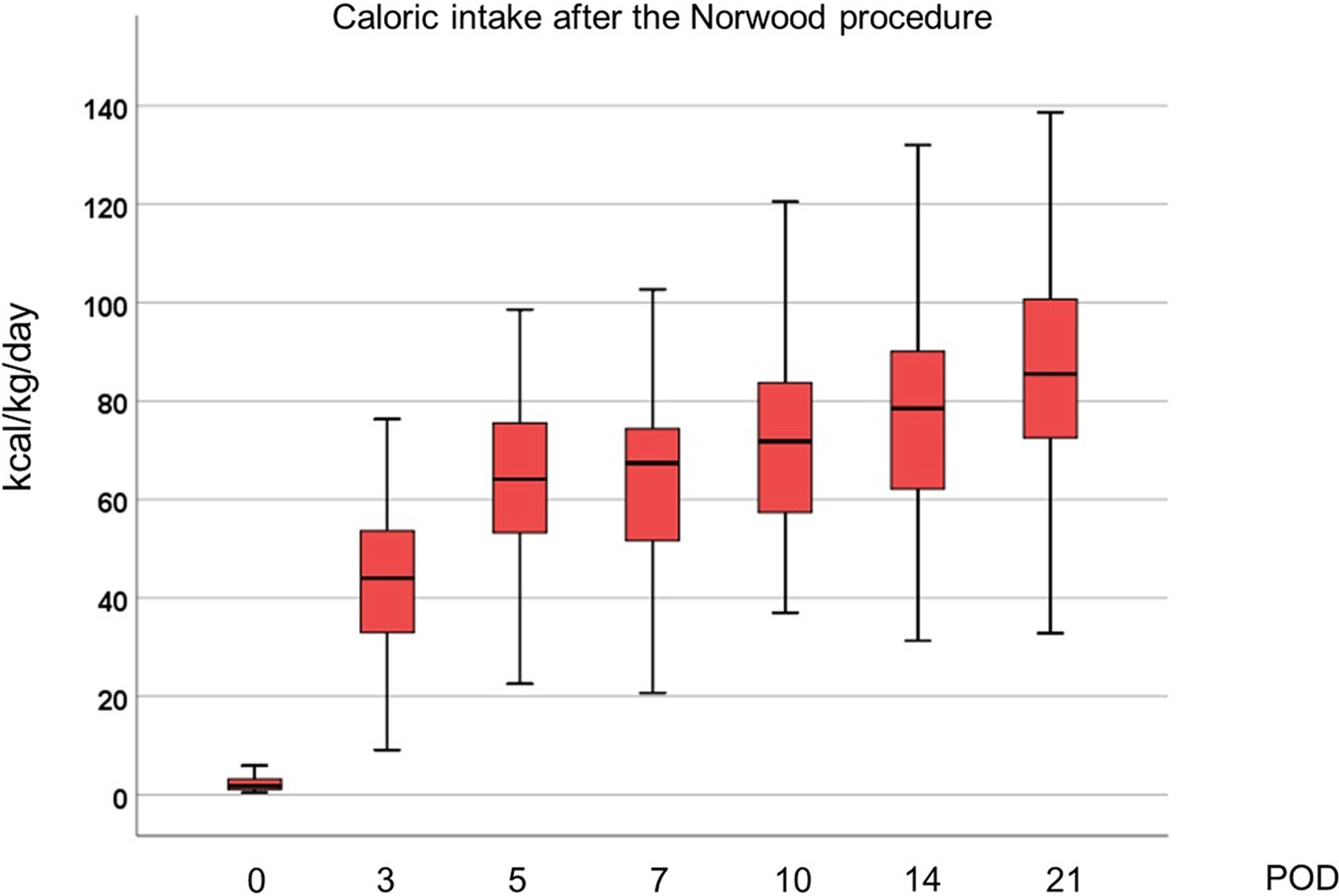
The caloric intake over the first 21 days after Norwood is shown in Figure 1 and Supplementary Table S1. A continuous increase of calories per body weight per day could be observed, ranging from a median of 44 kcal/kg/day on the third postoperative day to a median of 86 kcal/kg/day on the 21st postoperative day. Patients who had an early death had a significantly lower intake of calories than patients who survived (Supplementary Table S1).
Box-and-whiskers dot plots showing change of calorie intake after the Norwood procedure. The top and bottom whiskers mark the minimum and maximum values, the upper and lower borders of the box represent the upper and lower quartiles, and the middle horizontal line represents the median.

The increase in caloric intake contrasts with the development of weight gain recorded over the first five months postoperatively. In particular, patients showed a significant decrease in weight-for-age z-score within the first 21 days (Fig. 2). Median weight-for-age z-score at Norwood was –0.72 (–1.4 to –0.1) and –2.5 (–3.1 to –1.7) three weeks postoperatively.
Box-and-whiskers dot plots showing serial changes of weight for age z-score (WAZ). The top and bottom whiskers mark the minimum and maximum values, the upper and lower borders of the box represent the upper and lower quartiles, and the middle horizontal line represents the median.

Inter-stage survival and results after bidirectional cavopulmonary shunt
Among 132 early survivors after Norwood, 17 patients died during the interstage period, 103 underwent bidirectional cavopulmonary shunt, and 12 were alive without bidirectional cavopulmonary shunt. Patients who underwent bidirectional cavopulmonary shunt reached significantly higher calorie intake (94.9 ± 28.7 versus 76.7 ± 29.1kcal/kg/day, p = 0.016) and higher weight-for-age z-score (–2.57 ± 0.95 versus –3.40 ± 1.14, p = 0.013) at 28 days after Norwood, compared to patients who did not receive bidirectional cavopulmonary shunt (Supplementary Table S2). Median age, weight, and weight-for-age z-score at bidirectional cavopulmonary shunt were 3.4 (3.0–4.3) months, 4.9 (4.3–5.5) kg, and –1.9 (–2.7 to –1.1), respectively. Median ICU and hospital stay were five (3–8) days and 18 (11–32) days, respectively. There was no significant difference in ICU or hospital stay between patients with weight-for-age z-score > –3 and weight-for-age z-score ≤ –3 at two months of age or at the time of bidirectional cavopulmonary shunt (Supplementary Table S3). There were 11 deaths after bidirectional cavopulmonary shunt, 52 patients underwent total cavopulmonary connection at the median age of 2.1 (1.7–2.4) years, and 40 patients were awaiting total cavopulmonary connection. The median follow-up period after bidirectional cavopulmonary shunt was 681 (155–1289) days. There was no heart transplantation or total cavopulmonary connection takedown. Transplant-free survival at 1, 3, and 5 years after bidirectional cavopulmonary shunt was 90.1, 85.3, and 80.6%, respectively. For patients with weight-for-age-Z-score > –3 at two months old, transplant-free survival at 1, 3, and 5 years was 92.9, 92.9, and 92.9%, and for patients with weight-for-age-Z-score ≤ –3 at two months old, it was 85.2, 73.4, and 36.7% (Fig. 3a, p = 0.017, log-rank test). There was also a significant difference in transplant-free survival for the cut-off values of weight-for-age-Z-score > –2 and weight-for-age-Z-score ≤ –2 (p = 0.032, log-rank test). Comparing the survival after bidirectional cavopulmonary shunt using the weight-for-age-Z-score at bidirectional cavopulmonary shunt, there was no significant difference in survival with either the cut-off value of –2 (p = 0.646) or of –3 (p = 0.421).
A). Comparison of survival after BCPS in patients who had WAZ < –3.0 and who had WAZ > –3.0. B). Comparison of survival after BCPS in patients who had WAZ < –2.0 and who had WAZ > –2.0.

Pre- and postoperative parameters associated with lower weight-for-age-Z-score
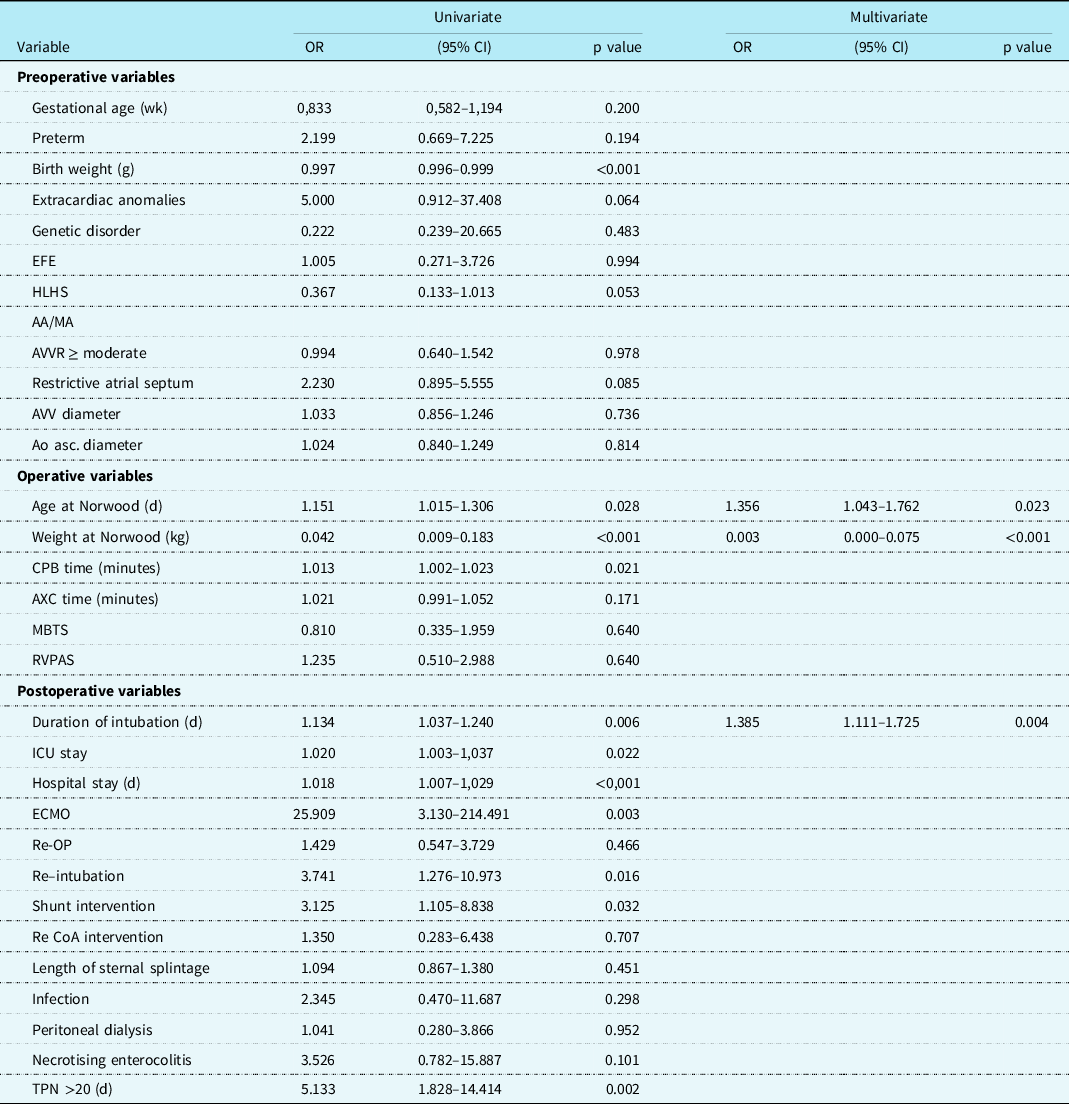
Several perioperative parameters were identified to be associated with lower weight-for-age-Z-score measured prior to bidirectional cavopulmonary shunt at two months of age (Table 3). Lower weight-for-age-Z-score was defined as a weight-for-age score < –3. We found lower birth weight (p < 0.001, odds ratio (OR): 0.997), older age at Norwood (p = 0.028, OR: 1.152), lower weight at Norwood (p < 0.001, OR: 0.042), longer CPB time (p = 0.021, OR: 1.013), longer duration of intubation (p = 0.006, OR: 1.134), prolonged ICU stay (p = 0.022, OR: 1.020), prolonged hospital stay (p < 0.001, OR: 1.018), postoperative extracorporeal membrane oxygenation support (p < 0.001, OR: 25.909), need for re-intubation (p = 0.016, OR: 3.741), need for shunt intervention (p = 0.032, OR: 3.125), and duration of total parenteral nutrition >20 days (p = 0.002, OR: 5.133) to be risk factors for lower weight-for-age-Z-score using univariate mode. Among those, older age (p = 0.023, OR: 1.356), weight at Norwood (p < 0.001, OR: 0.003), and longer duration of intubation (p = 0.004, OR: 1.385) were identified as independent risk factors using a multivariate model. Lower weight at Norwood (p = 0.925, HR: 0.504, 95% CI: 0.276–0.919) and longer duration of intubation (p < 0.001, HR: 1.051, 95% CI: 1.029–1.073) were also identified as risks for mortality after bidirectional cavopulmonary shunt, but age at Norwood procedure (p = 0.992, HR: 1.000, 95% CI: 0.946–1.057) was not.
Risk factors for low weight-for-age z-score (<–3.0 at 2 months after Norwood).

AA = aortic atresia; Ao Asc = ascending aorta; AVV = atrioventricular valve; AVVR = atrioventricular valve regurgitation; AXC = aortic cross clamp; CoA = coarctation of aorta; CPB = cardiopulmonary bypass; ECMO = extracorporeal membrane oxygenation; EFE = endocardial fibroelastosis; HLHS = hypoplastic left heart syndrome; ICU = intensive care unit; MA = mitral atresia; MBTS = modified Blalock-Taussig shunt; RVPAS = right ventricle to pulmonary artery shunt; TPN = total parental nutrition.
In addition, the impact of right ventricular function and atrioventricular valve regurgitation on weight-for-age-Z-score was separately analysed. As a result, patients with ventricular dysfunction at discharge tended to show lower weight-for-age-Z-score at two months (–0.125 versus 0.87, p = 0.448) and three months (–0.247 versus 0.122, p = 0.138). However, there was no statistical difference between the patients with and without ventricular dysfunction. Similarly, patients with significant AVV regurgitation (moderate or more) at discharge tended to show lower weight-for-age-Z-score at two months (–0.284 versus 0.210, p = 0.077) and three months (–0.291 versus 0.178, p = 0.062), but p-value did not reach statistical significance between the patients with and without significant atrioventricular valve regurgitation. When comparison was done using the degree of ventricular dysfunction at two months, there was a significant difference in weight-for-age-Z-score at two months (–0.529 versus 0.118, p = 0.038). As for the atrioventricular valve regurgitation at two months, patients with significant atrioventricular valve regurgitation showed lower weight-for-age-Z-score (–0.178 versus 0.192, p = 0.056), but the p-value did not reach statistical significance between the patients with and without significant atrioventricular valve regurgitation.
Impact of shunt types modified Blalock-Taussig shunt versus right ventricle to pulmonary artery conduit on calorie intake and weight-for-age-Z-score
The choice of modified Blalock-Taussig shunt or right ventricle to pulmonary artery conduit did not influence the weight-for-age-Z-score at no point during the evaluated period. However, daily caloric intake (kcal/kg/day) at 10 and 14 days after surgery was lower in patients with right ventricle to pulmonary artery conduit compared to modified Blalock-Taussig shunt (Supplementary Table S4).
Discussion
Our data showed that lower calorie intake was observed in patients who died before bidirectional cavopulmonary shunt. Although calorie intake was postoperatively increased, weight-for-age-Z-score continued to decrease until bidirectional cavopulmonary shunt procedure. Older age and lower weight at Norwood and longer duration of intubation were identified as risk factors for low weight-for-age-Z-score at two months of age. Patients with weight-for-age-Z-score < –3 at two months of age had poorer survival after bidirectional cavopulmonary shunt than those with weight-for-age-Z-score ≥ -3.
Weight gain after the Norwood procedure
Previous studies demonstrated that single ventricle physiology poses a significant risk for impaired somatic growth after stage I palliation. Reference Luo, Xu, Zhang, Hong, Zhang and Zhang18–Reference Lambert, Pike and Medoff-Cooper20 This might be because of the parallel circulation of the shunt-dependent physiology. The systemic single ventricle is posed to support both systemic and pulmonary circulation, resulting in volume overload of the ventricle and heart failure. Especially after the Norwood procedure, postoperative complications might cause prolonged recovery and inadequate nutrition. Our data showed a consistent decrease in weight-for-age-Z-score within the first five months after Norwood surgery. This observation is consistent with numerous other studies. Reference Van den Eynde, Bartelse and Rijnberg9,Reference Hong, Moffett, Payne, Rich, Ocampo and Petit13,Reference Granegger, Küng and Bollhalder21–Reference Baldini, Librandi, D'Eusebio and Lezo25 Our results also demonstrated that patients with ventricular dysfunction showed lower weight-for-age-Z-score at 2 months compared to those with normal ventricular function. Whereas Van den Eynde et al. demonstrated the recovery of weight-for-age-Z-score after stage 2 palliation in their systematic review and meta-analysis. Reference Van den Eynde, Bartelse and Rijnberg26 It is well recognised that catch-up of somatic development is obtained by volume unloading by stage 2 palliation in patients with single ventricle physiology. Therefore, our institute has a policy to perform bidirectional cavopulmonary shunt as soon as possible from 3 months old and farewell to the shunt-dependent circulation. The antegrade pulmonary blood flow should be eliminated at the time of bidirectional cavopulmonary shunt. Reference Ono, Burri and Mayr27
Caloric intake after the Norwood procedure and impact in interstage survival
There are considerable differences in calorie intake after the Norwood procedure among studies, measuring 54 to 120 kcal/kg/day. Reference Hong, Moffett, Payne, Rich, Ocampo and Petit13,Reference Nicholson, Clabby, Kanter and Mahle24 We administered an average of 86 kcal/kg/day, corresponding to the recommendations proposed by the ESPGHAN/ESPEN/ESPR/CSPEN guidelines. Reference Joosten, Embleton, Yan and Senterre17 We showed that the daily calorie intake directly influenced in-hospital and interstage survival after Norwood. Caloric intake may be increased in patients with stable postoperative haemodynamic status. Cardiopulmonary instabilities, the need for re-interventions or extracorporeal membrane oxygenation support, might hinder calorie intake, and patients with impaired cardiac or organ function cannot receive enough calories due to fluid restriction. This may be caused by volume overload and fluid retention, impairment in renal function, and acute kidney injury, among others. Reference Nicholson, Clabby, Kanter and Mahle24,Reference Ono, Burri and Mayr27 Furthermore, the possibility of enteral nutrition is also restricted by mechanical ventilation, risk of mesenteric ischaemia, non-cardiac anomalies, gastrooesophageal reflux, dysphagia, and vocal cord dysfunction. Reference Hong, Moffett, Payne, Rich, Ocampo and Petit13,Reference Sethi, Goyal and Yadav28 These factors might impair the calorie intake and increase mortality after the Norwood procedure.
During the interstage period, there was no significant correlation between provided calories and weight-for-age-Z-score before bidirectional cavopulmonary shunt. This may be due to the general problem of shunt dependent physiology as described above. Early volume unloading by stage 2 palliation might be the solution to promote catch-up growth.
Risks for low weight gain after the Norwood procedure
In this study, age and weight at Norwood and duration of total parenteral nutrition were associated with lower weight-for-age-Z-score. As for the age at Norwood as a risk, we assume that older age at Norwood means late referral from other clinics or preoperative problematic conditions that delayed the timing of the Norwood procedure. Longer duration of total parenteral nutrition might represent the prolonged recovery after the Norwood procedure. These patients had complications, such as respiratory dysfunction, ventricular dysfunction, or need for extracorporeal membrane oxygenation support. Likewise, this was observed for longer intubation, ICU stay, and extracorporeal membrane oxygenation implantation. Other studies showed a wide range of associated factors. Anderson et al. found higher mean pulmonary arterial pressure and systemic oxygen saturation to be associated with poor growth. Reference Anderson, Beekman and Eghtesady23 Kelleher et al. demonstrated the number of readmissions, length of ICU stay, and diuretic dose as negative correlates of nutritional status. Reference Kelleher, Laussen, Teixeira-Pinto and Duggan12 Also, severe tricuspid regurgitation and repeat interventions were associated with lower weight-for-age-Z-score. Reference Hong, Moffett, Payne, Rich, Ocampo and Petit13,Reference Hehir, Cooper, Walters and Ghanayem29 These data suggest that preoperative worse condition and postoperative delayed recovery might affect the postoperative weight gain.
This could be improved, for example, by using adapted feeding protocols. Reference Slicker, Hehir and Horsley11,Reference Lambert, Pike and Medoff-Cooper20
Impact of low weight-for-age-Z-score on outcome after bidirectional cavopulmonary shunt
Our analysis demonstrated that weight-for-age-Z-score < –3 at two months showed a reduced transplant-free survival after bidirectional cavopulmonary shunt. Ross et al. demonstrated that within a z-score ≤ –2, each additional unit decrease in weight-for-age-Z-score was associated with increased mortality risk. Reference Chaves, Baker-Smith and Rosenthal30 Barron et al. also showed failure to thrive as a risk for survival after bidirectional cavopulmonary shunt, increasing with lower z-scored weight. Reference Ross, Latham and Joffe31
In this study, weight-for-age-Z-score at two months, but not at bidirectional cavopulmonary shunt influenced the survival after bidirectional cavopulmonary shunt. We assume that we can modify the timing of Glenn between three to six months. When patients present with anatomical complications, such as Re-CoA, relevant aortopulmonary collaterals, or significant tricuspid regurgitation before bidirectional cavopulmonary shunt, we address them and perform bidirectional cavopulmonary shunt. Pulmonary artery pressure and PA development are also issues that influence the timing of bidirectional cavopulmonary shunt. Therefore, weight-for-age-Z-score at Glenn was modified by other patient conditions. Hence, weight-for-age-Z-score at two months might influence the Glenn outcome more than at bidirectional cavopulmonary shunt.
Future perspective prospective
We showed that causes of low weight-for-age-Z-score after the Norwood procedure are multi-factorial and might be considered mainly shunt dependent parallel circulation. Postoperative complications and delayed recovery might cause impaired weight gain. However, the question remains to what extent a low weight-for-age-Z-score, independent of the factors it is influenced by, impacts survival after bidirectional cavopulmonary shunt. Recently, Vest et al. demonstrated that patients with severe cardiac cachexia or malnutrition were also at risk for survival after ventricular assist device implantation, and early weight gain was independently associated with improved survival during subsequent ventricular assist device support. Reference Vest, Price and Chanda34 Most essential issues include avoiding postoperative complications that impair adequate postoperative calorie intake, providing enough calories during the inter-stage period to gain weight, and performing stage 2 palliation as soon as possible to unload the systemic ventricle. Further studies are needed that separate individual weight gain and weight-for-age-Z-score from determining perioperative variables and finding a way to treat patients demonstrating severe cardiac cachexia postoperatively.
Limitations
The study was limited by its retrospective, single centre nature. Follow-up duration is limited, and few patients were still awaiting Fontan palliation.
Conclusion
Although caloric intake was increased within the first 21 postoperative days, weight-for-age-Z-score decreased over the first five months after Norwood. Several variables, like weight at Norwood, duration of TPN, the need for ECMO support, and ICU length of stay, were associated with lower weight gain. Calorie intake and weight-for-age-Z-score were significantly higher in patients receiving bidirectional cavopulmonary shunt. Patients with WAZ ≤ –3 showed worse transplant-free survival after bidirectional cavopulmonary shunt than patients with weight-for-age-Z-score ≥ –3. These results demonstrated that weight gain after the Norwood procedure, optimising haemodynamics and improving nutrition might be essential for better long-term results.
Supplementary material
The supplementary material for this article can be found at https://doi.org/10.1017/S1047951123003736.
Financial support
This research received no specific grant from any funding agency, commercial, or not-for-profit sectors.
Competing interests
None.