Introduction: The Relationship of Quotidian Life and the Law
Scholars agree that medieval Jewish legal writers responded to “the needs of the times” in making their legal rulings, carefully choosing the legal sources and precedents upon which they relied, rereading or even rejecting those sources in light of their quotidian reality.Footnote 1 Particularly in the Geonic Period,Footnote 2 as Talmudic norms encountered a geographically expansive community experiencing radical social transformations in the engagement with Islam, as well as rapid economic development concomitant with the rise of the ʿAbbāsids, which urbanized and transformed the economic life of the Jewish community,Footnote 3 classical sources of Jewish law faced new pressures.Footnote 4 Geonic leaders responded to these pressures by making recourse to the traditional institutions of taqqana (Hebrew, “legislative enactment”)Footnote 5 and minhag (Hebrew, “custom”).Footnote 6 Therefore, it is widely accepted that the vicissitudes of daily life influenced both the responsa of the GeonimFootnote 7 and their contributions to the expanding codificatory literature.Footnote 8 On the other hand, the potential influence of Jewish legal norms upon daily life remains an unsettled area in the study of the history of the premodern Jewish community. A paucity of documentary or archaeological evidence complicates this problem, and edited literary texts of various genres remain themselves among the most important witnesses to Jewish life in the period.
This article will seek to transcend earlier studies showing the mutability of law in light of daily life, adding to the discussion by revealing that Jewish legal norms also played an influential role in determining quotidian practice. The article will focus on rabbinic legal materials from late antiquity and their reception through the Geonic community and its Rabbanite constituents in medieval Egypt, and will turn to the historical witnesses of the Rabbanite community, which have emerged as further documentary evidence has come to light. The documents of the Cairo GenizaFootnote 9 provide the historical evidence for the relations between norms and practice within the Rabbanite Jewish community of medieval EgyptFootnote 10, a legally pluralistic environment in which litigants had access to both Jewish and Islamic courts.Footnote 11 The choice of members of this community to bring their proceedings to Jewish courts will, therefore, be seen as deliberate. Furthermore, a close reading of court practice as described in the Geniza documents will reveal the decision of Jewish economic actors to structure their relationships according to Jewish legal norms to be no less deliberate. In an environment of competing canonical legal norms, which included several gradations among the various orthodox schools of Islamic law as well as those of Jewish law, the survival of a significant corpus of legal agreements in the Geniza reflecting the typology of economic partnership models seen in Jewish law that deviate from corresponding models seen in Islamic lawFootnote 12 can even be seen as a vehicle for expressing Jewish communal self-consciousness in the economic domain. First recapitulating the approaches of other scholars—notably Abraham Udovitch and Avner Greif—to the economic relations of Jewish merchants in the medieval Islamic Mediterranean, both of whom hold that classical Jewish legal codes were not in fact determinative of commercial practice in the environment that produced the Cairo Geniza documents, I will sketch out the complex dialogue between canonized legal norms and commercial practice. The center of this dialogue will be shown to have been a legal system relying heavily on a process of mediation that educated Jewish economic actors as to the norms of Jewish law, and encouraged them to align their commercial practice with those norms.
Thus, I will then turn to a summary of contemporary mediation theory, in order to reveal a number of models for the relationship between canonical legal norms and actual mediated agreements; and the procedural details of court practice in Jewish medieval Egypt will be measured against these models. Revealing court practice to follow a “norm-educating” model, the documentary output of the Jewish court will be shown to be in dialogue with canonical Jewish legal norms. Although much ink has been shed by other scholars revealing ways in which the Mishneh Torah and other classical Jewish legal works were influenced by forces emerging from their quotidian environment, causing their writers to incline toward one or another Talmudic ruling or even to do violence to the Talmudic text itself in order to accommodate quotidian practice, I will demonstrate that positive law had a corresponding determinative influence on that environment, affecting the choices of Jewish economic actors as they opted to structure their relationships according to Jewish norms, which themselves emerged from the classical compendia of Jewish law.
The advantage of “norm-educating” models of mediation is that the legal agreements that they produce do not necessarily accord with all the codified norms of the system that produced those agreements. Jewish legal norms influenced commercial practice without completely determining or defining it. This understanding suggests that the choice of Jewish economic actors to structure their relationships generally according to those norms should be seen as a conscious decision. The key role of the courts as well as the influential role of classical Jewish legal norms in shaping and implementing agreements should also suggest the importance of the Gesellschaft as opposed to the Gemeinschaft (to use the language of sociologist Ferdinand Tönnies), challenging the application of “Lawlessness and Economics” literature to the Jewish merchants of the eleventh century Mediterranean.Footnote 13 Scholars of this literature have argued that coalitions of merchants turned to local subgroup norms to define their own behavior, which was then monitored outside the formal legal system.Footnote 14 Instead, I will show that classical Jewish legal norms compiled in the Mishneh Torah Footnote 15 shaped Jewish economic relationships and Jewish identity.
Commercial Law and Mercantile Practice: Previous Studies
Any analysis of partnership relations in the medieval Islamic Mediterranean and the connection between commercial law and practice must take as its starting point Abraham Udovitch's seminal 1970 work Partnership and Profit in Medieval Islam. Turning to business letters from the Cairo Geniza concerning mercantile partnerships, Udovitch concludes that “[w]hen compared, a remarkable symmetry becomes evident between the legal formulations of the late eighth century on the one hand, and the documented commercial practice of the eleventh and twelfth century Geniza merchants on the other.”Footnote 16 Udovitch's analysis of the parallels between commercial letters and Islamic commercial codes vindicated his predecessor Joseph Schacht's reading of Islamic law as both reflecting and accommodating commercial practice.Footnote 17 Udovitch even described Ḥanafī law as a “medieval Islamic Law Merchant.” This term is clearly apposite given that Ḥanafī law is the most developed and flexible of the four major Sunnī schools, and therefore most broadly capable of vindicating custom (Arabic, ʿurf) in order to establish positive law. In the absence of any “religious or moral principle”Footnote 18 governing commercial practice, the Ḥanafī lawyers were free to develop legal devices that accommodated—indeed, canonized—a local practice encountered by Islamic conquest over the course of the seventh century, despite the fact that this local practice may have diverged from behavioral norms envisioned by the early Islamic conquerors themselves.Footnote 19
Although he lacked commercial documents from medieval Islamic merchants, Udovitch did have a corpus of documentary evidence to which he could turn in order to bolster his claims concerning commercial practice: the Cairo Geniza. This treasure trove of documents, which began to enter the hands of scholars in the middle of the nineteenth century and had by Udovitch's time begun to receive systematic treatment, particularly by the twentieth century doyen of Geniza studies, S.D. Goitein, includes fragments representing a multitude of genres, from classical biblical and rabbinic texts to pages on which children had practiced writing the Hebrew script, to eleventh century petitions to the Fāṭimid caliph written in Arabic. With the rise of Arabic as the lingua franca among the Jewish community of the southern Mediterranean and the Levant in the centuries following the Islamic conquests, Jews produced documents in Judeo-Arabic, a “middle-Arabic” written in Hebrew script often peppered with Hebrew and Aramaic idioms from the rabbinic argot. The so-called “documentary Geniza”, containing documents from all walks of life, represents one tenth of the Geniza trove as a whole or perhaps even less, which is overwhelmed by fragments of classical rabbinic sources; however, this alone represents a corpus of more than 15,000 fragments of paper.Footnote 20 However, despite Goitein's attestation that “[t]he largest and most valuable group of Geniza documents is made up of court depositions,”Footnote 21 Goitein's own attention, as well as that of Udovitch, was focused overwhelmingly on letters. Although the first volume of Goitein's A Mediterranean Society did discuss a number of legal agreements concerning commercial cooperation,Footnote 22 Goitein and Udovitch both turned primarily to letters for their depictions of economic life. Unfortunately, however, much of the specific detail concerning commercial cooperation, such as the planned allocation of profit and loss between partners, is entirely absent from commercial letters, which typically include such vague phrases as “[f]or our joint business, too, make an effort and buy whatever you see fit of flax and spices.”Footnote 23 Indeed, it is only where Udovitch turns to Goitein's analysis of the small collection of legal documents that the latter did examine,Footnote 24 that Udovitch concludes that “[m]ost arrangements…involved complex patterns of distribution of investments, work, risks, and profits among the parties to a partnership or commenda.”Footnote 25 Amidst a Judeo-Arabic corpus that alludes to partnerships, agency agreements, brokerage, and commenda often using the Arabic terms recognizable from fiqh (Islamic legal) compendia, Udovitch claims that “[t]hose aspects of commerce which loomed large for the Geniza merchants are exactly those to which the legal texts devote lengthy and detailed discussions,”Footnote 26 leading to his conclusion that Islamic law—and not Jewish law—represented nothing more (and nothing less) than a record of commercial practice.
The detail that Udovitch gathered from that “record of commercial practice” led him to conclude that most commercial cooperation was conducted on the basis of ties that “had no specific shape or content”Footnote 27 but instead relied on quid pro quo transactions that were fulfilled by associates relying on mutual trust built over the course of longstanding relationships. These relationships were also bilateral and dyadic, through which each individual could be seen as the focal point from which many dyadic ties extended outward.Footnote 28 Importantly, the expectations of these relationships were not necessarily articulated explicitly, and relationships were managed through the instruments of personal guarantee and trust.
Udovitch's work on the nature of commercial cooperation and the role of traders’ behavioral expectations in defining that cooperation was developed more fully by the economist Avner Greif.Footnote 29 Unlike Udovitch, who saw relationships as negotiated through personal guarantee and trust, Greif saw these relationships—or, at least, the punishment mechanism that governed these relationships—to be multilateral and to be defined by a specific community of traders. That is, whereas a principal–agent relationship was maintained at the level of the node, between two individuals, a principal would express his dissatisfaction with any particular agent in his letters to his other associates, and this dissatisfaction would thereby be communicated to the group as a whole. According to Greif, members of the group as a whole would show common cause with their fellow by shunning the erstwhile agent, agreeing never to employ an agent who cheated while operating for any coalition member.Footnote 30 In an environment in which the legal system was expensive, slow, or generally inaccessible, this multilateral punishment structure could provide a framework that made for an efficient wage and provided the agent with a disincentive to cheat.Footnote 31 Greif saw a somewhat tight-knit group of eleventh-century traders, whom (following Goitein) he calls the “Maghribīs,” placing the center of their network in the Maghreb (that is, central North Africa), although he seems unwilling to describe this as a subculture per se, and he rejects Werner Sombart's reliance on relationships within “natural groups.”
However, Greif does argue that there was a sense of connection and esprit de corps among these traders, a sense prefigured by Udovitch's allusion to the self-description of these traders as “aṣḥābunā, our colleagues.”Footnote 32 Supporting Greif's understanding that the Maghribīs established a distinct group in the eleventh century Mediterranean trade is his claim that evidence of cooperation with non-Maghribī traders by members of this group is rare, and that connections within the group were often sustained for multiple generations.Footnote 33 Whereas Udovitch described these connections as intensely personal and non-inheritable, Greif describes relations as extending to the group as a whole, which established and maintained its own behavioral norms.
Greif's research was an important contribution to the “Lawlessness and Economics” literature, which seeks to adduce alternative methods for the enforcement of property rights and the management of contracts in light of the ineffectiveness or absence of a structured legal enforcement mechanism. Greif suggests that this subgroup maintained distinctive ex-ante behavioral norms (defining, for example, what exactly “cheating” is) that did not extend beyond that specific group. Therefore, Greif writes that “[b]y discouraging intercoalition agency relations, these factors make the expectations on which the coalition rests self-enforcing. Hence, once a coalition is formed through some historical process, agency relations will be established only among the traders for whom expectations were initially crystallized.”Footnote 34
One consequence of this, according to Greif, is that the expectations of the coalition were transmitted intergenerationally, insuring that the coalition consisted only of Maghribīs and their descendants. Presumably, one could only become acculturated to the norms of the group by growing up in that group. Therefore, the source of those norms was the group itself, the small-scale Gemeinschaft, as opposed to the behavioral norms described by the classical legal literature of the (Rabbanite) Jewish community as a whole, representing the broader Gesellschaft. Neither Udovitch nor Greif would have understood Jewish legal norms to have played a role in the practice of the community of Jewish economic actors in the medieval Islamic Mediterranean. Examining the epistolary corpus of the Geniza, both scholars turn to the dominance of custom in determining practice: in Udovitch's case, it is the custom of the broader (that is, the “Islamic”) marketplace; in Greif's, it is the custom of the coalition itself. Therefore, Greif writes that “[t]he Maghribi's code of conduct was a social norm, a rule that is neither promulgated by an official source, such a court or legislator, nor enforced by the threat of legal sanctions but is nevertheless regularly complied with.”Footnote 35
Coming from the domain of institutional economics, Ethan Bueno de Mesquita and Matthew Stephenson have challenged Greif's conclusions by considering the possibility that the coalition and the legal system operated as parallel enforcement mechanisms; however, their study turns to Greif's analytical model, rather than the Geniza documents that underpin his conclusions, in order to challenge him.Footnote 36 On the other hand, Jeremy Edwards and Sheilagh Ogilvie have rejected entirely Greif's reliance on the multilateral punishment mechanism, examining detail from Geniza documents to argue that Jewish merchants turned both to Jewish and Muslim courts for conflict resolution.Footnote 37 Arguing along with these scholars that the legal mechanism did play an important role in the management of mercantile relationships, I will add to their challenges by drawing connections between the conduct of the merchants and the very same “official sources” that Greif says did not play a role in influencing behavior, by exploring the legal process through which conflicts were resolved and by bringing to light the norms that were implemented through that process.
Detail from Legal Documents in Light of Jewish and Islamic Law
One problem with the analyses of Udovitch and Greif is that their studies of Geniza documents rely almost exclusively on epistolary material. Mercantile letters in the Geniza are certainly rich in detail concerning what Goitein would call “the subjective aspect of trade, trade as seen by the people who were engaged in it,”Footnote 38 often providing exactly the sort of detailed information sought by Greif concerning merchants’ satisfaction with their partners and agents. Letters often also provided lists of commodities in which merchants transacted. However, as mentioned, merchants’ letters are particularly spare in precisely the sort of detail that would allow the researcher to determine the precise nature of the cooperative enterprise imagined by the counterparties. For example, exactly what sort of relationship was the “joint business” in the typical Geniza letter mentioned previously?Footnote 39 In this section of the article, I will challenge Udovitch's understanding that Ḥanafī law was descriptive of the practice of the Geniza merchants. This challenge will turn to the legal documents of the Geniza to demonstrate a general (if incomplete) correspondence between the detail seen in the documents and in the forms of economic cooperation seen in classical (Talmudic and Geonic) sources of Jewish law, and a corresponding disjunction with the classical sources of Islamic law. Subsequent sections will challenge Greif's claim that the source of norms was the Gemeinschaft, demonstrating that merchants were educated as to the norms of the Gesellschaft through the court system.
In reviewing the Geniza corpus, a telling silence emerges in certain domains: for example, in surveying legal documents concerning commercial life, very few such documents are concerned with agency relations. Whereas commercial letters often ask distant agents to buy or sell specific items as a wikāla (Arabic, “agency appointment”), Jewish law requires the writing of an agency appointmentFootnote 40 in but one case: when the agent is retained to collect on a deposit or a debt recorded in a document.Footnote 41 Likewise, narrative works of Islamic law do not mention the writing of agency documents—although Islamic formularies do contain formulae for agency appointment.Footnote 42 As Jewish law would have required the act of qinyan (Hebrew, “act effecting acquisition”) only in the case of debt collection, the court would not have been the usual or primary locus of agency appointment—except in this specific case.
On the other hand, the Geniza does reveal a substantial number of legal documents concerning commercial partnerships, at least many more than suggested by Goitein's list of 27Footnote 43 “industrial partnerships.”Footnote 44 A cursory survey of unpublished documents from the Geniza corpus reveals at least that number of heretofore unpublished partnership agreements, as well as at least twice that number of legal documents dissolving partnerships or indemnifying erstwhile partners from any future obligations relating to their partnership.Footnote 45
The fact that legal documents were written concerning partnership says nothing about the norms that they embody, nor does it say anything about the relationship of classical Jewish or Islamic legal codes to the partnerships described by those documents. In fact, if the legal documents had reflected partnership models seen in Islamic law, this analysis would simply bolster and even extend Udovitch's claim that Ḥanafī law was a “medieval Islamic Law Merchant” to include Jewish economic actors—a conviction seemingly held by Udovitch.Footnote 46 On the other hand, if the partnership models described by the legal documents were entirely eclectic, bearing no relationship either to Jewish or Islamic law, one could perhaps claim that the norms they reflected had actually emerged from the local norms of the guild-like coalition of merchants envisioned by Greif. However, as I have shown elsewhere,Footnote 47 and as will be discussed in brief detail subsequently, the partnership structures described by the legal documents actually echo the models described by Maimonides in his Laws of Agency and Partnership, even where those models differ from Ḥanafī law.
On the other hand, much of the data that can be gleaned from the legal documents of the Geniza suggest that the models of commercial cooperation that were utilized by Jewish merchants were those seen in classical Jewish codes and formularies. The basic categories of agency (Hebrew, “sheliḥut”), partnership (Hebrew, “shutafut”), and investment partnershipFootnote 48 (Hebrew, “ʿeseq”; Aramaic, “ʿisqa”) that are clearly laid out in Maimonides’ Laws of Agency and Partnership closely follow Talmudic models that are maintained with little variance in the Geonic codes and monographs that were composed and disseminated in the intervening centuries.Footnote 49 These categories are reflected in the Geniza documents as well:Footnote 50 as mentioned, few fragments of general agency survive, perhaps because ordinary agency appointment was effected orally rather than in writing;Footnote 51 however, the Geniza does reveal legal documents related to partnership and investment partnership. Although Goitein wrote that “[t]he Jewish ʿisqa was less common in the Geniza period than the Muslim commenda, as witness the extant contracts,”Footnote 52 a survey of the legal documents demonstrates that ʿisqa was not at all uncommon.Footnote 53 A search of more than 4,000 documents in the Princeton Geniza Project electronic text databaseFootnote 54 reveals no documents that actually bear the specific phrase “qirāḍ al-goyim” (“an ‘Islamic’ commenda”) mentioned by Goitein, suggesting that Goitein's conclusion relied on the testimony of Maimonides’ responsa rather than on that of actual legal agreements,Footnote 55 whereas a search of the same database reveals a document described as “qirāḍ be-torat ʿisqa” (“a commenda according to the laws of the ʿisqa”).Footnote 56 Investment partnerships do not always use one or the other of these phrases, but the absence of the former from among a significant swath of the “documentary Geniza” should be noted.
The most significant difference between the Islamic commenda and the Jewish ʿisqa lies in how these structures distribute losses experienced in the ordinary course of business: whereas the Islamic commenda indemnifies the agent in an investment partnership from such losses, the ʿisqa reckons half of the investor's capital to be a loan to the agent that therefore must be repaid in the case of loss.Footnote 57 That is, the commenda frees agents from liability for losses, whereas the ʿisqa does not. However, out of approximately 14 Geniza documents describing investment partnerships, which contain sufficient detail to discern the distribution of partnership losses,Footnote 58 only one document indemnifies the agent;Footnote 59 the other 13 all explicitly assign the agent a share of those losses. Although Goitein argues that “[a]ctual contracts according to Jewish law, which give the manager two-thirds of the profit but make him responsible for losses…are rare,”Footnote 60 it would seem that their presence is actually more prominent than understood by Goitein.Footnote 61
Nonetheless, the existence of investment partnership agreements executed in Jewish courts that reflect Jewish legal norms concerning the division of profits and, particularly, losses, does not suggest that the Islamic commenda did not occupy a prominent or perhaps even dominant place in the economic life of Jewish merchants in medieval Egypt. The Geniza reveals several documents pointing to the termination of a partnership that seems to have been formed according to the model of the commenda,Footnote 62 as well as “Arabic documents”Footnote 63 describing commercial relations that were formed in or in some cases even adjudicated in Islamic courts and subsequently brought to Jewish courts. Well aware of this, Goitein concluded that settlements were often made before Muslim notaries;Footnote 64 and that “[s]ince the most common form of legally valid business cooperation was the Muslim commenda, it is only natural that such contracts should be made before a Muslim notary.”Footnote 65 However, as will be shown, the range of outcomes that the Jewish courts were willing to authorize or even to endorse included those that fell beyond the range of Jewish legal norms as they are described in Talmudic literature, Geonic codes, and Maimonides’ Mishneh Torah.Footnote 66 Therefore, litigants’ choice of venue cannot necessarily be seen (as Goitein would seem to understand) as emerging from the details of the partnership structure that they chose to employ. Without a corresponding corpus of documents executed by Jews in Islamic courts, the extant evidence should drive scholarly conjecture; that evidence suggests that many Jewish merchants chose the Jewish courts as the venue for the establishment and maintenance of their partnership agreements, and that at least a significant proportion of those merchants who contracted investment partnerships did rely on the Talmudic ʿisqa rather than the Islamic qirāḍ.
As it has for “investment partnerships,” documentary evidence from “ordinary partnerships”Footnote 67 also reveals some important affinities with the distinctive structures of Jewish law. Those affinities are both formal and substantive. Beginning with the formal: in the case of ordinary partnership agreements, Maimonides requires that the partners initiate their relationship by placing their joint capital in a common purse;Footnote 68 whereas only one school of Islamic law requires this.Footnote 69 In contrast, neither Jewish nor Islamic law requires the common purse to initiate an investment partnership. In line with the Jewish legal requirement of a common purse for the ordinary partnership, the Judeo-Arabic word “wasaṭ” (“middle”), indicating the common purse, appears in approximately eleven Geniza documents describing ordinary partnerships,Footnote 70 but only one describing an investment partnership.Footnote 71 As pointed out by Jessica Goldberg, Geniza letters usually refer to the “ordinary partnership” (in her words, “an investment-shares venture partnership”) as a khulṭa (“mixture”), “referring to the mixing of monies in a single purse.”Footnote 72 It would even seem that Jewish merchants had a distinct word for ordinary partnerships having been formed without the formal requirement of raising up the common purse,Footnote 73 suggesting the transformative role of that act in the life of the partners’ relationship.
In addition to the formal requirement of raising up the common purse, there may also have been substantive matters in which Jewish commercial practice of ordinary partnership reflected a preference for Jewish legal norms rather than Islamic norms. However, the models of day-to-day management of ordinary partnership (“sharikat al-ʿinān” in Arabic) prescribed by Islamic law vary among the Mālikī, Shāfiʿī, and Ḥanafī schools,Footnote 74 and, therefore, the model of ordinary partnership described by each Islamic legal school should be considered separately vis à vis the Geniza documents.
First, in assessing the Mālikī school, Udovitch writes that ʿinān partnership “appears to have been conceived as pertaining either to a single commodity or to a single transaction.”Footnote 75 This model is a clear departure from Goitein's description of traders who often “had one article as their main business” yet nonetheless actively traded in a very broad range of commodities.Footnote 76 Partnership agreements from the Geniza support Goitein's understanding and also suggest that commercial relationships typically extended beyond single transactions.
Second, the Shāfiʿī model for ʿinān partnership demands that profit- and loss-sharing follow investors’ respective shares in the partnership capital, whereas Geniza merchants often preferred an equal (or evenly proportioned) division of profits and losses even when partners’ investments varied wildly.Footnote 77 The inflexibility of the Mālikī and Shāfiʿī models and their general incompatibility with a developed system of trade and commerce has already been noted by Udovitch.Footnote 78
However, Ḥanafī law shares much with Jewish law in its general framework for ordinary partnership, as well as its flexibility towards profit- and loss-sharing arrangements; given its general flexibility, it is unsurprising that Udovitch latched on to Ḥanafī law as a medieval Islamic “Law Merchant.” Geniza documents reflect the flexibility given to partners imagined by both Maimonides and Ḥanafī law. Although both Maimonides’ work and the important Ḥanafī code Kitāb al-Mabsūṭ of Muḥammad b. Aḥmad al-Sarakhsī (d.1106 CE) treat “general” partnerships the same, giving partners the freedom to transact in whatever commodities they see fit, at least one significant difference is to be found in the approach of these two works to the day-to-day management of partnerships in which the range of commodities is specified in the agreement (that is, in “specified” partnerships). This difference comes to the fore when one of the partners has used partnership capital to transact in a commodity other than those specified in the agreement.
Whereas Maimonides divides any profit from such a transaction equally among the partners (and allocates any losses solely to the individual who transgressed the specifics of the agreement), Sarakhsī holds that any profits or losses from such a transaction are the sole responsibility of the offending partner.Footnote 79 Jewish law discourages economic opportunists from transgressing the bounds of their partnership agreement by demanding that profits from any such transaction would be divided among the partners; Islamic law permits such opportunism where one takes on all of the risk and reward.
The variety of commodities that appear on bills of lading and in traders’ letters suggests that Jewish traders were economic opportunists who tried to take advantage of the myriad opportunities that presented themselves in the moment.Footnote 80 In the case of “ordinary partnerships” (as opposed to “investment partnerships”), both partners would be actively involved in seeking opportunities for themselves and for the partnership. Had these traders been operating under Islamic law, they would have had a strong incentive to specify the commodities or range of commodities in which they intended to transact.Footnote 81 Islamic formularies even point to the ex-ante mutual agreement of the partners on which commodities are to be traded.Footnote 82 This would allow an economic opportunist who saw a periodic “bargain” outside this range of commodities to employ the full partnership capital for his sole advantage, even if this meant taking on additional risk.
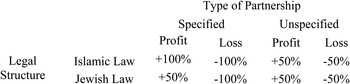
On the other hand, Jewish law does not permit this loophole of sorts, since the profits from such transactions would be split between the partners. (Figure 1 shows the various distributions of profit and loss to the “opportunistic” partner under the structures of Islamic and Jewish law.) Opportunists functioning under Jewish law might even prefer the unspecified partnership, as this would minimize their exposure to potential losses from taking risk on “bargains” that would have been outside the realm of the specified partnership. Unsurprisingly, perhaps, the main Jewish formularies even emphasize the unspecified nature of partnerships, referring to “whatever types of merchandise which the Heavens may permit us.”Footnote 83 The formulary of Hai Gaon (d.1038 CE) is an exception, as it explains that the partners may make certain stipulations, among them that no partner may transact without his fellow being physically present, somewhat reminiscent of the use of the dual in the Islamic formularies to indicate ex-ante mutual agreement.Footnote 84 However, such a stipulation would clearly be of little use to traders physically distant from one another, and, therefore, it would seem instead that such traders would stipulate that “each of us may buy and sell according to what he sees fit—whether in the presence of his fellow or on his own.”Footnote 85
Percentage of profit or loss assigned to the opportunistic partner from transacting in a commodity other than that specified in the partnership agreement. Note that the unspecified agreement is to be preferred by the economic opportunist functioning under Jewish Law; whereas the specified agreement essentially gives the economic opportunist functioning under Islamic Law access to a larger pool of partnership capital.

Whereas partnership agreements from the Geniza concerning a specific shop or economic enterprise such as a sugar factory often contain detail concerning the commodities to be manufactured or traded, only about half of the partnership agreements involving long-distance trade (as opposed to work in a shop or a factory) provide any description whatsoever of the nature of the commodities to be traded.Footnote 86 Goitein argues that broad discretion and latitude was assumed: “[s]ometimes it was expressly stated that the managing partners were free to act as they saw fit. Where no such statement was made, it was taken for granted.”Footnote 87 The slight numerical dominance of unspecified partnership in Geniza documents resonates with opportunists’ desire to minimize their exposure to losses, but the lack of a very strong preference for one type or another among the community of merchants may express the sentiment that a trader would only take advantage of such “bargains” when they were particularly likely to work out or they were particularly advantageous. As Jewish law would treat profits from the bargain transaction the same whether or not the underlying partnership was “specified,” traders would have had no clear preference for either form of partnership. On the other hand, opportunistic traders working under norms described by Islamic law might have preferred to specify their agreements, because their opportunistic use of partnership capital would garner them all the profits from transactions in commodities beyond those specified in the agreement (although they would also be liable for all the losses from such transactions). That the agreements found in the Geniza do not express a strong preference for specification suggests that these opportunistic traders might not have expected to allocate profits and losses according to the model presented by Sarakhsī. Rather, the slight preference for unspecified agreements suggests that they may have expected to have done so in the manner described by Maimonides. In matters of form and substance, then, the documentary evidence from the Geniza suggests that the structure of agreements concerning commercial cooperation from the Rabbanite community, particularly of eleventh and twelfth century Egypt, generally followed details and structures resident in Jewish codes and formularies, even where those details and structures diverged from those in their Islamic counterparts.
Significantly, there are periodic exceptions to the general affinities between the relationships described by the Geniza documents and the models for economic cooperation provided by Jewish law described in this section of the article, and even the exceptions to these general affinities were themselves ratified in the Jewish court. For example, the folio British Museum Oriental Collection 10126.6Footnote 88 (written in Bilbays, in the Nile Delta, in 1239 CE) reveals a commenda-style relationship between two Jews to have been renegotiated or restructured into a loan with a “fixed rate of profit” (Arabic, “fā’ida mutaʿayyina”), an arrangement clearly proscribed by Jewish law. A close examination of court practice in Jewish medieval Egypt will help adduce the ways in which those courts might have influenced practice and might explain these outcomes. Such an analysis is necessary to explain both the commonalities and the inconsistencies between the Mishneh Torah and the documents of the Geniza, which could otherwise be explained as a happy coincidence in which the norms of the Gemeinschaft happened to overlap significantly with those of the Gesellschaft.
The Courts: Pedagogues rather than Demagogues
Is the apparent—and, significantly, incomplete—correspondence between Jewish legal norms and the details of commercial arrangements just a happy coincidence? What role did the court have in informing merchants’ choices in structuring their business relationships? This section of the article will show that legal procedure in the Jewish courts included a process whereby Jewish merchants were educated as to the classical norms of Jewish law in commercial matters; in light of this, I suggest that this process of education played a role in merchants’ choices. After outlining the process of decision making in the Jewish court, this section will examine that process in light of contemporary mediation theory. Judicial authorities will be shown to have acted as mediators rather than adjudicators, and the role of rabbinic “judges” in educating “litigants” as to the bounds of Jewish law in the process of mediation will be shown to have influenced the outcomes of the court, although perhaps not to have defined those outcomes, and, therefore, to have had an important role in establishing commercial practice.
Demonstrating the ways in which the norms that are described by the classical sources of Jewish law were implemented by the Jewish courts of medieval Egypt might be somewhat simple if the Geniza retained a large corpus of detailed court judgments. Unfortunately, however, such “[f]ormal judgments, quoting the legal sources and detailing the reasons for the decision made, are almost entirely lacking.”Footnote 89 Court records are instead often either depositions germane to the matter at hand, or declarations by the parties. These declarations fall into two broad categories: “acquittals” or “acknowledgments”. In both cases, these documents suggest a resolution of the matter at hand: an “acquittal” denotes the release—often effected bilaterally—from the litigants of any future possible obligation toward each other, at times subject to a final condition such as settlement of a debt; whereas the “acknowledgement” declares an outstanding obligation from one party to the other.
However, even in the absence of formal judgments, there is no reason to believe that statutory law played no role in dispute resolution. As Goitein explains, the composition of myriad rabbinic responsa attests to the role of formal legal norms in the legal process. Rather, rabbinic concern with punishment for error in judgment—a concern reflected in Maimonides’ Mishneh Torah and its Talmudic sources that point out that “any judge who rules in a less than true manner causes the shekhina”—that is, the divine presence—“to depart from Israel”Footnote 90—led the court to set down its judgments in the form of declarations on the part of the parties instead of in the form of decisions written in the voice of the court. Goitein even mentions a tenth century judge who accepted his appointment only on condition that he should never be obliged “to give formal judgments in cases which he would decide.”Footnote 91 Therefore, the literary form taken by “judgments”—to wit, acquittals and acknowledgments—should not mislead the researcher into thinking that they do not represent actual decisions made by the court. Goitein believed that “Muslim judges adopted a similar attitude”Footnote 92 and also avoided formal judgments: a famous ḥadīth teaches that “When a judge gives a decision, having tried his best to decide correctly and is right, there are two rewards for him; and if he gave a judgment after having tried his best (to arrive at a correct decision) but erred, there is one reward for him.”Footnote 93 Chibli Mallat's description of a common “Middle Eastern” court practice in his 2007 Introduction to Middle Eastern Law parallels much of Goitein's description, including an absence of professional counsel, the recourse to outside legal experts, and the centrality of “consensual decision-making, with the judge as the holder of the last say in the matter at hand.”Footnote 94 Interestingly, Mallat was unable to find evidence of adjudication in documents from the Geniza. The absence of adjudication per se might not be surprising if, as explained by Lawrence Rosen, the goal of the qāḍī, “setting litigants back on a course of negotiating their own relationships”Footnote 95 was taken up by Jewish judges in medieval Egypt who relied on a consensual, non-adjudicative method of dispute resolution.Footnote 96
Court process in the Rabbanite community of medieval Egypt involved a preliminary review of the evidence in both oral and documentary form by the rabbinic court, almost without exception in the absence of legal advocates for either party. On the other hand, where the legal questions were complex, the initial presentation of evidence would be followed by recourse to jurisconsults whose opinions served the advocacy function: Goitein writes that “the parties, and if he saw fit, also the presiding judge, would present the case, as it had been formulated in court, to one or more legal experts.”Footnote 97 This process mirrors the practice in Islamic law of qāḍīs (judges) referring their legal questions to muftīs (jurisconsults) and could help reveal why both Islamic and Jewish responsa from the period remove detail from their legal opinions: the advocacy function could be served by these responsa even without all of the personal details from the specific case at hand. As is well known from the responsa of the Geonim, heads of the central academies in Babylonia or Palestine, which reveal multiple authorities responding to a single question or case, Jewish litigants would often send queries to multiple jurisconsults. Additionally, a single jurisconsult can even be seen periodically to respond to opposing litigants in a single case.Footnote 98 Jurisconsults were aware of this, and specified in their responsa that their “rulings”—that is to say, the conclusions drawn in their responsa—applied only if the details of the case were as stated in the question.Footnote 99
Analyzing the records of the Geniza, Goitein outlines in detail what, in his understanding, would proceed once the litigants arrayed the responsa of the jurisconsults:
After receipt of the opinions of the legal experts, a settlement outside court would be attempted first. Throughout our records, several arbiters, never a single one, are referred to, and as with the composition of a court, a large number of arbiters was considered more conducive to equity than a small one. In a little town in the Nile Delta we find nine persons mentioned by name acting as a board of arbitration with a circuit judge sent from the capital presiding. The circuit judge was advised by his superior to attempt a decision by law only if arbitration failed. Many lawsuits in the Geniza were settled by such agreements.Footnote 100
Thus, receipt of these legal opinions would be followed by an attempt to settle the case extra-curially, apparently by “arbitration” panels that often included judges. Only after efforts at arbitration “failed” would the court hand down a judgment, and even then only after the court itself had sent legal queries to its superiors either in Fusṭāṭ (old Cairo) or, when the chief judges in Fusṭāṭ were themselves involved in a case, to the authority figure—the gaon or nagid (that is, the local communal head)—who appointed them. At the same time, the litigants would also appeal to the higher court or the authority figure even before the lower court had handed down a decision. Finally, just before the court handed down its decision, it would give the parties the opportunity to save face by satisfying one another, particularly where the presumed loser was an individual of high standing. The decision itself often demanded that one or more parties take an oath, a ritual that included removing a Torah scroll from the ark and placing it in the hands of the party required to take the oath.
Examining the dispute resolution process in general, it is clear that rabbinic adjudication as such was not the default resolution technique, but was rather the last resort when disputes were not resolved successfully by other means, just as Mallat mentions with respect to his seventeenth century Lebanese court register.Footnote 101 On the other hand, a number of preliminary stages in the litigation involve something that Goitein describes as “arbitration” or “settlement.” This part of the process merits closer examination, not only because it seems likely that the process to which Goitein attaches the term “arbitration” was indeed the manner in which parties seeking recourse through the Rabbanite community actually resolved most disputes, and therefore a close study of this process might give a clearer idea of the social function of the court generally, but also because an examination of the roles played by the primary characters involved in this process and the documents that this process produced might yield some insights into exactly which sets of possible social norms were implemented as a result of the activities of the court, which (in turn) may make for a reevaluation of Greif's fundamental assumption that the community of traders held and implemented their own set of Gemeinschaft norms.
In attempting to adduce the role of classical Jewish legal norms in court practice, it is worthwhile examining the “arbitration” described by Goitein. As opposed to a contemporary understanding of arbitration as a process involving the binding adjudication of third parties, the attempted “out of court” settlement by a “board of arbitration”Footnote 102 that Goitein describes is only the first step in a larger process of dispute resolution; if “arbitration failed,” the court would “attempt a decision by law.” However, it would seem that the very essence of the process of arbitration—to wit, the binding aspect of third-party adjudication—is absent from Goitein's description. That is, the “board of arbitration” to which Goitein alludes may have been educated as to the details of the case and to the fine points of law as detailed in rabbinic responsa and precedent that had been brought to the court, but that board of arbitration seems to have lacked the power to hand down a binding decision. Otherwise, it is unclear why this board would ever need to return the case to the court itself. Therefore, “failure” of the board of arbitration, as understood by Goitein, would seem to mean a failure to bring the litigants together in agreement in a settlement, not a failure of the board of arbitrators itself to arrive at such a settlement. Goitein's use of the term “arbitration,” then, seems to refer to settlements outside the court.
However, in at least some cases, the out of court settlement process may have involved the litigants themselves in determining the details of settlements in a more active manner than that typically described by the contemporary legal term “arbitration.” It seems that at times the actual function of this board of legal experts was mediation rather than arbitration—that is, attempting to bring the parties together to arrive at a settlement rather than actually handing down a binding decision per se. Although the traditional Hebrew term for “arbitration,” “peshara,” Footnote 103 is not uncommon in legal documents executed in Jewish courts and preserved in the Geniza, the “peshara” described by these documents (to the extent that this can be determined) is only sometimes the product of the “outside” intervention of “elders,”Footnote 104 whereas at other times it is explicitly the product of the litigants themselves.Footnote 105 Furthermore, whereas classical rabbinic literature understands “peshara” to involve the binding adjudication of elders or judges,Footnote 106 the possibility of “failure” of arbitration can only indicate that the litigants themselves had a role either in arriving at or in accepting the settlement of the “board of arbitration”—suggesting that the meaning of “peshara” was broader in the Geniza period than in the rabbinic period, and encompassed both arbitration and mediation. Finally, that the very documents that allude to “peshara” were executed in the Jewish court suggests that this process was not one that functioned extracurially, but was instead an integrated component of the Jewish court's dispute resolution system.
Perhaps, then, Goitein's characterization of the dispute resolution process should be modified slightly. It would seem that the court would begin with an attempt to resolve disputes through mediation, in the hopes that this would save the judges from the possibility of error. This may also have had the added benefit of preventing the dissatisfaction of one or more parties with a judgment decreed by the court, which would have been highly attractive to the Jewish court. The legal environment was one in which enforcement of judgments and the coercive power of the court is unclear. Goitein writes that “[t]he handing down of a judgment did not always mark the end of a lawsuit. Its execution, even with the aid of the state authorities…sometimes caused great trouble.”Footnote 107 Therefore, reducing the role of adjudication in favor of mediation in order to reduce litigants’ dissatisfaction might have saved the resources of the court for attempting to enforce particularly difficult situations.Footnote 108 Given that any case could be taken to an Islamic court “on appeal”—that is, if one or more of the litigants was unhappy with the result in the rabbinic court, he or she could take the case to an Islamic court—the Jewish court would seem to have a vested interest in producing results that had the support of all concerned. Particularly in Fāṭimid Egypt (969–1171 CE), when Shīʿī rulers recognized qāḍīs of all four major Sunnī schools, Jewish, Christian, and Muslim litigants had their pick of a broad range of courts;Footnote 109 litigants’ choice of venue meant that the Jewish and Christian (Coptic) courts essentially competed to attract cases. Geniza documents often allude to “Arabic” documents (that is, presumably, documents whose origin was in the Islamic courts) making their way as “evidence”Footnote 110 in the Jewish court, and it is clear that scribes in the Jewish court composed legal documents in order to respond to legal concerns present in Islamic as well as Jewish law,Footnote 111 just as scribes in Islamic courts of any particular legal school turned to the practice of iḥtiyāṭ (Arabic, “precaution”) and composed their documents to respond to the legal concerns of the other Sunnī schools.Footnote 112 Mediation, then, would have been encouraged by the Jewish court as more expedient for all concerned. Although the court presumably had the power to intervene and to adjudicate, the vast majority of court records does not indicate adjudication per se, but only acknowledges a solution that was the product of the dispute resolution process as a whole. In many of these instances, it seems likely that success was achieved in the early stage of the process (that is, mediation), saving the court the trouble of arbitration (that is, adjudication) and its attendant risks both practical and spiritual.
It may be that Goitein's use of the term “arbitration” instead of “mediation” was purely an error in nomenclature, because in using the term “arbitration” Goitein is sensitive to the understanding of legal scholars that “mediation” of disputes generally avoids recourse to social or legal norms in the service of a solution acceptable to the disputing parties. Goitein's understanding should, therefore, be weighed against theoretical models of mediation. In his seminal article “Mediation—Its Forms and Functions,” published in 1971, the very same year that Goitein published the volume of A Mediterranean Society that discusses court procedure, the scholar of jurisprudence Lon Fuller wrote that “mediation is commonly directed, not toward achieving conformity to norms, but toward creation of the relevant norms themselves.”Footnote 113 Likewise, Goitein's assumption that mediation (in his words, arbitration) creates norms rather than conforms to norms is palpable when he protests that “[i]t would be entirely wrong to assume that the courts acted merely as boards of arbitration, without having recourse to statutory law.”Footnote 114 Although Goitein understood that the court was well versed in the details of cases at hand and the relevant points of law, he would seem to admit Fuller's point that mediation involves enabling the parties “to meet shared contingencies without the aid of formal prescriptions laid down in advance.”Footnote 115 Fuller even sees “not in the making of legal rules, but in their enforcement and administration that a certain incompatibility may be perceived between mediative procedures and the ‘rule of law’.”Footnote 116
The understanding, then, that mediation dominated the Jewish courts of medieval Egypt, and that mediation meant a certain detachment from the norms of the Gesellschaft, would seem to support clearly Greif's model of a tight-knit coalition with the norms of its own Gemeinschaft, even though the court may have been the forum in which those norms were implemented. However, more recent study of mediation has sought to “separate out the variety of processes grouped together as mediation and distinguish them based on their treatment of social norms.”Footnote 117 Therefore, in her 1997 article “The Role of Social Norms in Mediation,” Ellen Waldman outlines three distinct models of mediation: “norm-generating,” “norm-educating,” and “norm-advocating.” The first of these models is prefigured by Fuller's claim that mediation is directed “toward creation of the relevant norms themselves.” In this model, participants in the mediation process themselves articulate possible solutions, encouraged by the mediator to do so. Significantly, Waldman explains that in this model “the mediator does not remove identified options from consideration simply because those options conflict with existing social norms.”Footnote 118
On the other hand, Waldman's other two models, the “norm-educating” and the “norm-advocating” models, both place the mediator in the role of informing the disputants as to relevant social and legal norms, which are then used as a “baseline framework for discussion of disputed issues.”Footnote 119 The main distinction to be drawn between these two models is that the “norm-educating” mediator does not insist that the parties implement the norms, whereas the “norm-advocating” mediator establishes the bounds for any possible settlement based on the range of options allowed by the norms that he or she advocates.
In her discussion of “norm-educating” mediation, Waldman points out that some American corporations have developed in-house mediation programs to resolve employee disputes that are not explicitly norm-educating yet are nonetheless informed by legal norms. Indeed, one corporation's decision to use only mediators with an employment law background leads Waldman to conclude that in such cases “[t]he ‘objective perspective’ is, thus, informed by judicial norms and standards.”Footnote 120 Likewise, although Goitein does mention that “upright elders” or “peace-loving persons”Footnote 121 might play a role in extra-curial settlement, Geniza documents periodically allude to a mediation board headed by a circuit judge.Footnote 122 Therefore, members of the court may well have been familiar with Jewish law and (like the employment law mediators) they may well have been norm-educators simply by virtue of their educational and professional background. The norm-educating aspect of mediation would undoubtedly have been facilitated by the introduction into the mediation dialogue of expert legal opinions; as mentioned, Goitein explains that these opinions were composed and received by the court prior to the attempt to resolve the matter via mediation.
On the other hand, the mediation system of the Jewish court can hardly be said to have been “norm-advocating” as described by Waldman, for which she explains that “the mediator not only educated the parties about the relevant legal and ethical norms, but also insisted on their incorporation into the agreement.”Footnote 123 The documentary evidence itself suggests that this model is inappropriate, with the aforementioned agreement renegotiating a failed partnership into a loan at a fixed interest rate being the clearest example.Footnote 124 In bringing to light that the conditions of this document violated classical Jewish legal prohibitions on interest-bearing loans, Udovitch is certainly correct that the court did not act in a “norm-advocating” role. However, Waldman herself points out that the mediation of agreements in a norm-educating context may periodically involve overriding a norm without destroying the system on which that norm is based. Therefore, Waldman writes that “a settlement in which one waitress trades her right to be free of admiring but objectifying comments at work for higher pay is less disturbing from a public policy viewpoint than a class action settlement in which thousands of women workers ‘agree’ to continue to work in an obscene, insulting, and intimidating environment. The norm-educating model is appropriate only in conflicts in which the relevant norms may be disregarded without weakening the ideals upon which our government and legal structure are based.”Footnote 125
Whereas it is clear that a loan at fixed interest transgresses classical Jewish legal prohibitions, it hardly seems likely that the single commercial relationship described in BM Or 10126.6 would have weakened the ideals upon which medieval Jewish society was based. On the contrary, it would seem that this document, which Goitein described as unique among Geniza documents in stipulating a fixed interest rate, represented an exception proving the rule that traditional prohibitions on interest-bearing loans were indeed followed, at least overtly.Footnote 126 The Jewish court's imprimatur on a loan at fixed interest is clear evidence that those courts were not norm-advocating, but this does not mean that the courts were exclusively norm-generating as opposed to norm-educating. Rather, the model of elders as court representatives charged with the specific role of bringing counterparties together and educating them as to classical Jewish norms, whether through the opinions of jurisconsults arrayed by the various litigants or simply in session with those litigants, suggests that the Jewish court served in a norm-educating role. At times, this process failed, but it would seem that the first stage of decision making, at least, gave the litigants the opportunity to come to agreement after having been educated as to Jewish legal norms in the area in which they wished to draw up a contract or to resolve a dispute.
The reading of the court as “norm-educating” is further supported by the general adherence of partnership agreements as they appear in the court records of the Geniza to legal norms as canonized in classical Jewish legal codes. The preponderance of agreements formed in line with Jewish norms by merchants and traders understood to have been educated as to those norms seems to have resulted in agreements that integrated those norms; whereas a norm-generating process in which the counterparties would have had less direction from the agents of the court would likely have resulted in a distribution of outcomes less reflective of classical Jewish norms. Both the general proximity of actual arrangements much nearer to classical Jewish norms than envisioned by Goitein or Udovitch, and the occasional exceptions such as BM Or 10126.6, combine with the foregoing analysis of court procedure to strengthen the depiction of the Jewish court as norm-educating.
Which “Norms”?
In reviewing the work of the court, it is important to distinguish between the canonical norms of Jewish law in the domain of commerce and the default norms of the marketplace, to establish precisely which set of norms were those with which the court might have “educated” litigants. Although the legal experts who wrote opinions that came before the court serving in its role as mediator may have had personal experience as merchants, as perhaps did the members of the court themselves, the court's legal experts did not explicitly self-identify in their role as merchants when they were serving in their capacity as jurisconsults or as mediators. Therefore, merchants are certainly found as signatories notarizing court records; however, it was not in this capacity that they signed those records. The norms to which jurisconsults made reference, and for which mediators found themselves in a norm-educating role, were not those of the merchant community per se but were rather of Jewish society as a whole, which those jurisconsults were presumed to represent. In this, the Jewish court is to be distinguished from the “Piepowder” or “Law Merchant” courts found in twelfth through fifteenth century Britain. In describing the Piepowder courts, Scott Belhorn writes that “Over the course of these several centuries, commercial law developed at a distance from the powers of the state, regulated by mechanisms operating mainly within the market. The remarkable feature of this history is that the very merchants most affected by this law oversaw the arena in which it was administered…In effect, the laws of the fair were the merchants’ own evolving social norms.”Footnote 127
Jewish law, as found in classical legal compendia, did not generally suffer the problem faced by medieval European merchants, which was that the variation of local standards from borough to borough would have made it difficult for merchants to discover, much less conform to, such standards, begging the formation of cross-jurisdictional courts. This may have allowed Jewish law to serve as a cross-jurisdictional law. On the other hand, Menaḥem Ben-Sasson does note, citing a responsum of Sherira Gaon, that local practice in Fez was to indemnify agents serving principals in a commenda from liability for trading losses except in the case of malfeasance—a divergence from classical Jewish law that resonated with Islamic law.Footnote 128 Jurisconsults were therefore clearly aware of some local norms in writing their opinions. A norm-educating model for mediation practice among the Jewish courts would allow for the possibility that local traders actually formed their agreements according to that custom even after having been educated as to the classical sources of Jewish law on the matter. This is once again to be contrasted with the Piepowder courts, for which Bellhorn points out that lawyers “were generally denied entrance to the piepowder courts.”Footnote 129
Sherira Gaon's acknowledgement of local custom in Fez is important, because it points to an understanding that Jewish legal norms were neither promulgated nor perpetuated in a vacuum, but responded to pressures from local custom and from realia generally. Thus, a Gaonic responsum famously refers to “ḥukm al-tujjār” (Arabic, “the law of the merchants”),Footnote 130 as the legal basis on which the practice of check-writing was permitted, despite an explicit Talmudic ruling to the contrary. Whether the ultimate source of Rabbanite Jewish legal norms was quotidian practice itself or Talmudic texts, it would seem clear that involving agents of the court in the mediation process could make the court the locus of a dialogue between standards canonized in legal compendia and responsa on the one hand, and customary practice and the pressures of the marketplace on the other. The “norm-educating” model allows, even makes for, this dialogue. This dialogue would also have provided an important feedback loop, as those agents of the court continued to be in dialogue with their own jurisconsults.
The “norm-educating” model can be seen as creating a dialogue between the legal opinions of jurisconsults and the needs of individual litigants, as those litigants arrayed opinions (that is, responsa) in their favor and then presented them to the court, or Jewish judges requested those opinions and then brought them to the court. Examining responsa and the process of their dissemination can shed some light on precisely whether judges and jurisprudents made recourse to Talmudic norms or instead to some other set of customary rules. As mentioned previously, Waldman understands the selection of employment law practitioners as mediators by some American corporations to influence the range of outcomes, although obviously not to limit that range. The regular citation of Talmudic norms in responsa, even in the infrequent case in which they are presented to point out a divergence in customary practice from those norms, suggests that jurisprudents were aware of these norms and that litigants had at least a rudimentary exposure to those norms. Indeed, Jewish litigants’ presumed ability to act intelligently in choosing a venue that would give their case a good hearing from among a number of different Sunnī courts as well as dhimmī (Jewish and Christian) courts suggests that they may indeed have been somewhat sophisticated as to the norms that would form what Waldman calls as the “objective perspective” of the various venues in which they could seek recourse. This suggestion is bolstered by the existence of Geonic legislative innovations from Babylonia in the wake of Islamic conquest, which permitted the Jewish court to grant a divorce from a “rebellious wife” immediately instead of after the Talmudically imposed delay of one year. Robert Brody explains that “[t]his ordinance was apparently motivated by the fear that Jewish women … might seek the assistance of Islamic authorities and possibly even convert to Islam in order to dissolve their marriages without delay.”Footnote 131 It is clear, then, that the Geonim themselves were aware of the competitive nature of venue selection and understood litigants to have at least an elementary knowledge of the various expected baseline outcomes in each venue.
It perhaps goes without saying that Jewish jurisconsults themselves were aware of Talmudic norms, but even if this were the case, the fact that responsa of the period avoided citation of Talmudic material as often as they cited it might suggest that jurisconsults were themselves actually “norm-generating” and unconstrained by statutory law. Although Geonic codes such as Halakhot Pesuqot and Halakhot Gedolot (eighth and ninth century, Babylonia, respectivelyFootnote 132), as well as Alfasi's Halakhot Rabbati (eleventh century, Fez) largely recapitulate Talmudic material, the popularity of these works does not necessarily suggest that the rank and file of the Jewish community in the medieval Mediterranean was familiar with Talmudic norms. The possibility that even the learned elite in the Mediterranean diaspora may have maintained a low level of Talmudic learning is colorfully described by Abraham Ibn Daud in his “Story of the Four Captives.”Footnote 133 Likewise, Maimonides reflects a similar sentiment in his apologia for composing the Mishneh Torah: “…our wise men have lost their wisdom, and the understanding of our astute people is hidden.”Footnote 134 This suggests that Geonic jurisconsults could take at least some liberties in laying down the law against the grain of its Talmudic sources without fear of being challenged.
However, codificatory works seem to have mediated a dialogue between Talmudic sources, responsa, and Geonic monographs that occasionally challenged the opinions of the Geonic authorities. The interpolation of Geonic responsa in the various recensions of Halakhot Gedolot Footnote 135 points to a perception among copyists, and, perhaps, also among users of these codes, that a dialogue existed among these various sources of Jewish law. Thus, these codes served not only to communicate Talmudic norms and to make them more accessible to a population for whom those Talmudic sources were obscure, but also to react to the casuistry of the Geonic authorities to whom it had fallen to implement those norms. The phenomenon of reconciling Talmudic sources with Geonic opinion, embryonic in Halakhot Gedolot, comes into fuller flower with Alfasi's Halakhot Rabbati. Thus, the former code cites a relatively small number of geonic authorities, notably the eighth century Suran Geonim MariFootnote 136 and ḤaninaiFootnote 137 as well as Yehudai,Footnote 138 but Maimonides writes concerning Halakhot Rabbati “[i]n this work, he [Alfasi] cleared up all the errors that had crept into the rulings of his predecessors,”Footnote 139 and Alfasi cites the opinions of Geonim ranging from the eighth to the eleventh centuries.Footnote 140 Each generation of codification, serving to “correct” Geonic opinions, would, therefore, have exerted a subtle pressure on subsequent generations of geonic authorities, who would have expected that their opinions would be reviewed by later codifiers who would examine those opinions in light of the Talmudic sources. The dialogue between the various genres of Geonic legal composition is brought into relief in the following citation from the ʿIṭṭur of the twelfth-century Provençali jurist Isaac b. Abba Mari: “Rabbenu Samuel b. Ḥofni wrote in The Book of Partnership that despite the fact that partnership funds are not commingled, the relationship is still considered a partnership, and profits are to be divided; Rav [Isaac] Alfas(i) disagreed with him in a responsum, writing that this applies only when the (partners) commingled the funds in a common purse.”Footnote 141
Although it is not clear from the text of the ʿIṭṭur that Alfasi's responsum actually cited Samuel b. Ḥofni's monograph on partnership,Footnote 142 Isaac b. Abba Mari's arrangement of the legal sources produces a dialogue between the two; and the arraying of Talmudic sources, Geonic monographs, and responsa alike in the ʿIṭṭur as a synthetic code suggests a productive tension among these diverse literary genres in the development of the substance of law.
The act of composing responsa, then, can and must be seen as extending beyond the production of an opinion to be implemented in a specific case. The citation of responsa in subsequent legal works suggests that responsa were disseminated among the legal elite, and that the opinions of prominent Geonic jurists would both be cited and challenged later on. As is well known, the working relationships between the communities of the Mediterranean diaspora and the geonic scholarly centers of Babylonia and Palestine were such that responsa were copied and broadly distributed, both for practical use and as study aids as local centers of learning developed.Footnote 143 Geniza documents also allude to the copying of responsa for use by local authorities,Footnote 144 as well as the aggregation of such responsa in collections;Footnote 145 such documents also attest to prominent local authorities both reading and writing responsa, which were copied and distributed beyond their own locales.Footnote 146 As local centers of learning arose, the copying and distribution of responsa of the Geonim of the academies throughout the Jewish community as a whole may have been augmented by a similar practice disseminating responsa of local authorities—as attested by the responsa of Alfasi, which found their way into the Geniza.
As they were aware that their responsa would be publicly distributed, more broadly applied as precedents, and perhaps even subject to challenge, later Geonim “more frequently discuss in detail the sources and interpretations underpinning their decisions and are likelier to address issues which are broader than those required for the solution of the question which they were posed.”Footnote 147 As local centers of learning developed, particularly in Qayrawān,Footnote 148 Cordoba,Footnote 149 and Cairo,Footnote 150 local authorities would have been aware that that their opinions were subject to the same scrutiny as their Geonic predecessors. This contributed to a legal environment in which jurisconsults would have been under some significant pressure to be “norm-educating” rather than “norm-generating.” Even where the local level of learning was quite low, the accessibility and popularity of both broad-based codes and halakhic monographs from the Geonim and from Alfasi would have limited the freedom of jurists. That such codes were broadly received can be inferred from the fact that there are extensive textual witnesses to Alfasi's code and Halakhot Gedolot alike among the Cairo Geniza fragments, as well as extensive reference to Alfasi's work in subsequent codes.Footnote 151 Alfasi's efforts in responding to the responsa of Geonic authorities would have encouraged jurisconsults of eleventh century Fusṭāṭ to pen responsa that did not do violence to his reading of Talmudic sources. The dissemination of responsa among jurists, the economic and commercial elite of the North African Jewish community,Footnote 152 and, perhaps, even in the hands of a rank and file who could use responsa to support their claims in a Jewish court, would likely have encouraged jurisconsults to issue their opinions carefully.
The ever-present possibility that a judge might return a particular jurisconsult's ruling on appeal to a more senior authority, diminishing the status of the jurisconsult whose ruling was appealed if his opinion was publicly overruled, would indicate a pressure on jurisconsults to rule in a manner that was recognizably in dialogue with precedent, consisting of Talmudic sources; Geonic monographs and legal compendia; and the responsa of other jurisconsults, including both the Geonim of the academies and other local jurisconsults. As the movement toward codification developed from the ninth century to the twelfth, legal compendia strove increasingly to reach a population that was perceived as being incapable of interpreting Talmudic precedent;Footnote 153 Maimonides’ code is even composed to supplant recourse to the “Oral Law” itself as the source of legal decisions.Footnote 154 Despite his attestation that “…I explicitly wrote that my sole purpose in composing it was to alleviate the burden of those students who because of their impatience of spirit were not able to descend to the depths of the Talmud…”,Footnote 155 the Mishneh Torah seems to have been disseminated quite quickly and with great popularity. This would have made it even more difficult for a local jurisconsult to incline away from Talmudic norms as they were characterized in this compendium.
As jurisconsults would have been under some pressure to toe the line of Talmudic and Geonic precedent in their opinions, it seems likely that litigants in the Jewish courts would have been exposed to classical Jewish norms through the mediation process. It is impossible to determine whether it is the exposure to these norms in the courts, in the marketplace as a whole, or in the familial clan-cum-coalition, which Greif describes as the seat of Gemeinschaft norms, that leads to their adoption in agreements. However, that the legal agreements in the Geniza generally reflect those norms to which all litigants would have been exposed when initiating, maintaining (such as when rendering accounts), or terminating partnership relations, would seem to challenge the proposal that the norms reflected in those agreements actually reflected the distinctive Gemeinschaft norms of a subset of Jewish merchants. Rather, it would seem that these norms were implemented in part because of the influence of the Gesellschaft, personified by the official representatives of the mediation process. At the margins, where the Gesellschaft might not have had such influence, the “norm-educating” role of the court was such that the legal opinions that it produced reflected the norms of the Gesellschaft, even if the agreements that it produced did not always do so. This would have insured the integrity of the system and its fealty to classical texts without sacrificing the flexibility required to meet the needs of the marketplace.
The Social Role of the Courts
That Jewish partnership agreements generally seem to be in line with Talmudic norms may say something about economic practice, but it also says something about the social role of the courts in which these agreements were notarized. Although traders were undoubtedly acculturated to local practice in the marketplace itself, the court provided a vehicle for educating those traders to the norms of Jewish law both at the formation of and during the maintenance of those agreements. Although some scholars of contemporary American law view the adversarial process of adjudication as putting pressure on a contractual relationship—Stewart Macaulay, one of the founders of the study of the sociology of law, describes litigation as damaging if not damning to a relationship—it would seem that the Rabbanite Jewish court simply provided a forum for public acknowledgement of milestones in the life cycle of a partnership relationship. Therefore, agreements were initiated publicly and also terminated publicly with the execution of an acquittal or release. The Geniza even reveals partnership release documents to which a renewal of the very same partnership was appended at the bottom.Footnote 156 It would seem, then, that the social function of the release document was that of a regularly scheduled cyclical audit of accounts, a milestone in a relationship rather than its terminus; to this end, partnership agreements periodically stipulate such a reckoning,Footnote 157 and release documents often explicitly mention that exactly such a reckoning has taken place.Footnote 158 Arabic documents produced in Islamic courts would make their way into the Jewish courts, but the attachment of renewals to the bottom of releases would suggest that the locus of the cyclical ritual of settling accounts (at least on paper) was the Jewish court.
As a forum for mediation rather than adjudication, courts could focus on maintaining relations rather than on negotiating their termination. Greif is undoubtedly correct that the reputation mechanism played an important role in preserving an individual's future opportunities in the marketplace, and the information flow depicted in letters is clearly important for gauging agents’ behavior. However, the courts seem also to have had a role in mediating conflict and managing relationships; and the norm-educating role of the courts meant that in tandem with Gemeinschaft-like norms of the trading community, economic actors were asked to measure their behavior up against the norms of the Gesellschaft found in the works of contemporary Jewish jurists.
Settlements Outside of the Jewish Court
Even though this paper has identified a correspondence between documents executed in the Jewish courts and the Gesellschaft norms of the Rabbanite legal system, such a correspondence may have been irrelevant for most of the community of Jewish merchants. After all, Goitein believed that much of the time “settlement was made out of court, or before Muslim notaries.”Footnote 159 In this section of the article, I will consider ways in which even those agreements made outside the Jewish courts were nonetheless influenced by Jewish Gesellschaft norms.
First, in the general absence of Jewish documents emerging from Islamic courts,Footnote 160 it is difficult to conclude much about the relative frequency with which they were written or their contents, although it is possible and likely that some such agreements did transgress the Gesellschaft norms—for example, in following the structure of the Muslim commenda. But Goitein's understanding that a general tendency among merchants to employ the commenda-form is what led Jewish merchants to Muslim courts is challenged by the willingness of Jewish courts to execute agreements that followed the Islamic form; and, therefore, the use of Muslim courts by Jews to execute commenda-style agreements may have been less frequent than Goitein thought.
However, the importance of what Goitein calls “out of court” settlement cannot be underestimated. As mentioned, attempts at this sort of settlement were actually part and parcel of court practice, attested to by existence of scribal formulae for “settlement” documents.Footnote 161 Saʿadya Gaon's scribal manual even contains a formula for a “settlement” document (Arabic, “ṣulḥ”, a calque on the Hebrew “peshara”), which Saʿadya describes as a frequently used document form.Footnote 162 According to Saʿadya, the executing judge “only turns to ṣulḥ when the claims of both litigants have been considered.”Footnote 163 In his discussion, he refers to a statement from the Babylonian TalmudFootnote 164 in which two camels are walking up a dangerous and narrow path; the parties need to make a decision in the moment as to which camel is to go first. Saʿadya explains that a document of ṣulḥ is written when the court examines the decision and then proceeds to affirm it.Footnote 165
Although the extra-curial aspect of this “settlement” might seem at first blush to remove commercial agreements from the norm-educating forum of the court, the role of the court in giving its imprimatur to these agreements suggests otherwise. That counterparties were educated as to Jewish legal norms through their regular recourse to the court as part of their process of maintaining long-term partnership relations suggests that even if the “settlement” was made entirely out of court, the process of “norm education” on the part of the court when that court examined and affirmed the “settlement” decision would create an iterative feedback loop, through which counterparties would be aware of the relevant Jewish Gesellschaft norms when they next needed to arrive at a “settlement.” Furthermore, the documentary evidence reveals that ṣulḥ was understood by the Jewish community to include both the court's affirmation of an extra-curial determination on the part of the parties and actual court-implemented settlements.Footnote 166
Jewish Courts, “Jewish” Structures: A Deliberate Choice
Whereas Jewish agreements seem generally to reflect the norms canonized in compendia such as the Mishneh Torah, it would seem that the Jewish community's court process was structured such that individuals could have chosen to structure their partnership relationships otherwise. Therefore, in a broader, Islamic, environment that likely disseminated Islamic legal norms through a system of jurisconsults and judges similar to that sustained by the Jewish community, and in which participants in the marketplace were generally aware of Islamic legal norms, even if the majority of economic actors (to wit, Muslims) may not have been aware of Jewish legal norms, the choice of Jewish economic actors to make recourse to Jewish legal norms must be seen as deliberate.
There may or may not also have been economic reasons for principals and agents to choose the models of cooperation offered by Jewish law over those offered by Islamic law. The practice of indemnifying the agent from losses as in a commenda arrangement produces a serious adverse selection problem that has come to light in contemporary economic literature.Footnote 167 Yet if medieval Jewish and Islamic merchants were aware of this potential problem, they could simply have dealt with it by limiting the commodities in which their agents were permitted to trade;Footnote 168 to this end, Goitein mentions that individual merchants often specialized in certain commodities.Footnote 169 On the other hand, the commenda would seem to offer advantages of its own: giving the agent an equity interest while indemnifying him from liability for losses, utilizing the commenda might have expanded the pool of possible agents to include those who would have otherwise lacked the capital to participate in ventures whose payoffs were variable and in the distant future.Footnote 170 However, the ʿisqa actually shared this characteristic in that it required no cash outlay on the part of the agent, and widely-available credit may also have made it possible for agents participating in ʿisqa agreements to cover their losses.Footnote 171 Although Udovitch believes the commenda to have been ideally suited for long-distance trade, he muses that the flexibility of Ḥanafī law as to the division of profits between principal and agent is “probably allowed in recognition of the varying degrees of risk involved in obtaining, transporting, and profitably trading with different categories of merchandise,”Footnote 172 whereas the Jewish instrument actually contains this same flexibility. The most significant difference between the commenda and the ʿisqa, then, is the agent's ultimate liability for losses, an eventuality that may have been significant and perhaps even frequent, but was on balance certainly not the expected outcome for trade.Footnote 173
However, if the Jewish preference for the ʿisqa form as opposed to the commenda, as outlined in this article, was motivated by economic rather than cultural reasons, it would likely have been the case that Muslim merchants would also have employed a similar form. This might even suggest that it was the Mishneh Torah, and not Ḥanafī law, that was a “medieval Islamic Law Merchant”—a proposition that seems difficult to accept given that most merchants (that is, Muslims) would likely not even have been aware of the norms of the Mishneh Torah. Correspondingly, if the ʿisqa form had a significant foothold in the commercial practice of Muslim merchants, one might expect Ḥanafī law, at least, to have acknowledged it in some way, particularly in light of the prominence of custom in Ḥanafī law.Footnote 174
The fact that the two instruments seem to be economically closer to one another than previously thought emphasizes the volitional aspect in Jewish merchants’ apparent choice of (if not a preference for) the Talmudic ʿisqa over the Muslim commenda. Having been regularly educated as to the norms of Jewish law when they made their agreements, and yet retaining the freedom to structure those agreements in other forms that may even have been popular among their Muslim colleagues, Jewish merchants’ employment of “Jewish” models of commercial cooperation must be seen as a deliberate choice. That choice did not express a loyalty to the Jewish legal system per se, because the court seems to have been willing to approve agreements that disagreed with Jewish legal norms, nor did it express an allegiance to a small subgroup. Rather, it seems that the deliberate choice of identifiably “Jewish” partnership models, structures, and commercial language in legal documents reflected an affinity for the Jewish community as a whole and the social and cultural institutions that it sustained.