Ron Pramschuffer and Robert Johnson, two enterprising Maryland businessmen of the “Archie Bunker persuasion,” had an idea.Footnote 1 They would turn the rage, frustration, and alienation of the white working and lower middle class into a board game. Their brainchild, Public Assistance: Why Work for a Living When You Can Play This Great Welfare Game, hit stores just in time for the 1980 holiday shopping season.Footnote 2 Modeled after Monopoly, the game retailed for about $16 and included a game board, four playing pieces, four identical pieces representing each player’s live-in or spouse, a set of cardboard pieces representing illegitimate children, and a supply of play money. The rules were straightforward. Players rolled a set of dice and moved accordingly along one of two tracks: the “Able Bodied Welfare Recipient’s Promenade,” or the “Working Person’s Rut.” Whoever ended the game—usually twelve trips around the board—with the most money won.
Like many members of what President Richard M. Nixon once called the “Silent Majority,” Johnson and Pramschuffer were fed up with a federal government that seemed to do little more than exploit “poor hardworking taxpayers like themselves.”Footnote 3 The Welfare Game reflected and reproduced this widespread sense of victimization at the hands of federal bureaucrats, “welfare blocs and social engineers.”Footnote 4 Life on the “Working Person’s Rut” was expensive and dangerous. Players unlucky enough to land there found themselves “burdened by oppressive taxes, strangled by government regulations, and victimized by reverse discrimination.”Footnote 5 By contrast, those on the “Able-Bodied Welfare Recipient’s Promenade” experienced what journalist Nicholas Lemann described as a “pleasantly racy round of looting, gambling, drinking, having illegitimate children, and of course, collecting government benefits.”Footnote 6 The game provided ample opportunities for welfare recipients to cheat the government out of money. Players on the “Promenade” might expect to gain $500 by selling “tranquilizers . . . to distraught housewives,” to collect another $700 in “emergency grants” from “five different welfare offices on [their] way to Atlantic City”; or to earn $200 from an “ethnic” politician interested in getting out the welfare vote. Of course, the easiest way for “Able Bodied Welfare Recipients” to collect additional money was simply to have more children.
Drawing on hoary racial and gendered stereotypes, the game visually insisted on a zero-sum competition between tax recipients and taxpayers that, by the end of the 1970s, had become central to mainstream discourse about welfare in particular, and liberalism in general.Footnote 7 Not only did the game provide separate paths for Able-Bodied Welfare Recipients and Working Persons, but its rules made it clear that workers’ burdens were caused by the behavior of both welfare recipients and their government enablers. Any time a player on the Welfare Promenade landed on a “Have an Illegitimate Child” square, for example, each player in the Working Person’s Rut had to pay that player $50. Most of the setbacks dealt to Working Persons came at the hands of the federal government or the social-work establishment. And even if a player in the Working Person’s Rut somehow managed to beat the odds and finish the game with the most money, that player would still owe taxes (anywhere from 10 percent to 50 percent) to the “custodian of the taxpayers’ hard earned dollars.”
By 1980, the world of the Welfare Game would have looked familiar to many Americans. “We didn’t invent this game,” Johnson later insisted, “Government liberals did. We just put it in a box.”Footnote 8 Its basic conceit—that welfare spending alone could be blamed for rising taxes—had become central to most critiques of the liberal state.Footnote 9 So too had the claim that the legitimate rights and interests of taxpayers competed with and were jeopardized by the suspect rights claims and illegitimate demands of the so-called loafing classes on the welfare rolls.Footnote 10 The era’s uncertain economy, its confounding combination of spiraling inflation, mounting unemployment, and stagnant wages only sharpened Americans’ sense that they were the victims, rather than the beneficiaries, of liberal tax and spending polices.Footnote 11 As the economy faltered, many citizens took matters into their own hands and joined one of the thousands of local taxpayers groups organized to challenge the fairness and even the legitimacy of existing taxes. These grassroots developments profoundly influenced national politics, and eventually transformed the Republican Party. Hoping to capture and control the emerging taxpayers’ revolt, and convinced by strategist Kevin Phillips’s bold claim that the nation was “in motion between a Democratic past and a Republican future,” GOP leaders turned to tax cuts as a way to appeal to white working and middle-class voters “fed up with the incursions of big government,” including “taxes, inflation, welfarism and social engineering.”Footnote 12 By appealing to these voters as “hapless victims” of the “liberal welfare state,” conservative strategists hoped they could “establish [the] common ground and new alliances” necessary to transform the GOP into the dominant force in American political life.Footnote 13
Conservatives most certainly endorsed and nurtured this victimization narrative. But its origins lie in a long history of choices made by liberal state builders to obscure and even deny the role that public policy played in creating and protecting middle-class economic security. Liberals’ preference for public policies that privileged the market—a preference evident even during the worst years of the Great Depression—stemmed from these state builders’ own deeply held ambivalence and even hostility toward welfare spending.Footnote 14 From President Franklin Roosevelt’s 1935 pledge to “quit this business of relief” to Bill Clinton’s late twentieth century promise to bring the “era of Big Government” to an end by “ending welfare as we know it,” liberals have long matched this ambivalence to a spirited defense of taxpayers’ rights and privileges.Footnote 15 The New Deal’s architects, for example, rejected any effort to expand the federal income tax base to pay for the New Deal.Footnote 16 Likewise, President Lyndon Johnson tied his plans to wage an unconditional War on Poverty to a massive income tax cut.Footnote 17 Indeed, low tax burdens for the majority of Americans must be understood as a central element of the liberal social compact itself. American liberals may have promised to give citizens a Fair Deal, to build a Great Society on the New Frontier, to redress the deprivation of the Other America, and to remove the barriers that had for too long walled some Americans within a “gate-less poverty,” but these same policymakers consistently yoked these commitments to a policy agenda that promised to protect the majority’s rights to economic security, individual mobility and low taxes.Footnote 18
Liberal policymakers generally reconciled these competing commitments by doubling down on the New Deal’s foundational free market myths. After World War II, housing officials brushed off old scripts insisting that federal housing agencies, including the Veterans Administration and the Federal Housing Administration, neither built houses nor lent money, but simply “insured mortgage loans made by local approved financial institutions to responsible potential homeowners.”Footnote 19 Social insurance advocates rehearsed earlier claims that Social Security was no more than a “kind of government insurance company” or a program for “organized and intelligent thrift.”Footnote 20 So framed, these stealth programs enjoyed broad support. By the mid-1950s, most Americans agreed that the government had a role to play in managing the economy to ensure economic stability and individual mobility. Even David Lawrence, the editor of the frankly pro-business U.S. News and World Report, admitted in 1950 that federal intervention in the “economic life of business and the individual” was “no longer vulnerable in principle.” Only the “scope and degree and quality thereof” was in question.Footnote 21
The consensus around these kinds of economic security programs contrasts sharply with the outrage expressed toward those “welfare queens” and “welfare kings” whose unwholesome dependence on government subsidy threatened the nation’s social and economic future.Footnote 22 As early as 1948, local officials across the country initiated well-publicized purges of local welfare rolls. Arguing that the “public treasury” should not be used as a “substitute for frugality, prudence and self denial,” welfare administrators and ambitious politicians in places like Baltimore, Detroit, and New York targeted the “cheats, bums, prostitutes, irresponsible parents, and well-heeled sons and daughters of the aged” who used taxpayer dollars to help themselves to such luxuries as “whiskey, marijuana and tropical fish.”Footnote 23 Well covered in the nation’s press, these campaigns to root out “relief chiselers” who used “public charity” to buy “cars, television sets, phonographs, furs and jewelry” helped to draw a clear and inviolable distinction between direct assistance programs for the poor and other forms of government intervention in the economy, or assistance to individual citizens.
Liberals played a major part in this process. After the war, experts in the Social Security Board and later Social Security Administration responded to mounting congressional and popular hostility toward public spending and rising taxes by redoubling efforts to distance their favored programs from the dole. By the end of the 1940s, these efforts were so successful that many refused to acknowledge that the Social Security system pointed in any way in the “direction of a welfare state.”Footnote 24 Years later, officials in the Johnson White House likewise went out of their way to distinguish War on Poverty programs from “a federal hand-out or national dole.”Footnote 25 As Johnson himself noted, the antipoverty programs did not propose “simply to support people, to make them dependent on others,” but rather were part of a “comprehensive plan” to “give people a chance” to “develop and use their capacities . . . so that they can share as others share in the promise of the nation.”Footnote 26 This kind of politics, mobilized by liberals to justify new social and economic interventions, effectively increased the visibility and political vulnerability of welfare, which, combined with the suspect moral and racial character of its recipients, played a vital role in obscuring the extent to which government policies have long helped to underwrite middle-class prosperity and mobility.Footnote 27
In the end, the decisions made by New Deal and postwar state builders set the stage for the decline of the liberal order in the late 1960s and 1970s by codifying a free-market narrative that convinced many Americans that prosperity stemmed not from federal economic interventions or welfare programs, but rather from a genuinely unfettered market. The pervasiveness of this myth eventually undermined liberals’ post-1968 plans to use the “new movement in the suburbs . . . on abolishing the property tax” to piece together a new progressive political coalition comprising the minority poor, the “near poor, the middle class, the ethnics and the blue collar worker.”Footnote 28 With the benefits of liberalism largely attributed to the market, only its costs remained visible. Indeed, few working or middle-class Americans saw themselves as the beneficiaries of the tax-and-spend liberal state; rather, they were its victims. As one Detroit resident complained in 1968, the only thing “poor working people” ever got from government was more taxes.Footnote 29 This same history allowed antiliberal forces to link the tax burdens of ordinary Americans to suspect “welfare” programs that seemed to benefit only the minority poor.Footnote 30 With so much of the liberal welfare state hidden in plain sight, Democratic liberals and progressive activists found themselves unable to answer the vexing question one strategist posed on behalf of the “working man” in 1967: “What have you done for me lately?”
Fed Up with Taxes
In February 1973, a group of thirty St. Louis taxpayers celebrated the two hundredth anniversary of the Boston Tea Party by heaving food and medicine crates into the Mississippi River. Dressed in eighteenth-century costumes, and carrying signs that read “Fair Taxation or New Representation,” the protesters marched through the city, handing out leaflets attacking “unfair” and “burdensome taxes on food and medicine.” Once downtown, the protestors stopped briefly at the Missouri Department of Revenue to deliver their demands for tax justice.Footnote 31 Two years later, a small group of California taxpayers demonstrated in the streets of working-class Chino to protest local property tax laws. Accompanied by a makeshift ambulance pulling an eight-by-sixteen-foot flatbed trailer carrying a dummy on a stretcher, the tax protesters took aim at the state’s “sick” tax system.Footnote 32 In New Bedford, Massachusetts, another four thousand taxpayers descended on the mayor’s office to protest new property tax assessments. The ensuing riot destroyed the mayor’s car and temporarily closed City Hall.Footnote 33
These protests, and countless others like them, represented the public expression of a long-simmering and nationwide taxpayer revolt that at once presented opportunities and posed significant risks to American lawmakers. Initially, Democratic liberals seemed best positioned to benefit from these grassroots demonstrations. In January 1969, just days before Richard Nixon took the oath of office, officials in the outgoing Johnson Treasury Department unleashed a firestorm of taxpayer anger when they published a list of some two hundred wealthy individuals—dubbed “tax millionaires”—who had used loopholes in the tax code to reduce, or even eliminate, their federal taxes.Footnote 34 The Treasury team simultaneously released a proposal for comprehensive tax reform comprising eighteen revisions to the individual income tax and four to the corporate tax code. Pointing out the “intricate, subtle and difficult” tax laws that allowed some wealthy taxpayers to escape federal taxation, and promising to provide tax relief to those at the bottom of the income scale, the proposal offset $3.4 billion in tax cuts for poorer taxpayers with revenue-raising structural reforms aimed at increasing the take from upper-bracket taxpayers and corporations.Footnote 35
The Treasury report helped mobilize taxpayers already “sensitive to the amount of taxes” they paid thanks to a 10 percent income tax surcharge passed the year before.Footnote 36 “Rightly aroused . . . about unfairness in taxation,” and outraged at a “system that imposes a tax surcharge on the ordinary man while a handful of men with riches beyond imagination pay no taxes at all,” irate taxpayers worked with members of Capitol Hill’s tax reform community to push basic changes to the tax code onto the national political agenda.Footnote 37 Nixon’s Treasury Department reported receiving a record 1,930 letters about tax reform in February 1969 alone; a year earlier, the department had received only 34 such letters.Footnote 38 With an intensity said to rival “the student protests against the Vietnam War,” taxpayers flooded Congress and the administration with letters demanding that the tax privileges of the rich be eliminated and ordinary taxpayers’ burdens reduced.Footnote 39
The campaign was remarkably effective. By the end of 1969, Congress had approved a significant tax reform package despite Nixon’s repeated veto threats. The issue provided Democratic liberals with an unexpected victory in an otherwise grim political season. Looking to the future, Democratic strategists hoped tax fairness might give the party a way to win back the loyalties of the “unpoor, unyoung and unblack” Middle American majority.Footnote 40 Capitol Hill Democrats heralded the law as a triumph for the Silent Majority. Tennessee Democratic senator Albert Gore praised the bill for helping “lower middle income . . . people . . . trying to meet the payment on a home and rear a family of children.” Indiana liberal senator Vance Hartke saw the measure as a “major victory for the forgotten American,” who had for too long been “taking it on the chin.”Footnote 41 Concern over these middle-income taxpayers likewise drove the Nixon administration’s year-end decision to abandon its opposition to the tax revisions for fear that a veto might be “interpreted as denying taxpayers, especially low-income taxpayers . . . advantages offered by Congress while protecting upper-income taxpayers against the loss of their loopholes.”Footnote 42
The passage of the 1969 reform law did little to quiet mounting taxpayer anger. If anything, the yearlong campaign for tax reform had enlarged the scope of the grassroots tax movement by bringing the attention of newly formed taxpayer organizations to the issue of fairness in the federal tax code. Tax groups continued to attract new members; according to some reports, by 1971 more than 2 million taxpayers had joined some 2,300 local protest organizations.Footnote 43 Like the Forgotten Americans they represented, these tax protesters defied easy political categorization.Footnote 44 Some seemed to embody the popular image of the white “backlash”—white working- and middle-class homeowners who, in the words of tax protester Robert Bartell, had learned from the “radicals” that “all you have to do to get some attention is to shout loud enough.”Footnote 45 Not surprisingly, some blamed liberal social policies for rising tax bills. In Fannin County, Georgia, members of a local tax protest organization urged the county board of supervisors to publish the names of food stamp recipients, and questioned the costs of other public services including libraries, jails, and government workers’ salaries.Footnote 46 Other groups, however, defied the backlash stereotype. For example, in 1970, a group of housewives in affluent Newton, Massachusetts, announced a “mass non-payment of telephone taxes” to register opposition to the ongoing war in Vietnam.Footnote 47 In Arkansas, California, and Massachusetts, veterans of the welfare rights movement used their organizational experience to mobilize low-income taxpayers and to direct public attention to corporate and wealthy tax avoiders.Footnote 48
Liberals hoped to tap this latter vein of tax protest to win back the White House in 1972. “I don’t think it’s fair,” Senator George McGovern of South Dakota announced on Meet the Press, “to load an undue burden of taxes upon middle-income Americans, upon the wage earner . . . and to let a handful of people in this country . . . literally have every special privilege and every tax loophole that the modern mind and legal fraternity can figure out.”Footnote 49 Committing itself to combating the “economically depressing effects of a regressive income tax scheme,” the Democratic Party pledged “further revision of the tax law to ensure economic equality of opportunity to ordinary Americans” and vowed to be “responsive to the millions of hardworking lower- and middle-income Americans who are traditionally courted by the politicians at election time, get bilked at taxpaying time and are too often forgotten the balance of the time.”Footnote 50 Democrats also hoped that tax reform would allow them to reconcile the party’s social spending agenda with its pitch to frustrated taxpayers. The Democratic Policy Council, for example, went so far as to claim that eliminating unfair “loopholes” in the tax code would produce more than enough revenue to “pay for any foreseeable increase in expenditures that may become necessary”Footnote 51
Nixon trounced McGovern at the polls with almost 61 percent of the popular vote. But the South Dakotan’s defeat only increased tax reform’s appeal to many Democrats and other liberals. Convinced that the loyalty of the Silent Majority was still up for grabs, but worried that progressives had become members of a minority coalition in the “sad position” of “defending social programs against . . . the majority against ‘welfare’ and ‘taxes,’” many Democratic strategists and liberal activists pushed for a new political approach explicitly designed to forge an electoral majority by demonstrating the adverse impact of GOP economic policies on constituencies beyond the minority poor.Footnote 52
Taxes played a critical role in this campaign. In February 1973, former Senator Fred Harris, an Oklahoma liberal, announced plans to lead a taxpayer revolt aimed at “reforming America’s tax laws and ‘getting the rich off welfare.’”Footnote 53 With an initial budget of $100,000 and plans to raise more from supporters of both Senator McGovern and segregationist Alabama Democrat, Governor George Wallace, Harris’s group, the New Populist Action (NPA), sought to coordinate a popular campaign to reform the tax system. Concentrating on mobilizing aggrieved taxpayers at the grass roots, the NPA laid out plans to “build local pressure groups to gather support for tax reform,” to hold a series of public hearings on inequities in the tax code, and to apply pressure on members of the House Ways and Means and Senate Finance Committees. The group also planned a “National Tax Action Day” to be held on April 16, 1973, the filing deadline for federal taxes.Footnote 54 The group’s public presentation deliberately avoided the era’s divisive social and cultural politics in favor of an economic populism arrayed against the unfair privileges of the rich. National publicity for the Tax Action Day, for example, focused on a white, middle-aged, middle-income woman named Karen Miller, whose work outside the home stemmed not from any feminist principles, but rather from her family’s “struggle to pay bills.”Footnote 55
Harris was not alone among liberal strategists and activists to look to tax fairness to give life to a new, progressive majority. In 1973, noted welfare rights leader George Wiley urged his fellow progressives to use the federal tax system itself as a “grassroots organizing tool.” Pointing to the ways the federal tax code subsidized corporations, millionaires, and oil companies, Wiley, who had helped found the National Welfare Rights Organization (NWRO) in 1966, blamed these corporate tax loopholes for the burdens borne by ordinary men and women with no “lobbyists to influence the lawmaking in Congress.”Footnote 56 Speaking to and on behalf of the “average Middle American taxpayer,” Wiley issued a call for a nationwide taxpayers’ uprising directed at the “flagrantly unjust tax structure in this country.” Mindful of welfare’s disastrous reputation among both the public and the policymaking elite, he reminded his audience, “It is not the welfare poor who are picking your pocket, but the welfare rich.”Footnote 57
A few months earlier, Wiley had resigned from the NWRO to found the Movement for Economic Justice (MEJ).Footnote 58 The veteran civil rights organizer hoped to bring the Silent Majority together with the poor and minorities around basic economic security issues.Footnote 59 Although Wiley listed housing, wages, health care, consumer protection, welfare, Social Security, and unemployment as key elements of the MEJ agenda, he chose tax reform as the new organization’s first priority. Inequities in the federal tax code, Wiley suggested, affected “people of all interests and backgrounds”; a movement that aimed to challenge and remove those inequities would bring together the “elderly and black Vietnam veterans . . . hospital workers, household employees, women, tenants, farm workers, welfare recipients, mineworkers, day care parents, unemployed workers, Chicanos, Blacks, Puerto Ricans, [and] white ethnics.”Footnote 60
In February 1973, the MEJ launched the Tax Justice Project (TJP) to “involve poor, low, and moderate income people in the issue of tax justice.” TJP organizers directed much of their effort at individual taxpayers, setting up at least 125 free tax clinics to help people with their tax problems and to demonstrate how these problems were “symptomatic of an entirely unjust system.”Footnote 61 The group also worked closely with state and local organizations to plan “local tax happenings directed against corporations who avoid their taxes” and to provide these groups with information about the “injustices in the current tax system . . . how to get a free tax clinic started . . . and how [to] get involved in the legislative battle over tax reform.”Footnote 62 The MEJ and other national organizations, such as Ralph Nader’s Tax Reform Research Group, devoted much of their time to setting up “trained local teams” able to “mobilize quickly and efficiently [to put] maximum pressure . . . on key Senators or Congressmen.” The national organizations could provide local groups with “information on elected officials” and help train local activists in the skills needed to effect legislative change. The initial groups might then become the “nucleus” for a larger taxpayers’ organization somewhere down the line.Footnote 63
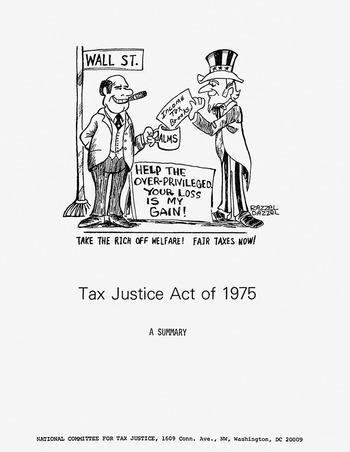
TJP organizers also reached out to organized labor, pitching their arguments to the concerns of working-class voters. A tax organizing kit prepared by TJP staff for union members included sample press releases, petitions to Congress, fliers, and fact sheets that showed how the unfair tax privileges of the rich and of corporations hurt the average worker. One flier cast the tax treatment of capital gains income as a form “welfare for Wall Street” that added “$90 to the tax bill of each and every wage earner.”Footnote 64 Another blamed corporate and “political pickpockets” for adding $900 to the tax bills of “every American family” just to pay for the tax dollars lost through “tax loopholes for big corporations and the rich.”Footnote 65 Yet another accused Congress of raiding workers’ paychecks to “bankroll big oil.” The National Committee for Tax Justice joined the fight in the mid-1970s to introduce a “Tax Justice Act.” Like the TJP, the National Committee redirected anxieties about and hostility toward welfare onto Wall Street and the rich. The cover of the committee’s summary of its 1975 tax proposal featured a cartoon drawing of Uncle Sam pouring “income tax breaks” into the “alms” cup of a Wall Street Banker. “Take the Rich off Welfare!” the pamphlet read, “Fair Taxes Now!” (Fig. 1).
National Committee for Tax Justice, “Tax Justice Act,” Summary, 1975.
In 1975, the National Committee for Tax Justice (NCTJ) proposed a “Tax Justice Act” in hopes of reviving progressive tax reform. The proposal eliminated many tax loopholes enjoyed by corporations and wealthy individuals. Like many progressive tax reformers, the NCTJ inverted conservative claims about welfare dependency and attacked “welfare” for the rich. Although the organization convinced one Member of Congress to introduce the bill, the measure died in committee.
Source: Image No. WHi-94403, Courtesy of Wisconsin Historical Society, Madison Wisconsin.

The tax-fairness movement also blamed inequities in the tax code for larger problems in the American economy. Tax laws that allowed corporations to pay no taxes on the profits of their foreign subsidiaries, for example, encouraged companies to build new plants and invest profits outside the United States.Footnote 66 A TJP fact sheet on the need for tax reform likewise tied closing corporate “loopholes amounting to billions of dollars” and a “tax cut for those who are feeling the heaviest burden of inflation” to the revitalization of the American economy, and the fight against recession and inflation.Footnote 67 Tax breaks for the rich and for large multinational corporations, one tax-reform group argued in 1975, had simply passed the cost of government at the local, state, and federal levels onto the “millions of working, productive Americans.”Footnote 68
In the end, however, progressive efforts to channel and control taxpayer anger proved futile. The continued deterioration of the national economy—a combination of rising unemployment, stagnating growth, and spiraling inflation—made it difficult, if not impossible, for progressives to use tax politics to underwrite a new progressive majority. Inflation pushed many middle- and lower-income taxpayers into higher marginal tax brackets, transforming earlier calls for tax reform into strident demands for tax cuts. Regressive payroll taxes used to fund Social Security and Medicare took an ever larger bite out of every paycheck, particularly among lower and middle-income workers. By the end of the 1970s, these earmarked levies accounted for 22 percent of all federal tax collections, up from 13 percent at the beginning of the decade.Footnote 69 Overall, personal income and payroll taxes rose twice as fast as prices for food, housing, and transportation.Footnote 70 Faced with economic decline and rising tax burdens, middle and working-class voters increasingly felt stuck with a “sharply rising tax burden that appeared to yield no tangible benefits.”Footnote 71
Liberal tax reform discourse and policies offered little to those homeowners and taxpayers “squeezed” by inflation and high taxes.Footnote 72 Eager to broaden their appeal among these voters, progressive tax reformers were reluctant to point out what a whole generation of scholars has since made clear—that the federal government had long underwritten the middle class.Footnote 73 Despite the Forgotten American’s conviction that “there was no welfare state for him,” working- and middle-class whites had benefited significantly from federal economic security programs.Footnote 74 The G.I. Bill of Rights, for example, had allowed more than 7 million veterans to buy a home, start a business, or further their education. Federal housing programs, including low-interest amortized mortgages guaranteed by the Federal Housing Administration or the Veterans Affairs not only spurred the development of the American suburb but also provided countless American families with the economic security and personal equity that comes with homeownership.Footnote 75 Social Security, and later Medicare, provided millions of older Americans—poor, middle-class, and rich alike—with a significant degree of health and retirement security. Tax expenditures including the home mortgage interest deduction and certain tax preferences for married couples benefited not only the wealthy but also those with annual incomes between $10,000 and $24,000.Footnote 76 But few working or middle-class Americans saw themselves as the recipients of any federal “welfare” dollars.Footnote 77 Indeed, by the end of the 1960s, these voters were far more likely to see themselves as the victims rather than the beneficiaries of the tax-and-spend liberal state.”Footnote 78
Despite its initial promise, tax reform failed to revitalize progressive politics. Liberals found their options limited by the institutions and ideological commitments of New Deal and postwar liberalism. Ironically, these same commitments allowed conservatives to translate the inchoate but powerful taxpayer movement into a transformative political force. Responding to the reintroduction of tax politics during the 1972 Democratic primary, GOP strategists developed and deployed a persuasive political story that blamed rising tax burdens almost exclusively on “irresponsible” and “wasteful” Democratic social programs. Hostility toward the War on Poverty, widespread recognition of a national “welfare crisis,” and rising concern that the civil rights revolution had empowered and enriched the African-American minority at the expense of the white majority, gave these arguments coherence and salience. By the end of 1972, conservatives had successfully appropriated liberal attacks on the “rigged” tax code and turned them against the national state itself.
Capturing the Insurgency
A month before the 1972 election, President Nixon explained the importance of “Strong U.S.; Patriotism; Moral Values . . . [and] religion” to his plans to build what he termed the “New American Majority.” Although the president touched on issues familiar to historians of this period—“Square America,” “heartland values,” patriotism, the “Southern Strategy”—his recipe for a conservative political majority did not rely exclusively on identity or cultural politics. Equally important was the president’s conviction that Silent Majority voters would come to the polls on the issue of “taxes and prices.” Concerned by surveys that showed considerable doubt about his administration’s economic stewardship, Nixon ordered his lieutenants to remind voters that Democratic “elites” wanted to “take their money” to pay for expensive welfare programs.Footnote 79
A year earlier, Patrick Buchanan, a member of the Nixon press team and one of the administration’s conservative Young Turks, had outlined a similar political and economic strategy. Convinced that the administration’s domestic policy agenda—which included a guaranteed annual income program, wage and price controls, and revenue sharing with the states—had succeeded only in alienating the GOP’s “conservative foot soldiers,” Buchanan recommended that the president use the promise of tax reductions to appeal to the alienated members of the crumbling Democratic coalition. Taking “a hard line on welfare,” Buchanan advised, would allow the president to consolidate support among blue- and white-collar workers and force the Democrats to “choose between the working class outraged by the excesses of the program and the welfare class.” If the president picked up the cause of tax reduction, he could secure his reputation as “the visible and outspoken champion of the Forgotten Americans, the working people of this country,” and force a final and perhaps fatal “division within the Democratic Party.” But, Buchanan warned, if the president did not force his opposition to choose between its left flank and its white working- and middle-class supporters, he—and the GOP—would be left with “welfare reform, revenue sharing, environment, while they [Democrats] are talking about reducing the tax burden of the workingman.”Footnote 80
Buchanan had some reason to worry. Although national polls generally agreed that Nixon would easily win reelection in 1972, the public gave the president low marks for his handling of the economy in general, and on tax reform and tax fairness in particular.Footnote 81 Despite the president’s best efforts, many voters continued to see the GOP as “sleek, fat . . . incumbent” and “in bed with Big Business.”Footnote 82 A poll taken only a month before the November election found that the “tax-reform issue could be one of the strongest working for McGovern in this final month.”Footnote 83 The president had already found himself on the losing end of the tax issue in 1969, when he publicly opposed tax reform and reduction. Instead of stoking taxpayers’ anger, the president had then opted to defend taxes as giving “life to the people’s purpose in having a Government to provide protection, service and stimulus to progress.”Footnote 84 Early in Nixon’s first term, the White House had even considered a new Value Added Tax (VAT) to offset the costs of “revenue sharing, depreciation reform, tax relief on tuition costs and child care costs for the working wife, integration of personal and corporate taxes and local property tax relief.”Footnote 85
Indeed, the Nixon administration’s embrace of tax reduction in 1972 represented a significant policy shift. Between 1969 and the end of 1971, the Nixon White House had pursued a domestic agenda that aimed to secure the affection and votes of the Silent Majority by extending to the white working and middle classes the benefits of the visible welfare state. The Family Assistance Plan (FAP)—a proposal to replace the existing Aid to Families with Dependent Children (AFDC) program with what amounted to a guaranteed annual income—is perhaps the best example of this expansionary agenda. First introduced in August 1969, the FAP would have provided all families with children, including those in which both parents worked, with a guaranteed income of $1,600 per year. The White House hoped that the program, which directed more than 50 percent of new benefits to the South and included more white (62 percent) than nonwhite families (38 percent), would secure the allegiance of white working- and middle-class voters.Footnote 86 Those members of the White House staff charged with drafting the program explicitly promised the president that by reversing the perceived racial logic of the War on Poverty, the FAP would demonstrate Nixon’s material commitment to blue- and white-collar whites.Footnote 87
Things did not go as planned. Although initial polls suggested popular support for the proposal, and the House Ways and Means Committee, with the blessing of its chairman and its ranking member, approved it early in 1970, the FAP stalled in the Senate Finance Committee. The delay proved fatal, allowing anti-FAP forces on both the left and the right to muster their strength, and giving the president time to reconsider. Republican losses in the 1970 midterm elections further undermined Nixon’s faith in his plan to use new spending programs to attract lower-middle- and working-class voters into a political coalition.Footnote 88 Early in 1971, even as Ways and Means Chairman Wilbur Mills shepherded a new and more conservative version of the FAP through the House, the president began to fear that he was “on a bad wicket.” In April, Nixon ordered his deputies to drop assistance to two-parent families, by far the most radical element of the proposal, because the public had no interest in “providing aid to working families.”Footnote 89 By the late spring, convinced that the proposal was “a political loser” that “would add numbers to the rolls to malinger,” Nixon abandoned the FAP altogether. With the White House’s blessing, the Senate Finance Committee delayed consideration of the bill until September 1972, when it finally reported a defanged version to the full Senate. By this time, as Mills noted, genuine welfare reform was “dead as a doornail.”Footnote 90
Conservative opposition to the program, particularly among business groups, and mounting pressure from antiwelfare conservatives like California governor Ronald Reagan, certainly help explain Nixon’s eventual repudiation of what might have been his administration’s signature domestic reform.Footnote 91 More important, however, the program was not popular with the working- and middle-class voters it was designed to attract. Organized labor had endorsed the FAP, but its support was lukewarm at best. Although labor “would join in some coalition efforts” to rally support for the president’s plan, one of the program’s chief architects later complained, “on balance it stood apart, looking to what it perceived to be its own interests.”Footnote 92 Union leaders objected in particular to work requirements and “workfare” programs, out of concern that such policies would provide a federal subsidy to low-wage employers to hire welfare recipients, drive down prevailing wages, and harm union members. Conservative anti-FAP groups recognized and reinforced these fears, encouraging workers to consider how a guaranteed annual income would affect them individually as taxpayers.Footnote 93
The failure of the FAP and the rest of the administration’s expansionary domestic agenda to challenge the GOP’s reputation as “enemy of the poor and unemployed,” in combination with economic uncertainty and continued pressure from grassroots tax groups, transformed the administration’s tax agenda.Footnote 94 Conservative stalwarts like Buchanan joined other members of the White House team, including Treasury Secretary and former Democrat John Connally, in urging the president to link tax reduction for “lower- and middle-income groups” to a hard line on the “issue of federal spending.”Footnote 95 Warning voters that the big spenders in the “Democratic liberal establishment” would “bankrupt the workingman” and “tax to death the middle class,” the White House aimed to cement recent electoral gains among the Silent Majority by blaming AFDC and other poverty programs for the “always increasing tax burdens” of the “conscientious, middle-class taxpayers.”Footnote 96 This discourse, which nurtured the Forgotten American’s sense of victimization at the hands of “ultra-liberals who overlook the well-being of the masses and accede to the demands of well organized minorities,” and depended on hiding the federal subsidy underwriting middle- and working-class economic security, anchored the GOP’s successful appeal to the working and middle-class majority.Footnote 97
The national Democratic Party unwittingly gave credence to GOP claims that Democratic tax reform would help the “welfare class” at the expense of the “working class” when Sen. McGovern linked a comprehensive tax reform proposal to a controversial $1,000/family “demogrant” that was almost universally seen and reviled as a guaranteed annual income. According to public opinion expert Lou Harris, middle-income voters feared that, if elected, McGovern would “raise their taxes to pay for higher welfare payments.”Footnote 98 In tying tax reform to income redistribution, Nixon economic advisor Herbert Stein observed, McGovern effectively shifted economic politics from “unemployment-inflation issues to the income distribution-tax reduction issues where [the administration] position is stronger,” and allowed the White House to align itself with the “apparently popular position against tax increases.”Footnote 99 Casting the Democrat’s tax-reform proposal as a thinly disguised tax increase intended to pay for a new welfare program for the minority poor, the Nixon campaign constantly reminded voters that the middle class and working class—not simply the rich—would have to “foot the bill for McGovern’s schemes.”Footnote 100 This rhetorical strategy at once reflected and reproduced what many Silent Majority voters already believed. As AFL-CIO president George Meany, who had declined to give the union’s endorsement to either candidate in 1972, told Labor Secretary George Shultz, “our guy,” “thinks he’s paying his taxes so that somebody else can get welfare.”Footnote 101
Becoming St. Nick
“The only thing wrong with the U.S. economy,” wrote Wall Street Journal editorialist Jude Wanniski in 1976, “is the failure of the Republican Party to play Santa Claus.” Bemoaning the GOP’s tendency to become “hypnotized by the prospect of an unbalanced budget,” Wanniski revisited the history of the 1920s, reimagining that decade not as the prelude to the worldwide economic collapse of the 1930s, but rather as a “glorious” period, in which the average worker enjoyed “fuller employment,” consumers benefited from the “multiplication of goods in common consumption,” businessmen felt free to invest in “productive industry,” and everyone benefited from a lower cost of living. The key to this economic nirvana, Wanniski concluded, lay in the fact that Congress, under the influence of Treasury Secretary Andrew Mellon, had slashed “tax rates no less than five times” over the course of the decade.Footnote 102
Wanniski, who by the mid-1970s had become the chief publicist for supply-side economics, made his case for a change in GOP tax policy in historical and economic terms. But, at its heart, the argument was a profoundly political one. Wanniski argued forcefully that the right could recapture the kind of power it commanded in the “GOP heyday” of the 1920s only by concentrating on tax reduction. After all, he pointed out, the Democrats had amassed huge congressional majorities throughout the post–World War II period only by alternating “between increased spending and occasional tax cuts.” To reclaim not only the White House but control of the entire American political system, the party must abandon concerns over deficits and transform itself into a “tax-cutting St. Nick.”Footnote 103
Few economists took Wanniski’s prescriptions seriously.Footnote 104 But he received a warm welcome among conservative politicians, pundits, and strategists who, like Nixon had a few years earlier, saw tax-cut politics as a way to attract working- and middle-class voters to the GOP without risking the support of the party’s more traditional backers.Footnote 105 With the help the era’s newly powerful conservative counter-establishment, this tax-cut agenda spread like wildfire on the right.Footnote 106 Irving Kristol, a leading neoconservative thinker and editor of the influential opinion journal The Public Interest, later recalled, “It was Jude [Wanniski] who introduced me to Jack Kemp, a young congressman and recent convert. It was Jack Kemp who, almost single handedly converted Ronald Reagan.”Footnote 107 Tax cuts were always more about politics than they were about economics. As Robert Bartlett, the Wall Street Journal editor who turned that paper’s editorial page into the leading voice for supply-side ideas, admitted, “Economists still ridicule” supply-side theory, “but policymakers pay it careful heed.”Footnote 108
Wanniski’s Santa Claus strategy transformed the GOP. By the end of the decade, the American right completed the task begun during the Nixon years by decisively claiming the tax issue as its own. The Republican platform, unveiled at the party’s 1980 convention, for example, contained a full 115 sentences about tax policy; twenty years earlier, the platform had devoted only two sentences to tax policy.Footnote 109 The faltering economy, the collapse of the Keynesian consensus among professional economists and economic policymakers, and a precipitous decline in the public’s trust in government, lent credence and popular support to the party’s new antitax identity.Footnote 110 As inflation pushed middle- and working-class Americans into tax brackets once reserved for the very wealthy, Democratic efforts to generate populist anger against the tax advantages of the very wealthy and harness the tax revolt as they had in 1969 fizzled and died.Footnote 111 As Congressional Quarterly noted, a “coalition of Republicans and conservative Democrats” who “rejected the traditional belief that tax bills should ‘redistribute income’” had pulled the center of gravity in tax policy decisively to the right.Footnote 112
Welfare politics played a key role in the right’s success in reinventing itself as the tax-cut party. Republican leaders used the public’s long-standing hostility toward welfare to articulate a public politics that simultaneously attacked the liberal state and pledged to protect the economic and social privileges enjoyed by the majority of American voters. This dynamic is particularly clear in the case of Proposition 13. Sponsored by two conservative political entrepreneurs, and approved by more than two-thirds of California voters, this 1978 ballot initiative placed sharp limits on the state legislature’s ability to raise property taxes.Footnote 113 Although many understood Proposition 13 as a massive rejection of the liberal state, public-opinion surveys taken at the time suggest a far more complicated story. While California voters were not particularly satisfied with government, they nevertheless remained committed to most governmental activities, including programs to protect the environment, provide access to health care and education, and to prevent crime.Footnote 114
The significant exception to this broad support for the service state was welfare. A CBS/New York Times poll taken shortly after the Proposition 13 vote found that 43 percent of Californians favored large cutbacks in welfare and social services.Footnote 115 This should come as no surprise. Welfare had long been on the receiving end of political condemnations—from both the left and the right—for being both inefficient and corrupt. From the early postwar attacks on “welfare loafers” to the Great Society’s commitment to providing a “hand up rather than a hand out,” to Ronald Reagan’s factually inaccurate yet often-repeated story about a Chicago “welfare queen” who had “used 80 names, 30 addresses” and “12 Social Security numbers” to bilk taxpayers out of $150,000 in “tax-free cash income,” public figures on both the left and the right had long used the term “welfare” to connote the inefficient and possibly immoral use of taxpayer dollars.Footnote 116 Proposition 13 supporters made this association explicit. “The people who wrote the Constitution,” quipped the initiative’s septuagenarian co-sponsor Howard Jarvis, “said the people of the United States should be protected in their life, liberty and property. They didn’t say, life, liberty and welfare, or life, liberty and food stamps.”Footnote 117 By reducing government spending to welfare and food stamps, Jarvis, and others like him, suggested that taxes could be cut—and cut a lot—without endangering the social entitlements of middle-class citizens. Predictably, polls found that most Americans believed that tax limitation measures modeled on the California plan would not result in any substantial cuts in necessary social services.Footnote 118
In California and elsewhere, conservative politicians, policymakers, and strategists exploited both the long-standing antipathy toward welfare and the reality of rising tax burdens and economic insecurity to develop a policy program around tax and spending cuts. These policy elements coalesced in Ronald Reagan’s first year in the White House. The former California governor had given Proposition 13 his enthusiastic endorsement, and tax policy played a significant role in the GOP primaries as well as in the general election campaign. Once in office, Reagan moved quickly to slash taxes and cut government spending. Although the administration had initially promised that the spending cuts would include all areas of the budget, the White House bowed to what one official later called “fierce political pressures” and placed popular “safety net” programs like “Social Security benefits for the elderly” and “social obligations for veterans” off limits.Footnote 119 Given these restrictions, it is hardly surprising that about 70 percent of the cuts made in the 1981 budget bill came from discretionary and entitlement programs for the poor.Footnote 120
To overcome voters’ doubts about the wisdom of cutting taxes—only 23 percent of the public favored large tax cuts, while 70 percent wanted to balance the budget first—or about the social consequences of the proposed budget cuts, the administration focused much of its public relations campaign on “welfare.” By exploiting long-standing beliefs about “fraud, inefficiency and abuse” in the welfare system, the White House successfully met charges that the proposed budget and tax cuts would hurt the “truly needy” or have any impact on necessary (or at least popular) social safety-net programs.Footnote 121 The Reagan team did not invent this tactic; they borrowed heavily from post–World War II discourse about welfare. For example, in late March, staffers in Chief Domestic Policy Adviser Martin Anderson’s office pulled together a list of “typical . . . stories” about fraud and abuse in AFDC that bore an uncanny resemblance both to the public exposés of welfare fraud common in the late 1940s and early 1950s and to many of the scenarios spelled out in the Welfare Game. Focused on individual narratives—a Philadelphia native who continued to collect AFDC, Medicaid, and food stamps even after she had died; Ohio steelworkers out on strike who “coerced” the county into providing “food stamps at the Union Hall”; or a St. Louis woman who “claimed to be indigent” but in fact “owned a four-family flat . . . [and] drove a Cadillac (Coupe de Ville)” while receiving both welfare and unemployment insurance—the White House strategy successfully minimized resistance to budget cuts and helped to build support for the tax program.Footnote 122
The passage of Reagan’s tax and spending bills in the spring and summer of 1981 completed the transformation of the GOP into the tax-cut party. This process had begun almost a decade before, when strategists in the Nixon administration recognized in the grassroots revolt against state and local taxes an opportunity to capture the loyalty of Silent Majority voters who saw themselves as the overtaxed victims of the liberal state. In the 1980s and early 1990s, an older generation of Republicans reared on the party’s traditional fiscal sobriety, checked this new tax-cut agenda. Even Ronald Reagan, the hero of the tax-cut right, signed two significant tax increases in 1982 and 1983, and in 1986 approved a major tax-reform bill that imposed substantially larger tax burdens on wealthy individuals and corporations.Footnote 123 By the mid-1990s, however, these forces had been all but sidelined within the party, as enthusiastic and well-funded antitax groups, including Grover Norquist’s Americans for Tax Reform and Stephen Moore’s Club for Growth, spent considerable effort and money to increase the number of dedicated tax cutters in Congress.Footnote 124
The success of the GOP’s tax agenda and its ability to appeal to the majority of voters depended on the spoken and unspoken politics of welfare. Whereas liberal state builders from Roosevelt to Johnson had used the so-called failure of welfare to justify new investments in social policy, conservatives have used that same alleged failure to condemn the state itself. By promising tax cuts, and blaming welfare for rising tax burdens, the right was able to build a popular, if unstable, electoral majority, and, more important, to shift the terms of political debate. In the mid-1970s, as the economy fell apart and political trust cratered, Republicans popularized a political agenda that promised to lower taxes on the increasingly overburdened Silent Majority without jeopardizing the privileges delivered and secured by the middle-class welfare state. The popular iteration of conservative antitax politics thus drew significantly on the legacies of postwar liberalism, and ultimately reproduced many of the same contradictory impulses and promises that had once sustained the liberal state but ultimately contributed to its collapse. Much like the liberals who dominated national politics between the end of World War II and the early 1970s, Republican conservatives have seen their agenda founder on the basic dilemma of contemporary politics: Americans want more and more services from the government, but they don’t want to pay for them.