1. Introduction
China's growth over the past decade has been astounding. China is now the world's largest exporter,Footnote 1 has overtaken Japan as the world's second largest economy,Footnote 2 and is projected to have the single largest economy in the world by 2016.Footnote 3 Although this growth has faltered slightly over the course of the global economic recession, the overall trends are still remarkable.
Among the many important implications of this growth and of China's development as a regional and global superpower is the relationship between China and its Asian neighbors. For much of the past decade, China adopted a position toward its neighbors that scholars have referred to as a ‘charm offensive’, in which China demonstrated its benign intentions both by engaging more fully and by softening its military stance. Arguably, a pinnacle of this charm offensive was China's hosting of the 2008 Summer Olympic Games in Beijing. More recently, however, China has taken on a more aggressive posture both regionally and globally, particularly in its conflict with Japan over the Senkaku Islands in the East China Sea and its ongoing standoff with the United States and other major economies over the value of its currency. As China continues to grow, it will be important to understand not only its evolving policy toward Asia and the rest of the world, but the response of Asian elites and Asian publics to Chinese influence in their political, economic, and social life.
This article explores this issue by looking specifically at the response of the Asian population to Chinese influence at a particular point in time. We use data from the AsiaBarometer Survey (ABS) conducted between 2005 and 2007 in 23 Asian countries to answer two important yet understudied questions.Footnote 4 First, what do Asian publics think about Chinese influence on their states? Is China's role, particularly at a time when it was described as engaging in a charm offensive, viewed in generally positive or generally negative terms? And how does the evaluation of China compare to views of other influential states in the region? Second, we ask what specifically drives public opinion – positive and negative – of China. Do issues such as broad national interest and cultural and political similarity play a significant role in the evaluations made by citizens? Or are views regarding Chinese influence driven more by individual variables such as national pride or contact with foreign cultures?
We find that, in all but two states, views of Chinese influence are more positive than they are negative and that the publics in most of these states view Chinese influence as being as positive as, or more positive than, the influence of other key countries (including the United States and South Korea). In fact, the only state that has a consistently higher average rating than China is Japan.
In addition, multilevel statistical analysis reveals at least partial support for each of four general categories that explain this public perception: (a) national interest, (b) identity, (c) foreign contact, and (d) military conflict. Specific measures tapping foreign policy interest, recent military conflict, foreign contact, and national identity are all statistically significant. More surprisingly, however, our measures of national economic interest and regime type do not prove to be significant determinants of individual opinion. All of this has implications for understanding the generally positive assessment of Chinese influence across Asia at the beginning of the twenty-first century.
The study begins with a literature review showing how our study fits into larger debates within international relations on the interaction between China and other Asian states. We then review our data and discuss initial descriptive results regarding average views of Chinese influence. The third section explores four distinct theoretical strands explaining these opinions, and the final sections present the statistical analysis and concluding remarks.
2. Existing literature and debates
Although there are a number of recent studies examining both anti-Americanism and Americans’ feelings about Asian countries (Farber, Reference Farber2007; Katzenstein and Keohane, Reference Katzenstein and Keohane2007; Page et al., Reference Page, Rabinovich and Tully2008), public attitudes regarding China and Chinese influence, and particularly public attitudes coming out of Asia specifically, have received much less attention in the public opinion and international relations literatures. Most of the exceptions to this involve recent surveys conducted by the Pew Research Center and the Chicago Council on Global Affairs.
Over a period of several years, the Pew Global Attitudes Project has, among other things, asked individuals in as many as 24 countries whether they have a favorable opinion of China and whether China's growing economy is a good or bad thing. The basic results of this project have generally captured positive images of the country. Most of the citizens surveyed in 2005 from selected Asian countries, for instance, viewed China's rise in positive terms and expressed a belief that Chinese economic growth would be beneficial to them.Footnote 5 Japanese respondents as a whole are one of the few exceptions to this trend, with majorities in 2006 and 2008 holding an unfavorable view of China (even though only a quarter or fewer of the respondents had a negative view regarding China's growing economic power or described China as an enemy).Footnote 6
The generally favorable evaluation of China is largely echoed in the surveys released by the Chicago Council on Global Affairs, which asked respondents in Asia and in other countries to rate their feelings toward China and to evaluate China's role in resolving key problems in Asia. The prevailing sentiment in 2006 was that Asians (including Indians, South Koreans, and Australians) were quite comfortable with the rise of China and held positive views of China's role in resolving key regional problems.Footnote 7 In a follow up study in 2007, majorities or pluralities of respondents from 15 countries agreed that China's economy will grow to be as large as the US economy and majorities in every country (Thailand, India, and the Philippines representing Asia) felt this is either a good thing or equally positive or negative.Footnote 8
While these recent survey results have certainly contributed to scholarly understanding of the public opinion surrounding China's rise and influence, there are several clear shortcomings that this article intends to improve upon. First, most of the polling has been conducted in only a handful of Asian countries, which makes it difficult to generalize the results across this vast and dynamic region. Second, there is little discussion of the specific factors that help shape and influence popular perceptions, which is unfortunate because the overall patterns cannot be effectively interpreted and explained without this part of the analysis. Our study therefore addresses these issues by (1) using data from the recent AsiaBarometer Surveys to provide a broad examination of opinion throughout Asia and (2) offering a multilevel statistical analysis of the national and individual factors that shape views of Chinese influence within and across Asia.
In addition to adding to the growing literature on international and Asian public opinion, this study also contributes to several ongoing academic debates regarding the role of China within Asia more generally. The first of these debates revolves around China's ‘charm offensive’ in Southeast Asia. As discussed in the introduction, China has begun over the course of the past decade to soften its stance and tactics in its relations with many of its neighboring states. The resulting charm offensive has included, among other things, an expansion in strings-free foreign aid, considerably more active participation in multilateral organizations, and enhanced diplomatic engagement more generally.Footnote 9
Furthermore, although Southeast Asia has been the focus of many of these policies, they are by no means limited to this sub-region (or even to Asia as a whole). China's preparations for and handling of the 2008 Beijing Summer Olympics, for instance, can easily be read as a large-scale international charm offensive. The Chinese regime used the Games to soften its international image on environmental, economic, humanitarian, and other issues, and, for many in China, the Games were certainly much more than a mere sporting event. They were representative of China's emergence onto the international stage and were a chance for China to project itself as a rising power and peace-loving country.Footnote 10 Similarly, the extensive recent development, in over 94 countries and regions, of Confucius Institutes promoting Chinese language and culture can be seen as another example of Beijing's growing concern for global and regional image enhancement.Footnote 11
By most scholarly accounts, China's regional charm offensive has been quite successful. According to David Shambaugh, ‘most nations in the region now see China as a good neighbor, a constructive partner, a careful listener, and a nonthreatening regional power’ (2003: 22). David Kang (Reference Kang2007) concurs, arguing that other East Asian states have largely accepted China's rising power and that accommodation has occurred in part because China has successfully persuaded these states of its peaceful intentions. China is now the biggest trading partner for many states in the region, including South Korea and Japan (Christensen, Reference Christensen2006: 89) and is actively involved in regional multilateral organizations to an unprecedented degree (Glosny, Reference Glosny2006: 34). The Congressional Research Service even found in 2008 that China now outspends the United States in foreign aid to developing states within Southeast Asia (Lum et al., Reference Lum, Morrison and Vaughn2008).
All of this is evidence at the national level of the success of China's regional engagement. Two key questions about this engagement, however, remain. The first of these involves incidents that are more recent, such as the Senkaku Islands dispute and whether the positive assessment of China's influence and intentions will continue if China adopts a more aggressive stance on territorial and economic issues. Will these countries remain persuaded regarding China's peaceful intentions as its charm offensive fades?
The other question, and the subject of this article, is whether the people are as charmed by China as many of those at the elite level have seemed to be. Studies of the charm offensive have focused almost exclusively at the elite level and have not examined how well China's actions have resonated with publics residing in Asia. A public-level analysis, though, is important for at least two reasons. First, not all of international politics happens at the state or even elite level, and understanding the ‘complex interdependence’ (Keohane and Nye, Reference Keohane and Nye2000) that connects Asian states involves looking below the state and examining the perceptions of individuals, corporations, and other non-state actors. Popular perception should be a part of the complete analysis. Second, especially as Asian states continue to democratize, state interest will be at least in part driven by popular perception. Therefore, understanding how the people are responding to Chinese influence is important to understanding how states may respond to this influence in the future. Understanding what this popular perception is and, as importantly, what specifically drives popular perception, is a key part of the larger debate on Chinese influence in Asia.
A related issue that has been heavily discussed in the academic literature involves the perception of China as a threat to the broader region. After all, even before the Senkaku Island incident, China's charm offensive was accompanied over the past decade by strong economic growth and substantially increased military spending (Lampton, Reference Lampton2007). These are not necessarily the hallmarks of a constructive regional ally.
According to many realist scholars, for instance, these increases in state power translate directly to an increase in threat potential and threat perception by other states in and beyond the region. John Mearsheimer is particularly direct on this point. ‘If China becomes an economic powerhouse it will almost certainly translate its economic might into military might and make a run at dominating Northeast Asia’ (Reference Mearsheimer2001: 4). Charming or not, China is potentially a significant threat to its neighbors and economic competitors.
Others, however, have argued that China is seen by those surrounding it as more of a benign regional hegemon, a power that has been normalizing diplomatic relations and opening up economic and security partnerships with many neighboring states.Footnote 12 Fears of an imminent Chinese threat would be, for those in this camp, overstated. China's growth and regional involvement may instead become established as beneficial to businesses and individuals, both within China and within the larger region. Once again, though, debate on this point is still open and ongoing, and a broad examination of popular opinion would be instructive to the question of Chinese threat perception.
A final source of debate has involved great power competition throughout the region, particularly the question of whether the United States or China is and will remain the dominant regional power. Evelyn Goh states this dilemma well. ‘While most Asia scholars note that China's successful “charm offensive” has assuaged many but not all suspicions in Southeast Asia, other analysts see that its growing economic clout and deft diplomacy already mean that China is rapidly becoming the predominant power in Southeast Asia . . . leaving in question the US role and commitment to the region, even with traditional allies and friends’ (Reference Goh2008: 114).
Goh goes on to argue that the elites in Asian states are generally hedging their bets. They do not want to be forced to choose between the United States and China and are essentially playing the great power competitors off against each other in an attempt to gain more investment and more secure engagement. As with debate on the charm offensive more generally, though, most of this analysis has taken place at the elite level. Questions regarding popular perception of the great powers acting in Asia (including but not limited to China and the United States) are unaddressed yet relevant to the future of the region. This study and its findings represent a contribution to this larger debate.
3. AsiaBarometer Survey
To address the questions raised above and to begin an analysis of the popular opinion surrounding Chinese influence in Asia, we use the AsiaBarometer Survey (ABS) conducted in 2005, 2006, and 2007 in 23 countries. This survey involves face-to-face interviews with randomly selected citizens and spans four Asian sub-regions: East Asia (Japan, South Korea, and Mongolia); Southeast Asia (Cambodia, Indonesia, Malaysia, Philippines, Thailand, Singapore, Laos, and Vietnam); South Asia (Bangladesh, Bhutan, India, Maldives, Nepal, Pakistan, and Sri Lanka); and Central Asia or Central Eurasia (Afghanistan, Kazakhstan, Kyrgyzstan, Tajikistan, and Uzbekistan).Footnote 13 Each country has a sample of at least 800 adults, and the total sample of the merged survey data involves 21,517 respondents.
The key question in ABS regarding China concerns perceptions of influence. Specifically, survey respondents are asked to evaluate whether China is a (1) good influence; (2) rather good influence; (3) neither good nor bad influence; (4) rather bad influence; or (5) bad influence on their country. Conceptually, it is important to note that this question does not ask respondents for their abstract or general feelings about China. Nor are respondents asked to evaluate different dimensions of Chinese influence. Instead, the focus is simply on whether or not China in general has a good influence on the specific country in question. As such, this question is limited but appropriate for our efforts to examine how China's rise and influence are broadly perceived in Asia.
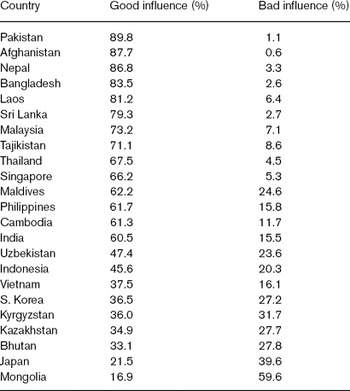
We present a first-cut analysis of the responses to this question in Table 1. The two columns represent the percentage of respondents from each surveyed country who indicated that China's influence was either good/rather good or bad/rather bad. Respondents who answered that China's influence was ‘neither good nor bad’ are omitted from the table.
Views of Chinese influence

Notes: ‘Don't know’ responses are excluded.
Source: ABS 2005–07.
The first thing that is immediately apparent in the data is that individuals in most Asian states view China's influence as more positive than negative. In fact, there is a clear majority that views Chinese influence as positive in 14 out of the 23 surveyed states, and in only two states (Mongolia and Japan) are the average views more negative than positive. ABS data thus seem to mirror several of the basic patterns captured in the Pew and Chicago Council surveys discussed in the previous section.
To provide additional context for these results, a brief examination of Asian views regarding the influence of other states important to the region is necessary and in order. Is opinion of Chinese influence significantly more positive or more negative than that of other states and rivals (including the United States and Japan)? How much variation is there across the surveyed countries on this question?
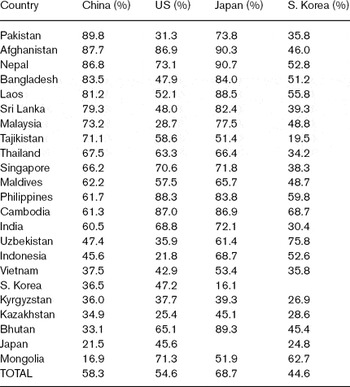
Comparative data addressing these questions are presented in Table 2. In all of the surveyed countries, ABS respondents were asked their opinion regarding not just Chinese influence but also the influence of the United States, Japan, and South Korea. The table shows the percentage of respondents in each surveyed country who ranked the influence of these states as ‘good’ or ‘rather good’ and is ordered according to views of Chinese influence.
Comparative views of good influence

Notes: The figures represent the percentage of respondents who answered ‘good influence’ or ‘rather good influence’. ‘Don't know’ responses are excluded.
Source: ABS 2005–07.
The first thing the results show is that, unsurprisingly, there is indeed significant variation within and among the surveyed states. Different states view various regional powers quite differently. This is particularly stark, for instance, within Pakistan, the first state listed in the table. Between 70% and 90% of those surveyed in Pakistan saw Chinese and Japanese influence as positive, while well less than half of the respondents viewed American and South Korean influence positively. Many other surveyed states show similar variation.
Second, China is, on average, viewed as, or more, positively as two of the three states in question. Only six surveyed states (Japan, Indonesia, Cambodia, Bhutan, Uzbekistan, and Mongolia), for instance, view South Korean influence more positively than Chinese influence. The exception is Japan, which received the highest positive rating of the countries represented in Table 2. Japanese influence is viewed very favorably across Asia, even though its relations with its neighbors have been subject to controversies over its wartime past, censorship of school textbooks, and visits by Japanese politicians to Yasukuni shrine. However, as David Kang (Reference Kang2007: 173) argues, it is important to keep these disputes in context as few of them have had actual consequences for policies between Japan and its neighbors. Although he has not examined public opinion on this matter directly, he highlights the strong economic relationships between Japan and Asian states. Southeast Asia, in particular, has received considerable official development assistance from Japan for decades, which likely pays positive dividends in terms of Japan's image (Trinidad, Reference Trinidad2007).
Third, although views regarding Chinese and American influence are often diametrically opposed within a single state, they are essentially evenly split across the region as a whole. In 13 of the cases, Chinese influence is viewed more positively than that of the United States, and in the remaining ten cases, American influence is ranked by those surveyed as more positive. Indeed, the totals at the bottom of the table show China with a 58.3% average overall, which is just slightly higher than the average of 54.6% for the United States.
Overall, the AsiaBarometer Surveys show that, although average opinions of Chinese influence are largely positive, there is still substantial variation both among and within individual states. What remains to be determined, however, are the causes of this variation. The following sections therefore turn to a discussion and analysis of the factors believed to shape perceptions of China at both the national and individual levels.
4. Explaining perceptions of Chinese influence
One of our central propositions is that external perceptions of China are affected by a combination of factors, some of which function at the national level and some of which function at the level of the individual. There are, for instance, likely broad national reasons why average ratings of Chinese influence are significantly higher in Pakistan and Afghanistan than they are in Japan and Mongolia. But there are also sub-national reasons why individual interview subjects within these states responded in the particular way they did.
Theoretically, we divide these national and individual explanations into four distinct strands, each of which is derived from previous public opinion and international relations research. These strands focus on the influence of national interest, political and national identity, individual foreign contact, and recent military conflict. Our expectation is that each of them will contribute to overall perceptions of Chinese influence.
The first set of explanations explores the possibility that individual perceptions of Chinese influence are significantly shaped by economic and foreign policy interest at the national level. The logic of this strand goes back to the idea of the Chinese charm offensive. As discussed earlier, Chinese diplomatic and economic efforts to portray a softer regional image have, at the time of the polling, been at least partially successful at the national and elite levels. States benefitting from Chinese engagement have begun to see China as a benign regional hegemon. The idea here is that, through the influence of both political elites and the national media, this positive perception will also trickle down to the public level. Individuals from states benefitting from Chinese engagement should be more likely to have a positive view of Chinese influence than similarly situated individuals in other non-benefitting states. Again, the key mechanisms are the media and the political elite. Individuals may or may not be directly aware of China's relationship to their national-level interest, but this interest may still affect individual attitudes indirectly through these and other sources.
This interest explanation could be expressed in a number of ways. First, the relevant interest might be economic, with states that trade heavily with China being more likely to have a favorable aggregate opinion of Chinese influence on their country and region. Although it is certainly possible that the economic dependence created by a strong trade relationship could also foster negative evaluations in some segments of a state's population, we apply insights from the charm offensive literature to anticipate that heavy trade will on the whole engender relatively positive evaluations of China's influence. Strong trading patterns indicate strong economic interest, which influences individual perceptions through the mechanisms described above.
Another possibility is that national foreign policy interest drives public perceptions of Chinese influence. Just as states with common economic interests are likely to value Chinese engagement, states with a strong set of common foreign policy interests are more likely to view Chinese influence as positive or benign. This includes both extra- and intra-regional concerns and particular foreign policy issues ranging from direct security threats to environmental degradation and energy depletion. Again, the expectation is that national foreign policy interest will also manifest itself at the individual level. Individuals whose states share broad foreign policy goals with China should, all else being equal, be more likely to have positive perceptions of Chinese influence.
A third possible interest-based explanation involves foreign aid and the idea that states receiving a high volume of Chinese foreign aid will have publics with more positive images of Chinese influence. This is certainly a feasible hypothesis, but data on Chinese foreign aid are not broadly available, so this explanation will not be discussed in depth or included in the empirical analysis.
The second theoretical strand moves beyond national interest to stress the importance of political similarity and national identity to international public opinion. The basic premise is that individuals are likely to be positively predisposed to states that are politically or culturally similar to them and negatively predisposed to states that are significantly dissimilar. We focus here on three particular measures of political and cultural identity, but there may certainly be others that are left unaccounted for or ones that we are unable to directly test in this study.
The political half of this explanation is based on international relations research showing that states tend to favor states with similar political structures. Democratic states, for instance, are consistently more likely to trade and ally with, and less likely to go to war with, other democracies (Russett and Oneal, Reference Russett and Oneal2001; Doyle, Reference Doyle1986; and Owen, Reference Owen1997). Because of mutually transparent democratic institutions, the influence of democratic norms, or some other factor, democratic states behave differently toward other democracies than they do toward non-democracies. Furthermore, these findings do not just apply to democratic political systems. Other work has shown that similar factors affect other types of states and may create, among other possibilities, an ‘autocratic peace’ (Werner and Lemke, Reference Werner and Lemke1997; Henderson, Reference Henderson2002, and Bennett, Reference Bennett2006). The relevant variable in these and other studies is not economic interest, security interest, or cultural value, but the influence of political institutions and political norms. All of this suggests that political identity does matter at the state level.
As a part of the identity strand, we simply extend this logic to the individual level and argue that individual citizens will be more likely to appreciate the influence of states that are politically similar to them. Individuals in an autocratic state should be more willing to see the influence of another autocratic state in a positive light than individuals living in democracies. This may be because of the direct influence of democratic or other norms or because of the indirect influence of the media or political elites. All else being equal, though, we expect individuals from democratic states to be less likely to view autocratic Chinese influence positively than individuals living in non-democratic states.
The second part of the identity strand is based not on politics but on culture. Our expectation is that positive assessment of China's influence is likely to be greater among individuals who strongly identify and associate themselves with Chinese culture and the Chinese people. This expectation taps into a growing scholarly focus on the importance of collective national identity in the modern era. National identity concerns the bonds between citizens and the state. It is defined as the ‘continuous reproduction and reinterpretation of the pattern of values, symbols, memories, myths and traditions that compose the distinctive heritage of nations’ as well as the ‘identifications of individuals with that pattern and heritage with its cultural elements’ (Smith, Reference Smith2001: 18).Footnote 14
Our hypothesis is that individuals who live in other countries but actively identify as Chinese will share cultural or national characteristics and will therefore be more likely to assess China's influence in positive terms than respondents without this cultural identification. We expect that common cultural identity, like common political identity, should have a significant and positive influence on public opinion.
A final part of this identity-based strand involves the issue of national pride. Tom Smith and Seokho Kim define national pride as the ‘sense of esteem that a person has for one's nation and the pride or self-esteem that a person derives from one's national identity’ (Reference Smith and Kim2006: 127). They argue that general national pride is strongly and positively associated with having a demanding sense of what is needed for someone to be considered a true member of a country. It is also more moderately, but significantly, linked to low support for globalization and unfavorable attitudes towards immigrants.
In an earlier study of public opinion in four Western countries, Mikael Hjerm also found a positive link between national pride and both feelings of xenophobia and possession of a negative attitude toward individuals or groups of individuals that are in some sense different from oneself or the groups to which one belongs (Reference Hjerm1998). Following this logic, we hypothesize that strong pride in one's country may contribute to lower evaluations of foreign influence in general and Chinese influence in particular. The prouder individuals are of their own country, the less likely they will value the influence of other countries.
The third theoretical strand shifts focus to individual information about and contact with foreign countries and cultures. This theory primarily builds upon work done in the context of the United States and international anti-Americanism and previous studies based on the AsiaBarometer Surveys. Giacomo Chiozza, for instance, has shown that respondents in other countries who watch international news and have friends and relatives in the United States are more likely to hold general pro-American views and to have a positive opinion regarding more specific issues such as American democracy and the spreading of American customs (Reference Chiozza, Katzenstein and Keohane2007: 199). Using the AsiaBarometer, Michael Hsin-Huang Hsiao and Po-San Wan (Reference Hsiao and Wan2007) examine opinions regarding cultural globalization experiences in seven Asian societies with a set of questions that include whether respondents have family members living abroad or often watch foreign TV programs. They hypothesize that the responses regarding these international ties and contacts help explain an individual's level of support for globalization, which is measured by responses for whether the United States has a good influence or a bad influence on society as well as two additional questions related to the World Trade Organization and multinational companies. In both studies, information and contact with other countries and cultures are shown to play a role in breeding familiarity, trust, and a more global outlook toward other countries
Our argument here is that this basic logic should also extend to other countries besides the United States. Individuals who have more frequent foreign contact as well as more experience traveling abroad and communicating with people from other countries will be more likely to hold more cosmopolitan attitudes and offer positive evaluations regarding general foreign influence. This should be as true of Chinese influence as it has been for American influence, particularly given the size and prominence of China in the international system today.
Our expectations regarding the final theoretical strand, military conflict, are quite straightforward. We expect that the presence of recent and substantial conflict between China and any of its Asian neighbors will contribute significantly to critical opinions regarding Chinese influence. Not only is conflict indicative of pre-existing tensions between a given pair of states, but it can also contribute, directly and indirectly, to increased tension.
For instance, individuals could certainly experience the negative effects of conflict in a very direct economic and political sense. Military conflict, after all, brings with it infrastructural damage and human casualty. Furthermore, negative portrayals of the opponent state in the media and by political elite could also indirectly contribute to this assessment. For these reasons, recent military conflict should be negatively and significantly associated with our public opinion measure. Just as common economic and strategic interest should lead to positive individual assessments, evidence of common enmity should have the opposite effect.
5. Dependent and independent variables
The previous section identified four sets of explanations based on interest, identity, contact, and conflict that we will use as the theoretical base for our examination of perceptions of Chinese influence. This section discusses the measurement issues surrounding the conversion of these four theoretical strands into operationalized independent variables.
The dependent variable in this study is the perception of Chinese influence in Asia, measured at the level of the individual using the ABS survey question discussed earlier. The question is based on a five-point scale and asks respondents whether China has a good or bad influence on their country. We have recoded the answers so that higher values indicate more positive perceptions of China. ‘Don't know’ responses, which amounted to 7.4% of the total, were coded as missing data and not included in the final analysis.
5.1. Interest variables
Our first theoretical strand of national interest produces two country-level measures, trade and foreign policy preference, each of which is hypothesized to correlate positively with the dependent variable. Trade is measured as the sum of the exports and imports between China and the surveyed state, divided by that state's yearly GDP. This sum is then averaged over a three-year period prior to the year of the survey to control for any single-year aberrations. This is essentially a measure of trade dependence and controls for the size of the state and the relative importance of China's exports and imports to its economy. Among those states surveyed in ABS, Mongolia, Malaysia, and Singapore have the highest trade dependence with China, whereas Bhutan, Afghanistan, and Maldives are the least dependent. States such as Cambodia, Indonesia, and Laos are in the middle of this list.
Our second interest-based independent variable, foreign policy preference, is more difficult to capture accurately. Formal alliances are often used as a proxy for common policy preferences, but this measure has the problem of being both broad and relatively static. Large military alliances do not often change and thus may not be particularly reflective of contemporary foreign policy debates. We have thus opted to utilize an updated version of the Affinity of Nations Index (Gartzke and Jo, Reference Gartzke and Dong-Joon Jo2002).Footnote 15 This index captures the similarity in the United Nations General Assembly voting record between a given pair of states. States with a similar yes/no/abstain voting pattern have a higher score on this index and are presumed to have relatively similar foreign policy preferences. States with lower scores have divergent voting patterns and, presumably, divergent preferences regarding key foreign policy issues.
As Eric Gartzke and Dong-Joon Jo maintain, the fact that General Assembly votes are largely symbolic and non-binding actually reduces the potential distortion of this measure. These votes are less likely to be simply reflective of international power politics than alliance portfolios or other institutional decisions. It is not a perfect measure, but it is widely used and has the virtue of capturing a wide range of foreign policy issues and interests (Neumayer, Reference Neumayer2008; Voeten, Reference Voeten2004). As with trade, we average the affinity score between China and each surveyed state over three years prior to the year of the survey. The resulting data show significant variation. Vietnam, for instance, is congruent with China over 95% of the time. Laos, Indonesia, Bangladesh, Malaysia, Cambodia, and Pakistan have similarly high scores. Uzbekistan, South Korea, and Japan, however, have affinity scores at or below 50%. Our prediction, again, is a positive relationship between this score and our dependent variable.
5.2. Identity variables
We use three distinct indicators to test our theoretical expectations regarding political and cultural identity. First, we equate political identity with the level of political liberalization in each surveyed state and measure political liberalization via the Freedom House data.Footnote 16 Freedom House uses a checklist of 25 questions to score states on their recognition of political rights and civil liberties. The political rights questions cover such areas as the electoral process and political pluralism and participation, whereas the civil liberty questions deal with freedom of expression and the rule of law. The combined score, ranging from 0 to 100, is often used as a proxy measure of democracy and authoritarianism. As above, we average this score in our analysis over a three-year period prior to the date of the survey.
Second, we measure national identity at the individual level using the ABS results. Survey respondents were asked, ‘Throughout the world many people identify themselves by their nationality. For example, Korean, Indian, etc. Do you think of yourself as being your country's people, or do you not think of yourself in this way?’ Ten of the 23 surveyed countries allowed respondents to select ‘Chinese’ as an answer to the follow-up question, and we have coded these answers as a binary measure of national identity. It should be noted that these ten countries are the only ones in the survey with known significant populations of Chinese.
Third, feelings of pride are also measured using a question from ABS. The question is straightforward and taps a general notion of national pride. It asks, ‘How proud are you of being [your country's people]?’ Respondents are asked to select an answer on a 1–64 scale that ranges from ‘very proud’ to ‘not proud at all’. We have recoded the responses so that higher values on the scale equal more pride, and our prediction is that high national pride will correlate with lower evaluations of Chinese influence.
Among the surveyed countries, Freedom House scores range from a low of 11.7 in Uzbekistan to a high of 88.3 in Japan, with a mean score of 47.5 and a standard deviation of 23.5. We expect this score to be negatively related to our dependent variable. For the national identity variable, approximately 3.5% of the respondents thought of themselves as being ethnically Chinese. Singapore had the highest proportion at 9%, followed by Malaysia (4.3%) and Vietnam (1.6%). Finally, in terms of pride, approximately 93% of all respondents indicated that they are ‘very proud’ or ‘somewhat proud’ in being their country's people. Laos has the highest average of 99.9%, followed by Thailand (99.6%) and India (99.4%). The lowest averages are from Uzbekistan (66.2%), Japan (80.1%), and Tajikistan (80.1%). Less than 1% of respondents across the surveyed countries indicated that they did not know.
5.3. Contact variable
To measure the importance of information and foreign contact, we make use of a question in ABS that asks respondents whether any of the following statements applies to them: (1) a member of my family or relative lives in another country; (2) I have traveled abroad at least three times in the past three years; (3) I have friends from other countries; (4) I often watch foreign-produced programs on TV; (5) I often communicate with people in other countries via the Internet or email; and (6) my job involves contact with organizations or people in other countries. We count the number of positive individual responses to produce an ordinal variable that ranges from 0 to 6.
Across the surveyed countries, the mean score of the contact index was a 1.46, with a standard deviation of 0.92. The three highest averages, ranging from 2 to 2.8, are from Bhutan, Maldives, and Singapore. The lowest averages, ranging from 1 to 1.1, are from Indonesia, Thailand, and India. Because increased foreign contact should contribute to favorable evaluations of foreign influence, we expect a positive and statistically significant relationship with our dependent variable.
5.4. Conflict variable
There are a number of possible datasets we could use to measure the independent variable coming out of our final theoretical strand, military conflict. We chose the lower-threshold Militarized Interstate Disputes (MID) data (Ghosn et al., Reference Ghosn, Palmer and Bremer2004) but checked these results against both the Correlates of War (COW) and International Crisis Behavior (ICB) data for consistency.Footnote 17
MIDs is a large dataset capturing instances of militarized conflict involving states. However, because not every recorded instance is likely to be directly relevant to our study of contemporary Asian public opinion, we limit this conflict data by two criteria. First, we utilize the MIDs measure of conflict hostility and include only those Chinese conflicts that reach a hostility level of either 4 (‘Use of Force’) or 5 (‘War’). Lesser conflicts, including ‘Threat to Use Force’ and ‘Display Use of Force’ are excluded because they are unlikely to be significant determinants of individual attitudes. Our definition of conflict is meant to include only actual use of military force between China and another country.
Second, we include only conflicts occurring within the ten years prior to the year of the ABS survey. This ten-year restriction is admittedly arbitrary, but our intention is to include only cases of relatively recent conflict, as the causality for conflicts occurring earlier in the twentieth century is likely to be more complicated and less direct. In practice, only Mongolia and the Philippines have a recent history of military conflict with China. These cases are therefore coded as ‘1’ with all others coded as ‘0’. Notably, our coding decision excludes significant post-World War II conflict with both India and Vietnam, but as discussed below, we also ran a version of the model with these earlier wars included.
5.5. Individual control variables
Finally, our model also includes four demographic control variables measured at the individual level: age, gender, education, and standard of living. Although we do not have strong theoretical expectations for any of these variables, these are commonly used demographic markers that we believe should be included in our model.
Age is a recoded variable on a scale of 1–5, where the youngest group (20–29 years old) is labeled ‘1’ and the oldest group (60–69 years old) is ‘5’. For gender, all female respondents are coded with the value of ‘1’ and all males with ‘0’. Education is recoded using a 1–3 scale, where ‘1’ indicates low education and ‘3’ equals high. Finally, to use as a measure of respondents’ subjective standard of living, respondents were asked to describe this standard on a 1–5 scale, where ‘1’ indicates high and ‘5’ equals low. We have reversed the original scale so that higher values indicate higher self-placement for the standard of living question.
6. Multilevel statistical analysis
As our research design has hierarchically nested data – individuals situated within countries – we analyze our data using a statistical method called multilevel analysis (Rasbash et al., Reference Rasbash, Steele, Browne and Goldstein2009). This methodology allows us to assume that variation in our dependent variable is a function of both lower-level and higher-level factors. From an econometric standpoint, the regression coefficients in the micro-level models are allowed to vary across these factors rather than being fixed (Steenbergen and Jones, Reference Steenbergen and Jones2002).
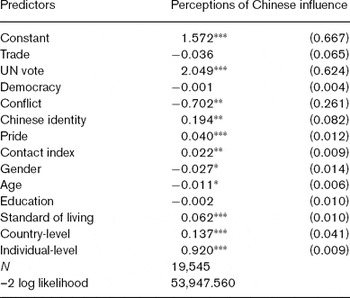
Table 3 presents the results of the multilevel analysis for our dependent variable: respondents’ views regarding Chinese influence on their country. Country-level measures are presented first in the table and variables at the individual level second.
Multilevel analysis of perceptions of Chinese influence

Notes: Maximum likelihood estimates using MLwin 2.02; standard errors in parentheses. *p<0.05; **p<0.01; ***p<0.001.
Our first hypothesis, coming out of the theoretical strand suggesting that public opinion is influenced by national economic and foreign policy interest, is that trade dependence will be positively related to views of Chinese influence. The model shows, however, that the effect of trade is not statistically significant. Under the assumption that Chinese imports may be more immediately apparent to individual respondents than their own country's exports, we also ran a version of the model with an import-only measure of trade dependence. The results were similarly insignificant. All of this suggests that this type of economic interest does not have a consistently positive or negative effect on individual attitudes. Trade, though potentially important at the elite level is not significant at the public level. Ideally, we would confirm these economic findings using a measure of Chinese foreign aid, but such data are at this time unavailable for empirical analysis.
The results for the second half of the interest strand, foreign policy interest, are more promising. Using voting records in the General Assembly, we hypothesized that high voting congruence indicates a commonality in foreign policy interest and will be positively linked with public evaluations of Chinese influence. As shown in the table, this measure is indeed statistically significant in the expected direction, indicating that foreign policy similarity, unlike trade, does translate into positive views of China's influence. The overall theoretical strand of national interest is thus partially supported.
The second-strand measure for democracy is hypothesized to be significantly and negatively correlated with the dependent variable. This expectation is not, however, supported by the statistical model – we discovered no clear relationship between political identity and evaluation of Chinese influence. To check these findings, we also ran a version of the model using Polity IV data instead of Freedom House data as a measure of political similarity. Polity relies much more on institutional measures of democracy and authoritarianism.Footnote 18 Again, however, the results were statistically insignificant.
Another component of the second-strand theory involves the concepts of national identity and pride. Respondents who identified as Chinese are expected to offer more favorable opinions toward China, whereas high national pride is hypothesized to contribute to negative evaluations. All else being equal, self-identified Chinese were indeed more likely to indicate that China's influence on their country is positive. Our results also indicate a statistically significant effect for national pride, but the positive effect runs counter to the hypothesized negative relationship. This suggests that respondents who profess significant pride in their country are more likely to view Chinese influence in a positive light. One of the claims in the literature is that strong feelings of national pride can be linked to greater fear of outsiders and xenophobia. However, it is clear that in the case of Chinese influence in Asia, greater pride does not translate into more negative evaluations. Strong national pride and pro-Chinese evaluations are by no means mutually exclusive.
We note, however, that the positive effect for pride is partially driven by the fact that relatively few respondents report feeling anything but being ‘very proud’ or ‘somewhat proud’ in being their country's people. In the entire sample, only 7% of respondents fall into the ‘not proud’ categories (‘not really proud’ or ‘not proud at all’). Moreover, the differences of opinion regarding Chinese influence between those who are proud and not proud are not vast in quantitative terms. Among those who are proud, 59.7% think Chinese influence is good, whereas 15.5% answer that it is bad. For the not proud group, 48.1% view Chinese influence as good and 23.6% view it as bad.
Nonetheless, the results are still statistically significant, and the message remains that national pride is by no means linked to negative evaluation of Chinese influence. Furthermore, these results hold when we look at individual evaluations of the influence of other powerful states such as the United States. Here too there is no positive connection between national pride and external evaluation.
The third theoretical strand, contact with foreign countries, stresses the importance of information and international contact and hypothesizes a positive relationship with the dependent variable. These expectations are borne out in the results. As described above, the contact index was created by summing positive responses for a number of individual questions including whether the respondent has a family member or relative living abroad and whether they communicate with people in other countries. The results suggest that respondents in Asia who score higher on this index do evaluate Chinese influence in more positive terms than respondents who score lower on the scale. We note that the effect of increased contact is not limited to China per se, but also extends to how respondents view the influence of foreign countries in general.
The fourth and final theoretical strand suggests that views of Chinese influence may be affected by a recent history of military conflict. The measure, based on the Militarized Interstate Dispute data, is statistically significant in the expected direction. Recent military conflict does have a significantly negative effect on public perceptions of China. This finding is particularly interesting because neither of the cases of conflict themselves, Mongolia in 1999 and the Philippines in 1995, are especially substantial. The Mongolian case, for instance, involved the shooting of a single Mongolian national at the border between the two states.Footnote 19 And the conflict with the Philippines was a small part of a larger dispute over the Spratly Islands in the South China Sea. In this instance, the Philippines responded to the construction of a new Chinese guard post on one of the islands by seizing several Chinese ships and blowing up a series of Chinese territorial markers.Footnote 20 Although both of these conflicts are significant uses of force as coded by MIDs, by no means is either a large-scale war.
As suggested earlier, even these smaller conflicts are indirectly reflective of broader tensions between the pairs of states, and clearly this tension may affect perceptions at the individual level. It should also be noted that we ran a version of the model with an alternative measure that accounts for historical wars with China. Two states, Vietnam and India, have been involved in such wars with China since World War II. And although both have relatively low average views of Chinese influence, the variable was not statistically significant in our tests.
Finally, the model includes four demographic controls measured at the respondent level: gender, age, education, and standard of living. Although we did not have any strong theoretical expectations for these measures, three of the four are statistically significant. Respondents who described their standard of living as high are, all else being equal, more likely to evaluate Chinese influence in positive terms. Likewise, females and older respondents seem to venture slightly more critical opinions than either their male or younger counterparts. There was no effect for education.
The multilevel results of this section help explain what factors shape opinions regarding the influence of China across Asia. At the country level, the significant factors are shared foreign policy preferences and recent history of conflict. We were unable to confirm any significant relationship between the dependent variable and our measures for trade and political identity. At the individual level, the measures for national identity and pride, increased contact with foreign countries, standard of living, gender and age all exerted some impact on assessments of Chinese influence.
7. Conclusions
Our study of Asian attitudes regarding Chinese influence has reached two main conclusions. First, we found that the attitudes on the whole were quite positive, even in comparison with views regarding the influence of other states important to the region. These results complement previous work showing similar effects at the elite level, and although they cannot alone prove the success of the Chinese charm offensive, they suggest at the very least that Asian publics have not reacted negatively to growing Chinese influence and power.
This is particularly interesting in the context of realist theories suggesting that any such growth will and should be perceived as threatening. By realist logic, power equals threat, and power expansion at the level of China in the past decade should be very threatening indeed. Nonetheless, this logic does not seem to prevail at the individual level, where perceptions remain, on the whole, quite positive. All such work, however, must be understood in the context of renewed recent aggression by China. Will the positive results hold as China's actions become less charming?
Second, we used multilevel analysis to examine four major theoretical strands (interest, identity, contact, and conflict) and found that each played a role in explaining perceptions of Chinese influence. In particular, foreign policy interest, cultural identity, national pride, foreign contact, and recent conflict were all significant variables. Trade and democracy, our measures of economic interest and political identity, proved insignificant. Their insignificance, however, is itself quite interesting.
Much of the existing literature discussing the Chinese charm offensive, for instance, has focused on the importance of the economic dimensions of this offensive and the fact that China's charm has frequently taken the form of economic incentives. Our results, though, suggest that such incentives do not have a clear effect on the views of actual individuals within the charmed countries. Further research should explore this discrepancy more fully and look at the relationship between economic interest and individual perception in other areas.
Regarding political identity, although there has been considerable research pointing to the role democratization and political identity play in a range of international relations issues, many of these findings have been critiqued as overly based on the particular (and unique) relationships among Western states. The absence of significance in this study limited to Asian states is therefore striking and contributes to the question of whether findings regarding democratization will ultimately hold in non-Western contexts.
Overall, it is clear that China's new position as the world's second largest economy will afford it greater opportunities to charm Asia and the rest of the world. At the same time, however, it must be remembered that these opportunities can be fleeting and that a single influential event, such as the Tiananmen Square incident in 1989 or the outbreak of conflict involving China, could dramatically impact both public and elite evaluations of China and its role in the region. Recent events, in fact, seem to indicate that China is moving away from its charm offensive and toward a more confrontational regional posture. Future research on public opinion will therefore be needed to determine how much and in what direction the levels of popular support for Chinese influence change as China continues to rise as a regional and global superpower.
About the authors
Travis Nelson is an Assistant Professor of Political Science at the University of Wisconsin-Platteville. His work is in the area of international relations and foreign policy. Recent publications examine issues such as the politics of foreign disaster aid, the connections between natural disaster and conflict, and the protest activity surrounding international sporting events.
Matthew Carlson is an Associate Professor of Political Science at the University of Vermont. He specializes in Asian politics, public opinion, electoral systems, and human rights. Publications include Money Politics in Japan: New Rules, Old Practices (Lynne Rienner Publishers, 2007) and ‘Citizens’ Perceptions of Human Rights Practices: An Analysis of 55 Countries’, (coauthored) Journal of Peace Research, 44(4): 465–483.