Introduction
Biobanking is the process of storing high quality human specimens (of tissue, blood, saliva, DNA, RNA, etc) together with linked clinical data, for research purposes. It is not a new concept, but one which has been little explored in ENT practice. A biobank, unlike a tissue repository, has extensive clinical and follow-up data linked to the stored tissue specimens. This linkage facilitates the identification of diagnostic and prognostic biomarkers, so that in future disease can be predicted and prevented. Excess tissue not required for diagnostic purposes can be taken for biobanking, provided appropriate consent has been given. Biobanked samples are cryopreserved in order to optimally preserve the genomic and proteomic material within the samples for future research. As samples are often kept in storage for many years before they may be used, it is important to establish reliable storage protocols for the specimens.
Currently, most stored human tissue samples are preserved as formalin-fixed tissue blocks. These are held, and owned, by histopathology departments within hospitals, universities or private laboratories. Whilst these provide a valuable resource, annotated with some clinical data, they lack the breadth of relevant clinical data that future researchers may require. Additionally, formalin-fixed tissue samples are rarely suitable for molecular, proteomic or immunohistochemical analysis. In contrast, frozen specimens (like fresh samples) can be analysed using these techniques.Reference Oosterhuis, Coebergh and van Veen1
A further issue with tissue samples currently held in tissue repositories worldwide is that they generally consist solely of pathology: samples have been resected at surgery with little or no associated normal tissue. Additional tissue samples from uninvolved sites in the same patient are needed in conjunction with the pathology, in order to aid the identification of prospective disease markers. Similarly, matched tissue specimens taken from patients who lack the particular condition are necessary to aid future biomarker research by acting as ‘normal’ controls.
These difficulties forced many to conclude that prospective banks of fresh-frozen tissue were needed, and numerous large tissue banks have now been created. However, these have unfortunately been either too large, and thus economically unsustainable (e.g. the UK Biobank),Reference Peakman and Elliott2 or small ‘backroom’ operations with idiosyncratic storage protocols which often failed to guarantee consistency and quality across samples.Reference Riddick, Barker, Sheriffs, Bass, Ellis and Sethia3
Is biobanking needed in ENT?
Freezing tissue specimens for future research is of particular relevance to the field of ENT due to the infrequent nature of many ENT pathologies. Prospective storage of tissue is essential to enable those researchers who want to study uncommon pathological conditions to have access to sufficient quantities of fresh-frozen tissue when needed.Reference Pitchers, Stokes, Lonsdale, Premachandra and Edwards4 Throughout the ENT specialty, earlier diagnosis, pre-operative interventions and microinvasive treatment techniques are reducing the size and number of surgical specimens collected.Reference Reis, Feitosa, Pontes-Junior, Marin, Abe and Crippa5 This makes the need for dedicated biobanking specimen collection even more acute.
Proposal
The University College London and Royal Free Hospital BioBank is based at the Royal Free Hospital, London, and was launched in August 2010. This ‘state of the art' facility provides storage facilities for tissue samples collected at the Royal National Throat, Nose and Ear Hospital and elsewhere across the Academic Health Science Centre comprising University College London and its partners. An initial capital investment of £1 million enabled the purchase of multiple nitrogen vapour-phase storage tanks and a tailor-made computer software system. The latter enables organised storage of samples and linked clinical data, plus online ordering of tissue samples by researchers for ethically approved projects. The University College London and Royal Free Hospital BioBank already provides storage facilities for a number of other specialities within the University College London Partners network; these ‘sub-banks’ include the North Central London West Essex Cancer Network Biobank.
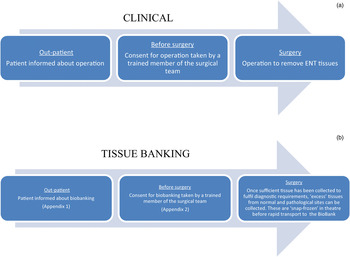
The University College London and Royal Free Hospital BioBank operates on a cost recovery basis, whereby the fee charged by the bank is used to cover on-going staffing, equipment and storage costs (Figure 1). Charging more than this for tissue storage would make the process unfeasible for sub-banks wanting to use the facility.
Pre-operative steps in tissue banking: (a) current, routine practice for tissue excision; and (b) practice required to make excised tissue available for biobanking (rather than discarding as clinical waste). Adapted with permission (A Flannagan, personal communication; and Enosawa et al.,6 © 2002, with permission from Elsevier).

Data collection for this paper
A literature search was conducted using the PubMed, Medline and Embase databases, utilising search terms including ‘tissue bank*’ ‘biobank*’, ‘tumour bank’, ‘method*’ and ‘best practice*’.
In addition, interviews were conducted with industry experts including Professor Kathy Pritchard-Jones and Professor Neil Sebire (Children's Cancer and Leukaemia Group Biobank, University College London Partners), Professor Adrienne Flannagan (Stanmore Musculoskeletal Biobank and University College London Cancer BioBank) and Dr Andrew Gallimore (Consultant Head and Neck Pathologist at University College London Hospital).
The protocol presented is based on their recommendations and advice.
How does biobanking currently work in ENT?
Ethical approval
The chief investigator must obtain approval both from a national or local research ethics committee and from the research and development office of the hospital where collection is to take place, before collection of samples and data for biobanking can occur. In the UK, the database must be registered with the local data protection officer, and updates about stored data must be reported annually. Specimen storage during the period of ethical approval does not require authorisation by the Human Tissue Authority, but thereafter all samples must be destroyed or transferred to a Human Tissue Authority licensed bank. For this reason, we believe it is better to place all samples within a secure biobank at the outset of sample collection.
International guidelines for research ethical approval require a patient information sheet (Appendix 1) and a consent form (Appendix 2). Patients are asked to give consent for ‘storage of their tissues for future ethically approved research’. They are unable to give specific informed consent for future use of their tissues since those uses are unknown at the time of collection. In the UK, this is covered within the legal framework of the Human Tissue Act (2004), which requires informed consent for storage but not for ethically approved research on the stored tissues.
Consent
Before the operation, a specifically trained member of the surgical team obtains consent for tissue banking. Any junior doctor or nurse specialist can be quickly trained to do this at the outset of their attachment by a qualified trainer. The surgical team liaises with the biobank technician about the names of any patients who have consented to biobanking that day, their position on the operating theatre list, and the location of the operating theatre where the surgery is taking place. A copy of the consent form (Appendix 2) is faxed to the biobank technician to facilitate access to the operating theatre department.
Sample procurement and storage
Tissue samples are collected using the specimen collection kits provided by the biobank technician, so that samples can be immediately frozen. The number of specimen tubes is pre-determined for specific ENT pathologies and tubes are pre-labelled. Colour-coded tubes are provided for ‘involved’ tissue from the pathological lesion (red) and for ‘non-involved’ associated normal tissue (green), as assessed by the surgeon. Parallel, formalin-fixed samples are taken for conventional histopathological diagnosis, and to confirm the ‘involved’ and ‘non-involved’ descriptions. In the operating theatre preparation room, samples are ‘snap-frozen’ in pre-cooled isopentane liquid, before transport in liquid nitrogen canisters to the University College London and Royal Free Hospital BioBank.
On receipt at the BioBank, the pre-labelled tubes are scanned into the database and transferred directly to vapour-phase nitrogen freezers for long-term storage at temperatures of below −135°C. Each freezer is fitted with an alarm system to alert staff to undue changes in temperature. The alarms are tested weekly. The use of colour coding for involved and non-involved samples ensures that there is no delay in transfer to long-term storage, which maximises the quality of the specimens. The histopathology report for the parallel, formalin-fixed tissue samples is appended to the BioBank database, which can also accommodate additional clinical information from the surgeon.
Sample tracking
Tailor-made computer software is used to track samples after procurement, but commercially available alternatives can also be used. A unique, 15-point bar code is used to anonymise the samples, and also incorporates details about the sub-bank to which the sample belongs, the tissue type, and the total number of tissue aliquots that have been stored. The bar code also enables precise sample localisation and real-time sample tracking as samples are scanned in and out of storage, enabling reliable monitoring of sample location. This coding system also enables patient follow-up information to be added to the sample records as and when it becomes known.
Data management
Software used by the University College London and Royal Free Hospital BioBank allows online browsing and requesting of anonymised tissue samples. It complies with the directive from the UK Human Tissue Authority requiring that human tissue samples must be traceable at all points (see http://www.hta.gov.uk/_db/_documents/2007-10-07_Directions_004_2007.pdf). At sample release, the software records the sample identifiers, the named recipient, the time of release and the personnel who released it. From this point onwards, it is the user's responsibility to track the tissue's use and to report back to the BioBank on the outcome of the sample and associated research. Continued traceability of samples and feedback about the quality of the sample is ensured through service level agreements between the BioBank and the end-user (e.g. the researcher, clinician or industrial partner). The software also facilitates linkage of relevant clinical imaging. This includes macroscopic images taken in the operating theatre to orientate the pathologist to the source and surgical site of the tissue specimen, as well as histopathology images which may be of subsequent interest to researchers. The software also conducts automated audits of the tissue holdings.
Cost
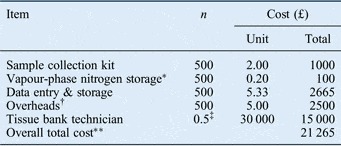
Estimated annual costs for this system are given in Table I.
Cost of biobanking 500 ent samples, 1st year

Data from Barbareschi et al. 7 *Annual cost. †Equipment, maintenance and service contracts. ‡50% of technician's time. **Storage of 500 ENT samples for one year.
Privacy
No information which can identify the patient is directly visible on the tissue sample. The bar code assigned to each aliquot enables linkage of the sample back to the relevant clinical information without compromising patient anonymity. Access to patient-identifying information remains under the control of the principal investigator who initiated the specific sub-bank, and approval (in the form of an authorisation code from the principal investigator) is needed in order to access any of the stored tissue samples. This is in contrast to many other biobanks in the UK and overseas, where decisions on who may access stored tissue samples are often made by the general biobank administration. By granting this power to the principal investigator of each sub-bank using the University College London and Royal Free Hospital BioBank facility, each sub-bank retains much greater autonomy over who can use ‘their' banked samples, and for what purpose.
Proposed protocol
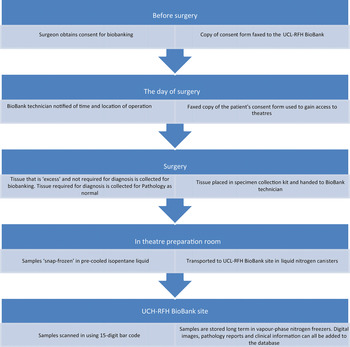
Our proposed protocol for the implementation of tissue banking at the Royal National Throat, Nose and Ear Hospital is shown diagrammatically in Figure 2.
Flow diagram presenting the proposed ENT tissue biobanking protocol. Adapted, © 2007, with permission from Elsevier.8 UCL-RFH = University College London and Royal Free Hospital

Discussion
Consent is an important consideration in any research involving humans as subjects. ‘Informed consent’ is not possible in the context of tissue banking because, at the time of collection, the nature of the research in which the tissue will be used may well be unknown.Reference Hansson, Dillner, Bartram, Carlson and Helgesson9 Once patients have been informed of the nature and purpose of tissue banking (Appendix 1), those who wish to participate are required to give ‘broad consent’ to the future use of their tissue (Appendix 2). Importantly, donors maintain some autonomy over their tissue sample by retaining the right to withdraw their consent to the storage of their tissue at any time, in line with the Human Tissue Authority (2004) regulations (see http://www.hta.gov.uk/_db/_documents/2007-10-07_Directions_004_2007.pdf).
Our proposed protocol for sample procurement and storage prioritises the close proximity of the sites of tissue extraction and initial cooling. The biobank technician is present in the operating theatre preparation room at the Royal National Throat, Nose and Ear Hospital when the operation is being conducted. This close proximity of tissue extraction and cooling minimises the period of warm ischaemia during which genes and proteins in the sample can deteriorate from their in vivo state.Reference Pitchers, Stokes, Lonsdale, Premachandra and Edwards4, Reference Naber10 Pre-cooled isopentane liquid is used for snap-freezing, which maintains the structural integrity of the sample.Reference Dhir11 Samples are then transported in portable liquid nitrogen canisters to the University College London and Royal Free Hospital BioBank, with their genetic material optimally preserved. The recommended minimum size of a sample for snap-freezing is 0.5 cm3; however, given the small size of many ENT specimens, smaller fragments may need to suffice.Reference Mager, Oomen, Morente, Ratcliffe, Knox and Kerr8
To ensure the preservation of resection margins when handling tumour tissue, our recommendation is that the orientation of tissue samples is indicated by the use of pins, in order to clarify the excision sites of both the Biobank and conventional histopathology samples. Digital photography can be a helpful reference for pathologists assessing the samples, and such images can also be linked to the BioBank inventory database. Equally, microscopic images of the specimen, taken by pathologists, can be linked back to the biobanked sample, providing more information for future researchers.Reference Dhir11
At the University College London and Royal Free Hospital BioBank site, −135°C vapour-phase nitrogen freezers are used to store the samples. Although more expensive than standard −80°C freezers, the lower temperature preserves the tissue DNA, RNA and proteins more effectively.Reference Chu, Hwang, Yu, Lee, Lai and Liu12 Importantly, the use of nitrogen vapour storage means that the BioBank is protected from the risk of short-term loss of electricity, and the risk of mechanical breakdown is virtually absent.
Access to the BioBank is facilitated by computer software that tracks the status of individual samples. This software system links the inventory of samples to a browser. Users are able to browse the available samples and order individual samples via a ‘shopping cart’ similar to those used in internet retail sites, within 15 minutes.
Currently, only principal investigators can access tissue samples via the World Wide Web. However, the BioBank's next software upgrade will allow a researcher anywhere in the world to search for samples within the BioBank sub-banks. Using the browser, researchers will be able to generate e-mail requests to individual principal investigators responsible for specific sub-bank holdings; this will give each sub-bank principal investigator autonomy over who can use their samples and for what purpose. This represents a substantial difference from other biobank protocols, in which the storage facility administrators grant permission for sample use to any requesting parties, rather than this being the preserve of the research team responsible for setting up and running the sub-bank. We believe that researchers retaining control over who can use their carefully collected samples is essential for successful biobanking.
One of the major issues in setting up a biobank is to ensure that the public are not alarmed by the possibility of the biobank detecting associations between genetic factors and a particular disease. The value of the resource is dependent upon having sufficient tissue donors.Reference Gaskell and Gottweis13 Donating tissue to a tissue bank benefits future individuals and science rather than the individual patient donor. Donors are not remunerated for the specimens they donate, and there is no advantage to the donor in terms of feedback of information. This is a logistical, financial and ethical consideration; furthermore, donors benefit indirectly in that, as they are not given information about any research findings, participating in biobanking cannot compromise them regarding employment or insurance. Encouragingly, it appears that informing the public about biobanks increases rather than decreases their participation. A recent Eurobarometer on Biotechnology survey found that, while only 10 per cent of respondents who had never heard of biobanks said that they would donate tissue, 28 per cent of respondents who had taken an active interest said that they would do so.Reference Gaskell and Gottweis13
The privacy of personal and genetic information is a primary concern of the public with regard to tissue banking. The Swedish public were outraged when a Swedish biobank was used to identify the murderer of a popular government minister, Anna Lindh.Reference Melas, Sjoholm, Forsner, Edhborg, Juth and Forsell14 Whilst this case had a recognisably positive outcome, privacy breaches such as this are a major public concern as regards biobanking. Stored tissue samples must be linked to anonymous clinical information at one level and also, at a completely separate and secure level, be uniquely linked to patient identifiable information. This is achieved in the University College London and Royal Free Hospital BioBank by holding anonymised data and patient identifiable data on two separate computer servers, with a common, 15-point alphanumeric code as the only link.
• ENT tissue biobanking will help identify biomarkers, enabling disease prediction and prevention
• Difficulties in tissue collection and storage have obstructed advances in this field
• The value of biobanks depends on consistent, high quality tissue collection and storage
• Operating protocols will help ensure transparency and maintenance of rigorous standards
• Initial establishment costs will be high, but offset by future academic and commercial worth
Finally, cost is a considerable hurdle to establishing and maintaining a large tissue specimen biobank, with estimated costs of over £20 000 for collecting 500 tissue samples in the first year (Table I).Reference Barbareschi, Cotrupi and Guarrera7 However, the impact of biobanking is potentially huge, and as such, pharmaceutical companies and independent research institutions alike are choosing to prioritise investment in this area.
Future directions for the University College London and Royal Free Hospital BioBank will involve expansion of the annual target number of specimens collected and broadening of the scope of specimen types accepted (from tissue samples only to a range of saliva and blood products). Extraction of these additional samples at the time of surgery would minimise discomfort and inconvenience to the donor. The less invasive collection methods for these new sample types should mean that relatives of existing donors will be more willing to donate samples also, enhancing our understanding of the genetic and environmental contributions to disease.
Conclusion
Setting up ENT-specific tissue banking is important. It will enable the field to keep abreast of technological developments in genomics, proteomics and bioinformatics.
Although there are a number of issues to consider, including privacy, public opinion and sampling techniques, none of these is insurmountable and practical solutions have already been proposed.
The proposed tissue banking protocol for the Royal National Throat, Nose and Ear Hospital has been described. The key to this process is to move away from ‘do it yourself’ style tissue collection, whereby ad hoc consent procedures and storage methods raise the risk of untenable samples and misleading results. Rather, biobanking systems must aim to assure the high quality of stored material, and consequently, therefore, the maximum scientific impact of related research.
It is clear that the future value of the Royal National Throat, Nose and Ear Hospital Biobank as a research tool will more than offset its initial costs, as it will provide a gateway via which healthcare can be transformed from expensive treatment interventions to cost-effective, preventative measures.
Acknowledgements
The preparation of this paper was assisted by Mr Kwok Pang and Dr Kirstin Goldring of the University College London and Royal Free Hospital BioBank. We also express our great thanks to Professors Kathy Pritchard-Jones and Neil Sebire (Children's Cancer and Leukaemia Group Biobank), Professors Adrienne Flannagan and Ms Nadege Presneau (Stanmore Musculoskeletal Biobank), Dr Andrew Gallimore (Consultant Head and Neck Pathologist, University College London Hospital) and Ms Anne Oliphant (secretary to Professor Martin Birchall) for her excellent administrative support.
Appendix 1. Royal National Throat, Nose and Ear Hospital BioBank for Studying Ear, Nose and Throat Disorders (a sub-bank of the University College London and Royal Free Hospital BioBank): adult patient information sheet
Why have I been asked to read this document?
We are inviting patients at University College London Hospital NHS trust (UCLH) to donate tissue and provide access to their clinical notes and imaging to the Royal National Throat, Nose and Ear Hospital BioBank for Studying Ear, Nose or Throat Disorders. Storage of these samples will be at the University College London and Royal Free Hospital (UCL-RFH) BioBank based at the RFH site.
Please read the following information carefully and discuss it with others if you wish. Please ask us if there is anything that is not clear or if you would like more information.
Why do we want to study your notes and imaging (X-rays)?
Research will add to our overall understanding of human disease and the normal functioning of the human body, and may help to design new ways to diagnose and treat disease.
What is the Royal National Throat, Nose and Ear Hospital BioBank for Studying Ear, Nose and Throat Disease?
This biobank is a collection of human material, including normal and diseased tissue (e.g. bone, tonsils, as well as other biospecimens such as blood and saliva), from patients attending the Royal National Throat, Nose and Ear Hospital (RNTNEH). Samples from the biobank are used in ethically approved research.
What is the purpose of the Royal National Throat, Nose and Ear Hospital BioBank for Studying Ear, Nose and Throat Disease?
The purpose of this tissue bank is to have tissue available, now and in the future, for research projects investigating human disease and the normal functioning of the human body. The tissue bank will consider applications from all scientists conducting research in areas covered by the RNTNEH BioBank for Ear, Nose and Throat Disease, providing they have appropriate ethics approval. They will be eligible to apply to use banked tissue whether they are working within or outside the UK or in the public or private sector.
Do I have to take part?
No. Whatever your decision, it will not affect any treatment or care you receive in this or any other hospital, now or in the future.
What will it involve if I decide to take part?
You will be asked to sign a consent form:
– That allows clinical information to be extracted from your notes and imaging (X-rays, scans and digital photography of any resected tissue specimens) from any hospitals you attend,
– That allows your data to be stored on a secure database in a coded and anonymised form, and
– That allows the storage of a small piece of tissue, in addition to that which is needed for your clinical care, for research projects including genetic research. (Genetic analysis of tissue and blood can often explain why certain diseases develop.)
Additional tissue purely for research purposes is not removed at any time.
All these samples will be collected when visiting the RNTNEH. We may have to collect samples on more than one occasion, but you can refuse at any time without giving a reason and without your medical care being affected.
What are the advantages and disadvantages of taking part?
There are potentially no advantages to you if you participate in research, but it may help others in the future. You will not receive a financial reward. Donated tissue is considered to be a ‘gift’ to the BioBank.
Will my information be kept confidential?
Yes. All information about you and your tissue samples will be treated with the strictest confidence. None of the confidential, anonymised information about you can be traced back to you personally by the researcher.
Results from genetic studies will be placed on a database to which only authorised individuals have access. Before being granted access to your clinical information and/or tissue samples, researchers must agree to conditions that safeguard your confidentiality. You will not be informed of the results of any genetic testing, and donating tissue to the BioBank will have no impact on your medical insurance.
Family members
It is sometimes useful to have samples from family members (e.g. blood and/or saliva) as this allows us to study the impact of genetic and environmental factors on the development of a disease. Therefore, in some instances we may ask you to consent to allow us to contact your family members (e.g. parents, grandparents, cousins etc).
What if there is a problem or I require further information?
If you would like further information or you have concerns about this research at any time you can:
– Discuss it with your doctor or nurse, or
– Contact the person designated by the BioBank on …[telephone number] …, who will try to answer your questions
What will happen if I do not want to carry on with the study?
You are free to withdraw your consent at any time. This means that researchers will no longer be able to access any of your notes or images, and your tissue samples in the BioBank will be destroyed. You do not have to give a reason for changing your mind. However, if the data has already been used it is not always possible to recall it.
Who is organising and funding the UCL-RFH BioBank?
The UCL-RFH biobanking facility at the RFH has been provided by a joint grant from UCL and the RFH. The cost of operating the BioBank is recuperated through small charges made to the research team for storing each sample.
Who has reviewed the project?
The RNTNEH BioBank for Studying Ear, Nose and Throat Disease has been given a favourable ethics opinion for conduct in the NHS by the ……… Research Ethics Committee (REC reference number:……….)
Many thanks for taking the time to read this information.
Appendix 2. Royal National Throat, Nose and Ear Hospital BioBank for Studying Ear, Nose and Throat Disorders (a sub-bank of the University College London and Royal Free Hospital BioBank): Consent form
Patient name: ………
Hospital number: ………
Patient date of birth: ………
Please tick appropriate box
I confirm that I have read and understood the information sheet provided, Version 1, dated 1 October 2011, and have had the opportunity to ask questions: □ Yes □ No
I give permission for my clinical data (including imaging) from any hospital that I attend to be stored on a database in an anonymised format and made available for ethically approved research in the UK and abroad (this could include research by a hospital, university, non-profit organisation or a commercial laboratory): □ Yes □ No
I give permission for my tissue, blood or other fluid samples (surplus to diagnostic requirements) from any hospital that I attend to be made available for ethically approved research, including genetic analysis, in the UK and abroad (this could include research by a hospital, university, non-profit organisation or a commercial laboratory) : □ Yes □ No
I understand that all data and samples will be coded for anonymising purposes: □ Yes □ No
I understand that an ethics committee will have to give its approval to all relevant research projects: □ Yes □ No
I understand that my participation is voluntary and can be withdrawn at any time without giving a reason, and that this will not affect my medical treatment or legal rights: □ Yes □ No
Patient signature: …………
Print full name: …………… Date: …
Staff signature: …………
Institution: …………
Print name: ………… Date: …