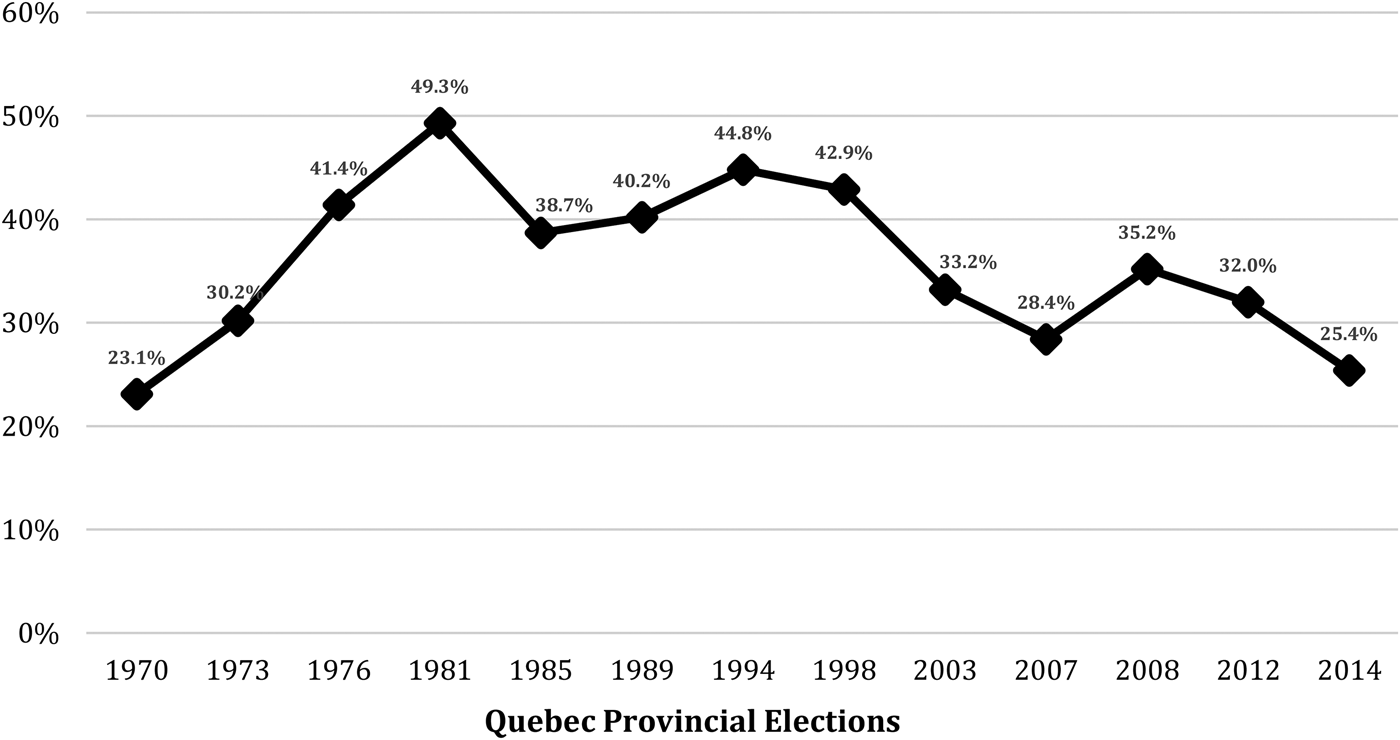


With the rise and fall of several third parties since the mid-1990s, the Quebec party system has become increasingly fractionalized, and support for the two dominant parties has been oscillating (Godbout, Reference Godbout, Bastien, Bélanger and Gélineau2013). Most notably, the Parti Québécois (PQ) has been in continuous decline since the 1995 referendum defeat. The 2014 Quebec election was a particular setback for the PQ, as the support for the party hit a historic low, winning only 25 per cent of the vote share (Bélanger and Falk Pedersen, Reference Bélanger and Pedersen2015; Maioni, Reference Maioni2014). The PQ emerged during the nationalist resurgence that accompanied the province's Quiet Revolution, and was founded by René Lévesque in 1968 with the clear objective to achieve Quebec sovereignty. While in power, the PQ adopted several important political reforms, such as the Charter of the French Language (better known as Bill 101), and held two referendums on Quebec sovereignty (Montigny, Reference Montigny2011). But with the PQ's decline, political observers have wondered if that party still has a role to play in Quebec politics, or if it is ultimately bound to disappear.
The PQ has been described as a “generational party” that emerged as a response to the sociopolitical context of the 1960s and 1970s, when dissatisfaction over economic and linguistic inequalities built up and tensions with the federal government grew (Lemieux, Reference Lemieux2011). The electoral successes of the party were grounded in the mobilization of the young generation at the time: the baby boomers (Blais and Nadeau, Reference Blais, Nadeau and Crête1984). But given that the PQ has been winning smaller vote shares since the 1980s, some have questioned whether the PQ was the party of a single generation. Generation X and millennials have been socialized in different sociopolitical contexts, with living conditions and problems that are distinct from those experienced by baby boomers. Consequently, these cohorts have developed political attitudes specific to their generation. The rise of new political generations, who have different political priorities and who progressively replace older generations, has the potential to shift how Quebec politics is conducted.
In this study, we consider the theory of generational parties developed by Lemieux (Reference Lemieux2011), which states that a party grounded in one generation will inevitably decline when this generation no longer constitutes the majority of the electorate and when new generations are not recruited into the party ranks. Our objective is to examine support for the Parti Québécois among different generations in the 2014 Quebec election, and test different explanations for these levels of support. The intention is to ground Lemieux's hypothesis in empirical evidence and to consider the implications for the future of the PQ. Using data from an opinion survey conducted at the time of that election, we offer a snapshot of the generational dynamics currently at play in Quebec electoral politics. We first present the profiles of the three generations who were politically active in the 2014 Quebec election—baby boomers, generation X and millennials—and examine the sociodemographic and attitudinal differences between these generations. Second, we test how different factors explain support for the PQ across the three generations. The evidence shows that while the profile of generation X is not so different from baby boomers in terms of attitudes, the profile of millennials is particularly distinct from that of boomers on several dimensions. Furthermore, we demonstrate that the decline of the PQ in 2014 was mostly concentrated among millennials, who were less inclined to see the Quebec sovereignty project as a priority and less likely to support the PQ's controversial proposal to adopt a Charter of Quebec Values.
The Parti Québécois: A Generational Party?
According to Lemieux (Reference Lemieux2011), a generational party is one that is anchored in one political generation, with the Parti Québécois being one example.Footnote 1 These parties emerge as a response to the problems of a specific generation and propose a new conception of politics, one that distinguishes them from the other parties. The emergence of the PQ was strongly supported by the youth of the 1960s and 1970s, also known as the baby boomer generation. The youth of this period were socialised in a context of socioeconomic and linguistic inequalities and sought political alternatives to voice their dissatisfaction. Blais and Nadeau (Reference Blais, Nadeau and Crête1984) showed that electoral support for the PQ in the 1970s was in fact the strongest among those born between 1945 and 1959. During this time, the PQ was becoming a dominant political force in Quebec by offering a renewed nationalist perspective and an egalitarian political project.
However, from the electoral successes of the 1970s up to the 1990s, popular support for the party has declined (see Figure 1). We can think of several explanations to account for this downturn, either related to the demobilization of the sovereignist movement (Mendelsohn et al., Reference Mendelsohn, Parkin, Pinard and Murphy2007) or to the party's internal organization (Montigny, Reference Montigny2011). However, we argue that the source of this progressive erosion in PQ support lies deeper than contextual factors and is not only tied to short-term factors (such as interactions with Ottawa or leader characteristics). Lemieux (Reference Lemieux2011) argued that generational parties usually maintain themselves for a period of 30 to 40 years; they emerge with a new generation, acquire political prominence as this generation matures and subsequently decline as the generation ages. Following Lemieux, we argue that changes in the PQ's electoral support reflect a process of intergenerational change. If the baby boomers who gave rise to the party are progressively replaced in the electorate by younger generations with different political priorities and orientations, then the PQ is unlikely to recruit voters among these new generations and may decline and disappear. Our generational argument rests on two hypotheses. First, the different generations of citizens were socialized in different sociopolitical environments and thus developed distinct political orientations and priorities. Second, their different political outlooks influence their electoral behaviour.
Vote Shares Received by the PQ between 1970 and 2014

Generations, Continuity and Political Change
The political outlook of individuals is shaped by both early life influences and their contemporaneous political context. The main postulate of political socialization is that actors and events during an individual's childhood and adolescence shape their political development, affecting their adult political attitudes and behaviours (Beck and Jennings, Reference Beck and Jennings1982). Most notably, the family is considered the prime locus of political learning, as parents directly transmit their political values to their children and act as political role models (Jennings and Niemi, Reference Jennings and Niemi1968). Parental socialization thus explains some of the continuity of attitudes and resemblance between generations (Jennings et al., Reference Jennings, Stoker and Bowers2009; Neundorf et al., Reference Neundorf, Smets and Garcia-Albacete2013). But this process of intergenerational transmission of political traits is conditional on context, as individuals are also influenced by contemporaneous forces and societal events (Jennings, Reference Jennings2002; Johnston, Reference Johnston1985). In fact, even if the early phases of childhood and adolescence are important in the political development of individuals, this development does not suddenly stop when one enters adulthood. Individuals can further be influenced by events during the impressionable years of early adulthood. As individuals of the same birth cohort are socialized in a similar sociopolitical context and share common experiences of political events during their formative years, they tend to develop political attitudes that are distinct from other birth cohorts. In times of rapid and intense societal change, individuals are more likely to develop a common consciousness and particularly distinct political orientations, giving rise to a political generation (Mannheim, Reference Mannheim1952). Thus, citizens display some of the values and attitudes of their parents, as well as the imprint of the values and attitudes dominant in their political times. This explains why we both find continuity and change in social and political orientations from one generation to another.
In Quebec, three main generations are currently taking part in elections: baby boomers (born before 1960), generation X (born between 1960 and 1979), and millennials (born after 1979) (Gélineau, Reference Gélineau2015). Each generation was socialized in a different sociopolitical context. Firstly, the baby boomer generation was socialized in a context of economic and linguistic inequalities and experienced an era of rapid social, political and economic modernization during the Quiet Revolution (Guay, Reference Guay1997). The economic development and growth of the 1960s moved this generation away from materialist goals and towards post-materialist considerations (Inglehart, Reference Inglehart2008; Martin, Reference Martin1994; Pinard et al., Reference Pinard, Bernier and Lemieux1997; Piroth, Reference Piroth2004). As a result, the PQ was able to capitalize on the appetite for more social and political reforms as well as on dissatisfaction over the place of Quebec in the Canadian federation. The party presented political sovereignty as a way to further Quebec's economic, political and social development (Lemieux, Reference Lemieux2011; McRoberts and Posgate, Reference McRoberts and Posgate1983). Thus, with the advent of the boomers generation in the 1970s, the national question became a significant political cleavage in Quebec electoral politics (Bélanger et al., Reference Bélanger, Nadeau, Henderson and Hepburn2018).
The next generation, generation X, grew up in times marked by more limited opportunities due to the recession of the 1990s and rising unemployment (Zukin et al., Reference Zukin, Keeter, Andolina, Jenkins and Delli Carpini2006). In Quebec, the pace of reforms slowed and inequalities between anglophones and francophones progressively diminished. While support for the sovereignty project rose steadily in the 1970s, it was more mixed in the 1980s and 1990s. In fact, these two decades saw two referendums and several constitutional crises, which alternatively led to increases in support for Quebec sovereignty, followed by the demobilization and depoliticization of the national question, although perceptions of economic inequalities with anglophones remained (Mendelsohn et al., Reference Mendelsohn, Parkin, Pinard and Murphy2007; Pinard et al., Reference Pinard, Bernier and Lemieux1997).
Finally, millennials came of political age during the 1990s and 2000s. They experienced an era of improved life possibilities with some economic prosperity, rising levels of education, rapid changes in media and technologies, and increased movements of population across the world (Putnam, Reference Putnam2000; Zukin et al., Reference Zukin, Keeter, Andolina, Jenkins and Delli Carpini2006). In Quebec, with successes in language protection and increased economic well-being, economic, cultural and linguistic grievances were less salient to this generation (Pinard et al., Reference Pinard, Bernier and Lemieux1997). Hence, after the 1995 referendum on Quebec sovereignty, there was less interest in constitutional debates. This period reflects a return to “normal politics,” with increased salience of the left-right socioeconomic cleavage and a relative depoliticization of the national question (Mendelsohn et al., Reference Mendelsohn, Parkin, Pinard and Murphy2007; Nadeau and Bélanger, Reference Nadeau, Bélanger, Bastien, Bélanger and Gélineau2013).
Based on the different contexts of political development of these three generations, we hypothesize that attachment to Quebec and the importance of the sovereignty project will be highest among baby boomers, whereas they will be lowest among millennials. However, given the important fluctuations in the salience of the constitutional and nationalist debates during the 1980s and early 1990s, it is less clear where levels of attachment and the importance of sovereignty fall for generation X. It remains an open question whether the attitudinal profile of generation X more closely resembles the profile of baby boomers or that of millennials.
Factors Explaining Electoral Behaviour in Quebec: The 2014 Election
In Quebec, two main dimensions structure electoral politics: the left-right socioeconomic dimension and the national question (Bélanger and Nadeau, Reference Bélanger and Nadeau2009; Hudon, Reference Hudon1976). Since the 1970s, positions on the sovereignty-federalism axis have been a key determining factor of electoral behaviour. But depending on the time period, positions on the sovereignty-federalism axis have been sometimes more or less important relative to positions on the left-right axis in explaining vote choice (Nadeau et al., Reference Nadeau, Guérin and Martin1995). While positions on these two axes strongly impact Quebecers’ electoral behaviour, contemporary issues that occupy a central place in electoral campaigns also matter in explaining vote choice and more so when the sovereignty-federalism axis is less salient (Bélanger and Nadeau, Reference Bélanger and Nadeau2009; Nadeau and Bélanger, Reference Nadeau, Bélanger, Bastien, Bélanger and Gélineau2013). As a consequence, to investigate and compare the electoral behaviour of the three generations in the 2014 provincial election, we focus on individuals’ position on the issue of sovereignty, their position on the left-right axis and positions on the Charter of Values, which was a central issue during this election (Tessier and Montigny, Reference Tessier and Montigny2016).
While there is still a relatively high level of support for sovereignty among all generations (Tanguay, Reference Tanguay and Murphy2007), there is a general disengagement from the national question, which is most pronounced among younger Quebecers (Guay, Reference Guay2004; Mendelsohn et al., Reference Mendelsohn, Parkin, Pinard and Murphy2007). Guay (Reference Guay2004) explains this “paradox” of Quebec's public opinion by the fact that people can support “symbolic sovereignty” (that is, the idea that Quebec is a distinct nation, especially culturally) but at the same time not support “real sovereignty” (that is, the concrete project of founding a country). Guay makes the claim that “real sovereignty” is not a major concern anymore, especially for the younger generation that prioritises issues of sustainable development, the environment and cultural diversity. In this sense, the PQ's agenda may not be in tune with the priorities of millennials. The more recent return to “normal politics” means that positions on the left-right socio-economic dimension become more important in explaining electoral behaviour in Quebec. While we do not necessarily expect strong generational differences in terms of left-right positions, we know that there are generally age-related differences in left-right positions, with younger people usually more left-leaning and older citizens tending to be right-leaning. Even though the PQ emerged as a socio-democratic party promoting state intervention and egalitarian policies, the party's position on the left-right axis has oscillated in the past decades (Guay, Reference Guay2004). We thus expect the youngest citizens to turn to parties that are more clearly left-leaning (rather than the PQ), compared to older citizens.
The Charter of Quebec Values was a project proposed by the Parti Québécois. This policy proposal was made public before the 2014 election campaign and aimed at reinforcing the secular nature of Quebec society by (among other things) banning “ostentatious” religious symbols for public employees at work (Tessier and Montigny, Reference Tessier and Montigny2016). This Bill was presented by the governing PQ as a way to continue the secularisation of Quebec society started in the Quiet Revolution. However, opponents presented this project as an anti-immigration bill that privileged Quebec's Catholic heritage and discriminated against newcomers, especially Muslim immigrants (Melançon, Reference Melançon2015). In this sense, the charter continues the discussion about diversity within the province, after the 2006-2007 debate over reasonable accommodations (Laxer et al., Reference Laxer, Carson and Korteweg2014). As the younger generations are more ethnically diverse and have grown up in a more diverse and globalized world, we expect that they will be more open to diversity and immigration (Mendelsohn et al., Reference Mendelsohn, Parkin, Pinard and Murphy2007), and thus less supportive of the charter. Alternatively, for the baby boomers who experienced the transition to a secular society during the Quiet Revolution and who were socialized in a less ethnically diverse environment, support for the charter should be higher.
As it is hypothesized that the youngest generation will give less importance to the national question, other issues—such as diversity—should have more impact on their electoral behaviour. Hence, millennials’ attitudes on the national question and diversity should make them more likely to support a party other than the PQ, while positions of baby boomers on diversity and the importance of the national question should make them more likely to vote for the PQ. In sum, the generational hypothesis is that the determinants of a PQ vote will vary across generations, most notably between millennials and baby boomers.
Data and Methods
To examine these questions, we make use of individual-level data from an online opinion survey conducted during the week that followed the Quebec provincial election of April 7, 2014. The survey was designed by Éric Bélanger (McGill University) and Richard Nadeau (Université de Montréal) and was administered to 1,517 adult Quebecers by Léger Marketing through Web-based interviews between April 9 and 16, 2014. The survey respondents were recruited from Léger Marketing's LégerWeb online panel of Canadian households. Weighting procedures are used to make the sample more representative of the Quebec population. The survey weights are based on official data from the 2011 Statistics Canada census about gender, age, region of residence and language.
Our key independent variable of interest is the generation to which these survey respondents belong. For our analyses, we distinguish between three age groups: individuals born before 1960 (who were 55 years old or more at the time of the 2014 election), those born between 1960 and 1979 inclusively (who were between 35 and 54 years old), and those born in 1980 or later (who were between 18 and 34 years old).Footnote 2 These three age groups make up 37 per cent, 36 per cent, and 27 per cent of our survey sample, respectively.Footnote 3 In addition to the nature of the times during which they were politically socialized, these three age cohorts also differ on another key aspect: their ethnic background. Whereas 88 percent of the baby boomer generation self-declare as having either Québécois or Canadian ethnic origins, the other two generations present a more diversified ethnic profile with close to a quarter of each group self-declaring an ethnic origin other than Québécois or Canadian (24% for generation X and 25% for millennials). That said, the three age groups do not significantly differ from one another in terms of language (francophone, anglophone, allophone) or place of birth (in Quebec or outside). These findings mirror the greater ethnic diversity found in Quebec following the rise in immigration that occurred over the past few decades: younger individuals may be born in Quebec and may speak French, but they are less likely to be of French-Canadian descent than those of the baby boomer generation.
Analysis
The attitudinal profile of three generations in Quebec
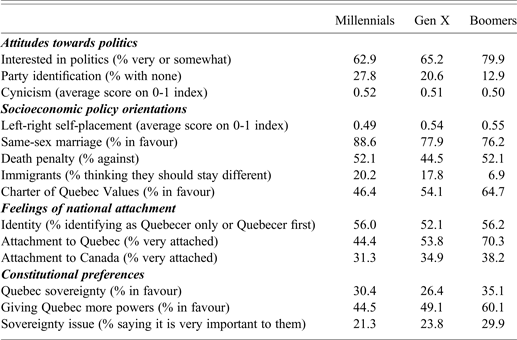
Table 1 presents a summary of the distribution of Quebecers’ attitudes on a host of political variables, broken down by our three age groups. We first look at general attitudes towards politics. The findings are consistent with what we know about youth's views about politics when compared to older voters: they are less interested in politics in general, they tend to identify less with a political party, and they are more cynical vis-à-vis the political system (Gidengil et al., Reference Gidengil, Blais, Nevitte and Nadeau2003; Putnam, Reference Putnam2000). In short, young Quebecers do not diverge much from the typical observations already made about youth's attitudes towards politics in general.
Political Attitudes by Generations (2014)

The table also offers a breakdown of each generation's respective socioeconomic policy orientations, feelings of national attachment, and constitutional preferences.Footnote 4 In terms of socioeconomic policy orientations, millennials in Quebec appear to be the most left-leaning of the three age groups (lower values indicate a left-leaning self-placement on the ideology scale, whereas higher values indicate a more right-leaning orientation). They are also the most morally liberal individuals, at least when looking at their opinions about same-sex marriage and the death penalty.Footnote 5 Again, these findings confirm expectations regarding intergenerational differences in ideological positions.
With regards to the issue of immigration, we can look at two different indicators. The first one taps into a general view about immigrant integration and is measured in the survey using the following question: “There are different views about those who come from outside Quebec, often bringing their own customs, religion and traditions with them. Do you think it is best if such newcomers try to adapt and blend into the local culture? Or is it best if they stay different and add to the variety of customs and traditions in the locality?” Although the majority opinion is in favour of the cultural adaptation and blending of immigrants, we can clearly see in Table 1 that millennials are the most open to the cultural differences that newcomers bring to Quebec. The second indicator assesses opinion about the Parti Québécois government's proposal to adopt a Charter of Quebec Values. On this specific issue, we see disagreement between generations. While a majority of baby boomers and generation X are in favour of the charter, a majority of millennials are against this proposal. Taken together, these two indicators clearly show that the youngest generation in Quebec seems to be the most “multiculturalist” in its views about immigrant integration.
What about feelings of national identity and attachment? Given that the three generations examined here have been socialized during very different political times as it pertains to the national question, we would expect to see notable generational differences in terms of their nationalist feelings. That said, the past literature has tended to show that Quebec youth are generally the most nationalist in their sentiments, no matter the historical period (Bélanger and Perrella, Reference Bélanger and Perrella2008; Piroth, Reference Piroth2004). The results in Table 1 provide a nuanced view on this question. On the one hand, we see that millennials are as likely as baby boomers to identify themselves either as “Quebecer only” or as “Quebecer first, Canadian second.” Millennials are also the ones to display the lowest level of attachment to Canada. On the other hand, the table reveals that youth feel the least attached to Quebec in 2014, and by a good margin; while 70 per cent of baby boomers feel very attached to Quebec, only 44 per cent feel so among the 18-34 age group. Members of generation X stand somewhere in between, but lean a bit closer to millennials than to baby boomers on this variable. The low level of attachment to Quebec among the younger generation constitutes one of the most surprising findings from these survey data; this goes contrary to usual expectations about Quebec youth's nationalist sentiments (Piroth, Reference Piroth2004) and offers one clear piece of evidence that millennials in Quebec may be disconnected from the perennial national debate in their province.
Finally, results on the constitutional preferences of the different generations offer the same kind of nuanced conclusions. As Table 1 shows, the level of support for sovereignty as a constitutional option in a hypothetical referendum stands at 30 per cent among millennials, which is slightly higher than among generation X (26%), but remains lower than among baby boomers (35%). While support for sovereignty is not entirely collapsing among Quebec youth, the 18-34 age group is nonetheless the one that considers this issue as the least important to them (only 21% say that it is very important to them personally, compared to 30% among baby boomers). In addition, millennials are the least supportive of the option to have more powers from Ottawa (that is, more autonomy) for Quebec's National Assembly, which is a constitutional position that has deep historical roots in the province and that is currently being defended by the Coalition Avenir Québec.
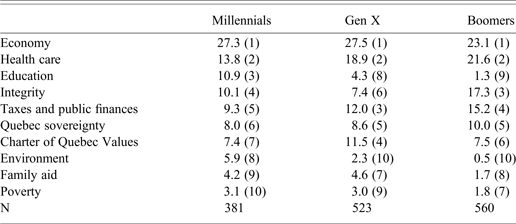
When asked which issue was, for them personally, the most important in the 2014 provincial election, respondents ranked the issue of Quebec sovereignty as fifth among the list of ten issues offered to them. As Table 2 indicates, there was not much variation between the three generations with regards to the salience of the sovereignty issue. Baby boomers and members of generation X ranked it as fifth, whereas millennials ranked it as sixth (8% of them mentioned sovereignty as the most important issue to them personally in that election, a proportion that is only slightly lower than for the other two age groups). Remarkably, the three generations mentioned the same top two issues: the economy and health care. Where they markedly differed in their issue priorities was on the importance given to education (third-most mentioned issue for millennials, compared to eighth and ninth for the other two groups), the environment (eighth for the youth, tenth for the others), and the charter (seventh for millennials, but mentioned more frequently among the other two age groups).
Salience of Issues in the 2014 Election by Generations (in per cent)

Note: Figures in parentheses indicate the issue's rank within the column (generation).
To sum up, the three generational groups display some similarities in their attitudinal profiles. But the differences between the younger generation (18-34 years old) and older Quebecers are worth keeping in mind as we move forward in our analysis. Millennials are more disengaged from politics, as one would expect.Footnote 6 They locate themselves on the left of the ideological spectrum in greater proportion than older Quebecers, which is not surprising either. They are clearly more open to a multicultural approach to immigrant integration than are baby boomers and, to a lesser degree, members of generation X. They are also more likely to consider issues like education and the environment to be important in an election (at least in 2014). Quebec sovereignty is less of a priority for them, and they do not seem as convinced by the idea of giving Quebec more powers within the Canadian federation. Even more surprising is the fact that they are less attached to Quebec, although they are not necessarily more attached to Canada in return.
Generations and the vote in the 2014 election
We now examine the differences among generations in their voting behaviour, as well as the extent to which some of the political attitudes having just been examined have had more or less weight in determining this behaviour in the 2014 provincial election. We can first note that millennials had the lowest turnout rate in this election. According to answers given to the survey's self-reported electoral participation question, individuals aged between 18 and 34 years old were twice as likely to abstain than those belonging to generation X and were three times as likely to abstain than baby boomers.Footnote 7 This result is not unexpected given the high degree of cynicism and disinterest in politics we previously noted among the youngest generation of Quebecers in 2014.
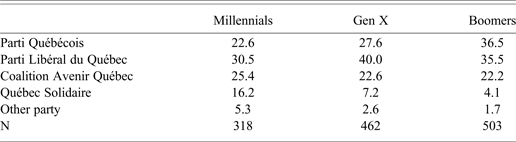
Table 3 presents the distribution of voting preferences among those individuals who reported having cast a ballot in the election. Looking first at support for the Parti Québécois, we can see that it received the lowest proportion of votes from millennials: 23 per cent of members from that generation voted for the PQ, as compared to 28 per cent among generation X and 37 per cent among baby boomers. Second, we can also note that Québec Solidaire received most of its support among the youngest generation (16% of millennials voted for QS, as opposed to 7% of generation X and 4% of baby boomers). Small parties like the Green Party and Option Nationale also fared the best among millennial voters. One final observation worth making is that the PQ was the first choice of only one generation, namely the baby boomers. The party came in second place among members of generation X, and in third place among millennials (behind the Parti Libéral du Québec and the Coalition Avenir Québec). Based on all the figures reported in Table 3, it is thus clear that in the 2014 election the PQ was becoming increasingly less popular from one generation to the next.Footnote 8
Vote Choice in the 2014 Election by Generations (in per cent)

Note: Columns each add up to 100 per cent. Total number of observations is 1,283.
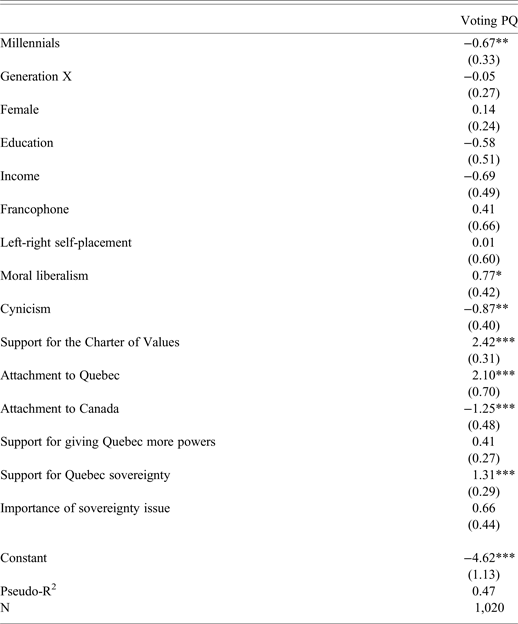
Table 4 displays results from a multivariate analysis of support for the PQ via binomial logit regression. The vote model includes as predictors many of the attitudinal variables examined in the previous section, together with some usual sociodemographic and socioeconomic control variables (gender, education, income and language). We include two dummy variables, one for millennials and another for generation X, leaving out baby boomers as the reference age group to which the voting behaviour of the other two is compared. Looking only at the statistically significant variables, the model indicates that the PQ found its support in 2014 among those individuals scoring low on cynicism and high on moral liberalism (the latter variable is an index combining views about same-sex marriage and the death penalty), those feeling attached to Quebec and not attached to Canada, those supportive of the PQ's proposed Charter of Quebec Values, and those in favour of making Quebec a sovereign country. None of the other independent variables’ impact on the PQ vote is significantly different from zero, except for the relationship between voting for the PQ and belonging to millennials. According to this result, millennials were 7 percentage points less likely to vote for the PQ than members of the baby boomer generation (the reference group), everything else being equal. Since the coefficient associated with the dummy variable for generation X is not statistically significant, this indicates that the 35-54 year old and the baby boomer age groups did not significantly differ in their level of support for the PQ, everything else being equal. But millennials did significantly differ from the other two generational groups, on top of all the attitudinal differences already uncovered in the previous section and which are de facto captured in this multivariate model.Footnote 9
Determinants of Voting for the Parti Québécois in the 2014 Election

Note: Entries are unstandardized logit regression coefficients; standard errors in parentheses.
***p < 0.01; **p < 0.05; *p < 0.10 (two-tailed test).
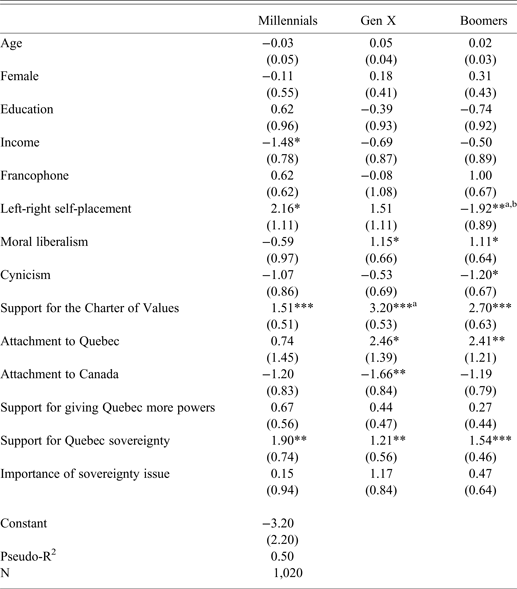
Table 5 presents one last regression analysis. In this table we re-estimate the PQ vote model from Table 4 by adding interactions between the generation dummy variables and each of the other independent variables, in order to more directly assess the extent to which the generations differ in the determinants of their voting decision.Footnote 10 Several interesting conclusions can be drawn from this table. Note first that the sovereignty issue operates in similar ways across the three generational groups. The salience of the issue as well as the variable capturing support for more power devolution have no significant influence on the vote decision for any of the three cohort groups, and the variable measuring support for making Quebec a sovereign country systematically impacts vote choice in all three groups in a roughly similar way (the change in the probabilities of voting for the PQ associated with this variable is equal to 0.17 for millennials, 0.11 for generation X, and 0.19 for baby boomers).
Determinants of PQ Vote by Generations (Results based on an Interaction Model)

Note: Entries are unstandardized logit regression coefficients. Coefficients represent the main effects for each generation, taking into account the interaction coefficients (not reported here). Standard errors in parentheses.
***p < 0.01; **p < 0.05; *p < 0.10 (two-tailed test).
aIndicates the effect is statistically different (at p < 0.05, two-tailed test) from that for millennials.
bIndicates the effect is statistically different (at p < 0.05, two-tailed test) from that for generation X.
Where we do find striking differences in vote determinants across generations is with feelings of attachment and support for the charter. In the former case, we clearly see that attachment to Quebec has no significant impact on the vote choice of millennials, contrary to members of the other two generational groups for whom it significantly increases the probability of supporting the PQ by 21 and 29 percentage points, respectively. Combined with the fact that millennials are the least attached to Quebec, this result provides additional insight into the decline of the PQ in the 2014 provincial election. Looking at support for the charter, we see that this variable had much less of an influence on the youngest generation's decision to vote for the PQ than for the other two age groups. While being statistically significant, this variable only increases the probability of voting for the PQ by 14 points for millennials, compared to 28 and 33 points for generation X and baby boomers, respectively. Again, viewed in tandem with the earlier finding about the youngest voters being the least supportive of the charter project, this provides further explanation for the lower level of PQ support observed among the youngest generation of voters in 2014.
Another result from Table 5 worth highlighting concerns the influence of left-right ideological self-placement on support for the PQ. This variable may reveal a rather deep (and surprising) generational gap in the PQ's 2014 support base. According to our estimates, voters positioning themselves on the right-leaning end of the scale saw their probability of voting for the PQ decrease by 24 points among baby boomers, but increase by 19 points among the youth. While the result for the baby boomer generation is not surprising, since it fits well with that party's social democratic roots, the finding for millennials provides further evidence that the more progressively oriented youth are increasingly attracted to a party like Québec Solidaire than to the PQ, leaving only right-leaning young voters to join older left-leaners among the pool of PQ supporters. At the very least, it suggests that in the eyes of Quebecers aged 18 to 34 years old, the PQ of 2014 was not viewed as a progressive party alternative, reinforcing Pétry's conclusion (Reference Pétry, Bastien, Bélanger and Gélineau2013) that the PQ does not differentiate itself significantly from the PLQ on the left-right axis.
Note finally that we find no evidence of a linear effect of age on PQ support. Indeed, an individual's ageFootnote 11 does not contribute significantly to the likelihood of voting for the PQ, which indicates that membership in a generational group appears to be a better predictor of PQ support than age itself. This suggests that what we are observing is a genuine generational phenomenon as opposed to a mere life-cycle effect.Footnote 12
Conclusion
The PQ has been one of the two dominant parties in Quebec since the 1970s. However, its progressive decline, as well as the rise of other parties (notably the Coalition Avenir Québec and Québec Solidaire), have raised questions about its current and future centrality in Quebec's party system. This study examined whether the demographic decline of its founding generation, the baby boomers, and the rise of new generations could help explain the party's declining electoral force. To do so, we looked into differences between generations with regard to the factors linked to vote choice in the 2014 election. Our argument of intergenerational change posits that generation X and millennials, who were socialized in a different sociopolitical context, have developed different sets of political orientations than the baby boomers, which leads them to be less supportive of the Parti Québécois.
This study provided evidence of clear generational differences in Quebecers’ political attitudes. In fact, millennials appear to be more left-leaning, more morally liberal, more open to cultural differences, more opposed to the Charter of Quebec Values, much less attached to Quebec and less engaged with the issue of sovereignty than baby boomers. While millennials’ position on the left-right axis may be due to a life-cycle effect, as young people are usually more left-leaning than older citizens, this generation's position on the issue of diversity and the national question may reflect more permanent societal changes. One important finding is that there are large attitudinal differences between millennials and baby boomers, whereas generation X seems to fall somewhat in between these two generations. These conclusions extend those of Guay (Reference Guay1997), who observed that the greatest difference in political values and attitudes was between baby boomers and the generation that directly preceded it, while baby boomers and the members of generation X proved to be much closer in their views.
When examining the electoral behaviour of these three generations, again the contrast was most pronounced between millennials and baby boomers. The Parti Québécois proved to be the most popular party among baby boomers, while it was the second choice in terms of voting preference for generation X, and the third choice for millennials. This tends to confirm the theory of Lemieux (Reference Lemieux2011) that the PQ is the party of the baby boomers’ generation. The slower and more progressive than expected decline of this party's vote shares may be explained by two factors. First, the baby boomers’ generation was one of the largest birth cohorts in recent times and it was able to maintain its weight in the electorate due to gains in life expectancy. Second, generation X proved to be rather similar to baby boomers in some significant respects. It seems that the political context of the 1980s and 1990s has allowed the PQ to partly mobilize generation X and to keep—more or less—its place and relevance in the party system despite the beginning of the decline of the baby boomer generation.Footnote 13
But as millennials come to occupy a larger place in the electorate, and as the weight of the boomers continues to decrease, we may witness a continued decline of the PQ. When we look at the reasons behind the vote for the PQ, we see a clear divide between millennials and the others, a divide that limits the possibilities for the PQ to durably maintain itself in the electorate. First, while those who support the Quebec sovereignty project are still more likely to vote for the PQ, regardless of the generation to which they belong, millennials are much less likely to see Quebec sovereignty as a priority. Given that the first objective in the PQ's program is to achieve Quebec's sovereignty, it thus seems unlikely that the PQ could consistently recruit a sufficient number of supporters among millennials to compensate for the increasingly limited importance of the baby boomers’ generation. Second, the issue of diversity played a significant but different role in the electoral behaviour of the three generations. While support for the charter had a significant and positive impact on the likelihood of voting for the PQ among all generations, it was a less important factor for millennials, compared to the other two generations. Also, millennials were more likely to oppose the project of the charter than generation X and baby boomers. This means that the core policy of the PQ in the 2014 election tended to push away the younger generation. In a context of increasing rates of immigration, the issue of diversity will likely remain a central issue in Quebec politics in the years to come. The charter was a strong signal about the turn of the PQ towards an “identity-centred nationalism,” and this project led to heated debates within Quebec society. The question is now whether the PQ has permanently alienated the youngest generation, or if a change in the party's stance on diversity would succeed in building support among its members.
In this study, we have provided some evidence that the long-term reasons behind the shift in electoral behaviour indicate a possible realignment in Quebec's party system. The question is now when such a realignment could occur. Political predictions are always a risky business. However, the present analysis of the generational dynamics of electoral behaviour, coupled with information on Quebec's demography (Gélineau, Reference Gélineau2015), can help us assess a range of possible outcomes for the Parti Québécois. On one hand, if generation X continues to align with boomers and offers some support to the PQ, the combined demographic weight of these two generations could help the PQ to maintain itself in the electorate until the 2034 election when millennials will make up the majority of Quebec's electorate. On the other hand, if generation X distances itself from the boomers’ preferred policies and the PQ loses this support, the party could fall even more rapidly to third or fourth place in election results and as soon as 2018, when generation X and millennials will make up 66 per cent of Quebec's electorate (Gélineau, Reference Gélineau2015). That being said, several factors may condition these possible outcomes, such as the lower rates of electoral participation among generation X and millennials and the ability of the PQ to renew its political project. In addition, we have witnessed moments in the past when conflictual relationships with Ottawa and constitutional disputes revived sovereignist aspirations among Quebec's citizens (Yale and Durand, Reference Yale and Durand2011). Such moments have helped mobilize part of generation X in favour of the PQ and its constitutional option, which explains why the PQ remains a relevant actor of the party system at the moment. Similar events in the future could help either the PQ or another actor of the sovereignist movement mobilize millennials for the first time.
Supplementary materials
To view supplementary material for this article, please visit https://doi.org/10.1017/S0008423917001147.