Introduction
Since approximately 2002, mortality events numbering tens of thousands of waterbirds have resulted from infections of introduced trematodes (Digenea) during spring and autumn migration in the upper Midwest, USA, and no species has been more affected than the lesser scaup (Aythya affinis) (Sauer et al., Reference Sauer, Cole and Nissen2007; Herrmann & Sorensen, Reference Herrmann and Sorensen2011). The continental breeding population of lesser scaup reached a record low of 3.2 million in 2006 and has since remained below the goal of 6.3 million set by the North American Waterfowl Management Plan (Austin et al., Reference Austin, Anteau, Barclay, Boomer, Rohwer and Slattery2006; USFWS, 2015). A myriad of factors, including habitat loss and degradation, climate change, predation, competition, invasive species and contaminants have been identified as stressors potentially influencing lesser scaup condition and subsequent breeding success (Afton & Anderson, Reference Afton and Anderson2001; Anteau & Afton, Reference Anteau and Afton2004, Reference Anteau and Afton2006, Reference Anteau and Afton2008; Austin et al., Reference Austin, Anteau, Barclay, Boomer, Rohwer and Slattery2006; Drever et al., Reference Drever, Clark, Derksen, Slattery, Toose and Nudds2012). The Spring Condition Hypothesis suggests that the major contributor to the population decline is reduced recruitment resulting from female lesser scaup reaching their breeding grounds in poor condition (Anteau & Afton, Reference Anteau and Afton2004).
Additionally, parasitism may play a role in the population decline of lesser scaup if nutrient acquisition and deposition is negatively affected during spring migration. Parasitism is an important ecological factor influencing populations both directly and indirectly through diversion of energy from the host species (e.g. blood meal acquisition and initiation of an immune response, respectively) (Wobeser, Reference Wobeser, Atkinson, Thomas and Hunter2008). Spring migration is an energetically expensive time in the annual cycle of waterfowl, especially for females that must not only replace endogenous resources expended during migration but also simultaneously develop reserves for subsequent breeding efforts. Therefore, it is important to understand the effects of parasitic infections on female scaup since future recruitment is tied to their condition and reproductive capacity (Anteau & Afton, Reference Anteau and Afton2004). Intestinal helminths tend to reduce the condition of their host through direct and indirect means (e.g. reduced ability to forage, defend territories; lowered reproductive success; increased vulnerability to predators) (Møller, Reference Møller, Thomas, Renaud and Guégan2005); however, parasites are often not considered to be significant regulators of wildlife populations unless infections result in mass mortalities (Lafferty, Reference Lafferty2010). At present, no large-scale studies have examined the distribution and overall loads of parasites occurring in lesser scaup in the Midwest, a critical stopover region. Changes in parasite infracommunities and infection intensities as birds move northward towards the breeding grounds may be related to reduced habitat quality and contribute to the Spring Condition Hypothesis.
Historically in Midwestern wetlands, lesser scaup primarily consumed amphipods (Gammarus lacustris and Hyalella azteca) (Anteau & Afton, Reference Anteau and Afton2008); however, declines in amphipod populations have caused lesser scaup diets to shift to more abundant gastropod and bivalve species (e.g. faucet snails (Bithynia tentaculata) and zebra mussels (Dreissena polymorpha)) (Anteau & Afton, Reference Anteau and Afton2006; Karatayev et al., Reference Karatayev, Mastitsky, Burlakova, Karatayev, Hajduk and Conn2012). The faucet snail is native to the waterways of Eurasia and was most likely introduced into the Great Lakes during the late 1800s via cargo ship ballast waters (Mills et al., Reference Mills, Leach, Carlton and Secor1993). This snail serves as the first and second intermediate host for the introduced trematodes Cyathocotyle bushiensis, Sphaeridiotrema pseudoglobulus and Sphaeridiotrema globulus, which are believed to be responsible for the large-scale mortality events of lesser scaup in the upper Midwest and elsewhere in the faucet snail's expanding range (Cole & Friend, Reference Cole, Friend, Friend and Franson1999; Sandland et al., Reference Sandland, Gillis, Haro and Peirce2014). Earlier publications may have mistakenly identified S. pseudoglobulus as the closely related S. globulus, yet there is ongoing debate as to which species is most prevalent in water bodies associated with the upper Midwest (Bergmame et al., Reference Bergmame, Huffman, Cole, Dayanandan, Tkach and McLaughlin2011). Regardless, both species have been reported as having caused deaths in 13 species of waterbirds in areas where B. tentaculata occurs (Hoeve & Scott, Reference Hoeve and Scott1988; Bergmame et al., Reference Bergmame, Huffman, Cole, Dayanandan, Tkach and McLaughlin2011). Unlike the closely related greater scaup (Aythya marila), the distribution of lesser scaup is limited to the western hemisphere, and lesser scaup (hereafter, scaup) are thought not to have had sufficient time yet to develop co-evolutionary immunity to the introduced trematodes carried by the faucet snail, which is not reported to mediate die-offs within its native range (Karatayev et al., Reference Karatayev, Mastitsky, Burlakova, Karatayev, Hajduk and Conn2012). The digeneans responsible for these mortality events are contracted once an infected intermediate host, the invasive faucet snail, is ingested, and death can occur 3–10 days after ingesting a single infected snail (Hoeve & Scott, Reference Hoeve and Scott1988; Cole & Friend, Reference Clarke, Gorley, Somerfield and Warwick1999).
Little information is available to characterize helminth communities parasitizing scaup during the spring, and even less is known about their impact on scaup health. The current dogma in ecology dismisses the idea that parasites have a substantial influence on host populations and tends to exclude them from food webs entirely (Lafferty et al., Reference Lafferty, Dobson and Kuris2006). However, to ascertain the dynamic interactions associated with helminths and the declining scaup numbers, a description of all parasites infecting the latter during all periods of their annual cycle is needed to pave the way for future research into more complex host–parasite interactions (Pedersen & Fenton, Reference Pedersen and Fenton2006). Spatiotemporal dynamics can influence how parasitic helminths limit and regulate scaup hosts through increased death rates and increased morbidity (Holt & Boulinier, Reference Holt, Boulinier, Thomas, Renaud and Guégan2005). Furthermore, spatial and temporal heterogeneity can influence host–pathogen interactions by way of parasite infection and transmission, which may lead to reduced host condition (Holt & Boulinier, Reference Holt, Boulinier, Thomas, Renaud and Guégan2005). A comprehensive examination of intestinal helminths in scaup is needed to determine if they are a factor contributing to the scaup population decline and therefore the Spring Condition Hypothesis.
In the current study, we examined intestinal helminths of scaup to: (1) identify and differentiate intestinal helminth infracommunities of female scaup in the Midwest during spring migration; (2) quantify the influence of host characteristics on infracommunity structure; and (3) define these infracommunities across a spatiotemporal gradient within the study area. During spring migrations of 2014 and 2015, we identified and enumerated intestinal helminths in 130 scaup from stopover locations in four regions of the upper Midwest, to examine the effects of host age and body size as well as the region and year of collection on helminth infracommunity structure (Santoro et al., Reference Santoro, Badillo, Mattiucci, Nascetti, Bentivegna, Insacco, Travaglini, Paoletti, Kinsella, Tomás, Raga and Aznar2010, Reference Santoro, Aznar, Mattiucci, Kinsella, Pellegrino, Cipriani and Nascetti2012; Kanarek & Zaleśney, Reference Kanarek and Zaleśny2013). Results from this investigation will be valuable for identifying possible relationships between intestinal helminth communities and key stopover locations of spring-migrating scaup.
Materials and methods
Collection and examination of lesser scaup
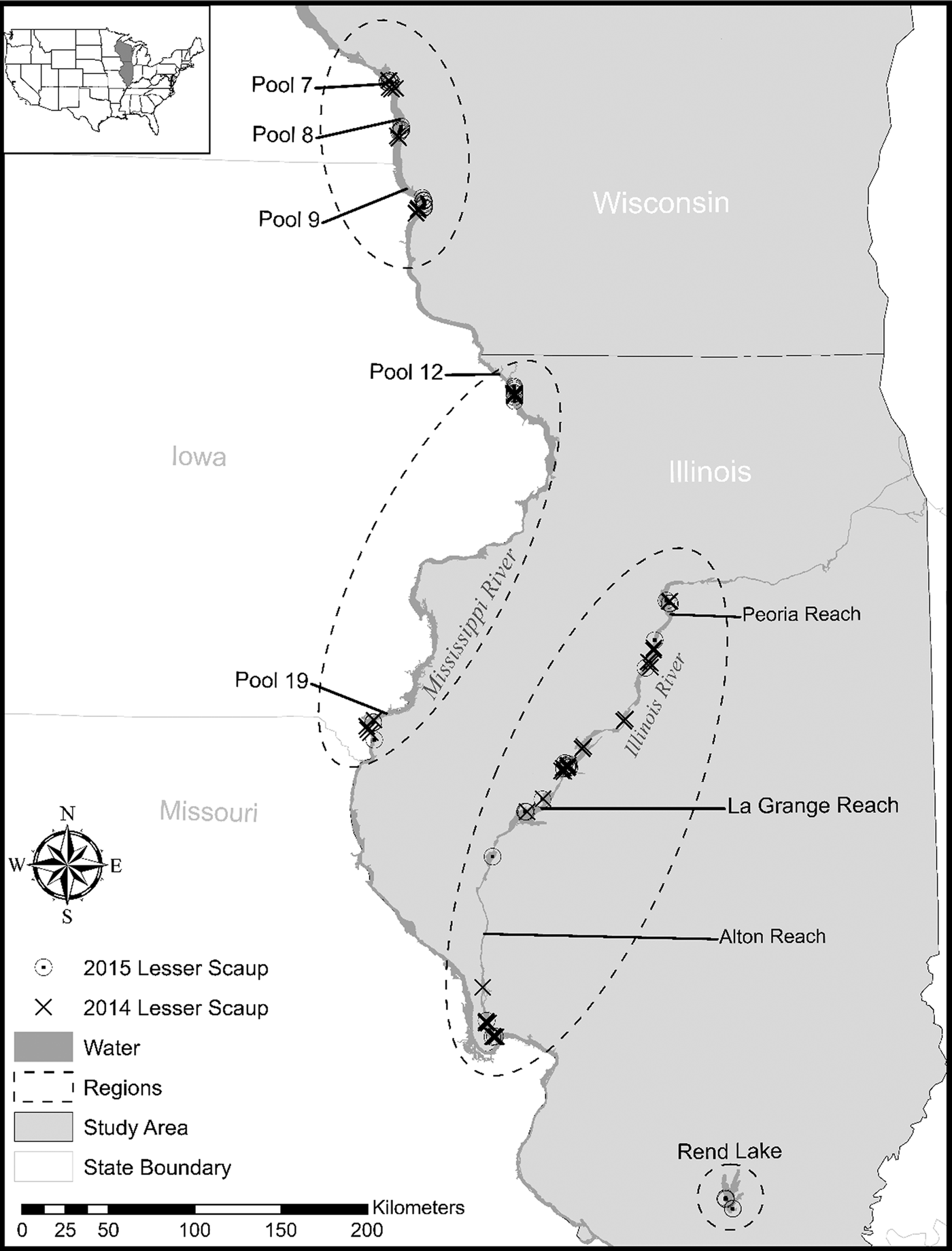
We experimentally collected female scaup from wetlands and lakes within and nearby the Illinois and Mississippi River valleys and other important lakes and reservoirs in Illinois and western Wisconsin (fig. 1). Regions of collection were categorized into four distinct areas post hoc based on latitude, physiography and habitat type (fig. 1): Southern Illinois (SI (Rend Lake; 38°06ʹN, 88°58ʹW; centred)), the Illinois River Valley (IRV (Peoria Reach – Alton Reach; 39°17ʹN, 90°36ʹW to 41°01ʹN, 89°25ʹW; centred, respectively)), the Central Mississippi River Valley (CMRV (Pools 12 and 19; 40°38ʹN, 91°10ʹW and 42°24ʹN, 90°31ʹW; centred, respectively)), and the Upper Mississippi River Valley (UMRV (Pools 7–9; 43°21ʹN, 91°12ʹW to 43°55ʹN, 91°21ʹW; centred, respectively)).
Locations of the collection sites of 130 female lesser scaup (Aythya affinis) collected from four regions of the upper Midwest, USA, during spring 2014 and 2015. From top to bottom, the regions were: Upper Mississippi River Valley (Pools 7–9), Central Mississippi River Valley (Pools 12 and 19), Illinois River Valley (Peoria Reach–Alton Reach) and Southern Illinois (Rend Lake).

A total of 130 female scaup were collected with shotguns from layout boats during the spring migration (10 February 2014 to 20 April 2014 and 11 March 2015 to 12 April 2015). Flocks were first observed to confirm the foraging activity of individuals as part of a concurrent study examining scaup diets and wetland quality (Hagy et al., Reference Hagy, Yetter, Osborn, Horath, Hine, McClain, Walter, Gilbert, Benson, Fox and Ward2015). Due to the unpredictable and continuous movement of scaup during migration, collection sites were identified based on scaup use during weekly ground and aerial surveys, reports from wetland managers or extensive scouting by project personnel. After collecting a foraging female scaup, a global positioning system (GPS) waypoint was created at the collection site and identified with a unique alpha-numeric code. Immediately following collection and prior to necropsy, the lengths of the body (tip of the bill to distal retrix), culmen, wing chord, retrix, keel and tarsometatarsus were measured to the nearest 1 mm for each individual. Mass was recorded to the nearest 20 g using a spring scale both before and after necropsy. Two age classes, hatch year (HY) and after hatch year (AHY), were established based on retrices and wing plumage condition in conjunction with iris coloration (Trauger, Reference Trauger1974). Of the 130 female scaup, 105 were determined to be AHY birds, 20 were HY, and 5 could not be aged due to damage during collection. However, the missing ages were estimated to be AHY based on 10,000 Expectation Maximization (EM) iterations using previously mentioned scaup morphometric measurements (Clarke et al., Reference Clarke, Gorley, Somerfield and Warwick2014).
Scaup were necropsied in situ within 15 min of collection. The body cavity was accessed via an incision along the keel. A gross examination of internal organs was conducted and the intestinal tract (proximal duodenum to the cloacal vent) was sealed at each end with a zip-tie, excised from the body cavity, and injected with 70% ethanol (EtOH) and submerged in a marked plastic bag containing the same. The fixed intestines were refrigerated until helminth extraction could take place in the laboratory.
In the laboratory, the intestines were opened, washed and the ingesta was concentrated in a conical beaker using a modified sedimentation technique (Pritchard, Reference Pritchard1982; Bush & Holmes, Reference Bush and Holmes1986b). Fresh tap-water was added to the beaker containing the sample until the total volume equalled 100 ml and a 10% subsample (10 ml) was removed using an aliquot technique (Bush & Holmes, Reference Bush and Holmes1986b). The aliquot was transferred to a gridded Petri dish and systematically examined under a stereoscope. For each scaup, helminths were enumerated (total helminths = aliquot helminths × 10), and preserved using 70% EtOH. Nematodes and acanthocephalans were cleared in lactophenol for temporary mounts and identified to the lowest taxon using procedures found in Sepúlveda & Kinsella (Reference Sepúlveda and Kinsella2013). Following Pritchard (Reference Pritchard1982), trematodes and cestodes were stained using either Semichon's acetocarmine stain or Malzacher's staining technique, cleared in xylene, mounted in Canada balsam, and identified to the lowest taxon achievable (genus and/or species) using morphological characteristics under compound light microscopy and various helminth identification keys (McDonald, Reference McDonald1974, Reference McDonald1981, Reference McDonald1988; Schmidt, Reference Schmidt1986; Kahlil et al., Reference Kahlil, Jones and Bray1994). Helminths reported with the scientific epithet ‘sp.’ were not definitively classified at the species level, but were determined to be unique based on morphology and treated as such. Genera followed by the scientific epithet ‘spp.’ were typically immature individuals of already identified conspecifics whose underdevelopment rendered additional identification under our methods unsuccessful. Voucher specimens are deposited at the US Harold W. Manter Laboratory of Parasitology, University of Nebraska, Lincoln, Nebraska (accession number: P-2016-028).
Helminth infection analysis
Following the definitions and statistical descriptions proposed by Bush et al. (Reference Bush, Lafferty, Lotz and Shostak1997), we examined the prevalence, abundance, intensity, total abundance and species richness of parasite taxa of each bird (Santoro et al., Reference Santoro, Aznar, Mattiucci, Kinsella, Pellegrino, Cipriani and Nascetti2012). Herein, we define ‘prevalence’ (P) as the percentage of scaup infected with a particular helminth taxa; ‘intensity’ (of infection) as the number of a particular helminth taxa in a single infected scaup; ‘abundance’ as the number of individuals from a particular helminth taxa in an individual host, regardless of whether or not the host is infected; ‘total abundance’ (TA) as the number of all helminth taxa in each scaup; and ‘species richness' as the number of helminth species recovered in each scaup. Mean values were calculated for abundance (MA; total number of individuals of a particular parasite species in a sample of scaup divided by total number of hosts) and intensity (MI; average intensity of a particular helminth taxa among infected members of host population). The 95% confidence intervals (CI) for prevalence were set using Sterne's exact method (Reiczigel, Reference Reiczigel2003), and for mean values of intensity and abundance using the bias-corrected and accelerated bootstrap method with 20,000 replications (Ròzsa et al., Reference Ròzsa, Reiczigel and Majoros2000; Santoro et al., Reference Santoro, Aznar, Mattiucci, Kinsella, Pellegrino, Cipriani and Nascetti2012).
Due to the variation of helminth families and genera among regions, we grouped helminths into the higher taxonomic classifications Trematoda, Cestoda, Nematoda and Acanthocephala to allow for comparisons across sites and regions. Lower taxonomical comparisons would have been difficult to interpret statistically by weakening our inferences, in addition to a lack of literature describing the effects the taxa reported herein have on scaup (Shutler et al., Reference Shutler, Alisauskas and McLaughlin2012). We then calculated mean values of each and compared the means among the variables year and region, as well as host age and size. Acanthocephalan helminths were excluded from further analysis because of their infrequent occurrence.
Host size was indexed by conducting principal component analysis (PCA; PROC PRINCOMP) on scaup morphometrics (i.e. mass, and body, culmen, wing chord, retrix, keel and tarsometatarsus lengths) and using the first Principle Component (PC1) as an index of adjusted structural size (Shutler et al., Reference Shutler, Alisauskas and McLaughlin2012). Brillouin's diversity index was calculated to determine infracommunity diversity (Santoro et al., Reference Santoro, Aznar, Mattiucci, Kinsella, Pellegrino, Cipriani and Nascetti2012). The mean values of species richness, total abundance and Brillouin's index of species diversity were used as infracommunity parameters for all helminths. Transformations [log10 (x + 1)] were used to normalize the data and separate generalized linear models (PROC GLM) were performed to assess the effects of year, region, age and size, and their interactions, on infection parameters (Shutler et al., Reference Shutler, Alisauskas and McLaughlin2012). Non-significant predictor variables were sequentially removed from models by using partial sums of squares until only significant associations remained (Crawley, Reference Crawley2005; Shutler et al., Reference Shutler, Alisauskas and McLaughlin2012). Statistically significant results (α = 0.05) were investigated with post-hoc pairwise comparisons between the terms in the factor region, using Tukey's honest significant difference (HSD) testing (Zar, Reference Zar2010).
Helminth infracommunities
To compare helminth infracommunity structure, the helminth counts of all species were first 4th root transformed to downweight the contributions of the highly abundant helminth species (Santoro et. al., Reference Santoro, Aznar, Mattiucci, Kinsella, Pellegrino, Cipriani and Nascetti2012; Clarke et al., Reference Clarke, Gorley, Somerfield and Warwick2014). Then, a Bray–Curtis similarity coefficient was calculated for all scaup individuals and represented in a non-metric multidimensional scaling (NMDS) plot (Clarke et al., Reference Clarke, Gorley, Somerfield and Warwick2014). The number of NMDS dimensions was selected using 1000 restarts for a maximum of 10 dimensions. A scree plot depicting each dimension and its corresponding stress statistic was assessed for an asymptotic plateau, thus indicating the appropriate number of NMDS dimensions to be used in subsequent analyses. Additionally, helminth infracommunity group means for each region and year term were obtained using 100 iterations of bootstrap averaging with 95% confidence ellipse, and then plotted into NMDS ordination space to further assist in identifying spatiotemporal differences in infracommunity structure (Clarke et al., Reference Clarke, Gorley, Somerfield and Warwick2014, Clarke & Gorley, Reference Clarke and Gorley2015). The transformed Bray–Curtis index for each helminth taxon was then correlated to each axis from the NMDS ordination using Pearson correlation values. After sorting the Pearson correlation values from smallest to largest r-value for each axis, the top and bottom 5% (n = 6) of helminth taxa were examined and determined to be most influential on NMDS axis formation (Beals, Reference Beals2006). Lastly, the pairwise Bray–Curtis indices and geodesic distances (km) between the latitude, longitude centroid of each of the four regions were correlated to assess the decay of similarities between the helminth infracommunities.
To further investigate the effects of spatiotemporal and host parameters on helminth infracommunities, permutational multivariate analysis of covariance (PERMANCOVA) was implemented using the aforementioned Bray–Curtis similarity index (Anderson et al., Reference Anderson, Gorley and Clarke2008; Santoro et al., Reference Santoro, Aznar, Mattiucci, Kinsella, Pellegrino, Cipriani and Nascetti2012). The PERMANCOVA procedure tests for the simultaneous response of one or more variables/co-variables in an analysis of covariance (ANCOVA) on the basis of a resemblance measure using permutation methods (Anderson et al., Reference Anderson, Gorley and Clarke2008). Region, year and host age were treated as fixed effects, while the host size index was used as a covariate. Interaction terms were included for all main effects and the covariate, yet were sequentially removed from the final model due to a lack of statistical significance. The removal of the interaction terms increased analytical sensitivity and the proper interpretation of the model's main effects (Santoro et al., Reference Santoro, Aznar, Mattiucci, Kinsella, Pellegrino, Cipriani and Nascetti2012). The null hypothesis was constructed by 10,000 permutations and pseudo-F statistics were obtained (Anderson et al., Reference Anderson, Gorley and Clarke2008; Santoro et al., Reference Santoro, Aznar, Mattiucci, Kinsella, Pellegrino, Cipriani and Nascetti2012). Type III sums of squares were used to adhere to independence of all effects in the unbalanced model. Pairwise comparisons between the region variable's terms (IRV, CMRV and UMRV) were further examined in PERMANCOVA. Due to small sample sizes and unbalanced collection of samples across years, the SI region was excluded from all statistical analyses with the exception of NMDS ordination. However, descriptive statistics for helminth and health parameter values are reported for the SI region.
The software Quantitative Parasitology v. 3 (Reiczigel & Ròsza, Reference Reiczigel and Ròzsa2005) was used to create basic measures of helminth infection and their corresponding 95% CIs, and to execute comparisons (e.g. Chi-squared test and Fisher's exact test) of infection measures. The statistical software package PRIMER v. 7 (Clarke & Gorley, Reference Clarke and Gorley2015) was utilized for performing the Expectation Maximization and NMDS ordination analyses. The addition PERMANOVA + for PRIMER v. 7 (Clarke et al., Reference Clarke, Gorley, Somerfield and Warwick2014) was used for PERMANCOVA procedures. All remaining analyses (e.g. summary statistics, generalized linear models, PCA and Tukey's HSD) were done in SAS v. 9.4 (SAS Institute Inc., Cary, North Carolina, USA). Statistical significance for all analyses was set at α = 0.05.
Results
Helminth infracommunities
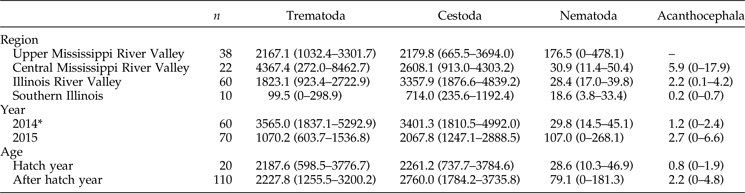
A total of 40 intestinal helminth taxa encompassing 20 trematodes, 14 cestodes, 4 nematodes and 2 acanthocephala were identified in the parasitological examinations of 130 female scaup collected during the spring migrations of 2014 and 2015 (see supplementary table S1). Of the 647,174 helminths found, 44.6% were trematodes, 53.9% were cestodes, 1.4% were nematodes and less than 0.05% were acanthocephalans (table 1). All scaup were infected with 2–23 helminth taxa. All helminth species recovered were found to be of reproductively mature stages, with the exception of an unidentified juvenile cestode (reported here as Juvenile). Infection parameters for each helminth species varied widely across the regional gradient (supplementary table S1). Markedly prevalent helminth species regardless of region or year were the cestodes Hymenolepis spinocirrosa and Hymenolepis pusilla, which were present at a prevalence of ≥70% in each region (supplementary table S1). The nematodes Capillaria anatis, Baruscapillaria obsignata and Strongyloides sp. were also common in scaup from each region (supplementary table S1). Less regional variability existed in the occurrence of higher taxa groupings (i.e. Cestoda, Nematoda, Trematoda) than species or families of helminths, which made higher taxa suitable for statistical analyses (table 1). No effect of spatiotemporal variables was detected on mean helminth species richness or the abundances of the taxa Cestoda and Nematoda. Mean trematode abundance varied between years (F 1,118 = 13.8, P < 0.001), with 2015 having fewer trematodes than 2014 (t = 3.53, P < 0.001). Additionally, the digeneans C. bushiensis and Sphaeridiotrema spp. were limited in their distributions to Pool 12 of the CMRV and the entirety of the UMRV (supplementary table S1). Infections of C. bushiensis and Sphaeridiotrema spp. did not differ between 2014 and 2015 (P = 0.09 and P = 0.34, respectively). One digenean, Plenosoma minimum, is reported for the first time in scaup as well as in the upper Midwest, with prevalence estimates ranging from 1.7 to 52.6% across regions.
Mean abundance values (95% confidence intervals in parentheses) of intestinal helminth taxa found in 130 female lesser scaup (Aythya affinis) collected from four regions of the upper Midwest, USA, during the spring of 2014 and 2015, including the Upper Mississippi River Valley, Central Mississippi River Valley, Illinois River Valley and Southern Illinois; n, number of hosts examined.

*Hosts not collected from Southern Illinois in 2014.
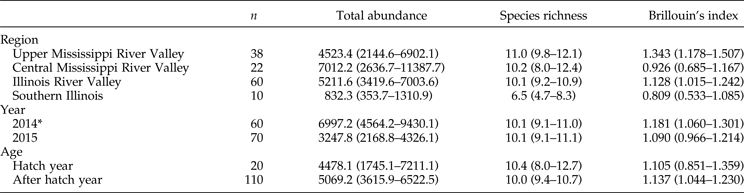
Host age and size were not associated with aspects of infracommunity structure; however, several helminth infection metrics differed by year and region (table 2). Mean total helminth abundance differed between years (F 1,118 = 7.9, P = 0.01), with 2014 comprising 68.3% (2014: 6997.2/10,245 vs. 2015: 3247.8/10,245) of the mean total abundance. The Brillouin's species diversity index differed by region (F 2,117 = 5.5, P = 0.005) (table 2) with the UMRV having greater diversity than the CMRV (t = 3.25, P = 0.004).
Mean values (95% confidence intervals in parentheses) of infracommunity parameters of intestinal helminths found in 130 female lesser scaup (Aythya affinis) collected from four regions of the upper Midwest, USA, during the spring of 2014 and 2015, including the Upper Mississippi River Valley, Central Mississippi River Valley, Illinois River Valley and Southern Illinois; n, number of hosts examined.

*Hosts not collected from Southern Illinois in 2014.
Helminth infracommunity comparisons
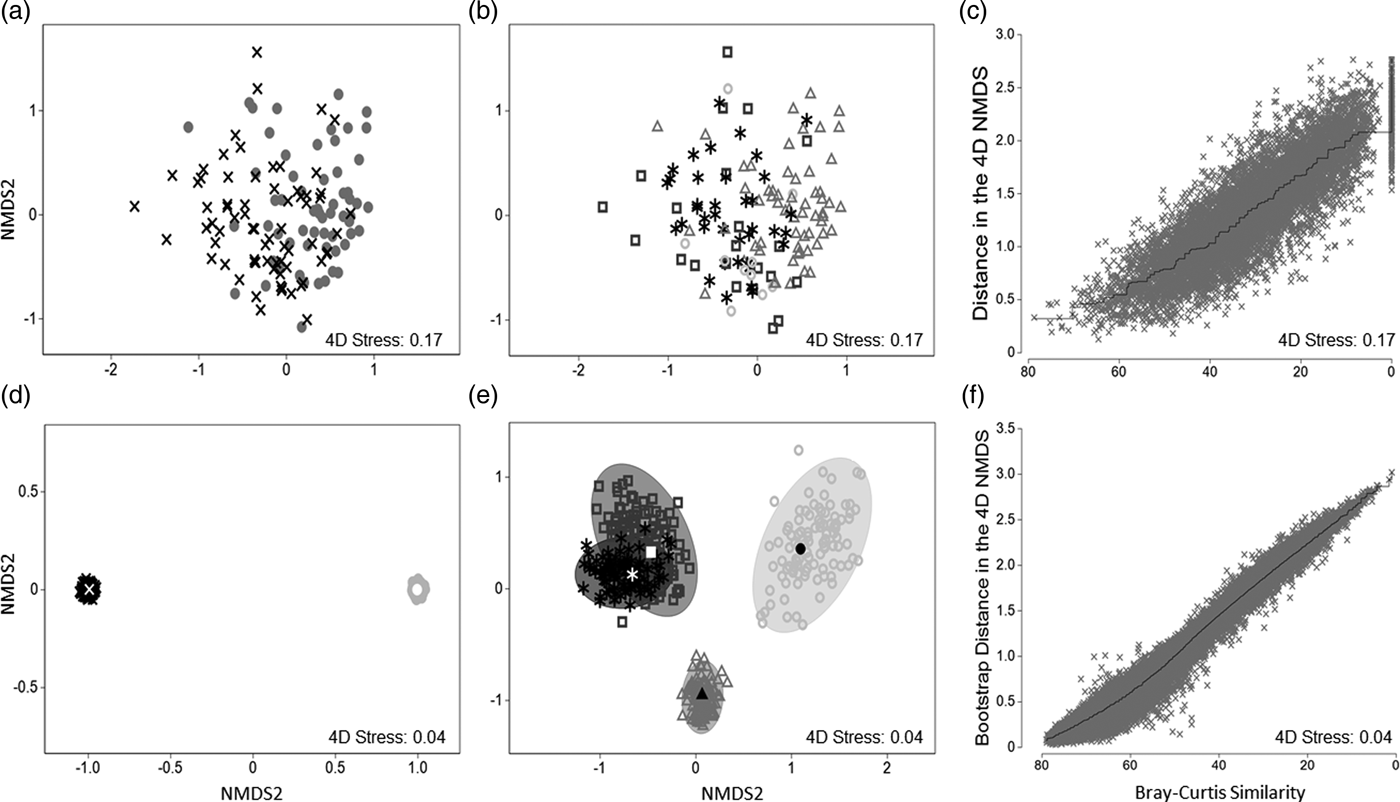
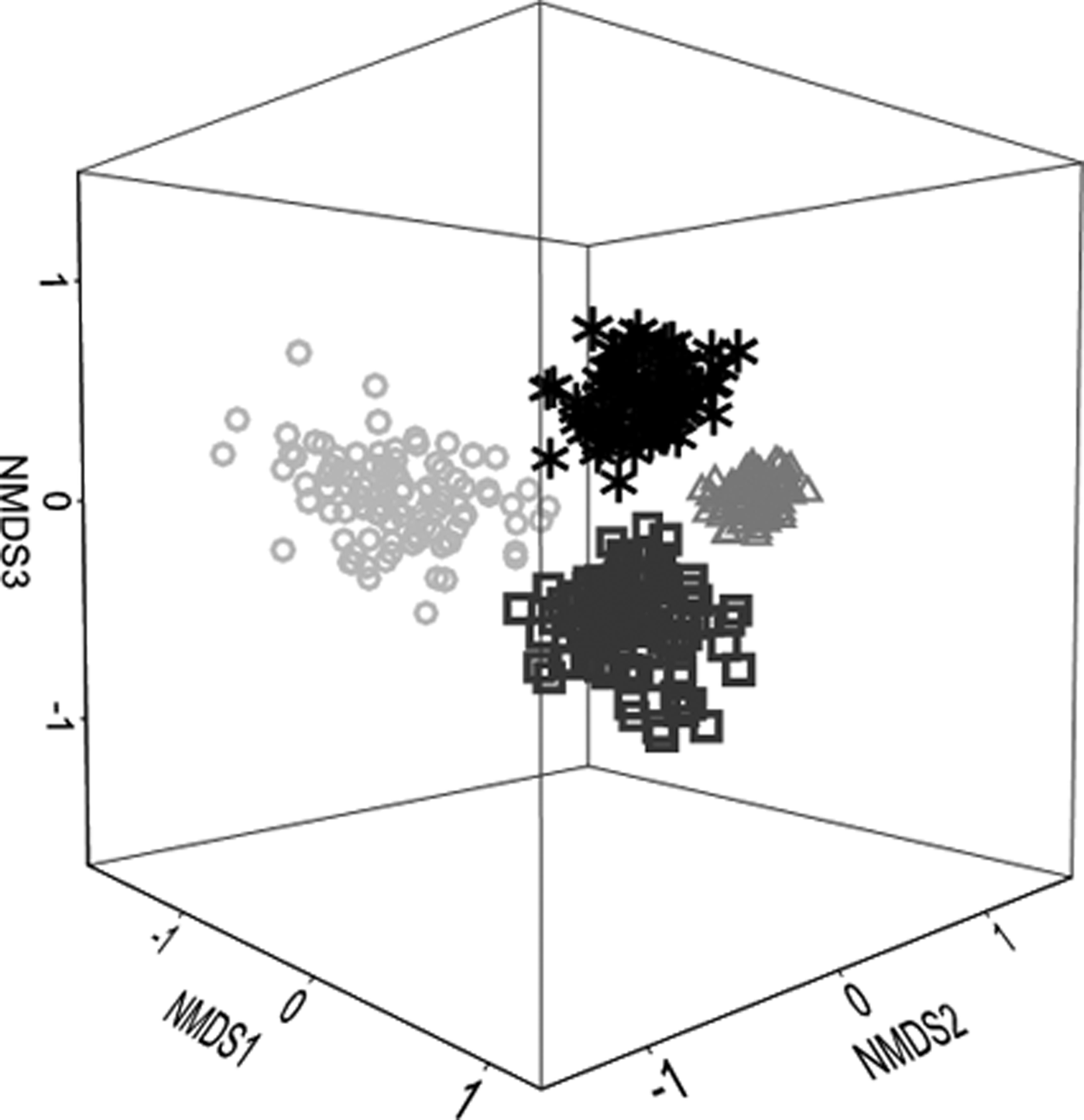
The 4D ordination displayed the most significant decrease in stress and was chosen as the representative dimension for the original data. The 2D ordination plot resulted in a relatively high stress (0.28), whereas the 4D ordination resulted in a lower stress level (0.17) for the helminth infracommunity comparisons across regions and years. Bootstrap averages plotted in 2D resulted in well-defined, distinguishable infracommunity groups based on year of collection within the 4D ordination (fig. 2). The bootstrap averages between all infracommunity comparisons and means of comparisons by region were also well separated, with the exception of the overlapping 95% confidence ellipses of UMRC and CMRV in the 2D representation of the first two axes (fig. 2). Regional separation was most evident in the 3D NMDS plot demonstrating structural helminth infracommunity differences across the study area, and signifies that helminth infracommunities differ with region in our study area (fig. 3 and supplementary video V1). The Pearson correlations of the Bray–Curtis similarity index infracommunities and each of the 4D NMDS axes revealed the helminth species influencing these ordination patterns. Microphallus oblonga had the strongest negative correlation (r = −0.55) with axis 1, and Echinoparyphium recurvatum displayed the strongest positive correlation (r = 0.75). Axis 2 was highly influenced by the negative loadings of the cestodes H. pusilla (r = −0.73) and H. spinocirrosa (r = −0.72), which were found to be prevalent in >75% of collected scaup (see supplementary table S1). Microphallus oblonga was most prevalent in 2015 (P = 31.4%; P = 0.021) in the northerly regions of the study area (CMRV (P = 36.4%, MI = 1951.5); UMRV (P = 28.9%, MI = 85.8)). The mean infection of E. recurvatum was greater in the IRV (P = 85.0%, MI = 1831.3) than other regions and proportions of infected host scaup were greater in 2014 than in 2015 (P < 0.001) (supplementary table S1). Although we detected a slight negative association between the pairwise Bray–Curtis similarities and geodesic distances of the four regions, the results were not significant (F 1,5 = 0.7, P = 0.713).
Non-metric multidimensional scaling (NMDS) ordination of intestinal helminth infracommunities of 130 female lesser scaup (Aythya affinis) according to year of collection and four regions of the upper Midwest, USA, during spring 2014 and 2015. (a) NMDS plot of the 4D axes 1 and 2 for year of collection (grey circles, 2014; black Xs, 2015). (b) NMDS plot of 4D NMDS axes 1 and 2 for four regions of collection, including the Upper Mississippi River Valley (black asterisks), Central Mississippi River Valley (open, grey squares), Illinois River Valley (open, grey triangles) and Southern Illinois (open, grey circles). (c) NMDS Shepard diagram in the 4D NMDS. (d) NMDS plot of 4D axes 1 and 2 for year of collection from 100 bootstrap averages (grey circles, 2014; black Xs, 2015) and means (white circle, 2014; white X, 2015). (e) NMDS plot of 4D axes 1 and 2 for four regions of collection, including the Upper Mississippi River Valley (bootstrap averages – black asterisks; bootstrap mean – white asterisks), Central Mississippi River Valley (bootstrap averages – grey, open squares; bootstrap mean – white square), Illinois River Valley (bootstrap averages – grey, open triangle; bootstrap mean – black triangle), and Southern Illinois (bootstrap averages – grey, open circle; bootstrap mean – black circle). (f) NMDS Shepard diagram in the 4D NMDS from 100 bootstrap averages.

Three-dimensional representation of the 4D non-metric multidimensional scaling (NMDS) ordination of intestinal helminth infracommunities of 130 female lesser scaup (Aythya affinis) collected from four regions of the upper Midwest, USA, during spring 2014 and 2015, including the Upper Mississippi River Valley (black asterisks), Central Mississippi River Valley (open, grey squares), Illinois River Valley (open, grey triangles) and Southern Illinois (open, grey circles).

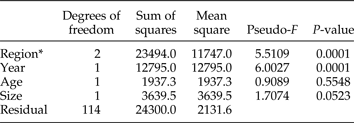
The PERMANCOVA results indicated that region (Pseudo-F 2,114 = 5.5, P < 0.001) and year (Pseudo-F 1,114 = 6.0, P < 0.001) had a significant impact on the structure of the helminth infracommunities (table 3). Pairwise comparisons between the regions revealed that infracommunity structures were different between all regions of the study area (table 4). Neither age (Pseudo-F 1,114 = 0.9, P = 0.55) nor body size (Pseudo-F 1,114 = 1.7, P = 0.052) were significant predictor variables of helminth infracommunity structure.
Permutational multivariate analysis of covariance model variables examined for effects on intestinal helminth infracommunity structure in 120 female lesser scaup (Aythya affinis) collected from four regions of the upper Midwest, USA, during the spring of 2014 and 2015, including the Upper Mississippi River Valley, Central Mississippi River Valley, Illinois River Valley and Southern Illinois;

*Analysis from Southern Illinois is excluded as hosts were not collected in 2014.
Mean similarity values (Bray–Curtis similarity index) of intestinal helminth infracommunities from 120 female lesser scaup (Aythya affinis) between (lower diagonal) and among (diagonal) the four regions of the upper Midwest, USA, collected during the spring of 2014 and 2015, including the Upper Mississippi River Valley, Central Mississippi River Valley, Illinois River Valley and Southern Illinois. Values of the t-statistic, with associated nominal P-values in parentheses, of pairwise permutational multivariate analysis of covariance tests (upper diagonal).

*Analysis from Southern Illinois is excluded as hosts were not collected in 2014.
Discussion
Spatiotemporal assessment
The structure of helminth infracommunities of scaup migrating through the upper Midwest during spring varied substantially among regions and years, indicating that the effects of parasite loads may also vary spatiotemporally. The differing helminth infracommunity structures observed herein occurred within a small geographical scale relative to the annual cycle of scaup, indicating that these hosts may experience frequent and rapid changes in intestinal parasite infracommunities, which may be strongly related to intermediate hosts present in diets. Global climate change and increased habitat fragmentation are of increasing concern for conservation efforts (Austin et al., Reference Austin, Anteau, Barclay, Boomer, Rohwer and Slattery2006; Drever et al., Reference Drever, Clark, Derksen, Slattery, Toose and Nudds2012) and may affect the dispersal of hosts and parasites, thereby altering their interactions and disease dynamics at different scales (Holt & Boulinier, Reference Holt, Boulinier, Thomas, Renaud and Guégan2005). Considering the temporal proximity of the spring migration and breeding seasons, energetic and behavioural costs of immune responses to varying helminth infections may lead to reduced survival and/or productivity (Hanssen et al., Reference Hanssen, Hasselquist, Folstad and Erikstad2004; Stafford et al., Reference Stafford, Janke, Pearse, Fox, Elmberg, Straub, Eicholz and Arzel2014).
Differences in parasite infracommunities between years was likely due to weather-related factors influencing the timing and duration of scaup migration, and the chronology, emergence and viability of intermediate hosts and the parasites they harbour. The winter of 2014 was long and cold compared to the mild winter of 2015 (NOAA, 2015). Abiotic factors, such as temperature and ice coverage, undoubtedly play an integral part in the life strategies of many of the helminths (Lafferty & Kuris, Reference Lafferty, Kuris, Thomas, Renaud and Guégan2005). Wallace & Pence (Reference Wallace and Pence1986) found that the helminths of blue-winged teal (Anas discors) may have been acquired in areas outside of their immediate study area, but, unlike blue-winged teal, scaup have one of the most protracted spring migrations of any North American waterfowl species (Bellrose, Reference Bellrose1976) and may remain at a stopover location in the upper Midwest for up to 20 days (Hagy et al., Reference Hagy, Yetter, Osborn, Horath, Hine, McClain, Walter, Gilbert, Benson, Fox and Ward2015). Generally, intestinal helminths are relatively short lived in scaup (1–2 weeks), and their abundance and infracommunity structure depend on their ability to persist in the environment (Huffman, Reference Huffman, Atkinson, Thomas and Hunter2008). Turnover of helminth infracommunities often occurs from shifts in diet during migration across the landscape and can be either chemically induced or due to the abrasive scraping of the intestinal walls from mollusc shells (McLaughlin & Burt, Reference McLaughlin and Burt1973). Therefore, scaup continuously shed and replace helminths from their immediate environment, thus leading to an ongoing shift in intestinal helminth infracommunities during migration and possible variation in the effects of those differing infracommunities on body condition and subsequent reproduction.
Although the impacts of continuous shifts in helminth infracommunity structure are not well understood, parasites have evolved to exploit host resources and to influence infection and/or transmissibility. Our data show that parasite infracommunities can change rapidly and are likely linked to regional variation in habitat and prey base (Brown et al., Reference Brown, André, Ferdy, Godelle, Thomas, Renaud and Guégan2005). Study regions differed on the basis of mean latitude, geomorphology, hydrological patterns, habitat structure, and forage type and availability. The most southerly region (SI) was represented by a man-made reservoir, Rend Lake, which is deep and experiences comparatively stable water levels by way of dam control. Spring migration at Rend Lake during our study years coincided with the break-up of ice on the reservoir, and scaup primarily consumed American gizzard shad (Dorosoma cepedianum), an atypical food item of scaup in our study area (Hagy et al., Reference Hagy, Yetter, Osborn, Horath, Hine, McClain, Walter, Gilbert, Benson, Fox and Ward2015). Although some fish species are capable of transmitting helminths to waterbirds (Kanarek & Zaleśney, Reference Kanarek and Zaleśny2013), helminths found during this project are typically transmitted by arthropods or molluscs (McDonald, Reference McDonald1974, Reference McDonald1981, Reference McDonald1988). The small sample size of scaup in concert with the limited diversity of prey items and the anthropogenic influence over water levels may be determinant factors reducing helminth species richness, diversity and abundance in this region.
The IRV differs from the other regions of the study area in that it is a riverine system regulated by a series of locks and dams, with a diversity of primary habitat used by scaup, including: nutrient-rich connected backwater lakes devoid of aquatic vegetation due to dynamic water levels; partially connected backwater lakes and wetlands managed using seasonal drawdowns for moist-soil vegetation; and disconnected floodplain lakes with abundant submersed, emergent and floating-leaf aquatic vegetation. Consistent with habitat diversity, the IRV had a greater diversity of invertebrate food items than SI, CMRV and UMRV (Hagy et al., Reference Hagy, Yetter, Osborn, Horath, Hine, McClain, Walter, Gilbert, Benson, Fox and Ward2015), and only lacked 4 of the 40 helminth taxa reported across all regions. Like the IRV, the CMRV experiences more dynamic water levels and has greater habitat diversity than SI, most likely due to the fact that it is part of a large riverine system with diverse communities of submersed and floating-leaf aquatic vegetation. Although water levels fluctuate behind the lock and dam at Pools 12 and 19, the hydrological variation is much less in the CMRV than the IRV, allowing growth of some aquatic vegetation. The UMRV encompassed Mississippi River Pools 7–9, which is within the range where biannual scaup die-offs have occurred since the early 2000s (Sauer et al., Reference Sauer, Cole and Nissen2007; Herrmann & Sorensen, Reference Herrmann and Sorensen2011). Helminth infracommunity differences between the UMRV and the other regions were driven by the elevated prevalence of C. bushiensis, Sphaeridiotrema spp. and P. minimum. Although spatiotemporal comparisons for the UMRV in 4D NMDS ordination space slightly overlapped with the CMRV, mean Trematoda abundance, total helminth abundance and Brillouin's species diversity index were greatest in the UMRV. The CMRV and UMRV differ on the basis of food availability, habitat type and geomorphology. Although food availability in both regions was relatively low, the pools comprising the UMRV contained 2–3 times more food for scaup than the pools of the CMRV, indicating differences in habitat type and food availability (Hagy et al., Reference Hagy, Yetter, Osborn, Horath, Hine, McClain, Walter, Gilbert, Benson, Fox and Ward2015). Furthermore, the UMRV contains artificial islands that are absent in the CMRV, which provide breeding areas for B. tentaculata because of the shallow waters and riprap used in island construction (Herrmann & Sorensen, Reference Herrmann and Sorensen2011). During collection in this region, scaup were frequently seen diving near the islands where the faucet snail has been reported previously to occur at high densities. Scaup likely foraged on B. tentaculata, and the increased prevalence of C. bushiensis and Sphaeridiotrema spp. may be explained based on faucet snail abundance in the UMRV. Although not specifically examined, we speculate that intermediate host diversity is most likely the cause of higher helminth diversity in scaup. Unlike SI, where scaup foraged almost exclusively on dead and/or dying American gizzard shad, the regions sampled within the Illinois and Mississippi River complexes contained a diverse suite of animal and plant food items (Hagy et al., Reference Hagy, Yetter, Osborn, Horath, Hine, McClain, Walter, Gilbert, Benson, Fox and Ward2015). In these regions, invertebrate food items consumed by scaup occurred in diets at a frequency of 82%, with the taxa Chironomidae (37%), Amphipoda (30%), Physiidae (29%), Sphaeriidae (27%) and zebra mussels (21%) occurring most frequently (Hagy et al., Reference Hagy, Yetter, Osborn, Horath, Hine, McClain, Walter, Gilbert, Benson, Fox and Ward2015). Of the 17 invertebrate prey items reported by Hagy et al., (Reference Hagy, Yetter, Osborn, Horath, Hine, McClain, Walter, Gilbert, Benson, Fox and Ward2015), six belonged to Gastropoda and three to Bivalvia. Many of the species eaten by scaup are often utilized as intermediate hosts for helminths infecting scaup and other waterbirds (McDonald, Reference McDonald1981; Kahlil et al., Reference Kahlil, Jones and Bray1994; Huffman, Reference Huffman, Atkinson, Thomas and Hunter2008).
Helminth assessment
Unlike most other helminth taxa, the trematode taxa reported herein display indirect life cycles that typically require an obligate intermediate host (usually a gastropod), followed by a second intermediate host (i.e. gastropods, bivalves, amphibians, fishes) and, finally, an avian definitive host (Huffman, Reference Huffman, Atkinson, Thomas and Hunter2008). Scaup serve as a definitive host for all helminth taxa reported here, with the possible exception of the recovered unidentified juvenile cestode and Echinostoma trivolvis, for either of which no sexually mature adults were found. Of the 20 trematodes encountered, 18 have been identified as causing disease, epizootic events and/or death in North American hosts of the order Anseriformes (McDonald, Reference McDonald1981 and references therein; Huffman, Reference Huffman, Atkinson, Thomas and Hunter2008). Species of the genera Apatemon, Cotylurus, Echinoparyphium, Echinostoma, Psilochasmus, Maritrema, Microphallus, Notocotylus, Paramonostomum and Zygocotyle are capable of negatively affecting scaup condition and were found parasitizing scaup in this study (McDonald, Reference McDonald1981). Cyathocotyle bushiensis and Sphaeridiotrema spp. were not found outside of the currently known distribution of the faucet snail (Sauer et al., Reference Sauer, Cole and Nissen2007). Cyathocotyle bushiensis was only found to occur in the caeca of scaup, but Sphaeridiotrema species were found infecting both intestines and caeca, though generally amassing within the former. Differentiation between the introduced Sphaeridiotrema species (S. globulus and S. pseudoglobulus) known to infect waterbirds in the upper Midwest was not possible in this study, although Bergmame et al. (Reference Bergmame, Huffman, Cole, Dayanandan, Tkach and McLaughlin2011) identified all Sphaeridiotrema species collected on Pool 7 of the Mississippi River as S. pseudoglobulus, based on DNA analyses. Regardless, both species cause mortality in many North American waterbirds and have similar life cycles.
In North America, P. minimum has previously only been reported in black oystercatchers (Haematopus bachmani) and south Pacific sea otters (Enhydra lutris nereis) and is known to cause pathology in the latter host (Mayer et al., Reference Mayer, Dailey and Miller2003). Oddly, P. minimum appeared in all regions of the current study except for SI, yet approximately 97% of scaup harbouring P. minimum were collected in the UMRV. An explanation of the high prevalence of P. minimum in the region was not evident in this study, and a literature review revealed no references of P. minimum having ever occurred in the Midwest or scaup hosts. It is plausible that P. minimum has been spread to the Midwest (e.g. waterbird migrations, invasive species introductions) and has become established due to favourable environmental conditions and suitable intermediate freshwater hosts. The remaining trematodes found in scaup have been reported parasitizing scaup or closely related congenerics (McDonald, Reference McDonald1981; Bush & Holmes, Reference Bush and Holmes1986a, b).
Cestodes comprised 14 individual taxa and nine species that occurred throughout all regions and years of the study area. The hymenolepids Dicranotaenia coronula, Fimbriaria fasciolaris, Sobolevicanthus sp. and Hymenolepis megalops have been reported to cause pathology, disease and mortality within Anseriformes hosts (Wobeser, Reference Wobeser1974). In scaup, infections with cestodes may affect population size indirectly through reduced host fitness and reproductive success (McLaughlin, Reference McLaughlin, Atkinson, Thomas and Hunter2008). All identified taxa herein have been reported parasitizing scaup and their relatives (Schmidt, Reference Schmidt1986; Kahlil et al., Reference Kahlil, Jones and Bray1994).
Only four nematode species from two genera were observed parasitizing scaup, and most individuals were found within the caeca. The capillarids C. anatis and B. obsignata are considered to be characteristically common helminths infecting waterfowl, including scaup, and were found in each region of the study during both years (McDonald, Reference McDonald1981). In contrast, Capillaria spinulosa occurred less frequently and was only found in scaup from the IRV. Capillaria species often occur at high prevalences but low intensities and rarely cause disease in wild hosts (Yabsley, Reference Yabsley, Atkinson, Thomas and Hunter2008). Strongyloides species occurred in all regions and years of the study, and have been reported in scaup breeding in Alberta, Canada (Bush & Holmes, Reference Bush and Holmes1986b). Similar to capillarids, strongyloids rarely produce overt signs of pathology unless host health is compromised and unable to initiate an immune response (Viney & Lok, Reference Viney, Lok, Hodgkin and Anderson2007).
Acanthocephalans were the least frequently encountered intestinal parasites of scaup. Only Polymorphus marilis and Corynosoma constrictum occurred and, like most species reported herein, have been observed in previous studies (Bush & Holmes, Reference Bush and Holmes1986a, Reference Bush and Holmesb). Additionally, several acanthocephalan species have been documented as the aetiological agent causing decreased health (e.g. reduced weight gain and altered blood metabolite ratios), lowered reproduction and die-offs of various sea duck species (e.g. common eiders (Somateria mollissima)) in Arctic regions of North America and Europe (Hollmén et al., Reference Hollmén, Lehtonen, Sankari, Soveri and Hario1999; Skerratt et al., Reference Skerratt, Franson, Meteyer and Hollmén2005).
In summary, helminth infracommunity structure of scaup migrating through the Midwest was spatiotemporally variable, with helminth assemblage changing according to the study area region and year. Observed differences in helminth species prevalence, abundance and diversity were presumably driven by the timing of migration, annual climatic variation and regional prey diversity. Hechinger & Lafferty (Reference Hechinger and Lafferty2005) documented correlations between avian host species richness, species heterogeneity and abundance, and the species richness, species heterogeneity and abundance of trematodes from intermediate snail hosts. Considering the diversity of invertebrate species utilized by scaup as food items in the study area, and the fact that over 40% of continental populations of nearly 30 different species of North American waterfowl use the Mississippi Flyway during migrations, it is reasonable to expect that parasite diversity would be high in the regions of our study area during periods of scaup migration. This research illuminates the distributions and some of the factors associated with the development of helminth infracommunities parasitizing scaup, and may assist in the development of up-coming conservation efforts. Future research emphasis should be placed on identifying the effects of these helminth infections on scaup hosts, as well as unravelling the complex, underlying mechanisms associated with host–parasite interactions and their effects on body condition of migrating waterfowl. Increasing our understanding of the abiotic and biotic factors influencing helminth infection dynamics, and identifying their impacts on scaup health and condition, will assist in future conservation efforts for this species of concern.
Supplementary data
Video V1. Three-dimensional graphical mp4 representation of the 4D non-metric multidimensional scaling (NMDS) ordination of intestinal helminth infracommunities of 130 female lesser scaup (Aythya affinis) collected from four regions of the upper Midwest, USA, during spring 2014 and 2015, including the Upper Mississippi River Valley (black asterisks), Central Mississippi River Valley (open, grey squares), Illinois River Valley (open, grey triangles) and Southern Illinois (open, grey circles).
Table S1. Infection parameters of the intestinal helminth species of 130 female lesser scaup (Aythya affinis) collected from four regions of the upper Midwest, USA, during spring 2014 and 2015.
To view supplementary material for this article, please visit http://dx.doi.org/10.1017/S0022149X16000493
Acknowledgements
The authors thank the many technicians, personnel and other assistants of the Forbes Biological Station for specimen collection efforts; M. Rojano, the USGS National Wildlife Health Center and University of Tennessee College of Veterinary Medicine Parasitology Laboratory, for parasitic examination/identification assistance; and the Illinois Department of Natural Resources, the United States Fish and Wildlife Service, the Nature Conservancy and many private landowners for providing in-kind support and access to collection sites. We thank R. Smith, G. Soulliere and J. Vest, for project support and helpful suggestions regarding study design. Finally, the authors thank two anonymous reviewers for helpful comments and suggestions.
Financial support
For funding and support, we thank the Illinois Department of Natural Resources (IDNR); the Federal Aid in Wildlife Restoration Program (J.M.L., H.M.H., W-176-R-1 & 2; H.M.H., A.P.Y., W-43-R-61 & 62); the United States Fish and Wildlife Service (USFWS) through the Flex Fund Grant Program of the Upper Mississippi River and Great Lakes Region Joint Venture (H.M.H., A.P.Y., J.M.L., F13AP00229); and the University of Illinois at Urbana-Champaign's Illinois Natural History Survey (INHS) and Department of Natural Resources and Environmental Sciences (NRES).
Statement of interest
Any opinions, findings and conclusions or recommendations expressed in this report are those of the authors and do not necessarily reflect the views of the USFWS, INHS, IDNR or the University of Illinois. Use of trade, product or firm names is for descriptive purposes only and does not imply endorsement by the US Government.
Ethical standards
The authors assert that all procedures contributing to this work comply with the ethical standards of the relevant national and institutional guides on the care and use of experimental animal specimens.