Recent years have seen an increase in the study of cognitive difficulties associated with posttraumatic stress disorder (PTSD). A meta-analysisReference Brewin, Kleiner, Vasterling and Field1 found that PTSD was associated with decrements in memory, particularly for verbal information, but that effect sizes were small to moderate. The question of whether these cognitive deficits represent premorbid risk factors for PTSD, effects of PTSD, or both has yet to be definitively determined.Reference Brewin, Kleiner, Vasterling and Field1, Reference Vasterling and Verfaellie2
An earlier reviewReference Horner and Hamner3 noted that no studies at that time had systematically evaluated effort on neuropsychological examination, even though over-reporting of psychiatric symptomatology and impairment has been reported in certain subsets of PTSD patients.Reference Frueh, Gold and de Arellano4, Reference Frueh, Hamner, Cahill, Gold and Hamlin5 Thus, inclusion of PTSD patients who were exerting suboptimal effort could have exaggerated findings of impairment. Other factors, such as substance abuse and other psychiatric comorbidity, had also not been consistently controlled in many studies. These factors continue to be significant potential confounds in many of the studies included in Brewin etal.'sReference Brewin, Kleiner, Vasterling and Field1 meta-analysis.
Several of the studies since Horner and Hamner'sReference Horner and Hamner3 earlier review have reported decrements in attention and memory among combat veterans with PTSD.Reference Gilbertson, Gurvits, Lasko, Orr and Pitman6–Reference Woodward, Kaloupek and Grande10 Other studies have reported deficits in a broad range of cognitive functions in individuals with non-combat–related PTSD.Reference Eren-Kocak, Kilic, Aydin and Hizli11–Reference Twamley, Allard and Thorp15 There is also evidence that veterans with PTSD are at higher risk of later developing dementia.Reference Yaffe, Vittinghoff and Lindquist16 However, some studies have produced essentially negative findings when controlling for various potential confounds.Reference Brandes, Ben-Schachar and Gilboa17–Reference Demakis, Gervais and Rohling21
Thus, despite continuing, active research in this area, fundamental questions remain about whether specific neuropsychological deficits are associated with PTSD. Furthermore, only two studies to dateReference Marx, Brailey and Proctor7, Reference Demakis, Gervais and Rohling21 have systematically examined whether patients were exerting adequate effort on cognitive tests. The present study attempted to address some of the methodological confounds in previous studies by excluding patients who failed formal tests of effort, or who had various other potentially confounding comorbidities. As several previous studiesReference Gilbertson, Gurvits, Lasko, Orr and Pitman6–Reference Vasterling, Duke and Brailey9 had reported attentional impairment in PTSD patients, and as difficulty concentrating actually constitutes one of the diagnostic criteria for PTSD,22 we specifically examined attentional functioning in these patients. We hypothesized that patients with PTSD would perform more poorly than patients without psychiatric disorders on standard tests of attention.
Methods
This study was approved by the Institutional Review Board of the Medical University of South Carolina, and by the Research and Development Service of the Ralph H. Johnson Department of Veterans Affairs Medical Center.
Participants
Data were drawn from an initial sample of consecutive patients referred from Primary Care, Neurology, Mental Health and other VA clinics for neuropsychological evaluation in a VA Medical Center's Neuropsychology Clinic. Referrals were typically made because of concerns on the part of the patient, family member, or healthcare provider about cognitive difficulties.
Patients were included in the study only if their effort during testing had been formally assessed and found to be adequate. Effort was determined at the time of clinical examination using the Test of Memory Malingering (TOMM)Reference Tombaugh23 and/or Word Memory Test (WMT).Reference Green24 In addition, due to a policy implemented in 2003, nearly all patients were administered the Rey Fifteen-Item Test (RFIT),Reference Strauss, Sherman and Spreen25 and, due to a policy implemented in 2005, nearly all patients were also administered the Recognition Trial of this test.Reference Boone, Salazar, Lu, Warner-Chacon and Razani26 Standard cutoffs were used for each effort test (for TOMM, Trial 2 and Retention Trial ≥ 45; for WMT, Immediate Recall, Delayed Recall, and Consistency >90%; for RFIT, recall>8 and [recall +hits − false positives] ≥ 20). Other clinical indicators of effort were also used, including impairment on formal tests that was grossly disproportional to the patient's observed or reported functional abilities, notably unusual errors or patterns of performance, and other behaviors that were strongly suggestive of suboptimal effort. In general, patients who scored below the standard cutoff on at least one effort index and who demonstrated other such indications of poor effort were excluded from the study.
Psychiatric diagnoses were made by the neuropsychologist at the time of clinical examination based on patients’ current symptomatology, using standard DSM-IV criteria.22 Thus, all patients in the PTSD group met full diagnostic criteria for that disorder. Patients were excluded from the study if any of the following conditions were present: (1) diagnosis, based on the neuropsychological examination, of dementia, delirium, or current dependence on alcohol or other drug except nicotine or caffeine; (2) history of cerebrovascular accident; (3) history of traumatic brain injury with loss of consciousness.
Of the remaining sample, patients who were diagnosed in the examination with PTSD (with or without comorbid psychiatric diagnosis) comprised the “PTSD” group. In light of the study hypotheses, two patients were excluded from the PTSD group because of psychiatric comorbidities known to affect attentional functioning: one with attention-deficit/hyperactivity disorder and one with schizoaffective disorder. In the final sample, there were 19 patients in the PTSD group. Comorbid psychiatric diagnoses in this group included major depressive disorder (N = 7), generalized anxiety disorder (N = 1), borderline personality disorder (N = 1), and obsessive-compulsive personality disorder (N = 1).
A second subset of patients was identified who, based on the neuropsychological examination, were not diagnosed with any psychiatric or cognitive disorder; these comprised the “No Diagnosis” group. While not necessarily healthy controls, these were individuals who had been referred for neuropsychological evaluation for complaints generally similar to those in the PTSD group, but who were found not to have significant psychopathology or cognitive impairment. In the final sample, there were 22 patients in the No Diagnosis group.
Neuropsychological test batteries had been individualized for each patient in the course of clinical evaluation. Thus, a subset of neuropsychological tests (see below) was identified that was sensitive to attentional dysfunction, and that had been administered to an adequate number of patients in each group.
Procedures
All neuropsychological tests were administered and scored according to their test manuals, as part of routine neuropsychological evaluation. Raw scores were used for all analyses. The attentional tests examined in this study were those that had been administered to all patients in each of the two groups, in the course of routine clinical evaluation. These tests were as follows:
• Digit Span subtest of Wechsler Memory Scale, third edition (WMS-III) Reference Wechsler27: This is an attentional test in which participants repeat auditorily presented strings of numbers forward and backward.
• Mental Control subtest of WMS-III Reference Wechsler27: This is an attentional test consisting of timed items in which participants recite overlearned information forward or backward.
• Trail Making Test Reference Reitan and Wolfson28: In Part A, which is sensitive to difficulties in attention and information-processing speed, participants connect numbers on a page sequentially. In Part B, which is additionally sensitive to executive dysfunction, participants alternate between numbers and letters.
Results
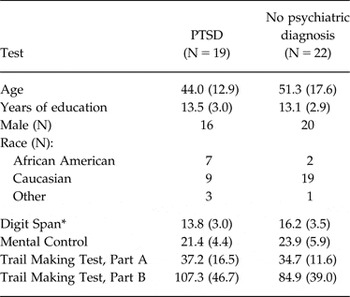
As shown in Table 1, the groups did not differ significantly in age or level of education. Group performance on cognitive tests was compared using a series of t-tests, as the small sample size did not permit use of MANOVA. Patients with PTSD performed significantly more poorly than patients with no diagnosis on Digit Span (t = −2.38, p < .05). PTSD patients also performed slightly more poorly on the other tests, but no other group differences were significant. The effect size for group difference on Digit Span was estimated to be within the medium range (Cohen's d = .59).
Mean (SD) demographic characteristics and raw scores on neuropsychological tests of the two patient groups

*p ≤ .05.
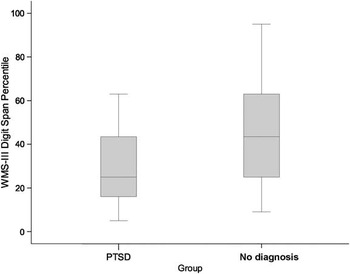
To explore whether Digit Span performances in patient groups were deficient relative to the general healthy population, raw scores from individual patients were converted to age-adjusted percentiles according to procedures described in the test manual. Boxplots of percentile ranks, with median percentile illustrated with a black line and whiskers set to 1.5 times the interquartile range, are shown in Figure 1. The median score in the PTSD group (24th percentile) fell within the low average range, while the median score in the No Diagnosis group fell in the average range, according to standard qualitative guidelines for interpretation.Reference Lezak, Howieson and Loring29 The distribution of performances observed in PTSD patients was also found to be restricted relative to the comparison group.
Percentile ranks on Digit Span subtest of the Wechsler Memory Scale, Third Edition (WMS-III) by group.

Discussion
In this clinical sample of patients exerting valid effort on neuropsychological examination, patients diagnosed with PTSD performed more poorly than those who were not assigned a cognitive or psychiatric diagnosis on one measure of focused attention. To our knowledge, among previous neuropsychological studies of PTSD patients, very fewReference Marx, Brailey and Proctor7, Reference Demakis, Gervais and Rohling21 have reported the use of symptom validity tests to ensure the validity of cognitive data. Demakis etal.Reference Demakis, Gervais and Rohling21 noted that the existing literature on cognition in PTSD is probably contaminated by invalid data produced by patients who were not motivated to exert maximal effort on examination. Across clinical settings, up to 39% of patients with various diagnoses may fail to exert adequate effort on cognitive testing.Reference Mittenberg, Patton, Canyock and Condit30 Thus, we believe that the present study is one of the first to demonstrate selective attentional impairment in PTSD patients, compared to individuals without psychiatric diagnoses, even when participants exerting suboptimal effort were excluded from the analyses.
Several aspects of the present study indicate that the results should be considered very preliminary. As patients were typically referred for neuropsychological evaluation because of cognitive complaints, it is quite possible that the present findings would not generalize to PTSD patients as a whole (e.g., those without significant cognitive complaints). Thus, attentional dysfunction might not be present in all, or even most, patients with PTSD. But the present results do suggest that such dysfunction is present in at least a subset of PTSD patients, and that it is not easily attributable to various other confounding factors such as history of traumatic brain injury (TBI), current substance abuse, or inadequate effort during cognitive testing.
The small sample size further indicates that the present results be should be interpreted cautiously. Replication in a larger sample, perhaps including PTSD patients with and without cognitive complaints, will be important. Similarly, the demographic composition of the two groups was not identical. While the mean age of the PTSD patients was somewhat lower than that of the other group, this difference was not statistically significant. Also, while a clear relationship between racial background and attentional functioning has not been established, the patients with PTSD included fewer Caucasians and more African Americans than the comparison group. Thus, while these demographic factors would not be expected to affect the present findings, it will be important to match groups more closely in future studies.
It is possible that the use of the TOMM with some patients, rather than potentially more sensitive effort tests such as the Word Memory Test, might have led to the inclusion of patients who were not actually exerting adequate effort on cognitive tests. Future studies could thus consistently include stringent measures of effort. Finally, the present findings, even if replicable, might not be specific to PTSD; it is possible that mild attentional decrement is present in, e.g., other anxiety disorders also.
The mechanism by which PTSD would be associated with attentional decrement remains unclear, and would merit future investigation if the present findings are replicated in larger samples. In addition, to help clarify whether the present findings might pertain to PTSD patients more generally, future studies could compare PTSD patients who have cognitive complaints and who are referred for neuropsychological evaluation to PTSD patients who have not been referred. More definitive results could also be obtained by using comparison groups of trauma-exposed individuals who have not developed PTSD. Finally, future studies could assess attentional functioning in PTSD patients before and after PTSD treatment, to determine whether reduction of PTSD symptoms might similarly improve attention.
Conclusions
While the present results must be considered preliminary, they suggest some attentional decrement in patients diagnosed with PTSD compared to patients who are without psychiatric or cognitive disorders. Future studies are needed to elucidate the nature and mechanism of this decrement.
Disclaimer
The contents of this manuscript do not represent the views of the Department of Veterans Affairs or the United States Government.
Disclosures
Jacobo Mintzer has the following disclosures: Pfizer: research support (grant); NIH/NIA: research support (grant); Genentech: research support (grant); University of San Diego: research support (grant); Novartis, Inc.: research support (grant); Janssen: research support (grant); Wyeth, Inc.: research support (grant); Lilly Research Labs: research support (grant); Eli Lilly & Company: research support (grant); CSP #545: research support (grant); Elan Pharmaceuticals: research support (grant); BioPharma Connex: founder and chair (salary); NeuroQuest: consultant. Olga Brawman-Mintzer has the following disclosures: Takeda: research support (grant); Shire: research support (grant); Novartis: research support (grant). The remaining authors have nothing to disclose.